
Project Management Interview Questions: Complete 2026 September Prep Guide
Ace your PM interview with 50+ project management interview questions, expert answers, and prep tips for PMP, CAPM & Google certificates. 🏆
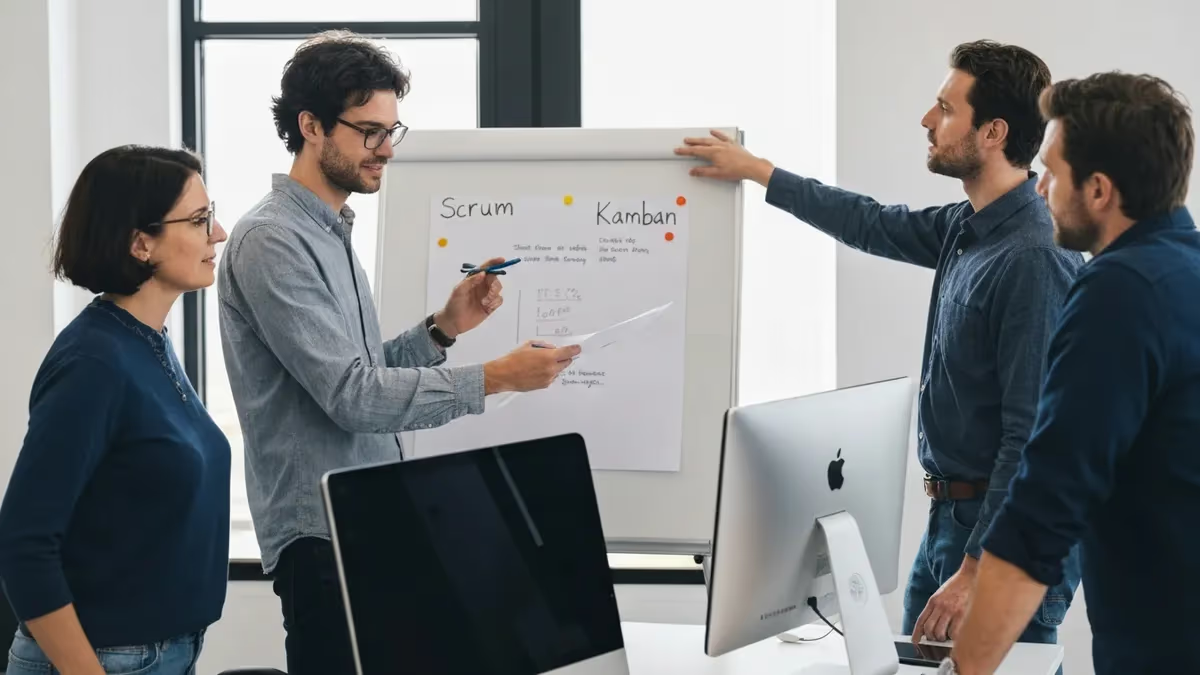
Project management interview questions are the gatekeepers between you and a role that can shape your entire career trajectory. Whether you are pursuing an entry-level coordinator position, a senior project manager title, or a specialized role in construction, technology, or healthcare, interviewers use a consistent set of behavioral, situational, and technical questions to evaluate your readiness. Understanding which questions are asked most frequently — and how to answer them with confidence — is the single most important preparation step you can take before walking into that room or joining that video call.
The landscape of project management hiring has shifted dramatically over the past few years. Companies increasingly require candidates to hold formal credentials such as the google project management certificate, the PMP, or the CAPM before even granting a first interview. This credential-first culture means that preparing for interviews now involves two parallel tracks: mastering the answers to common questions and demonstrating the knowledge depth that your certification implies. Interviewers will probe whether you truly understand the frameworks or simply memorized acronyms to pass an exam.
Behavioral questions dominate modern project management interviews, accounting for roughly 60 percent of the typical question set. These questions follow the STAR format — Situation, Task, Action, Result — and ask you to narrate real experiences managing scope creep, resolving stakeholder conflicts, recovering a failing project, or delivering under budget. Hiring managers are not just listening for the outcome; they are evaluating your decision-making process, your communication habits, and your ability to stay calm under pressure. Preparing five to seven strong STAR stories before your interview gives you a flexible toolkit that can answer almost any behavioral prompt.
Technical questions form the second major category and focus on your command of project management methodologies. Expect to explain the difference between Waterfall and Agile, describe when you would choose Scrum over Kanban, and demonstrate familiarity with tools such as Microsoft Project, Jira, Asana, or Smartsheet. Interviewers at larger organizations often ask candidates to walk through a Work Breakdown Structure on a whiteboard or describe how they calculate Earned Value metrics like CPI and SPI. If you have a construction project manager background, expect additional questions about bid management, subcontractor coordination, and RFI processes.
Situational questions present hypothetical scenarios and test your judgment in real time. A classic example: "Your project is three weeks behind schedule and the sponsor just cut your budget by 15 percent. What do you do?" There is no single correct answer, but strong responses share a common structure — they acknowledge the constraint, assess the impact, engage stakeholders immediately, evaluate trade-offs, and communicate a revised plan. Practicing these scenarios aloud, ideally with a colleague acting as interviewer, builds the mental fluency to answer confidently without rambling or freezing.
Leadership and soft-skill questions round out the interview. Project managers are, at their core, team leaders without direct authority over most of their team members. Interviewers want to know how you motivate a disengaged developer, how you handle a stakeholder who keeps expanding scope, and how you deliver bad news to a sponsor. These questions have no certification-prep shortcut — they reveal genuine character and experience. However, studying real interview transcripts, practicing with mock interviewers, and reflecting deeply on past projects will dramatically sharpen your answers before the interview date.
This guide covers the full spectrum of project management interview questions you are likely to face in 2026, including domain-specific questions for IT, healthcare, finance, and construction roles. We have organized questions by type, provided sample answers for the hardest prompts, and included prep checklists and study strategies to help you walk into every interview with confidence. Use the practice quizzes linked throughout this page to reinforce the technical knowledge that interviewers test most often.
Project Management Careers by the Numbers

Types of Project Management Interview Questions
Ask you to describe past experiences using the STAR method. Examples include managing scope creep, resolving team conflict, and delivering projects under pressure. These account for roughly 60 percent of questions in most PM interviews.
Test your command of Agile, Waterfall, Scrum, and Kanban frameworks, plus tools like Jira and MS Project. Expect Earned Value Management calculations and Work Breakdown Structure exercises at senior levels.
Present fictional crises — budget cuts, schedule slips, or stakeholder escalations — and evaluate your real-time judgment. Strong answers follow a structured approach: assess, engage stakeholders, evaluate trade-offs, and communicate clearly.
Probe your ability to motivate teams without direct authority, navigate office politics, deliver difficult news to sponsors, and maintain team morale during crunch periods. These reveal genuine character beyond any certification.
Tailored to your industry — construction PMs answer questions on subcontractor coordination and RFIs; IT PMs face sprint planning and release management scenarios; healthcare PMs must address regulatory compliance and cross-functional team dynamics.
Behavioral questions are the most revealing part of any project management interview, and they are also the category where candidates most often stumble. The STAR method — Situation, Task, Action, Result — gives you a reliable framework for structuring your answers, but the real differentiator is the quality of the stories you choose to tell. Generic answers like "I always communicate proactively" fall flat. Interviewers want specific numbers, named stakeholders, real timelines, and measurable outcomes. If you cut project costs by $40,000 through risk mitigation, say so explicitly.
One of the most common behavioral prompts is: "Tell me about a time you managed a project that was falling behind schedule." A strong answer names the project type, explains what caused the delay (resource conflict, unclear requirements, a third-party vendor miss), describes the corrective actions you personally drove, and quantifies the recovery. Did you implement daily stand-ups to surface blockers faster? Did you re-sequence tasks to find float in the critical path? Did you negotiate a scope reduction with the sponsor to protect the deadline? Each of these details demonstrates genuine PM competency.
Stakeholder management questions are equally common and equally important. Interviewers frequently ask how you handle a stakeholder who keeps adding requirements outside the original scope. The ideal answer acknowledges the stakeholder's goals respectfully, explains the formal change control process you followed, quantifies the impact of the requested change (cost, schedule, quality), and describes how you secured sponsor approval or rejection. Responses that simply say "I explained scope creep to them" are too thin. Real PM experience shows up in the details of how you documented, escalated, and resolved the situation.
Conflict resolution questions test interpersonal intelligence. A typical prompt: "Describe a situation where two team members disagreed on the technical approach and it threatened the project timeline." Strong answers demonstrate that you gathered both perspectives privately before convening a group discussion, that you used objective criteria (timeline impact, cost, quality trade-offs) to evaluate the options, and that you helped the team reach a consensus rather than imposing a top-down decision. Project managers who facilitate resolution rather than dictate it build far more cohesive teams over the long run.
The project management news consistently highlights that hiring managers rank communication skills above technical knowledge when evaluating PM candidates. This means your interview answers must themselves demonstrate excellent communication — clear structure, concise language, confident delivery, and the ability to read the room. Rambling, jargon-heavy, or disorganized answers signal poor communication habits regardless of what the content actually says. Practice your STAR stories aloud until they feel natural but not robotic, targeting a 90-to-120-second delivery for each response.
Situational questions require a slightly different approach because you are building a hypothetical response rather than recalling a memory. The key is to demonstrate a structured thought process rather than an immediate solution.
When asked how you would handle a sudden 20 percent budget cut mid-project, walk the interviewer through your assessment steps: first, understand what triggered the cut and whether it is permanent or deferrable; second, map the budget reduction against the project WBS to identify which workstreams are most impacted; third, meet with the sponsor to discuss trade-offs between scope, schedule, and quality; fourth, communicate the revised plan to the full team within 24 to 48 hours. This structured approach signals PM maturity even if your specific answer differs from the interviewer's preferred solution.
Leadership questions are often the trickiest because they require candidates to demonstrate influence without authority — the core challenge of project management. When asked how you motivate a disengaged team member, avoid platitudes about team spirit. Instead, describe a specific technique: a one-on-one conversation to understand the root cause of disengagement, a role adjustment that aligns the individual's strengths with project needs, or a transparent conversation about performance expectations and support available. Interviewers want evidence that you treat team members as professionals with valid concerns, not as resources to be managed by deadline pressure alone.
Project Management Courses & Certifications for Interview Readiness
The Google Project Management Certificate on Coursera has become one of the most recognized entry-level credentials in the field, with over 14,800 monthly searches confirming its popularity. The six-course program covers Agile methodologies, Scrum fundamentals, stakeholder communication, risk management, and project documentation — exactly the topics that appear most frequently in entry and mid-level PM interviews. Completing the certificate takes approximately six months at ten hours per week and costs around $200 total through a Coursera subscription.
Interviewers at companies that partner with Google's certificate program — including major employers in tech, retail, and financial services — often ask specific questions about the capstone projects candidates completed during the course. If you earned the certificate, prepare to discuss a specific project scenario from the curriculum in STAR format, quantify what you learned about scope management or risk registers, and explain how you would apply those skills on day one of the new role. Treating the certificate as live experience, not just a credential, dramatically strengthens your interview answers.

Getting a PM Certification Before Your Interview: Pros and Cons
- +Signals formal commitment to the profession and immediately differentiates your resume from uncertified candidates
- +PMP and CAPM holders earn 20-25% higher salaries on average, improving your negotiation position from day one
- +Certification prep forces deep study of methodologies, giving you confident answers to technical interview questions
- +Many employers list PMP or Google Certificate as a required or preferred qualification, opening roles that were previously screened out
- +PMI membership provides access to networking events, job boards, and chapter resources that accelerate the job search
- +Certified candidates are more likely to advance to senior PM or program manager roles within 2-3 years of hire
- −PMP exam requires 36 months of documented project experience, making it inaccessible for true career changers or new graduates
- −Exam fees range from $275 to $555 for PMI credentials, plus study materials, which adds up to $1,000 or more total investment
- −Certification prep takes 3-6 months of consistent study, potentially delaying your active job search during that period
- −Some agile-first employers view PMP as overly focused on predictive/waterfall methodologies and prefer Scrum certifications instead
- −Maintaining PMP certification requires 60 PDUs every three years, adding ongoing time and cost obligations post-hire
- −A certification alone does not substitute for real project experience — interviewers will probe for stories that credentials cannot manufacture
Project Management Interview Prep Checklist
- ✓Research the company's current projects, methodologies, and industry to tailor your STAR stories to their context.
- ✓Prepare 6-8 STAR stories covering scope creep, stakeholder conflict, schedule recovery, budget management, and team leadership.
- ✓Review the PMBOK Guide process groups and knowledge areas so you can answer methodology questions confidently.
- ✓Practice explaining the difference between Agile, Scrum, Kanban, and Waterfall in plain language without jargon.
- ✓Prepare a 2-minute summary of your most successful project, including the business impact and your specific contributions.
- ✓Review Earned Value Management formulas: CPI, SPI, EAC, and VAC, and practice applying them to a sample scenario.
- ✓Update your portfolio with project artifacts — charters, risk registers, status reports, or WBS diagrams you can reference.
- ✓Prepare three thoughtful questions to ask the interviewer about team structure, current project challenges, and success metrics.
- ✓Confirm your familiarity with the PM tools listed on the job description and be ready to demonstrate basic proficiency.
- ✓Conduct at least two mock interviews with a colleague, recording yourself to identify filler words and unclear explanations.
The #1 Differentiator in PM Interviews Is Specificity
Candidates who name real numbers, specific stakeholders, and concrete outcomes consistently outperform those who speak in generalities. Before your interview, audit every STAR story you plan to tell and add at least one quantified result — a dollar amount saved, a percentage improvement in delivery speed, or a specific number of stakeholders managed. Interviewers remember the candidate who said "I reduced rework by 30 percent by implementing a formal definition-of-done checklist" far longer than the candidate who said "I improved quality on my projects."
Technical interview questions for project managers span a wide range of topics, from methodology frameworks to specific tool proficiency to quantitative analysis. The most commonly tested technical area is Agile vs. Waterfall, and almost every PM interview includes at least one question asking you to compare the two or explain when you would choose one over the other.
A strong answer avoids the trap of declaring one superior and instead discusses the factors that drive the decision: project requirements stability, stakeholder availability, regulatory constraints, and team experience. Waterfall works well for fixed-scope construction or compliance projects; Agile excels when requirements evolve rapidly or when customer feedback loops are essential.
Earned Value Management (EVM) questions appear regularly in interviews for senior and mid-level PM roles. Interviewers may give you a scenario: "Your project has a BAC of $500,000, you are 40 percent through the schedule, but you have spent $230,000 and completed only 35 percent of work.
Calculate the CPI and SPI and interpret what they mean." Practicing these calculations until they feel automatic is non-negotiable for anyone pursuing roles at organizations that require formal EVM reporting. EV = BAC × % complete; CPI = EV / AC; SPI = EV / PV. In this scenario, CPI = 0.76 and SPI = 0.875, both signaling a project in trouble that requires immediate corrective action.
Risk management is another rich area for technical questions. Interviewers ask candidates to describe their risk identification process, explain the difference between qualitative and quantitative risk analysis, and describe risk response strategies — avoid, transfer, mitigate, accept. Be prepared to walk through a real risk register you have maintained, including how you assigned probability and impact scores, who owned each risk response, and how you tracked residual risk throughout the project lifecycle. Candidates who have only encountered risk management in textbooks often give theoretically correct but experientially thin answers that interviewers can immediately identify.
Schedule management questions test your familiarity with Critical Path Method (CPM), resource leveling, fast-tracking, and crashing. A common prompt: "Your project is two weeks behind. What schedule compression techniques would you consider, and what are the trade-offs?" Fast-tracking overlaps activities that were originally planned sequentially, which saves time but increases risk and requires close coordination.
Crashing adds resources to critical path activities, which saves time but increases cost and may reduce quality if resources are less experienced. Knowing not just the definitions but the practical implications of each technique is what separates candidates with real experience from those who have only studied for a certification exam.
Tool proficiency questions have become increasingly important as organizations standardize on specific platforms. If the job description mentions Jira, be ready to describe how you configure backlogs, manage sprint boards, set up dashboards, and generate burndown charts. If it mentions Microsoft Project, expect questions about Gantt chart construction, baseline setting, resource allocation, and critical path visualization.
If it mentions Smartsheet or Monday.com, demonstrate familiarity with workflow automation, dependency tracking, and real-time reporting features. Claiming proficiency in a tool you have not used recently is a significant interview risk — interviewers sometimes ask candidates to walk through a scenario live on screen.
Domain-specific technical questions add another layer for candidates pursuing specialized roles. A construction project manager role will involve questions about contract types (lump sum vs. cost-plus vs. time and materials), subcontractor bid evaluation, RFI and submittal management, and safety compliance. IT PM roles involve questions about release management, change advisory boards, ITIL alignment, and DevOps coordination. Healthcare PM roles touch on regulatory frameworks such as HIPAA compliance, clinical trial protocols, and cross-functional coordination between clinical, legal, and IT stakeholders. Researching the domain-specific vocabulary and processes for the industry where you are interviewing is an often-overlooked but high-impact preparation step.
Methodology-specific questions arise when organizations have committed to a particular framework. If the company uses SAFe (Scaled Agile Framework), expect questions about PI Planning, Agile Release Trains, and Program Increment objectives. If they use PRINCE2, be ready to discuss the seven themes, seven principles, and seven processes that structure that methodology.
If the organization uses a hybrid approach, interviewers want to know how you would blend predictive planning with iterative execution — for example, using a Waterfall phase for infrastructure setup followed by Agile sprints for feature development. Demonstrating flexibility across methodologies signals the kind of adaptive thinking that organizations increasingly prize in senior project managers.

PMI periodically updates PMP eligibility requirements, and changes can affect how your experience hours are counted. If you are close to meeting the 36-month experience threshold, submit your application before any announced policy changes take effect. Additionally, PMP exam fees increase periodically — the current non-member fee is $555, but locking in your exam date before the next adjustment can save $50 to $100. Application review takes 5 to 10 business days, and audit selection (random) adds another 3 to 4 weeks, so plan your timeline accordingly.
Understanding the project manager job description before your interview is one of the highest-leverage preparation activities available to you. Most job descriptions contain direct clues about which questions you will face — they reflect the team's current pain points, the methodologies they use, and the seniority level they are hiring for. A job description that emphasizes "cross-functional stakeholder management" signals heavy behavioral questions about influence without authority. One that lists "Earned Value reporting" as a daily responsibility signals technical questions about EVM calculations. One that mentions "Agile transformation" signals questions about change management and organizational readiness for iterative delivery.
Salary negotiation is an underrated part of the interview process, and project managers who understand market rates consistently secure better compensation than those who accept the first offer. The typical project manager job description in the United States lists a base salary range of $75,000 to $125,000 depending on industry, location, and experience, with senior PMs in financial services or technology frequently exceeding $150,000.
PMP certification adds a documented premium. Before your final interview round, research comparable roles on LinkedIn Salary, Glassdoor, and the PMI Salary Survey to ensure you anchor your expectations to current market data rather than your prior salary.
Construction project manager vacancies represent one of the fastest-growing segments of the PM job market, driven by massive federal infrastructure investment and a persistent shortage of experienced project leaders in the construction sector. If you are targeting construction roles, interview preparation requires extra attention to industry-specific topics: reading construction drawings, understanding critical path scheduling in Primavera P6, managing subcontractor performance, and navigating OSHA compliance requirements. Many construction PM interviews also include practical assessments — candidates may be asked to review a set of construction documents and identify scheduling or cost risks on the spot.
The rise of hybrid work has added a new category of interview questions: how do you manage distributed teams and maintain project momentum when team members are across time zones or working asynchronously? Strong answers reference specific tools and practices — asynchronous daily status updates via Slack or Teams, shared digital dashboards in Confluence or Notion, weekly video stand-ups with recorded summaries for absent members, and explicit communication norms about response time expectations. Interviewers at organizations with remote-first cultures weight these answers heavily because distributed PM is genuinely harder than co-located PM and requires deliberate process design.
Post-interview follow-up is a professional practice that many candidates neglect but that significantly influences hiring decisions, particularly when multiple finalists are closely matched. Send a personalized thank-you email within 24 hours of each interview, referencing a specific topic from the conversation to demonstrate genuine engagement. If you discussed a particular project challenge the team is facing, briefly restate how your experience positions you to contribute to solving it. This follow-up is not about flattery — it is about reinforcing your professional communication habits, which are precisely the habits that project managers must demonstrate every day on the job.
Negotiating beyond base salary is increasingly important as total compensation packages become more complex. Project managers at mid-to-large organizations often receive annual bonuses of 10 to 20 percent tied to project delivery metrics, professional development budgets for maintaining certifications, and remote work stipends.
When discussing compensation in final interview rounds, ask explicitly about the full package — not just salary, but bonus structure, equity (if applicable), professional development budget, and flexibility. Understanding the total value of the offer prevents the common mistake of accepting a lower base at one company without recognizing that the benefits package makes it the financially superior choice.
Keeping up with project management news through professional associations, LinkedIn groups, and industry publications positions you as a candidate who is genuinely invested in the field rather than simply job-hunting. Referencing a recent trend — AI-assisted project scheduling tools, the growing adoption of OKRs alongside traditional PM frameworks, or the shift toward product-centric organizational structures — in an interview demonstrates intellectual curiosity and professional engagement. Interviewers who are themselves active in the PM community particularly appreciate candidates who bring fresh perspectives from outside the organization rather than simply echoing back the company's own internal language and frameworks.
Final preparation in the 48 hours before a project management interview should focus on consolidation rather than new learning. Review your STAR stories one final time, checking that each has a clear quantified result and runs under two minutes when delivered aloud. Organize your physical or digital portfolio — project charters, status report samples, risk registers, or retrospective summaries — so you can reference specific artifacts if an interviewer asks to see examples of your work. Knowing that concrete evidence is available to you will reduce anxiety and increase confidence during the conversation itself.
Research the individuals who will interview you on LinkedIn before the meeting. Understanding their professional background, the types of projects they have led, and any thought leadership they have published helps you tailor your answers to what they specifically value. A former Scrum Master turned PM Director will respond differently to your Agile stories than a PMP-certified VP from a traditional waterfall organization. This five-minute research step costs almost nothing and can meaningfully improve the relevance and resonance of your answers during the conversation.
Dress and logistics deserve more attention than many candidates give them. For virtual interviews, test your camera, microphone, lighting, and background at least an hour before the call. A dark, cluttered, or noisy environment creates a negative first impression that your excellent STAR stories will have to overcome.
For in-person interviews, arrive ten to fifteen minutes early to allow time for building security, parking, or unexpected delays. First impressions form within seconds and influence how interviewers interpret everything that follows — treating logistics as a professional deliverable rather than a minor detail reflects the same attention to quality that project managers must bring to every project.
Practice quantifying impact even for projects where formal metrics were not tracked. If you managed an office relocation, estimate the number of employees affected, the square footage of space managed, and the timeline compressed. If you ran a marketing campaign launch, reference the campaign budget you managed and the number of cross-functional stakeholders you coordinated. Interviewers understand that not every project generates formal EVM reports — what they want to see is that you think in terms of measurable impact and can translate experience into numbers that convey scale and complexity.
Managing interview nerves is a practical skill that responds to preparation. Physical symptoms of anxiety — increased heart rate, dry mouth, mental blanking — are amplified by the fear of not knowing what to say next. The best antidote is thorough preparation: when you have practiced your STAR stories so many times that they feel natural, when you understand the technical concepts so deeply that they feel effortless, and when you have researched the company so thoroughly that the conversation feels familiar, the physiological anxiety response diminishes substantially. Preparation is the most reliable confidence-building tool available.
Following up after rejection is as important as following up after success. If you receive a rejection, send a brief, gracious response thanking the interviewers for their time and asking whether they have feedback on where your candidacy fell short. Many interviewers will provide honest, specific input that is more valuable than any interview prep guide because it reflects what they specifically observed in your performance.
Some candidates have converted rejections into offers by demonstrating exceptional professionalism in their follow-up — hiring managers occasionally encounter a change of circumstance that reopens a role, and the candidate who handled rejection with grace is the one they remember favorably.
Building a long-term interview preparation habit — rather than cramming before each application — dramatically improves outcomes over a PM career. Maintain a running document of your project achievements with quantified results, updated quarterly. Stay active in the PMI community or local Agile meetups to sharpen your thinking through peer conversations. Take one new practice quiz per week to keep technical knowledge fresh. These habits ensure that when the right opportunity appears, you can move from application to offer in days rather than months — because your preparation never really stopped.
Project Management Questions and Answers
About the Author

Educational Psychologist & Academic Test Preparation Expert
Columbia University Teachers CollegeDr. Lisa Patel holds a Doctorate in Education from Columbia University Teachers College and has spent 17 years researching standardized test design and academic assessment. She has developed preparation programs for SAT, ACT, GRE, LSAT, UCAT, and numerous professional licensing exams, helping students of all backgrounds achieve their target scores.
Join the Discussion
Connect with other students preparing for this exam. Share tips, ask questions, and get advice from people who have been there.
View discussion (6 replies)