
Phlebotomy Training Online: Cost, Length & Programs 2026 October
Phlebotomy training online: 4-8 months, $599-$2,400, accredited NHA/ASCP programs with externships. State rules and cost breakdown for 2026 October. ✏️
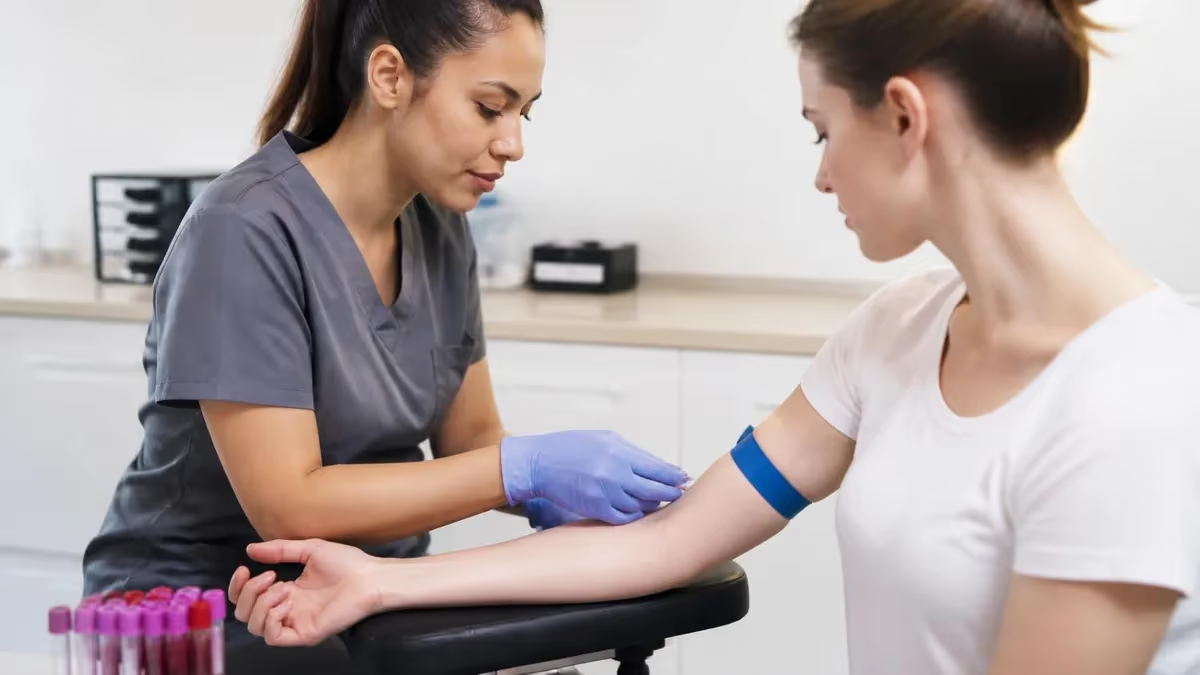
Phlebotomy training online has become the go-to path for career-changers, parents, and shift workers who can't sit in a daytime classroom. You'll learn anatomy, infection control, and the order of draw from your laptop, then finish with a short hands-on externship at a local clinic. The hybrid model is what makes it work — theory at your pace, needles under supervision.
But not every online program leads to a job. Some skip the externship. Some are rejected by the NHA or ASCP. And a few cost more than a one-month community college course. Before you click "enroll," you need to know what a legitimate online phlebotomy program looks like in 2026 — what it costs, how long it really takes, and which certifying bodies will let you sit for the exam afterward.
This guide walks you through everything: accreditation red flags, state-by-state quirks (California and Louisiana are the strict ones), the typical 4 to 8 month timeline, and how the externship piece actually gets arranged when you're studying from your living room. By the end, you'll know whether online training fits your situation — or whether a 12-week in-person phlebotomy course at a community college is a better bet.
Is Phlebotomy Training Online Legitimate?
Short answer — yes, when the school is accredited and pairs the coursework with an in-person clinical externship. Long answer — it depends on three things: who accredits the program, whether your target employer accepts online-trained candidates, and whether your state mandates a specific certification.
The certifying bodies you want recognition from are the National Healthcareer Association (NHA), American Society for Clinical Pathology (ASCP), and National Center for Competency Testing (NCCT). If a program's marketing page doesn't name at least one of these, walk away. Those exams are what 90% of employers ask for on day one.
You can verify a program's eligibility directly on the certifying body's website. NHA, for instance, lists approved training providers in a searchable directory. ASCP requires graduates to log a minimum of 100 successful venipunctures and 5 capillary draws before they can test — so any "online-only, no externship" program is functionally useless if you want ASCP.
How Long Does Online Phlebotomy Training Take?
Most reputable online phlebotomy programs run 4 to 8 months from first login to externship completion. That's longer than the 4 to 8 weeks you'll see at community colleges — and there's a reason. Online students typically work part-time, so the schedule is stretched to fit around jobs and family.
A few breakdowns of what you'll actually spend time on:
- Lecture and reading (60 to 120 hours) — anatomy of the upper arm, vein selection, additive tubes, what each lab analyzer measures.
- Interactive labs and video demonstrations (20 to 40 hours) — you watch a phlebotomist draw, then quiz on the order of draw, tourniquet placement, and angle of insertion.
- Externship (40 to 120 hours) — this is the in-person piece. You report to a clinic, hospital, or plasma center and complete a set number of successful draws under supervision.
If you're working full-time, expect closer to 8 months. If you can devote 20+ hours a week, 4 months is doable. Accelerated bootcamps that promise "online phlebotomy in 4 weeks" are almost always missing the externship — which means you'll graduate without the clinical hours you need to certify.
What Does Online Phlebotomy Training Cost?
Tuition for online phlebotomy programs ranges from $599 (self-paced, no-frills) up to $2,400 (instructor-led with externship placement). The mid-market — where most legitimate programs sit — is $999 to $1,500.
What's actually included in that price tag varies wildly. Watch for these line items, because they're often billed separately:
- Textbooks and lab manuals — $80 to $150
- Practice kit (tourniquet, gauze, training arm) — $90 to $200
- Background check for externship clearance — $40 to $75
- Certification exam fee (NHA, ASCP, or NCCT) — $115 to $135
- Externship site fee — $0 to $500 depending on whether the school has partnerships
A program advertising "$599 all-in" is usually leaving out the externship or the exam fee. Add those back in, and the real cost lands around $850 to $1,100 — still cheaper than most in-person options. Compare that against community college phlebotomy classes, which often run $1,800 to $3,000 but include everything plus job placement support.
How the Externship Works When You Study Online
This is the part most people don't think about until they're three months in. You can't certify without clinical hours, and you can't get clinical hours from your bedroom. So how does it work?
Three models exist:
1. School-placed externships. The best online programs have partnerships with national lab chains (Quest, LabCorp, BioReference) or hospital systems. You apply, get placed, and complete your hours at a location near you. Look for programs that guarantee placement in writing — not "assistance," not "support."
2. Self-arranged externships. Cheaper programs make you find your own externship site. This means cold-calling local clinics, plasma donation centers, and urgent care facilities. It can take 2 to 4 weeks of phone calls and emails, and some students never find a placement.
3. Simulation labs. A few states allow "high-fidelity simulation" hours to count toward the externship requirement. This is rare — California and Louisiana explicitly do not accept simulation in place of real patient draws.
State Rules You Need to Know
Four states regulate phlebotomy at the state level: California, Louisiana, Nevada, and Washington. Everywhere else, certification is voluntary (though employers usually require it).
California is the strictest. You need a state-issued Certified Phlebotomy Technician 1 (CPT1) license, which requires 40 hours of classroom instruction, 40 hours of practical instruction, and 50 successful venipunctures and 10 skin punctures on real patients. Online-only programs do not satisfy California requirements — you need a CDPH-approved school. Same story for Louisiana, which requires state-level licensure.
Nevada and Washington are less strict but still require formal certification through a recognized body. The other 46 states leave it to employers — and most employers default to NHA, ASCP, or NCCT credentials. Check phlebotomy license rules in your state before enrolling, especially if you plan to work in California or Louisiana.
Sample Phlebotomy Practice Questions
Try these questions from our free Phlebotomy practice tests. The correct answer and an explanation follow each question.
What organization accredits phlebotomy training programs recognized by the ASCP Board of Certification?
- A. NAACLS
- B. JCAHO
- C. CLIA
- D. CAP
Answer: A. NAACLS
NAACLS (National Accrediting Agency for Clinical Laboratory Sciences) accredits programs accepted by ASCP BOC.
A laboratory's QA program identifies that STAT order turnaround times frequently exceed the 60-minute target. The MOST effective initial intervention is to:
- A. Purchase additional laboratory analyzers immediately
- B. Map the current STAT process to identify the specific step causing delay
- C. Mandate that all STAT specimens be run before routine tests without exception
- D. Increase the STAT TAT target to 90 minutes to reduce perceived failures
Answer: B. Map the current STAT process to identify the specific step causing delay
Process mapping visualizes each step in the STAT workflow, identifying the specific bottleneck causing delays before implementing targeted, effective interventions.
A candidate applies for the PBT(ASCP) exam under Route 1 (formal training). Which document must accompany the application?
- A. A letter from their physician
- B. Official transcripts from an accredited phlebotomy program
- C. A state phlebotomy license
- D. A letter from a clinical lab director only
Answer: B. Official transcripts from an accredited phlebotomy program
Route 1 requires official transcripts verifying completion of a NAACLS-accredited phlebotomy training program.
Which ASCP certification is specifically designed for phlebotomy technicians who have completed an accredited phlebotomy program?
- A. MLT(ASCP)
- B. PBT(ASCP)
- C. MLS(ASCP)
- D. CLSup(ASCP)
Answer: B. PBT(ASCP)
PBT(ASCP) stands for Phlebotomy Technician certified by the American Society for Clinical Pathology.
Choosing the Right Online Phlebotomy Program
Here's the checklist I'd run before paying anyone tuition:
- Is the school accredited? Look for accreditation from the National Accrediting Agency for Clinical Laboratory Sciences (NAACLS), the Accrediting Bureau of Health Education Schools (ABHES), or regional accreditation.
- Does the program lead to a recognized exam? NHA, ASCP, or NCCT — confirm in writing.
- Is the externship placement guaranteed? Not "assistance" — guaranteed. Ask for the names of partner clinics in your area.
- What's the total cost? Add textbooks, kit, externship fee, exam fee, and background check. The sticker price is usually 60 to 80% of the real number.
- Is the program approved in your state? Especially if you live in California, Louisiana, Nevada, or Washington.
If a program fails any one of those, keep looking. There are dozens of legitimate online programs in 2026 — community college continuing education divisions, Penn Build, and Stepful are commonly cited examples. You don't need to settle.
What Comes After Training
Once you've passed the certification exam, the job hunt begins. Entry-level pay ranges from $17 to $22 per hour depending on location and setting. Hospital roles pay better than donation centers but require more credentialing. Plasma centers hire fast and offer overtime — useful for the first year while you build hours.
Within 18 to 24 months, you'll have enough experience to specialize. Some phlebotomists move into mobile phlebotomy, traveling to patients' homes. Others go into research labs, plasma collection management, or cross-train as medical assistants. The credential opens doors — but only if you actually finish the program and pass the exam.
Online phlebotomy training is legitimate, accessible, and increasingly common. Just don't let the flexibility fool you into thinking it's easy. You'll still spend 200+ hours over several months, including time at a real clinic poking real people. Pick an accredited program, confirm the externship, budget for the full cost, and start applying for jobs the day your externship begins. That's the playbook. For a deeper dive into the credential itself, see our guide to phlebotomy certification.
About the Author

Registered Nurse & Healthcare Educator
Johns Hopkins University School of NursingDr. Sarah Mitchell is a board-certified registered nurse with over 15 years of clinical and academic experience. She completed her PhD in Nursing Science at Johns Hopkins University and has taught NCLEX preparation and clinical skills courses for nursing students across the United States. Her research focuses on evidence-based exam preparation strategies for healthcare certification candidates.