
What Does PCA Stand For? Complete Guide to the Personal Care Assistant Acronym and Career
🎓 What does PCA stand for? Personal Care Assistant explained, plus PCA skin, PCA medical, PCA meaning, duties, salary, and how to start your career.
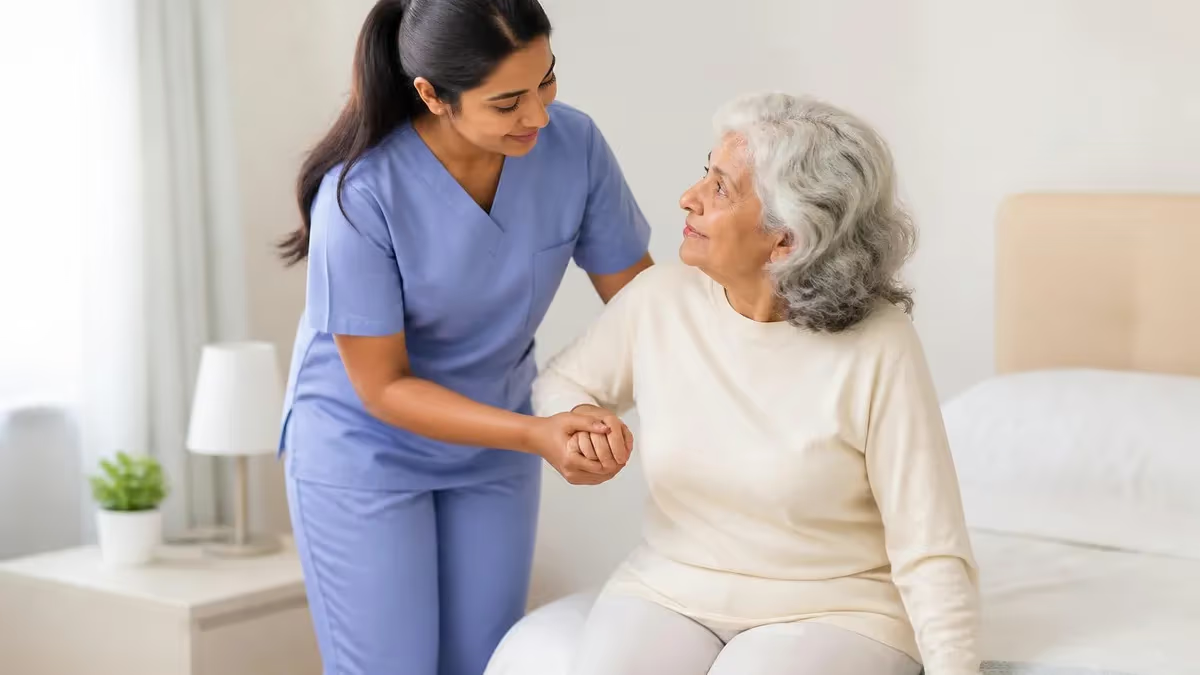
If you have been searching for what does PCA stand for, you have probably noticed that the three letters mean very different things depending on who is using them. In healthcare, PCA most commonly stands for Personal Care Assistant, a frontline caregiver who helps clients with bathing, dressing, mobility, meals, and basic medical observation in homes, group settings, and long-term care facilities. Understanding the PCA meaning is the first step toward exploring this fast-growing career path.
The acronym PCA appears in dozens of industries, which is why search results can feel confusing. You might see pca skin products at a dermatology office, a PCA pump in a hospital room, the Presbyterian Church in America at a Sunday service, or Porsche Club of America at a track day. Each of these uses the same three letters but refers to a completely different concept, organization, or profession with its own training and culture.
This guide focuses primarily on the healthcare meaning because that is the most common use of PCA in the United States workforce. A Personal Care Assistant, sometimes called a Personal Care Aide, supports people who cannot fully care for themselves due to age, illness, disability, or recovery from surgery. The role sits at the foundation of the home health and long-term care industries and offers a low-barrier entry point into nursing, allied health, and social work careers.
The Bureau of Labor Statistics projects that demand for personal care and home health aides will grow by roughly 21 percent through 2032, far faster than the average for all occupations. That projection is driven by an aging baby boomer generation, expanding Medicaid waiver programs, and a strong consumer preference for aging in place rather than moving into institutional care. For job seekers, this means stable demand, flexible scheduling, and clear pathways to advancement.
Beyond healthcare, the PCA acronym also matters in skincare, statistics, religion, technology, and automotive culture. In data science, PCA stands for Principal Component Analysis, a method used to simplify large datasets. In skincare, PCA Skin is a popular professional brand. In medicine, a PCA pump delivers Patient Controlled Analgesia. Knowing which meaning applies to your context prevents costly misunderstandings, especially when reading job postings or product labels.
Throughout this article we will define each major use of PCA, explain how the Personal Care Assistant role works in practice, outline the training and certification you need, and walk through realistic salary expectations across states. We will also cover the daily duties, working conditions, and emotional realities of the job, plus the lesser-known meanings of PCA so you leave with a complete picture of the acronym and the career.
Whether you are a high school student weighing a career, a career changer exploring healthcare, a family caregiver hoping to get paid for the work you already do, or simply someone curious about a term you read on a label, this guide will give you accurate, up-to-date information you can trust. By the end, you will know exactly what PCA stands for in every common context and what it takes to become one.
PCA by the Numbers

What Does PCA Stand For? The Five Most Common Meanings
The most common U.S. meaning. A trained caregiver who helps clients with daily living activities like bathing, dressing, meal prep, and mobility in home and facility settings.
A medical pump system that allows hospital patients to self-administer pain medication within safe preset limits. Common after surgery, childbirth, and cancer treatment.
A statistical technique used in data science and machine learning to reduce the number of variables in a dataset while preserving as much meaningful information as possible.
A conservative Protestant denomination founded in 1973 with over 1,900 congregations across North America. Often referenced simply as the PCA church.
The largest single-marque automotive club in the world, organizing track days, the Porsche experience program, parts swaps, and social events for enthusiasts.
In American healthcare, the Personal Care Assistant role is one of the most accessible entry points into a paid caregiving career. PCAs work under the supervision of registered nurses, physical therapists, or care coordinators, and they perform tasks that allow elderly, disabled, or chronically ill clients to remain safely in their own homes. Unlike a Certified Nursing Assistant, a PCA typically does not perform clinical procedures, but the daily relationship with the client is often deeper and more personal.
To understand pca hydrating toner the full scope of what a Personal Care Assistant does, think of the role as a blend of practical help, social companionship, and basic health monitoring. A typical shift might involve preparing breakfast, helping a client shower safely using a transfer bench, assisting with prescribed exercises, driving to a medical appointment, picking up groceries, and reporting any changes in mood or appetite back to a supervising nurse. The variety is what attracts many people to the profession.
Most states require PCAs working for Medicaid-funded agencies to complete at least 40 to 75 hours of training, including supervised clinical practice. Topics covered include infection control, body mechanics, communication with people who have dementia, emergency response, nutrition basics, and the rights of clients receiving home care. Some states also require a competency exam, fingerprinting, and a criminal background check before you can begin paid work.
The PCA role differs from a Home Health Aide, Certified Nursing Assistant, or Medication Aide in important ways. HHAs can take vital signs and assist with limited medical tasks under nurse supervision. CNAs work primarily in nursing homes and hospitals and have stricter scope-of-practice rules. PCAs focus on non-medical support, although in some states they can be trained to administer specific medications or perform skilled tasks under a delegated nursing model.
Employers of PCAs include home care agencies, hospice programs, assisted living facilities, group homes for adults with developmental disabilities, and government-funded consumer-directed programs that let family members get paid to care for relatives. The consumer-directed model has grown rapidly because it allows clients to choose their own caregivers and keeps care within trusted family networks while still drawing on Medicaid funding.
Personal qualities matter just as much as paperwork in this profession. Strong PCAs are patient, observant, physically fit enough to assist with transfers, comfortable with personal hygiene tasks, and able to communicate clearly with both clients and supervising nurses. They also need cultural humility because they enter homes that reflect every background, faith tradition, and lifestyle imaginable, and respecting those differences is central to the job.
If you are considering this career, ask yourself whether you can balance compassion with professionalism. PCAs witness clients at their most vulnerable, and the work can be emotionally heavy. But for the right person, the role offers daily proof that what you do matters, plus a flexible schedule and a reliable paycheck in an industry that is not going away anytime soon.
PCA Practice Test Questions
Prepare for the PCA - Personal Care Assistant exam with our free practice test modules. Each quiz covers key topics to help you pass on your first try.
PCA Duties and Responsibilities
Free PCA Practice Test featuring Duties and Responsibilities. Improve your PCA Exam score with mock test prep.
PCA Qualifications
PCA Mock Exam on Qualifications. PCA Study Guide questions to pass on your first try.
PCA Working Conditions
PCA Test Prep for Working Conditions. Practice PCA Quiz questions and boost your score.
PCA Assisting with Daily Living Activities
PCA Questions and Answers on Assisting with Daily Living Activities. Free PCA practice for exam readiness.
PCA Basic Nursing Skills
PCA Mock Test covering Basic Nursing Skills. Online PCA Test practice with instant feedback.
PCA Basic Patient Care Skills
Free PCA Quiz on Basic Patient Care Skills. PCA Exam prep questions with detailed explanations.
PCA Communication and Interpersonal Skills
PCA Practice Questions for Communication and Interpersonal Skills. Build confidence for your PCA certification exam.
PCA Ethical and Legal Responsibilities
PCA Test Online for Ethical and Legal Responsibilities. Free practice with instant results and feedback.
PCA Health and Safety Procedures
PCA Study Material on Health and Safety Procedures. Prepare effectively with real exam-style questions.
PCA Health & Safety Protocols
Free PCA Test covering Health & Safety Protocols. Practice and track your PCA exam readiness.
PCA Infection Control
PCA Exam Questions covering Infection Control. Master PCA Test concepts for certification prep.
PCA Mental Health & Emotional Support
Free PCA Practice Test featuring Mental Health & Emotional Support. Improve your PCA Exam score with mock test prep.
PCA Nutrition & Hydration
PCA Mock Exam on Nutrition & Hydration. PCA Study Guide questions to pass on your first try.
PCA Patient Mobility & Transfers
PCA Test Prep for Patient Mobility & Transfers. Practice PCA Quiz questions and boost your score.
PCA Meaning Across Industries: Healthcare, Skincare, and Beyond
In healthcare, PCA almost always means Personal Care Assistant, although it can also refer to Patient Controlled Analgesia, a hospital pump that delivers preset doses of pain medication when a patient presses a button. Both meanings appear in clinical conversations, so context matters. Nurses, social workers, and case managers use the term Personal Care Assistant when discussing staffing and home-based care plans.
The pca medical meaning of Patient Controlled Analgesia is most common in surgical recovery units, oncology wards, and labor and delivery suites. PCA pumps are programmed to limit how much medication a patient can receive in a set window, which prevents overdose while giving the patient control over their own pain management. Both PCA meanings are central to modern patient-centered care.

Pros and Cons of Becoming a Personal Care Assistant
- +Low entry barrier with no college degree required to start
- +Flexible scheduling including part-time, overnight, and weekend shifts
- +Strong job security driven by aging population and Medicaid demand
- +Meaningful daily work that directly improves another person's quality of life
- +Clear advancement pathway to CNA, LPN, RN, or social work careers
- +Family caregiver programs that let you get paid for caring for relatives
- +Diverse work settings from private homes to group homes to hospice
- −Median pay remains modest compared to other healthcare roles
- −Physically demanding work including lifting, transfers, and standing
- −Emotionally challenging when clients decline or pass away
- −Inconsistent hours if agency caseload fluctuates
- −Limited benefits in some private-pay and gig-style positions
- −Exposure to bodily fluids and infectious illness risks
- −Travel between client homes often unpaid in mileage and time
What You Need to Become a PCA (Personal Care Assistant)
- ✓Be at least 18 years old in most states (some allow 16 with restrictions)
- ✓Pass a criminal background check and fingerprinting screening
- ✓Complete a state-approved PCA or home care training program (40 to 75 hours)
- ✓Pass a competency evaluation or skills test if your state requires one
- ✓Obtain CPR and basic first aid certification from an accredited provider
- ✓Provide proof of a recent TB test and required vaccinations
- ✓Hold a valid driver's license if traveling to client homes
- ✓Show legal authorization to work in the United States
- ✓Register with your state's PCA or home care worker registry where required
- ✓Be comfortable performing personal hygiene tasks for clients of any gender
PCA has more than 30 documented meanings across U.S. industries.
Search engines see millions of queries for PCA every month, but the intent varies dramatically. A nursing student researching the career, a hospital patient looking up pain pumps, an esthetician ordering toner, and a Porsche owner checking event dates all type the same three letters. Always confirm context before responding to any PCA question.
A typical day in the life of a Personal Care Assistant looks different depending on the setting, but the rhythm follows a predictable arc. Morning shifts often start with helping a client wake, take medications, eat breakfast, and complete a bath or shower. Midday tasks might include light housekeeping, laundry, grocery shopping, transportation to a doctor's appointment, and preparing lunch. Evening shifts focus on dinner, mobility exercises, and getting the client ready for bed safely and comfortably.
Documentation is a critical part of the role that surprises many new PCAs. After each shift, you typically log the tasks you completed, the client's mood and appetite, any changes in skin condition or behavior, and the time you arrived and left. This record is often the only communication a supervising nurse has about the client's status between visits. Sloppy documentation can lead to missed warning signs, denied insurance claims, or even legal exposure for the agency.
Safety is a daily concern in homes that were not designed for care. PCAs are trained to identify fall hazards like loose rugs, poor lighting, and clutter in walkways. They also learn proper body mechanics for transferring clients from bed to wheelchair, using gait belts, and operating mechanical lifts. Many shoulder, back, and knee injuries among caregivers come from improper technique during transfers, so retraining and refresher courses are valuable throughout your career.
Working conditions vary widely. A PCA at an assisted living facility might care for six to ten residents in a single shift, share supplies, and have immediate access to a registered nurse on site. A home-based PCA might drive to three different houses in a single day, work alone, and rely on phone consultation with a supervisor. Each setting has trade-offs in pace, autonomy, and emotional intensity, and most experienced PCAs eventually develop a strong preference for one over the other.
Relationships with clients are the heart of the job. Many PCAs work with the same clients for months or years, forming bonds that resemble extended family. You learn their favorite breakfast, their grandchildren's names, the stories they tell over and over, and the small comforts that brighten difficult days. This continuity is also why the job can be emotionally taxing when a client's health declines or they pass away, and most agencies offer some form of grief support for staff.
Cultural awareness shapes every shift. PCAs work in homes that reflect every religion, language, family structure, dietary preference, and political viewpoint in America. Respecting those differences is not optional. Strong caregivers learn to ask what a client prefers rather than assuming, to honor food restrictions, to remove shoes when entering, and to adapt communication styles to people whose first language might not be English. This skill is what separates a competent PCA from an exceptional one.
Finally, technology is reshaping the daily PCA experience. Electronic Visit Verification systems now require many home care workers to clock in and out using a phone app that tracks GPS location. Some agencies use shared scheduling apps, secure messaging with supervising nurses, and digital care plans accessible at the point of service. Comfort with smartphones and basic apps has become a practical job requirement, even for caregivers who never expected to work in tech.

Tasks that are legal in one state can be a license violation in another. Florida, Minnesota, and New York all use the title PCA but define duties differently, and Medicaid rules add another layer. Always read your state's official caregiver scope-of-practice document before performing any task involving medication, injections, or wound care.
Salary expectations are one of the most common questions people ask when researching what PCA stands for and whether the career is worth pursuing. The federal Bureau of Labor Statistics reports a median annual wage near $33,530 for personal care aides, but real earnings vary dramatically by state, agency, shift differential, and certification level. Hourly pay typically ranges from $13 to $22, with overnight and live-in roles paying premiums on top of the base rate.
Geography is the single biggest factor in PCA pay. California, Washington, Massachusetts, and Minnesota tend to pay the highest hourly rates due to higher Medicaid reimbursement rates and stronger union representation. States in the Southeast and parts of the Midwest pay closer to the federal minimum wage. Cost of living usually balances out part of the difference, but caregivers willing to relocate to high-paying states can see meaningful income gains.
Specialization can boost earnings without leaving the PCA category. Dementia-trained caregivers, hospice-trained PCAs, and those who work with clients on ventilators or feeding tubes often earn $2 to $5 more per hour than entry-level peers. Certifications like CPR, first aid, dementia care, and end-of-life support are short, affordable, and pay back quickly. Agencies actively seek out these pca pump and high-acuity skill profiles when bidding on complex cases.
Benefits matter as much as hourly wages. Larger agencies and hospital-affiliated home care programs often offer paid time off, health insurance, retirement plans, and tuition reimbursement. Smaller agencies and gig-style staffing apps usually do not. When comparing job offers, always calculate the total compensation package rather than focusing solely on the hourly rate, especially if you need family health coverage or want to attend nursing school later.
Career advancement from a PCA role is one of the most overlooked benefits. Many registered nurses, social workers, occupational therapists, and physician assistants began their careers as PCAs. Working as a caregiver while attending community college gives you direct exposure to clinical reasoning, patient communication, and healthcare team dynamics that classroom instruction cannot teach. Agencies often work around school schedules and may offer tuition assistance to retain promising staff.
Entrepreneurship is another pathway worth considering. Experienced PCAs sometimes start their own small home care agencies, become independent private-pay caregivers, or launch consulting businesses for families navigating elder care. Licensing requirements for opening an agency vary by state and can be costly, but the demand is strong and the entry barrier is much lower than starting most other healthcare businesses. Networking with social workers, hospital discharge planners, and senior centers is critical to early success.
Finally, the emotional and intangible benefits of PCA work are real, even if they do not show up in a paycheck. Many caregivers describe the job as meaningful in a way that office work rarely is. You see immediate, tangible results from your effort, you build deep relationships, and you accumulate stories you will carry your entire life. For people drawn to service, the career offers something money alone cannot buy, even while still providing a livable income.
If you have decided to pursue a Personal Care Assistant career after learning what PCA stands for, the most important first step is identifying which program matches your state's requirements. Visit your state department of health, human services, or aging agency website and search for the home care worker or personal care assistant training section. Each state lists approved training providers, hour requirements, competency exams, and registry rules in plain language, so do not rely on rumor or social media.
Choose a training program that fits your schedule and learning style. Community colleges, vocational schools, Red Cross chapters, and large home care agencies all run training cohorts, sometimes free of charge if you commit to working for the agency afterward. Online hybrid programs let you complete coursework at home and finish supervised clinical hours at a partner facility. Make sure the program you pick is approved by your state Medicaid office if you plan to work for an agency that bills Medicaid.
Prepare for the interview process by thinking carefully about why this work appeals to you. Hiring managers consistently say the strongest candidates can give specific examples of caregiving they have already done, whether for a grandparent, a sibling, or a neighbor. They also look for honesty about challenges. If you have never bathed an adult, helped someone with toileting, or seen serious illness up close, say so and explain how you plan to learn. Coachability matters more than experience.
Build a basic professional toolkit before your first shift. Comfortable closed-toe shoes with good arch support, scrubs or simple uniform pants, a small notepad and pen, a charged phone with the agency app installed, hand sanitizer, gloves, and a refillable water bottle will see you through most shifts. Many caregivers also carry a small bag with their lunch, snacks, a sweater, and any personal medications they need, since shift timing can be unpredictable.
Develop a learning mindset for your first ninety days. The fastest-growing PCAs treat every shift as a chance to learn one new skill, observe one new technique, or build rapport with one new client. Ask questions when supervisors visit, request feedback on your documentation, and shadow more experienced caregivers when scheduling allows. Most agencies will gladly assign you to ride along with senior staff during orientation if you ask. Curiosity is a competitive advantage in this field.
Take care of your own body and mind from day one. Caregivers who skip self-care burn out quickly. Stretch before transfers, drink water throughout your shift, eat real meals rather than snacks alone, and get enough sleep between shifts. Use your agency's employee assistance program if grief, stress, or family pressure starts to weigh on you. The clients you serve need you to last in this profession, and your future self will thank you for protecting your health.
Finally, look ahead. Decide whether the PCA role is your destination or your launching pad. Both choices are valid. Some caregivers work as PCAs for thirty years and retire deeply respected by the families they served. Others use the role to fund nursing school or pivot into healthcare administration. Map out a realistic five-year plan, share it with your supervisor, and ask for the certifications, mentoring, and shift opportunities that align with where you want to go. The PCA path is what you decide to make of it.
PCA Questions and Answers

PCA - Personal Care Assistant: Complete Study Guide 2026
What Does a PCA Do? Complete Guide to Personal Care Assistant Duties and Daily Responsibilities
PCA - Personal Care Assistant: Career Paths, Salary, and Requirements 2026
Personal Care Assistant Jobs Near Me: How to Find Local PCA Positions, Apply Successfully, and Start Your Caregiving Career in 2026
PCA (Personal Care Assistant) Test: What to Expect
About the Author

Registered Nurse & Healthcare Educator
Johns Hopkins University School of NursingDr. Sarah Mitchell is a board-certified registered nurse with over 15 years of clinical and academic experience. She completed her PhD in Nursing Science at Johns Hopkins University and has taught NCLEX preparation and clinical skills courses for nursing students across the United States. Her research focuses on evidence-based exam preparation strategies for healthcare certification candidates.