
PADI Scuba Course: Complete Guide to Open Water Certification, Training & What to Expect
Everything you need to know about the PADI scuba course — costs, requirements, what to study & how to pass. 🎯 Start your open water journey today.

The padi scuba course is the world's most recognized pathway to becoming a certified scuba diver, opening up an entirely new dimension of underwater exploration to millions of people every year. PADI — the Professional Association of Diving Instructors — has trained more than 29 million divers worldwide since its founding in 1966, and its Open Water Diver certification remains the gold standard entry-level credential accepted at dive shops, liveaboards, and resorts on every continent.
Whether you're planning a reef dive in the Florida Keys, a wreck dive in the Great Lakes, or a tropical adventure off the coast of Hawaii, completing the PADI scuba course is your first and most important step.
Understanding what the PADI scuba course actually involves — the knowledge development portion, the confined water sessions, and the open water dives — helps you walk in on day one with realistic expectations and a clear study plan. Too many aspiring divers show up underprepared for the knowledge review quizzes or the final exam, which covers diving physics, physiology, equipment, and dive planning. This guide breaks down every phase of the course in practical, step-by-step detail so you can approach your certification with confidence rather than anxiety.
The PADI Open Water Diver course is designed to be completed in as few as three to four days, but many students spread it across a few weekends to absorb the material more thoroughly. The course has three main learning components: self-study knowledge development (typically done via the PADI eLearning app or a printed manual), confined water dive sessions (usually in a pool), and four open water training dives. Each phase builds directly on the last, so solid preparation at the knowledge stage pays dividends when you're in the water performing skills.
Cost is one of the most common questions prospective students ask before enrolling. In the United States, a complete PADI Open Water Diver course — including all pool sessions, open water dives, instructor time, and certification fees — typically ranges from $350 to $600 depending on your location, the dive shop, and whether rental equipment is included. Urban dive centers in expensive markets like New York or San Francisco tend to charge toward the upper end, while shops in Florida or coastal dive communities often offer more competitive pricing due to higher volume and lower overhead.
Age requirements for the PADI scuba course are straightforward: students must be at least 10 years old. Children aged 10 to 14 earn a PADI Junior Open Water Diver certification, which carries a few additional depth restrictions (maximum 40 feet unless accompanied by a PADI professional). At age 15 these restrictions are automatically lifted and the certification converts to a full Open Water Diver credential. Adults of any age can participate provided they meet the medical requirements outlined in the PADI Medical Statement, which screens for conditions that could pose a risk underwater.
The medical form is a self-declaration document that lists conditions such as asthma, heart conditions, epilepsy, and recent surgeries. If you answer yes to any flagged question, a physician must sign off before you can dive. This step is often overlooked by students who assume they'll complete it on the first day, but waiting for a doctor's appointment can delay your course start significantly. Download the PADI Medical Statement in advance, review it honestly, and — if needed — schedule your physician visit well before your course begins so you don't lose your deposit or delay your certification timeline.
One of the most compelling aspects of the PADI system is its global portability. Once you earn your Open Water Diver card, it is recognized at dive sites and rental shops worldwide with no expiration date. Unlike many professional certifications, your PADI card never technically expires — though dive operators may ask you to complete a refresher if you haven't dived in more than 12 months. The PADI Scuba Review or ReActivate program covers exactly that scenario and can be completed in a single afternoon at most dive centers.
PADI Scuba Course by the Numbers

PADI Open Water Diver Course Structure
Five knowledge sections covering diving physics, physiology, equipment, skills, and planning. Completed via PADI eLearning app or printed manual with review questions and knowledge reviews at the end of each section. Typically takes 8-12 hours of self-study.
Five pool sessions where you practice and demonstrate 25 core scuba skills including mask clearing, regulator recovery, buoyancy control, and emergency ascents. Each session builds on the previous one before you move to open water.
Four open water training dives completed in pairs of two over one or two days. You demonstrate skills from confined water in real conditions and experience actual diving environments like lakes, quarries, or ocean sites.
A 50-question multiple-choice written exam covering all five knowledge sections. A minimum score of 75 percent is required to pass. Most students who complete all knowledge reviews score well above the minimum threshold.
The knowledge development phase of the PADI scuba course is where most of the academic work happens, and it deserves far more attention than many students give it.
PADI organizes its Open Water Diver curriculum into five distinct sections, each covering a major pillar of safe scuba diving: the basics of scuba diving and your equipment, the physics of diving and how pressure affects your body, the physiology of diving including decompression sickness and nitrogen narcosis, dive planning with tables and dive computers, and the practical skills you'll execute underwater. Each section ends with a knowledge review quiz that your instructor checks and discusses before you move on.
Physics is the section that surprises most first-time students, particularly those who haven't thought about science since high school. Boyle's Law — which describes the inverse relationship between pressure and volume — is the foundational principle behind almost every safety rule in scuba diving. As you descend, water pressure increases and the air in your lungs, BCD, and equipment compresses.
As you ascend, that air expands. Understanding why you must never hold your breath during ascent, why ears need to be equalized during descent, and why your buoyancy changes throughout a dive all trace back to these basic gas laws. PADI explains them clearly and practically, but spending extra time here before your pool sessions pays off enormously.
Physiology covers what happens inside your body at depth and during ascent, and this section demands careful reading. Decompression sickness — commonly called the bends — occurs when nitrogen absorbed by your body tissues under pressure comes out of solution too quickly during an ascent, forming bubbles in joints, blood vessels, and the spinal cord.
The PADI course teaches you how to avoid DCS by following the dive tables or your dive computer, ascending at no faster than 30 feet per minute, and performing a safety stop at 15 feet for three minutes at the end of every dive. These protocols are not optional suggestions — they are the core habits that keep recreational divers safe on thousands of dives.
Dive planning is where the padi owd course gets genuinely practical and immediately applicable. You'll learn to use the Recreational Dive Planner (RDP) tables — a color-coded system that tracks your nitrogen exposure across multiple dives in a day — and you'll also learn how most modern divers use dive computers to perform the same calculations automatically and continuously.
While dive computers have largely replaced manual table use in the field, PADI still teaches table planning because it builds a fundamental understanding of dive limits, surface intervals, and repetitive dive adjustments that makes you a safer diver even when relying on technology.
Equipment knowledge runs throughout all five sections, not just the dedicated equipment chapter. You'll learn the function and maintenance of your BCD (buoyancy compensator device), regulator, cylinder, wetsuit, mask, fins, weights, dive computer, and surface marker buoy.
More importantly, you'll learn how to conduct a pre-dive safety check — the BWRAF acronym stands for BCD, Weights, Releases, Air, and Final okay — which every responsible dive team performs before entering the water. Instructors will quiz you on equipment assembly and disassembly during confined water sessions, so reviewing these skills from the manual before each pool class keeps you ahead of the curve.
The confined water sessions translate all that book knowledge into muscle memory. Your PADI instructor will demonstrate each skill, then have you practice it until you can execute it correctly and calmly. Key skills include flooding and clearing your mask (while staying calm and continuing to breathe through your regulator), recovering a dislodged regulator from behind your shoulder, performing an emergency ascent if your air supply fails, hovering neutrally buoyant without touching the bottom, and signaling your buddy throughout the dive.
Neutral buoyancy is often the skill that takes the most practice — achieving it requires constant, small adjustments to your breathing and BCD inflation — but it is also the skill that most dramatically improves your enjoyment and air consumption once mastered.
Your four open water training dives consolidate everything from knowledge development and confined water into real diving conditions. Dives one and two typically focus on basic skills review and familiarization with the open water environment, while dives three and four involve more navigation, deeper exploration up to 40 feet, and demonstration of the remaining certification skills. If you're doing your course inland at a quarry or lake, expect lower visibility and cooler water than tropical environments, but don't let that discourage you — the skills and certification are identical regardless of where the open water dives take place.
PADI Open Water Certification: Study Strategies by Learning Style
Visual learners thrive with the PADI eLearning platform, which combines video demonstrations, animated diagrams of gas laws and body physiology, and interactive quizzes after each lesson segment. Watching an instructor demonstrate regulator recovery or mask clearing on video before attempting the skill in the pool significantly reduces anxiety and improves first-attempt success rates. Supplement the PADI app with YouTube dive videos showing real open water conditions and skill demonstrations from multiple angles.
Create a set of color-coded flashcards for the RDP dive tables, marking pressure groups, surface interval credits, and repetitive dive adjustments in different colors. Draw your own diagrams of how pressure changes at depth affect air spaces in your ears, sinuses, and BCD. Visual mapping of cause-and-effect relationships — such as descending too fast leading to ear squeeze, or ascending too quickly causing DCS — helps the physiology section click in a way that passive reading often does not.

Is the PADI Scuba Course Right for You?
- +Globally recognized certification accepted at dive shops and resorts worldwide with no expiration date
- +Flexible completion options including eLearning self-study, classroom-based courses, and referral programs for travel
- +Relatively short time commitment of 3-4 days minimum, or spread over weekends to fit busy schedules
- +Clear prerequisite pathway that scales from Open Water to Advanced, Rescue Diver, and Divemaster without starting over
- +PADI's DAN dive accident insurance partnership provides affordable emergency medical coverage for certified divers
- +Practical skills-based curriculum means you exit the course genuinely prepared to dive safely, not just certified on paper
- −Course costs of $350-$600 are significant, and ongoing gear rental or purchase adds substantially to the total investment
- −Medical conditions including asthma, certain heart conditions, and pregnancy may require physician clearance or disqualify candidates
- −Open water dive conditions vary widely — lake quarry certifications may not prepare students for ocean currents and surge
- −The 40-foot depth limit for new Open Water Divers restricts access to many interesting dive sites until Advanced certification is earned
- −Air consumption rates for new divers are typically much higher than experienced divers, shortening bottom time on early dives
- −Finding consistent dive buddies and maintaining skills between trips requires active effort, especially for landlocked divers
PADI Open Water Certification Preparation Checklist
- ✓Download the PADI eLearning app or purchase the Open Water Diver manual before your first class meeting.
- ✓Complete the PADI Medical Statement honestly and schedule a physician visit if you answer yes to any flagged question.
- ✓Review Boyle's Law and basic gas physics before your first knowledge development session.
- ✓Memorize the BWRAF pre-dive safety check acronym and practice it on your gear before each pool session.
- ✓Practice equalizing your ears using the Valsalva maneuver at the surface before your first pool descent.
- ✓Learn the five main signs and symptoms of decompression sickness and the appropriate emergency response.
- ✓Study the Recreational Dive Planner tables until you can calculate pressure groups and surface intervals without assistance.
- ✓Research the open water dive site your instructor uses so you know what visibility, temperature, and conditions to expect.
- ✓Purchase or rent a properly fitting wetsuit appropriate for your open water dive location's water temperature.
- ✓Arrive at each confined water session with your knowledge review questions completed and questions prepared for your instructor.
Buoyancy Control Is the Most Important Skill You'll Ever Learn
Every experienced diver will tell you the same thing: neutral buoyancy is the single skill that separates comfortable, air-efficient divers from those who struggle on every dive. Practice hovering motionless at 15 feet in the pool until it feels completely natural. Divers with good buoyancy consume 30-40% less air per dive, experience less fatigue, and cause zero damage to coral reefs or visibility.
The cost structure of the PADI scuba course varies more than most prospective students expect, and understanding all the components helps you budget accurately and avoid surprise expenses. The base course fee quoted by most dive shops covers instructor time, pool access, equipment rental during training sessions, PADI eLearning access or manual, and the certification processing fee that PADI charges the dive shop to register your credential in their global database.
What it often does not cover is personal equipment you might want to purchase, specialty fees for particular dive sites, or travel to open water locations if the shop operates out of an inland city.
Equipment rental versus purchase is one of the biggest cost decisions new divers face. Renting equipment for your certification course makes complete financial sense — you haven't yet developed personal preferences for fit and features, and buying a full set of scuba gear before you know whether you'll dive regularly is a significant gamble.
A basic personal equipment set including mask, fins, and wetsuit runs $200 to $400 and is worth purchasing early because fit is critical for comfort and safety. Regulators, BCDs, and cylinders are the expensive items — a quality regulator runs $400 to $800, a BCD $250 to $600 — and renting these from your local dive shop for the first year or two of diving is entirely reasonable.
PADI Travel is the organization's dedicated trip booking platform, connecting certified divers with liveaboard expeditions, resort packages, and guided dive tours worldwide. After certification, many new divers plan a celebratory dive vacation within their first year, and PADI Travel's curated destination listings include quality ratings, depth profiles, and certification level requirements for each site.
Popular US destinations for newly certified Open Water Divers include the Florida Keys (especially John Pennekamp Coral Reef State Park), the Channel Islands off Southern California, and the Blue Hole area near Santa Rosa, New Mexico — a freshwater inland site beloved for its crystal-clear visibility and consistent 60-degree temperatures.
The padi open water certification card arrives either as a physical plastic card or a digital eCertification that lives in your PADI app. Both are equally accepted everywhere in the world. The digital version has a practical advantage: you can pull it up on your phone instantly when a dive operator asks for proof of certification, eliminating the risk of forgetting your card at the hotel.
PADI's online verification system also allows operators to look up your certification directly using your name and date of birth, so losing your physical card is never a career-ending catastrophe — replacement cards cost about $10 through the PADI website.
DAN — Divers Alert Network — is the dive industry's leading emergency medical organization and is closely partnered with PADI worldwide. DAN membership provides access to a 24-hour diving emergency hotline staffed by physicians specializing in hyperbaric medicine, travel assistance services, and optional dive accident insurance that covers hyperbaric chamber treatment (which can cost $1,000 or more per hour without coverage). Annual DAN membership starts at around $35, and most experienced divers consider it non-negotiable.
Your PADI instructor will likely mention the dan padi relationship during your course, and signing up during your certification period is the smartest time to start.
Dive travel insurance separate from DAN is worth considering for international trips, covering not just dive accidents but trip cancellation, emergency evacuation, and lost equipment. Standard travel insurance policies typically exclude scuba diving injuries above certain depths or classify them as extreme sports, so reading the fine print carefully — or choosing a policy specifically marketed to divers — avoids nasty surprises if something goes wrong abroad. Several providers including DAN, Divers Alert Group, and World Nomads offer diver-specific policies that cover emergency recompression treatment at any certified hyperbaric facility worldwide.
The PADI login portal at padi.com gives certified divers access to their certification records, specialty course transcripts, eLearning purchases, and dive log history. Creating your account during or immediately after your certification course is worth the five minutes it takes — the portal becomes your permanent diving resume, and PADI professionals worldwide can verify your credentials through the same system. The portal also shows you which specialty and continuing education courses you've completed, which helps you track progress toward the Master Scuba Diver rating, PADI's highest non-professional certification, which requires five specialty certifications plus Rescue Diver.

If you answer yes to any question on the PADI Medical Statement — including a history of asthma, heart conditions, ear surgeries, or recent hospitalizations — you must obtain physician sign-off before your first confined water session. This process can take one to two weeks depending on appointment availability. Download the medical form from padi.com well before your course start date so any delays do not cost you your enrollment deposit or push back your certification timeline.
Once you have your Open Water Diver certification in hand, the PADI continuing education pathway opens up a rich progression of specialty courses and advanced certifications that most divers find more addictive than they expected. The natural next step for the majority of newly certified divers is the PADI Advanced Open Water Diver course, which requires completing five adventure dives — two mandatory (deep diving to 100 feet and underwater navigation) and three elective specialties of your choice.
The Advanced Open Water certification deepens your skill set dramatically and raises your maximum recreational depth limit from 60 feet to 100 feet, unlocking a completely new category of dive sites including most shipwrecks and many dramatic wall dives.
The PADI Rescue Diver course is widely regarded as the most personally transformative certification in the recreational diving system, and many dive professionals consider it more valuable than Advanced Open Water in terms of real-world skill development.
Rescue Diver teaches you to recognize and manage dive emergencies before they become fatalities — panicked diver assistance, unconscious diver rescue from the surface and the bottom, first aid and oxygen administration, and coordination with emergency services. The course is physically and emotionally demanding but produces a level of underwater confidence that changes how you approach every dive for the rest of your life.
Specialty courses allow you to pursue the types of diving that excite you most. PADI offers dozens of specialty certifications including Wreck Diver, Drift Diver, Night Diver, Underwater Photographer, Peak Performance Buoyancy, Deep Diver, and Search and Recovery Diver, among many others. Each specialty typically requires two dives and can be completed in a single day at most dive shops.
Peak Performance Buoyancy is particularly recommended for every diver regardless of experience level — it refines the core buoyancy skill that underpins enjoyable, low-impact, air-efficient diving in a way that the basic Open Water course simply doesn't have time to cover in depth.
The Divemaster certification is PADI's first professional-level rating, and for many recreational divers it represents the ultimate goal of the certification ladder. Divemaster candidates complete a rigorous program that includes assisting with Open Water courses, conducting discover scuba experiences for non-certified participants, leading certified diver groups, and demonstrating mastery of all recreational diving skills to professional standards.
The program typically requires 40 or more logged dives to begin and 60 dives to complete, and the time commitment ranges from several weeks of intensive training to several months of part-time study. Many dive shops offer working internships where Divemaster candidates assist with real courses in exchange for guided mentorship.
Logging your dives after certification is not mandatory, but it is one of the habits that separates divers who improve rapidly from those who plateau. A complete dive log entry includes the date, site, depth, bottom time, visibility, water temperature, equipment configuration, and notes on what you saw and any skills you practiced or struggled with.
Over time, your dive log becomes an invaluable tool for tracking air consumption improvement, buoyancy progress, and site conditions across different seasons. Many dive operators require a minimum number of logged dives before allowing access to more challenging sites, and some liveaboard operators review logs as part of their safety briefing process.
Finding a community of local divers accelerates your development more than almost any other factor after initial certification. Most cities with access to diveable water have local dive clubs affiliated with PADI or other organizations that organize regular group dives, equipment swap meets, and training workshops.
Dive with more experienced divers as often as possible — watch how they manage their buoyancy, plan their dives, respond to current changes, and signal their buddies. The informal mentorship that happens during buddy diving with experienced divers transmits knowledge that no classroom or manual can fully replicate. PADI's online community at padi.com and regional dive club networks make finding dive buddies easier than ever regardless of where you live.
Maintaining your skills between dives is the challenge that every certified diver faces, particularly those in landlocked states or northern climates with short diving seasons. PADI's ReActivate program is the official refresher course for divers who haven't been in the water for a year or more — it involves an online knowledge review followed by a single pool session to reestablish comfort with equipment and core skills.
Many dive shops offer free or low-cost ReActivate sessions as a courtesy to their regular customers, particularly at the start of diving season. Even for active divers, spending time in a pool practicing buoyancy, mask clearing, and navigation during winter months keeps your skills sharp for the moment spring arrives and conditions improve.
Preparing specifically for the PADI Open Water Diver final exam requires a different approach than the knowledge review quizzes that appear throughout the course. The final exam is 50 questions drawn from all five knowledge sections, and while the passing score is 75 percent, most students who have actively engaged with the material throughout the course score in the 85 to 95 percent range.
The exam is closed-book and timed, though most students finish well within the allotted period. The questions test conceptual understanding more than memorization — knowing why a rule exists makes it easier to answer questions that frame the scenario differently than your manual did.
Gas law questions are among the most commonly missed on the PADI final exam, so they deserve focused preparation. Boyle's Law (pressure and volume), Dalton's Law (partial pressures of gas mixtures), Charles's Law (temperature and volume), and Henry's Law (gas dissolving into liquid under pressure) all appear in the exam.
The practical application questions — such as calculating how many times more dense the air is at 66 feet than at the surface, or predicting what happens to a balloon released at depth — require you to understand the relationships between the laws rather than simply recite their names. Work through every practice calculation in your manual at least twice, once following the steps and once from memory.
Physiology questions often hinge on precise terminology and timing. Know the difference between arterial gas embolism (AGE) and decompression sickness (DCS) — AGE results from pulmonary barotrauma due to breath-holding during ascent, while DCS results from nitrogen bubble formation during too-rapid ascent from a dive that loaded nitrogen into tissues. Both are serious emergencies requiring recompression treatment, but they have different onset patterns and triggers. Knowing these distinctions cold — not just recognizing the terms but being able to distinguish the scenarios — separates students who score 90 percent from those who barely clear 75.
Dive table questions appear reliably on the PADI exam and require practice with the actual RDP table to answer confidently under time pressure. Common question types include: determining a diver's pressure group after a single dive, calculating the required surface interval before a repetitive dive, finding the adjusted maximum depth and time for a repetitive dive, and identifying whether a dive profile is within no-decompression limits.
Practice a minimum of 10 complete table scenarios before the exam — work from the starting dive profile all the way through a surface interval and repetitive dive — until the table lookup process becomes automatic and you stop making transposition errors.
Equipment identification questions test whether you know not just what each piece of gear is called but what its components do and what failure modes look like.
Know the components of a two-stage regulator (first stage, second stage, SPG, alternate air source), the parts of a BCD (inflator mechanism, dump valves, bladder, harness), and the markings on a scuba cylinder (working pressure, hydrostatic test date, visual inspection sticker). Your instructor will review equipment thoroughly during confined water sessions, but reinforcing the terminology from the manual ensures you don't blank on a multiple-choice question during the exam because the gear looked different on paper than in the pool.
Time management during the exam is rarely a problem for prepared students, but pacing matters for test-anxious individuals. Read each question fully before looking at the answer choices — many distractor answers are plausible if you scan the question quickly but clearly wrong after careful reading. If you're unsure of an answer, mark it and return to it after completing the questions you're confident about. Changing your first answer is statistically disadvantageous on knowledge-based tests unless you have a specific reason — a fact you recalled after moving on — rather than second-guessing your instinct.
Practice tests are one of the most effective preparation tools available to PADI students, and PracticeTestGeeks.com provides free PADI-aligned practice questions that mirror the format and difficulty level of the actual final exam. Working through practice sets across all five knowledge categories helps identify your weak areas before the real exam, builds familiarity with how questions are phrased, and reduces exam-day anxiety by making the experience feel familiar. Aim to complete at least three or four full practice sets, reviewing every wrong answer in detail, in the week leading up to your scheduled exam date for maximum retention and confidence.
PADI Questions and Answers

PADI Rescue Course: Complete Guide to Certification, Training & What to Expect
PADI Rescue Diver Course: Complete Guide to Certification, Training & What to Expect
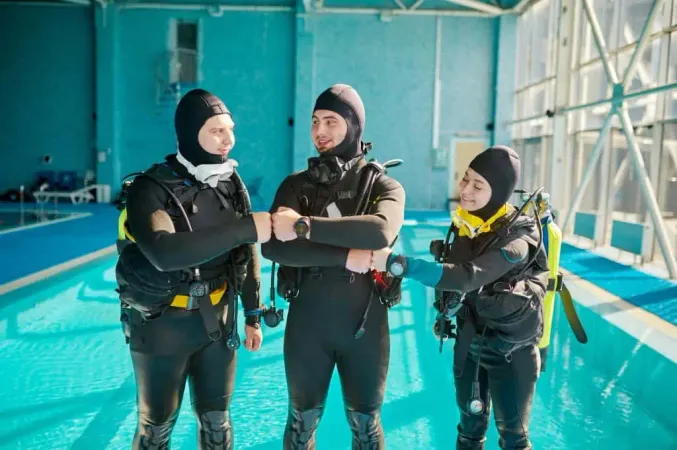
Certified Professional Association of Diving Instructors Diver: All You Need to Know
PADI Practice Test PDF (Free Printable 2026)
PADI OWD Course — Your Complete Open Water Diver Guide for 2026
About the Author

Educational Psychologist & Academic Test Preparation Expert
Columbia University Teachers CollegeDr. Lisa Patel holds a Doctorate in Education from Columbia University Teachers College and has spent 17 years researching standardized test design and academic assessment. She has developed preparation programs for SAT, ACT, GRE, LSAT, UCAT, and numerous professional licensing exams, helping students of all backgrounds achieve their target scores.
Join the Discussion
Connect with other students preparing for this exam. Share tips, ask questions, and get advice from people who have been there.
View discussion (8 replies)