
PADI Advanced Open Water Course: Complete Guide to Certification, Training & What to Expect
Master the PADI advanced open water course — requirements, adventure dives, costs & tips. 🎯 Complete 2026 September US guide for aspiring advanced divers.

The PADI advanced open water course is the natural next step for any certified diver who wants to explore deeper, dive more confidently, and expand their underwater skills beyond the basics. Recognized worldwide, padi has trained millions of divers across more than 180 countries, making its Advanced Open Water Diver (AOWD) certification one of the most respected credentials in recreational scuba. Whether you completed your
Unlike the entry-level Open Water course, the PADI Advanced Open Water course is not about mastering new theory from scratch — it is about getting in the water and doing. You complete five Adventure Dives with a PADI instructor, and two of those dives are mandatory: the Deep Adventure Dive and the Underwater Navigation Adventure Dive. The remaining three dives come from a menu of more than fifteen specialties, giving you real flexibility to pursue what excites you most, from night diving to fish identification to peak performance buoyancy.
One of the most common questions new divers ask is how the PADI Advanced Open Water course compares to specialty certifications. The short answer is that each Adventure Dive you complete during the AOWD course can be credited toward a full specialty certification later. For example, if you choose the Wreck Dive as one of your three elective dives, you only need two more wreck dives to earn the PADI Wreck Diver specialty. This makes the AOWD course one of the most efficient investments in your diving education.
The course typically takes two to three days to complete, depending on how your dive center schedules the dives. Some centers run it as an intensive weekend program; others spread it across a week of afternoon dives. There is no written exam required for the Advanced Open Water certification, which surprises many candidates. Your assessment is entirely performance-based — your instructor evaluates your skills, dive planning, and situational awareness in open water throughout the five dives.
Prerequisites are straightforward. You must be a certified PADI Open Water Diver (or hold a qualifying certification from another recognized agency such as SSI or NAUI), and you must be at least 12 years old. Divers aged 12 to 14 earn the PADI Junior Advanced Open Water Diver certification, which carries some depth restrictions until they reach age 15. Adults face no age ceiling — many divers complete their AOWD well into their 50s, 60s, and beyond, and the course adapts comfortably to varying fitness levels.
Cost is another common concern. In the United States, the PADI Advanced Open Water course typically ranges from $350 to $600 depending on location, the dive site, whether equipment rental is included, and whether the course is conducted locally in a lake or quarry versus a tropical destination. Many US dive centers bundle the course with travel packages to destinations like the Florida Keys, the Channel Islands, or the Caribbean, making it an attractive option for divers who want to combine education with a dive vacation.
Throughout this guide, you will find everything you need to know about the PADI Advanced Open Water course: the exact structure, what each dive covers, how to prepare, what gear you need, and how to maximize your learning so you leave the water a genuinely better, more confident diver. We have also included practice quiz tiles linked to real PADI deep diving questions so you can test your knowledge before you enter the water.
PADI Advanced Open Water Course by the Numbers

How the PADI Advanced Open Water Course Is Structured
Descend to a maximum of 100 feet (30 meters) with your instructor. This dive focuses on depth awareness, nitrogen narcosis recognition, gas consumption at depth, and safe ascent procedures including a safety stop at 15 feet.
Use a compass, natural references, and kick-cycle counting to navigate an underwater course. You practice straight-line navigation, reciprocal bearings, and square patterns — skills that make every future dive more efficient and safer.
Select any three dives from over fifteen options including night diving, wreck diving, peak performance buoyancy, fish identification, underwater photography, drift diving, and more. Each dive is logged and can credit toward a specialty certification.
Before each dive your instructor conducts a detailed briefing covering the dive plan, goals, safety signals, and emergency procedures. After each dive there is a structured debrief where your performance is reviewed and skills are reinforced.
After completing all five dives, your instructor submits your certification through the PADI system. You access your digital c-card through your PADI login account, and a physical card can be ordered if preferred.
The Deep Adventure Dive is the centerpiece of the PADI Advanced Open Water course, and for good reason — depth is where recreational diving gets genuinely exciting and where the risks increase enough to demand solid preparation.
During this dive, you and your instructor descend to between 60 and 100 feet (18 to 30 meters). Your instructor will likely conduct a simple task such as a color recognition exercise or arithmetic problem to illustrate how nitrogen narcosis can impair cognitive function at depth, even at recreational limits. Understanding narcosis is a critical safety concept, and this firsthand experience makes the lesson unforgettable.
Gas management becomes far more important at depth than it does in the 30- to 40-foot range where most beginners learn. At 100 feet, you consume air roughly four times faster than at the surface due to the increased ambient pressure. Your instructor will guide you in monitoring your pressure gauge regularly, planning your dive so that you surface with at least 500 PSI (or 50 bar) remaining, and executing a three-to-five-minute safety stop at 15 feet on every ascent. Developing these habits during the AOWD course means they become second nature before you dive independently at depth.
The Underwater Navigation Adventure Dive is equally fundamental. Poor navigation is one of the leading causes of unplanned diver separations and accidental drift, so the skills you build in this dive have direct safety implications. You will practice compass navigation using a standard diving compass or your dive computer's integrated compass feature. The three core exercises are straight-line navigation (swim a bearing, return on the reciprocal), square patterns (four 90-degree turns to return to your starting point), and natural navigation using landmarks such as coral formations, sand ripple direction, and the angle of sunlight.
Many divers are surprised by how difficult it is to maintain a straight heading underwater. Current, surge, and even your own breathing rhythm can push you off course. The navigation dive teaches you to compensate for these variables and builds a spatial awareness that experienced divers use unconsciously on every dive. Completing this dive well is one of the most immediately practical skills you will gain from the entire AOWD course, and it sets the foundation for more advanced navigation work if you later pursue the full PADI Underwater Navigator specialty.
Your three elective Adventure Dives are where the course becomes truly personal. If you are passionate about marine life, the Fish Identification or Underwater Naturalist dives let you focus on recognizing species, understanding reef ecology, and learning how to log your observations scientifically.
If underwater photography already interests you, the Digital Underwater Photographer adventure dive teaches framing, lighting, and macro versus wide-angle technique with a camera you either own or rent from the dive center. Discussing your interests with your instructor before enrolling helps ensure you select dives that genuinely advance your diving in the directions that matter most to you.
The padi owd course teaches the foundational skills every diver needs — mask clearing, regulator recovery, buoyancy control in shallow water — but the AOWD course is where those skills get stress-tested in more demanding conditions. Buoyancy, in particular, improves dramatically during the Advanced course. The Peak Performance Buoyancy Adventure Dive is one of the most popular electives, and instructors frequently comment that it produces more improvement in a single dive than students sometimes achieve during their entire Open Water course. This is because it is dedicated entirely to buoyancy refinement, with no other skills competing for your attention.
By the time you complete all five dives, you will have logged a minimum of nine total dives (four from Open Water plus five from Advanced). In practice, most candidates arrive with more logged dives and find the Advanced course a genuine opportunity to consolidate and elevate the skills they have already been practicing. Your PADI Advanced Open Water Diver certification card will be recognized at every dive operation and liveaboard in the world, and it opens the door to the Rescue Diver course — widely regarded as the most important and transformative course PADI offers.
PADI Advanced Open Water Course: Elective Dive Options Explained
Among the most popular elective Adventure Dives in the PADI Advanced Open Water course are night diving, wreck diving, and drift diving. The Night Dive introduces you to the dramatically different underwater world that emerges after dark — nocturnal predators, bioluminescent plankton, and the focused intimacy of navigating by torch light. You learn light signals, buddy awareness at night, and how to manage your gear in low-visibility conditions. Many divers describe their first night dive as one of the most memorable experiences in their diving life.
Wreck diving exposes you to the skills needed to safely explore artificial structures — from understanding the risks of entanglement and silt disturbance to reading a wreck layout and identifying penetration boundaries. Drift diving teaches you to read current, position yourself efficiently in the water column, and coordinate with a boat crew for pick-up. Each of these dives builds confidence and expands the range of environments where you can dive safely and enjoyably after certification.

PADI Advanced Open Water Course: Is It Worth It?
- +Increases your maximum recreational depth from 60 feet to 100 feet, opening access to deeper wrecks, walls, and reef structures
- +No written exam required — certification is entirely performance-based, ideal for divers who learn better in the water than in a classroom
- +Each Adventure Dive credits toward a full specialty certification, making the AOWD one of the most efficient investments in your diving education
- +Dramatically improves buoyancy, navigation, and gas management skills through hands-on repetition with professional instructor feedback
- +Globally recognized certification accepted by every dive operator, liveaboard, and dive resort in the world
- +Prerequisite for the PADI Rescue Diver course, which most experienced divers consider the most valuable certification they ever earned
- −Costs $350–$600 in the US, not including travel to a suitable dive site, which adds significant expense for inland divers
- −No classroom component means some theoretical concepts (gas laws, narcosis physiology) receive less structured coverage than in Open Water
- −Quality varies significantly between instructors and dive centers — a rushed or undersupervised AOWD course delivers far less value than a well-run one
- −Minimum five dives means the course moves quickly; divers who need more time to consolidate skills may feel pressured by the pace
- −The 100-foot depth limit still excludes many notable dive sites that require technical or extended-range training beyond recreational limits
- −Elective dive selection is sometimes constrained by local conditions — not every dive center offers every specialty as an Adventure Dive option
PADI Advanced Open Water Course Preparation Checklist
- ✓Confirm your Open Water Diver certification is current and recognized by PADI or a reciprocal agency such as SSI or NAUI.
- ✓Log at least a few recent dives before the course to refresh your buoyancy, mask clearing, and regulator recovery skills.
- ✓Research your local dive centers and read recent student reviews to find an instructor with a strong teaching reputation.
- ✓Discuss elective dive options with your instructor before enrolling and select three that align with your specific diving interests.
- ✓Verify that all required equipment is available — mask, fins, wetsuit or drysuit, BCD, regulator, computer, and SMB.
- ✓Review the PADI Recreational Dive Planner or your dive computer's NDL tables so you arrive familiar with depth and time limits.
- ✓Pack a logbook and pen — your instructor will sign off each Adventure Dive, and a detailed log builds your diving resume.
- ✓Arrive well-rested and hydrated on each dive day; fatigue and dehydration measurably increase decompression sickness risk.
- ✓Study basic compass navigation theory before the navigation dive so you can focus on execution rather than concepts in the water.
- ✓After completing the course, log into your PADI account to review your certification, order a physical c-card if desired, and explore next steps.
The Deep Dive Is Not Just About Depth — It Is About Gas Awareness
Most AOWD candidates focus on the excitement of reaching 100 feet, but experienced instructors consistently report that the most important skill developed during the Deep Adventure Dive is conservative gas management. Divers who internalize the habit of turning around at one-third of their tank pressure — a rule common in cave and technical diving but equally smart for recreational diving — become noticeably safer and more self-sufficient after completing their Advanced certification.
Understanding the full cost of the PADI Advanced Open Water course requires looking beyond the headline course fee. Most US dive centers charge between $350 and $600 for the course itself, which typically includes instructor fees, PADI materials (usually delivered digitally through the eLearning platform or a physical manual), and certification processing.
What that fee often does not include is equipment rental, which can add $50 to $100 per dive day if you do not own your own gear, and entry fees for dive sites, which range from zero at a public beach to $30 or more at a privately operated quarry or marine preserve.
Travel is the most significant variable in total AOWD cost for US divers. An inland diver in the Midwest might complete their course in a freshwater quarry for a total out-of-pocket cost under $500, while a diver who chooses to complete the course in the Florida Keys or on a liveaboard in the Channel Islands might spend $1,500 or more when accommodation, airfare, and dive fees are factored in.
Neither approach is inherently better — quarry diving in cool, low-visibility water can actually build stronger foundational skills because you cannot rely on clear water and warm temperatures to compensate for technique gaps.
Gear ownership is a financially sensitive topic in scuba, but the Advanced Open Water course is a reasonable point at which to invest in your own mask, fins, wetsuit, and surface marker buoy (SMB) if you have not already. These items are personal and affect safety and comfort more than rental BCD or regulator equipment.
A quality mask runs $50 to $150, fins $80 to $200, and a 5mm wetsuit appropriate for US temperate waters $150 to $400. A brightly colored SMB is inexpensive ($15 to $30) and is arguably the single most important piece of safety equipment you can own as a recreational diver.
The padi open water certification already requires a significant investment of time and money, and some divers hesitate before committing to the Advanced course so soon afterward. The counterargument is straightforward: the skills you gain from the AOWD course make every subsequent dive safer and more enjoyable, and the certification unlocks dive sites and experiences that are genuinely inaccessible without it. Waiting does not save you money — it just delays the benefits while your foundational skills may actually atrophy from underuse.
DAN (Divers Alert Network) insurance is worth mentioning in any discussion of PADI Advanced Open Water course costs. Annual DAN membership with dive accident insurance costs approximately $35 to $55, and it covers hyperbaric chamber treatment, which can cost tens of thousands of dollars out of pocket. Most responsible dive instructors will encourage you to maintain DAN membership throughout your diving career. The Advanced course deepens your dives, which marginally increases your decompression exposure, making the small annual premium an even more reasonable precaution.
If you are considering completing your PADI Advanced Open Water course abroad — a common approach among US divers who combine the certification with a tropical vacation — be aware that course pricing in destinations like Mexico, Thailand, or the Philippines is often significantly lower than in the US, sometimes by 40 to 60 percent.
The certification is identical regardless of where you complete it, and PADI's global standardization means your instructor in Cozumel has passed the same teaching qualifications as one in California. The primary consideration when choosing a dive center abroad is reputation — read current reviews on DiveAdvisor or Google, and confirm that the center has active PADI affiliation before booking.
Financing the course through a credit card rewards program or a dive center payment plan is an option some candidates explore, though the relatively modest total cost makes installment financing unnecessary for most divers. More commonly, divers bundle the AOWD course with a travel package that amortizes the cost across flights, accommodation, and multiple dives, making the per-day cost feel more manageable. However you finance it, the PADI Advanced Open Water certification is one of the best-value skills investments available to any recreational diver in the world.

Divers aged 12 to 14 who complete the PADI Advanced Open Water course earn the Junior Advanced Open Water Diver certification, which restricts independent diving to a maximum depth of 60 feet (18 meters) until age 15. When diving with a certified adult, junior divers may reach the full 100-foot limit. Parents and instructors should confirm these restrictions are understood before any post-certification diving to ensure full compliance with PADI standards and local dive site rules.
Once you hold your PADI Advanced Open Water Diver certification, a dramatically wider world of diving opens up. The most significant immediate change is your access to deeper dive sites — walls that drop below 60 feet, deeper wreck sections, and thermocline layers that many of the most biodiverse reef structures occupy in the 70- to 100-foot range. In popular US diving destinations like the Florida Keys, the Channel Islands off California, and the Blue Hole in New Mexico, depth access makes a tangible difference in what you can see and experience on each dive.
The path most experienced divers recommend after completing the AOWD course is the PADI Rescue Diver certification. This course is widely regarded as a turning point in a diver's development — the moment when you stop thinking primarily about your own experience and start thinking about the safety of every diver around you. The Rescue Diver course builds emergency response skills, stress management under pressure, and the psychological resilience to intervene effectively when something goes wrong underwater. Many diving professionals describe it as the most challenging and rewarding course they ever completed.
Specialty certifications are another logical next step after the Advanced course. If you completed Peak Performance Buoyancy as one of your Adventure Dives, you only need two more qualifying dives to earn the full specialty. The same credit system applies to Wreck Diver, Night Diver, Drift Diver, and other popular specialties. Building a portfolio of specialty certifications makes you a more versatile and capable diver, and each specialty typically takes only two to three additional dives to complete, making them practical additions to any dive trip.
The dan padi partnership between Divers Alert Network and PADI is worth understanding as you advance in your diving career. DAN conducts ongoing research into dive safety, near-miss reporting, and injury prevention, and their data consistently shows that more highly trained divers have better safety outcomes than less trained ones. Investing in continuing education through PADI is not just about accessing new dive sites — it is a genuine risk-reduction strategy that makes you a safer buddy and a more responsible member of the diving community.
For divers interested in eventually becoming professionals, the PADI Advanced Open Water certification is the second rung on the ladder that leads from Open Water Diver all the way to Divemaster and beyond.
The full pathway runs: Open Water Diver → Advanced Open Water Diver → Rescue Diver → Divemaster → Assistant Instructor → Open Water Scuba Instructor (OWSI). Each step has specific prerequisites, and the AOWD certification is required before you can even enroll in the Rescue Diver course, which is itself a prerequisite for Divemaster. If professional diving is on your horizon, completing your Advanced certification promptly keeps that pathway moving forward.
PADI Travel is a dedicated trip-booking platform run by PADI that connects certified divers with liveaboards, dive resorts, and guided day trips worldwide. Holding an Advanced Open Water certification significantly expands the trips you are eligible to book on PADI Travel, as many liveaboards and remote dive expeditions list AOWD as a minimum requirement. Planning a PADI Travel booking around the completion of your Advanced certification is a popular approach that gives you an immediate and rewarding use of your new credentials.
Finally, maintaining your skills after certification matters more than most new Advanced divers appreciate. The PADI Advanced Open Water course gives you foundational exposure to five types of diving, but true proficiency comes from repetition. Aim to dive at least ten to fifteen times in the year following your certification, preferably across a variety of conditions and dive sites.
Keep your logbook detailed — recording depth, visibility, temperature, current, gas usage, and any unusual observations. A well-maintained logbook is both a practical skill-tracking tool and an asset that any future instructor or dive operator will appreciate when assessing your experience level.
Practical preparation for the PADI Advanced Open Water course begins well before you arrive at the dive center. The single most effective thing you can do is log several refresher dives in the weeks leading up to your course. Even two or three dives in a local pool or lake will dramatically sharpen your buoyancy control, comfort with your equipment, and muscle memory for fundamental skills.
Divers who arrive at their AOWD course having not been in the water for six months or more spend the first Adventure Dive shaking off rust instead of building new skills, which reduces the overall value of the experience.
Reviewing the PADI Recreational Dive Planner (RDP) or your dive computer's NDL display before the course is also strongly recommended. The Deep Adventure Dive involves multi-level planning — you might descend to 100 feet, then ascend to 60 feet for the remainder of the dive, and understanding how your NDL changes at different depths helps you participate meaningfully in the dive briefing and planning process. Instructors appreciate students who arrive with this baseline knowledge, and it allows the briefing to focus on site-specific details rather than remedial theory.
Physical fitness plays a meaningful role in dive performance, particularly at depth. Strong cardiovascular fitness reduces your breathing rate, which extends your bottom time and reduces gas consumption — both critical factors at 100 feet. If you are not currently exercising regularly, adding thirty minutes of moderate cardio (swimming, cycling, or running) three to four times per week in the six weeks before your course will produce noticeable improvements in your underwater performance. Swimming in particular builds the body awareness and breath control that translate most directly to scuba.
Mental preparation is equally important and often overlooked. The Deep Adventure Dive can trigger mild anxiety in some divers, particularly those who experienced any discomfort during their Open Water equalization training or who have had ear issues in the past. Practicing gentle Valsalva maneuvers in the days before your deep dive, avoiding dairy products that increase mucus production, and arriving at the dive site well-rested will minimize the risk of equalization difficulties at depth. If you have any history of ear or sinus problems, consult a dive medicine physician before attempting the deep dive.
During the course itself, asking questions is the single most important behavioral habit you can develop. PADI instructors conduct detailed briefings before each dive, but no briefing covers every possible question a student might have. Asking about specific aspects of the dive plan, requesting clarification on a technique your instructor demonstrated, or sharing an observation from a previous dive that is relevant to the current one all help your instructor tailor the experience to your specific development needs. The best AOWD courses are dialogues, not lectures.
After each dive, take five to ten minutes to review your logbook entry and note not just what you did, but what you found difficult, what surprised you, and what you want to do better on the next dive. This active reflection accelerates learning more effectively than passive experience alone. Your instructor's debrief will highlight the most significant skill areas, but your own self-assessment adds a layer of personal accountability that many successful divers cite as a key factor in their progression. Skill development is an active process, not something that happens simply by accumulating dives.
When you are ready to take your preparation to the next level, the practice quizzes on this page offer targeted questions on deep diving techniques, gas planning, navigation theory, and specialty dive protocols. Engaging with these questions before your course ensures you can follow briefings more easily, ask more informed questions, and focus your attention on execution rather than trying to simultaneously absorb theory and perform skills in the water. The combination of knowledge preparation and physical practice is the formula that produces confident, capable PADI Advanced Open Water Divers.
PADI Questions and Answers

PADI Rescue Diver Course: Complete Guide to Certification, Training & What to Expect
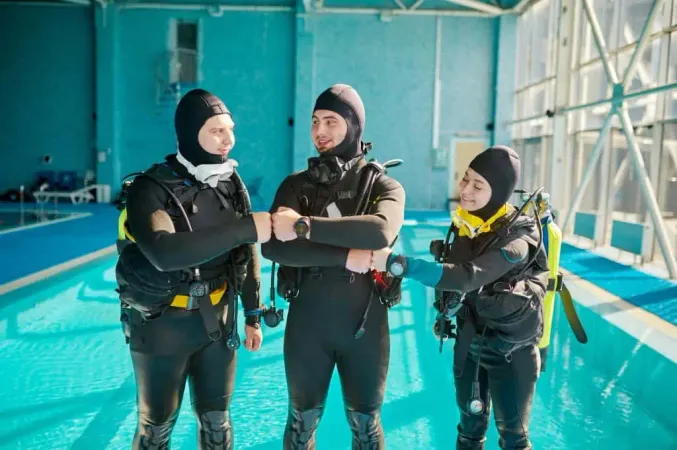
Certified Professional Association of Diving Instructors Diver: All You Need to Know
PADI Practice Test PDF (Free Printable 2026)
PADI OWD Course — Your Complete Open Water Diver Guide for 2026

PADI Scuba Course: Complete Guide to Open Water Certification, Training & What to Expect
About the Author

Educational Psychologist & Academic Test Preparation Expert
Columbia University Teachers CollegeDr. Lisa Patel holds a Doctorate in Education from Columbia University Teachers College and has spent 17 years researching standardized test design and academic assessment. She has developed preparation programs for SAT, ACT, GRE, LSAT, UCAT, and numerous professional licensing exams, helping students of all backgrounds achieve their target scores.
Join the Discussion
Connect with other students preparing for this exam. Share tips, ask questions, and get advice from people who have been there.
View discussion (8 replies)