
OSHA-Approved Equipment — Complete Guide (2026 September)
⏳ OSHA-approved equipment guide: ANSI standards for hard hats, hearing, respirators, ladders, fall protection. What's actually certified.

OSHA Equipment Standards At a Glance

OSHA-Approved Equipment: What the Term Actually Means
Here's the thing nobody tells you on the first day of safety orientation: OSHA does not approve products. Not hard hats. Not safety glasses. Not earbuds, ladders, harnesses, or air nozzles. Nothing. The agency writes performance standards — what gear must do — and then leaves it to manufacturers, third-party labs, and consensus standards bodies like ANSI and NIOSH to certify that specific products meet those rules.
So when someone hands you a hard hat and says it's OSHA approved hard hats, what they actually mean is the hat meets ANSI Z89.1 — the consensus standard OSHA references in 29 CFR 1910.135. The phrase "OSHA-approved" is industry shorthand. Useful shorthand. Just inaccurate.
Why does this matter? Two reasons. First, compliance audits. If an inspector asks how you verified a piece of PPE meets the rule, "the box said OSHA-approved" isn't an answer. You need the ANSI label, the NIOSH approval number, or the manufacturer's certificate. Second, knockoffs. There's a flood of imported gear marketed as "OSHA compliant" that has no actual third-party certification. Looks the part. Fails the drop test.
This guide walks through every major equipment category: hard hats, hearing protection (including the earbud question everyone asks), respirators, fall protection, ladders, eyewear, and the weird stuff — cowboy-style hats, bump caps, compressed air nozzles. For each one, you'll see the real standard, the brands that consistently meet it, and how to verify before you put it on a worker.
The Standards Map: What OSHA Actually Cites
OSHA's regulatory text rarely names a product. Instead, it incorporates by reference a list of voluntary consensus standards. These are the ones that matter for equipment:
Head protection: 29 CFR 1910.135 references ANSI Z89.1. Hats come in Type I (top impact) and Type II (top and lateral). Classes G (general), E (electrical, 20kV), and C (conductive, no electrical protection). Eye and face: 1910.133 references ANSI Z87.1. Look for the Z87+ mark for high-impact rating. Hearing: 1910.95 sets the action level at 85 dBA over an 8-hour time-weighted average. Once you hit that, you're in a hearing conservation program and protectors must be available. Respiratory: 1910.134 requires NIOSH-certified respirators. Period. No NIOSH approval number means it's not allowed.
For osha fall protection, the relevant subparts are 1910.140 (general industry) and Subpart M of 1926 (construction). Both reference ANSI Z359 for personal fall arrest. Ladders fall under 1910.23 with ANSI A14.2 as the underlying standard. Eyewash stations follow ANSI Z358.1. Foot protection — ASTM F2413, formerly ANSI Z41.
There Is No OSHA Approval Stamp
OSHA writes performance rules. ANSI, NIOSH, and ASTM publish the consensus standards. Manufacturers self-certify or pay third-party labs. When you see "OSHA-approved," what you want to verify is the ANSI label (hard hats, eyewear, ladders), NIOSH approval number (respirators), or ASTM rating (boots). No label, no compliance — even if the marketing says otherwise.
Equipment Categories & Their Real Standards
ANSI Z89.1-2014 (R2019). Type I or Type II. Class G, E, or C. Date of manufacture stamped inside. Replace every 5 years even if undamaged — the shell degrades from UV.
Compliance-Verified PPE Brands
- Strength: Hard hats, fall protection, gas detection
- Certifications: ANSI Z89.1, Z359, ATEX, NIOSH
- Used by: Heavy industry, oil & gas, mining
- Strength: Respirators, hearing protection, eyewear
- Certifications: NIOSH, ANSI Z87.1, ANSI S3.19
- Used by: Healthcare, construction, manufacturing
- Strength: Full PPE line, electronic hearing protection
- Certifications: ANSI, NIOSH, ASTM, IEC
- Used by: Industrial workforces, first responders
- Strength: OSHA-rated Bluetooth earbuds (NRR 22–27 dB)
- Certifications: ANSI S3.19, MIL-STD-810G
- Used by: Construction trades wanting music + protection
- Strength: Harnesses, lanyards, SRLs, vertical lifelines
- Certifications: ANSI Z359.11, Z359.12, Z359.13, Z359.14
- Used by: Tower climbers, steel erectors, wind energy techs
- Strength: Western-style ANSI hard hats for utilities & ranching
- Certifications: ANSI Z89.1 Type I/II, Class C/E/G
- Used by: Linemen, oilfield, rodeo industry workers
Pre-Purchase Verification Checklist
- ✓ANSI/NIOSH/ASTM mark visible on the product (not just the box)
- ✓Date of manufacture and standard year stamped on the gear
- ✓Third-party test lab name on documentation (UL, Intertek, SEI)
- ✓Product fits OSHA standard cited in the relevant CFR section
- ✓Manufacturer is registered (not a dropship Amazon brand)
- ✓Replacement schedule and inspection criteria documented
- ✓Spare quantity in stock — never run an audit short on PPE
- ✓Training records on file proving workers know how to use it
- ✓Fit test on respirators completed within last 12 months
- ✓Sizing range covers smallest and largest worker on the crew

Hard Hats: ANSI Z89.1 Is the Real Test
A hard hat is two things — a hard shell and a suspension. The shell takes the hit. The suspension absorbs and distributes the force so your skull doesn't. Z89.1 testing drops an 8-pound weight 5 feet onto the crown. Pass? Yes. Now do it cold (-18°C), hot (49°C), and after a UV bake. Most cheap imports fail the temperature cycles. That's where compliance separates from costume.
The 2014 revision (still current with a 2019 reaffirmation) added Type II for lateral impact — important on construction sites where falling tools come in at angles. osha hard hat rules don't mandate Type II for general industry, but if you do steel erection, scaffold work, or anything around overhead cranes, get Type II anyway.
Class Ratings
Class G: General. Tested to 2,200 volts. Class E: Electrical. Tested to 20,000 volts — this is what utility linemen wear. Class C: Conductive (vented for heat). Not for electrical work. Pick the wrong class and OSHA can cite you under 1910.137.
The 5-Year Replacement Myth (That's Actually Real)
Manufacturers stamp a date of manufacture inside the shell. Most spec sheets call for replacement at 5 years from manufacture or 2 years from first use, whichever comes first. UV exposure degrades polyethylene and ABS — even a hat that looks fine has lost impact rating after a couple of summer seasons on a roof.
Hearing Protection: Earbuds, Earmuffs, and the 85 dBA Question
Where it gets confusing is wireless audio. Workers want Bluetooth so they can take calls and listen to music. OSHA cares about exposure dose. Both can be true — but only if the earbuds carry an ANSI S3.19 NRR rating on the label. osha hearing protection rules don't ban music. They require that any protector worn meets a derated NRR sufficient for the noise environment.
What's on the market that actually works? ISOtunes PRO 2.0 (NRR 27 dB). 3M PELTOR WS ALERT XPI (NRR 25 dB, hearable communication). Honeywell Sync Wireless (NRR 25 dB). Walker's Razor Quad Bluetooth (electronic, NRR 23 dB). All carry the S3.19 label. Generic gym AirPods? Zero NRR. Wearing them on a jobsite over 85 dBA is a violation — and a hearing loss waiting to happen.
The Real Math
OSHA's safe formula derates the label NRR. Take NRR, subtract 7, divide by 2. NRR 27 becomes (27-7)/2 = 10 dB of real protection assumed. At a 95 dBA jobsite, that puts you at 85 dBA — right at the action level. Need more reduction? Double up: earplugs under muffs adds about 5 dB to the better device.
What About AirPods Pro Adaptive Audio?
No ANSI label. Not certified. Don't count for hearing conservation programs no matter how good the noise cancellation sounds. Apple has never submitted them to S3.19 testing because they're consumer electronics, not PPE.
Respirators: NIOSH Approval Is Non-Negotiable
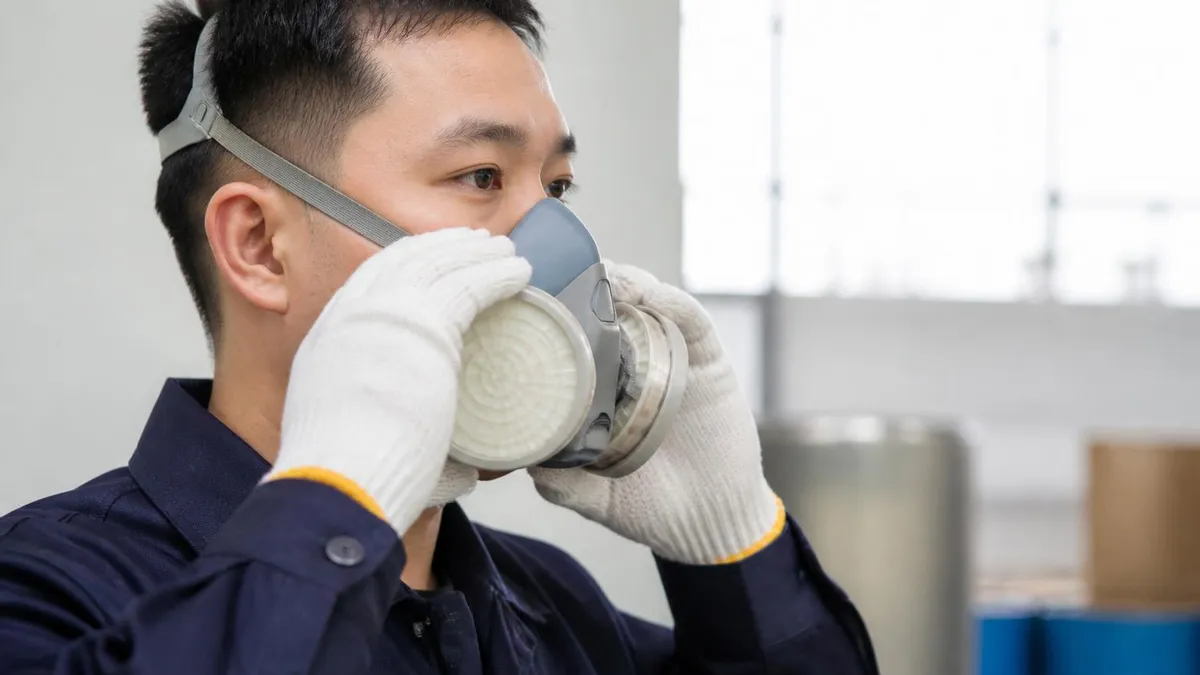
This is the one category where OSHA gets explicit. 1910.134(d)(1)(ii) says respirators "shall be certified by NIOSH." Not ANSI. Not a manufacturer's word. NIOSH itself. Every certified respirator carries a TC approval number — the format goes TC-XX-XXXX. N95 filtering facepieces are TC-84A. Half-face APRs are TC-23C with cartridges separately approved.
You can look up any approval number on the NIOSH Certified Equipment List. Type the TC number, see the brand, model, manufacturer, expiration. If it's not in the list — or the list is expired — it's not a respirator in OSHA's eyes. It's a dust mask, which is something else entirely.
What Got Pulled in 2026
NIOSH revoked dozens of approvals over the past year, mostly for counterfeit N95s flooding the market during pandemic-era surge buying. If your stockroom has boxes from before 2024, run the TC numbers against the current list before issuing them. An expired or revoked approval means non-compliant — even if it looks identical to a legitimate one.
Fall Protection: The 5,000-Pound Rule and Z359
Above 6 feet in construction (4 feet in general industry, 5 feet in shipyards), you need fall protection. The ANSI Z359 family covers the gear: harnesses, lanyards, self-retracting lifelines, anchor connectors. Every anchor point must hold 5,000 pounds per worker attached — or be engineered with a 2:1 safety factor on the maximum arresting force.
Harnesses must be full-body. Body belts haven't been compliant for personal fall arrest since 1998. The harness has to fit. A loose harness lets the worker invert in a fall and the dorsal D-ring slips toward the neck — that's where compression injuries happen. Check sizing per the manufacturer chart, not by eyeball.
Shock-Absorbing Lanyards vs. Self-Retracting
A standard 6-foot shock-absorbing lanyard requires 18.5 feet of clearance below the anchor. Six feet of lanyard, 3.5 feet of deceleration, 6 feet of worker, plus 3 feet of safety margin. Less clearance than that and you need a self-retracting lifeline (SRL) that limits free fall to 2 feet. SRLs are usually overhead-mounted and arrest within 24 inches.
Ladders: ANSI A14.2 Type Ratings
ANSI A14.2 covers portable metal ladders, A14.5 covers fiberglass. Five duty ratings: Type III (light/200 lb), Type II (medium/225 lb), Type I (heavy/250 lb), Type IA (extra heavy/300 lb), Type IAA (special/375 lb). The duty rating includes worker weight plus tools plus materials. Most construction sites should never go below Type IA.
osha ladder safety rules under 1910.23 require the rating label visible. Side rails extend 3 feet above the landing for stepoffs. The 4-to-1 angle rule for extension ladders: for every 4 feet of working height, the base sits 1 foot from the wall.
OSHA-Rated Earbuds: Pros and Cons
- +ANSI S3.19 NRR rating with documented test data
- +Bluetooth lets workers take calls without removing protection
- +Hearable communication models pass through speech, block impact noise
- +Single point of failure replaces two pieces (plugs + radio)
- +Active models (3M XPI, Walker's) amplify normal sound until threshold
- −Cost $100–$300 vs. $10 for disposable plugs
- −Battery life 8–14 hours — needs daily charging discipline
- −Lost or damaged units cost more to replace
- −Need replacement tips that maintain seal — generic tips void NRR
- −Some sites ban personal audio devices regardless of certification
Compressed Air Nozzles: The 30 PSI Rule
One of the most-cited and least-understood OSHA rules. 29 CFR 1910.242(b): compressed air used for cleaning must be reduced to below 30 psi at the nozzle outlet when dead-ended. Plus chip-guarding and PPE. The rule exists because high-pressure air can embolize through skin or eyes — fatal in seconds if it enters a blood vessel.
Compliant nozzles use side-relief ports or pressure-regulating tips. When the tip is blocked, internal pressure can't exceed 30 psi because air escapes laterally. Brands that ship code-compliant nozzles: Guardair, Coilhose Pneumatics, Exair, Silvent. Look for "OSHA 1910.242(b) compliant" plus "safety relief" or "30 psi dead-end." A plain blow gun off a hardware-store shelf usually fails the dead-end test.
What Doesn't Count
Reducing the line pressure to 30 psi at the regulator doesn't satisfy the rule. The test is at the nozzle outlet when blocked. A standard tip with 90 psi line pressure can still push 90 psi against skin. Cite the engineering control, not the line setting.
Cowboy-Style Hard Hats: Yes, They Can Be Legal
Western-style hard hats look like Stetsons but carry full ANSI Z89.1 shells underneath. Real options: Cosgrove Brim, Lift Safety DAX-HDF, Black Stallion Cowboy, MSA Skullgard Western, Bullard's wide-brim. All marked Z89.1 inside the shell. Brim included for sun and rain — popular with utility crews in the South and Southwest.
What's not legal: a fashion cowboy hat with no ANSI rating. Same rule for branded specialty hats — if there's no Z89.1 stamp inside, it's costume. Inspectors check for the mark, not the style. Western styling is fine; missing certification is a citation.
Bump Caps: Why They're Not Hard Hat Substitutes
Bump caps look like baseball caps with a plastic insert. They protect against minor knocks — walking into pipes, low ceilings, racking. They are not impact-rated to ANSI Z89.1. Cannot replace a hard hat where the rule requires one.
Where bump caps are fine: warehouse picking with low overhead, food processing, light maintenance. Where they fail OSHA: construction, demolition, anywhere 1910.135 requires head protection. The standard for bump caps is EN 812 — not Z89.1. So when someone asks "are bump caps OSHA approved?" — they're approved for bumps. Not impacts.
How to Verify Compliance Before a Citation
Five-minute process: pull the gear, find the standard stamp (Z89.1, Z87.1, S3.19), photograph the label. For respirators, check the TC approval number against the NIOSH Certified Equipment List. For ladders, the duty rating sticker on the side rail. For fall protection, the ANSI Z359 mark plus the inspection log.
Buy from authorized distributors. Grainger, Magid, Northern Safety, MSC Industrial certify their supply chain. Amazon marketplace sellers are where counterfeits enter. If the price seems 60% off retail, it almost certainly is — and so is the certification.
PPE Compliance Audit — What to Check
Step 1: Inventory
Step 2: Verify Labels
Step 3: Cross-Reference
Step 4: Inspect Condition
Step 5: Train
Step 6: Re-Audit
Typical PPE Budget per Worker
Cross-Industry Examples: What Compliance Looks Like
Construction site, residential framing crew. Hard hats: MSA V-Gard Type I Class E. Safety glasses: 3M Securefit Z87+. Hearing: ISOtunes XTRA NRR 27 dB Bluetooth for nail-gun work. Fall arrest above 6 feet: Miller Revolution harness with a Honeywell Twin Turbo SRL. Boots: Red Wing 2406 with ASTM F2413 EH rating. Every item has a sticker. Every sticker matches a CFR section. Everything verified before it goes on a body.
Now compare to the violation citation we see most often. Crew shows up. Hard hats — generic Amazon brand, no ANSI mark inside. Glasses — clear lens, no Z87 stamp. Earbuds — AirPods. Harnesses — cheap import, no Z359 mark. The job is the same. The compliance gap is huge. Inspector arrives, walks the site, writes 6 citations totaling $14,500 in proposed penalties.
The lesson runs through every category covered in this guide. Compliant gear costs more up front. Non-compliant gear costs more on the back end — citations, lost-time injuries, comp claims, OSHA repeat-violator status. The math always works out in favor of buying right the first time. Worth the line item every quarter.
For workers, the question to ask before clocking in: "What ANSI or NIOSH mark is on this gear?" If your supervisor can't answer, walk to safety. You have the right to refuse work without proper PPE under Section 11(c) of the OSH Act. Use it. Document it. And read up on safety equipment requirements before your next jobsite walk.
Where the Standards Are Headed
ANSI Z89.1 revision is in committee work for 2027 release. Expected changes: mandatory chinstrap testing for Type II, expanded lateral impact zones, harmonized icon labeling with European EN 397. Z359 family is consolidating — currently 15 sub-standards, likely to fold into 8 by 2028. NIOSH is finalizing the new elastomeric half-mask testing protocol, replacing the 1972-era CBRN baseline that's been the benchmark since the Nixon administration.
One bigger shift on the horizon: smart PPE. Connected hard hats with impact sensors, harnesses that log fall events, hearing protection that doses exposure in real time. The standards bodies haven't caught up yet — most smart gear ships with the underlying ANSI certification, plus a separate electronics rating. Expect dedicated test protocols for sensor-equipped PPE within three years. Until then, the sensor is a bonus and the underlying ANSI mark is what counts for compliance.
What stays the same: the principle. OSHA writes the rule. Consensus standards define the test. Manufacturers certify. Employers verify. Workers wear. Five steps, each one essential, and "OSHA-approved" is the shorthand that smushes them together. Now you know what it actually means and how to verify it on the floor.
OSHA Questions and Answers
Related OSHA Guides

OSHA Approved Hard Hats: Complete 2026 Guide to ANSI Z89.1 Compliance, Types, and Workplace Requirements

OSHA Fall Protection Requirements: Heights, Gear & Plans

OSHA Hearing Protection Fact Sheet: Complete 2026 Guide to Noise Exposure Limits, PPE Requirements, and Workplace Compliance

Ladder Safety Under OSHA: Standards, Cage Rules & Training

OSHA Approved Safety Glasses: Complete 2026 Guide to ANSI Z87.1 Eye Protection Standards, Selection, and Workplace Compliance

OSHA Hard Hat Requirements: 29 CFR 1910.135, ANSI Z89.1 Standards, Classes, and 2024-2026 Updates
About the Author

Certified Safety Professional & OSHA Compliance Expert
Indiana University of Pennsylvania Safety SciencesDr. William Foster holds a PhD in Safety Science from Indiana University of Pennsylvania and is a Certified Safety Professional (CSP) and Certified Hazardous Materials Manager. With 20 years of occupational health and safety management experience across construction, manufacturing, and chemical industries, he coaches safety professionals through OSHA certification, CSP, CHST, and safety management licensing programs.
Join the Discussion
Connect with other students preparing for this exam. Share tips, ask questions, and get advice from people who have been there.
View discussion (8 replies)