
OSHA Fall Protection Requirements: Heights, Gear & Plans 2026 October
OSHA fall protection rules: ⏳ 4/6/10 ft triggers, guardrails, PFAS, 5,000-lb anchors, 1926.502(k) plans, Cal/OSHA, flatbed and roof rules.

Falls remain the leading cause of death in construction and a top-five killer across general industry. That’s exactly why OSHA writes so many pages about them. If you supervise a crew, run a roofing job, dispatch flatbed drivers, or sit for a safety certification exam, you need to know the height triggers, the equipment, and the paperwork — not as trivia, but as the difference between a citation and a quiet workday.
This guide walks through what OSHA actually requires for fall protection. We’ll cover the four big height thresholds (general industry, construction, scaffold work, and longshoring), the gear that satisfies the rule, and how Cal/OSHA stretches a few of those numbers tighter. You’ll see how a written fall protection plan fits under 1926.502(k), what counts as a low-slope roof, and why flatbed trailers became a fight that took years to settle.
Think of OSHA’s fall rules as three overlapping circles. The first is the height: how high before the employer must act. The second is the method: guardrails, safety nets, or personal fall arrest. The third is the scenario: roof, scaffold, ladder, dock, vehicle. Get all three right and you’re compliant. Miss one and the inspector has a clean serious-violation write-up.
One more framing point before the numbers. OSHA’s fall standards changed substantially with the 2017 walking-working surfaces rule for general industry, and the agency keeps issuing letters of interpretation that clarify edge cases — solar installs, communications towers, mobile equipment. If you last took an OSHA 30 class a decade ago, some of what you learned about cages on fixed ladders or rooftop tie-off is now wrong. We’ll flag where the modern rule differs.
Those four numbers run the entire program. They are not interchangeable, and inspectors expect supervisors to know which one applies before the boots hit the deck. A roofer at 8 feet is in construction territory and triggers protection; a maintenance tech at 8 feet inside a factory is in general industry and was already past the threshold two rungs ago. Same height, different rulebook, sometimes different inspector.
Cal/OSHA — the California state plan — takes a stricter view in several places. Where federal OSHA gives construction a 6-foot buffer, California pulls residential roof work down to 7.5 feet from eaves and 15 feet from the ridge with very specific written exceptions. If your job site is in San Diego, you don’t get to quote 1926.501 to the inspector and walk away. State plans in Oregon, Washington, Michigan, and a handful of others run their own stricter variants too — check your local rule before estimating a multi-state job.
The other thing to remember: these triggers are minimums. Nothing in the standard stops an employer from requiring tie-off at 4 feet on a construction site. Some general contractors mandate 100% tie-off above ground level regardless of trade. That’s policy, not OSHA, but it’s perfectly legal and often a smart insurance move. Workers’ compensation carriers love these blanket policies because they translate directly into experience-modification rate reductions.
Heights also stack with hazards. Working over dangerous equipment — an open mixing tank, exposed rebar, energized conductors — the height threshold drops to zero. You need protection at any elevation above the hazard, even if it’s eighteen inches. That rule sits quietly inside the same 1910.28 section and is one of the most-cited general-industry violations every year.
Quick rule of thumb
If you are 4 feet up in a warehouse, factory, or any general-industry workplace, you need fall protection. 6 feet on a construction site. 10 feet on a scaffold. 8 feet at a longshoring operation. Above any dangerous equipment or open tank: protection at any height. Memorize those five facts and you’ve covered roughly 80% of fall-protection citations.
So the height question is settled. Now the harder one: what does “protection” actually mean? OSHA gives the employer a menu, not a single prescription. The three primary options are guardrail systems, safety net systems, and personal fall arrest systems (PFAS). Each has its own dimensional rules and inspection schedule, and each fits some jobs better than others.
Guardrails win on permanent edges — mezzanines, roof perimeters during long projects, improved platforms. They’re passive, meaning the worker doesn’t have to do anything to stay safe. Once installed, the system protects everyone who walks the area, including subs and visitors who never received specific training. Safety nets earn their keep on bridges, large-roof installations, and steel erection where tie-off points don’t exist yet. PFAS is the workhorse: use, lanyard or self-retracting lifeline, and an anchor rated for the load. Most contractors lean on PFAS because it travels with the worker and adapts to changing job-site geometry.
There are also “alternative” methods OSHA accepts in specific scenarios: warning lines, designated work zones, controlled access zones, and safety monitoring systems. These show up most often on low-slope roofs and during leading-edge construction. They are not stand-alone solutions for every job — they live inside narrow regulatory windows, and each comes with its own training and signage requirements.
Then there’s the question of positioning versus arrest. A positioning system holds a worker in place — think of a window-washer’s belt that lets them lean back against a façade. A fall arrest system catches them after the fall has begun. The two often look similar but operate under different rules: positioning gear must limit a free fall to 2 feet, while arrest gear may allow up to 6 feet of free fall before catching. Mixing them up gets people hurt.

The three primary fall protection systems
Top rail 42 inches (plus or minus 3 in) above the walking surface. Mid-rail at 21 inches. Top rail must withstand a 200-lb force in any outward or downward direction. Mid-rail handles 150 lb. Toeboards at 3.5 in minimum if there is a fall hazard below. Best fit for permanent edges and long-duration jobs.
Installed as close as practicable, never more than 30 feet below the work surface. Tested by dropping a 400-lb sandbag (max 30 in diameter) from the highest point. Inspected weekly and after any impact. Must extend 8 to 13 feet outward depending on drop distance. Common in bridge and steel-erection work.
Full-body use, lanyard or SRL, anchor point rated for 5,000 lb per worker (or 2x max arrest force in an engineered system). Must limit free fall to 6 feet, arrest force to 1,800 lb, and prevent contact with any lower level. Inspect before every use. The workhorse choice for mobile crews.
Each system has its own failure mode. Guardrails get removed for material handling and never go back. Nets sag, fray at the splice points, or get cut by torch sparks. Uses sit in a truck bed for two years collecting UV damage until the webbing tests out at half its rated strength.
OSHA expects a competent person — a defined regulatory term — to inspect this gear and document it. “Competent” means capable of identifying hazards and authorized to fix them. A foreman who can spot a frayed lanyard but can’t order the crew to stop work doesn’t meet the definition.
The 5,000-lb anchor number trips up a lot of people. It applies to non-engineered anchorages: a strap around a steel beam, a roof anchor screwed into a truss, a column anchor bolted to embedded plates. If a qualified person (engineer) designs and certifies the anchorage, the requirement drops to two times the maximum arrest force the system will generate — usually around 3,600 lb in practice. Big difference if you’re building a permanent rooftop tie-off grid, where each saved pound of structural capacity translates into cheaper anchor plates and less reinforcement of the deck.
Some scenarios deserve their own breakdown because the rules shift. Roofs, vehicles, and ladders all carry quirks that catch experienced supervisors off guard. The next section unpacks them. Pay close attention to the low-slope zones — the 6/15-foot distance rules are the single most-confused detail in the entire fall-protection standard.
Fall protection by scenario
A roof with a slope of 4-in-12 or less is a low-slope roof. For work performed 15 feet or more from the edge, OSHA allows a designated work zone with no fall protection if access is limited and a written plan exists. Between 6 and 15 feet from the edge, you need a warning line (rope, chain, or wire) supplemented by safety monitoring. Within 6 feet of the edge: conventional fall protection — guardrails, nets, or PFAS.
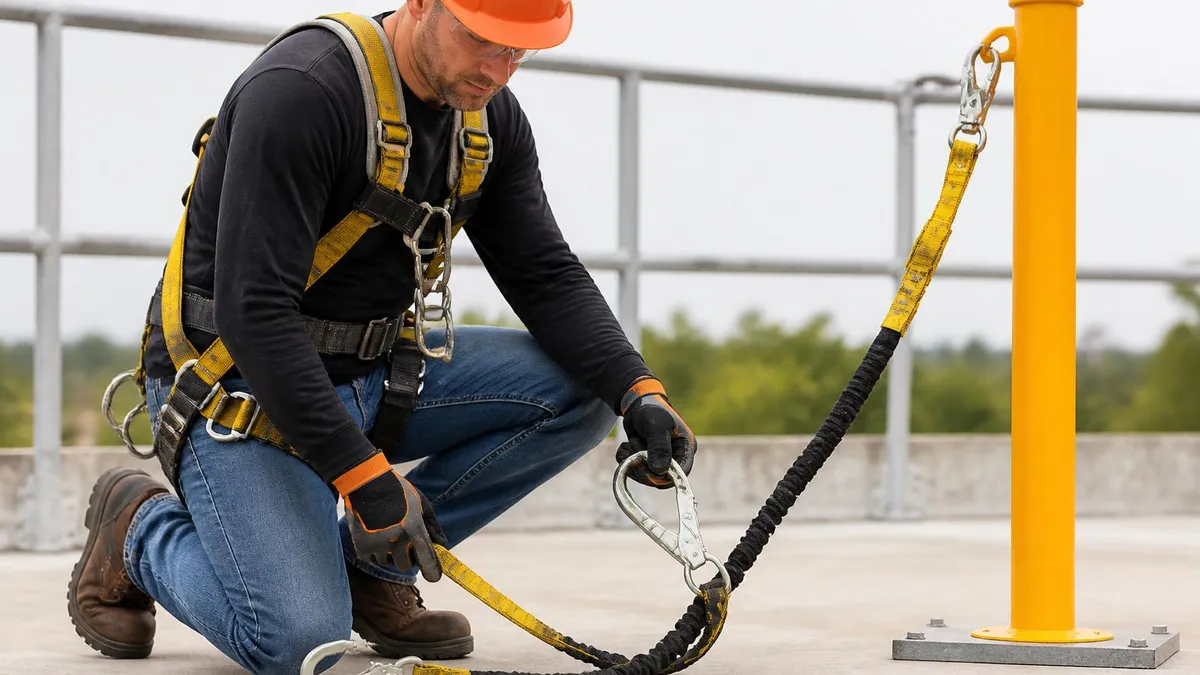
Notice how the rules narrow as the scenario gets more specific. The general 6-foot construction trigger is the floor; specialty subparts — scaffolds, steel erection, ladders, electric power transmission — layer their own thresholds on top. When two rules touch, the more protective one wins. That’s the “more stringent applies” principle, and it appears on almost every fall-protection exam. It also appears in real citations, where inspectors quote the tougher rule and the contractor argues the softer one in court — and usually loses.
Cal/OSHA adds its own scenario rules. Residential construction in California has a tighter trigger for roof work, and the state has issued letters of interpretation requiring tie-off during solar panel installation on slopes above 4-in-12. If you work in multiple states, build a job hazard analysis that defaults to the most protective rule across all jurisdictions. It’s slightly more expensive on a per-job basis, but it eliminates the constant rule-matching dance and protects you when crews cross state lines mid-project.
Equipment alone doesn’t finish the job. OSHA also requires a written approach in specific cases. The fall protection plan at 1926.502(k) is the most common one supervisors stumble on, because it’s an exception — not a default — and it has narrow eligibility. Get the eligibility wrong and the plan itself becomes evidence of a violation, not a defense.
Under 29 CFR 1926.502(k), a written fall protection plan is required when an employer can demonstrate that conventional fall protection (guardrails, nets, PFAS) is infeasible or creates a greater hazard. This option is limited to leading-edge work, precast concrete erection, and residential construction. The plan must be prepared by a qualified person, updated for each site, name a designated competent person, document the infeasibility, list alternative measures, and include a procedure for investigating any near-miss or fall.
The 502(k) plan is not a generic safety document. Inspectors look for site-specific detail: the exact infeasibility argument, the alternative measures (controlled access zones, safety monitors), the names and qualifications of the monitors, and signed acknowledgment from each worker. A plan downloaded from the internet and stamped with the project address fails on its face. Compliance officers have seen the templates — they know what a real site-specific plan looks like.
The plan also requires the employer to address each location where conventional protection is infeasible. A blanket statement covering “the entire roof” doesn’t cut it. If the eastern slope can be guarded with anchors and the western slope can’t, the plan needs to say so — and explain why the western slope is different. Photographs, sketches, and dated jobsite assessments make the plan defensible.
Training closes the loop. Workers must be trained by a competent person on the nature of the hazards, correct procedures for installing and inspecting the protection system, the proper use of PFAS components, and the limitations of the equipment. Retraining is required after policy changes, after observed deficiencies, or any time a worker shows they don’t understand the program. Document every session: date, attendees, topics, trainer credentials, sign-in sheet. Without those records, OSHA treats the training as not having happened.
Site fall protection audit checklist
- ✓Walking-working surfaces inspected before each shift; holes, weak spots, and unprotected edges flagged.
- ✓Height triggers identified for every active task (4/6/10 ft) and matched to a protection method.
- ✓Guardrails verified: 42-in top rail, 21-in mid-rail, 200-lb top-rail load, toeboards where needed.
- ✓PFAS gear inspected by user pre-shift; use webbing, D-rings, lanyard, SRL, and connectors all serviceable.
- ✓Anchor points rated for 5,000 lb (or engineered to 2x max arrest force) and documented.
- ✓Safety nets installed within 30 ft of work surface, drop-tested, weekly inspections logged.
- ✓Written 502(k) plan in place where conventional protection is infeasible — site-specific, signed, current.
- ✓Workers trained, retrained as needed, and training records on file.
- ✓Rescue plan in writing; rescue equipment staged and tested; suspension trauma addressed.
- ✓Incident investigation procedure ready to deploy after any near-miss or fall.
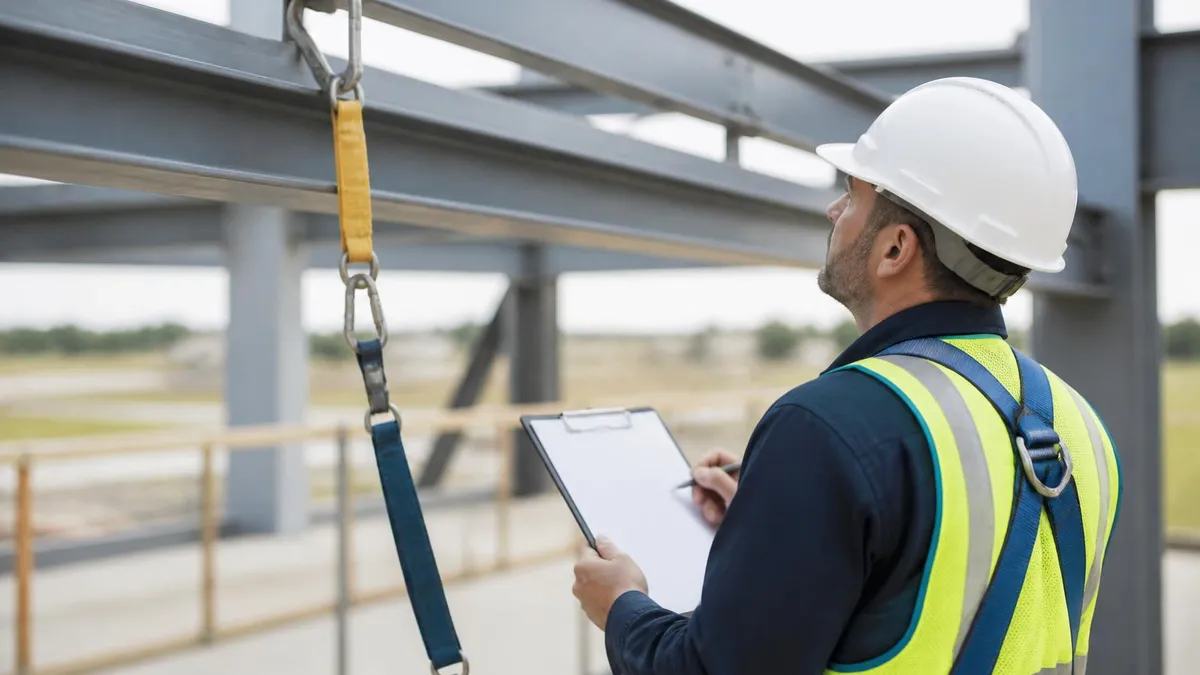
The audit checklist looks long, but most items become reflex once a competent person walks the job a couple of times a week. The two that get neglected most often are rescue planning and anchor documentation. Calling 911 is not a rescue plan. Suspension trauma can become fatal within 30 minutes, so the rescue team needs to reach a suspended worker fast — usually under 6 to 10 minutes — and you need a written procedure plus practiced drills. Rescue kits, descenders, and ladder-rescue platforms should be staged in clearly marked locations and inventoried weekly.
Anchor documentation matters because inspectors will ask. “Where is this anchor rated?” “Who certified it?” “When was it last inspected?” If a contractor installed a permanent roof anchor system, the engineering certification and inspection log should live in the building’s safety binder, not on someone’s laptop two states away. Permanent anchors also require recertification on a schedule the manufacturer sets — commonly every 12 months — and that recertification has to come from a qualified person, not the on-site supervisor.
Every system has tradeoffs. Picking the right one means weighing cost, mobility, worker comfort, and rescue access. The comparison below sketches the practical pros and cons supervisors weigh in the field. Neither column is “better” in the abstract — the right answer depends on the job, the crew, and the duration of the work.
Choosing your primary fall protection system
- + —
- + —
- + —
- + —
- + —
- − —
- − —
- − —
- − —
- − —
In real workplaces, the answer is usually “both.” A warehouse mezzanine gets permanent guardrails. The maintenance tech who climbs onto rooftop HVAC units gets a use, a self-retracting lifeline, and three certified anchors. The roofing crew gets warning lines on the low-slope sections and PFAS within six feet of the edge. Layered protection beats a single system every time, because no single layer is perfect — guardrails get removed, uses get forgotten, monitors get distracted.
Recordkeeping is the part most employers underrate. Inspectors don’t need to see your filing cabinet — they need to see that you can produce evidence on demand: anchor certifications, gear inspection logs, training rosters, drill notes, the 502(k) plan, the incident-investigation procedure. If it isn’t written, in the eyes of an osha compliance first aid kit officer, it didn’t happen. A clean recordkeeping system shaves hours off any inspection and often turns potential citations into informal advisories.
Penalties are another reason to take this seriously. As of the latest CPI-adjusted schedule, a serious fall-protection violation runs roughly $16,000 per instance. Willful or repeat violations climb to $165,000. Multi-employer worksite doctrine means a general contractor can catch citations for a subcontractor’s fall-protection failures — the controlling employer is on the hook even if their own people were nowhere near the hazard.
Before we wrap up with the FAQ, take a minute to test your retention. The practice quiz pulls directly from the height triggers, equipment specs, and 502(k) details we just covered.
One last reminder before you head out to the job: the standards we’ve walked through are minimums. Your job is to build a program that survives a real fall, not just an inspection. The companies with the cleanest safety records aren’t the ones that pass audits — they’re the ones that don’t need to. They build culture, not paperwork. A worker who calls out a missing guardrail without fear of being called a complainer is worth more than any binder.
Keep three numbers in your head: 4, 6, 10. General industry trips at 4 feet. Construction at 6. Scaffolds at 10. Layer the equipment, write the plan, train the crew, and document everything. That’s the program. Everything else — engineered anchors, monitoring systems, alternative methods — is detail that hangs off those three numbers.
The FAQ below collects the questions that come up most often during OSHA 10/30 classes and certification prep. If you’re studying for the OSHA Safety Certificate exam or refreshing a crew on the basics, treat these as the high-yield review. The same questions show up — in slightly rephrased form — on most state-administered safety certification exams.
Sample OSHA Safety Certificate Practice Questions
Try these questions from our free OSHA Safety Certificate practice tests. The correct answer and an explanation follow each question.
What is the minimum breaking strength required for a safety net used as fall protection under OSHA standards?
- A. 2,500 pounds
- B. 5,000 pounds
- C. 7,500 pounds
- D. 10,000 pounds
Answer: B. 5,000 pounds
OSHA requires safety nets used for fall protection to have a minimum breaking strength of 5,000 pounds to ensure they can withstand the forces of a fall arrest.
An employee is working over dangerous equipment, such as a vat of chemicals, with an unguarded edge. At what fall distance is the employer required to provide fall protection?
- A. Only if the fall distance is 4 feet or more.
- B. Only if the fall distance is 6 feet or more.
- C. At any height, regardless of the fall distance.
- D. Only if the employee is working for more than 15 minutes.
Answer: C. At any height, regardless of the fall distance.
OSHA requires that fall protection be provided when working over dangerous equipment and machinery, regardless of the fall distance. The potential for severe injury from the hazard below necessitates protection even from falls of less than 4 feet.
Which standard covers fall protection requirements for general industry walking-working surfaces?
- A. 29 CFR 1926.502
- B. 29 CFR 1910.28 and 1910.29
- C. 29 CFR 1910.146
- D. 29 CFR 1926.451
Answer: B. 29 CFR 1910.28 and 1910.29
29 CFR 1910.28 (duty to have fall protection) and 1910.29 (fall protection systems criteria) are the OSHA standards governing fall protection for general industry walking-working surfaces.
At what height in general industry does OSHA require fall protection?
- A. 2 feet
- B. 4 feet
- C. 10 feet
- D. 20 feet
Answer: B. 4 feet
In general industry, fall protection is generally required at 4 feet.
OSHA Questions and Answers
About the Author

Certified Safety Professional & OSHA Compliance Expert
Indiana University of Pennsylvania Safety SciencesDr. William Foster holds a PhD in Safety Science from Indiana University of Pennsylvania and is a Certified Safety Professional (CSP) and Certified Hazardous Materials Manager. With 20 years of occupational health and safety management experience across construction, manufacturing, and chemical industries, he coaches safety professionals through OSHA certification, CSP, CHST, and safety management licensing programs.
Join the Discussion
Connect with other students preparing for this exam. Share tips, ask questions, and get advice from people who have been there.
View discussion (8 replies)