
How Many Questions Are on the NYLE? Complete New York Law Exam Guide 2026
How many questions are on the NYLE? 50 open-book questions across 12 topics. Dates, registration, results & free practice tests. 🎯

You need a minimum score of 30 out of 50 questions correct, which is 60%, to pass. The passing score is a raw score and is not scaled. For nyle practice questions and timed practice, build your preparation around that target. Practice with the free NYLE - New York Law practice test on PracticeTestGeeks (500+ questions with answer explanations).
The NYLE is administered as an open-book exam, taken online on your own computer through Examsoft. You may use the official NYLC/NYLE course materials, but electronically searching a searchable copy of them during the exam is prohibited. The exam is timed at two hours, and test-takers who rely too heavily on their reference materials often run out of time before completing all 50 questions. Experienced candidates report that the key is to know the law well enough to locate answers quickly rather than reading source materials from scratch during the exam itself.
The New York Law Exam was introduced by the New York State Board of Law Examiners as part of the revised bar admission requirements that took effect in 2016. The Board's rules were amended effective September 1, 2026, and this guide reflects them.
The Board's twelve subjects are Administrative Law, Business Relationships, Civil Practice and Procedure, Conflict of Laws, Contracts, Criminal Law and Procedure, Evidence, Matrimonial and Family Law, Professional Responsibility, Real Property, Torts and Tort Damages, and Trusts, Wills and Estates. The Board does not publish a per-subject question count, so a well-balanced study plan that covers all twelve topics is essential to success.
Registering for the exam is managed through your account with the New York State Board of Law Examiners, after you complete the free New York Law Course (NYLC), about 17 hours of recorded lectures. The NYLE fee is $29, payable to Examsoft. The NYLC is free.
The exam is delivered online. You take it on your own computer through Examsoft, with no test center. The two-hour clock begins when you start the exam, and you may use the course materials during it.
Pacing yourself at about two to two and a half minutes per question will ensure you complete the full exam and have time to review flagged items before time expires.
Free NYLE - New York Law Exam Study Tools
Interactive NYLE - New York Law Exam resources on PracticeTestGeeks, free to start:
- Free NYLE Civil Procedure Questions and Answers 1 — 11 questions with instant scoring and answer explanations
- NYLE - New York Law Exam flashcards — review key terms and concepts card by card
- NYLE - New York Law Exam study guide — topic-by-topic overview of what the exam covers
- NYLE - New York Law Exam cheat sheet — one-page printable summary for last-minute review
NYLE: upcoming dates and official changes
- Nov 17, 2026: Registration for the December 17, 2026 New York Law Exam closes Tuesday, November 17, 2026 at 11:59 PM ET. (New York State Board of Law Examiners)
- Dec 17, 2026: The New York Law Exam (NYLE) is next scheduled for Thursday, December 17, 2026 at 12:00 PM ET, with later administrations on April 15, 2027, September 23, 2027 and December 16, 2027. (New York State Board of Law Examiners)
Facts verified Oct 26, 2026 against New York State Board of Law Examiners. Dates that have passed are removed automatically.
- The New York Law Exam consists of 50 open-book multiple-choice items administered online. (New York State Board of Law Examiners)
- Applicants have two hours to complete the New York Law Exam unless granted extended time for a disability. (New York State Board of Law Examiners)
- The passing score on the New York Law Exam is 60%, or 30 of 50 items correct. (New York State Board of Law Examiners)
- The New York Law Exam (NYLE) costs $29, payable to Examsoft, and the New York Law Course (NYLC) is free. (New York State Board of Law Examiners)
- An applicant who fails the New York Law Exam must retake both the New York Law Course and the exam. (New York State Board of Law Examiners)
- A passing New York Law Exam score expires three years from the date the applicant received it. (New York State Board of Law Examiners)
- Delivery: Online, via Examsoft software. (New York State Board of Law Examiners)
- Eligibility: Complete the NYLC first; take up to 1 year before or 3 years after the UBE. (New York State Board of Law Examiners)
- New York Law Exam results are generally available within two weeks of the exam date and are posted to the applicant's BOLE account. (New York State Board of Law Examiners)
Facts verified Oct 26, 2026 against New York State Board of Law Examiners. Dates that have passed are removed automatically.
NYLE Exam at a Glance
| Item | Detail | Official source |
|---|---|---|
| Number of questions | 50 multiple-choice items, open book | New York State Board of Law Examiners |
| Time limit | 2 hours | New York State Board of Law Examiners |
| Passing score | 60% (30 of 50 correct) | New York State Board of Law Examiners |
| Exam fee | $29, paid to Examsoft (NYLC course is free) | New York State Board of Law Examiners |
| Retake policy | Failing requires retaking both the NYLC and NYLE | New York State Board of Law Examiners |
| Validity | Passing score valid 3 years | New York State Board of Law Examiners |
| Delivery | Online, via Examsoft software | New York State Board of Law Examiners |
| Eligibility | Complete the NYLC first; take up to 1 year before or 3 years after the UBE | New York State Board of Law Examiners |
| Score release | Generally within 2 weeks, posted to BOLE account | New York State Board of Law Examiners |
| Next exam date | December 17, 2026, 12:00 PM ET | New York State Board of Law Examiners |
| Registration deadline | November 17, 2026, 11:59 PM ET (for the Dec 17, 2026 NYLE) | New York State Board of Law Examiners |
| Registration opens | Opens right after the previous NYLE's registration closes (NYLC must be completed first) | New York State Board of Law Examiners |
| Testing window | Offered 3 times per year | New York State Board of Law Examiners |
Facts verified Oct 26, 2026 against New York State Board of Law Examiners. Dates that have passed are removed automatically.
New York Law Exam by the Numbers

NYLE Exam Format: Full Question Breakdown by Subject
| Section | Questions | Time | Notes |
|---|---|---|---|
| Administrative Law | — | — | State agency rulemaking, adjudication and judicial review (Article 78) |
| Business Relationships | — | — | Business Corporation Law, LLC Law, Partnership Law and agency |
| Civil Practice and Procedure | — | — | CPLR: jurisdiction, pleadings, motions, disclosure, appeals |
| Conflict of Laws | — | — | Choice of law, jurisdiction and recognition of judgments |
| Contracts | — | — | NY contract formation, performance, remedies and defenses, including sales of goods under the UCC |
| Criminal Law and Procedure | — | — | Penal Law offenses and Criminal Procedure Law |
| Evidence | — | — | NY evidence rules (Guide to New York Evidence) |
| Matrimonial and Family Law | — | — | Domestic Relations Law, Family Court Act, custody and support |
| Professional Responsibility | — | — | NY Rules of Professional Conduct (22 NYCRR Part 1200) |
| Real Property | — | — | Real Property Law, RPAPL, conveyancing and landlord-tenant |
| Torts and Tort Damages | — | — | NY negligence, intentional torts, liability and damages |
| Trusts, Wills and Estates | — | — | EPTL and SCPA: intestacy, wills, trusts and probate |
| Total | 50 | 2 hours |
Each of the twelve subject areas on the NYLE tests New York-specific rules that frequently diverge from the common-law or multistate rules you learned in your first-year and upper-level law school courses. Understanding exactly what each subject covers, and where New York departs from the majority rule, is the foundation of effective preparation. Let us walk through what each subject tests so that you know where to focus your study energy.
Administrative Law covers the structure and procedure of New York's state agencies, including the State Administrative Procedure Act (SAPA), Article 78 review, the Freedom of Information Law (FOIL), and the Open Meetings Law. Questions frequently test the procedural requirements agencies must follow when promulgating rules, the standards of judicial review that apply to agency determinations, and the rights of individuals to access government records. Many candidates underestimate this topic because it is rarely covered in depth during law school.
Business Relationships encompasses New York's laws governing partnerships, limited liability companies, and corporations. The Business Corporation Law, the Limited Liability Company Law and the Partnership Law are the primary sources tested. Expect questions on fiduciary duties of managers and directors, the mechanics of formation and dissolution, rights of minority shareholders, and derivative action procedures.
Civil Practice and Procedure is arguably the most heavily studied topic among NYLE candidates, and for good reason. New York's Civil Practice Law and Rules (CPLR) differs substantially from the Federal Rules of Civil Procedure in areas like service of process, statutes of limitations, venue rules, and the mechanics of pre-trial disclosure. A question might ask which statute of limitations applies to a particular cause of action, or whether a particular method of service is sufficient under the CPLR. Knowing the CPLR inside and out gives you a significant edge.
Conflict of Laws covers choice of law, jurisdiction and the recognition of judgments, applied through New York decisions and statutes.
Contracts covers New York contract formation, performance, remedies and defenses, including the Statute of Frauds (General Obligations Law) and the sale of goods under UCC Article 2 as adopted in New York. Sales of goods are tested within Contracts, not as a separate subject.
Criminal Law and Procedure covers the Penal Law and the Criminal Procedure Law, from arrest and arraignment through grand jury, trial and sentencing.
Evidence is tested under New York evidence law (the Guide to New York Evidence and the CPLR), which differs from the Federal Rules of Evidence on privileges, hearsay exceptions and the Dead Man's Statute.
Matrimonial and Family Law covers the Domestic Relations Law and the Family Court Act, including grounds for divorce, equitable distribution, custody and support.
Professional Responsibility is governed by the New York Rules of Professional Conduct, which differ in important respects from the ABA Model Rules. New York has its own rules on confidentiality exceptions, conflicts of interest waivers, and advertising restrictions. Candidates who studied only the Model Rules for the MPRE need to pay careful attention to the New York-specific variations. Questions often present factual scenarios requiring you to identify whether an attorney's conduct is permissible, required, or prohibited under the specific New York rules.
Real Property law in New York includes the recording acts, the statute of frauds as applied to real property transactions, landlord-tenant law under both the Rent Stabilization Law and the common law, and the specific requirements for valid conveyances. New York is a race-notice jurisdiction for recording purposes, and the interplay between recording and good-faith purchaser status is a classic exam topic. The 2019 Housing Stability and Tenant Protection Act introduced significant changes to landlord-tenant law, so make sure your study materials are current.
Torts and Tort Damages covers negligence, intentional torts, strict liability, comparative fault and the measure of damages under New York law.
Trusts, Wills and Estates is tested under New York's Estates, Powers and Trusts Law (EPTL) and the Surrogate's Court Procedure Act (SCPA). Questions cover the formal requirements for executing a valid will, the rules of intestate succession, the rights of a surviving spouse to elect against a will, and the duties and powers of fiduciaries. Be sure you also understand the rules governing revocation of wills and the effect of divorce on testamentary dispositions. Check nyle results information and the Board's course materials to calibrate your study priorities accordingly.
Many readers pair this guide with the nyle practice tests to check their readiness before exam day.
New York Law Exam Dates, Registration & Results Timeline
The NYLE is offered at least three times per year, at 12:00 PM ET, and is taken online through Examsoft. The upcoming dates are December 17, 2026 (register by November 17, 2026), April 15, 2027 (by March 1, 2027), September 23, 2027 (by August 9, 2027) and December 16, 2027 (by November 1, 2027). From 2027, you must register at least 45 days before the exam.
The New York State Board of Law Examiners announces the specific nyle test dates on its official website. Because the exam is online, there is no testing center or appointment to book. You register through your BOLE account and take the exam on your own computer.
Check the Board's current rules and instructions for any policy on changing your date, and register early, since deadlines are firm.

Advantages and Challenges of the NYLE Format
- +Open-book format allows you to use the course materials during the exam
- +Online delivery on your own computer means no travel to a test center
- +Offered at least three times per year, giving candidates flexibility to choose their exam date
- +The fee is low: $29, and the NYLC is free
- +Pass/fail results arrive in about three weeks
- +A passing score is valid for 3 years
- −The two-hour time limit is tight if you rely too heavily on reference materials during the exam
- −Twelve subjects means you cannot safely deprioritize any single topic
- −The $29 fee and the 17-hour NYLC must both be redone for every retake
- −Electronically searching a searchable copy of the course materials is prohibited during the exam
NYLE Preparation Checklist: 10 Steps to Exam Day
- ✓Complete every segment of the free New York Law Course (about 17 hours) before you try to register.
- ✓Register through your BOLE account before the deadline (November 17, 2026 for December 17, 2026; at least 45 days before the exam from 2027) and pay the $29 fee to Examsoft.
- ✓Download the official NYLC/NYLE course materials and outline that cover all twelve subject areas with New York-specific rules.
- ✓Take at least one full timed practice exam of 50 questions in 2 hours.
- ✓Review your weakest subjects using targeted practice questions.
- ✓Organize your reference materials by subject area so you can locate information by section quickly (electronic searching of a searchable copy is prohibited).
- ✓Test your computer, webcam, microphone and internet connection with Examsoft at least a week before the exam.
- ✓Practice answering questions in about two minutes each to build the pacing habit you will need on exam day.
- ✓Log in to Examsoft early for the 12:00 PM ET start and clear two uninterrupted hours.
- ✓Review the Board of Law Examiners' official NYLE information page the week before your exam to confirm dates and materials policies.
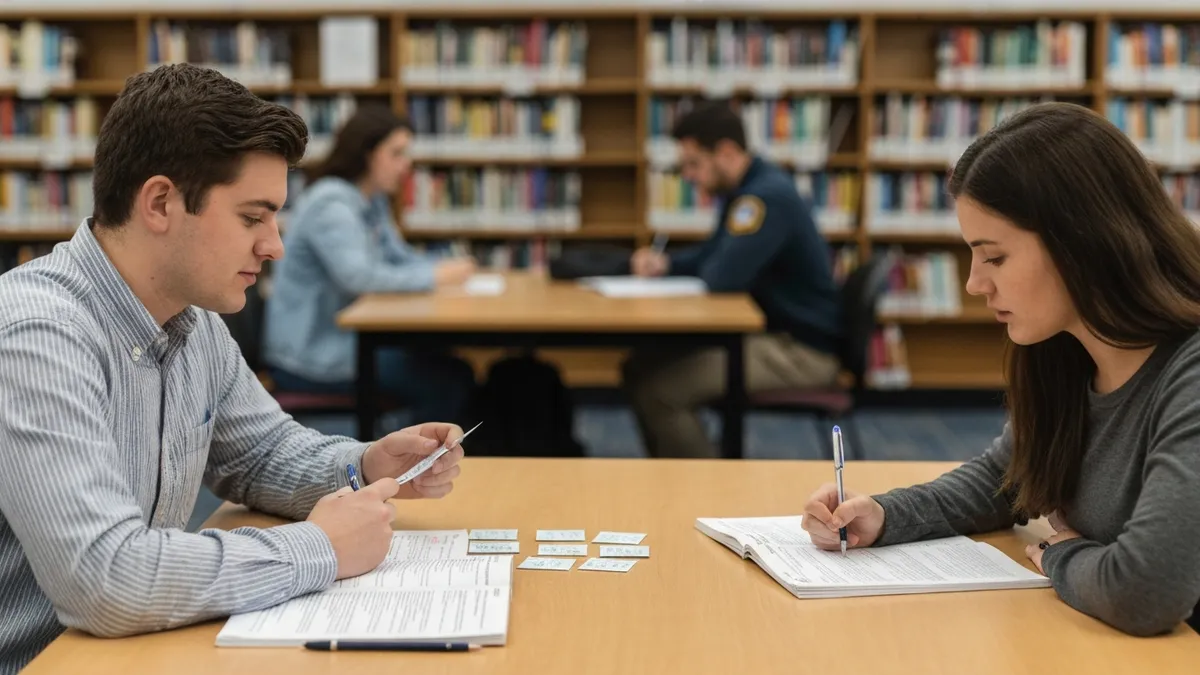
You Have About 2.4 Minutes Per Question: Plan Accordingly
With 50 questions and two hours on the clock, you average just 2 minutes and 24 seconds per question. Candidates who spend five or more minutes looking through their materials for a single answer often fail to complete the exam.
The NYLE is scored on a raw basis: all 50 questions count, and the passing score is 30 correct out of 50, or 60 percent. It is not a scaled score, and each question is worth one point. The required number of correct answers is the same for every exam administration.
Results are posted as pass or fail in your BOLE account. Analyzing your own practice-test results by subject before registering for a retake is the single most important thing you can do.
It is worth understanding what happens if you do not pass the NYLE and how it affects your overall bar admission timeline. The NYLE is one of several components of New York bar admission: you also need to pass the UBE (266 in New York), the MPRE (85), complete 50 hours of pro bono service and satisfy the skills competency requirement. You complete the free New York Law Course (NYLC) before the NYLE. The NYLC and NYLE can be completed up to one year before you first sit for the UBE or at any time after.
If you fail the NYLE, you can retake it at any later administration, but you must repeat the NYLC before each retake. Your UBE score remains valid regardless of your NYLE status.
For candidates transferring a UBE score from another jurisdiction to gain admission in New York, the NYLC and NYLE are still required. New York accepts UBE scores from other states through a score transfer process (minimum 266), but all transfer applicants must independently complete the NYLC and pass the NYLE to be admitted to the New York bar. This is a common point of confusion among lateral candidates who assume that a high UBE score from another jurisdiction exempts them from the NYLE.
Taking the NYLC and NYLE early can be advantageous because passing early removes one bar admission item from your to-do list. Note, however, that a passing NYLE score is valid for 3 years from the date you receive it. If it expires before you are certified for admission, you must retake the NYLC and the NYLE.
The cost of bar admission in New York can be substantial, and the NYLE represents one of the more affordable components. The $29 fee (paid to Examsoft) is modest compared to the UBE registration fee and commercial bar prep course costs, and the NYLC is free. Passing on the first attempt is always the most efficient outcome, which is why investing adequate time in structured preparation, including timed practice exams and subject-specific review, pays dividends well beyond the exam itself.
The deadline for the December 17, 2026 exam is November 17, 2026. From 2027, you must register at least 45 days before the exam (March 1, August 9 and November 1, 2027). Register with the Board of Law Examiners through your BOLE account as soon as you finish the NYLC. Waiting until the last week risks missing the deadline or being caught by a technical problem, which can delay your admission by months.
Developing an effective open-book strategy is arguably more important for NYLE success than raw memorization. Unlike a closed-book exam where you either know the answer or you do not, the NYLE's open-book format introduces a strategic dimension: how do you use your reference materials efficiently enough to gain the benefit of having them without sacrificing the time you need to complete all 50 questions? The candidates who master this balance consistently outperform those who treat the open-book policy as a substitute for genuine preparation.
The first pillar of open-book strategy is material organization. Before exam day, organize your course materials into clearly labeled sections for each of the twelve NYLE subjects. Use a detailed table of contents so that you can turn to the relevant section in under a minute. Because the exam is on your own computer, practice navigating to key statutes and rules by section quickly; electronically searching a searchable copy of the materials during the exam is prohibited. The goal is to know exactly where to look so that verifying an answer takes seconds, not minutes.
The second pillar is knowing when to use your materials and when to trust your preparation. For questions where you are confident in the answer, do not consult your materials at all — move on immediately and save that time for harder questions.
Reserve your reference materials for questions where you are genuinely uncertain between two or more answer choices, or where a specific statutory number, threshold, or procedural rule is at issue. Developing the judgment to distinguish between the two types of questions through practice is one of the most valuable skills you can build during your NYLE preparation period.
The third pillar is pacing. Complete at least three full 50-question practice exams under timed, open-book conditions before your actual exam date. Simulate the real conditions as closely as possible: use the same reference materials you plan to use, set a strict two-hour timer, and do not allow yourself any breaks beyond what the actual exam permits. After each practice exam, analyze where you lost time and which types of questions consumed the most of it. This diagnostic process will reveal the specific subjects and question types where your material organization or substantive knowledge needs improvement.
Many successful NYLE candidates also recommend creating a one-page cheat sheet for each subject that summarizes the most frequently tested rules, key statutory thresholds, and common answer traps. Even though you are allowed to use comprehensive materials, having a concise summary of the highest-yield content on a single page per subject lets you get to the right answer faster than flipping through a full statute. The act of creating these cheat sheets is itself a powerful study technique that forces you to distill the most important content from each subject area.
Pay particular attention to questions that seem to have two plausible correct answers. The NYLE, like most bar exam components, is designed to test fine distinctions in the law rather than simple recall of obvious rules. The wrong answer choices are typically constructed to reflect common misunderstandings or misapplications of the rule. Slow down on these questions, use your materials to confirm the precise rule, and eliminate answer choices systematically. The open-book format gives you the tools to resolve these close calls correctly — use them.
Finally, manage your energy strategically on exam day. Log in early, eat a solid meal beforehand, and keep water within reach. The two-hour exam is long enough that physical comfort has a meaningful impact on cognitive performance.
Many candidates experience a mental wall around the 90-minute mark — maintaining steady energy and hydration can help you push through that wall and finish the exam with the same focus and accuracy you had at the start. The NYLE rewards preparation and discipline in equal measure, and candidates who take both seriously almost always succeed. You can also take advantage of the nyle test dates flexibility to pick a time of day and day of week when you personally perform at your cognitive best.
As you enter the final weeks of your NYLE preparation, the most productive shift you can make is from passive study to active retrieval. Reading outlines and reviewing notes is useful for building initial familiarity, but the research on learning and memory is unambiguous: testing yourself repeatedly on the material — especially under conditions that mimic the actual exam — produces far greater retention and performance gains than passive review alone.
This principle is sometimes called the testing effect or retrieval practice, and it is the scientific foundation behind why practice questions are the single most effective preparation tool available to NYLE candidates.
Build your final four to six weeks of preparation around a structured practice question schedule. In the first two weeks, work through questions subject by subject, spending one to two days per topic. This allows you to identify your weak areas early while you still have time to address them.
In the middle two weeks, shift to mixed-subject practice sets that simulate the random ordering you will encounter on the actual exam. This helps you develop the mental flexibility to shift contexts quickly between questions, which is a skill the exam tests implicitly even if it is not listed as a subject area.
In the final one to two weeks before your exam, take two or three full-length 50-question timed practice exams. Review every question you missed, and do not just read the correct answer — understand why the wrong answers are wrong. This deeper analysis of your errors is where the most learning happens. Candidates who skip this step and simply move on to more questions without understanding their mistakes tend to repeat the same errors on the actual exam. Be rigorous with your error analysis, especially for the subjects where your practice scores are lowest.
Your reference materials should be fully organized and ready at least three days before your exam date. Do not make significant changes to your organizational system in the final 48 hours — familiarity with where things are located in your materials is itself a skill that takes practice, and disrupting it close to exam day creates unnecessary confusion. If you discover a gap in your materials during a final review, add a printed summary to the appropriate section rather than reorganizing the entire set of materials.
On the day of your exam, give yourself ample time to log in to Examsoft and complete the system checks without rushing before the 12:00 PM ET start. Check in early, complete the biometric verification process calmly, and begin the exam with a clear and focused mindset. Read each question stem and all four answer choices completely before selecting your answer — do not stop reading at the first answer choice that looks correct, because the NYLE frequently offers a better answer later in the list. This disciplined reading habit is one of the most impactful last-mile improvements you can make to your test-taking performance.
After the exam, regardless of how you feel about your performance, resist the temptation to dwell on specific questions or discuss answers with other candidates. You cannot change the outcome, and second-guessing yourself serves no productive purpose. Instead, note any subject areas that felt particularly challenging so that if you do need to retake, you already have a head start on identifying your study priorities. In most cases, candidates who prepare thoroughly and approach the exam systematically pass on their first attempt — and with the right preparation, you will too.
The NYLE is ultimately a manageable exam for candidates who approach it with discipline and respect for its New York-specific content demands. Fifty questions, twelve subjects, two hours, and an open book — those are the parameters. What determines whether you pass is not luck or natural talent, but the quality and consistency of your preparation in the weeks leading up to your exam date. Use every available resource, from structured outlines and organized reference materials to targeted practice questions and full-length timed mock exams, to put yourself in the best possible position on test day.
Sample NYLE - New York Law Exam Practice Questions
Try these questions from our free NYLE - New York Law Exam practice tests. The correct answer and an explanation follow each question.
A plaintiff files suit in Supreme Court, New York County. Defendant timely demands a change of venue to the county of defendant's residence. Under CPLR 511, within how many days of service of the demand must the plaintiff consent or the defendant move to change venue?
- A. 5 days
- B. 15 days
- C. 30 days
- D. 60 days
Answer: B. 15 days
Under CPLR 511(b), if the plaintiff does not consent within 5 days of demand, the defendant must move to change venue within 15 days after service of the demand.
Under New York's adoption of UCC Article 2, the statute of limitations for an action for breach of a sales contract is how many years from accrual?
- A. 2 years
- B. 3 years
- C. 4 years
- D. 6 years
Answer: C. 4 years
UCC 2-725, as adopted in New York, provides a four-year statute of limitations for breach of a contract for the sale of goods, accruing at the time of breach.
A defendant charged in New York with a felony has the right to a jury of how many persons?
- A. 6
- B. 10
- C. 12
- D. 8
Answer: C. 12
Under CPL § 270.05, felony trials in New York require a jury of 12 persons, consistent with constitutional requirements.
Under New York EPTL § 5-3.3, a bequest to a charity is subject to attack by certain surviving relatives if made within how many days of the testator's death?
- A. 30 days
- B. 60 days
- C. 90 days
- D. No such limitation exists in New York
Answer: D. No such limitation exists in New York
New York repealed its Mortmain statute; there is no longer a time-based restriction on charitable bequests under current EPTL.
Take the full NYLE - New York Law Exam practice test
NYLE Questions and Answers




How this page was made: written with AI tools and published by Nathan Beja, founder of Practice Test Geeks, who is responsible for its content. Exam facts are checked against the official sources listed below. Not reviewed by a subject-matter expert. Editorial policy
Sources & references
Exam facts on this page (fees, format, dates, passing scores) are checked against these official sources; the date is our last check. Editorial policy
- nybarexam.org — Exam dates, registration deadline, test delivery, eligibility, fees, exam format, passing score, registration, retake policy, score release · verified Oct 2026