
NREMT Study Guide: Complete 2026 September Preparation Resource
NREMT study guide with every domain, scoring breakdown, study schedule, and free practice tests. 🟢 Pass your EMT or Paramedic exam on the first try.
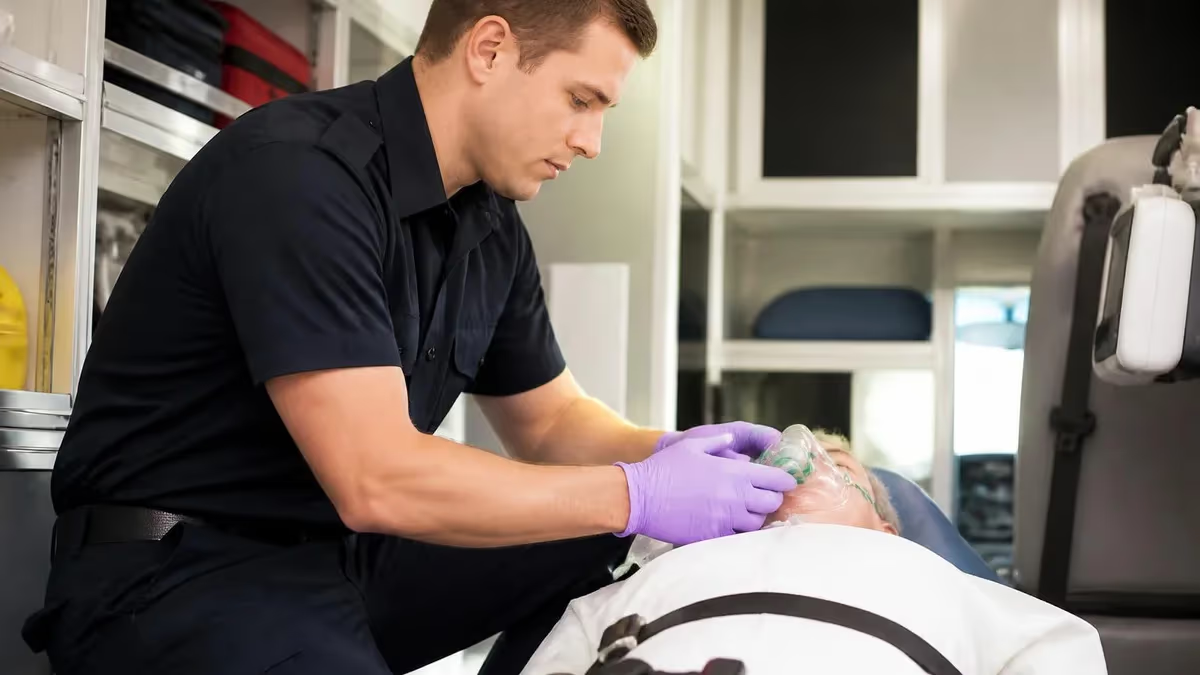
The NREMT exam is the final hurdle between months of EMT or Paramedic training and a real career on the ambulance. You sat through the classroom hours. You did the clinicals. You stuck the IVs and ran the megacodes. Now it's just you, a Pearson VUE testing center, and a computer that decides whether you go to work next week or stretch this out another month.
That gap — between knowing the material and proving it on a high-stakes computer adaptive test — is where most failures actually happen. Candidates don't fail because they're stupid. They fail because they studied the wrong things, ran out of time on practice questions, or never got comfortable with how the NREMT actually asks questions. Standard textbook reading isn't enough. You need a study system that mirrors the exam.
This guide gives you the full picture: every content domain on the cognitive exam, how the adaptive scoring really works, a week-by-week study schedule that's been used by thousands of candidates, and direct links to free practice tests that drill the exact question style the NREMT throws at you. Whether you're sitting for the EMT, AEMT, or Paramedic test, the strategy below works.

NREMT Pass Rates and Exam Facts
Key Facts at a Glance
| Item | Value | Details |
|---|---|---|
| Minimum Questions (EMT) | 70 | |
| Maximum Questions (EMT) | 120 | |
| Time Limit | 2 Hours | |
| Recommended Study Hours | 80–120 |
Read those numbers again. Roughly 3 out of every 10 EMT candidates fail on the first try. The Paramedic numbers are slightly better, but only because Paramedic students typically have more clinical exposure heading into the exam. That failure rate is not a reflection of how hard the medicine is — it's a reflection of how poorly most people prepare for the format of the test itself.
Here's what the data actually tells you: passing the NREMT isn't about being the smartest student in your class. It's about hitting roughly 80–120 focused study hours, using practice questions that resemble the real exam, and learning to recognize the question patterns. Students who put in fewer than 50 hours of structured prep fail at much higher rates than students who follow a defined schedule.
You don't need a $400 course. You need a clear map of the content, a stack of practice questions, and the discipline to do a little every day for four to six weeks. That's what this guide gives you.
What Makes the NREMT Different
Understanding the adaptive nature of the exam is the single biggest mental shift you need to make before test day. New candidates walk in expecting a normal multiple-choice test where harder questions = bad. On the NREMT, harder questions usually mean you're winning. The system pushes you toward your ceiling. If every question feels easy, that's the warning sign, not the other way around.
This also means you cannot "guess your way through." The CAT algorithm weighs each question heavily. A string of wrong answers early on drops the difficulty and forces you to answer more questions correctly at lower difficulty to claw back. There is no skipping, no flagging for review, and no going back. Once you click an answer, it's locked. You take each question with your full attention or you pay for it later.
The exam can also end at any time after question 70 (for EMT) — the screen goes black and you're done. You won't know if you passed or failed in the moment. Results post in 1–2 business days through your NREMT account. Most candidates leave the testing center convinced they failed. That's normal. The algorithm is designed to feel that way.
NREMT Content Domains and Weighting
Covers airway management, oxygen delivery, ventilation techniques, and respiratory pathophysiology. About 18–22% of the EMT exam. Master BVM technique, supraglottic devices, and respiratory distress vs. failure recognition.
ACLS-adjacent for Paramedic; basic life support and AED use for EMT. Roughly 20–23% of questions. Know your STEMI recognition, cardiac arrest algorithms, and post-arrest care cold.
Approximately 14–18% of the exam. Includes hemorrhage control, spinal motion restriction, burns, and shock. The NREMT loves trauma triage scenarios where you must prioritize multiple patients.
The biggest single domain at 27–32%. Endocrine emergencies, toxicology, behavioral, pediatrics, OB/GYN, and environmental emergencies all live here. This is where most candidates lose points.
10–13% of the exam. HazMat, MCI, ambulance operations, lifting and moving, and medical/legal/ethical issues. Easy points if you study, painful losses if you skip it.

Every NREMT cognitive exam — EMT, AEMT, and Paramedic — pulls from the five content domains above, but the weighting and depth shift dramatically between levels. The EMT exam stays at the recognition-and-stabilize level. The AEMT adds IV access, basic medication administration, and supraglottic airways. The Paramedic exam dives into pharmacology, 12-lead interpretation, advanced airway, and complex pathophysiology.
Here's the trap most candidates fall into: they over-study cardiology because it's the "exciting" domain and under-study EMS Operations because it sounds boring. Then they fail by 2–3 questions in a domain they could have nailed with a single afternoon of review. The NREMT doesn't care that you can recite the AHA algorithm by memory — it cares that you can also explain when to call for HazMat backup and how to document refusal of transport correctly.
Spend your study time proportional to the domain weighting. If Medical is 30% of the exam, it gets roughly 30% of your study hours. Track it. Use a spreadsheet or a notebook. The candidates who pass on the first attempt are almost always the ones who studied with intention, not just time.
6-Week NREMT Study Schedule
The six-week schedule above isn't magic — it's just the structure that works for most working adults studying around a job or another class. If you have more time, stretch it. If you only have three weeks because your test date is locked, compress it and double your daily question count, but don't cut the full-length simulation week. That final week of timed practice is what separates candidates who pass cleanly from candidates who burn out at question 60.
The biggest mistake people make is back-loading their studying. They read the textbook for five weeks, do 50 practice questions in the final week, and walk into the test cold. The NREMT format is itself a skill you have to practice. Reading about a tension pneumothorax is not the same as answering eight different question stems about a tension pneumothorax under time pressure. Practice questions are not a "check" on your knowledge — they ARE the studying.
Mix your sources. Use your school's question bank, plus at least two outside sources. If every question you've ever seen comes from one provider, you'll get blindsided by question styles you've never encountered. Free resources, paid resources, and the free practice tests on this site all serve different purposes. Triangulate them.
Pacing is the silent killer. Candidates fail not because they don't know the material, but because question 50 takes them three minutes to read and answer, and now they're behind. They panic. They start guessing on the back half. The CAT algorithm punishes guessing harder than thoughtful wrong answers — random clicks at the end can drop your difficulty band fast.
The fix is mechanical. Set a 60-second mental timer on every practice question starting in week 3. If you can't answer in 60 seconds, you eliminate the two worst options, pick between the remaining two, and move on. Do not stare at a question. Do not re-read it four times. The NREMT writes plausible distractors specifically to suck time from indecisive candidates. Decisiveness is a tested skill, not just speed.
One more pacing rule: do not eat a heavy meal before the test. Test centers are cold, the rooms are silent, and you do not want to be fighting a food coma at question 80. Light protein, water, and skip the caffeine if you don't normally drink it. Sleep matters more than any last-minute cramming the night before — your brain consolidates the previous six weeks of work during deep sleep.

NREMT Test Day Checklist
- ✓Two forms of valid government ID (one with photo, names must match exactly)
- ✓ATT (Authorization to Test) letter — print and bring it
- ✓Arrive 30 minutes early to your Pearson VUE testing center
- ✓No phone, watch, wallet, or food at your seat — lockers are provided
- ✓Empty your pockets completely before entering the testing room
- ✓Use the restroom before checking in — the clock keeps running on breaks
- ✓Wear layers — testing rooms run cold
- ✓Light breakfast: protein + complex carbs, easy on the caffeine
- ✓8 hours of sleep the night before — no cramming after 9 PM
- ✓Review your one-page high-yield cheat sheet, not your textbook
Free practice tests are the highest-use study tool you have. They're free, they mimic the question style, and you can take them as many times as you want. The mistake most candidates make is taking a practice test, looking at the score, and moving on. That is not studying. That is just measuring.
The actual studying happens in the review. After every practice test, go through every single question — including the ones you got right. For the right answers, ask: did I know it, or did I guess? For the wrong answers, ask: was it a knowledge gap, a reading-too-fast gap, or a "I knew this but picked the wrong distractor" gap? Each of those three failure modes has a different fix.
Knowledge gaps mean you go back to the textbook for that topic. Reading-too-fast gaps mean you slow down and underline the call-to-action in each question stem ("most appropriate," "next step," "best initial," etc.). Distractor gaps mean you study the NREMT's writing style and start recognizing the patterns they use to trap you. By week 4, you should be hitting 80%+ on practice tests in your strongest domains. If you're not, double the time you spend on review.
Self-Study vs Paid Prep Course
- +Free or near-free — your only cost is time
- +Self-paced — perfect for shift workers and parents
- +Forces you to identify your own weak spots
- +Builds the discipline you'll need as a working EMT
- +Practice tests and YouTube channels are world-class and free
- +You learn how to teach yourself — a career-long skill
- −No accountability — easy to skip days without realizing it
- −No one to ask when you get stuck on a concept
- −Easy to over-study comfortable topics and avoid weak ones
- −Requires honest self-assessment, which is harder than it sounds
- −Slower for candidates with no clinical experience
- −No structured feedback on your psychomotor skills
Self-study works for most candidates. About 70% of the candidates who pass on the first try report using free or near-free resources — textbook plus practice tests plus YouTube. Paid prep courses are not bad, and for some candidates they're the right call. If you have a history of failing standardized tests, if you've already failed the NREMT once, or if you genuinely cannot create a study schedule for yourself, a paid course can be worth it. For everyone else, the money is better spent on a quiet coffee shop or a tutor for the one topic that won't stick.
The candidates who pass with the lowest stress are usually the ones who treat NREMT prep like a part-time job. They block study time the same way they'd block a shift. They tell their family they're not available those hours. They show up to their own study sessions like a patient is depending on them — because in a few weeks, one will be. That mindset shift, more than any specific resource, is the difference between passing and retesting.
One last note on retesting: if you do fail, it's not the end. You can retest after a 15-day waiting period. After three failed attempts, you have to complete additional formal education. But the data is encouraging — most candidates who fail the first time pass on the second attempt because they finally take the prep seriously. Don't be that candidate. Take it seriously the first time and save yourself the $80 retest fee and the two weeks of waiting.
NREMT Questions and Answers
The NREMT exam is not the boss of your career. It's a checkpoint. A stressful, expensive, computer-adaptive checkpoint, but a checkpoint all the same. The fact that you're reading a 2,500-word study guide on a Tuesday night means you're already in the top half of candidates — most people just hope it works out and walk in cold. You're already past that.
Build the schedule. Block the hours. Do the practice questions. Review the wrong answers harder than the right ones. Skip the cramming. Sleep before test day. And when you sit down at that Pearson VUE workstation and the screen feels impossibly hard somewhere around question 60, remember: that's the algorithm pushing you toward your ceiling. Hard questions are good news. Stay calm, answer the one in front of you, and let the math do the rest.
Pass it the first time, and you walk out of that testing center as an EMT or Paramedic. You start your career. You stop being a student. The 80 hours of study you put in over the next six weeks will pay off for the next 30 years of your working life. There is no better investment of your time right now than the practice tests, the schedule above, and the discipline to follow through. Bookmark this guide, start tonight, and we'll see you on the other side.
Before you close this tab, set up your study environment tonight. Pick a single notebook, not multiple. Pick a single question bank as your primary, with one or two backups. Open a fresh Google Doc and copy the 6-week schedule into it with actual calendar dates. Write down your test date at the top in red.
Every time you finish a study block, log it in that doc — date, hours, topic, practice score. By week 4 you'll have a running data set on yourself that tells you exactly where to invest your final two weeks. That kind of measurable progress is what turns vague anxiety ("am I ready?") into specific, fixable problems ("Medical domain is at 68%, I need three more hours").
If you take only one thing from this study guide, take this: the candidates who pass the NREMT on their first attempt are not smarter than the ones who fail. They are more deliberate. They follow a schedule. They review every wrong answer. They drill practice questions until the format becomes muscle memory.
They take care of their body in the final week so their brain works on test day. None of that requires special talent. All of it requires showing up to your own study sessions with the same seriousness you'd bring to a 911 call. Do that for six weeks and you pass. Skip it and you join the 30% who retest. The choice, and the work, is yours.
One question we get a lot: should you take the NREMT cold right after your program ends, or wait a few weeks to study more? The honest answer depends on where you are coming from. If your program included frequent quizzes, full-length simulation exams, and active recall drills, you may be ready within two weeks of graduation. If your program was mostly lecture-and-listen with light testing, give yourself the full six weeks. Schools vary wildly. Be honest with yourself about how often your program actually drilled you under exam conditions versus how often it just covered material in slides.
Another common trap: studying with friends who are at a different prep stage. Group study is great for explaining concepts out loud, but only if everyone is at roughly the same level. If you are three weeks ahead of your study partners, you end up teaching instead of learning. If you are three weeks behind, you spend the session pretending to understand and absorb nothing. Pick study partners who are tracking similar test dates, and limit group sessions to one specific topic per meeting, not "general review."
About the Author
Paramedic & Emergency Services Certification Trainer
George Washington UniversityCaptain Ryan O'Brien is a licensed paramedic and NREMT-certified emergency medical professional with a Bachelor of Science in Emergency Medical Services from George Washington University. He has 15 years of field experience as a paramedic and firefighter, and has coached hundreds of EMT and paramedic candidates through their NREMT written and psychomotor licensing examinations.
Join the Discussion
Connect with other students preparing for this exam. Share tips, ask questions, and get advice from people who have been there.
View discussion (2 replies)