
NREMT Exam Practice Questions: Realistic Scenarios and Detailed Rationales
Sharpen your NREMT exam skills with realistic practice questions covering airway, 🧠 trauma, cardiac, OB, and operations scenarios. Detailed rationales
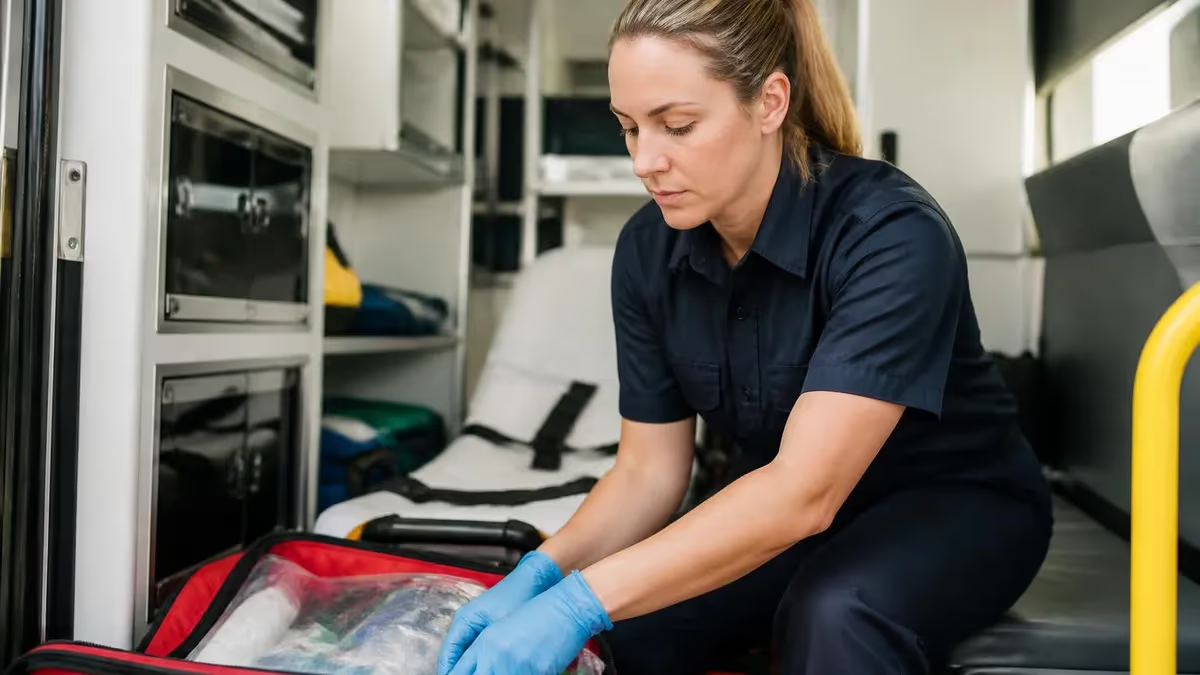
The National Registry of Emergency Medical Technicians (NREMT) exam stands between you and a career on the ambulance. The questions are nothing like the multiple-choice quizzes from your EMT course. The Registry uses a computer-adaptive test (CAT), which means the software constantly recalibrates: get a question right and the next one bumps up in difficulty; miss one and the level drops slightly.
That mechanic trips up candidates who expected a static test. You won't see a percentage score either. You either pass (the algorithm decided, with 95% confidence, you're above the standard) or you don't. So drilling realistic NREMT practice test scenarios isn't optional. It's how you teach your brain to think at the level the Registry measures.
Below: a walkthrough of the exam, how the adaptive engine works, what to study during your final week, and a long block of practice scenarios with answer explanations. For higher-level prep, the NREMT paramedic practice test follows the same blueprint.
NREMT Exam at a Glance
Key Facts at a Glance
| Item | Value | Details |
|---|---|---|
| Questions per attempt (EMT level) | 70-120 | |
| Time limit, computer-adaptive | 2 hrs | |
| Scenario-based items | 85% |

How the NREMT Cognitive Exam Is Built
The Registry publishes a content outline every cycle. The EMT-level cognitive exam splits roughly into five domains. Airway, Respiration, and Ventilation accounts for 18-22% of items. Cardiology and Resuscitation pulls another 20-24%. Trauma takes 14-18%. Medical consumes the largest slice at 27-31%, and EMS Operations rounds it out at 10-14%. Pediatrics is woven throughout, so expect roughly 15% of every domain to feature a patient under 18.
Questions arrive in three flavors. Recall items ask you to identify a structure, dose, or definition. Application items hand you a partial scenario and ask what step comes next. Analysis items, the highest cognitive level, give you a full clinical picture and force you to weigh two reasonable interventions against each other. The Registry loads the test toward application and analysis because that predicts safe field performance.
The Five NREMT Content Domains
BLS airway adjuncts, oxygen delivery devices, BVM technique, supraglottic airways, CPAP indications, suction limits, pediatric airway differences.
ACS recognition, nitro and aspirin protocols, AED operation, CPR ratios across age groups, cardiogenic shock signs, stroke scales, return-of-circulation care.
MOI assessment, hemorrhage control hierarchy, tourniquet use, spinal motion restriction criteria, burn estimation, blast injury phases, pediatric trauma triage.
Diabetic emergencies, seizure management, anaphylaxis and epinephrine auto-injectors, behavioral restraint, opioid overdose, normal delivery, postpartum hemorrhage.
Scene safety, hazmat awareness, triage tagging (START and JumpSTART), incident command, lifting mechanics, infection control, documentation, ambulance operations.
Why Practice Questions Beat Re-Reading the Textbook
Cognitive science calls it the testing effect: every time you retrieve information under exam-like conditions, the memory trace strengthens far more than from passive review. A 2011 Karpicke and Blunt study showed students who practiced retrieval outperformed students who built concept maps, even though the concept-mappers spent the same study time and felt more confident. That feeling of fluency from re-reading is a trap. You recognize the material and mistake recognition for mastery.
Realistic practice questions correct that mistake. They force genuine retrieval. You produce the answer instead of nodding along when you see it. They also expose the gap between knowing a fact and applying it under pressure. You may know epinephrine 0.3 mg IM is the anaphylaxis dose for an adult. But can you also explain why you'd give it to a wheezing 26-year-old with a peanut allergy and hives, even though her BP is still 110/70?
Working through practice questions also builds pattern recognition. Experienced providers don't reason through every step from first principles. They pattern-match. "Crushing substernal chest pain radiating to the jaw, diaphoresis, 58-year-old male, history of hypertension" lights up the cardiac pattern instantly. Each scenario you complete is one more pattern you can pull from on test day.
The 3-Pass Method for NREMT Practice Questions
Pass 1: Answer cold with no notes, simulating test pressure.
Pass 2: Review every rationale, even for questions you got right; you may have been right for the wrong reason.
Pass 3: Re-attempt only the items you missed, 48 hours later. This spacing forces consolidation. Candidates who use the 3-pass method on 400+ questions average 8-12 points higher on Registry-style benchmark exams.
Sample Practice Questions With Detailed Rationales
The block below walks through scenario items pulled from the domains the Registry weights heaviest. Read each stem, commit to an answer before you scroll, then check the rationale. Several wrong answers are also defensible interventions. The question asks for the best next action, which means triaging priorities the way a field provider does.
Question 1: Airway and Respiration
You respond to a 62-year-old female with end-stage COPD reporting worsening shortness of breath over six hours. She's tripod-positioning, speaking three-word sentences, RR 32 and labored, SpO2 84% on room air, breath sounds with diffuse wheezing, and end-tidal CO2 waveform shows a shark-fin pattern. Her husband says her home CPAP is at 8 cmH2O. What's your best next action?
A. Apply a non-rebreather at 15 L/min and reassess
B. Administer her prescribed albuterol via nebulizer and titrate oxygen to SpO2 of 92%
C. Initiate BLS CPAP at 5 cmH2O and reassess after one minute
D. Begin assisted ventilations with a BVM at 12 per minute
Best answer: B. A COPD patient in moderate distress with bronchospasm benefits first from rescue bronchodilator. Titrating oxygen to 92% avoids over-oxygenating a chronic CO2 retainer. CPAP is appropriate if she fails the nebulizer trial, but starting it before the bronchodilator skips a less invasive, more targeted intervention. A non-rebreather would push her SpO2 too high. BVM assistance isn't justified yet because she's moving air and oriented.
Many readers pair this guide with the nremt practice test free to check their readiness before exam day.
In COPD exacerbation with wheezing, the bronchodilator is the highest-yield first move, not oxygen escalation. Titrate O2 to 88-92%; chronic CO2 retainers can lose their hypoxic drive at higher saturations.
Question 2: Cardiology
A 54-year-old male is found unresponsive in his garage. His wife performed bystander CPR for an estimated four minutes before your arrival. The AED analyzed and delivered one shock prior to your patient contact. On arrival, the patient is pulseless and apneic, CPR is ongoing, and the AED is mid-cycle waiting to re-analyze. What's your immediate priority?
A. Pause compressions to allow the AED to analyze
B. Continue high-quality compressions until the AED prompts to analyze
C. Insert a supraglottic airway before the next analysis
D. Switch out the compressor immediately to reduce fatigue
Best answer: B. The 2020 AHA guidelines emphasize minimizing interruptions in chest compressions. You don't pause compressions until the AED prompts "stand clear, analyzing." Inserting an airway during active resuscitation never takes priority over compressions. Compressor swaps occur every two minutes during the rhythm check, not arbitrarily mid-cycle.
High-Quality CPR Targets
Question 3: Trauma
You arrive at a single-vehicle collision into a tree. The driver, a 28-year-old male, is ambulatory at the scene, complains of right-knee pain, denies LOC, GCS 15, vital signs stable. The windshield is starred on the driver's side. What's your most appropriate spinal motion restriction decision?
A. Apply a cervical collar and place him on a long backboard for transport
B. Apply a cervical collar only and transport seated
C. Perform a focused spinal assessment using NEXUS or Canadian C-Spine criteria
D. Decline SMR because he's walking
Best answer: C. Modern SMR protocols use clinical decision rules rather than reflexive boarding. A starred windshield is a concerning MOI, but absence of midline tenderness, neurological deficit, distracting injury, intoxication, and altered mentation may safely defer immobilization. Walking alone doesn't clear the spine. A focused exam does.

NEXUS Low-Risk Criteria for SMR Deferral
- ✓No midline cervical tenderness on palpation
- ✓No focal neurological deficit on motor or sensory exam
- ✓Normal level of alertness, GCS 15
- ✓No evidence of intoxication
- ✓No painful distracting injury (long-bone fracture, large laceration, etc.)
Question 4: Medical
A 19-year-old female is found unresponsive in a college dorm. Roommate reports she took "a bunch of her boyfriend's pills" two hours ago. Pinpoint pupils, RR 6 and shallow, SpO2 82%, weak pulse 58. What's your best next action?
A. Administer activated charcoal per protocol
B. Begin BVM ventilations and administer intranasal naloxone
C. Place the patient in the recovery position and transport
D. Initiate compressions; she's near respiratory arrest
Best answer: B. Pinpoint pupils plus hypoventilation is opioid toxidrome until proven otherwise. The immediate threat is respiratory failure, so BVM support comes first while you draw up naloxone. Activated charcoal is contraindicated in patients with depressed mentation due to aspiration risk. Compressions aren't indicated yet because she has a pulse.
Standard intranasal naloxone dose is 4 mg in one nostril (2 mg per spray, both nostrils with the older device). Repeat every 2-3 minutes as needed if no response. Always ventilate the patient between doses; naloxone fixes the receptor problem but doesn't fix established hypoxia until you move air.
Question 5: OB
You're assisting a 32-year-old G3P2 in active labor. The infant's head delivers, you check for a nuchal cord (none present), and the shoulders fail to deliver with the next contraction. What maneuver should you perform first?
A. Apply gentle downward traction on the head
B. Place the mother in McRoberts position with knees flexed sharply toward her abdomen
C. Reach in and rotate the posterior shoulder
D. Transport immediately with shoulders impacted
Best answer: B. Shoulder dystocia is a true obstetric emergency. McRoberts position widens the pelvic outlet and resolves roughly 40% of dystocias on its own. Aggressive downward traction risks brachial plexus injury. Internal rotation is a paramedic-level maneuver and follows McRoberts plus suprapubic pressure.
Domain-Specific Pitfalls to Watch
Pediatric vitals shift dramatically by age. An infant with a heart rate of 90 is bradycardic, while a 10-year-old at 90 is normal. Use the pediatric assessment triangle (appearance, work of breathing, circulation) before vitals on every pediatric call. Compensated shock in children masks itself until they crash hard. Memorize the JumpSTART triage algorithm; it differs from adult START in the apnea step.
The Registry writes distractors that are technically correct but not the best next action. Underline the patient's age, chief complaint, and vital sign trend before you scan the answer choices. About one in five missed questions come from candidates choosing a reasonable intervention that wasn't the priority. Slow down on the first 20 questions because they set your adaptive difficulty for the rest of the exam.
More Practice Scenarios
Question 6: Toxicology
A 45-year-old male sprayed an unmarked container of pesticide in a closed garage. He presents with copious oral secretions, miotic pupils, bradycardia at 48, wheezing, and muscle fasciculations. What's the highest priority?
A. Decontamination and aggressive suctioning
B. Albuterol via nebulizer for bronchospasm
C. Atropine administration
D. Transport in the recovery position
Best answer: A. This is organophosphate toxicity, SLUDGE/DUMBELS toxidrome. Decontamination prevents continued exposure to you and the patient, and aggressive suctioning addresses the immediate airway threat. Atropine is paramedic-level, but secondary to source control. Albuterol won't reverse cholinergic excess.
SLUDGE vs DUMBELS Toxidrome Mnemonics
Excessive drooling and oral secretions overflow the airway, demanding aggressive suction.
Tearing eyes alongside other secretions point to muscarinic excess.
Involuntary voiding is common; document for handoff.
GI hyperactivity completes the cholinergic picture.
Cramping and vomiting often arrive before other signs.
Aspiration risk compounds the airway threat; suction is non-negotiable.
Question 7: Stroke
A 71-year-old female experienced sudden left-sided weakness and slurred speech 45 minutes ago per family. Cincinnati Stroke Scale is positive on all three elements. Blood glucose 118 mg/dL. What's your most important transport decision?
A. Transport to the closest hospital because time is critical
B. Transport to the closest primary stroke center even if it adds 15 minutes
C. Transport to a comprehensive stroke center even if it adds 30 minutes
D. Hold for ALS intercept before deciding
Best answer: B. Last-known-well at 45 minutes puts her inside the tPA window. Primary stroke centers can administer thrombolytics. A comprehensive stroke center adds thrombectomy capability but adds transport time, usually only justified if a stroke severity score suggests large-vessel occlusion.

Hypoglycemia mimics stroke perfectly. Cincinnati positive plus a glucose of 38 is not a stroke, it's hypoglycemia. Glucose check is mandatory on every altered or focal-deficit patient before you commit a stroke center to a workup.
Question 8: Burns
A 34-year-old male sustained burns to his entire right arm and the anterior chest from a grease fire. He's alert, in moderate pain, with stable vitals. Using the rule of nines, what's the estimated TBSA?
A. 9%
B. 13.5%
C. 18%
D. 22.5%
Best answer: C. Adult rule of nines. Entire arm is 9%, anterior chest is 9%. Total = 18%. Burn shock fluid resuscitation kicks in around 20% TBSA in adults, so this patient is near that threshold and benefits from early IV access.
Adult Rule of Nines
Question 9: Operations and Triage
A bus crash produces 24 patients. You're the first arriving EMS unit. A walking patient with a forearm laceration approaches you asking for help. How should you triage him?
A. Treat his laceration first because he's right in front of you
B. Tag him green (minor) and direct him to the casualty collection point
C. Tag him yellow (delayed) for the bleeding
D. Skip triage on him because he's ambulatory and alert
Best answer: B. The START algorithm tags ambulatory patients as green immediately so resources focus on non-ambulatory patients first. He still needs assessment later but isn't a priority. Treating individuals before triage in MCIs is the single biggest pitfall on operations items.
Final Week NREMT Study Checklist
- ✓Complete at least 200 mixed-domain practice questions
- ✓Review every rationale for items you missed AND items you got right
- ✓Drill medication dosages: aspirin, nitro, epi, naloxone, albuterol, glucose, activated charcoal
- ✓Memorize compression-to-ventilation ratios across all age groups and rescuer counts
- ✓Re-watch a BVM technique video; 2-person grip is the highest-yield psychomotor skill
- ✓Review the START and JumpSTART triage flowcharts until you can draw them from memory
- ✓Sleep 8 hours the two nights before because the adaptive engine punishes fatigue mistakes
- ✓Eat protein the morning of, hydrate moderately, and arrive 30 minutes early
Question 10: Anaphylaxis
A 26-year-old female was stung by a wasp 10 minutes ago. She has urticaria across her trunk, mild facial swelling, audible wheezing, and reports throat tightness. Vitals: BP 102/68, HR 118, RR 26, SpO2 94%. What's your best next action?
A. Administer her prescribed epinephrine auto-injector (0.3 mg IM) and high-flow oxygen
B. Administer diphenhydramine and reassess
C. Wait for BP to drop before giving epinephrine
D. Transport rapidly without intervention
Best answer: A. Anaphylaxis is defined by multi-system involvement. Skin plus airway is enough to act. Don't wait for hypotension; that's late and often pre-arrest. Epinephrine IM is the first-line, life-saving intervention. Antihistamines are adjuncts only.
Question 11: Diabetic Emergency
A 58-year-old male is altered and diaphoretic. Family says he took his insulin and missed breakfast. He's oriented to person only, blood glucose 38 mg/dL, intact gag reflex. What's the most appropriate intervention?
A. Place oral glucose paste between his cheek and gum
B. Withhold treatment and transport rapidly
C. Administer glucagon IM
D. Establish IV access and give D10
Best answer: A. EMT-level scope allows oral glucose for hypoglycemic patients with an intact gag reflex and ability to swallow. Glucagon IM is in some EMT scopes regionally but oral glucose is faster when feasible. IV dextrose is ALS scope.
Choosing a Question Bank
- +Free banks let you build initial volume without spend
- +Often used to supplement a primary paid bank
- +Good for spot-checking specific weak domains
- +Useful for last-minute confidence drills
- −Item quality varies; many recycle outdated guidelines
- −Rationales are often one-sentence and skip the why
- −No adaptive engine, so you don't experience the real test mechanic
- −Limited scenario depth; mostly recall-level distractors
How the Adaptive Engine Decides Pass or Fail
The Registry uses item response theory, a statistical framework that treats each question as a calibrated probe of your ability level. Every item carries a difficulty parameter, and your responses produce a running estimate of your ability. The exam continues until the standard error drops below a threshold AND your estimate sits clearly above or below the passing standard. That's why some candidates pass at 70 questions while others go the full 120.
Two practical implications follow. You cannot strategy your way to a pass by guessing on hard questions; the algorithm models guessing. And you should treat early questions as the most consequential. Slow down for the first 20 items. That's where your ability estimate locks into a band. After that, the algorithm is mostly fine-tuning.
Some candidates worry about a hard exam where everything felt difficult. That's actually a signal you may have done well because the engine kept pushing you harder when you kept getting items right. The reverse can be true: an exam that felt easy may indicate you were struggling early. Don't read your performance from how you feel walking out.
Common Mistakes That Sink Otherwise-Strong Candidates
The most common error is treating practice questions as a pass/fail benchmark instead of a learning tool. Candidates obsess over their percentage, get discouraged when they dip below 75%, and quit before extracting the bank's full value. The percentage means nothing. The rationales mean everything. Each wrong answer points to a specific knowledge or reasoning gap you can close before test day.
The second is over-reliance on memorization. You can memorize that the adult BLS ratio is 30:2, but if you can't explain why it differs from infant 2-rescuer (15:2), the Registry will catch you on a scenario item. Understand the physiology behind every fact because the why anchors the what.
The third is skipping psychomotor preparation. The cognitive exam is what most candidates fear, but the psychomotor stations have their own traps: missing safety checks during medical assessment, forgetting to ventilate during cardiac arrest management, skipping baseline vitals during trauma assessment. Practice the skill sheets out loud until they're automatic.
NREMT Questions and Answers
About the Author
Paramedic & Emergency Services Certification Trainer
George Washington UniversityCaptain Ryan O'Brien is a licensed paramedic and NREMT-certified emergency medical professional with a Bachelor of Science in Emergency Medical Services from George Washington University. He has 15 years of field experience as a paramedic and firefighter, and has coached hundreds of EMT and paramedic candidates through their NREMT written and psychomotor licensing examinations.
Join the Discussion
Connect with other students preparing for this exam. Share tips, ask questions, and get advice from people who have been there.
View discussion (2 replies)