
How to Get Fit for the Police Fitness Test: Complete NPOST Physical Preparation Guide
Master the national police officer selection test with our fitness & written prep guide. Training plans, practice tests, and expert tips. ✅

Knowing how to get fit for the police fitness test is the single most important thing you can do before applying to any law enforcement agency. The national police officer selection test — commonly called the NPOST — evaluates both your cognitive abilities and your physical readiness, and departments increasingly weigh both components equally when making hiring decisions. Whether you are a first-time applicant or a returning candidate, building a structured preparation plan several months before your scheduled test date gives you a significant competitive advantage over unprepared peers.
The NPOST physical fitness standards are designed to reflect the genuine demands placed on officers in the field. Running a suspect on foot, restraining a combative individual, or dragging an injured colleague to safety are not hypothetical scenarios — they are real job tasks documented by law enforcement agencies nationwide. When departments set minimum fitness benchmarks, they base those numbers on task analyses that show exactly what the human body must accomplish during an average patrol shift, which can involve bursts of intense activity separated by long periods of moderate effort.
Most candidates underestimate how much time serious preparation actually requires. Fitness researchers consistently find that meaningful cardiovascular and muscular improvements take at least eight to twelve weeks of consistent training to manifest reliably. If you start running two weeks before the test, you will not be meaningfully fitter — and you may actually show up fatigued from unaccustomed exertion. The candidates who pass on their first attempt almost always began structured training at least three months out, following a periodized plan that systematically increases volume and intensity over time.
It is equally important to understand that the NPOST is not a single standardized physical test with identical requirements across every jurisdiction. Different departments use different protocols — some use the Cooper Standards, others use the POPAT or a department-designed obstacle course, and still others rely on validated fitness batteries developed by state commissions. Before you train, download your target department's exact physical fitness standards document and build every workout around those specific benchmarks, because training for a 1.5-mile run when your department tests a 300-meter sprint and a 1-mile run is wasted effort.
Alongside physical fitness, the written portion of the national police officer selection test demands serious academic preparation. The NPOST written exam covers reading comprehension, mathematics, grammar, and — in many versions — incident report writing and legal reasoning.
Candidates who focus exclusively on pushups and running while neglecting the written test routinely fail the academic portion even when they post excellent physical scores. Integrating both streams of preparation into a unified schedule is the hallmark of a well-rounded candidate. You can find a comprehensive national police officer selection test study guide to help you align your written and physical prep timelines.
One underappreciated element of fitness preparation is mental conditioning. The ability to push through the final quarter-mile of a timed run when your lungs are burning and your legs feel heavy is a skill that must be practiced deliberately, not assumed. Mental toughness training — which includes controlled breathing, positive self-talk scripts, and simulated test-day stress through mock assessments — accounts for a measurable portion of actual test-day performance. Top candidates practice under conditions that mimic the test environment, including testing in the morning, wearing the required attire, and timing every drill precisely.
Nutrition and recovery are the silent pillars of any effective fitness program, and police fitness test candidates frequently overlook both. Chronic under-eating — especially of protein — slows muscular adaptation, while poor sleep impairs reaction time and cognitive function. A candidate who trains hard but sleeps five hours per night and skips breakfast will systematically underperform relative to their potential. Committing to eight hours of sleep, 1.0 to 1.2 grams of protein per pound of bodyweight daily, and adequate hydration throughout the training cycle can meaningfully shift both physical scores and written exam performance.
NPOST Fitness Preparation by the Numbers

12-Week Police Fitness Preparation Schedule
- ▸Complete a full baseline fitness test (pushups, situps, 1.5-mile run) and record scores
- ▸Begin NPOST written test diagnostic: take one full-length practice exam untimed
- ▸Start a 3-day-per-week run program at conversational pace (20–25 minutes each session)
- ▸Introduce bodyweight strength training: 3 sets each of pushups, situps, and squats
- ▸Increase run duration to 30 minutes per session, maintaining comfortable effort level
- ▸Study NPOST reading comprehension strategies: main idea, inference, vocabulary in context
- ▸Add a fourth running day using walk-run intervals to build volume without injury
- ▸Begin daily pushup progression: add 2 reps per set every 3 days
- ▸Introduce circuit training combining pushups, situps, squats, and burpees
- ▸Review NPOST math topics: fractions, percentages, ratios, basic algebra
- ▸Run 3 x 10-minute tempo intervals at a comfortably hard effort level
- ▸Track weekly pushup and situp max scores to monitor progress
- ▸Reduce training volume by 30% to allow recovery and supercompensation
- ▸Retest baseline fitness scores and compare to Week 1 numbers
- ▸Complete a timed NPOST written practice exam and score all four sections
- ▸Identify weakest written and physical areas and adjust Weeks 5–8 focus accordingly
- ▸Add interval run sessions: 6 x 400 meters at target test pace with 90-second rest
- ▸Study grammar rules tested on the NPOST: subject-verb agreement, punctuation, sentence structure
- ▸Incorporate core stability training: planks, hollow holds, and dead bugs
- ▸Practice incident report writing using sample police scenario prompts
- ▸Increase pushup training volume: 5 sets to near-failure 4 days per week
- ▸Begin NPOST law and legal concepts review using official study materials
- ▸Run one long easy run weekly (40–45 minutes) plus two interval sessions
- ▸Practice observation and memory drills: study a scene image, then answer questions from memory
- ▸Perform a full simulated physical fitness test at scheduled test start time
- ▸Take a full timed NPOST written practice exam under strict test conditions
- ▸Analyze results: identify question types missed and physical events needing improvement
- ▸Review all incorrect written answers and study related concepts in depth
- ▸Achieve highest training volume of the cycle: 5 run days and 4 strength sessions
- ▸Complete two full NPOST written practice tests — one per test section per day
- ▸Focus on weak spots revealed in Week 7 simulation results
- ▸Begin mental performance work: visualization and controlled breathing before each workout
- ▸Train the exact events at the exact distances and repetition counts required by your department
- ▸Memorize your target department's minimum and competitive passing scores
- ▸Simulate test-day nutrition: eat the same meal you plan to eat on test day before workouts
- ▸Continue NPOST written review with a focus on flashcard drilling of rules and formulas
- ▸Reduce physical training volume by 20% while maintaining intensity
- ▸Complete final NPOST written practice test and review all remaining weak areas
- ▸Confirm all test-day logistics: location, required documents, attire, arrival time
- ▸Perform one final full physical fitness simulation at reduced effort
- ▸Reduce training volume by 40%: short, fast workouts only to stay sharp
- ▸Focus on sleep quality: target 8–9 hours per night throughout this week
- ▸Light review of NPOST written material — no heavy studying, reinforce confidence only
- ▸Lay out all test-day gear, documents, and equipment by Wednesday of this week
- ▸Monday–Wednesday: one 20-minute easy jog and one 10-minute bodyweight circuit only
- ▸Thursday before the test: complete rest — no physical training of any kind
- ▸Friday (Test Day): arrive 30 minutes early, execute your warm-up protocol, trust your training
- ▸Post-test: regardless of outcome, document scores and lessons learned for future cycles
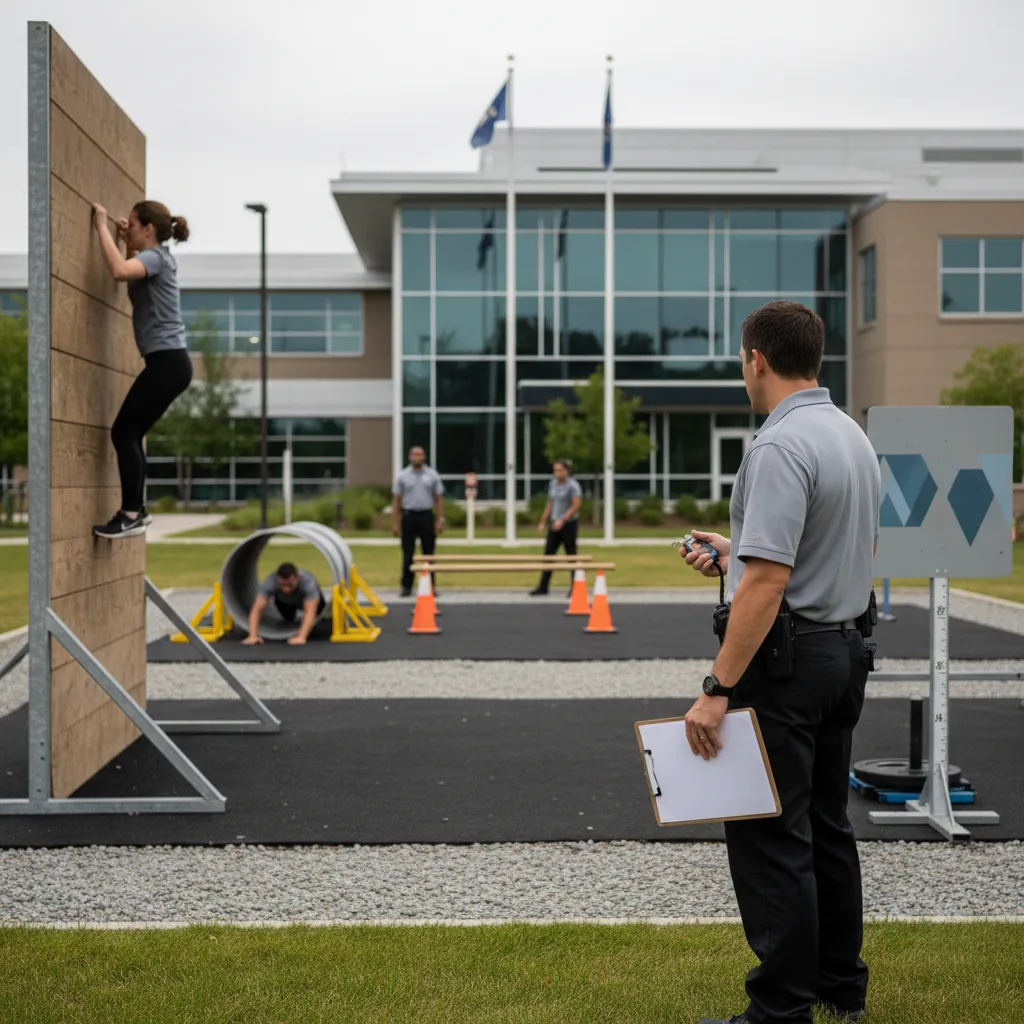
Building an effective police fitness training plan requires understanding the three physical components that appear most consistently across law enforcement fitness batteries nationwide: cardiovascular endurance, muscular endurance, and functional strength. Cardiovascular endurance is typically tested through a timed 1.5-mile run, a 300-meter sprint, or a beep test, depending on the department. Muscular endurance appears as maximum pushups and situps in a fixed time window. Functional strength and agility are assessed through events like the obstacle course, dummy drag, or 165-pound bag carry, which simulate real rescue and pursuit scenarios officers face on duty.
Cardiovascular training should constitute roughly 50 percent of your total training volume, especially in the first six weeks. Three distinct run types build the aerobic engine most efficiently: easy base runs at a conversational pace build aerobic capacity without excessive stress; tempo runs at a comfortably hard effort (about 75–80 percent of max heart rate) train the lactate threshold that determines how fast you can sustain a pace; and interval sessions at 90–95 percent effort build top-end speed and VO2 max.
Rotating between these three types each week prevents adaptation plateaus and systematically improves every energy system tested by law enforcement fitness batteries.
Pushup and situp performance improves faster than most candidates expect when progressive overload is applied systematically. The key principle is to consistently perform sets at 80–90 percent of your current maximum, with brief rest intervals, and to add volume or intensity every three to five days rather than waiting weeks. A candidate who maxes 20 pushups today can realistically reach 35–40 pushups in eight weeks through structured daily progression, which moves many candidates from a failing score into a competitive range. Grease-the-groove training — performing sub-maximal sets multiple times per day — is particularly effective for pushup improvement.
Functional strength training bridges the gap between gym fitness and field-ready fitness. Events like the 165-pound dummy drag require a combination of hip hinge strength, grip endurance, and cardiovascular output that standard gym programs do not develop well. Include farmer's carries with heavy dumbbells, sled drags, and loaded carries in your weekly programming to train exactly the movement patterns that appear in obstacle course-style fitness tests. If your department uses a specific obstacle course, obtain a diagram of the course layout and reproduce as many elements as possible in your training to develop muscle-specific endurance and course familiarity.
Recovery is a training variable, not an afterthought. Active recovery sessions — a 20-minute walk, light yoga, or foam rolling — accelerate muscle repair between hard sessions by increasing blood flow without adding training stress. Police fitness candidates who train hard seven days per week without dedicated recovery days frequently develop overuse injuries, most commonly shin splints, IT band syndrome, and rotator cuff irritation, that derail preparation two to four weeks before the test. Scheduling two full rest or active recovery days per week is a strategic decision that maximizes adaptation, not a sign of inadequate commitment.
You can access free national police officer selection test practice questions to complement your physical training with targeted written exam preparation, ensuring both components of your readiness are developing in parallel. The strongest candidates do not separate physical and written preparation — they treat them as interdependent elements of a unified readiness plan, scheduling study sessions on lighter physical training days and keeping heavy cognitive work away from the hardest workout days.
Tracking your progress objectively is one of the most powerful motivational and strategic tools available to you. Keep a training log that records every run time, every repetition count, and every study session score. Review it weekly to confirm that you are trending in the right direction, and adjust the plan if a metric has stalled for more than two weeks. Candidates who log their training are significantly more likely to arrive at test day having achieved their target scores than those who train informally without documented benchmarks.
National Police Officer Selection Test: Written Exam Preparation by Section
The reading comprehension section of the national police officer selection test presents passages drawn from police reports, legal documents, and policy manuals — the same types of texts officers read every day on the job. Questions test your ability to identify the main idea, draw logical inferences, determine the meaning of vocabulary in context, and recognize the author's purpose. The single most effective preparation strategy is daily practice with realistic police-style passages, not generic reading comprehension exercises.
Time management is the most common challenge candidates face on the reading section. You have approximately 90 seconds per question in most NPOST administrations, which means reading a 200-word passage and answering three to four questions in under six minutes. Practice active reading techniques — annotating key ideas, underlining topic sentences, and circling unusual vocabulary — to extract meaning faster without sacrificing accuracy. Candidates who read every word of every passage before looking at questions tend to run out of time, while those who preview the questions first and read purposefully score significantly higher.

Structured Training Program vs. Self-Directed Preparation: What Works Better?
- +Structured programs provide week-by-week progression that systematically builds both aerobic and muscular capacity without plateaus
- +Scheduled rest and recovery days in structured plans prevent the overuse injuries that sideline self-directed trainees
- +Written and physical preparation are integrated and balanced, ensuring neither component is neglected as test day approaches
- +Objective benchmarks and weekly progress checks allow you to identify and address weak areas before they become disqualifying deficiencies
- +Mental performance techniques — visualization, controlled breathing, stress inoculation — are built into structured plans and rarely self-discovered
- +Accountability mechanisms in structured programs (logged workouts, scheduled simulations) improve adherence rates significantly over informal training
- −Structured programs require consistent time commitment that can be difficult to maintain around shift work, family obligations, or a current job
- −Generic programs may not reflect the exact physical standards of your specific target department, requiring manual customization
- −Candidates who are already highly fit may find the early phases of structured programs insufficiently challenging, slowing their initial progression
- −The cost of quality structured programs, coaching, or comprehensive study guides adds to the financial burden of the hiring process
- −Rigid program schedules can cause anxiety when illness or life events force missed sessions, which self-directed trainees handle more flexibly
- −Without professional guidance, candidates may misinterpret program instructions and train the wrong energy systems for their specific test format
Pros and Cons at a Glance
| Pros | Cons |
|---|---|
| Structured programs provide week-by-week progression that systematically builds both aerobic and muscular capacity without plateaus | Structured programs require consistent time commitment that can be difficult to maintain around shift work, family obligations, or a current job |
| Scheduled rest and recovery days in structured plans prevent the overuse injuries that sideline self-directed trainees | Generic programs may not reflect the exact physical standards of your specific target department, requiring manual customization |
| Written and physical preparation are integrated and balanced, ensuring neither component is neglected as test day approaches | Candidates who are already highly fit may find the early phases of structured programs insufficiently challenging, slowing their initial progression |
| Objective benchmarks and weekly progress checks allow you to identify and address weak areas before they become disqualifying deficiencies | The cost of quality structured programs, coaching, or comprehensive study guides adds to the financial burden of the hiring process |
| Mental performance techniques — visualization, controlled breathing, stress inoculation — are built into structured plans and rarely self-discovered | Rigid program schedules can cause anxiety when illness or life events force missed sessions, which self-directed trainees handle more flexibly |
| Accountability mechanisms in structured programs (logged workouts, scheduled simulations) improve adherence rates significantly over informal training | Without professional guidance, candidates may misinterpret program instructions and train the wrong energy systems for their specific test format |
Complete NPOST Fitness Preparation Checklist
- ✓Download your target department's official physical fitness standards document and identify every tested event and minimum passing score
- ✓Complete a baseline fitness assessment for all tested events and record your starting scores in a training log
- ✓Schedule your 12-week training calendar backward from your test date, marking all simulation weeks and taper phases
- ✓Begin a periodized cardiovascular program using easy runs, tempo runs, and interval sessions across each week
- ✓Start a progressive pushup and situp program targeting your department's competitive (not minimum) score as your goal
- ✓Take a diagnostic NPOST written exam to identify your weakest cognitive sections before beginning structured written study
- ✓Allocate at least four dedicated written study sessions per week covering reading, math, grammar, and legal concepts
- ✓Complete at least three full timed physical fitness simulations before test day, performed under test-day conditions
- ✓Practice test-day nutrition by eating the same pre-test meal before every simulation session to confirm it sits well
- ✓Confirm all required test-day documents — government ID, registration confirmation, required attire — at least one week before the test

Competitive Scores, Not Minimum Scores, Win Offers
Passing the minimum fitness standard gets you through the door — it does not get you a conditional offer. In competitive hiring cycles where dozens of candidates pass the physical test, departments rank applicants by their composite scores and select from the top of the list. Candidates who train to exceed minimums by 15–20 percent consistently rank higher and receive offers in cycles where minimum-passers are waitlisted or passed over entirely.
Understanding the most common preparation mistakes that eliminate candidates gives you a structural advantage before you ever show up to test day. The number-one mistake is starting physical training too late. Physiological adaptations — improved VO2 max, increased muscular endurance, reduced resting heart rate — require eight to sixteen weeks to consolidate at measurable levels. A candidate who begins serious cardiovascular training four weeks before the test will not be meaningfully fitter than when they started, and may actually perform worse due to accumulated fatigue from suddenly unaccustomed training loads.
The second most common mistake is training in isolation without any simulation experience. Many candidates complete twelve weeks of solid training but have never run their 1.5 miles on the specific surface, in the specific type of shoes, at the specific start time of day that the actual test uses. Test-day variables — anxiety, different terrain, unfamiliar surroundings, the presence of other competing candidates — reliably degrade performance by 3–7 percent compared to familiar training environments. The solution is deliberate simulation: schedule at least three sessions where you replicate every testable variable as closely as possible.
Neglecting the written examination is a catastrophic oversight that eliminates otherwise physically capable candidates every hiring cycle. The NPOST written test is administered before, alongside, or immediately after the physical fitness test depending on the department's protocol, and a failing written score disqualifies you regardless of your physical performance. Candidates who are highly fit but who have not maintained or developed their reading, math, and grammar skills since high school are particularly vulnerable because they assume academic competency from their school years will transfer without refreshing — it frequently does not after years away from structured academics.
Overtraining is the hidden saboteur of candidates who are highly motivated but inexperienced in periodized fitness programming. Training hard every single day without rest or recovery phases produces diminishing returns after two to three weeks and often leads to systemic fatigue, hormonal disruption, and musculoskeletal injury in weeks four through eight. The body does not improve during training sessions — it improves during the recovery between sessions. Candidates who treat rest days as failures rather than planned adaptations frequently arrive at test day fatigued, injured, or both, performing well below their true prepared level.
Poor nutrition timing is an underappreciated contributor to failed test performances. Candidates who eat a large unfamiliar meal the morning of the test, or who show up having skipped breakfast entirely to avoid GI discomfort, pay a measurable physiological penalty. Blood glucose levels directly impact both physical performance and cognitive function, and a poorly timed meal — whether too large, too small, or composed of unfamiliar foods — can cause nausea, cramping, energy crashes, or concentration failures at precisely the moment you need peak output. Test your pre-test nutrition protocol during simulation sessions months before the actual test date.
Mental preparation is the component most often dismissed as soft or optional, but the research on athletic performance consistently shows that psychological readiness accounts for 20–30 percent of test-day outcomes for candidates who are physically well-prepared. Anxiety is the primary performance disruptor: improved cortisol levels impair working memory, reduce fine motor control, and increase perceived effort, meaning tasks that felt manageable in training suddenly feel harder on test day. Systematic exposure to test-day conditions — simulations, timed drills, visualization routines — desensitizes the threat response and trains the nervous system to perform under pressure rather than constrict in it.
Candidates who research and use high-quality national police officer selection test practice materials demonstrate better test-day performance than those who rely on general fitness or general academic preparation alone. Domain-specific practice — using materials that closely replicate the actual NPOST question format, difficulty level, and content distribution — builds both competency and confidence simultaneously, which is a combination that generic preparation simply cannot replicate. Investing in the right materials early in your preparation cycle compounds over the weeks that follow.
Do not assume your target department uses the same fitness test or passing standards as other agencies you have researched. Some departments use age- and gender-normed standards from the Cooper Institute, others require absolute performance standards regardless of age or gender, and some use state-mandated batteries that differ entirely from both. Always verify your specific department's current physical fitness standards directly from their official recruitment page or by contacting the hiring unit, as standards are updated periodically and outdated information is widely circulated online.
Test-day execution is a skill that must be rehearsed as deliberately as every physical and written component of your preparation. Candidates who have completed multiple simulation sessions arrive at the actual test with a mental blueprint of exactly what to expect, which dramatically reduces anxiety and allows them to allocate full cognitive and physical resources to performing rather than to processing an unfamiliar environment. The logistics of test day — parking, check-in procedures, required documentation, equipment inspection, warm-up time — all benefit from advance planning that prevents them from becoming unexpected stressors on the day itself.
The warm-up protocol you use on test day should be the same warm-up you have used before every physical simulation session for the past twelve weeks. Your body has learned to interpret that specific sequence of movements as the signal that high-intensity output is about to begin, and the neuromuscular priming that occurs during a familiar warm-up is measurably superior to an improvised warm-up or no warm-up at all.
A standard warm-up for most NPOST physical events includes five minutes of brisk walking, dynamic stretches targeting the hips and shoulders, two to three strides at slightly faster than test pace, and thirty seconds of deep diaphragmatic breathing before the starting signal.
Pacing strategy for the 1.5-mile run is one of the highest-use decisions you will make on test day. The most common catastrophic error is running the first quarter-mile significantly faster than target pace due to adrenaline and competitive excitement, accumulating a lactic acid debt that cannot be repaid in the remaining miles.
Your simulation sessions should have established a precise target pace — calculated as your goal time divided by 1.5 — and you should run the first mile three to five seconds per mile slower than that pace, reserving your energy for a genuine push in the final 400 to 500 meters where your fitness, not your pacing error, determines your finishing time.
Managing the sequence of events strategically matters when the physical test includes multiple back-to-back components. If you have a choice of order — some department tests allow candidates to complete events in self-selected order — consider completing your strongest events first to bank early confidence and points, or completing the most cardiovascularly demanding event (usually the run) last so that maximum pushups and situps are not compromised by cardiovascular fatigue. If the order is fixed, calibrate your effort on earlier events to leave adequate capacity for the run, which is the event with the highest pass/fail impact at most departments.
For the written portion of the test, time management is your most critical operational skill. Distribute your available time evenly across sections at the start, and mark any question that takes more than ninety seconds as a provisional skip — return to it after completing the questions you can answer confidently. Answer every question even if uncertain, because blank answers on the NPOST receive zero points while wrong answers do not carry negative penalties at most administrations. Eliminating one or two obviously wrong choices before guessing improves your statistical odds on every question you cannot confidently answer from knowledge.
The psychological state you carry into the test center is partly a product of choices you make in the days immediately before test day. Avoid high-intensity training in the 48 hours before the test — you cannot meaningfully increase your fitness in two days, but you can absolutely arrive fatigued by trying.
Limit sodium and alcohol in the 72 hours before the test to reduce inflammation and fluid retention. Prepare a test-day bag the evening before with every required item — ID, registration confirmation, water bottle, appropriate footwear, and any required forms — so that morning logistics require zero stressful decisions.
For candidates seeking comprehensive written exam preparation alongside physical readiness, a quality national police officer selection practice test that covers all written domains provides the most efficient path to identifying and closing preparation gaps. Using realistic practice materials that match the NPOST's question format, time constraints, and content distribution is significantly more effective than general academic review, because domain-specific familiarity reduces cognitive load during the actual exam, freeing working memory for the reasoning the questions actually require.
Injury prevention is a non-negotiable priority in any police fitness preparation program because an injury that sidelines you for two weeks can unravel months of progressive training in a program that depends on continuous stimulus to maintain adaptation.
The most common training injuries among law enforcement candidates are predictable and preventable: shin splints from too-rapid increases in running volume, IT band syndrome from insufficient hip strength and flexibility, rotator cuff impingement from pushup volume without shoulder mobility work, and lower back strain from situp-heavy training without adequate core stability work. Addressing each of these with targeted prevention protocols before symptoms appear is vastly more efficient than treating them after they develop.
Progressive overload — the systematic increase of training stress over time — is the mechanism by which all fitness adaptations occur, but the rate of progression matters enormously. Research on running injuries consistently shows that increasing weekly mileage by more than 10 percent in a single week significantly improves injury risk, even for experienced runners.
For candidates starting from low fitness baselines, the temptation to progress aggressively to close large gaps to passing scores quickly frequently produces the injuries that prevent them from reaching the test date at all. Patience in the early weeks of a twelve-week program is not a weakness — it is the strategic decision that keeps you training consistently through week eleven.
Cross-training is an underutilized tool for police fitness candidates that provides cardiovascular training stimulus without the impact stress that makes running injury-prone at high volumes. Swimming, cycling, and rowing all develop the aerobic engine that the 1.5-mile run requires, while placing zero impact stress on the knees, shins, and hips.
Substituting one to two weekly run sessions with cross-training sessions during periods of high training load — or when early signs of shin irritation or knee soreness appear — allows you to maintain cardiovascular development while reducing injury risk. This is especially valuable for candidates who are carrying higher body weight at the start of their preparation.
Sleep quality is a legitimate performance-enhancing factor backed by substantial scientific evidence that police fitness candidates should take as seriously as training or nutrition. Studies on both military recruits and athletes show that restricting sleep to six hours per night for two weeks produces cognitive impairment equivalent to two full nights of total sleep deprivation — yet most sleep-deprived individuals cannot accurately self-assess their own impairment level.
For candidates preparing for the cognitive demands of the NPOST written exam alongside physical training, consistently prioritizing eight to nine hours of sleep per night during the preparation cycle is one of the highest-return investments they can make.
Hydration affects both physical and cognitive performance in ways most candidates underestimate. Even mild dehydration — defined as a body water deficit of just 2 percent — is sufficient to increase perceived effort during exercise, reduce time-to-fatigue, impair working memory, and slow reaction time. All four of these effects are directly relevant to police fitness test performance. Candidates should arrive at test day in a fully hydrated state achieved through consistent daily hydration in the preceding week, not through aggressive fluid loading the morning of the test, which risks GI discomfort and hyponatremia in rare cases.
The social dimension of fitness preparation is frequently underestimated by candidates who train alone. Training with a partner or group who shares your test preparation goals provides accountability, competitive stimulus during hard sessions, and emotional support during the discouraging days that inevitably occur during any twelve-week program. Police academy recruits who prepare together consistently report higher training adherence, faster performance improvement, and lower dropout rates than those who prepare in isolation. If you do not have a training partner, consider joining a law enforcement fitness preparation group, which are increasingly available both in person and through online platforms.
Final-week mental preparation centers on building a specific pre-performance routine that channels any remaining anxiety into productive arousal rather than performance-impairing stress. The physiological symptoms of anxiety — increased heart rate, heightened alertness, muscle tension — are nearly identical to those of excitement and readiness.
The cognitive label you apply to those symptoms significantly influences their effect on performance: candidates who interpret their pre-test physical state as excitement and readiness consistently outperform those who interpret the same state as fear and anxiety. Practicing this cognitive reframe during simulation sessions trains it into an automatic habit that activates when you need it most on test day.
Sample NPOST Police Test Practice Questions
Try these questions from our free NPOST Police Test practice tests. The correct answer and an explanation follow each question.
What part of the following sentence needs to be changed? When training for the army, one should consider not only the rigorous physical demands but also the emotional toil, should he enlist.
- A. Change "but also" to "in addition"
- B. Change "he" to "one"
- C. Remove the comma after "army"
- D. No correction is necessary
Answer: B. Change "he" to "one"
Explanation: Because it makes no sense to change to the pronoun "he" if the sentence's subject pronoun is the word "one."
While questioning a witness, his account contradicts physical evidence at the scene. What is the most logical step?
- A. Arrest the witness for lying
- B. Ignore the physical evidence
- C. Politely probe further and document both the statement and the discrepancy
- D. End the interview immediately
Answer: C. Politely probe further and document both the statement and the discrepancy
Documenting both and clarifying preserves the investigation without premature conclusions.
An officer should document a witness's physical description of a suspect by:
- A. Recording only the officer's own impression
- B. Noting specific features such as height, build, clothing, and distinguishing marks
- C. Writing 'average looking person'
- D. Skipping it unless an arrest is made
Answer: B. Noting specific features such as height, build, clothing, and distinguishing marks
Specific, observable features make a description useful for identification.
Passage: 'Officers responding to a domestic disturbance must first ensure the scene is safe before rendering aid. Only after securing any weapons should medical assistance be summoned.' What is the FIRST priority for the officers?
- A. Summon medical assistance
- B. Ensure the scene is safe
- C. Interview witnesses
- D. Write a report
Answer: B. Ensure the scene is safe
The passage states officers must first ensure the scene is safe before any other action.
NPOST Questions and Answers

National Police Officer Selection Test (NPOST): Complete Guide to Acing Your Police Test in 2026

Police Psychological Exam Practice Test: Complete NPOST Study Guide 2026
NPOST - Police Test: Complete Study Guide 2026

Police Officer Tests: Complete Guide to the National Police Officer Selection Test (NPOST) in 2026

Police Hiring Process: Complete Guide to NPOST, Background Checks, and Polygraph Requirements 2026
About the Author

Educational Psychologist & Academic Test Preparation Expert
Columbia University Teachers CollegeDr. Lisa Patel holds a Doctorate in Education from Columbia University Teachers College and has spent 17 years researching standardized test design and academic assessment. She has developed preparation programs for SAT, ACT, GRE, LSAT, UCAT, and numerous professional licensing exams, helping students of all backgrounds achieve their target scores.
Join the Discussion
Connect with other students preparing for this exam. Share tips, ask questions, and get advice from people who have been there.
View discussion (8 replies)