
National Police Officer Selection Test (NPOST): Complete Guide to the Police Officer Selection Test
✏️ National police officer selection test guide covering format, scoring, study tips, practice questions, and what to expect on test day.

The police officer selection test is the standardized hurdle that stands between thousands of aspiring recruits and a badge each year, and understanding it thoroughly is the single fastest way to improve your odds of being hired. Officially known as the national police officer selection test, this assessment measures the foundational cognitive skills that academy instructors and field training officers consistently identify as essential for new recruits, including basic mathematics, reading comprehension, grammar, and incident-report writing under timed conditions.
Developed by Stanard & Associates and widely adopted by municipal, county, and state hiring agencies across the United States, the national police officer selection test has become the most common entry-level law enforcement examination in the country. More than 1,200 departments use it as either the primary cognitive screen or as one component of a larger assessment battery, which means that mastering its content carries weight far beyond a single city or county application.
The exam is delivered in four sections totaling approximately 116 multiple-choice and short-answer questions, with a strict overall time limit of roughly two hours and ten minutes. Most agencies set the minimum passing score at 70 percent, though competitive departments routinely require scores in the mid-eighties or higher before extending an interview invitation. Knowing where the cut score sits in your jurisdiction shapes how aggressively you need to prepare.
What makes the test challenging is not the difficulty of individual questions, which generally hover around an eighth-to-tenth-grade reading level, but rather the pace at which candidates must answer them while maintaining accuracy. Many otherwise qualified applicants fail not because the material is unfamiliar but because they freeze on basic arithmetic, mismanage their time on the reading passages, or panic when asked to draft a clear, grammatically correct incident report from a list of facts.
This guide walks you through every section of the exam, the scoring system used by most agencies, the most effective study strategies based on candidates who passed on their first attempt, common pitfalls that derail otherwise strong applicants, and the broader hiring process that follows a passing score. By the end, you should have a clear, realistic plan for the next four to twelve weeks of preparation.
You will also find direct links to free practice questions in math, reading, grammar, law, and observation, along with answers explained step by step so you can see exactly how to approach each question type. Practice testing under realistic conditions is the single most predictive activity for success, and the resources linked throughout this guide are designed specifically to mirror the format, difficulty, and pacing of the real exam.
If you are weeks away from your scheduled test date, treat this article as both a study roadmap and a final-week reference. If you are months out, use it to design a longer, deeper preparation plan that builds reading speed, mental math fluency, and report-writing confidence well before the pressure of the testing room arrives.
National Police Officer Selection Test by the Numbers

Exam Format and Section Breakdown
| Section | Questions | Time | Weight | Notes |
|---|---|---|---|---|
| Mathematics | 20 | 20 min | 25% | Basic arithmetic, percentages, fractions |
| Reading Comprehension | 25 | 25 min | 25% | Police-context passages |
| Grammar | 20 | 15 min | 25% | Usage, punctuation, sentence structure |
| Incident Report Writing | 10 | 15 min | 25% | Short writing samples |
| Total | 116 | 2h 10m | 100% |
The national police officer selection test post evaluates four cognitive skills that hiring agencies consider non-negotiable for safe, effective police work. Each section is designed not to test esoteric academic knowledge but to confirm that candidates have the everyday literacy and numeracy required to write coherent incident reports, calculate blood alcohol concentrations or vehicle speed estimates, read statutes and policy manuals, and communicate clearly in writing with prosecutors, defense attorneys, and supervisors.
The mathematics section is built around real policing scenarios. Expect word problems involving distance, time, and speed calculations from traffic enforcement, percentage and ratio questions tied to crime statistics, basic geometry for crash reconstruction sketches, and straightforward arithmetic operations on whole numbers, decimals, and fractions. Calculators are not permitted on the official exam, so mental math fluency and scratch-paper organization become decisive factors in how many questions you can confidently complete within the twenty-minute window.
The reading comprehension portion presents passages drawn from departmental policy manuals, training bulletins, statutes, court decisions, and incident summaries. Questions test your ability to identify the main idea, locate specific facts, draw reasonable inferences, and distinguish between what the passage actually states and what merely seems consistent with it. Many candidates lose points here by relying on prior knowledge or assumptions rather than sticking strictly to the text on the page in front of them.
Grammar questions cover subject-verb agreement, pronoun reference, parallel construction, punctuation, capitalization, and commonly confused words such as their and there, affect and effect, and lie and lay. The goal is not to test obscure rules but to confirm that you can write reports that will survive scrutiny in a courtroom. Sloppy grammar in a probable cause affidavit can suppress evidence and ruin an otherwise solid case, which is why agencies take this section seriously.
The incident report writing section provides a list of facts, witnesses, and observations, and asks you to weave them into a brief, organized, grammatically correct narrative. Graders evaluate clarity, logical sequencing, completeness, spelling, and correct verb tense. Many candidates underestimate this section because it feels like creative writing, but in reality it rewards plain, chronological prose that omits opinion and sticks to observable, verifiable facts in active voice and past tense.
Taken together, these four sections give hiring boards a defensible, validated measure of the cognitive baseline a recruit brings to the academy. Departments are not looking for English professors or accountants. They are confirming that you have the literacy and numeracy to absorb academy instruction, write defensible reports, and testify credibly in court when defense counsel inevitably challenges every word you wrote.
Understanding this purpose changes how you study. Instead of cramming abstract grammar rules, you focus on the patterns that appear in real police reports. Instead of relearning algebra, you drill the specific arithmetic that traffic stops, drug weight conversions, and shift-end reporting require. Targeted preparation beats general review every time, and the highest-scoring candidates are almost always the ones who studied police-specific content rather than generic civil service prep books.
NPOST Practice Test Questions
Prepare for the NPOST - Police Test exam with our free practice test modules. Each quiz covers key topics to help you pass on your first try.
NPOST Police Math
NPOST Exam Questions covering Police Math. Master NPOST Test concepts for certification prep.
NPOST Police Reading & Grammar
Free NPOST Practice Test featuring Police Reading & Grammar. Improve your NPOST Exam score with mock test prep.
NPOST Police Test Law and Legal Concepts
NPOST Mock Exam on NPOST Police Test Law and Legal Concepts. NPOST Study Guide questions to pass on your first try.
NPOST Police Test Observation and Memory S...
NPOST Test Prep for NPOST Police Test Observation and Memory Skills. Practice NPOST Quiz questions and boost your score.
NPOST Police Test Grammar and Punctuation
NPOST Mock Test covering Police Test Grammar and Punctuation. Online NPOST Test practice with instant feedback.
NPOST Police Test Grammar and Spelling
Free NPOST Quiz on Police Test Grammar and Spelling. NPOST Exam prep questions with detailed explanations.
NPOST Police Test Incident Report Writing
NPOST Practice Questions for Police Test Incident Report Writing. Build confidence for your NPOST certification exam.
NPOST Police Test Logical Reasoning and Ju...
NPOST Test Online for Police Test Logical Reasoning and Judgment. Free practice with instant results and feedback.
NPOST Police Test Mathematics and Arithmetic
NPOST Study Material on Police Test Mathematics and Arithmetic. Prepare effectively with real exam-style questions.
NPOST Police Test Police Arithmetic Skills
Free NPOST Test covering Police Test Police Arithmetic Skills. Practice and track your NPOST exam readiness.
NPOST Police Test Police Report Writing
NPOST Exam Questions covering Police Test Police Report Writing. Master NPOST Test concepts for certification prep.
NPOST Police Test Police Vocabulary and Te...
Free NPOST Practice Test featuring Police Test Police Vocabulary and Terminology. Improve your NPOST Exam score with mock test prep.
NPOST Police Test Problem-Solving Scenarios
NPOST Mock Exam on Police Test Problem-Solving Scenarios. NPOST Study Guide questions to pass on your first try.
National Police Officer Selection Test Practice by Section
The math section is twenty questions in twenty minutes, which gives you exactly one minute per item. That tight pacing rewards candidates who have practiced mental arithmetic until basic operations feel automatic. Expect questions about converting fractions to decimals, calculating percentages of large numbers without a calculator, working out elapsed time across shift changes, and solving simple distance-rate-time problems framed around traffic enforcement scenarios.
To prepare, drill multiplication tables through twelve, practice converting common fractions like one-third, three-eighths, and five-sixths into decimals from memory, and rehearse percentage shortcuts such as moving the decimal for ten percent and halving for five percent. Time yourself rigorously during practice. If you cannot finish twenty problems in eighteen minutes during practice, you will likely run out of time on the real exam under stress.

Is the National Police Officer Selection Test Hard?
- +Content is at an eighth to tenth grade level, not college level
- +All questions are multiple choice or short writing samples
- +Scoring is standardized and transparent across agencies
- +Free and low-cost practice resources are widely available online
- +Many agencies allow retesting after thirty to ninety days
- +Passing scores transfer between many departments using POST
- +Preparation time of four to eight weeks is usually sufficient
- −No calculators are permitted in the math section
- −Pacing pressure causes many candidates to leave items blank
- −Incident report writing is intimidating for non-writers
- −Some agencies set cut scores well above the 70 percent minimum
- −Test anxiety significantly impacts borderline candidates
- −Limited retesting windows in some jurisdictions
- −Grammar rules trip up otherwise strong applicants
National Police Officer Selection Practice Test Prep Checklist
- ✓Confirm your test date, time, location, and required identification at least two weeks ahead
- ✓Complete at least three full-length timed practice tests before exam day
- ✓Drill mental math daily for fifteen minutes, focusing on percentages and time calculations
- ✓Read police-style passages and summarize them aloud in two sentences
- ✓Memorize the ten most commonly tested grammar rules and confused word pairs
- ✓Write one practice incident report per day from a list of facts during the final two weeks
- ✓Sleep at least seven hours the night before the exam, no exceptions
- ✓Eat a moderate breakfast with protein and complex carbs, avoiding heavy sugar
- ✓Arrive at the testing site thirty minutes early with two forms of ID
- ✓Bring only permitted materials and leave your phone in your vehicle

Pacing kills more candidates than content
The single most common reason qualified applicants fail the police officer selection test is running out of time, not lack of knowledge. Train yourself with a stopwatch on every practice section so the pacing feels automatic on test day. If you cannot finish a section in practice, you will almost certainly leave questions blank on the real exam.
Scoring on the national police officer selection test is straightforward but varies by agency in important ways. The base scoring system awards one point per correct answer on the multiple-choice sections, with no penalty for incorrect answers. This means you should answer every single question, even guessing on items you do not have time to read carefully. Leaving a question blank is mathematically identical to getting it wrong, and a lucky guess on five remaining items can swing a borderline score into a clear pass.
The incident report writing section is scored holistically by trained graders using a rubric that evaluates clarity, organization, grammar, spelling, completeness, and chronological accuracy. Most agencies weight this section equally with the other three, meaning your written sample carries roughly twenty-five percent of the total score. Candidates who skip practicing report writing because it feels harder to grade often discover too late that this section disproportionately separates passing scores from competitive scores.
The standard minimum passing score across most jurisdictions is seventy percent overall, often with a requirement that no individual section falls below sixty-five percent. Some departments use a sliding cut score that rises and falls depending on how many applicants are being processed in a given hiring cycle. In a high-volume cycle with strong applicants, the practical cut may rise to eighty or eighty-five percent even though the official minimum remains lower on paper.
Score reports are typically delivered within seven to fourteen days, either by mail, email, or through a candidate portal. Many agencies share only a pass or fail notification rather than the actual numeric score, while others provide section-by-section breakdowns that help candidates understand where they were strong or weak. If you are allowed to see your detailed score, request it, because that information shapes how you prepare for retests or for similar exams at other departments.
Retesting policies vary significantly. Some agencies allow a retake after thirty days, others require ninety days or six months, and a small number permit only one attempt per hiring cycle. A failing score with one department does not necessarily prevent you from testing at another agency in the same week, since each department maintains its own eligibility list and applicant pool. Many candidates strategically schedule tests with multiple agencies to maximize their chances of landing on at least one active hiring list.
Score validity also varies. Most agencies treat a passing score as valid for one to two years, after which you must retake the exam if you have not been hired. Some departments accept transferred scores from other agencies that use the same test, while others require you to test directly with them regardless of previous results. Always confirm transferability before assuming your score from one application will satisfy a different department.
Finally, scoring is just one input into the final hiring decision. A passing score advances you to the next stage, which typically includes a physical agility test, an oral board interview, a background investigation, a polygraph, a psychological evaluation, and a medical examination. Candidates who score in the top ten percent on the written exam often receive priority scheduling for these later steps, so even small score improvements pay outsized dividends in the overall competitive hiring process.
There is no guessing penalty on the multiple-choice sections. Leaving a question blank guarantees zero points, while a random guess gives you a twenty-five percent chance of being correct. With one minute left, fill in every remaining bubble before time expires, even if you have not read the questions.
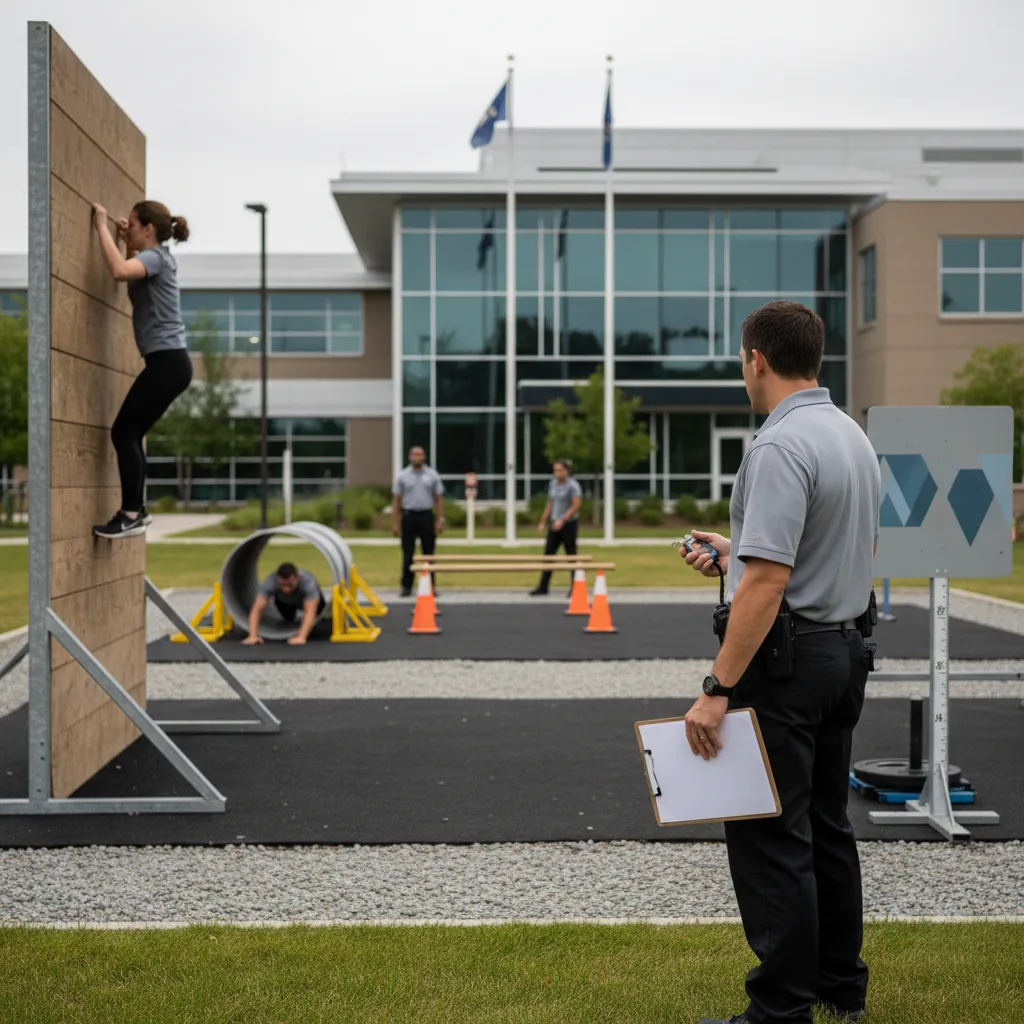
Passing the exam is only the first step in a hiring process that typically takes four to nine months from application to academy start date. Once your national police officer selection test post study guide work pays off with a passing score, you move into the physical agility test, which most agencies administer within two to four weeks of the written exam. Standards vary widely, but the most common battery includes a 1.5 mile run, push-ups, sit-ups, and either a vertical jump or an obstacle course mimicking a foot pursuit.
The oral board interview follows. A panel of three to five sworn officers and civilian human resources staff will ask scenario-based questions designed to evaluate your judgment, integrity, communication skills, and motivation for choosing police work. Common questions explore how you would respond to a fellow officer using excessive force, why you want to leave your current career, how you have handled past conflict, and what you understand about the specific community the agency serves. Prepare specific personal examples for each common theme.
The background investigation is the longest and most invasive stage. Investigators will contact every employer, neighbor, relative, and reference you list, plus many you did not. They will pull credit reports, criminal histories from every jurisdiction you have lived in, military records, school transcripts, and social media archives going back at least ten years. Honesty during the personal history questionnaire is the single most important factor here, because investigators routinely disqualify candidates for lying about minor incidents that would have been forgivable if disclosed.
The polygraph examination typically follows or accompanies the background investigation. Polygraph results are not admissible in court but remain a standard hiring tool in law enforcement. Questions focus on undisclosed drug use, undetected crimes, employment-related theft, and the truthfulness of your application. The polygraph is not a memory test; small forgotten details are not what triggers a failure. Deliberate deception, especially repeated deception about the same topic, is what gets candidates removed from consideration.
Psychological evaluation combines written personality inventories such as the MMPI with a clinical interview by a licensed psychologist. The goal is to confirm that you can handle the stress, trauma, and authority of police work without developing dangerous behavioral patterns. Answer honestly. Trying to game the test often produces inconsistent profiles that flag you for additional scrutiny, while genuine answers from a mentally healthy candidate almost always produce passing results.
The medical examination and drug screen close the process. Vision, hearing, cardiovascular health, and overall fitness are evaluated against agency standards, which are often more lenient than candidates fear. Corrected vision is acceptable at most agencies, and tattoos that were once disqualifying are now permitted in most jurisdictions as long as they are not on the face or neck and do not contain offensive imagery.
Once you clear every stage, you receive a conditional offer and a reporting date for the academy. Academy training lasts sixteen to thirty weeks depending on the state, after which you spend an additional twelve to twenty weeks in field training with a senior officer before patrolling solo. The entire journey from first application to solo patrol takes most candidates twelve to eighteen months, but the work you do studying for the written exam now creates the foundation that carries you through every subsequent stage.
With your test date approaching, the final two weeks of preparation matter more than any single previous month of study. Shift away from learning new material and focus exclusively on timed practice, error review, and physical readiness for sitting through a two-hour, ten-minute examination under fluorescent lights. The the national police officer selection test rewards candidates who have rehearsed the experience so many times that nothing on test day surprises them, including the cold room, the noisy proctor, and the candidate next to you who finishes the math section in nine minutes.
Run at least one full-length, timed practice exam in the final week using only the materials you would have on test day, which usually means two number-two pencils, a quiet space, and a stopwatch you cannot see during sections. Resist the urge to pause for snacks, bathroom breaks, or phone checks. The closer you can simulate the real testing environment, the smaller the gap between your practice scores and your live score on the day that counts.
Review every missed question from your practice tests and write a one-sentence explanation of why the correct answer is correct. This forces you to engage with the reasoning rather than simply noting that you got something wrong. Patterns will emerge. Many candidates discover they consistently miss percentage-of-percentage questions, or always mix up affect and effect, or rush past the second paragraph of long reading passages. Targeting your three or four most common error types in the final week often yields more score improvement than studying new content.
Manage your physical readiness with the same discipline you apply to academic prep. Sleep at least seven hours each night for the final week, hydrate consistently, and avoid heavy alcohol or significant schedule changes. Caffeine is fine if it is part of your normal routine, but the morning of the test is not the day to try a new pre-workout supplement or skip breakfast. Eat a meal you have eaten many times before, leave for the testing site with thirty minutes of buffer, and bring water and a light snack for breaks.
On test day, manage your pacing aggressively from question one. If a math question takes more than seventy-five seconds, mark your best guess, circle it on the booklet if permitted, and move on. Return to flagged questions only after completing every other item in that section. The same rule applies to reading and grammar. One difficult question is worth no more than one easy question, and time spent agonizing over an outlier is time stolen from items you could have answered correctly.
Approach the incident report section with a deliberate structure. Spend the first three minutes organizing the facts into chronological order on your scratch paper, the next ten minutes writing the narrative in plain past-tense prose, and the final two minutes proofreading for spelling, verb tense consistency, and missing facts. A clean, organized, complete report scores higher than a longer, more elaborate one with grammatical errors and missing details.
Finally, trust your preparation. Candidates who have run multiple timed practice exams, drilled their weak areas, and slept well almost always score within a few points of their practice average. The test is not designed to trick well-prepared applicants. It is designed to identify candidates with the cognitive baseline to succeed in the academy, and the work you have done to read this guide and follow its recommendations puts you firmly in that group. Walk in expecting to pass, and the data overwhelmingly suggests you will.
NPOST Questions and Answers

About the Author

Educational Psychologist & Academic Test Preparation Expert
Columbia University Teachers CollegeDr. Lisa Patel holds a Doctorate in Education from Columbia University Teachers College and has spent 17 years researching standardized test design and academic assessment. She has developed preparation programs for SAT, ACT, GRE, LSAT, UCAT, and numerous professional licensing exams, helping students of all backgrounds achieve their target scores.
Join the Discussion
Connect with other students preparing for this exam. Share tips, ask questions, and get advice from people who have been there.
View discussion (8 replies)