
National Police Officer Selection Test & Police Physical Fitness Test: Complete 2026 September Guide to Format, Scoring, and Passing
Master the national police officer selection test (POST): 💡 format, scoring, free practice questions, and a proven study plan to pass on your first try.
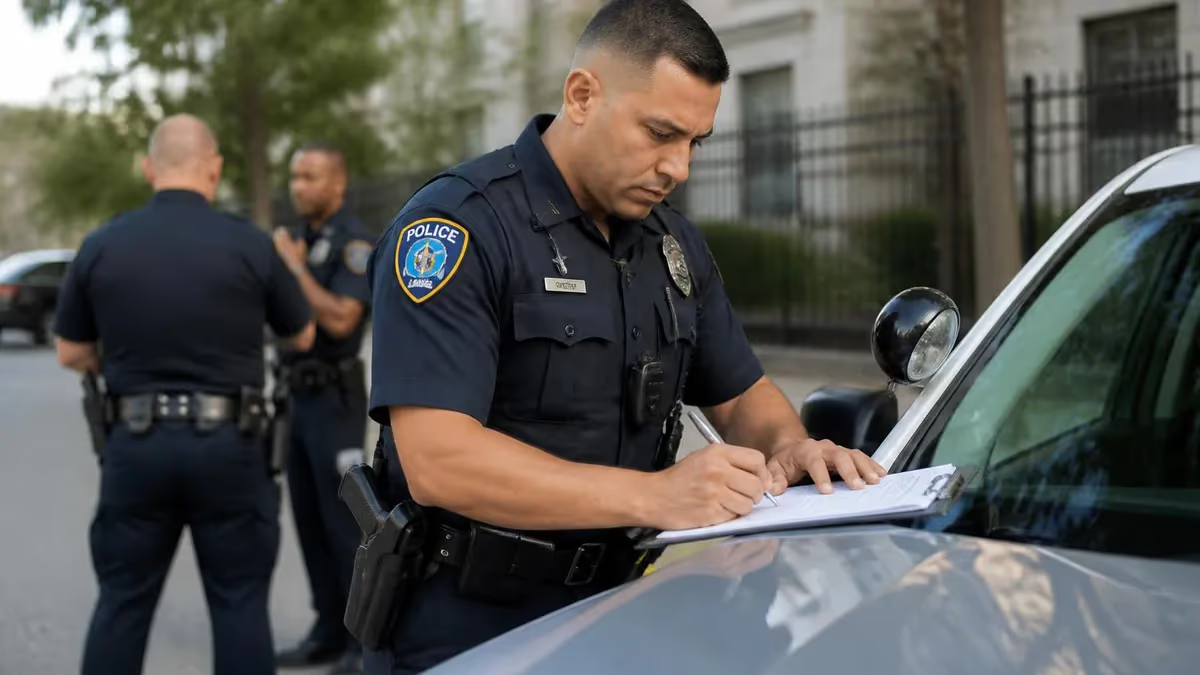
If you are chasing a badge, two hurdles stand between you and the academy: the police physical fitness test and the written exam most agencies call the national police officer selection test. The physical fitness test measures whether your body can survive a foot pursuit, a fence climb, and a struggle to handcuff a resisting subject. The written exam measures whether your brain can read a statute, calculate a speed, and write a coherent report. Departments weigh both, and a stumble on either one ends the process before it really begins.
This guide treats the two halves as one selection gauntlet because that is how hiring boards see them. You cannot bench-press your way past the reading section, and you cannot flash-card your way through a 1.5-mile run. Most candidates underestimate exactly the half that does not match their background. Former athletes blow off the math; honor-roll students assume push-ups are trivial. The applicants who get sworn in are the ones who respect both columns and train both deliberately, starting months ahead rather than the week before the appointment.
The national police officer selection test, frequently abbreviated POST and published by Stanard & Associates, is the written instrument used by hundreds of municipal, county, and state agencies across the United States. It is not a trivia quiz. It samples four skills that field officers use every shift: arithmetic, reading comprehension, grammar, and written report construction. The questions are deliberately plain, but the time pressure and the volume of items trip up people who never practiced under a clock. Familiarity with the format is worth more than raw intelligence here.
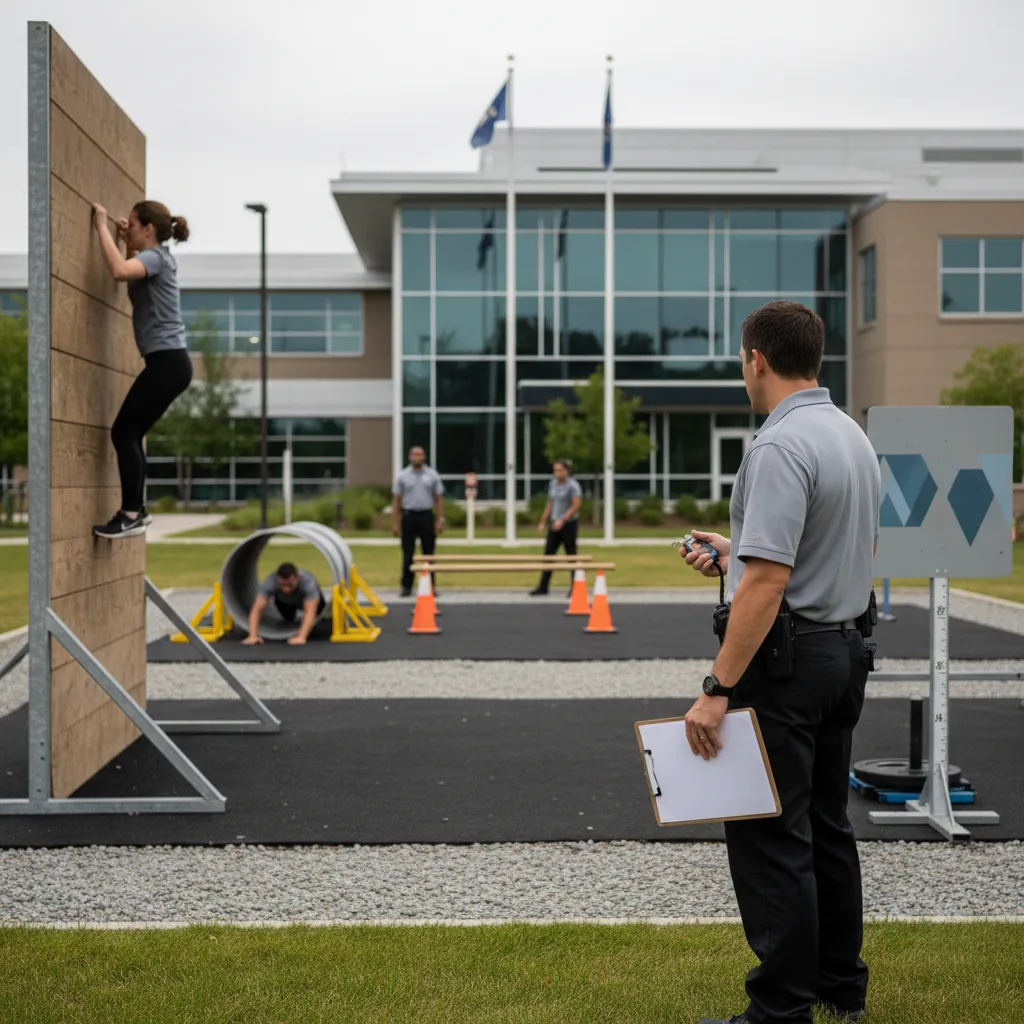
On the physical side, the most common battery in America is the Cooper Standards model, which scores five events against age- and gender-adjusted percentiles: sit-and-reach flexibility, a one-rep-max bench press, a one-minute sit-up test, a one-minute push-up test, and a 1.5-mile run. Some departments swap in a Physical Abilities Test, or PAT, that mimics job tasks instead, like dragging a 165-pound dummy or scaling a six-foot wall. Knowing which model your target agency uses changes how you train completely.
What this article delivers is concrete: the exact event standards, the scoring thresholds that separate pass from fail, the four written subjects with sample problems, a 12-week training and study schedule, and the mistakes that quietly disqualify strong candidates. We pull the numbers from published Cooper charts, agency academy handbooks, and the POST examiner materials so you are not guessing about what good enough actually means in your county or your target city.
By the end you will know what a passing score looks like, how to build it from wherever you are today, and how free practice tools can sharpen the written half while you build the physical half in the gym. The selection process is demanding by design, but it is also predictable. Predictable means trainable, and trainable means that a motivated candidate with a calendar and a plan beats a more naturally gifted one who walked in cold. Let us build that plan together, step by step.
Police Selection Testing by the Numbers
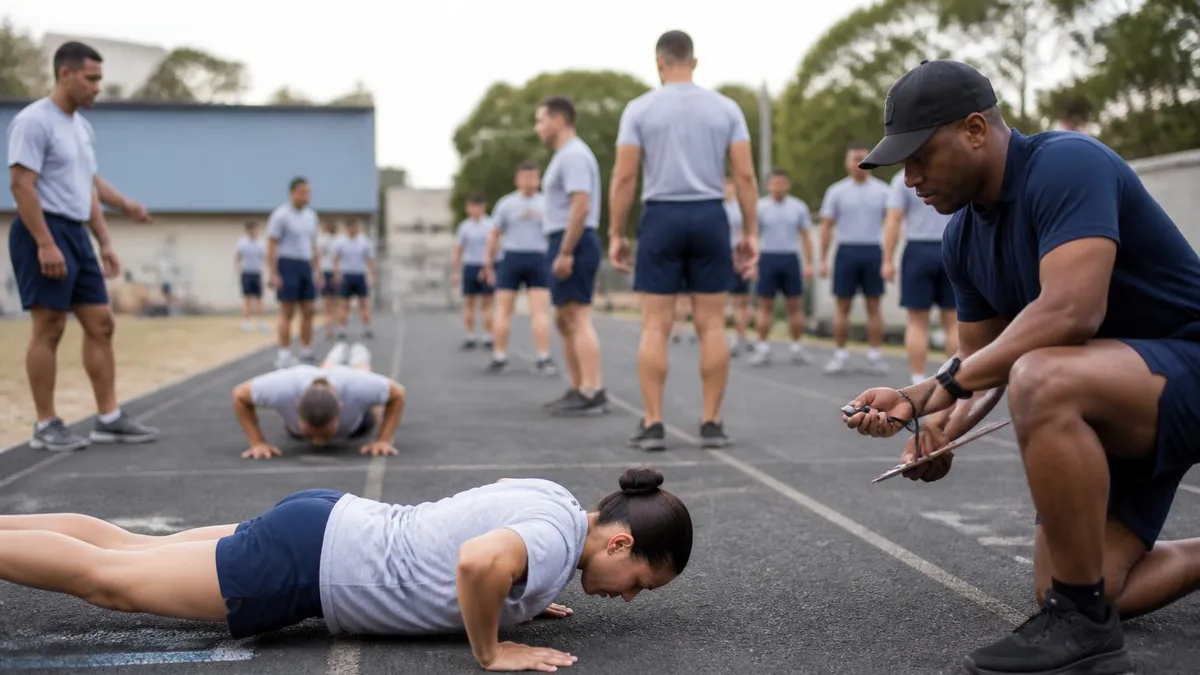
Physical Fitness Test Events & Standards
| Section | Questions | Time | Weight | Notes |
|---|---|---|---|---|
| Sit-and-Reach (Flexibility) | 1 | 3 min | ~15 in | Measured to nearest 0.25 inch |
| 1-Min Sit-Ups (Core) | 1 | 60 sec | ~30+ reps | Bent knees, hands at chest |
| 1-Rep Max Bench (Upper Strength) | 1 | 5 min | ~0.75x BW | Ratio of weight to body weight |
| 1-Min Push-Ups (Endurance) | 1 | 60 sec | ~25+ reps | Full range, no rest on floor |
| 1.5-Mile Run (Cardio) | 1 | ~14 min | Pass/Fail | Track or treadmill |
| Total | 5 | Approx. 45 min | 100% |
Understanding how the physical fitness test is scored removes most of the fear around it. The dominant scoring framework is the Cooper Institute standard, which converts your raw performance in each event into a percentile rank based on a large reference population, then adjusts that rank for your age and gender. A 25-year-old man and a 45-year-old woman are not held to identical raw numbers, because the standards recognize that physiology changes with age. Most academies set the passing bar at the 40th percentile, though competitive agencies push it toward the 50th.
Take the 1.5-mile run as the clearest example. For a man aged 20 to 29, the 40th percentile sits around 12 minutes 51 seconds, while a woman in the same bracket needs roughly 15 minutes 26 seconds. Push that candidate into the 40 to 49 bracket and the male standard relaxes to about 14 minutes 4 seconds. These numbers are not arbitrary; they come from decades of Cooper data, and your target academy publishes its exact cutoff in its applicant handbook, which you should download before you train a single day.
The push-up and sit-up events are deceptively technical. Examiners do not count repetitions that fail the form standard, and that single rule sinks many candidates who trained sloppily. A push-up only counts when your chest descends to a fist-height or to the floor and your elbows lock out at the top, with no sagging hips and no resting. Sit-ups require your shoulder blades to touch the mat and your elbows or hands to reach the knees. Train to the standard, not to your ego or your comfort.
The bench press is scored as a ratio of weight lifted to your body weight rather than an absolute number, which keeps the test fair across body sizes. A 40th-percentile young male typically benches about 0.99 times his body weight, while the female standard sits near 0.59. This ratio approach means losing excess weight can improve your score even if your raw strength stays flat, a useful lever in the final weeks. Flexibility, measured by the sit-and-reach box, rounds out the battery and is the easiest event to improve quickly with daily stretching.
A growing number of departments have replaced the Cooper battery with a job-related Physical Abilities Test, or PAT. Instead of isolated events, the PAT strings together simulated duties on a clock: sprinting 220 yards, climbing a six-foot wall or chain-link fence, dragging a 165-pound dummy 32 feet, dry-firing a trigger pull a set number of times, and completing the circuit under a maximum time, often around four to six minutes. The PAT rewards anaerobic power and grip strength far more than the steady-state Cooper run ever does.
Before you build any training plan, confirm exactly which model your agency uses and pull the published cutoffs. Pair that physical research with a realistic look at the written half through the national police officer selection test post, because most candidates have to clear both within the same hiring window. Knowing your numbers in both columns turns a vague goal into a measurable target, and a measurable target is one you can actually hit with weeks of focused, progressive work rather than a last-minute scramble the night before.
National Police Officer Selection Test Study Guide: Written Subjects
The math section covers practical arithmetic that officers use daily: addition, subtraction, multiplication, division, fractions, decimals, percentages, and word problems built around speed, distance, time, and evidence counts. A typical item asks you to calculate a vehicle's speed given a distance and time, or to total the value of stolen property. Calculators are usually prohibited, so mental math fluency matters as much as knowing the formula itself when you are working under the clock.
Reading comprehension presents short passages resembling policies, statutes, or incident reports, then asks what the passage states or implies. Success depends on reading carefully rather than skimming, since answer choices are designed to punish assumptions. Practicing with a national police officer selection test study guide trains you to locate the exact sentence that supports each answer instead of relying on memory or on what you simply expected the passage to say before reading it.

Cooper Standards vs. Job-Related PAT: Which Is Easier?
- +Cooper standards are published openly so you know exact targets in advance
- +Each Cooper event is trainable in isolation with clear progressions
- +Age- and gender-adjusted percentiles keep Cooper scoring fair
- +Cooper events use common gym equipment you can replicate at home
- +Cooper retests are often allowed, giving candidates second chances
- +Improving body-weight ratio boosts multiple Cooper scores at once
- −PAT circuits demand anaerobic power that steady cardio does not build
- −Wall climbs and dummy drags reward grip and explosive strength heavily
- −PAT time limits leave little margin for a slow transition between tasks
- −PAT course layouts vary by agency and are harder to rehearse exactly
- −A single dropped task can fail the entire PAT regardless of fitness
- −PAT often must be completed in uniform or duty gear, adding weight
National Police Officer Selection Test Practice & Pre-Test Checklist
- ✓Download your target agency's applicant fitness handbook and note exact cutoffs.
- ✓Confirm whether the department uses Cooper standards or a job-related PAT.
- ✓Schedule a baseline fitness test eight to twelve weeks before exam day.
- ✓Take a full-length national police officer selection practice test for a written baseline.
- ✓Build a weekly run plan progressing toward your 1.5-mile target time.
- ✓Train push-ups and sit-ups to strict examiner form, not loose reps.
- ✓Stretch daily to improve your sit-and-reach flexibility score.
- ✓Review a commonly-confused-words list to sharpen grammar and spelling.
- ✓Practice timed math drills without a calculator three times weekly.
- ✓Sleep at least seven hours nightly during the final test week.
- ✓Hydrate and eat a light carbohydrate meal before the physical test.
- ✓Arrive early, in proper attire, with all required identification documents.
Know your agency's exact percentile cutoff before you train
Most candidates train toward a vague idea of being fit enough and discover too late that their academy sets the bar at the 50th percentile, not the 40th. Pull the published cutoff first, calculate the raw numbers it requires for your age and gender, and train to beat those specific targets by a comfortable margin so that test-day nerves never push you below the line.
The fastest way to fail a police physical fitness test is to make one of a handful of predictable training mistakes, and almost every one of them is avoidable with a little foresight. The first and most common is starting too late. Cardiovascular fitness and strength both improve on a timeline measured in weeks, not days. A candidate who begins serious training two weeks out cannot meaningfully change their 1.5-mile time, and overtraining in panic mode often produces shin splints or a strained back that sidelines them entirely.
The second mistake is training the wrong energy system. Many applicants log long, slow, steady-state runs because that is what feels like real cardio, yet a job-related PAT demands explosive anaerobic bursts: sprinting, climbing, and dragging. If your agency uses a PAT, you need interval sprints, hill repeats, and grip work, not just three-mile jogs. Conversely, if your agency uses the Cooper 1.5-mile run, pure sprint training will leave you gassed at the one-mile mark. Match your training stimulus to the actual test you face.
The third mistake is ignoring form on the bodyweight events. Candidates who do hundreds of half-range push-ups in practice are stunned when an examiner discounts a third of their reps for not reaching full depth or lockout. Train every single repetition to the published standard from day one, ideally with a partner or a phone propped to film you, so the movement pattern you groove is the exact one the test rewards. Sloppy practice reps actively sabotage your scored reps on the day that counts.
The fourth mistake is neglecting flexibility and recovery. The sit-and-reach is the easiest event to improve, yet candidates skip stretching because it feels unimportant next to the run. Five minutes of daily hamstring and lower-back stretching can move you from a failing reach to a comfortable pass within a few weeks. Recovery matters too: muscles adapt during rest, not during the workout itself, so cramming daily max-effort sessions without rest days produces plateaus and injuries rather than measurable gains.
The fifth mistake is treating the written exam as an afterthought. Strong, athletic candidates routinely assume they will breeze through the math and reading, then panic when the no-calculator arithmetic and dense reading passages eat their clock. The written exam and the fitness test are usually scheduled close together, so you must prepare both in parallel. Working through a national police officer selection test post study guide while you train physically keeps both halves moving forward at once.
The sixth mistake is dehydration and poor fueling on test day. Showing up to a maximal physical battery underfed or dehydrated tanks performance across every event, sometimes by a full percentile bracket. A light carbohydrate meal two hours before, steady water intake the day before, and avoiding heavy or unfamiliar food the night before all protect the fitness you worked weeks to build. The smallest logistical errors erase the largest training gains, so plan the final 48 hours as carefully as you planned the workouts themselves.
On most physical fitness tests, falling below the cutoff in even one event fails the whole assessment, regardless of how strong your other scores are. Do not over-index on your strongest event and neglect your weakest. Identify your lowest-scoring event early and give it the most training attention, because the test is only as strong as your single weakest link.
A structured twelve-week plan is what separates candidates who pass comfortably from those who scrape by or fail. The first four weeks build a base: easy-paced runs three times a week to develop aerobic capacity, full-body strength training twice a week, and daily flexibility work. In this phase you are not chasing test numbers; you are building the engine and the connective-tissue resilience that lets you train hard later without breaking down. Resist the urge to test yourself maximally too soon and risk an early, avoidable injury.
Weeks five through eight shift toward specificity. Now your runs include interval work tuned to your test: tempo runs if you face the Cooper 1.5-mile, sprint repeats and circuit drills if you face a PAT. Strength sessions move toward the bench-press ratio you need and toward grip and explosive power. You begin doing timed push-up and sit-up sets to the strict standard so you can track real, scoreable progress. Retest your baseline at the end of week eight to recalibrate your remaining plan.
The final four weeks are about peaking and polishing. You taper volume slightly to arrive fresh, run full mock fitness tests under realistic conditions, and rehearse the exact event sequence your agency uses. On the written side, you take full-length timed practice exams to build stamina and pacing. The goal of this phase is not to gain new fitness but to convert the fitness you already built into reliable, repeatable test-day performance that survives nerves and a surge of adrenaline.
Parallel to the physical plan, your written study should follow the same arc: broad review early, targeted weakness work in the middle, and full timed simulations at the end. Spend the first weeks refreshing arithmetic and grammar fundamentals, the middle weeks drilling your weakest subject, and the final weeks taking complete practice exams. Reviewing the national police officer selection test format repeatedly removes the surprise factor that causes careless errors under time pressure.
Throughout all twelve weeks, track your numbers in a simple log: run times, rep counts, bench ratio, reach distance, and practice-exam scores. Data turns a vague sense of getting better into hard proof, and proof builds the quiet confidence that steadies you on test day. A log also exposes plateaus early, so you can adjust your approach before a stalled event becomes a failed one. What gets measured gets managed, and police selection testing rewards managed, deliberate preparation every single time.
Finally, build in two or three full rehearsals where you replicate test-day logistics exactly: the same wake time, the same pre-test meal, the same warm-up, and the same clothing. These rehearsals surface problems while they are still fixable, like discovering that your usual breakfast leaves you sluggish or that your running shoes cause a hot spot at mile one. By the time the real test arrives, nothing about the day should feel new, and that familiarity is itself a performance advantage that many of your competitors will skip entirely.
With your training and study plans built, the final layer is test-day execution, where small, practical decisions protect everything you have worked toward. Begin with sleep: aim for seven to eight hours each night during the last week, not just the night before, because a single good night cannot offset a week of accumulated deficit. Sleep is when your body consolidates strength adaptations and your brain consolidates the practice problems you drilled, so treat rest as part of training rather than a luxury you can afford to skip.
On the morning of the physical test, eat a light, familiar carbohydrate-forward meal about two hours out, something like oatmeal and a banana, and avoid heavy fats or anything new that could upset your stomach mid-run. Hydrate steadily the day before rather than chugging water at the last minute, which only sends you to the bathroom. Arrive early enough to complete an unhurried dynamic warm-up: leg swings, light jogging, and mobility drills that raise your heart rate and loosen your joints without fatiguing you beforehand.
Pace the run intelligently. The most common 1.5-mile mistake is sprinting the first lap on adrenaline and then collapsing into a walk by the halfway point, posting a far slower total than an even pace would produce. Know your target split per lap from your training log and hold it. Bank nothing; spend evenly. On the push-up and sit-up events, settle into a sustainable rhythm rather than burning out in the first fifteen seconds, and breathe deliberately so you do not gas your muscles prematurely and stall.
For the written exam, manage the clock before you manage the content. Do a quick pass answering every question you find easy, then return to the harder items, because every question typically carries equal weight and a hard problem is worth no more than an easy one. Never leave a question blank if there is no penalty for guessing; an educated guess beats a guaranteed zero. On the no-calculator math, write out your work neatly so a small arithmetic slip does not cascade into a wrong final answer.
For reading and grammar, trust the text over your assumptions. The correct answer is the one the passage actually supports, even when it contradicts what you expected or what seems true in the real world. For grammar items, read each option aloud in your head and listen for the version that flows cleanly without a misplaced comma or a disagreeing verb. On report-writing tasks, prioritize a strict chronological order and complete coverage of who, what, when, where, why, and how over any flashy prose.
If your agency allows retests, a single failed event is a setback, not the end of your career; many sworn officers failed an early attempt and passed cleanly the next time after targeted work on a weakness. Treat any failure as data, request your specific scores, attack the weak event for several weeks, and return stronger. Reviewing your full preparation approach between attempts often reveals exactly which subject or event quietly cost you the points and how to close that gap.
Above all, remember that this selection process is designed to be passed by prepared people. The standards are public, the subjects are knowable, and the timeline is generous if you start early enough. Candidates who respect both the physical and written halves, train each to its specific demands, and rehearse the logistics walk in on test day calm and ready. That calm is earned, not innate, and it is the surest single predictor that the badge you are chasing is genuinely within reach.
NPOST Questions and Answers

Police Hiring Process: Complete Guide to NPOST, Background Checks, and Polygraph Requirements 2026

Police Practice Test: Complete NPOST Prep Guide with Free Questions and Answer Keys for 2026
Police Exam Practice Test: Free Questions, Study Guide & Pass Tips
NPOST - Police Test: Complete Study Guide 2026
NPOST Police Test Video Answers
About the Author

Educational Psychologist & Academic Test Preparation Expert
Columbia University Teachers CollegeDr. Lisa Patel holds a Doctorate in Education from Columbia University Teachers College and has spent 17 years researching standardized test design and academic assessment. She has developed preparation programs for SAT, ACT, GRE, LSAT, UCAT, and numerous professional licensing exams, helping students of all backgrounds achieve their target scores.
Join the Discussion
Connect with other students preparing for this exam. Share tips, ask questions, and get advice from people who have been there.
View discussion (8 replies)