
Police Physical Test: Complete NPOST Prep Guide for 2026 September
✏️ Master the police physical test with our complete NPOST prep guide. Exam format, scoring, study tips, and free practice questions for 2026 September.

The national police officer selection test is one of the most important hurdles you will face on your path to becoming a law enforcement officer in the United States. Known widely as the NPOST, this standardized written exam is used by hundreds of agencies across the country to screen candidates for cognitive aptitude before they ever set foot in an academy.
Understanding what the police physical test entails — both the written cognitive portion and the accompanying physical fitness component — gives you a decisive edge over candidates who walk in underprepared. This guide covers every critical detail you need to know.
Many aspiring officers conflate the written NPOST exam with the physical agility test, and agencies often administer both components during the same hiring cycle. The written portion evaluates your reading comprehension, mathematics, grammar, and incident report writing skills, while the physical component assesses cardiovascular endurance, muscular strength, and flexibility. Agencies weight these components differently, but failing either one typically removes you from the candidate pool entirely. That means preparation across both dimensions is non-negotiable if you want to advance to the background investigation and psychological evaluation stages.
One of the most common mistakes candidates make is assuming that prior athletic experience or a college degree alone will carry them through the selection process. The NPOST is a timed, standardized exam with specific question formats that reward deliberate practice over general intelligence. Similarly, the physical fitness test uses normed scoring tables based on age and gender, so a candidate who has never run a timed 1.5-mile or completed a structured push-up test may underperform significantly even if they consider themselves fit. Structured preparation is the only reliable path to a competitive score on both assessments.
The national police officer selection test is developed and maintained by Stanard & Associates, the same firm that has administered law enforcement testing since the 1980s. Because the test is nationally normed, your raw score is compared against a large reference population of police applicants — not just the candidates in your specific agency's hiring cohort. This means a strong score not only helps you pass the local minimum but also positions you favorably for competitive agencies that rank candidates by score before extending conditional offers.
Preparation timelines vary depending on your baseline abilities. Candidates with strong math and reading skills who are already physically active may need only four to six weeks of focused review. Candidates who have been out of school for several years or who have not followed a structured fitness routine may benefit from a twelve-week preparation window. Either way, beginning with a diagnostic self-assessment — completing a timed practice test under realistic conditions and running a timed 1.5-mile — gives you an honest baseline from which to build a realistic study and training schedule.
Throughout this guide you will find detailed breakdowns of the NPOST exam format, the physical fitness standards used by most agencies, subject-specific study strategies, and links to free practice questions that mirror the actual test content. Whether you are applying to a municipal police department, a county sheriff's office, or a state law enforcement agency, the fundamentals covered here apply broadly. Bookmark this page and return to it regularly as you work through each phase of your preparation.
By the time you finish reading, you will understand exactly what scores you need to achieve, which subject areas demand the most attention, how to structure your physical training in the weeks before testing, and which free resources give you the most accurate preview of real exam questions. Let's start with the numbers that define success on this exam.
NPOST Police Physical Test by the Numbers
NPOST Exam Format
| Section | Questions | Time | Weight | Notes |
|---|---|---|---|---|
| Reading Comprehension | 20 | 30 min | 19% | Passages + questions |
| Mathematics | 20 | 30 min | 19% | Arithmetic, algebra, problem-solving |
| Grammar & Vocabulary | 20 | 20 min | 19% | Sentence structure, word usage |
| Incident Report Writing | 20 | 20 min | 19% | Logic-based narrative completion |
| Writing Skills (Clarity) | 25 | 30 min | 24% | Sentence correction and clarity |
| Total | 105 | 2 hours 30 minutes | 100% |
Mastering the written portion of the national police officer selection test post requires a subject-by-subject approach rather than generic test-taking advice. Each of the five NPOST sections draws on a distinct skill set, and the most effective candidates allocate their study hours proportionally to their weakest areas rather than spending equal time across all subjects. Begin by completing a full-length diagnostic practice test under timed conditions, then score each section separately to identify your biggest gaps before building your weekly study plan.
Reading comprehension on the NPOST presents short to medium-length passages drawn from topics relevant to law enforcement — crime reports, legal statutes, departmental policies, and community communications. Questions test your ability to identify the main idea, draw logical inferences, interpret vocabulary in context, and distinguish fact from opinion. The most effective practice method is to read each passage actively: underline key claims, circle transition words that signal contrast or causation, and briefly summarize each paragraph in the margin before answering questions. This slows initial reading slightly but dramatically improves accuracy on inference questions.
Mathematics on the NPOST covers arithmetic operations, fractions, decimals, percentages, basic algebra, and applied word problems involving rates, ratios, and unit conversions. The word problems are typically set in law enforcement contexts — calculating vehicle speed from distance and time, determining blood alcohol content from formula inputs, or computing overtime pay for a shift schedule.
Candidates who struggle with word problems benefit most from practicing the habit of identifying the unknown quantity first, then working backwards through the given information to build the equation. A calculator is not permitted, so mental math fluency with multiplication tables and percentage shortcuts pays dividends.
Grammar and vocabulary questions on the NPOST assess your ability to recognize correct sentence structure, identify subject-verb agreement errors, spot misplaced modifiers, and choose the most precise word from a set of near-synonyms. Police report writing demands exact language, and the exam reflects that standard. The most efficient preparation strategy is to review the twenty most commonly tested grammatical rules — comma splices, pronoun-antecedent agreement, parallel structure, and apostrophe usage among them — and then complete sentence-correction exercises that expose you to realistic error patterns. Reading quality nonfiction prose daily also sharpens your intuitive sense for grammatical correctness.
The incident report writing section presents a sequence of information — witness statements, officer observations, timelines — and asks you to identify the most logical and accurate way to organize or complete a narrative report. This section rewards candidates who understand the standard elements of a police report: date, time, location, subjects involved, sequence of events, and observed evidence. Practicing with sample incident scenarios, where you write out a complete report and then compare it to a model answer, builds the pattern recognition skills that make multiple-choice report questions feel intuitive rather than confusing.
Writing skills and clarity questions ask you to identify the clearest, most concise version of a sentence from among four options. Common issues include redundancy, passive voice overuse, ambiguous pronoun reference, and unnecessarily complex sentence structures. The guiding principle for these questions is that the best police writing communicates a single clear idea in the fewest words without sacrificing accuracy. When two options seem equally clear, the shorter one is almost always correct. Practicing these questions daily for two to three weeks measurably improves both your test score and your actual report-writing quality in the field.
Consistency matters more than intensity in written test preparation. Candidates who study thirty to forty-five minutes per day, five days per week, consistently outperform candidates who cram for three hours on weekends. Spaced repetition — reviewing material at increasing intervals — is especially effective for vocabulary retention and grammar rules. Combine spaced repetition flashcards with timed section practice, and you will enter test day with both deep conceptual understanding and the test-pacing habits needed to complete all 105 questions without running out of time.
Physical Fitness Standards by Agency Type
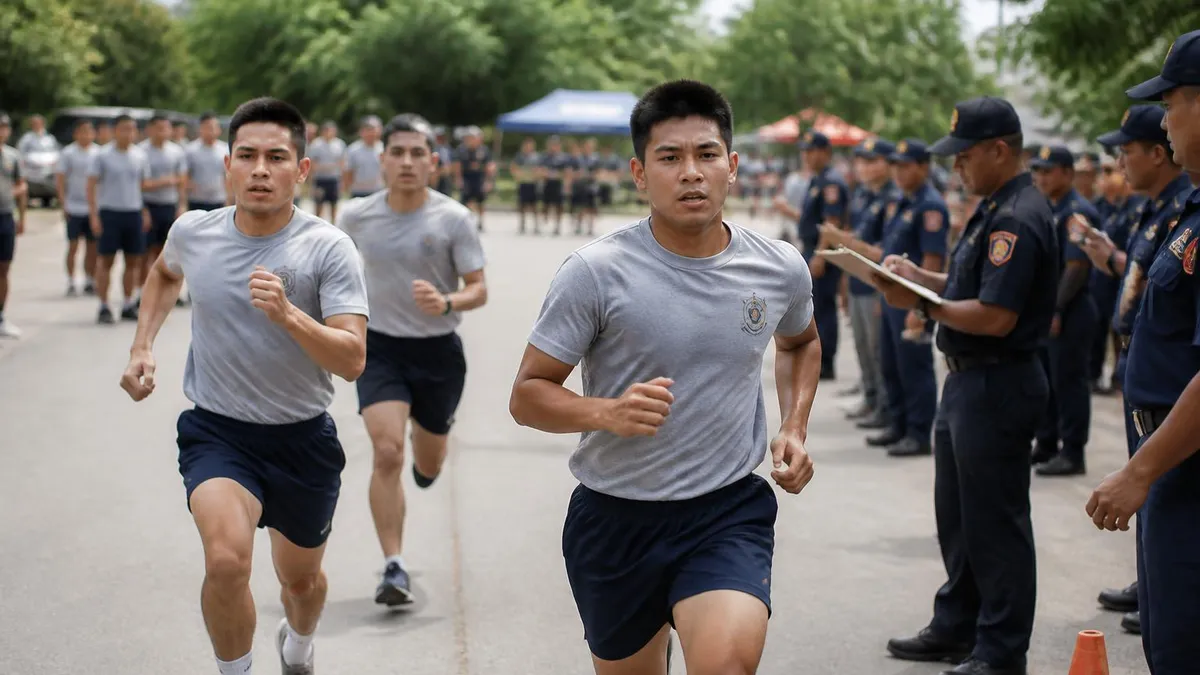
Municipal police departments — city and town agencies — typically use the Cooper Institute fitness norms or a custom Physical Abilities Test (PAT) developed by an occupational analyst. Most require candidates to score at or above the 40th percentile for their age and gender group on each of the four core components: 1.5-mile run, push-ups, sit-ups, and sit-and-reach flexibility. For a 25-year-old male, this typically means completing the 1.5-mile run in under 13 minutes 35 seconds and performing at least 35 push-ups without stopping.
Scoring below the 40th percentile on even one component usually disqualifies the candidate for that hiring cycle, though some agencies allow a single retest within 30 days. Preparation should begin at least 10 weeks before the scheduled test date, with running volume increasing gradually to avoid injury. Strength training for push-ups and sit-ups should emphasize muscular endurance through higher-repetition sets rather than maximum-load lifting, as the test measures sustained output over multiple repetitions rather than single-rep strength.

NPOST Preparation: Advantages and Challenges to Expect
- +Standardized format means you can practice with authentic question types before test day
- +NPOST scores are transferable — many agencies accept scores from recent tests at other departments
- +Written exam covers core literacy and numeracy skills you can improve significantly with structured practice
- +Physical fitness standards are published in advance, allowing precise, targeted athletic preparation
- +Free and low-cost practice resources are widely available online for every NPOST subject area
- +Passing the NPOST with a competitive score puts you ahead of the majority of the applicant pool
- −No calculator permitted on the math section, requiring mental arithmetic fluency under time pressure
- −Physical test standards vary by agency, making it difficult to train for one universal benchmark
- −Timed sections penalize candidates who read slowly or second-guess multiple-choice answers
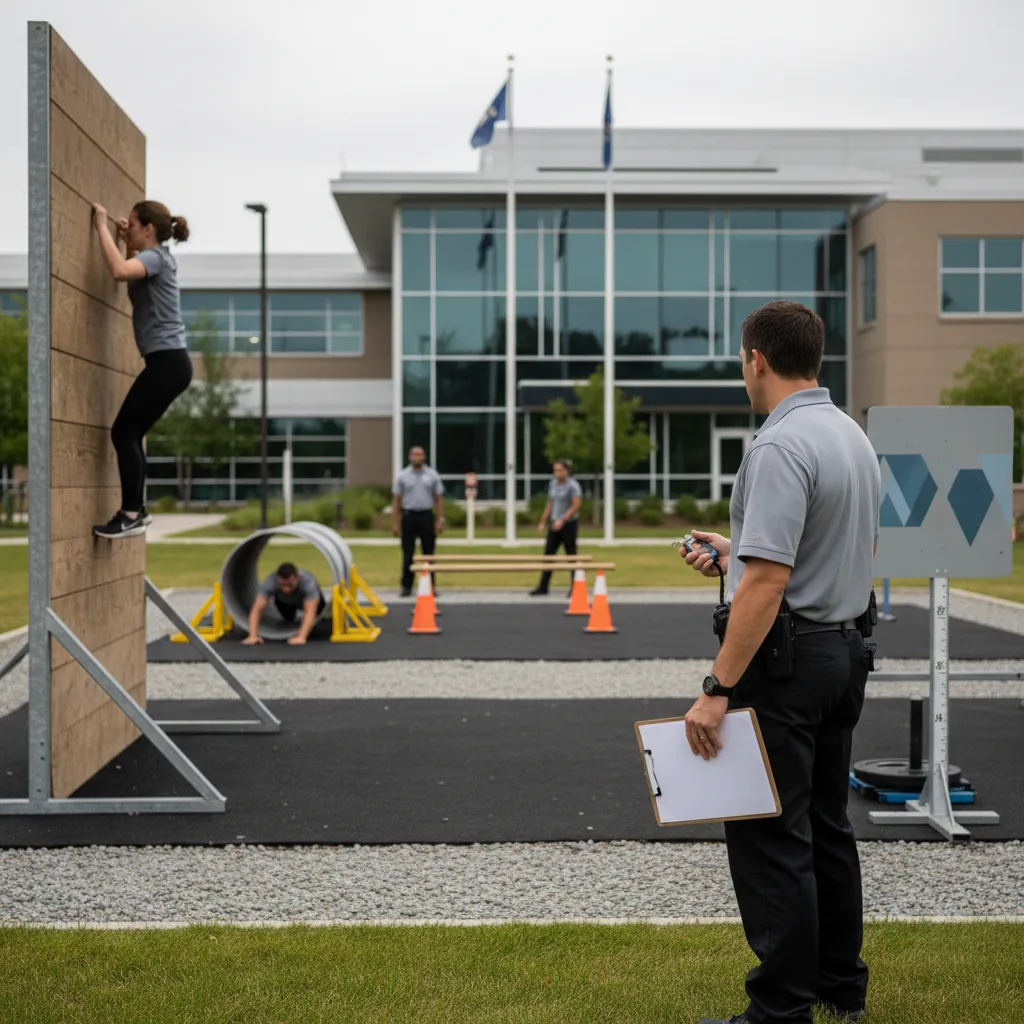
- −Physical agility test components like obstacle courses are hard to replicate without specialized training facilities
- −A single failed component — written or physical — typically eliminates candidates from the current cycle
- −Test anxiety and unfamiliar testing environments can suppress scores even for well-prepared candidates
NPOST Preparation Checklist: 10 Steps to Test-Day Readiness
- ✓Complete a full-length timed NPOST practice test to establish your baseline score in each section.
- ✓Identify your two weakest subject areas and allocate 60% of your study hours to improving them.
- ✓Run a timed 1.5-mile at race effort to establish your aerobic baseline at least 10 weeks before testing.
- ✓Review agency-specific physical fitness standards and confirm the exact events, norms, and passing thresholds.
- ✓Build a weekly study schedule with 30-45 minute daily sessions and at least one full practice test per week.
- ✓Practice mental arithmetic daily — multiplication tables, percentage calculations, and unit conversions without a calculator.
- ✓Complete one incident report writing exercise per week using real scenario prompts from practice books.
- ✓Incorporate progressive overload into your physical training by adding repetitions or cutting run time each week.
- ✓Sleep 7-9 hours per night during your preparation period to consolidate memory and optimize physical recovery.
- ✓Confirm test date, location, required identification documents, and reporting time at least one week in advance.

Competitive Candidates Score Above the 70th Percentile
Most agencies set a minimum passing score around the 40th to 50th percentile, but the candidates who receive conditional offers first are typically those who score above the 70th percentile on both the written and physical components. If your target agency ranks candidates by composite score before extending academy invitations, every additional point on the written test and every second shaved off your 1.5-mile time directly improves your position in the hiring queue. Aim higher than the minimum.
Understanding how NPOST scores translate into hiring decisions is essential for setting realistic preparation goals. The NPOST produces a raw score that is converted to a percentile rank based on a national normative sample of law enforcement applicants. A raw score of, say, 78 correct answers out of 105 might correspond to the 65th percentile, meaning you outperformed 65 percent of all applicants in the norm group. Agencies then set their own minimum percentile cutoff — commonly between the 40th and 55th percentile — and candidates who score below that cutoff are eliminated regardless of their other qualifications.
Some agencies use a compensatory scoring model, where strong performance in one area can offset a weaker performance in another, as long as the overall composite meets the minimum. Other agencies use a multiple-hurdles model, where a candidate must independently meet the minimum standard in every section before advancing. Confirming which model your target agency uses changes how you should prioritize your study time: compensatory models reward doubling down on your strongest subjects, while multiple-hurdles models demand that you bring every subject up to the minimum threshold.
Physical fitness test scoring is typically norm-referenced in the same way. The Cooper Institute publishes detailed tables showing the percentile rankings for each fitness event broken down by age group and gender. A 30-year-old female who completes the 1.5-mile run in 14 minutes and 30 seconds is roughly at the 50th percentile for her cohort, meaning half of all 30-year-old female candidates in the norm database run faster and half run slower. Agencies set their own passing percentile, so reviewing the Cooper Institute norms alongside your agency's specific cutoffs tells you exactly what performance levels you need to achieve.
After passing both the written and physical components, candidates typically advance to a background investigation, which includes a polygraph examination, psychological evaluation, medical exam, and an extensive review of criminal, employment, and financial history. The NPOST score is sometimes revisited at this stage — agencies may rank candidates who are otherwise equally qualified using their written test scores to determine the order in which background investigations are initiated. This is another reason to aim for a competitive score rather than merely clearing the minimum cutoff.
Conditional job offers are typically extended after the background investigation and psychological evaluation are complete. At this stage, the physical fitness standards may be tested again — either as a final confirmation before academy enrollment or during the first week of the academy itself. Candidates who let their fitness slip between the initial screening test and academy entry sometimes face remediation programs or, in rare cases, separation from the academy class. Maintaining your physical conditioning after passing the screening test is therefore just as important as achieving it in the first place.
The the national police officer selection test does not have a published universal pass rate because each agency sets its own cutoff and applicant pools vary widely. However, industry sources suggest that roughly 30 to 40 percent of first-time applicants fail to meet the minimum written or physical standards at their first attempt. This underscores the value of preparation: the candidates who pass on their first attempt are overwhelmingly those who prepared systematically, not those who happened to have the most raw aptitude entering the process.
Agencies in high-demand hiring markets — large metropolitan departments, federal agencies, and state patrol organizations — may receive hundreds of applications for a single academy class and use the NPOST score as a primary screening tool to reduce the candidate pool before investing in background investigation resources. In these competitive environments, every point above the minimum cutoff translates directly into a better competitive position. Treat your NPOST preparation not as a pass-fail hurdle but as an opportunity to distinguish yourself from other qualified candidates.
Most agencies accept NPOST scores that are no more than one to two years old, but some require a fresh test for each new application cycle. If you are applying to multiple agencies simultaneously, confirm each department's score validity policy before submitting a score from a prior test. Some agencies require you to test at their designated testing facility rather than accepting scores from another agency's session, even if the test is identical and recently dated.
The weeks immediately before your test date are when preparation discipline pays its biggest dividends — and when common mistakes can most easily derail an otherwise well-prepared candidate. One of the most frequent errors candidates make in this window is dramatically increasing training volume in a last-minute push to squeeze out extra fitness gains.
The body adapts to training stress over weeks and months, not days, and ramping up run mileage or strength training in the final two weeks typically produces fatigue and elevated injury risk rather than meaningful fitness improvement. The final two weeks should be a taper period: maintain frequency of training sessions but reduce total volume by 20 to 30 percent to arrive at the test feeling fresh and recovered.
On the written test side, the final week should focus on review and confidence-building rather than learning new material. Attempting brand-new subject areas in the last few days before the exam can introduce confusion and anxiety rather than useful knowledge. Instead, revisit your strongest practice areas to build momentum, run one complete timed practice test under exam conditions to recalibrate your pacing, and spend one focused session on your most persistent grammar or math weak spots. The goal in this final week is mental sharpness and confidence, not cramming new content.
Sleep is perhaps the single most underappreciated performance variable in the final stretch of NPOST preparation. Research on cognitive test performance consistently shows that sleep deprivation of even one night reduces working memory, attention, and processing speed — all of which are directly tested by the NPOST. Aim for at least seven to nine hours of sleep every night during the final week, and treat your sleep schedule as seriously as your study schedule. Going to bed at a consistent time each night also reduces the likelihood of sleep disruption the night before the test itself.
Nutrition and hydration in the 48 hours before the physical fitness test significantly affect performance. Carbohydrate loading — increasing your intake of complex carbohydrates in the two days before an aerobic performance test — is a validated strategy for improving sustained cardiovascular performance. Arrive at the physical test well-hydrated: begin drinking extra water 24 hours in advance and avoid alcohol, which dehydrates tissues and disrupts sleep architecture. Eat a balanced meal with moderate carbohydrates and protein two to three hours before the physical test, and avoid experimental foods that might cause digestive discomfort.
For the national police officer selection test post study guide, one overlooked preparation element is familiarizing yourself with the testing environment and administrative procedures in advance. If the written test is administered at a specific facility, visit it before test day to understand the parking situation, check-in procedure, and room layout. Arriving flustered and late after a navigation problem consumes mental bandwidth that should be reserved for the exam itself. Arrive at least 20 to 30 minutes early, bring all required identification documents, and complete any pre-test administrative tasks calmly before the test begins.
Test-taking strategy during the written exam matters as much as content knowledge. Work through each section in order, flagging questions you are uncertain about and returning to them after you have answered all the questions you can answer confidently. Spending too long on a single difficult question early in a timed section often causes candidates to run out of time before reaching easier questions later. On the NPOST, unanswered questions receive no credit, so completing more questions — even with some uncertainty — is generally better than perfecting a smaller subset.
After the exam, resist the impulse to dissect every answer with other candidates in the parking lot. Post-exam rumination about specific questions you may have answered incorrectly serves no practical purpose once the test is submitted and tends to amplify anxiety rather than resolve it.
Focus instead on the elements you controlled well: your preparation process, your time management, your physical performance. Regardless of the outcome, you will emerge from this experience knowing more about your own strengths and development areas — information that is valuable whether you receive a conditional offer or decide to apply again in a future hiring cycle.
Building a practical week-by-week preparation plan ties together all the strategy and content advice covered in this guide into a concrete schedule you can follow starting today. A twelve-week preparation timeline works well for most candidates, providing enough time to develop real fitness gains while also building deep familiarity with every NPOST subject area. Divide the twelve weeks into three four-week phases: diagnostic and foundation building in weeks one through four, intensive skill development in weeks five through eight, and test-specific sharpening in weeks nine through twelve.
During the foundation phase, complete your diagnostic practice test and 1.5-mile time trial in the first week so you have objective baseline data. Use weeks two through four to address your lowest-scoring written subjects and to build a consistent running base of three to four runs per week at conversational pace. This foundation phase is not about peak performance — it is about establishing habits and identifying the specific skills that need the most development. Do not skip this phase in an eagerness to jump straight to intensive practice.
The intensive development phase in weeks five through eight is where the bulk of your score improvement happens. For the written test, complete two to three timed subject-area practice sets per day and attempt at least one full-length practice test each weekend. Review every incorrect answer immediately after each practice session, identifying whether each error stemmed from content knowledge gaps, misreading the question, or time pressure. For physical fitness, introduce interval training — short bursts of fast running with recovery periods — which builds aerobic capacity more efficiently than steady-state runs alone.
Weeks nine through twelve shift the focus from acquisition to consolidation and simulation. Complete at least three full-length timed practice tests in test-center conditions — no phone, no breaks beyond what the actual test allows, strict time limits on each section. Review results carefully but spend the majority of your remaining study time reinforcing your strong areas rather than starting new topics. On the physical side, begin the taper protocol in week eleven, reducing volume while maintaining intensity so your body arrives at the test date in peak condition.
Studying with a partner or in a small group can meaningfully accelerate preparation for some candidates, particularly for the incident report writing section where peer feedback on clarity and organization is valuable. Study groups also create accountability structures that help candidates maintain consistent daily preparation habits across a twelve-week timeline. If you study in a group, ensure that each session has a specific agenda — a defined set of practice questions to complete or a writing exercise to critique — rather than open-ended discussion that can drift into non-productive territory.
Free online resources for NPOST preparation include official practice materials from Stanard & Associates, practice question banks on sites like PracticeTestGeeks.com, and study guides available through public library digital lending programs. Paid options include comprehensive study guides from major test preparation publishers and structured online courses that include video instruction, adaptive practice question banks, and progress tracking. The right resource level depends on your timeline, budget, and learning style, but starting with high-quality free resources and adding paid materials only if your diagnostic scores indicate a significant gap is a cost-effective approach.
The most important thing to remember as you build your preparation plan is that consistency over time beats any single intensive preparation session. The candidates who succeed on the NPOST police physical test are not necessarily the most naturally gifted writers or the fastest runners — they are the candidates who showed up to practice every day, honestly assessed their weaknesses, and made steady incremental improvement across the full preparation window.
That process of disciplined daily work is also, not coincidentally, exactly the kind of character that law enforcement agencies are looking for when they hire the people who will represent their department in the community.
NPOST Questions and Answers

Police Hiring Process: Complete Guide to NPOST, Background Checks, and Polygraph Requirements 2026

Police Practice Test: Complete NPOST Prep Guide with Free Questions and Answer Keys for 2026

National Police Officer Selection Test & Police Physical Fitness Test: Complete 2026 Guide to Format, Scoring, and Passing

Police Exam Practice Test: Free Questions, Study Guide & Pass Tips
NPOST - Police Test: Complete Study Guide 2026
About the Author

Educational Psychologist & Academic Test Preparation Expert
Columbia University Teachers CollegeDr. Lisa Patel holds a Doctorate in Education from Columbia University Teachers College and has spent 17 years researching standardized test design and academic assessment. She has developed preparation programs for SAT, ACT, GRE, LSAT, UCAT, and numerous professional licensing exams, helping students of all backgrounds achieve their target scores.
Join the Discussion
Connect with other students preparing for this exam. Share tips, ask questions, and get advice from people who have been there.
View discussion (8 replies)