
How Hard Is the Police Fitness Test? NPOST Difficulty, Requirements & Training Guide
How hard is the national police officer selection test? 🎯 Scores, sections, pass rates, and a full training plan to help you pass on your first attempt.

If you are preparing for a career in law enforcement, one of the first questions you probably have is how hard is the police fitness test — and more specifically, how difficult is the national police officer selection test (NPOST) that many agencies across the United States now require. The NPOST is a written cognitive exam, not a physical fitness test, and it is designed to measure the reading, math, grammar, and incident-report-writing skills that every officer needs from day one on the job.
The short answer is that the NPOST is moderately difficult for candidates who walk in unprepared, but very manageable for those who put in structured study time over four to eight weeks. The exam is not designed to trick you or test obscure trivia.
It tests foundational skills that are well within reach for most adults — yet a significant number of candidates underestimate it and fail on the first attempt simply because they did not review the material beforehand. Understanding what the test covers, how it is scored, and where most people lose points is the foundation of any smart prep strategy.
The NPOST was developed by the International Public Management Association for Human Resources (IPMA-HR) and has been adopted by hundreds of police departments as a standardized gateway exam. Because agencies set their own minimum cut scores — typically between 70 and 80 percent — your target score will depend on which department you are applying to. Some competitive metro departments require scores of 80 or higher, which means you need to get roughly four out of every five questions correct. Knowing your target before you start studying changes how hard you need to work.
Candidates who struggle most with the NPOST tend to fall into three categories: those who have been out of school for many years and find the grammar and reading-comprehension sections rusty, those who have math anxiety and freeze on the arithmetic and data-interpretation questions, and those who simply run out of time because they did not practice under timed conditions. Each of these challenges is fixable with the right preparation, and this guide will address all three in detail.
For a comprehensive overview of everything the exam covers, including a breakdown of every section and sample question types, start with our national police officer selection test study guide before diving into the difficulty analysis below. Having that structural foundation will help everything in this article make more sense and allow you to map your weaknesses to specific study resources.
This article is organized as a complete training guide. You will find a section-by-section difficulty breakdown, pass-rate data, a study schedule, a preparation checklist, and expert tips drawn from candidates who have passed on their first attempt. Whether you are testing in two weeks or two months, the information here will help you walk into the exam room confident and ready to perform at your best.
Throughout the guide, references to the national police officer selection test POST follow IPMA-HR's official documentation. Where agencies customize the exam or add local sections, those differences are noted so you know exactly what to expect at your specific department. Let's start with the numbers that define this exam's actual difficulty.
NPOST by the Numbers
Key Facts at a Glance
| Item | Value | Details |
|---|---|---|
| Total Questions | 105 | Across 4 scored sections |
| Total Exam Time | 2.5 hrs | Strict time limits per section |
| Recommended Prep Time | 4–8 wks | For most adult learners |

NPOST Exam Format & Sections
| Section | Questions | Time | Weight | Notes |
|---|---|---|---|---|
| Reading Comprehension | 25 | 35 min | 24% | Passages from police reports and policies |
| Math & Arithmetic | 20 | 25 min | 19% | Basic algebra, percentages, fractions |
| Grammar & Writing | 25 | 30 min | 24% | Sentence correction, punctuation, spelling |
| Incident Report Writing | 35 | 60 min | 33% | Largest section; tests report clarity and logic |
| Total | 105 | 2 hours 30 minutes | 100% |
Understanding how to study for the national police officer selection test begins with an honest self-assessment. Before you open a study guide or start a practice test, sit down and honestly rate your confidence in each of the four test sections: reading comprehension, math, grammar, and incident-report writing. Most candidates are strong in one or two areas and weak in the others. Your study schedule should reflect this reality — do not spend equal time on every section if your grammar is already solid and your math needs serious work.
The most effective approach for the majority of candidates is a six-week study plan that starts broad and narrows toward exam-specific practice. In weeks one and two, focus on concept review — revisiting the types of fractions, percentages, and ratios that appear on the math section, and reviewing grammar rules like subject-verb agreement, comma usage, and commonly confused words. Do not try to practice test questions yet; build the underlying knowledge first so that practice questions actually reinforce understanding rather than just exposing gaps.
In weeks three and four, shift to section-level practice. Take timed 20-question math quizzes and 25-question grammar quizzes to simulate the actual pressure of the exam. When you miss a question, do not just note it and move on — look up exactly why your answer was wrong and write the correct reasoning in your own words. This active retrieval process locks in corrections far better than passive re-reading. Keep an error log so you can identify patterns: are you consistently missing percentage problems? Are pronoun-antecedent agreement questions tripping you up every time?
Week five is the time to tackle the incident-report writing section, which is the longest and most unique part of the exam. This section presents a set of facts — names, times, locations, descriptions — and asks you to answer multiple-choice questions about a properly constructed report. The key skill is extracting accurate information from disorganized input and arranging it in a logical, legally sound format. Practice by reading sample police reports online and identifying the structure: who, what, when, where, and how. Then write short summaries from scrambled fact sets to build speed and accuracy.
Week six should be entirely devoted to full-length timed practice tests. Taking at least two or three complete mock exams under real testing conditions — no phone, no breaks between sections, strict time limits — is the single most important thing you can do in the final week. Simulate the test environment as closely as possible, including taking the test at the same time of day you will sit for the real exam. Your brain performs better when routines are consistent, and you will be less surprised by the mental fatigue that hits around the two-hour mark.
To access structured practice questions sorted by section and difficulty level, use our national police officer selection test practice questions resource, which includes hundreds of items across all four exam domains. Working through those questions systematically, rather than randomly, will give you a clear picture of your progress week by week and help you walk into the exam with a realistic sense of where you stand.
Finally, do not underestimate the role of physical preparation in your cognitive performance. Police candidates often focus so heavily on the written exam that they neglect sleep, nutrition, and exercise in the weeks leading up to the test. Research consistently shows that aerobic exercise improves working memory and attention, adequate sleep (7–9 hours) is essential for consolidating new information, and staying hydrated on test day meaningfully improves concentration. Treat your exam prep as total-body preparation, not just a desk exercise.
National Police Officer Selection Test — Section-by-Section Difficulty
The reading comprehension section presents three to five short passages — typically excerpts from police policies, witness statements, or crime reports — followed by five questions each. Most questions test your ability to identify the main idea, draw logical inferences, and locate specific details accurately. The difficulty level is roughly equivalent to an 11th-grade reading assessment. Candidates who read newspapers or nonfiction regularly tend to find this section the least stressful part of the exam, while those who rarely read dense prose find it the most time-pressured.
The grammar section tests punctuation, spelling, sentence structure, and word choice through 25 multiple-choice items. Common question types include identifying the correctly punctuated sentence, choosing the right homophone (affect vs. effect, their vs. there), and spotting subject-verb agreement errors. Approximately 30 percent of candidates lose the most points here, particularly on comma-splice questions and pronoun case (who vs. whom). A focused two-week grammar review using any standard workbook will address the most frequently tested rules and dramatically improve your score on this section.

Is the NPOST Worth the Preparation Effort?
- +Standardized format means preparation materials transfer directly to the real exam
- +No obscure trivia — all content is practical, job-relevant police knowledge
- +Most sections test skills you already use daily, making targeted review highly effective
- +A strong NPOST score can set you apart in competitive hiring pools with multiple candidates
- +Passing the NPOST is a one-time gateway that opens doors to hundreds of agencies nationwide
- +Structured prep for NPOST also improves communication skills useful throughout your career
- −Time pressure across all sections catches unprepared candidates off guard
- −Incident-report writing section has no direct equivalent in civilian experience for most people
- −Minimum cut scores vary by agency, making it hard to know exactly how high you need to score
- −Grammar rules tested can feel arbitrary without a focused review of specific conventions
- −Some departments only allow one or two retake attempts, raising the stakes of the first sitting
- −Limited official practice materials from IPMA-HR mean candidates must rely on third-party resources
NPOST Preparation Checklist: 10 Steps Before Exam Day
- ✓Confirm your agency's minimum cut score before you begin studying so you know your exact target.
- ✓Take a full-length diagnostic test in week one to identify your weakest sections and focus areas.
- ✓Complete a dedicated grammar review covering comma rules, pronoun case, and commonly confused words.
- ✓Practice mental math for percentages, fractions, and ratios without a calculator daily for two weeks.
- ✓Read at least five real police incident reports to internalize proper structure, tone, and attribution.
- ✓Time every practice session strictly — never allow extra minutes beyond the section time limits.
- ✓Keep an error log and review every missed question the same day you take each practice set.
- ✓Take at least two complete full-length mock exams under real conditions in the final week.
- ✓Get at least seven hours of sleep every night during the final week before your exam date.
- ✓Arrive at the testing center 20 minutes early with your valid ID and any required documentation.

The Incident-Report Section Is the Biggest Differentiator
Data from candidates who have retaken the NPOST consistently shows that the incident-report writing section is where the largest score gaps occur between first-time passers and those who need a retake. It is worth 33 percent of your total score and requires a unique skill set — disciplined factual accuracy combined with logical organization — that most candidates do not practice before the exam. Investing at least one full week on this section alone will produce the biggest score gains for the average candidate.
Understanding the NPOST passing score and how cut scores work is essential for calibrating your preparation. The national police officer selection test is scored on a scale, and each agency sets its own minimum passing threshold. Most departments require a score between 70 and 80 percent — meaning you need to answer 74 to 84 of the 105 questions correctly to be considered eligible. However, getting the minimum passing score is rarely enough in competitive hiring situations where dozens of qualified candidates are applying for the same few positions.
In competitive departments — particularly in larger cities — hiring managers frequently rank candidates by NPOST score after eligibility is established, then proceed through the ranked list until all positions are filled. This means a candidate who scores exactly 70 percent may technically pass but never receive a job offer because higher-scoring candidates fill all available slots first. If you are applying to a high-demand department, aim for 85 percent or above rather than targeting the minimum cut score. That higher benchmark requires more preparation time but dramatically improves your actual hiring probability.
Some agencies also use the NPOST score in a banded approach, where all candidates who score within a certain range (say, 80–90 percent) are treated as equally qualified and selected from randomly, while those in the 70–79 range form a lower priority band. Understanding which model your target agency uses will help you decide whether pushing from 78 to 85 percent is worth the extra preparation time. When in doubt, always aim higher — you can never be hurt by having a stronger score.
The national police officer selection test POST study guide available through IPMA-HR provides official sample questions but is relatively brief. Candidates who rely solely on the official guide typically find themselves underprepared for the volume and variety of questions they encounter on exam day. Supplementing with commercial prep books, online practice platforms, and timed mock exams is strongly recommended. The broader your exposure to question variations, the less likely you are to be surprised by an unfamiliar format on test day.
Score reporting timelines vary by agency. Some departments receive your NPOST score immediately via an electronic testing platform; others use paper-administered exams and may take two to four weeks to process and report results. If you are applying to multiple agencies simultaneously — which is a smart strategy for maximizing your hiring odds — clarify the score reporting process for each one so you can manage timelines accordingly. Some agencies also accept NPOST scores from other departments if the test was taken within a certain window, typically one to two years.
Candidates who do not pass on their first attempt should not be discouraged. Many successful officers failed the NPOST once before passing on a subsequent attempt. The key is to analyze your score report carefully — most agencies will tell you your raw score by section, which allows you to identify exactly where you lost points. Use that information to focus your retake preparation rather than studying everything equally again. A targeted three-week retake prep focusing only on your two weakest sections is typically more effective than a full six-week generalist review.
For candidates who want a fully structured path from registration to passing score, our national police officer selection test practice resource provides a complete roadmap with week-by-week study plans, section-specific drills, and full-length practice exams. Using a structured program significantly reduces the anxiety that comes from not knowing whether you have covered everything — and that reduced anxiety itself tends to improve performance on exam day.
Some police departments limit candidates to one or two NPOST attempts within a defined period — often six months to one year. Failing more than the allowed number of attempts may disqualify you from applying to that agency entirely for a set period. Always confirm your target agency's specific retake policy before scheduling your exam. This makes thorough preparation before your first attempt even more critical.
Test day performance often comes down to preparation habits built weeks in advance, not last-minute cramming the night before. Candidates who perform best on the national police officer selection test consistently report the same behaviors: they stopped studying new material two days before the exam, they prioritized sleep over late-night review sessions, and they arrived at the testing center calm and early with every required document ready. The cognitive benefits of rest and low stress in the 48 hours before a high-stakes exam are well documented and significantly outweigh any marginal gains from last-minute study.
On the morning of the exam, eat a nutritious breakfast that includes protein and complex carbohydrates — eggs and oatmeal, for example, or yogurt with fruit and nuts. Avoid excessive caffeine, which can increase anxiety and cause a mid-exam energy crash. Drink water before and during any available break periods. Your brain is approximately 75 percent water, and even mild dehydration measurably impairs focus and working memory — two abilities you need at full capacity during a 2.5-hour cognitive exam.
When the exam begins, use the first 60 seconds of each section to scan the instructions and count the questions so you can pace yourself appropriately. Do not spend more than 90 seconds on any single question — if you are stuck, mark it, move on, and return at the end if time permits.
Spending four minutes on one difficult math problem while leaving three easy questions unanswered is one of the most common and costly mistakes candidates make. The NPOST does not penalize you for wrong answers, so always guess if you cannot solve a problem in the time available.
For the reading comprehension section, adopt a read-the-questions-first strategy: skim the five questions associated with a passage before you read the passage itself. This tells your brain exactly what information to look for and dramatically reduces re-reading time. For grammar questions, read each answer choice aloud in your head — errors in punctuation or agreement often become obvious when you hear the sentence as a reader rather than just scanning it visually. These small strategic habits are worth several percentage points in your final score.
The incident-report writing section deserves its own tactical approach. When you receive the fact set, take 90 seconds to organize the information into categories — people, places, times, and actions — before reading the questions. This mental organization prevents the confusion that happens when questions jump between different aspects of a complex scenario. Cross-reference your organized notes against the answer choices rather than trying to hold all the facts in working memory. Structured reading of the fact set is the difference between 70 and 85 percent on this section alone.
Candidates who use our national police officer selection practice test resource in the weeks before their exam consistently report feeling significantly more confident and less surprised by question formats on test day. Familiarity is one of the most powerful anxiety reducers available to you, and exposure to authentic question types is the only way to build it. The more questions you have seen before the real exam, the fewer will feel unfamiliar when the clock is counting down.
After the exam, regardless of how you feel it went, avoid obsessing over individual questions you were uncertain about. Most candidates overestimate how many questions they got wrong in the immediate aftermath — post-exam anxiety tends to magnify doubt. Trust your preparation, note anything genuinely surprising for future reference, and focus your energy on the next steps in the hiring process. The NPOST is one gateway, not the final destination, and a confident mindset through the entire hiring process matters as much as any single test score.
Beyond the four core sections, many candidates wonder whether there are additional components to the police selection process that they should be preparing for alongside the NPOST. In most jurisdictions, the written cognitive exam is just one layer of a multi-stage hiring process that also includes a physical fitness test, a background investigation, a psychological evaluation, a polygraph examination, a medical exam, and an oral board interview. While this article focuses primarily on the written NPOST, it is worth understanding how each layer connects so you can plan your preparation timeline holistically.
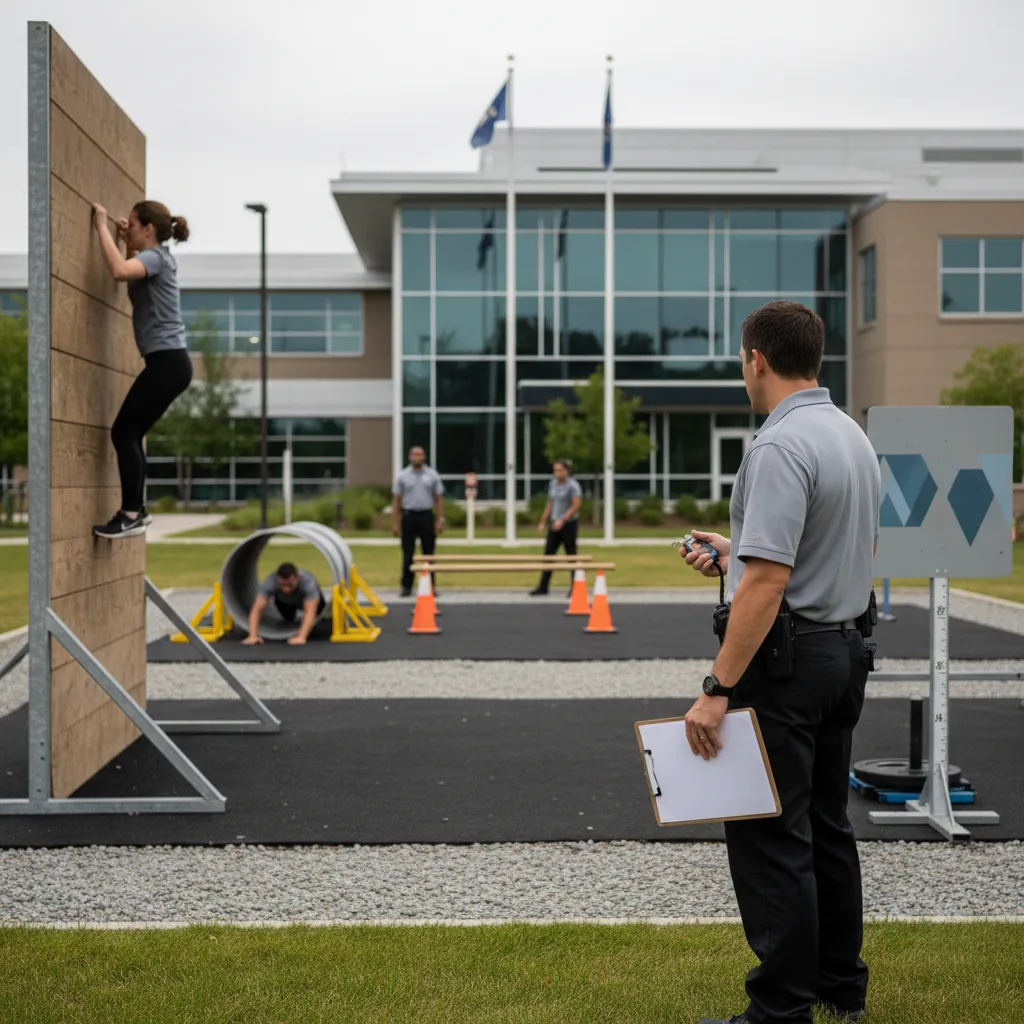
The physical fitness test — which is the element most people think of when they ask how hard is the police fitness test — is typically separate from the NPOST and administered at a different stage of the hiring process. Physical standards vary significantly by agency, but most require candidates to pass events such as a 1.5-mile run, a set number of push-ups and sit-ups, and occasionally a 300-meter sprint or vertical jump.
Typical benchmarks for a 25-year-old male candidate are completing the 1.5-mile run in under 14 minutes and 30 seconds and performing at least 30 push-ups without rest. Female candidates are assessed on gender-normed standards that reflect equivalent fitness percentile rankings.
The psychological evaluation is another stage that surprises many candidates in its scope and depth. Most agencies use standardized assessments like the MMPI-2, the PAI, or department-specific instruments to screen for personality traits, stress response patterns, and psychological stability. These tests are not something you can cram for — they measure long-term personality characteristics and are specifically designed to detect candidates who are trying to game the results. The best preparation is honest self-awareness and, if you have a history of mental health treatment, discussing with your recruiter how to handle disclosure appropriately and transparently.
Background investigations are among the most overlooked stages of police hiring, yet they eliminate a large percentage of candidates who successfully passed the NPOST and physical fitness test. A background check for law enforcement typically goes back 10 years and covers employment history, financial records (including credit score and bankruptcy history), criminal record, driving history, drug use (including marijuana even in states where it is legal), social media activity, and character references. Inconsistencies between what you disclose on your application and what investigators discover are disqualifying — honesty, including disclosure of past mistakes, is always the better policy.
Oral board interviews are the final cognitive challenge before a conditional offer of employment. A panel of officers and supervisors will ask you behavioral questions ("Tell me about a time when...") and situational questions ("If you observed your partner use excessive force, what would you do?"). Strong performance here requires the same logical, organized communication that the NPOST's incident-report section tests. Candidates who have practiced writing clear, structured reports tend to also give clearer, better-organized verbal answers in oral board settings — the skills transfer directly.
Polygraph examinations are required by most agencies and cover the same ground as the background investigation, plus questions about undisclosed criminal activity, drug use, and honesty on the application. While polygraphs are not scientifically infallible, agencies take failed polygraphs very seriously. The key preparation is the same as for the background investigation: be completely honest on every form and in every interview, because inconsistencies revealed by the polygraph are treated as disqualifying regardless of the underlying facts.
Understanding the full scope of the hiring process helps you allocate your time and energy appropriately across all stages rather than hyper-focusing on one component. A candidate who scores 90 percent on the NPOST but fails the physical fitness test is no closer to a badge than a candidate who never took the written exam. Build your preparation plan to address all the gates you need to pass through, starting with the NPOST and working forward through the physical, psychological, and background stages in parallel wherever possible.
Sample NPOST Police Test Practice Questions
Try these questions from our free NPOST Police Test practice tests. The correct answer and an explanation follow each question.
If a person is free to leave and not in police custody Miranda warnings:
- A. Are not required before questioning
- B. Are required before any questions are asked
- C. Must be given if questioning lasts more than 15 minutes
- D. Are required whenever questioning occurs at a police station
Answer: A. Are not required before questioning
Miranda warnings apply only during custodial interrogation — a person free to leave is not in custody and no warning is required.
In a police department, the number of traffic citations issued over a 4-week period were 152, 168, 140, and 164. What was the average number of citations issued per week during this period?
- A. 152
- B. 156
- C. 160
- D. 162
Answer: B. 156
To find the average, first sum the total number of citations issued: 152 + 168 + 140 + 164 = 624. Then, divide the total sum by the number of weeks (4). 624 / 4 = 156. The average number of citations issued per week was 156.
A police department's budget for new equipment is $120,000. They spend 35% of the budget on new vehicles. How much money is spent on vehicles?
- A. $35,000
- B. $42,000
- C. $48,000
- D. $78,000
Answer: B. $42,000
To find the amount spent, multiply the total budget by the percentage. Convert the percentage to a decimal by dividing by 100 (35% = 0.35). Then, multiply the budget by this decimal: $120,000 * 0.35 = $42,000.
Which of the following sentences, intended for a police report, is grammatically correct and avoids common sentence structure errors?
- A. The suspect fled the scene, he was last seen running northbound.
- B. The suspect fled the scene he was last seen running northbound.
- C. The suspect fled the scene; he was last seen running northbound.
- D. The suspect fled the scene, and was last seen running northbound.
Answer: C. The suspect fled the scene; he was last seen running northbound.
This sentence correctly uses a semicolon to join two closely related independent clauses. Choice A is a comma splice, Choice B is a run-on sentence, and Choice D uses a comma incorrectly before the conjunction 'and' because 'was last seen...' is not an independent clause.
NPOST Questions and Answers

National Police Officer Selection Test (NPOST): Complete Guide to Acing Your Police Test in 2026

Police Psychological Exam Practice Test: Complete NPOST Study Guide 2026
NPOST - Police Test: Complete Study Guide 2026

Police Officer Tests: Complete Guide to the National Police Officer Selection Test (NPOST) in 2026

Police Hiring Process: Complete Guide to NPOST, Background Checks, and Polygraph Requirements 2026
About the Author

Educational Psychologist & Academic Test Preparation Expert
Columbia University Teachers CollegeDr. Lisa Patel holds a Doctorate in Education from Columbia University Teachers College and has spent 17 years researching standardized test design and academic assessment. She has developed preparation programs for SAT, ACT, GRE, LSAT, UCAT, and numerous professional licensing exams, helping students of all backgrounds achieve their target scores.
Join the Discussion
Connect with other students preparing for this exam. Share tips, ask questions, and get advice from people who have been there.
View discussion (8 replies)