
Nassau County Police Test: Everything You Need to Know About the National Police Officer Selection Test
National police officer selection test prep for Nassau County. Scores, format, study tips & practice questions. 🎯 Start here.

The national police officer selection test — commonly called the NPOST — is the standardized written exam that tens of thousands of law enforcement applicants across the United States take every year.
If you have ever wondered how many people took the Nassau County police test in a given cycle, the honest answer is that Nassau County's civil service commission does not always publish exact applicant tallies, but competitive exam cycles routinely draw several thousand candidates competing for a limited pool of officer positions. Understanding the test's scope, content, and difficulty is the first step toward rising to the top of that list.
The NPOST was developed by Stanard & Associates specifically to measure the core cognitive skills that predict success in police academy training and on-the-job performance. Unlike agency-specific exams of the past, the national police officer selection test provides a nationally normed, legally defensible framework that agencies such as Nassau County can adopt without building a proprietary test from scratch. That standardization actually works in your favor as a candidate: because the exam format is well-documented, preparation resources are widely available and directly applicable to what you will face on test day.
Nassau County has long been one of the most competitive law enforcement agencies in New York State, and for good reason. The Nassau County Police Department is one of the largest municipal police forces in the United States, with approximately 2,500 sworn officers patrolling a densely populated suburban county on Long Island. Entry-level officer positions come with strong union contracts, excellent benefits, and starting salaries that exceed the national average — all of which means that demand for open examination cycles is intense and the competition is stiff.
One of the most important things to understand before you sit for the national police officer selection test practice test is that the exam is broken into clearly defined cognitive sections, each weighted toward a distinct skill set. Reading comprehension, grammar, arithmetic reasoning, and incident report writing are the four pillars of the NPOST.
Nassau County typically weighs these sections equally, though the commission retains the right to adjust the formula. Knowing exactly what each section measures — and where your personal gaps lie — allows you to direct your study time efficiently rather than reviewing material you already know cold.
Preparation timelines vary considerably depending on your baseline academic skills. Candidates with strong math backgrounds often spend the bulk of their time on reading comprehension and incident report writing, while candidates who excelled in English tend to focus energy on arithmetic reasoning. Most successful test-takers report spending between eight and fourteen weeks in structured preparation, dedicating roughly ninety minutes per day to practice questions and targeted review. Building that schedule around realistic, timed practice exams is far more effective than passive reading of a study guide alone.
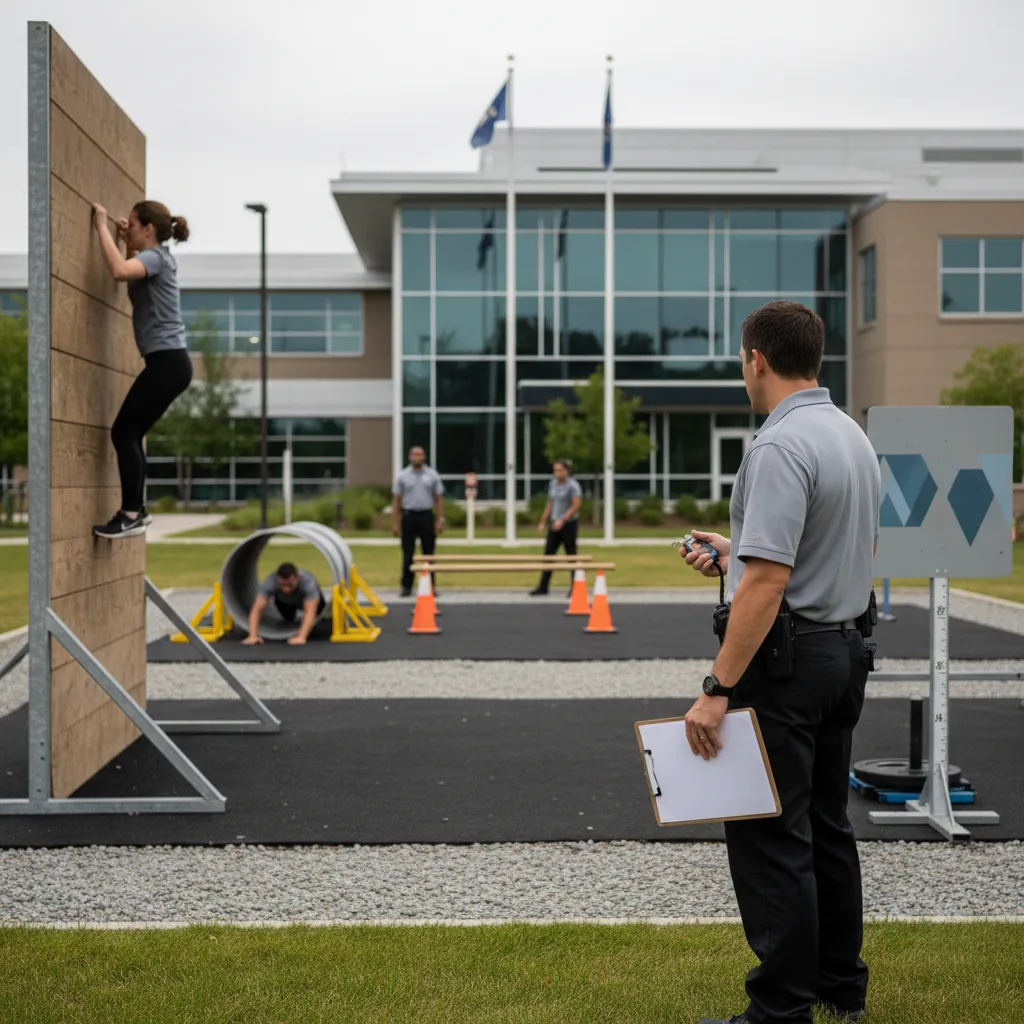
Beyond the written exam, Nassau County's full selection process includes a physical agility test, medical and psychological evaluations, a polygraph, and a thorough background investigation. The NPOST written exam is the first formal hurdle and functions as a filter: only candidates who score above the minimum cutoff — and more practically, above the competitive range established by the highest-scoring applicants in that cycle — will move forward. A score that would qualify you in a lower-competition cycle may not be sufficient when thousands of motivated candidates are competing for the same openings.
This guide walks you through every dimension of the national police officer selection test as it applies to Nassau County candidates: the exam format, what each section demands, realistic score benchmarks, the most effective study strategies, and how to integrate free practice resources available right here on PracticeTestGeeks to sharpen your skills before exam day. Whether you are preparing for your first attempt or retaking after a previous cycle, the information below will help you build a precise, evidence-based preparation plan.
Nassau County Police Test by the Numbers

NPOST Exam Format & Section Breakdown
| Section | Questions | Time | Weight | Notes |
|---|---|---|---|---|
| Reading Comprehension | 25 | 30 min | 25% | Passages with multiple-choice questions |
| Grammar | 25 | 25 min | 25% | Sentence correction and usage |
| Incident Report Writing | 30 | 45 min | 25% | Narrative comprehension and sequencing |
| Arithmetic Reasoning | 25 | 30 min | 25% | Basic math and applied reasoning |
| Total | 105 | 2 hours 30 minutes | 100% |
Nassau County's civil service process transforms raw NPOST scores into a ranked list that determines who advances to the next phase of selection. Understanding how that scoring mechanism works — and what competitive scores look like in practice — is essential information that many candidates overlook in favor of simply studying content.
A raw score of 70 percent meets the minimum passing threshold in most NPOST-administering jurisdictions, but in Nassau County's highly competitive environment, candidates who hover near the minimum rarely receive job offers. Historical exam cycles suggest that candidates landing in the 85th percentile or above have the strongest prospects of receiving timely appointment.
The civil service list established after each Nassau County police exam remains active for a set period, typically two to four years. When the department needs to hire, it draws from the top of the list in rank order.
This means that even a modest difference in your score — say, two or three additional correct answers — can translate into meaningful movement up the list and a substantially shorter wait for a job offer. Treating every question as a valuable point rather than accepting a "good enough" score is the mindset that separates candidates who get called quickly from those who wait years.
One detail candidates frequently misunderstand is the relationship between the written score and Veterans' Preference credits. New York State law grants eligible veterans additional points — typically five points for non-disabled veterans and ten points for disabled veterans — added to their passing scores. These credits can meaningfully shift a candidate's list position. If you are a veteran, confirming your eligibility and submitting the required documentation during the application window is as important as scoring well on the exam itself. Missing that documentation deadline can cost you the credit entirely.
Residency preference is another factor that can influence your effective ranking. Nassau County may apply additional weight to candidates who reside within the county or within New York State, depending on the specific exam administration. Checking the official exam announcement carefully for any residency credits is a step that costs nothing and could improve your standing without any additional study. The exam announcement — typically posted on the Nassau County Department of Civil Service website — is the authoritative source for scoring formulas, eligibility requirements, and application deadlines for each cycle.
A common question among first-time NPOST takers is whether the exam penalizes for wrong answers. The standard NPOST scoring model does not apply a penalty for incorrect responses, which means you should always answer every question even when you are uncertain. Educated guessing — eliminating one or two clearly wrong options before choosing — dramatically improves your odds compared to leaving a question blank. Building the habit of always committing to an answer, even under time pressure, should be part of your practice routine from the very first timed mock exam you take.
Score reporting timelines vary by administration. In some Nassau County cycles, candidates receive preliminary score notifications within four to six weeks of the exam date, followed by official ranked list publication several months later. During that window, continuing to prepare for subsequent selection phases — physical agility, psychological evaluation, and background investigation — is strongly advised. Candidates who treat the written exam as the finish line rather than the starting line often find themselves underprepared when the remaining hurdles arrive unexpectedly soon after their score notification.
For candidates who do not score as high as they hoped, most Nassau County exam cycles allow retesting when a new examination is announced. Keeping the specific areas where you lost points in mind — reading comprehension, grammar, arithmetic, or incident report writing — and targeting those weaknesses with structured practice between cycles is the most effective path to a meaningfully higher score on the second attempt. To explore comprehensive tools for your next attempt, review the national police officer selection test post resources that cover the full selection pipeline.
National Police Officer Selection Test Study Guide: Section-by-Section Strategies
The reading comprehension section of the national police officer selection test presents passages drawn from police reports, legal statutes, department policies, and news-style narratives. Each passage is followed by four to six multiple-choice questions that test your ability to identify the main idea, draw inferences, define vocabulary in context, and distinguish between stated facts and implied conclusions. The most effective strategy is to read each question before you read the passage so you know exactly what information to prioritize as you move through the text.
Time management is critical in this section because passages can run to four hundred words or more. Experienced test-takers recommend spending no more than sixty seconds on each question after reading the passage. If a question stumps you, mark your best guess and move on rather than allowing one difficult item to eat into the time you need for the remaining questions. Reviewing official police department public communications and municipal reports in the weeks before your exam is a low-cost way to acclimate to the formal, procedural writing style that dominates NPOST reading passages.

NPOST vs. Agency-Specific Police Exams: Key Differences
- +Nationally normed so your score is benchmarked against a large, diverse candidate pool
- +Preparation materials are widely available because the format is standardized across agencies
- +Content directly maps to real policing tasks — reading reports, writing summaries, calculating response times
- +Passing score from one NPOST administration may be recognized by multiple agencies simultaneously
- +No obscure local trivia — the test focuses on transferable cognitive skills rather than agency-specific policies
- +Extensive free practice resources exist online, reducing the cost of effective exam preparation
- −A single standardized exam means Nassau County cannot weight skills that are uniquely important to its specific environment
- −High applicant volumes in competitive markets like Nassau County mean the passing score alone is rarely sufficient
- −Time pressure across all four sections simultaneously challenges candidates who need extra processing time
- −The arithmetic section's no-calculator rule disadvantages candidates who have not used manual math regularly since high school
- −Score lists can remain active for years, meaning a top-ranked candidate from a prior cycle may be ahead of you even if you score very well
- −The exam does not assess physical fitness, emotional resilience, or interpersonal skills that are critical for police work
National Police Officer Selection Test Prep Checklist: 10 Steps Before Exam Day
- ✓Download the official NPOST candidate information bulletin from the Nassau County Department of Civil Service website.
- ✓Confirm your eligibility requirements: age, citizenship, education credentials, and any residency preferences.
- ✓Submit Veterans' Preference documentation during the application window if you qualify for additional points.
- ✓Take a full-length timed NPOST diagnostic test to identify your weakest section before beginning focused study.
- ✓Build an eight-to-twelve-week study schedule with daily ninety-minute sessions targeting your identified weak areas.
- ✓Complete at least three full-length timed practice exams under realistic test conditions before the actual exam date.
- ✓Review all arithmetic without a calculator — rebuild mental math skills for percentages, fractions, and ratios.
- ✓Study grammar rules for subject-verb agreement, comma usage, parallel structure, and commonly confused words.
- ✓Practice reading and summarizing police-style incident reports to build speed and accuracy in the writing section.
- ✓Confirm the exam location, arrival time, and required identification documents at least forty-eight hours before test day.

Passing Is Not Enough in Nassau County
In Nassau County's most recent open competitive exam cycles, candidates needed scores in the upper 80th percentile to receive timely job offers. The minimum passing score of 70% places you on the list — but candidates scoring 90% and above are typically called first. Aim at least fifteen points above the minimum to give yourself a realistic shot at appointment within the active list period.
Nassau County's use of the NPOST score extends beyond simply sorting candidates into pass or fail categories. The civil service list functions as a priority queue: when a vacancy opens and the department receives authorization to hire, it contacts candidates in strict rank order. This means that a candidate ranked 50th on a list of 3,000 will be processed months or even years before a candidate ranked 500th, even though both candidates passed the exam. The practical implication is that every additional point you earn on the written exam is a meaningful investment in how quickly your career can begin.
The ranked list structure also affects how you should think about the physical agility test, psychological evaluation, and background investigation that follow the written exam. Because these hurdles come after the list is established, Nassau County invests significant resources in thoroughly vetting only the candidates at the top of the list.
If you are ranked in the top tier and something in your background raises a concern, the investigator will take the time to fully evaluate the circumstances. Candidates ranked lower may never reach the background phase at all during a given hiring cycle, not because they are disqualified, but simply because the department fills its positions before reaching their list number.
The psychological evaluation deserves specific attention because it often surprises candidates who sailed through the written and physical components. Nassau County, like most large agencies, uses a combination of standardized psychological testing instruments and a one-on-one clinical interview with a licensed psychologist. The written instruments typically include personality inventories and symptom checklists.
The interview focuses on your history, judgment under stress, attitudes toward authority, and emotional regulation. There are no trick questions, but there are patterns of response that experienced evaluators recognize as red flags — including excessive defensiveness, inconsistency between the written instrument and the interview, and attempts to present an implausibly perfect self-image.
The background investigation is similarly comprehensive. Investigators will contact references, interview neighbors and former colleagues, review your credit history, verify your employment and education records, and examine any prior contact with law enforcement — even contacts that did not result in charges. Complete honesty throughout the application process is not just ethically required; it is strategically essential. Inconsistencies discovered during the background investigation — even minor ones — can disqualify a candidate who would otherwise have passed easily. Investigators are highly experienced at identifying omissions, and the cover-up is almost always treated as more serious than the underlying fact.
Understanding how Nassau County uses NPOST scores also helps you make informed decisions about timing. If a new exam announcement is posted shortly after you have completed an intensive study cycle, applying for that examination makes obvious sense. If, however, you are still weeks away from peak readiness, it may be worth checking the application deadline carefully. Missing the application window by even one day disqualifies you from that entire cycle, which could mean waiting years for the next announcement. Staying subscribed to Nassau County Civil Service notifications ensures you never miss an exam cycle announcement.
Financial preparation is another dimension of the application process that candidates often underestimate. While the NPOST itself is low-cost or free to sit for in many jurisdictions, the full Nassau County selection process involves expenses: physical examination fees, travel costs if your background investigation requires records from multiple locations, and potential lost wages from time taken for multi-stage evaluations. Budgeting for these costs in advance reduces the stress that financial pressure can introduce at precisely the moments in the process when you need to project calm and confidence.
Finally, building a support network of fellow candidates who are preparing for the same exam cycle can meaningfully improve your preparation quality. Study groups allow candidates to quiz each other, share strategies for specific question types, and maintain accountability for consistent practice.
Online forums and local law enforcement interest groups often include members who have taken prior Nassau County exams and can offer first-hand insight into what the actual test day experience involves. To understand how the written test fits into the broader physical demands of the selection process, explore the national police officer selection test post practice test resources covering physical fitness standards.
Nassau County police exam application periods are typically open for only two to four weeks. Missing the deadline — even by one day — disqualifies you from that entire exam cycle, which may not repeat for two to four years. Set a calendar alert the moment the announcement is posted and submit your application well before the closing date to avoid last-minute technical issues with the online portal.
Effective preparation for the national police officer selection test is less about memorizing facts and more about building the cognitive habits that the exam rewards: careful reading, precise language, accurate arithmetic, and clear sequential thinking. These are skills that can be meaningfully improved with deliberate practice over a structured timeline, regardless of how strong or weak your starting baseline is.
The candidates who see the largest score improvements between diagnostic and actual exam are almost always those who practiced under realistic timed conditions from the very beginning of their preparation, not those who studied the most total hours in unstructured ways.
The reading comprehension section responds particularly well to a pre-questioning strategy. Before you read a passage, scan all the questions associated with it. This tells your brain what to look for as you read, dramatically improving retention of relevant details on the first pass through the text. Many candidates waste time re-reading passages to find answers that a pre-scan would have flagged during initial reading. On a strictly timed exam, eliminating unnecessary re-reads is among the highest-leverage efficiency improvements available to you.
Grammar preparation benefits enormously from active rather than passive study. Reading grammar rules is substantially less effective than applying those rules to practice sentences and immediately checking your answers. The specific grammar patterns tested on the NPOST are well-documented, and focusing your active practice on those patterns — rather than attempting comprehensive grammar review — gives you the highest return on your study time. Comma splices, dangling modifiers, and subject-verb agreement with collective nouns appear frequently and are worth dedicating specific practice sessions to each.
For the arithmetic section, consistent daily practice with untimed computation builds the baseline speed that timed practice then refines. If you find arithmetic problems taking more than ninety seconds each under timed conditions, the solution is almost always more untimed repetition before returning to the clock. Rushing arithmetic when you lack computational fluency increases error rates and produces a discouraging practice experience. Build the skill first, then add the time pressure. Within two to three weeks of consistent daily arithmetic practice, most candidates see meaningful improvements in both speed and accuracy.
The incident report writing section is the one most candidates feel least prepared to practice systematically. The key insight is that this section tests your ability to read a scenario carefully and answer specific comprehension questions — it is not asking you to write a report from scratch. Practicing by reading short police-style narratives (available in numerous free online resources) and answering comprehension questions about them directly builds the skills the section measures. Pay particular attention to sequence — what happened first, second, and third — because incident report questions frequently test whether you correctly understood the order of events.
Stress management on exam day is a preparation topic that does not receive enough attention in most study guides. Research on cognitive performance consistently shows that moderate anxiety improves focus and performance, while high anxiety impairs both working memory and decision-making. Building familiarity with exam conditions through realistic practice exams — same time limits, no phone, quiet environment — reduces the novelty of the actual exam day experience and keeps anxiety in the moderate, performance-enhancing range rather than the high, performance-impairing range. The most effective study schedule ends two to three days before the actual exam to allow mental recovery.
To get the most comprehensive written preparation available, use the national police officer selection test pdf study materials in combination with timed online practice to cover both content review and realistic exam simulation. The combination of structured content review and timed practice under exam conditions is consistently the most effective preparation approach across all standardized testing research, and it is particularly powerful for the NPOST, where all four sections demand different cognitive skills that benefit from differentiated practice strategies.
Test day logistics matter far more than most candidates appreciate. Arriving at the examination center fifteen to twenty minutes early — not just on time — gives you the opportunity to find your seat, organize your materials, and take several slow deep breaths before the proctor begins instructions.
Candidates who arrive rushed, having battled traffic or difficulty finding parking, start the exam with elevated cortisol levels that measurably impair performance on precisely the kind of careful reading and arithmetic reasoning that the NPOST demands. Plan your route the day before, account for realistic traffic conditions, and aim to park with twenty-five minutes to spare.
Bring only what is permitted into the exam room. Nassau County civil service exams typically allow valid photo identification, number-two pencils, and an eraser. Scratch paper may be provided by the proctor or may be prohibited depending on the administration — confirm this detail in your candidate information bulletin rather than assuming. Bringing prohibited items such as a phone, calculator, or unauthorized reference materials is grounds for immediate disqualification, regardless of whether you intended to use them. Leaving these items in your vehicle removes all risk.
During the exam itself, pace management is your most important in-room skill. Most NPOST sections allocate approximately seventy-two seconds per question. At the start of each section, count the number of questions, glance at the time limit, and set an internal checkpoint — for example, on a twenty-five-question, thirty-minute section, you should be through question thirteen by the fifteen-minute mark. Monitoring your pace at a single midpoint prevents the end-of-section panic that causes rushed, careless errors on the final questions.
Answer elimination is a systematic skill, not a guess. When you are uncertain about a question, begin by identifying and crossing off any answer choice you know is wrong. Even eliminating one of four choices raises your odds on a random guess from 25 percent to 33 percent. Eliminating two raises them to 50 percent.
For reading comprehension questions specifically, any answer that introduces information not present in the passage is almost certainly wrong — the NPOST tests reading, not outside knowledge. Training yourself to apply this rule reflexively during practice will save you meaningful time and improve accuracy on the actual exam.
Hydration and nutrition on exam day are practical factors with real cognitive effects. Mild dehydration — even at levels that do not produce thirst — measurably reduces attention and working memory performance. Eating a protein-containing meal approximately ninety minutes before the exam prevents the blood sugar fluctuations that cause mid-exam mental fatigue. Avoid heavy, high-fat meals that can produce drowsiness. If the exam center permits water bottles, bring one. These are small adjustments, but on an exam where two or three additional correct answers can significantly change your list rank, every margin matters.
After the exam, resist the temptation to discuss your answers with other candidates in the parking lot. Post-exam answer comparisons produce anxiety without producing information — you cannot change your responses, and comparing notes frequently leads candidates to second-guess answers they got right. Instead, immediately begin shifting your mental focus toward the next phase of the selection process. If you feel confident about your performance, start reviewing the physical fitness standards. If you have doubts, note the sections where you felt least confident so you can direct future study effectively.
Finally, maintain perspective throughout the entire process. Nassau County's police selection is designed to be thorough and competitive because the job itself carries enormous responsibility. The candidates who ultimately succeed are those who prepare systematically, stay organized through a multi-month process, and manage the emotional pressure of high-stakes evaluation without losing composure. The NPOST written exam is one component of a process that will test your resilience, honesty, and judgment as much as your reading and math skills. Approaching every phase with the same diligence you bring to your exam preparation is the most reliable path to the badge.
NPOST Questions and Answers

How Hard Is the Police Fitness Test? NPOST Difficulty, Requirements & Training Guide

NPOST Police Test Study Guide: Complete Prep for the National Police Officer Selection Test

Police Detective Test: Complete Guide to the National Police Officer Selection Test (NPOST) 2026

Police Psychological Exam Practice Test: Complete NPOST Study Guide 2026
NPOST - Police Test: Complete Study Guide 2026
About the Author

Educational Psychologist & Academic Test Preparation Expert
Columbia University Teachers CollegeDr. Lisa Patel holds a Doctorate in Education from Columbia University Teachers College and has spent 17 years researching standardized test design and academic assessment. She has developed preparation programs for SAT, ACT, GRE, LSAT, UCAT, and numerous professional licensing exams, helping students of all backgrounds achieve their target scores.
Join the Discussion
Connect with other students preparing for this exam. Share tips, ask questions, and get advice from people who have been there.
View discussion (8 replies)