
Notary Public Course: Complete Training Guide & Requirements for 2026
🟢 Complete notary public course guide: training requirements, state-by-state rules, exam prep, costs, and how to become a commissioned notary in 2026.
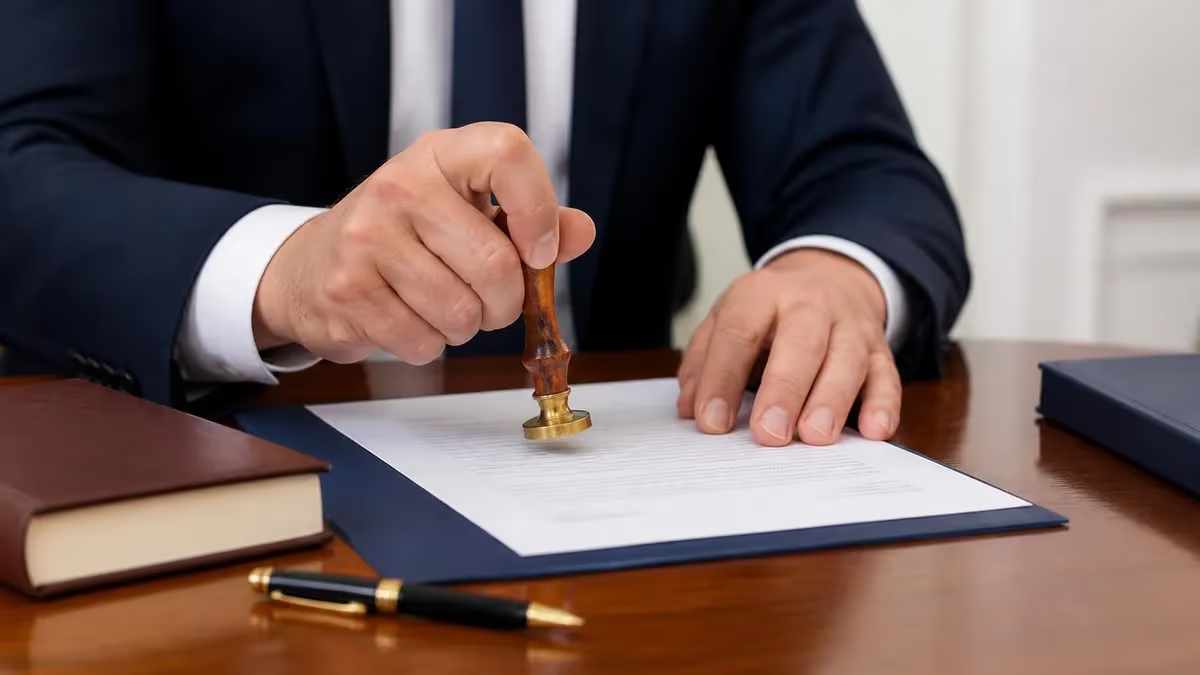
A notary public course is the foundational training program that prepares aspiring notaries to perform official notarial acts legally and ethically in their state. Whether you are pursuing a career change, supplementing income, or adding credentials to your business resume, completing a quality notary public course is the first critical step toward commissioning. These programs cover everything from identifying signers and administering oaths to detecting fraud and maintaining proper journals, giving you the practical knowledge needed for daily notarial work. Practice with the free Notary Public practice test on PracticeTestGeeks (11 questions with answer explanations).
Understanding public notary what is requires more than memorizing definitions. A notary public is a state-commissioned public official authorized to witness signatures, verify identities, administer oaths, and certify documents. The role exists to deter fraud and ensure that signers act willingly and knowingly. Because notarial responsibilities carry legal weight, every state requires some form of training, education, or examination before granting a commission to applicants who meet eligibility criteria.
The complexity of notary law varies dramatically by state. California, Florida, and New York require formal coursework plus passing an exam, while Texas requires only a short application process with no mandatory course. Despite these differences, a comprehensive notary public course covers universal principles: notarial acts, journal requirements, fee schedules, identification standards, signer competency, and ethical conduct. Investing in proper training reduces liability and builds the confidence needed for real-world appointments.
Modern notary courses are delivered through multiple formats, including self-paced online modules, live webinars, in-person classroom seminars, and hybrid programs that blend digital learning with proctored exams. Prices range from $25 for basic state-mandated refreshers to $400 for premium bundles that include study guides, surety bonds, errors-and-omissions insurance, and supply kits with stamps and journals. Choosing the right format depends on your learning style, schedule, and state-specific requirements.
Many candidates underestimate the depth of notarial knowledge required to perform competent work. A signer who challenges your acknowledgment in court can leave you personally liable for damages. A misplaced journal entry can result in commission revocation. Identifying fake IDs, recognizing duress, refusing improper requests, and documenting acts correctly are skills built through coursework, practice quizzes, and continuing education, not absorbed by reading a state handbook once.
This guide breaks down everything you need to know about choosing, completing, and benefiting from a notary public course. We will cover state requirements, course formats, costs, exam strategies, post-commissioning obligations, and how training translates into real income opportunities. Whether you are starting from zero or renewing an expiring commission, the right preparation transforms a confusing process into a clear path toward becoming a trusted, well-paid public official.
You will also learn how training intersects with related credentials such as remote online notarization certification, loan signing agent specialization, and Spanish-language notario publico services. Each of these niches commands premium fees, but only when supported by rigorous education. By the end of this article, you will know exactly what to look for in a course, what to budget, and how to position yourself for success in the growing notarial services industry.
Free Notary Public Exam Study Tools
Interactive Notary Public Exam resources on PracticeTestGeeks, free to start:
- Free Notary Public Questions and Answers 1 — 11 questions with instant scoring and answer explanations
- Notary Public Exam flashcards — review key terms and concepts card by card
- Notary Public Exam study guide — topic-by-topic overview of what the exam covers
- Notary Public Exam cheat sheet — one-page printable summary for last-minute review
Notary Public Course by the Numbers

Notary Public Course Requirements by State
California, Florida, Colorado, Missouri, North Carolina, Pennsylvania, and Oregon require completion of a state-approved education course before applying. Course hours range from three to six, with proctored exams in some states.
Texas, Virginia, Georgia, and Illinois do not mandate a formal course but strongly recommend training. Most applicants in these states still enroll to learn proper procedures and avoid costly mistakes during real appointments.
Several states require continuing education at renewal, including California (six-hour refresher), Pennsylvania (three hours), and Oregon. Renewal courses focus on law updates, electronic notarization rules, and ethics scenarios.
Remote online notarization, electronic notarization, and loan signing agent credentials require additional specialized coursework on top of the base commission. These endorsements typically add four to eight extra training hours.
Most course providers bundle surety bonds and E&O insurance with their training packages. Bond amounts vary by state, from $5,000 in Texas to $15,000 in California, and protect the public from notarial errors.
A high-quality notary public course covers far more than the legal definition of notarization. The curriculum typically begins with the history and purpose of the office, then moves into the specific notarial acts your state authorizes. These usually include acknowledgments, jurats, oaths and affirmations, copy certifications, signature witnessing, and protests. Each act has distinct requirements for signer presence, identification, language used in the certificate, and journal documentation that you must master before performing real work.
Identification standards form the backbone of any reputable course. Students learn how to evaluate a driver's license, passport, military ID, or other government-issued credential for authenticity. Coursework reviews security features such as holograms, microprinting, UV elements, and tactile printing. Trainees also practice using the credible witness rule, which allows notarization when a signer lacks ID but is personally known by sworn witnesses. Knowing these rules cold prevents fraud and protects your commission from challenge.
Journal recordkeeping receives heavy emphasis because it is the single most important tool for defending your notarial conduct. Courses teach the legally required entries: date, time, type of act, document title, signer name, ID details, fee charged, and signer signature. Students also learn how to handle thumbprint requirements in California, sequential numbering, retention periods, and secure storage. Reviewing the free public notary near me recordkeeping practices is essential before sitting for the exam.
Fee schedules and ethics modules round out the legal portion of training. Each state caps what notaries may charge per act, with limits ranging from $5 in some Midwestern states to $15 or more in California and Florida. Travel fees, after-hours charges, and waiver of fees for elderly or disabled signers are covered in detail. Ethics topics address conflicts of interest, refusing improper requests, dealing with biased pressure from employers, and avoiding the unauthorized practice of law.
Fraud detection has become a major curriculum focus in recent years. Courses include real case studies of forged signatures, impersonation schemes, elder financial abuse, mortgage fraud, and identity theft attempts notaries have witnessed. Students learn red flags such as nervous signers, third-party coaching, freshly printed identification, and pressure to skip journal entries. The training emphasizes that refusing a suspicious notarization is not only legal but ethically required.
Procedural mechanics finish the foundational course. This includes correct stamp placement, certificate language verification, embosser use, sealing notarial certificates onto loose documents, and handling foreign-language documents. Students practice completing certificates word-for-word using state-approved templates and learn how to make corrections without invalidating an act. By the end of the course, you should be able to walk into any signing appointment and execute the entire process from greeting to journal closure without hesitation.
Premium courses also include modules on customer service, marketing, and business development. After all, a commission is worthless if no clients call. Topics cover setting up Google Business profiles, partnering with title companies, joining loan signing agent directories, pricing mobile services, scheduling apps, and handling difficult clients. These business skills separate notaries who earn a few hundred dollars per year from professionals who generate $50,000 or more from mobile signing services.

Notary Public Practice Test Questions
Prepare for the Notary Public Exam exam with our free practice test modules. Each quiz covers key topics to help you pass on your first try.
Notary Public Basic Notary Public
Notary Public Exam Questions covering Basic Notary Public. Master Notary Public Test concepts for certification prep.
Notary Public Duties & Responsibilities of...
Free Notary Public Practice Test featuring Duties & Responsibilities of a Notary. Improve your Notary Public Exam score with mock test prep.
Notary Public Ethics & Professional Conduct
Notary Public Mock Exam on Ethics & Professional Conduct. Notary Public Study Guide questions to pass on your first try.
Notary Public Fraud Prevention & Security
Notary Public Test Prep for Fraud Prevention & Security. Practice Notary Public Quiz questions and boost your score.
Notary Public Identification & Credential ...
Notary Public Questions and Answers on Identification & Credential Verification. Free Notary Public practice for exam readiness.
Notary Public Jurats & Acknowledgments
Notary Public Mock Test covering Jurats & Acknowledgments. Online Notary Public Test practice with instant feedback.
Notary Public Notarial Acts & Procedures
Free Notary Public Quiz on Notarial Acts & Procedures. Notary Public Exam prep questions with detailed explanations.
Notary Public Notary Laws & Regulations
Notary Public Practice Questions for Notary Laws & Regulations. Build confidence for your Notary Public certification exam.
Notary Public MCQ
Notary Public Test Online for MCQ. Free practice with instant results and feedback.
Notary Public
Notary Public Study Material on Notary Public. Prepare effectively with real exam-style questions.
Notary Public Oaths & Affirmations
Free Notary Public Test covering Oaths & Affirmations. Practice and track your Notary Public exam readiness.
Notary Public Recordkeeping & Journal Entries
Notary Public Exam Questions covering Recordkeeping & Journal Entries. Master Notary Public Test concepts for certification prep.
Notary Public Exam Basic Notary Public
Free Notary Public Practice Test featuring Exam Basic Notary Public. Improve your Notary Public Exam score with mock test prep.
Notary Public Exam Duties & Responsibiliti...
Notary Public Mock Exam on Exam Duties & Responsibilities of a Notary. Notary Public Study Guide questions to pass on your first try.
Notary Public Exam Ethics & Professional C...
Notary Public Test Prep for Exam Ethics & Professional Conduct. Practice Notary Public Quiz questions and boost your score.
Notary Public Exam Fraud Prevention & Secu...
Notary Public Questions and Answers on Exam Fraud Prevention & Security. Free Notary Public practice for exam readiness.
Notary Public Exam Identification & Creden...
Notary Public Mock Test covering Exam Identification & Credential Verification. Online Notary Public Test practice with instant feedback.
Notary Public Exam Jurats & Acknowledgments
Free Notary Public Quiz on Exam Jurats & Acknowledgments. Notary Public Exam prep questions with detailed explanations.
Notary Public Exam Notarial Acts & Procedures
Notary Public Practice Questions for Exam Notarial Acts & Procedures. Build confidence for your Notary Public certification exam.
Notary Public Exam Notary Certificates & W...
Notary Public Test Online for Exam Notary Certificates & Wording. Free practice with instant results and feedback.
Notary Public Exam Notary Laws & Regulations
Notary Public Study Material on Exam Notary Laws & Regulations. Prepare effectively with real exam-style questions.
Notary Public Exam Notary Public
Free Notary Public Test covering Exam Notary Public. Practice and track your Notary Public exam readiness.
Notary Public Exam Notary Public MCQ
Notary Public Exam Questions covering Exam Notary Public MCQ. Master Notary Public Test concepts for certification prep.
Notary Public Exam Notary Seal & Stamp Req...
Free Notary Public Practice Test featuring Exam Notary Seal & Stamp Requirements. Improve your Notary Public Exam score with mock test prep.
Notary Public Course Formats Compared
Self-paced online notary courses are the most popular option in 2026, available through providers like the National Notary Association, Notary.net, and state-approved vendors. You log in whenever convenient, complete reading modules, watch instructional videos, and take quizzes at your own speed. Most platforms offer 30 to 90 days of access, mobile compatibility, and downloadable handbooks for offline study before the proctored final exam.
The biggest advantage is flexibility, especially for working professionals balancing family or jobs. The drawback is the lack of live interaction, which can leave nuanced questions unanswered. Look for courses that include instructor email support, recorded Q&A sessions, and active student forums. Prices typically range from $79 to $179, often bundled with the surety bond, journal, stamp, and four-year E&O coverage.
Should You Take a Paid Notary Course or Self-Study?
- +Structured curriculum aligned with your state's exact exam blueprint
- +Includes practice tests, journal templates, and certificate samples
- +Often bundled with surety bond, stamp, journal, and E&O insurance
- +Instructor support helps clarify confusing notarial scenarios
- +Higher first-attempt pass rates compared to self-study
- +Provides completion certificate required for application in mandatory states
- +Many courses include lifetime updates on law changes and renewal reminders
- −Costs $79 to $400 upfront before earning any income
- −Some bundled supplies are lower quality than buying separately
- −Self-paced courses require strong discipline to finish on time
- −Quality varies widely between providers, requiring careful review
- −Course completion alone does not guarantee state exam approval
- −Refund policies are often restrictive after course materials are accessed
Pros and Cons at a Glance
| Pros | Cons |
|---|---|
| Structured curriculum aligned with your state's exact exam blueprint | Some bundled supplies are lower quality than buying separately |
| Includes practice tests, journal templates, and certificate samples | Self-paced courses require strong discipline to finish on time |
| Often bundled with surety bond, stamp, journal, and E&O insurance | Quality varies widely between providers, requiring careful review |
| Instructor support helps clarify confusing notarial scenarios | Course completion alone does not guarantee state exam approval |
| Higher first-attempt pass rates compared to self-study | Refund policies are often restrictive after course materials are accessed |

Pre-Enrollment Checklist Before Choosing a Notary Public Course
- ✓Confirm your state's mandatory course requirements and approved provider list
- ✓Verify you meet age (usually 18+) and residency eligibility for commission
- ✓Check that you have no disqualifying felony convictions in the past 10 years
- ✓Compare course prices including bond, stamp, journal, and E&O coverage
- ✓Read recent student reviews on Trustpilot, Google, and notary forums
- ✓Verify the course includes a proctored final exam if your state requires one
- ✓Confirm course access duration (typically 30 to 90 days from enrollment)
- ✓Check that mobile and tablet compatibility match your study habits
- ✓Ensure the provider issues a completion certificate accepted by your Secretary of State
- ✓Confirm refund policy in case of personal scheduling conflicts or dissatisfaction
Match your course to your state, not your wallet
The cheapest course is rarely the best value when your state requires specific approved providers. California, Florida, and Colorado maintain published lists of authorized vendors, and using a non-approved course will disqualify your application. Always verify with your Secretary of State before purchasing.
Passing the state notary exam is the gateway between coursework and commissioning, and a structured approach makes the difference between first-attempt success and frustrating retakes. Most exams contain 30 to 50 multiple-choice questions covering law, procedure, and ethics, with a passing score requirement of 70 to 80 percent. Time limits range from 45 minutes to two hours, depending on jurisdiction. Knowing the format in advance lets you pace yourself and avoid panic during the test.
Effective study begins with mastering vocabulary. Terms like acknowledgment, jurat, affiant, principal, credible witness, ministerial duty, and protest must roll off your tongue. Confusion between an acknowledgment (signer admits already signing) and a jurat (signer signs and swears in your presence) is the single most common mistake on every state exam. Flashcards, spaced repetition apps, and practice quizzes help cement these distinctions until they become automatic reflexes during the test.
State law mastery comes next. Read your Secretary of State's official notary handbook cover to cover at least twice. Pay attention to maximum fees, journal retention periods, bond amounts, term length, and disqualifying conditions. Practice tests reveal which areas need reinforcement. Aim for at least three full practice exams under timed conditions during the final week of preparation. Most candidates who fail the first attempt skipped this critical drilling step.
Scenario-based questions trip up unprepared candidates more than pure law questions. The exam will present situations like a signer arriving without ID, a notary asked to certify a copy of a birth certificate, or a relative requesting notarization. You must apply the correct rule, not just recite it. Practice working through 50 to 100 scenario questions before exam day, explaining your reasoning aloud as you eliminate wrong answers and confirm the right one.
Exam-day logistics deserve attention too. Bring two forms of identification, arrive 30 minutes early, and avoid heavy meals that cause drowsiness. For online proctored exams, test your webcam, microphone, and browser the night before. Have a clean workspace, no notes within camera range, and a stable internet connection. Technical issues during a remote proctored exam can result in disqualification with no refund, so preparation matters more than test-day improvisation.
After passing, the next phase begins immediately. You will receive a completion notice that must be submitted with your application to the Secretary of State, along with a filing fee, surety bond, and proof of identity. Processing times vary from one week in Texas to six weeks in California. During this waiting period, order your stamp and journal, set up your business structure, and start marketing so you can begin earning income the moment your commission arrives.
Renewal candidates face a different challenge: complacency. Notaries who have practiced for years sometimes assume they know the rules, only to be tripped up by law changes. California's 2020 thumbprint expansion, Florida's remote notarization rollout, and Texas's online notary updates have all caught experienced notaries off guard. Treat every renewal exam like your first, study the current handbook fresh, and complete the refresher course with the same focus you brought as a new applicant.
Most states conduct criminal background checks before issuing commissions. Felony convictions, fraud charges, dishonesty offenses, or prior commission revocations can disqualify you even after passing the exam. Disclose all history honestly on your application — discovered omissions trigger automatic denial and possible criminal liability.
Once your commission arrives, the journey from student to working notary accelerates rapidly. Your first task is ordering official supplies that meet state specifications. A notary public stamp must include your name as commissioned, commission number, expiration date, and state seal. Embosser requirements vary, but many states require both an inked stamp and a raised embosser for added security. Purchasing from a reputable vendor like the NNA or American Association of Notaries ensures compliance with your state's exact size and ink color rules.
Your journal is equally important and legally mandatory in most states. Buy a bound book with sequentially numbered pages, never loose-leaf, to prevent claims of tampering. California requires thumbprint columns for certain acts involving real estate or powers of attorney. Florida and Texas allow electronic journals, but make sure your software meets state encryption and backup standards. Treat your journal as a courtroom-grade document, because that is exactly how it will be used if your acts are ever challenged.
Marketing comes next, and this is where most new notaries either thrive or stall. Set up a Google Business Profile, list yourself on Yelp, NotaryRotary, Notary Café, and Snapdocs, and create a simple website with your service area, fees, and contact information. Network with title companies, mortgage brokers, attorneys, hospitals, and assisted living facilities. Many beginners forget that notary public in bank of america employees handle limited acts, so independent mobile notaries fill enormous unmet demand for after-hours and travel work.
Specialization dramatically increases earnings. Loan signing agents earn $75 to $200 per signing, handling 50 to 150 documents per appointment for mortgage closings. Remote online notarization (RON), legal in over 40 states, lets you serve clients nationwide from your home office for $25 per signature. Spanish-language notario publico services command premium fees in Hispanic communities, provided you carefully avoid the unauthorized practice of law trap that has destroyed many bilingual notaries' careers.
Continuing education separates professional notaries from hobbyists. Subscribe to the NNA Bulletin, your state association newsletter, and law-change alerts from your Secretary of State. Attend at least one continuing education webinar per year, even when not required for renewal. New technologies like biometric ID verification, blockchain-anchored notarizations, and AI-powered fraud detection are reshaping the field. Notaries who stay current capture the highest-value clients and avoid liability traps that punish those running on outdated knowledge.
Insurance protects your livelihood. Surety bonds protect the public from your errors, but they do not protect you. Errors and omissions (E&O) insurance reimburses your legal defense and damages if a notarization is challenged. Most professional notaries carry at least $25,000 in E&O coverage, and loan signing agents typically carry $100,000 policies. Annual premiums range from $40 to $250, a small price compared to a single lawsuit that could cost tens of thousands in legal fees.
Finally, track your business like the professional you are. Use a simple spreadsheet or apps like Notary Gadget to log every signing, fee collected, miles driven, and supplies purchased. Mileage deductions alone can save thousands at tax time. File quarterly estimated taxes if you exceed $1,000 in annual notary income. The IRS treats notary fees as self-employment income, but actual notarial fees (not signing agent fees) are exempt from self-employment tax under Section 1402(c)(1), so categorize income correctly to maximize savings.
Practical preparation tips can make the difference between a stressful first month as a commissioned notary and a smooth, profitable launch. Start by performing five to ten mock notarizations with friends or family members. Walk through the entire script: greet the signer, ask for ID, verify willingness and awareness, complete the journal entry, recite the oath or acknowledgment language, apply the stamp, and provide the document back. Repetition builds muscle memory that carries through real client appointments without nervous fumbling.
Set firm pricing before your phone starts ringing. Decide your per-act fee within state limits, your mobile travel rate per mile or flat zone, and your minimum appointment charge. Print a simple price sheet and post it on your website. Notaries who quote prices uncertainly during calls lose business to those who answer confidently. Premium notaries charge $75 to $150 per mobile visit and rarely lose work because they project professionalism through clear, consistent pricing from the first interaction.
Master refusal scripts before you need them. You will be asked to notarize incomplete documents, sign as a witness when you should not, certify foreign-language documents you cannot read, or notarize for a signer who appears coerced. Practice saying politely but firmly: "I'm sorry, but state law does not allow me to notarize in this situation. I can recommend an alternative." Refusing improperly is just as dangerous as performing improperly, so know the rules cold and stick to them every time.
Build a referral network during your first 90 days. Visit five to ten title companies, three to five law offices, and several assisted living facilities to introduce yourself. Leave business cards, a one-page service sheet, and a simple letter explaining your availability. Most working notaries earn 60 to 80 percent of their income from repeat clients within their first year, so initial outreach pays dividends for years. Treat each contact like the long-term relationship it actually represents.
Keep your supplies stocked and your kit organized. A professional notary bag includes your stamp, journal, embosser, a backup pen, blank acknowledgment and jurat forms, your commission certificate copy, a magnifying glass for ID verification, and a small UV flashlight for security feature inspection. Some signing agents add a portable printer for last-minute document changes. Being the notary who arrives prepared earns repeat business; being the one who fumbles for supplies in the client's living room does not.
Plan for renewal from day one. Mark your commission expiration on multiple calendars, including a 90-day reminder to begin the renewal course and a 45-day reminder to submit paperwork. Lapsing your commission, even by one day, requires starting the entire process over in most states, including a new background check and exam. Continuing professional notaries build their reputations over decades, and that consistency only happens when renewal is treated as non-negotiable.
Finally, invest in your professional identity. A clean LinkedIn profile listing your commission and specializations, professional headshots on your website, and consistent branding across listings communicate trust to potential clients who often book the first notary who looks credible online. A notary public course gives you the legal foundation; everything that follows is built through deliberate, professional habits practiced every single appointment for as long as your career lasts.
Sample Notary Public Exam Practice Questions
Try these questions from our free Notary Public Exam practice tests. The correct answer and an explanation follow each question.
A notary is asked to notarize a document for a person who appears to be intoxicated. What is the notary's proper course of action?
- A. Proceed with the notarization since the document is legal
- B. Refuse to complete the notarization until the signer is sober and capable of understanding the act
- C. Ask a witness to sign on behalf of the signer
- D. Complete the notarization but note the signer's condition in the journal
Answer: B. Refuse to complete the notarization until the signer is sober and capable of understanding the act
A notary must verify that a signer is mentally and physically capable of understanding the document and act being performed. An intoxicated person cannot give informed, voluntary consent, so the notary must refuse until the signer is in a competent state.
Which of the following is typically a requirement to obtain a notary commission in most states?
- A. A law degree
- B. Being at least 18 years old and a legal resident of, or employed in, the state
- C. Ownership of a business
- D. Membership in a national notary association
Answer: B. Being at least 18 years old and a legal resident of, or employed in, the state
Common baseline requirements include minimum age (usually 18), residency in or employment within the state, and the absence of disqualifying criminal convictions. Some states also require an exam and training.
A notary is asked to notarize a document on behalf of their spouse. What is the best course of action?
- A. Proceed, since the notary knows their spouse's identity
- B. Decline, because notarizing for a spouse creates a conflict of interest
- C. Notarize only if the document is under $1,000 in value
- D. Notarize but note the relationship in the journal
Answer: B. Decline, because notarizing for a spouse creates a conflict of interest
Most states prohibit or strongly discourage notarizing for immediate family members due to conflict of interest concerns.
A notary performs a notarization and later realizes the wrong certificate type was used. What is the correct course of action?
- A. Cross out the old certificate and write the correction over it
- B. Contact the signer to appear again and execute the correct certificate
- C. Call the receiving party and verbally explain the error
- D. Leave it as is since the signature was still witnessed
Answer: B. Contact the signer to appear again and execute the correct certificate
Using the wrong certificate type invalidates the notarization; the signer must reappear so the correct certificate can be properly executed.
Notary Public Questions and Answers



How this page was made: written with AI tools and published by Nathan Beja, founder of Practice Test Geeks, who is responsible for its content. Exam facts are checked against the official sources listed below. Not reviewed by a subject-matter expert. Editorial policy
Sources & references
Exam facts on this page (fees, format, dates, passing scores) are checked against these official sources; the date is our last check. Editorial policy
- sos.ca.gov — Eligibility, score release, fees, retake policy, renewal · verified Oct 2026
- sos.la.gov — Fees, test delivery, passing score, renewal, score validity, registration · verified Oct 2026
- coraweb.sos.la.gov — Registration deadline · verified Oct 2026
- static.sos.la.gov — Exam information · verified Oct 2026
- dos.ny.gov — Score validity, time limit, fees, exam dates, registration · verified Oct 2026
- cpshr.us — Exam format, retake fee, passing score, time limit, registration, test dates · verified Oct 2026