
Notary Public Course Online: Complete 2026 Guide to Training, Certification, and Passing Your State Exam
Notary public course online: 🗨️ training requirements, costs, state rules, exam prep, and certification steps. Complete 2026 guide with checklists and FAQs.

A notary public course online is the fastest, most flexible way to satisfy your state's mandatory training requirement and prepare for commissioning as a public official. Whether you are asking what is a notary public, researching how to become a notary public, or comparing state-approved providers, virtual training lets you complete the entire curriculum from home, on your own schedule, and often for under one hundred dollars. Modern online programs cover statutes, ethics, fraud prevention, journaling, and the proper use of a notary public stamp and notary public seal. Practice with the free Notary Public practice test on PracticeTestGeeks (300+ questions with answer explanations).
The shift to digital education accelerated dramatically between 2020 and 2026, and today more than thirty states accept online coursework as the official path to certification. California, Florida, Texas, Pennsylvania, Colorado, and Nevada all require formal instruction, and each maintains a list of vendors that have been vetted by the Secretary of State. If you live in a state without mandatory training, an online course is still strongly recommended because it dramatically reduces the chance of costly notarial errors and lawsuits later.
For Spanish-speaking applicants, several providers now publish a full notario publico curriculum that mirrors the English version and includes bilingual practice questions, glossaries, and downloadable handbooks. This matters because the term notario publico carries different legal meaning in Latin American countries, and American notaries who serve Hispanic communities must be careful not to imply attorney-level authority. A good course explains the unauthorized practice of law boundary in detail and gives scripts for declining requests that exceed your commission.
Online courses also pair beautifully with practice testing platforms. Most students who pass on the first try complete two to four hundred sample questions before sitting for the state exam, which is far easier when the lessons and quizzes live in the same dashboard. You can stop a video, take a five-question quiz on what you just watched, and immediately see explanations for any wrong answers. That feedback loop is the single biggest predictor of first-attempt success in the data we have reviewed.
Cost is another reason the online format dominates in 2026. Classroom seminars typically run two hundred to four hundred dollars and require a full day of travel, while comparable online programs are sixty to one hundred forty dollars and can be completed in three to six sessions. Many vendors bundle the course with the state exam fee, fingerprinting referrals, the surety bond, and even the notary public stamp itself, creating an all-inclusive commissioning package that saves both time and money.
If you are unsure whether your state requires a course at all, the easiest check is the Secretary of State website, but a faster shortcut is a trusted directory. We maintain a database of every state's rules, fees, exam format, and approved vendors so you can confirm requirements in under sixty seconds. You can also browse our free public notary near me resource for a state-by-state breakdown of training mandates, renewal cycles, and journal rules before you buy any course.
This guide walks you through every major decision: choosing an accredited provider, budgeting for total commissioning costs, mastering the exam content, ordering your stamp and journal, and protecting yourself with errors-and-omissions insurance. By the end, you will know exactly which course to take, how long it will take, and what to expect on test day.
For a fuller set of questions on this topic, see our notary test questions and answers resource.
Free Notary Public Exam Study Tools
Interactive Notary Public Exam resources on PracticeTestGeeks, free to start:
- Free Notary Public Questions and Answers 1 — 11 questions with instant scoring and answer explanations
- Notary Public Exam flashcards — review key terms and concepts card by card
- Notary Public Exam study guide — topic-by-topic overview of what the exam covers
- Notary Public Exam cheat sheet — one-page printable summary for last-minute review
Notary Public Course Online by the Numbers

Notary Public Course Online Requirements by State
Mandatory six-hour course for new applicants and a three-hour refresher for renewals. Must be completed through a Secretary of State approved vendor before sitting for the proctored written exam.
Three-hour education requirement for first-time notaries. Course covers statutes, journal duties, fraud prevention, and the proper use of a notary public seal under Chapter 117.
No mandatory state-run exam, but a notary public Texas applicant is strongly encouraged to take a course. Training reduces errors and is often required by employers and bond providers.
Three hours of approved education plus a passing score on the state exam. The course covers the Revised Uniform Law on Notarial Acts and electronic notarization basics.
Both require completion of an online or in-person training program before applying. Nevada also requires Spanish-language options for notario publico applicants who serve bilingual clients.
A well-built notary public course online covers far more than a quick overview of definitions. Expect roughly thirty to forty distinct lessons grouped into six core domains: legal authority and jurisdiction, identification and credential verification, notarial acts and certificates, journal recordkeeping, fraud detection, and professional ethics. Each domain typically contains short video lectures, downloadable PDFs, and integrated practice questions so concepts are reinforced immediately. By the time you finish, you will recognize every common document type you will be asked to notarize.
The legal authority module begins by answering the question many students start with — public notary what is — and then expands into your specific state's statutes. You will learn the difference between an acknowledgment and a jurat, when each is required, and how to refuse a request that falls outside your commission. Most courses include downloadable certificate templates so you can practice filling them out exactly the way the state expects them to appear on a finished document.
Identification training is arguably the most important section because identity verification failures account for the majority of notary lawsuits. You will study acceptable IDs in your jurisdiction, learn to detect fake driver's licenses and altered passports, and practice asking the right credible-witness questions when a signer has no ID at all. Good courses include high-resolution images of real and counterfeit documents side by side so you can train your eye to spot subtle inconsistencies in fonts, holograms, and microprint.
Notarial acts and certificate wording occupy a large portion of the curriculum because even a single misplaced word can invalidate a transaction. You will learn the venue line, signer identification statement, signature, seal placement, and commission expiration requirements. Courses also explain when you must administer an oath aloud, when a simple acknowledgment is sufficient, and how to handle hybrid certificates that combine elements of both. Real-world examples from mortgage closings, power-of-attorney signings, and affidavits are walked through line by line.
Journal training teaches you not just what to record, but why each entry matters. The journal is your single best defense in court if a notarization is ever challenged. You will learn to record the date, time, type of act, document description, signer's printed name and address, type of identification presented, fee charged, and signer's signature. Several states now require thumbprints for high-risk documents like deeds, and your course will explain the exact procedure step by step.
Fraud prevention training has expanded significantly since 2023 because of the rise in deed theft and elder financial exploitation. Courses now spend a full hour on red flags, such as signers who appear coached, documents with blank spaces, or requests to backdate. You will learn scripts for politely refusing suspicious transactions and reporting them through proper channels. This module alone is often worth the entire price of the course because it can save you from devastating personal liability.
Finally, ethics and professional conduct close the curriculum. You will study conflicts of interest, the prohibition against notarizing for family members in many states, the unauthorized practice of law, advertising rules, and the proper handling of fees. Some courses include role-play videos showing how to gracefully decline a request from a relative or a coworker without damaging the relationship — practical skills that traditional textbooks rarely teach.

Notary Public Practice Test Questions
Prepare for the Notary Public Exam exam with our free practice test modules. Each quiz covers key topics to help you pass on your first try.
Notary Public Basic Notary Public
Notary Public Exam Questions covering Basic Notary Public. Master Notary Public Test concepts for certification prep.
Notary Public Duties & Responsibilities of...
Free Notary Public Practice Test featuring Duties & Responsibilities of a Notary. Improve your Notary Public Exam score with mock test prep.
Notary Public Ethics & Professional Conduct
Notary Public Mock Exam on Ethics & Professional Conduct. Notary Public Study Guide questions to pass on your first try.
Notary Public Fraud Prevention & Security
Notary Public Test Prep for Fraud Prevention & Security. Practice Notary Public Quiz questions and boost your score.
Notary Public Identification & Credential ...
Notary Public Questions and Answers on Identification & Credential Verification. Free Notary Public practice for exam readiness.
Notary Public Jurats & Acknowledgments
Notary Public Mock Test covering Jurats & Acknowledgments. Online Notary Public Test practice with instant feedback.
Notary Public Notarial Acts & Procedures
Free Notary Public Quiz on Notarial Acts & Procedures. Notary Public Exam prep questions with detailed explanations.
Notary Public Notary Laws & Regulations
Notary Public Practice Questions for Notary Laws & Regulations. Build confidence for your Notary Public certification exam.
Notary Public MCQ
Notary Public Test Online for MCQ. Free practice with instant results and feedback.
Notary Public
Notary Public Study Material on Notary Public. Prepare effectively with real exam-style questions.
Notary Public Oaths & Affirmations
Free Notary Public Test covering Oaths & Affirmations. Practice and track your Notary Public exam readiness.
Notary Public Recordkeeping & Journal Entries
Notary Public Exam Questions covering Recordkeeping & Journal Entries. Master Notary Public Test concepts for certification prep.
Notary Public Exam Basic Notary Public
Free Notary Public Practice Test featuring Exam Basic Notary Public. Improve your Notary Public Exam score with mock test prep.
Notary Public Exam Duties & Responsibiliti...
Notary Public Mock Exam on Exam Duties & Responsibilities of a Notary. Notary Public Study Guide questions to pass on your first try.
Notary Public Exam Ethics & Professional C...
Notary Public Test Prep for Exam Ethics & Professional Conduct. Practice Notary Public Quiz questions and boost your score.
Notary Public Exam Fraud Prevention & Secu...
Notary Public Questions and Answers on Exam Fraud Prevention & Security. Free Notary Public practice for exam readiness.
Notary Public Exam Identification & Creden...
Notary Public Mock Test covering Exam Identification & Credential Verification. Online Notary Public Test practice with instant feedback.
Notary Public Exam Jurats & Acknowledgments
Free Notary Public Quiz on Exam Jurats & Acknowledgments. Notary Public Exam prep questions with detailed explanations.
Notary Public Exam Notarial Acts & Procedures
Notary Public Practice Questions for Exam Notarial Acts & Procedures. Build confidence for your Notary Public certification exam.
Notary Public Exam Notary Certificates & W...
Notary Public Test Online for Exam Notary Certificates & Wording. Free practice with instant results and feedback.
Notary Public Exam Notary Laws & Regulations
Notary Public Study Material on Exam Notary Laws & Regulations. Prepare effectively with real exam-style questions.
Notary Public Exam Notary Public
Free Notary Public Test covering Exam Notary Public. Practice and track your Notary Public exam readiness.
Notary Public Exam Notary Public MCQ
Notary Public Exam Questions covering Exam Notary Public MCQ. Master Notary Public Test concepts for certification prep.
Notary Public Exam Notary Seal & Stamp Req...
Free Notary Public Practice Test featuring Exam Notary Seal & Stamp Requirements. Improve your Notary Public Exam score with mock test prep.
How to Become a Notary Public: Choosing Your Course Provider
The safest starting point is the Secretary of State website, which lists every vendor whose curriculum has been formally reviewed and accepted. In California alone there are more than two dozen approved providers, ranging from large legal-education companies to small regional schools. Approval means the course meets minimum hour requirements and covers all mandatory topics, but it does not guarantee high production quality, so reading recent student reviews is still essential.
For Texas applicants, even though the state does not mandate training, the National Notary Association, American Society of Notaries, and several bond companies all publish notary public Texas specific courses. These programs focus on Chapter 406 of the Government Code and the unique short-form certificate language Texas requires. A state-specific course is always preferable to a generic national one because exam questions are drawn directly from local statutes.
Notary Public Course Online: Pros and Cons
- +Self-paced learning lets you finish in a weekend or stretch across weeks
- +Significantly cheaper than in-person seminars in nearly every state
- +Includes embedded practice questions for immediate reinforcement
- +Downloadable PDFs and handbooks you can reference for years
- +Bilingual notario publico options available from several providers
- +Bundled packages cover stamp, journal, bond, and insurance in one purchase
- +Mobile-friendly platforms let you study during commutes or breaks
- −Less live interaction than classroom seminars
- −Requires self-discipline to finish without external deadlines
- −Not every state accepts online training as the sole requirement
- −Quality varies dramatically between providers — research is essential
- −Some bundles include outdated stamp designs that fail state spec
- −Refund policies are often stricter than for in-person programs
Pros and Cons at a Glance
| Pros | Cons |
|---|---|
| Self-paced learning lets you finish in a weekend or stretch across weeks | Less live interaction than classroom seminars |
| Significantly cheaper than in-person seminars in nearly every state | Requires self-discipline to finish without external deadlines |
| Includes embedded practice questions for immediate reinforcement | Not every state accepts online training as the sole requirement |
| Downloadable PDFs and handbooks you can reference for years | Quality varies dramatically between providers — research is essential |
| Bilingual notario publico options available from several providers | Some bundles include outdated stamp designs that fail state spec |
| Bundled packages cover stamp, journal, bond, and insurance in one purchase | Refund policies are often stricter than for in-person programs |
Online Notary Course Enrollment Checklist
- ✓Confirm your state requires (or accepts) an online course on the Secretary of State website
- ✓Verify the provider is on your state's official approved-vendor list
- ✓Check that the program meets your state's minimum hour requirement
- ✓Read at least ten recent student reviews on independent platforms
- ✓Compare standalone course price vs all-inclusive commissioning bundle
- ✓Confirm the included notary public stamp meets state size and wording rules
- ✓Ensure the bundle covers a surety bond in the correct amount for your state
- ✓Look for built-in practice exams with at least two hundred questions
- ✓Verify mobile compatibility if you plan to study on a phone or tablet
- ✓Save the certificate of completion as a PDF immediately after passing
Always verify the vendor on your state's official approved list
A course that looks polished and professional is worthless if your Secretary of State does not recognize the provider. Counties have rejected thousands of applications because applicants completed unapproved training. Spend the ninety seconds it takes to cross-reference the vendor name on the official state site — it is the single most important step of the entire enrollment process.
The total cost of becoming a commissioned notary in 2026 typically falls between one hundred fifty and four hundred fifty dollars depending on your state, but the online course itself is usually the smallest line item. California applicants, for example, pay roughly forty dollars for the state exam fee, twenty dollars for the application, fifteen for fingerprinting, and somewhere between sixty and one hundred forty for the online course. The remaining costs come from the stamp, journal, surety bond, and optional errors-and-omissions insurance.
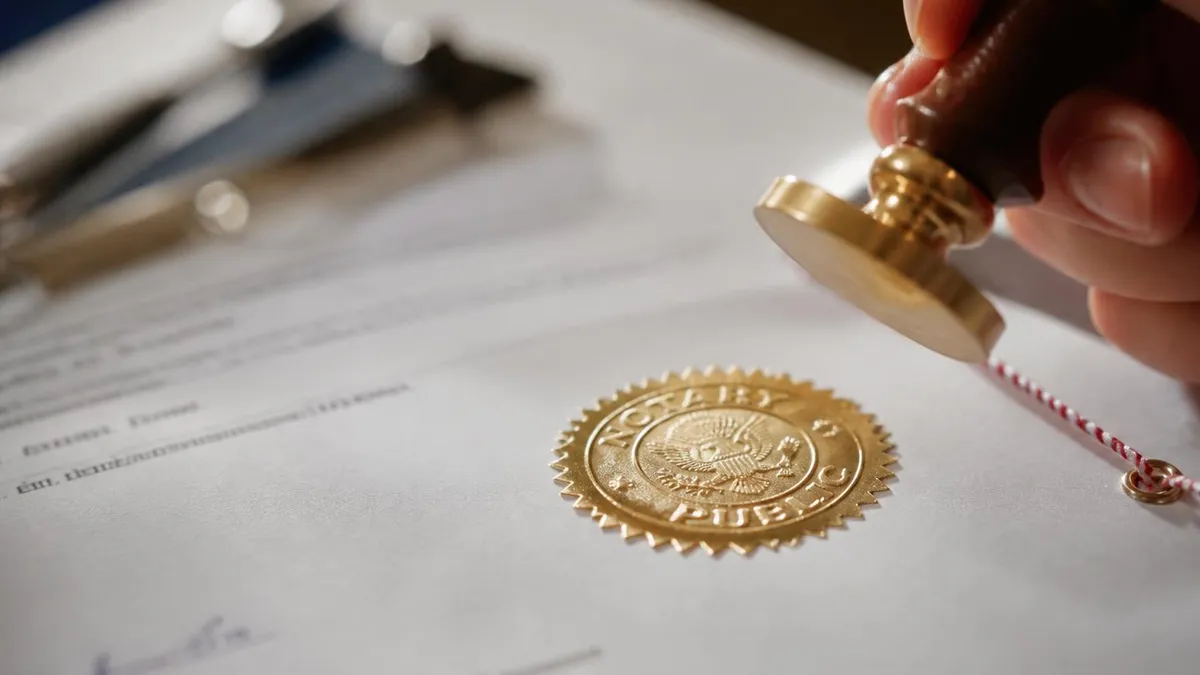
A notary public stamp typically costs fifteen to forty-five dollars depending on style. Self-inking models are the most popular because they produce a clean impression every time and last for tens of thousands of uses. Pre-inked stamps offer the sharpest impression but cost more and have a shorter ink life. Embossing seals are required in only a few states today, although many notaries still purchase one for documents that need a raised impression for additional security.
The surety bond is a required financial protection in most states, with amounts ranging from five hundred dollars in some jurisdictions to fifteen thousand in California and twenty-five thousand in others. The bond protects the public, not the notary — if you make an error that costs a signer money, the bond pays the claim and then seeks reimbursement from you. That is why most notaries also buy errors-and-omissions insurance separately, which covers up to one hundred thousand dollars in personal liability for around eighty dollars per year.
Renewal costs are roughly the same as initial commissioning costs, minus the application fee in some states. California requires a three-hour refresher course every renewal cycle, while Florida and Texas only require the original training once if completed within the last four years. Build the renewal cost into your long-term budget — most professional notaries treat it as a routine business expense and pass it along through slightly higher signing fees.
Many newer notaries also invest in a mobile notary kit for one hundred to two hundred dollars. This includes a portable printer, a thumbprint pad, extra journals, blank acknowledgment and jurat certificates, a flashlight for examining IDs in low light, and a fingerprint cleaner. If you plan to work as a mobile signing agent for title companies, you will also need a background check certification from the National Notary Association for an additional sixty-five to seventy-five dollars annually.
Banks, shipping centers, and some retail chains employ in-house notaries for free or low-cost public service. A notary public in Bank of America branch, for example, will notarize signatures for account holders at no charge during regular business hours. UPS Store locations charge five to fifteen dollars per signature. As you build your practice, understanding the local fee landscape — including ups notary public pricing — helps you set competitive rates while still earning a healthy profit on each signing.
Mobile notaries in major metro areas commonly charge seventy-five to two hundred dollars per signing, with refinance and reverse-mortgage packages paying one hundred fifty to two hundred fifty. After ten to twenty signings per month, the upfront cost of the course, stamp, and bond is fully recovered and everything beyond becomes profit, making the entire investment one of the highest-return certifications available to working adults today.
Your stamp must include your exact commissioned name and commission number, both of which are only finalized when the state issues your certificate. Ordering early almost always results in a stamp that must be reprinted, costing you the original purchase and delaying your first signings by one to two weeks. Wait until your official commission paperwork arrives.
Passing the state exam on the first attempt is realistic for almost every applicant who completes the full online course and supplements it with at least two hundred practice questions. The exam is multiple choice in most states, contains thirty to fifty questions, and gives you between forty-five minutes and two hours to complete it. Scores of seventy to eighty percent are required to pass, depending on the jurisdiction. California's exam is among the toughest, while Texas relies more on application review than a formal test.
The single most effective study tactic is spaced repetition. Instead of cramming the night before, schedule four to six study sessions of forty-five minutes each, spaced two to three days apart, and end every session with a twenty-question quiz. Research on adult learners shows this approach roughly doubles long-term retention compared to one or two marathon study days. Use a built-in tracker or a simple spreadsheet to log which topics you scored lowest on, then prioritize those topics in your next session.
Pay particular attention to certificate wording. A surprisingly large fraction of failed exam questions involve choosing the correct venue line, signer identification statement, or acknowledgment vs jurat distinction. Print out a one-page reference of the official certificate forms from your state and keep it next to your computer while you study. Several students who failed on their first attempt report that they had never actually read the official certificate templates word for word before sitting for the test.
Mock exams are essential during the final week. Take at least two full-length timed practice tests under realistic conditions — no notes, no phone, no breaks — and review every question you missed in detail. The goal is not just to know the right answer but to understand why every wrong answer is wrong. This deeper level of understanding is what separates a seventy-five-percent scorer from a ninety-five-percent scorer. You can find excellent timed tests through our free notary public near me resource library.
On exam day, arrive fifteen minutes early if the test is proctored in person, or test your camera, microphone, and internet connection at least thirty minutes ahead if it is online proctored. Have two forms of identification ready, plus the confirmation email or registration number. Most online-proctored exams require you to slowly pan your webcam around the room to prove no notes are visible, and some require you to use a handheld mirror to show the area behind your monitor.
Manage your time deliberately. Spend no more than ninety seconds on any single question during the first pass, marking anything you are uncertain about for review at the end. Statistically, your first instinct is correct on roughly seventy-five percent of questions, so do not change answers without a clear, specific reason. Once you have completed every question, return to your flagged items and use the remaining time to verify wording and certificate details.
After you pass, your commission is typically issued within one to four weeks. Use that waiting period to finalize your stamp order, purchase your journal and any supplemental supplies, and set up a simple bookkeeping spreadsheet for fees and mileage. Hitting the ground running on day one of your commission means a faster return on your training investment and a more professional impression on every signer you meet that first month.
Once you are commissioned, the real learning begins. The first ten signings are the most important of your career because they cement your habits. Use a checklist for every appointment until the steps become automatic: verify identity, record in journal, complete certificate, apply stamp, return the document. Skipping even one step a single time can create a liability that haunts you for years, so consistency in the early days is worth more than speed.
Build relationships with title companies, signing services, mobile-notary platforms, and local attorneys during your first ninety days. Most working notaries earn the majority of their income through repeat clients rather than walk-ins, so a polite, prompt, error-free reputation matters more than aggressive marketing. Send a brief introduction email to local title offices with your commission certificate, background check certification, and a one-page rate sheet. Many notaries land their first regular client within two weeks of doing this.
Invest in a high-quality digital scanner and a portable printer if you plan to do mobile signings. Title companies frequently send last-minute document updates that must be printed at the signing table, and arriving without a printer is one of the most common reasons new mobile notaries lose clients. A reliable laser printer with an extra toner cartridge in the car eliminates this risk and pays for itself within the first five signings.
Keep your journal in a locked, fireproof container when not in use. Several states require that the journal be retained for seven to ten years after your commission expires, and some require it to be turned in to the county clerk. Losing a journal can result in fines, civil liability, and loss of your commission. Treat it with the same care you would treat a passport or a property deed because legally, it carries similar weight.
Continuing education pays measurable dividends. Even in states that do not require renewal training, smart notaries take a refresher every two years to stay current on statutory changes. Recent amendments around remote online notarization, electronic journals, and elder-fraud reporting have changed best practices significantly since 2023. A two-hour annual update course costs less than fifty dollars and can save you from a single avoidable mistake. You can browse current refresher options through our ups notary public resource guide.
Consider adding the remote online notarization endorsement. Twenty-eight states now authorize RON commissions, and the average remote signing pays seventy-five to one hundred fifty dollars while taking only ten to twenty minutes online. Adding the certification typically requires an additional two-hour course, an approved RON platform subscription of thirty dollars per month, and an updated bond. For notaries willing to invest, RON can easily double monthly income within the first year.
Finally, build a simple personal website and Google Business Profile. Most consumers searching for a notary in 2026 type the phrase free public notary near me or free notary public near me into Google, and the top three local-pack results capture the vast majority of clicks. A basic site with your service area, fees, hours, and a click-to-call button takes one afternoon to build and can generate inbound leads for years with no further effort on your part.
Sample Notary Public Exam Practice Questions
Try these questions from our free Notary Public Exam practice tests. The correct answer and an explanation follow each question.
A notary is commissioned in State A. They travel to State B on vacation. May they notarize a document while in State B?
- A. Yes, if the document will be used in State A
- B. No, notary authority is limited to the issuing state's geographic boundaries
- C. Yes, reciprocity agreements allow notarization in neighboring states
- D. Yes, as long as both states use the same notary laws
Answer: B. No, notary authority is limited to the issuing state's geographic boundaries
A notary's commission is valid only within the geographic borders of the commissioning state. Performing a notarial act while physically in another state exceeds the notary's authority.
What must a notary retain after completing a Remote Online Notarization session?
- A. Only the signed and notarized documents
- B. An audio-visual recording of the session and an electronic journal entry
- C. A paper journal entry and the signer's original ID
- D. A written transcript of the conversation only
Answer: B. An audio-visual recording of the session and an electronic journal entry
Most state RON laws require notaries to retain an audio-visual recording of each RON session along with an electronic journal entry documenting the notarization.
Which of the following is a prohibited act for a notary in virtually every state?
- A. Notarizing a document written in a language the notary can read
- B. Notarizing a document when the signer is not physically or, where permitted, electronically present
- C. Charging a fee below the statutory maximum
- D. Recording the act in a journal
Answer: B. Notarizing a document when the signer is not physically or, where permitted, electronically present
Personal appearance of the signer before the notary is a fundamental requirement. Notarizing without the signer present is one of the most serious violations a notary can commit.
A notary who charges more than the maximum fee allowed by state law is guilty of:
- A. A civil infraction only
- B. Overcharging, which may result in disciplinary action or commission revocation
- C. No offense if the client agreed to pay
- D. A federal crime
Answer: B. Overcharging, which may result in disciplinary action or commission revocation
Charging fees above state-mandated maximums is a violation that can result in disciplinary action, fines, or revocation of the notary's commission.
Notary Public Questions and Answers




How this page was made: written with AI tools and published by Nathan Beja, founder of Practice Test Geeks, who is responsible for its content. Exam facts are checked against the official sources listed below. Not reviewed by a subject-matter expert. Editorial policy
Sources & references
Exam facts on this page (fees, format, dates, passing scores) are checked against these official sources; the date is our last check. Editorial policy
- sos.ca.gov — Eligibility, score release, fees, retake policy, renewal · verified Oct 2026
- sos.la.gov — Fees, test delivery, passing score, renewal, score validity, registration · verified Oct 2026
- coraweb.sos.la.gov — Registration deadline · verified Oct 2026
- static.sos.la.gov — Exam information · verified Oct 2026
- dos.ny.gov — Score validity, time limit, fees, exam dates, registration · verified Oct 2026
- cpshr.us — Exam format, retake fee, passing score, time limit, registration, test dates · verified Oct 2026