
Marine NDT: Complete Guide to Non-Destructive Testing Applications Across Industries
Explore marine NDT and industrial applications of non-destructive testing. Methods, industries, career paths, and real-world use cases. ✅

Marine NDT — non-destructive testing applied to ships, offshore platforms, subsea pipelines, and port infrastructure — sits at the intersection of some of the most demanding inspection challenges in modern industry. Saltwater accelerates corrosion, wave loading creates fatigue cracks, and hulls go years between dry-dock intervals, meaning inspectors must detect flaws through coatings, within tight compartments, and sometimes underwater. The stakes are enormous: a single undetected hull crack or corroded ballast tank can endanger crew, cargo, and the marine environment. Understanding how ndt applications work across maritime and other sectors is essential for anyone pursuing a career in inspection.
Non-destructive testing encompasses a broad family of methods — ultrasonic testing (UT), magnetic particle testing (MT), liquid penetrant testing (PT), radiographic testing (RT), visual testing (VT), and eddy current testing (ET), among others — each suited to different materials, geometries, and defect types.
What unites them is the fundamental principle that the component under examination is not altered, destroyed, or taken out of service permanently. A weld on a cargo vessel's deck plate can be scanned with phased-array UT and returned to service within hours. This non-invasive quality is what makes NDT indispensable across dozens of industries beyond maritime, from aerospace to civil infrastructure.
The global NDT market underscores its economic importance. Industry analysts value the market at roughly $8 billion annually, with growth projected at over 7 percent per year through the late 2020s. Offshore oil and gas inspection, wind energy, and transportation infrastructure are driving much of that expansion. Inspectors who hold multi-method certifications and who understand sector-specific codes — such as IMO SOLAS requirements for marine vessels or API 510 for pressure vessels — command significant salary premiums over single-method technicians.
For students and early-career professionals, the breadth of NDT applications can feel overwhelming. Should you specialize in marine inspection, or build a generalist portfolio? Should you pursue ASNT Level II certification first, or go straight for CSWIP or PCN credentials recognized overseas? Understanding where NDT methods are actually used — which industries, which components, which failure modes they target — makes those career decisions far clearer and helps you study smarter for the certification exams that gatekeep entry into the field.
This guide walks through the major industrial sectors where NDT is applied, explains which methods dominate in each sector, and provides practical context about why inspectors are needed and what they look for. We cover marine and offshore inspection in depth, then move through aerospace, oil and gas, power generation, transportation, and civil infrastructure. Along the way we flag certification requirements, salary benchmarks, and the technical nuances that distinguish routine inspection from specialized advanced testing. Whether you are preparing for your first NDT exam or mapping a specialty career path, the information here will give you a solid operational foundation.
NDT is also evolving rapidly. Automated UT crawlers, drone-based visual inspection, guided-wave systems for pipeline screening, and digital radiography have transformed what a single technician can cover in a shift. Understanding the technology landscape — not just the classical hand-scanner methods — prepares you to be productive in a modern inspection environment and to answer the increasingly common exam questions that cover computerized and automated techniques.
Finally, it is worth noting that NDT is fundamentally a quality-assurance discipline rooted in materials science, fracture mechanics, and code compliance. Effective inspectors do not just operate equipment — they interpret indications, apply acceptance criteria from codes like AWS D1.1, ASME Section V, or DNV offshore standards, and communicate findings clearly to engineers and regulators. The examination questions you will face on ASNT or CSWIP tests reflect that blend of technical knowledge and judgment, which is why study resources that mirror real exam formats are so valuable when you are preparing to certify.
NDT Applications by the Numbers

Key NDT Methods Used in Marine Inspection
The workhorse of marine hull and weld inspection. Phased-array UT maps corrosion thinning across large deck plate areas and characterizes weld flaws in structural members, often from one side without removing coatings. Mandatory for many DNV and ABS surveys.
Detects surface and near-surface cracks in ferromagnetic steels — ideal for welds in frames, bulkheads, and mooring fittings. Fast and low-cost; widely used during annual and special dry-dock surveys to screen high-stress areas before more detailed UT.
Applied to non-ferromagnetic components such as stainless steel fittings, aluminum superstructures, and copper alloy valves. Dye or fluorescent penetrant seeps into open surface cracks and is revealed under UV or white light. Simple, portable, and code-recognized.
Used for rapid screening of heat exchanger tubes, mooring chain links, and aluminum hull sections. No couplant required; the probe can scan through paint layers. Advanced pulsed eddy current (PEC) variants measure wall thickness through insulation and coatings.
Underwater In-Water Inspection with Lifting and Diver (UWILD) surveys use qualified divers or ROVs with cameras to assess hull coatings, anodes, propellers, and welds. Structured VT is the first-line method in virtually every marine inspection program.
Beyond the marine sector, NDT is deeply embedded in aerospace manufacturing and maintenance. Aircraft structural components — fuselage skins, wing spars, turbine discs, landing gear — must be inspected to tolerances measured in thousandths of an inch, because fatigue cracks in aluminum alloys and titanium can grow rapidly once initiated.
The FAA mandates specific inspection intervals and approved methods for each aircraft type, and airlines employ NDT technicians whose sole job is to perform those scheduled checks. Phased-array UT and eddy current testing dominate composite and metallic airframe inspection respectively, while fluorescent penetrant testing catches surface cracks invisible to the naked eye.
The oil and gas sector represents one of the largest employers of NDT professionals in the United States. Refineries, petrochemical plants, and upstream production facilities operate thousands of pressure vessels, heat exchangers, and piping circuits that degrade through corrosion under insulation (CUI), erosion, hydrogen-induced cracking (HIC), and stress corrosion cracking (SCC). Inspectors working to API 510 (pressure vessels), API 570 (piping), and API 653 (storage tanks) must assess remaining wall thickness, evaluate weld quality, and determine fitness for continued service.
A single unplanned shutdown at a large refinery costs hundreds of thousands of dollars per day, making proactive NDT programs a clear economic win for operators.
Power generation — nuclear, fossil-fuel, and increasingly wind and solar — relies heavily on NDT for both construction quality assurance and in-service inspection. Nuclear power plants operate under some of the strictest inspection regimes in any industry. The ASME Boiler and Pressure Vessel Code, Section XI, mandates inspection intervals and qualified procedures for reactor pressure vessels, steam generators, and primary coolant piping. Inspectors must demonstrate procedure qualification through performance demonstration initiatives (PDI) before working in a nuclear environment. Radiographic and ultrasonic methods are most common, but acoustic emission testing is also used to monitor reactor components in real time.
The transportation sector — rail, automotive, and heavy trucking — uses NDT extensively during manufacturing and maintenance. Rail inspection is particularly well developed: automated ultrasonic rail-testing vehicles scan hundreds of miles of track per shift, looking for transverse defects in the rail head that would be invisible from the surface. Wheel and axle inspection at maintenance depots uses MT and UT. Automotive manufacturing uses automated UT and eddy current systems inline on production lines to verify weld quality in body panels and chassis components before vehicles leave the factory.
Civil infrastructure — bridges, dams, tunnels, and pipelines — represents a growing application area as the US faces a significant backlog of aging structures. Ground-penetrating radar (GPR) locates rebar corrosion and voids behind bridge deck concrete. Acoustic emission sensors monitor crack growth in structural steel in real time. Impulse-echo and impact-echo techniques assess concrete integrity. The Federal Highway Administration funds research and field deployment of advanced NDT methods through its infrastructure inspection programs, creating demand for technicians with both traditional NDT skills and data-analysis capabilities.
Manufacturing quality control is perhaps the broadest NDT application area of all. Virtually every metal casting, forging, weld, and composite laminate produced for a safety-critical application undergoes some form of NDT before it leaves the factory. Foundries use RT to check for internal porosity in castings. Weld shops use MT or PT on every weld joint. Composite manufacturers use automated UT or thermographic inspection to find delaminations and disbonds that would cause premature structural failure. The inspection records generated become part of the component's traceability documentation, required by aerospace, defense, and nuclear customers.
Understanding the breadth of NDT applications not only expands your employment options but also deepens your grasp of why specific codes and acceptance criteria exist. When you study the ASMT SNT-TC-1A qualification standard, for example, knowing that it applies differently in a nuclear plant than in a marine shipyard — because the failure consequences, regulatory frameworks, and dominant defect types differ — helps you answer nuanced exam questions that test conceptual understanding rather than rote memorization.
NDT Methods and Their Industrial Applications
Marine NDT technicians work aboard vessels, at shipyards, and on offshore platforms inspecting hull plating, structural welds, mooring systems, and pressure equipment. Ultrasonic thickness gauging is performed at hundreds of measurement points per survey to map corrosion patterns, with results compared against minimum thickness requirements set by class societies such as ABS, DNV GL, or Lloyd's Register. Phased-array UT has become standard on major surveys because it produces a full volumetric image of weld cross-sections and can characterize defect orientation — critical for fitness-for-service assessments under API 579 or equivalent offshore codes.
Underwater inspection is a specialized subset where ROV-mounted inspection systems or qualified commercial divers perform visual surveys of hull coatings, sacrificial anodes, propellers, rudders, and sea chests. Magnetic particle testing with a wet fluorescent method is used on subsea welds and mooring chain links inspected by divers. Certification bodies such as CSWIP offer specific underwater inspection grades (3.1U and 3.2U) that combine NDT method knowledge with diver competency requirements, and these credentials are recognized by international oil companies operating in the North Sea, Gulf of Mexico, and Southeast Asia.

NDT Careers: Benefits and Challenges to Weigh
- +High demand across marine, aerospace, oil and gas, and infrastructure sectors ensures strong job security
- +Median US salary of $64K with specialists and Level IIIs regularly exceeding $90K–$110K
- +Portability of ASNT and CSWIP credentials allows work across multiple industries and internationally
- +Diverse work environments — shipyards, refineries, nuclear plants, offshore platforms, bridges — prevent routine monotony
- +Clear certification ladder (Level I → II → III) with objective exam and practical benchmarks at each stage
- +Growing role of advanced techniques (PAUT, TOFD, digital RT) keeps the field technically stimulating
- −Field work often involves confined spaces, heights, underwater environments, or radiation exposure requiring strict safety discipline
- −Certification exams are genuinely difficult — ASNT Level III pass rates typically run 50–60% on first attempt
- −Continuing education and recertification every three to five years adds cost and study time throughout a career
- −Night shifts, turnaround work, and travel assignments are common, affecting work-life balance for some technicians
- −Physical demands — carrying heavy equipment, crawling into tight compartments, standing for long shifts — limit longevity for some
- −Liability pressure is significant: a missed defect can result in catastrophic failure, making high-stakes judgment calls stressful
Pros and Cons at a Glance
| Pros | Cons |
|---|---|
| High demand across marine, aerospace, oil and gas, and infrastructure sectors ensures strong job security | Field work often involves confined spaces, heights, underwater environments, or radiation exposure requiring strict safety discipline |
| Portability of ASNT and CSWIP credentials allows work across multiple industries and internationally | Continuing education and recertification every three to five years adds cost and study time throughout a career |
| Diverse work environments — shipyards, refineries, nuclear plants, offshore platforms, bridges — prevent routine monotony | Night shifts, turnaround work, and travel assignments are common, affecting work-life balance for some technicians |
| Clear certification ladder (Level I → II → III) with objective exam and practical benchmarks at each stage | Physical demands — carrying heavy equipment, crawling into tight compartments, standing for long shifts — limit longevity for some |
| Growing role of advanced techniques (PAUT, TOFD, digital RT) keeps the field technically stimulating | Liability pressure is significant: a missed defect can result in catastrophic failure, making high-stakes judgment calls stressful |
NDT Inspection Readiness: 10-Point Pre-Inspection Checklist
- ✓Confirm the applicable code or standard (e.g., ASME V, AWS D1.1, DNV offshore) before selecting any method.
- ✓Verify that your certification level and method endorsements cover the scope of work assigned.
- ✓Calibrate all instruments to the correct reference standard at the start of each inspection shift.
- ✓Document surface condition — cleanliness, temperature, coating thickness — before applying any contact method.
- ✓Review the component's prior inspection records to focus effort on areas with known or expected deterioration.
- ✓Confirm correct consumables: penetrant family, particle suspension medium, film type, or calibration block alloy.
- ✓Apply the correct lighting conditions — minimum 1,000 lux for color-contrast PT, UV intensity for fluorescent methods.
- ✓Record all indications with location, orientation, length, and height data before applying acceptance criteria.
- ✓Complete the inspection report with method, procedure revision, calibration records, and technician certification details.
- ✓Obtain a qualified reviewer signature before releasing equipment back to service when required by applicable code.
Sector Knowledge Boosts Exam Scores
ASNT Level II and Level III exams include scenario-based questions that assume you understand why a method is used in a given industry context — not just how it works in isolation. Candidates who study real-world applications of marine NDT, aerospace inspection, and pipeline screening consistently outperform those who study method theory alone. Pair your method study with application context to maximize your exam performance.
Certification pathways in NDT are well-structured but genuinely demanding, and choosing the right credential for your target sector can save significant time and money. In the United States, the ASNT SNT-TC-1A and ASNT CP-189 standards govern most industrial NDT certification.
Level I technicians operate equipment under direct supervision and perform data collection; Level II technicians calibrate equipment, interpret results, and write procedures; Level III technicians are responsible for establishing techniques, qualifying procedures, and providing technical oversight. Each level requires a combination of documented training hours, hands-on experience, and passing a written examination — and in many employers' programs, a practical demonstration as well.
For marine and offshore work, the CSWIP (Certification Scheme for Weld Inspection Personnel) credentials issued by TWI in the UK are widely recognized by international oil companies, shipyards, and offshore contractors operating in the North Sea, Gulf of Mexico, West Africa, and Southeast Asia. The CSWIP 3.1 Welding Inspector and 3.2 Senior Welding Inspector exams test knowledge of weld metallurgy, joint preparation, code requirements, and inspection documentation in addition to NDT method theory. US technicians who add a CSWIP credential alongside their ASNT Level II certifications significantly expand their international employability and command higher contract rates.
Salary benchmarks help frame the certification investment. An entry-level NDT Level I technician in the US typically earns $42,000–$52,000 per year. A Level II technician with two or three method endorsements (commonly UT, MT, and PT) earns $58,000–$78,000. Level III professionals — especially those with engineering backgrounds and multiple method certifications — regularly earn $95,000–$130,000, and independent Level III consultants supporting nuclear or aerospace programs can bill $150+ per hour. In the marine sector, offshore platform inspection roles that require travel and overnight offshore stays add substantial per-diem and hazard allowances on top of base wages.
Preparation time for certification exams varies by method and level. For ASNT Level II, most candidates need 40–80 hours of focused study per method beyond their required training course hours. Ultrasonic testing Level II is generally considered the most demanding method exam because it covers sound physics, beam geometry, calibration techniques, flaw sizing, and code interpretation all in a single sitting.
Penetrant and magnetic particle Level II exams are shorter and many candidates pass on their first attempt after a weekend of structured practice. Acoustic emission testing is a specialized method where exam questions frequently test your understanding of signal interpretation and source location mathematics.
The ASNT NDT Level III examinations are administered in two parts: a Basic examination covering materials science, fabrication processes, and NDT method principles across all major methods, and a Method examination that dives deep into a single method. The Basic exam has historically had the lowest first-time pass rate — around 50% — because it requires broad knowledge that many working technicians have not revisited since their Level II training. Successful Level III candidates typically spend three to six months of structured preparation, using practice exams, the ASNT Handbook series, and mentorship from experienced Level IIIs.
Beyond formal ASNT credentials, some sectors have their own certification requirements. The nuclear industry requires qualification under the ASME Section XI Appendix VII and VIII performance demonstration programs for UT procedures applied to reactor coolant system components. These qualifications are procedure-specific and equipment-specific — a technician qualified on one UT system cannot simply transfer that qualification to a different phased-array instrument without requalification. Aerospace employers operating under FAA repair station certificates require technicians certified to NAS 410 or EN 4179 with employer-controlled qualification records, adding another layer of documentation to the credential stack.
For students mapping a career path, the most practical advice is to start with the methods most in demand in your target sector, build your Level II base, accumulate documented experience hours diligently, and then pursue Level III once you have three to five years of field experience behind you. The inspection experience you gather between Level II and Level III certification is not just a bureaucratic requirement — it genuinely sharpens your ability to pass the Level III exams, because real-world exposure to equipment, codes, and indications makes abstract exam questions much easier to parse and answer correctly.

ASNT SNT-TC-1A Level II certification requires a minimum of 400 hours of documented NDT experience for methods like UT and RT, and 200 hours for PT and MT. These hours must be recorded contemporaneously in a format your employer can verify — retroactively reconstructed logs are routinely rejected during audits. Start your experience log on your first day in the field and maintain it continuously to avoid delays when you apply for certification.
Advanced and emerging NDT technologies are reshaping what inspectors can accomplish in a single shift, and familiarity with these systems is increasingly tested on certification exams and expected by employers. Phased-array ultrasonic testing (PAUT) uses an array of piezoelectric elements that can be electronically steered to generate multiple beam angles simultaneously, producing a cross-sectional image of a weld or component in real time.
A single PAUT scan can replace four or five conventional UT angle-beam scans, cutting inspection time dramatically. Offshore and marine survey companies have adopted PAUT broadly because it reduces scaffold or staging requirements — fewer scan passes means less time at height or in confined spaces.
Time-of-flight diffraction (TOFD) is a complementary UT method that measures the time difference between diffracted signals from crack tips to calculate crack height with high accuracy. Combined PAUT/TOFD systems are now standard for major pressure vessel and pipeline weld inspections in the oil and gas sector. TOFD is particularly valued for fitness-for-service assessments because fracture mechanics calculations require accurate crack height input — the through-wall extent of a crack determines how quickly it will propagate under operating stress cycles, which drives the remaining-life calculation that justifies continued operation versus repair.
Guided-wave ultrasonic testing (GWUT) transmits low-frequency sound waves along the length of a pipe from a single collar-mounted transducer array, screening 100 feet or more of pipe in each direction for significant wall loss or cracking. GWUT is widely used in refineries and marine terminal piping because it can screen under insulation and through soil without excavating or removing cladding from every section. The screening results flag areas for detailed conventional UT follow-up, making the overall inspection program far more efficient than manual point-by-point measurement across miles of piping.
Digital radiography (DR) and computed radiography (CR) have largely replaced film-based X-ray in most industrial applications. DR panels produce images instantly, eliminating darkroom processing and chemical handling. Images can be digitally enhanced, measured, and archived with embedded calibration data. For marine applications, DR is used in shipyard weld inspection during new construction and in offshore fabrication yards where volumes of welds must be processed quickly during critical construction sequences. The elimination of film also removes the chemical waste stream that regulatory compliance requires for traditional RT operations.
Drone-based visual inspection is transforming survey work for large structures — ship hulls above the waterline, offshore jacket legs, bridge girders, and wind turbine towers. A drone equipped with high-resolution cameras and structured light can cover surface areas in minutes that would require hours of scaffold work, with digital image sets that can be processed by AI-assisted defect detection software. While drone VT does not replace contact methods for subsurface flaw detection, it dramatically improves the efficiency of the initial condition assessment that determines where to deploy contact NDT resources.
Thermographic inspection — both passive and active — detects disbonds, delaminations, moisture ingress, and insulation defects through temperature distribution analysis. Active thermography, where a flash lamp or ultrasonic excitation heats the surface and an infrared camera captures the thermal transient, is used in aerospace composite inspection to find impact damage beneath paint or surface plies. For marine applications, thermography identifies moisture trapped behind composite superstructure panels and insulation failures in refrigerated cargo compartments. The method requires specialist training and careful data interpretation, but it covers large areas quickly and leaves no residue or surface marking.
These advanced technologies are progressively appearing in NDT certification exams as the industry standardizes their application. ASNT has published Level II and Level III training syllabi for PAUT and TOFD, and PCN in the UK offers formal PAUT endorsements. Staying current with these evolving methods — through continuing education, employer training programs, and self-study using resources like practice question banks — is essential for technicians who want to remain competitive throughout a multi-decade NDT career. The field rewards those who combine classical method fundamentals with a genuine curiosity about emerging technology.
Practical exam preparation for NDT certification requires a systematic approach that mirrors how the exams are actually structured. ASNT Level II written exams typically contain 40–80 questions drawn from three areas: method-specific principles and theory, practical application and procedure questions, and code or specification interpretation. The weighting varies by method — UT exams are heavier on theory, while VT and PT exams lean toward procedure and application. Understanding this structure lets you allocate your study time efficiently rather than reviewing everything at uniform depth.
Practice questions are the single highest-value study tool available to NDT candidates. Working through large banks of exam-style questions reveals gaps in your understanding that passive reading never exposes. When you encounter a question you cannot answer confidently, that gap represents a topic to go back and study deeply — not simply to memorize the correct answer but to understand why the correct answer is correct and why the distractors are wrong. That level of comprehension is what carries you through the novel question formats that appear on real exams and that no practice bank will perfectly replicate.
Time management during the exam is a skill that practice tests build directly. Many candidates who know the material still run short on time because they spend too long on difficult questions early in the exam. A disciplined strategy — answer the questions you are confident about first, mark uncertain ones for review, and return to difficult ones with remaining time — consistently improves scores. Timed practice sessions under realistic conditions train this skill far better than untimed review sessions that allow you to linger on every question.
The practical examination component, where required, tests your ability to physically set up equipment, calibrate to the correct reference standard, scan a test specimen containing known defects, and report your findings within an allotted time. Practical exams in UT are particularly demanding because calibration errors that go undetected will compound through the entire scan and cause you to miss or missize defects. Practicing on actual equipment — not just studying diagrams — is irreplaceable preparation. Many community colleges, trade schools, and employer training programs provide hands-on lab time that directly prepares you for the practical component.
Group study with peers preparing for the same certification level is underrated. Discussing the reasoning behind correct answers, challenging each other's interpretations of code language, and walking through practical setup procedures together accelerates learning significantly. NDT forums and professional association study groups — including those organized through ASNT local sections — provide structured peer-learning opportunities that are far more effective than isolated self-study for candidates who struggle with motivation or who hit conceptual plateaus.
Code and specification reading is a specific skill that many candidates neglect until they face exam questions that require it. Examiners routinely ask candidates to interpret a specific paragraph from ASME Section V, AWS D1.1, or a sector-specific standard and apply it to a given scenario.
The language of codes is precise and technical, and misreading a single word — particularly terms like "shall," "should," "may," and the definitions of acceptance vs. rejection criteria — leads to wrong answers on questions that a code-fluent candidate answers quickly and correctly. Regular practice reading and interpreting the actual code documents you will be tested on is essential preparation, not optional supplementary work.
Finally, physical and logistical preparation for exam day matters more than many candidates realize. NDT exams can run three to four hours with no breaks permitted at some testing centers. Practice sessions of equivalent duration build the concentration stamina needed to maintain accuracy through the final quarter of the exam when fatigue sets in. Arriving familiar with the testing center location, having your certification documentation and identification organized, and having eaten a proper meal are mundane preparations that nevertheless have a measurable effect on performance when the stakes are high.
Sample NDT - Non-Destructive Testing Practice Questions
Try these questions from our free NDT - Non-Destructive Testing practice tests. The correct answer and an explanation follow each question.
Pulsed eddy current (PEC) testing differs from conventional eddy current testing primarily in that it:
- A. Uses multiple simultaneous sinusoidal frequencies instead of a single frequency
- B. Applies a step-change pulse excitation and analyzes the time-domain decay response
- C. Requires direct contact with the conductive surface for signal coupling
- D. Operates only on ferromagnetic materials at saturation
Answer: B. Applies a step-change pulse excitation and analyzes the time-domain decay response
PEC excites the coil with a sharp current pulse and measures the time-domain decay of the induced eddy currents, providing simultaneous multi-depth information from a single measurement.
In phased array ultrasonic testing (PAUT), what enables steering of the beam without physically moving the probe?
- A. Mechanical gimbals inside the probe housing
- B. Electronic time delays applied to individual array elements
- C. Variable frequency modulation of the pulser
- D. Magnetic field adjustments around the transducer
Answer: B. Electronic time delays applied to individual array elements
PAUT steers and focuses the beam by applying precisely calculated electronic time delays to fire individual array elements in a controlled sequence.
Which condition would most likely cause a false indication in magnetic particle testing?
- A. A tight fatigue crack on the surface
- B. Magnetic writing from contact with another magnetized part
- C. A cold shut in a casting
- D. A seam running longitudinally in a bar
Answer: B. Magnetic writing from contact with another magnetized part
Magnetic writing occurs when a magnetized tool or part contacts the test surface, creating localized field distortions that attract particles and produce false indications unrelated to actual discontinuities.
In eddy current testing, 'noise' most commonly refers to:
- A. Audible sounds produced by the test instrument
- B. Unwanted signals from material variations, geometry, or probe wobble that mask defect indications
- C. The electrical hum from the AC power supply
- D. Reflections from the far wall of the test piece
Answer: B. Unwanted signals from material variations, geometry, or probe wobble that mask defect indications
Noise in ECT is any unwanted signal — from surface roughness, microstructural variation, or probe instability — that reduces the signal-to-noise ratio and makes defect detection harder.
Take the full NDT - Non-Destructive Testing practice test
NDT Questions and Answers
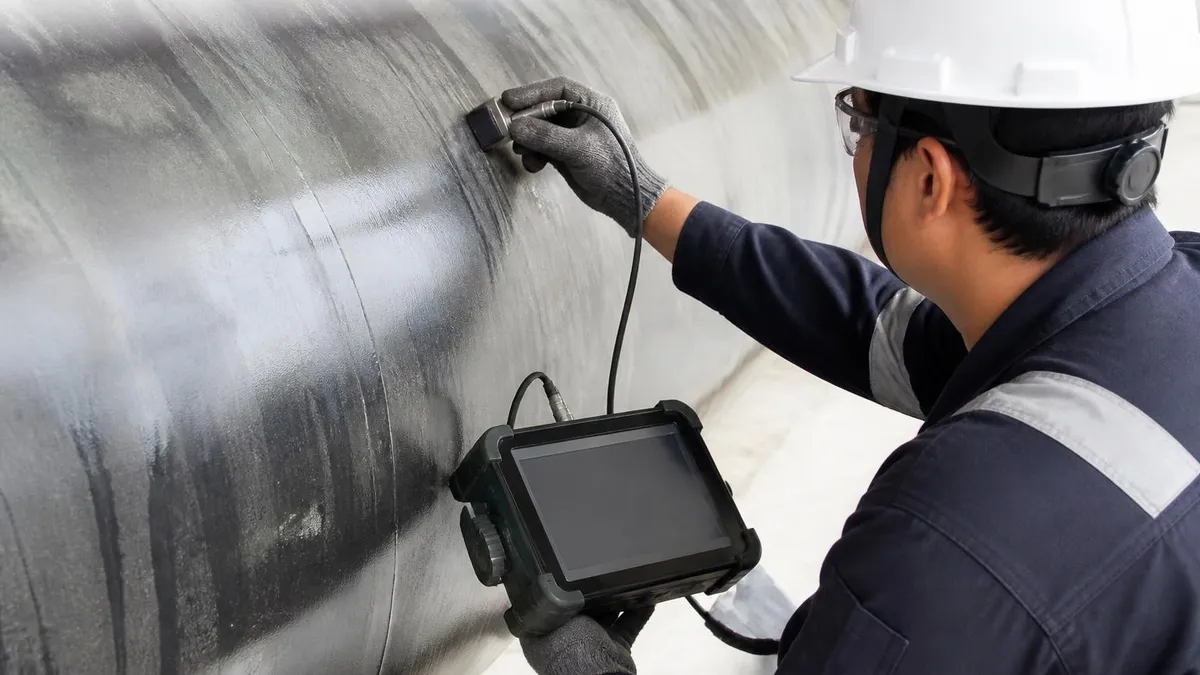
NDT Training: Complete Guide to Non-Destructive Testing Certification Courses in 2026

Crane NDT Inspection: Complete Guide to Non-Destructive Testing for Lifting Equipment

NDT Research: A Complete Guide to Non-Destructive Testing Science, Methods, and Career Opportunities
Non-Destructive Testing Courses: Complete Training Guide for NDT Certification in 2026

NDT Aerospace: Complete Guide to Non-Destructive Testing in Aviation and Aerospace Industries
About the Author

Educational Psychologist & Academic Test Preparation Expert
Columbia University Teachers CollegeDr. Lisa Patel holds a Doctorate in Education from Columbia University Teachers College and has spent 17 years researching standardized test design and academic assessment. She has developed preparation programs for SAT, ACT, GRE, LSAT, UCAT, and numerous professional licensing exams, helping students of all backgrounds achieve their target scores.