
Crane NDT Inspection: Complete Guide to Non-Destructive Testing for Lifting Equipment
Master crane NDT inspection methods, standards, and career paths. 🔎 Complete guide to keeping lifting equipment safe with non-destructive testing.

Crane NDT inspection is one of the most safety-critical applications of non-destructive testing in heavy industry. Overhead cranes, gantry cranes, jib cranes, and mobile lifting systems bear enormous loads on a daily basis, and even a hairline crack in a hook, boom, or weld can lead to catastrophic equipment failure. NDT allows inspectors to evaluate structural integrity, detect hidden defects, and document equipment condition without cutting, drilling, or otherwise damaging the asset being examined. For facilities managers, crane owners, and NDT professionals alike, understanding how these inspections work is the foundation of a safe workplace.
The regulatory landscape for crane inspection in the United States is anchored by OSHA 1910.179 for overhead and gantry cranes, ASME B30.2 for overhead and gantry cranes, and ASME B30.5 for mobile cranes. These standards mandate periodic inspections that go well beyond visual checks.
When a visual inspection raises a flag — a surface indication, a weld anomaly, or a dimensional change — NDT methods such as magnetic particle testing, ultrasonic testing, and dye penetrant testing are called in to characterize the defect, measure its depth or extent, and help engineers decide whether the crane remains fit for service. Skipping this step is not merely a compliance failure; it is an invitation to preventable accidents.
NDT inspection services for cranes cover the full spectrum of structural components: main girders and end trucks, runway rails and rail attachments, hooks and hook blocks, wire rope and sheaves, boom sections and lattice structures, and load-bearing welds throughout the frame. Each component type presents its own inspection challenges. Hooks are frequently evaluated with magnetic particle testing because cracks tend to initiate at the throat and shank threads. Boom sections and box girders are well-suited to ultrasonic shear-wave scanning, which can detect laminar defects and fatigue cracks beneath painted surfaces without requiring paint removal over the entire structure.
Crane NDT is not a one-size-fits-all discipline. The correct method depends on the material (steel, aluminum, cast iron), the defect type expected (fatigue crack, corrosion thinning, weld porosity), the surface condition, and the required sensitivity.
A new crane coming out of fabrication may receive radiographic testing on critical full-penetration welds during manufacture, while the same crane in service will be examined with portable magnetic particle or phased-array ultrasonic equipment that can be brought to the work site without taking the crane offline for an extended period. Selecting the right technique requires inspectors who understand both the physics of each method and the failure modes specific to lifting equipment.
Certified NDT technicians who specialize in crane inspection typically hold qualifications under the American Society for Nondestructive Testing (ASNT) SNT-TC-1A or the ACCP (ASNT Central Certification Program) at Level II or Level III. Some jurisdictions also require crane inspector certification from bodies such as the National Commission for the Certification of Crane Operators (NCCCO). If you are pursuing a career in this field, quality ndt inspection services training programs will prepare you for both the NDT methods and the crane-specific codes you will reference on every job.
This guide walks through the primary NDT methods used on cranes, the standards that govern them, what a typical crane NDT inspection involves from arrival to final report, and how to build the knowledge base you need to pass certification exams and succeed in the field. Whether you are a facility engineer trying to understand what your inspection contractor is doing, or a technician preparing for your first crane inspection assignment, the information here will give you a solid, practical foundation.
Crane NDT inspection is ultimately about risk management. Every crane has a finite service life, and fatigue accumulates with every lift cycle. By systematically applying NDT methods at defined intervals — and whenever visual inspection raises a concern — operators and owners can extend equipment service life safely, avoid unplanned downtime, and protect workers from the devastating consequences of an unexpected structural failure. The sections that follow cover each of these dimensions in depth.
Free NDT - Non-Destructive Testing Study Tools
Interactive NDT - Non-Destructive Testing resources on PracticeTestGeeks, free to start:
- NDT - Non-Destructive Testing practice test — 400+ questions with instant scoring and answer explanations
- NDT - Non-Destructive Testing flashcards — review key terms and concepts card by card
- NDT - Non-Destructive Testing study guide — topic-by-topic overview of what the exam covers
- NDT - Non-Destructive Testing cheat sheet — one-page printable summary for last-minute review
Crane NDT Inspection by the Numbers

Core NDT Methods Used in Crane Inspection
Detects surface and near-surface cracks in ferromagnetic steel components. Ideal for crane hooks, welds, and hook shanks where fatigue cracks typically initiate. Fast, portable, and low-cost — the most common method on steel crane hardware.
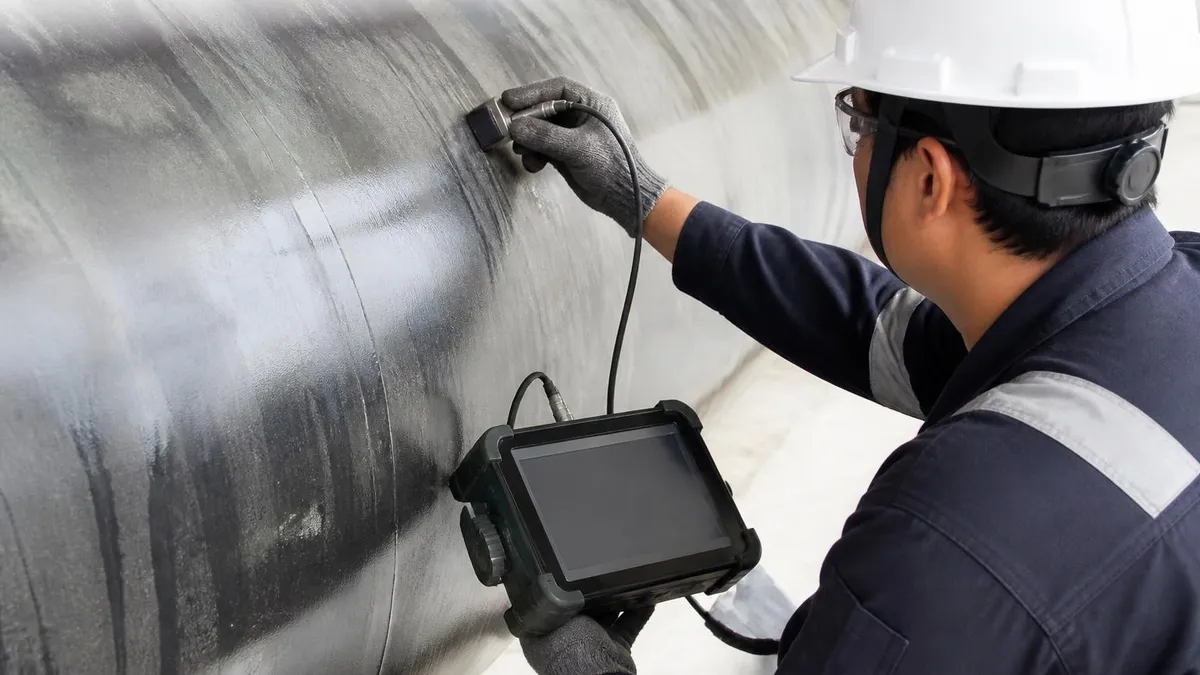
Uses high-frequency sound waves to detect subsurface flaws and measure material thickness. Phased-array UT is widely used on crane girder welds and boom sections to map internal discontinuities without removing paint over large areas.
Reveals surface-breaking cracks in non-ferromagnetic materials such as aluminum crane components and austenitic stainless fittings. Requires surface cleaning but no electrical equipment, making it adaptable to field conditions.
The foundation of every crane inspection program. Trained inspectors evaluate corrosion, deformation, wear, and weld surface condition. VT triggers the decision to apply other NDT methods when anomalies are found.
Uses X-ray or gamma-ray imaging to reveal internal weld defects such as porosity, inclusions, and lack of fusion. Primarily applied during crane fabrication on full-penetration welds; portable gamma-ray units are used selectively in field service.
The regulatory and standards framework governing crane NDT inspection in the United States is layered and interlocking. At the federal level, OSHA 29 CFR 1910.179 establishes minimum inspection requirements for overhead and gantry cranes in general industry, including requirements for frequent inspections (daily to monthly) and periodic inspections (one to twelve months). OSHA 1926.1412 extends similar requirements to cranes used in construction. These regulations do not specify which NDT methods to use; they require that inspections be performed by qualified personnel and that deficiencies be corrected before the crane is returned to service.
The technical substance of crane inspection — the acceptance criteria, the methods, and the documentation requirements — comes from the ASME B30 series of standards. ASME B30.2 covers top-running bridge and gantry cranes, B30.4 covers portal cranes, B30.5 covers mobile cranes, and B30.11 addresses monorails and underhung cranes. Each standard specifies what to inspect, at what intervals, and what conditions require the crane to be taken out of service. NDT is explicitly referenced in these documents for evaluating hook cracks, weld discontinuities, and structural member integrity when visual examination is inconclusive.
For the NDT methods themselves, the governing documents are the ASNT recommended practice SNT-TC-1A (which defines training, experience, and examination requirements for NDT personnel) and the applicable method standards from ASTM International. ASTM E709 governs magnetic particle testing, ASTM E165 governs liquid penetrant testing, and ASTM E317 covers ultrasonic testing calibration.
When crane inspections are performed as part of a weld quality assessment, AWS D1.1 (Structural Welding Code — Steel) provides the acceptance criteria for weld discontinuities detected by UT and RT. Inspectors must know which standard applies to which component and which defect type — a skill developed through both formal training and field experience.
Beyond federal OSHA, state plan states (such as California, Michigan, and Washington) may have additional or more stringent crane inspection requirements. Some states require crane inspection by a licensed professional engineer or a specifically credentialed crane inspector. Jurisdictional awareness is a key competency for NDT service providers operating across multiple states. Additionally, some industries layer their own requirements on top of the regulatory baseline: the nuclear power industry follows NRC regulations and ASME Section XI, the petrochemical sector often follows API RP 2D for offshore cranes, and the aerospace industry may apply MIL-HDBK-6870 for inspection of aerospace ground support equipment.
Understanding the applicable standard is not academic — it directly determines the sensitivity required of your NDT method, the acceptance criteria you apply, and the documentation you must produce. An MT inspection performed to ASTM E709 with a wet fluorescent bath and ultraviolet illumination will detect much finer indications than a dry powder examination, and the standard under which the work is performed must be clearly stated in the inspection report. Clients, auditors, and insurance underwriters will scrutinize this documentation.
Inspection intervals under the ASME B30 standards are risk-based. Cranes in heavy-duty service (Class D or E under ASME B30.2) may require monthly periodic inspections with NDT on selected components, while standby cranes in light service may have annual inspection cycles. After any incident — a load drop, a collision, an overload event — an immediate special inspection is required before the crane is returned to service, and NDT is almost always part of that special inspection. Inspectors must understand how service class affects inspection frequency and scope.
The trend in modern crane NDT is toward risk-based inspection (RBI) frameworks, which prioritize inspection resources based on consequence of failure and probability of defect occurrence. Rather than applying the same inspection scope uniformly to every component on every inspection cycle, RBI directs intensive NDT effort toward the highest-consequence, highest-probability failure locations — the hook throat, the main girder bottom flange welds near midspan, and the end truck connections where fatigue loading is greatest. This approach improves safety and reduces overall inspection cost by concentrating NDT where it matters most.
NDT Methods Compared: Crane Inspection Applications
Crane hooks are subject to tensile, bending, and fatigue stresses with every lift cycle, making them high-priority NDT targets. Magnetic particle testing (MT) is the dominant method for carbon steel hooks because cracks at the hook throat and shank thread root are surface-breaking and oriented perpendicular to the applied load. Wet fluorescent MT with AC yoke magnetization provides excellent sensitivity and is practical in field conditions. ASME B30.10 specifies that hooks with cracks must be removed from service immediately, with no weld repair permitted.
For alloy steel hooks and stainless components, liquid penetrant testing (PT) supplements MT by revealing fine cracks that might not be visible under dry magnetic particle conditions. Inspectors should pay special attention to the saddle and the point of the hook, where abrasion and impact can create stress risers. Dimensional inspection using a hook gauge (to check for throat opening beyond the 15% ASME tolerance) should always accompany NDT so that both cracking and plastic deformation are evaluated in the same inspection event, minimizing crane downtime.

Crane NDT Inspection: Benefits and Limitations
- +Detects cracks and defects before they grow to critical size, preventing catastrophic crane failure and load drops
- +Preserves the crane structure — no cutting, drilling, or disassembly required to examine internal conditions
- +Produces documented, defensible inspection records for OSHA compliance and insurance purposes
- +Enables risk-based maintenance decisions that extend crane service life and reduce total ownership cost
- +Multiple complementary methods can be combined to cover surface, near-surface, and volumetric defect types
- +Modern portable equipment allows full-capability inspections to be performed at the job site without mobilizing the crane to a shop
- −Requires highly trained, certified technicians — the quality of results depends heavily on inspector skill and experience
- −Access to crane structural members (top flange welds, end truck connections) can be difficult and may require scaffolding or crane shutdown
- −Some methods (radiographic testing, wet fluorescent MT) require safety controls and specialized equipment that add cost and scheduling complexity
- −NDT can characterize defects but cannot always predict remaining service life without engineering fitness-for-service analysis
- −False indications (non-relevant indications in MT, geometric reflectors in UT) require experienced interpretation to avoid unnecessary crane removals from service
- −Inspection results are point-in-time snapshots — defects that initiate between inspection cycles may not be detected until the next scheduled examination
Pros and Cons at a Glance
| Pros | Cons |
|---|---|
| Detects cracks and defects before they grow to critical size, preventing catastrophic crane failure and load drops | Requires highly trained, certified technicians — the quality of results depends heavily on inspector skill and experience |
| Preserves the crane structure — no cutting, drilling, or disassembly required to examine internal conditions | Access to crane structural members (top flange welds, end truck connections) can be difficult and may require scaffolding or crane shutdown |
| Produces documented, defensible inspection records for OSHA compliance and insurance purposes | Some methods (radiographic testing, wet fluorescent MT) require safety controls and specialized equipment that add cost and scheduling complexity |
| Enables risk-based maintenance decisions that extend crane service life and reduce total ownership cost | NDT can characterize defects but cannot always predict remaining service life without engineering fitness-for-service analysis |
| Multiple complementary methods can be combined to cover surface, near-surface, and volumetric defect types | False indications (non-relevant indications in MT, geometric reflectors in UT) require experienced interpretation to avoid unnecessary crane removals from service |
| Modern portable equipment allows full-capability inspections to be performed at the job site without mobilizing the crane to a shop | Inspection results are point-in-time snapshots — defects that initiate between inspection cycles may not be detected until the next scheduled examination |
Pre-Inspection Checklist for Crane NDT
- ✓Obtain and review the crane's maintenance history, previous inspection reports, and any known repair records before arriving on site.
- ✓Confirm the applicable inspection standard (ASME B30.2, B30.5, API RP 2D, etc.) and acceptance criteria with the client before beginning work.
- ✓Verify that all NDT equipment is calibrated and within its current calibration interval, and bring calibration certificates to the site.
- ✓Identify and document the crane's service class and duty cycle, as these determine which components receive enhanced inspection scope.
- ✓Coordinate with crane operators and facility safety staff to lock out and tag out the crane and establish a safe access plan before climbing.
- ✓Inspect all hook and rigging hardware dimensionally (throat opening, twist, wear) before applying MT or PT to those components.
- ✓Perform visual inspection of all structural members first to identify priority areas — visible corrosion, deformation, or weld irregularities should guide UT probe placement.
- ✓Apply the selected NDT method to all critical weld zones: main girder web-to-flange welds, end truck connections, and runway rail splice welds.
- ✓Document all indications with measurements (location, length, depth if UT), photographs, and sketches referenced to established crane datums.
- ✓Issue a written inspection report that clearly states the standard used, the findings, the accept/reject decision for each component, and any recommended follow-up actions.
ASME B30.10 — Zero Tolerance for Hook Cracks
Unlike many structural components where cracks below a threshold size may be accepted under fitness-for-service evaluation, ASME B30.10 mandates immediate removal from service for any crane hook exhibiting a crack, regardless of size or location. No weld repair is permitted. This hard line exists because hook failure typically results in a dropped load — a life-safety event. Inspectors must communicate this standard clearly to clients who may push back on the cost of hook replacement.
Reading and interpreting NDT findings on cranes requires both technical knowledge of the inspection method and engineering understanding of how cranes are loaded. Not every indication detected by magnetic particle or ultrasonic testing represents a defect that requires immediate action. The inspection standard applicable to the component defines what constitutes a relevant indication, what size of indication is rejectable, and what orientation of crack is most dangerous. Inspectors who understand structural mechanics can prioritize their findings correctly and communicate risk to crane owners in terms that support good maintenance decisions.
In magnetic particle testing, relevant indications are those caused by actual material discontinuities, as opposed to non-relevant indications caused by abrupt changes in section, keyways, or areas of high permeability contrast. A relevant linear indication longer than the threshold specified in the applicable standard (typically 3/16 inch for most crane applications) is rejectable.
For crane hooks evaluated under ASME B30.10, as noted above, any crack indication is rejectable regardless of size. When an MT indication is found, the inspector should document its location on a sketch of the component, measure its length, photograph it under both white light and UV illumination if wet fluorescent MT is being used, and note the orientation relative to the component's primary stress direction.
Ultrasonic testing interpretation requires additional skill because the inspector must evaluate a signal waveform or, in the case of phased-array UT, a color-coded cross-sectional image. The key parameters are the signal amplitude relative to the reference reflector used for calibration, the through-wall extent of the indication (its height), and its length along the weld.
AWS D1.1 provides acceptance criteria based on indication amplitude and length; the most stringent criteria apply to tension-loaded welds, which are the most common loading condition in crane girder bottom flanges. An indication that is acceptable in a compression-loaded top flange weld may be rejectable in the tension-loaded bottom flange even at the same amplitude, because fatigue crack growth rate is much higher under tensile cycling.
Phased-array UT on crane girder welds is increasingly used because it produces an immediately interpretable image of the weld cross-section (called a B-scan or S-scan) that can be saved as a permanent digital record. This is a significant documentation advantage over conventional single-element UT, where the inspector records only the peak amplitude and position of each indication rather than an image of the full weld volume. PAUT records allow another Level II or Level III technician to review the data independently, supporting quality assurance programs in large inspection organizations.
Final reports from crane NDT inspections must be comprehensive enough for an engineer or facility manager who was not present during the inspection to understand exactly what was found, where it was found, and what action is required. Best-practice reports include a component list with the inspection method, standard, and accept/reject result for each item; photographs of all relevant indications; calibration records; equipment serial numbers; and the inspector's certification level and signature.
Some clients also request that reports reference the specific clause of the applicable standard under which each finding was evaluated — this level of traceability is required in nuclear, aerospace, and some petrochemical inspection programs.
When a crane component is found to be rejectable, the inspector's role is to clearly communicate the finding and its implications, not to make the repair or fitness-for-service decision. The appropriate disposition — remove from service immediately, repair and re-inspect, or accept under engineering evaluation — is made by a qualified engineer or the crane owner in consultation with engineering support. Inspectors who understand this boundary and communicate their findings clearly add significant value to the crane safety management process without overstepping their technical authority.
Trend tracking across multiple inspection cycles is one of the most powerful tools in crane condition management. If a weld indication detected at 50% of the rejection amplitude in one cycle grows to 75% two years later, that rate of growth provides the data needed to calculate a safe inspection interval before the indication reaches the rejection threshold. This analytical approach transforms periodic NDT from a compliance exercise into a genuine predictive maintenance tool that supports both safety and cost management goals.

OSHA and ASME B30 inspection intervals represent the maximum permissible time between inspections — not suggested targets. If a crane operates in a corrosive environment, carries loads near its rated capacity regularly, or has a history of weld repairs, a risk-based inspection program may require more frequent NDT than the standard interval specifies. Discuss inspection frequency with a qualified engineer who understands your specific crane's service history and operating environment.
Building a career in crane NDT inspection requires combining NDT method certifications with crane-specific technical knowledge and a strong understanding of the applicable codes. The most common entry point is achieving ASNT Level II certification in magnetic particle testing and ultrasonic testing through an employer-based program governed by SNT-TC-1A.
These certifications require documented training hours, hands-on experience hours, and passing both written and practical examinations. Many employers structure their programs so that new technicians begin with Level I (performing inspections under the direct supervision of a Level II) and progress to Level II (capable of independently performing, interpreting, and documenting inspections) after accumulating the required experience.
Beyond method certifications, crane NDT specialists benefit from formal training in crane inspection under programs offered by organizations such as NCCCO (Crane Inspector Certification), LEEA (Lifting Equipment Engineers Association), and the Crane Institute of America. These programs cover crane mechanics, load path analysis, maintenance requirements, and the application of ASME B30 standards. A technician who holds both NDT method certifications and a crane inspector credential is well-positioned to provide high-value inspection services to construction, manufacturing, shipbuilding, and energy sector clients.
Salary potential in crane NDT inspection is strong relative to general industry NDT work because the combination of skills is specialized and the safety stakes are high. Entry-level Level II technicians in crane-focused roles typically earn $55,000 to $65,000 annually, while experienced Level III inspectors or inspection supervisors at major crane service companies can earn $85,000 to $110,000 or more. Per-diem and travel pay often supplement base salaries in field inspection roles, particularly for technicians who work at construction sites, offshore platforms, or remote industrial facilities.
Continuing education is essential in this field because both NDT technology and crane standards are continually evolving. The adoption of phased-array UT, digital radiography, and acoustic emission monitoring on cranes has created demand for technicians who can operate advanced equipment and interpret digital data. ASNT's annual conference, the ASNT Annual Conference (ASNDT), and the ASME Pressure Vessels and Piping Conference regularly feature technical sessions on crane inspection technology that provide valuable professional development opportunities.
Mentorship is a critical but sometimes overlooked element of career development in crane NDT. Reading a standard and passing an examination gives you the theoretical foundation; working alongside experienced inspectors on actual crane inspections — including the difficult access situations, the ambiguous indications, and the client conversations about rejectable findings — gives you the judgment that distinguishes a competent technician from an excellent one. Seek out employers who assign new Level IIs to work with experienced inspectors on complex jobs rather than immediately deploying them independently.
The job market for crane NDT inspectors is supported by structural trends that are unlikely to reverse: the aging infrastructure of US manufacturing facilities (many crane installations are 30+ years old), the growth of wind energy construction (which relies heavily on large mobile cranes and requires intensive NDT programs), and the expansion of port infrastructure (gantry cranes at container terminals are among the largest and most intensively inspected lifting machines in the world). These sectors collectively ensure sustained demand for qualified crane NDT professionals through the foreseeable future.
Entrepreneurial technicians sometimes establish independent inspection companies after gaining experience with a larger firm. The barriers to entry are relatively low — calibrated NDT equipment, an inspection vehicle, and the required certifications — and a single experienced Level III inspector can build a client base among smaller manufacturers and construction contractors who cannot justify a full-time in-house inspection department. Understanding the business side of crane NDT, including liability insurance requirements and the documentation practices that protect both the client and the inspector, is as important as technical skill for those pursuing the independent contractor route.
Preparing for NDT certification exams relevant to crane inspection requires a structured study approach that covers both the fundamentals of each method and the code knowledge that certification bodies test. For ASNT Level II examinations in MT and UT, the body of knowledge includes the physics of the method, equipment setup and calibration, technique selection, indication interpretation, and report writing. The ASNT Study Guides for each method provide the primary reference material, but supplementing with ASTM method standards (E709 for MT, E164 and E317 for UT) gives you the code fluency that translates directly to field practice.
Practical examination preparation is often the most challenging aspect for technicians who primarily study from books. Hands-on practice with actual calibration blocks, reference standards, and production specimens with known defects is essential. Many NDT training schools provide lab time as part of their courses, but independent practice — setting up your own calibration, scanning a weld specimen, documenting findings — solidifies the procedural knowledge in a way that reading cannot replicate. If your employer has a reference standard collection, ask to use it outside working hours to practice techniques you will be tested on.
For crane-specific code knowledge, studying ASME B30.2, B30.5, and B30.10 chapter by chapter — rather than just referencing them when questions arise — builds the familiarity with inspection scope, intervals, and acceptance criteria that makes you effective in the field. Pay particular attention to the tables in these standards that specify out-of-service criteria for hooks, ropes, and structural members. These tables are the decision framework you will use on every crane inspection, and knowing them fluently eliminates hesitation when a client is waiting for your accept/reject call on a piece of equipment.
Time management during NDT certification written examinations is a skill that benefits from practice. Most ASNT Level II written exams are timed, with questions drawn from the general, specific, and practical sections of the applicable recommended practice. Practice tests under timed conditions — answering quickly on questions you know well and flagging questions that require calculation or code lookup for review at the end — improve performance relative to simply reading the material. Many candidates find that working through practice questions exposes gaps in their knowledge more effectively than re-reading study guides.
After achieving your initial Level II certifications, the practical tip with the highest long-term career return is to document your field work carefully from day one. ASNT's recertification process requires documentation of continued relevant work experience and continuing education, and building a complete record of inspection projects, methods used, and standards referenced from the beginning of your career saves significant effort when renewal time arrives. A detailed work log also supports the portfolio evidence required for Level III applications, where demonstrated breadth and depth of experience across multiple methods and industries is evaluated.
Networking within the crane and NDT inspection communities pays dividends throughout your career. Industry associations such as ASNT, the Specialized Carriers and Rigging Association (SC&RA), and the American Institute of Steel Construction (AISC) host events and publish technical resources that keep you current with evolving standards and emerging technologies. Following the activities of the ASME B30 committee — which periodically revises the crane inspection standards — allows you to anticipate regulatory changes before they take effect and position your skills accordingly.
Finally, approach every crane inspection with the mindset that your work directly protects workers who will be standing under that crane's load every day. The thoroughness of your inspection, the accuracy of your interpretation, and the clarity of your report are not just professional obligations — they are the practical mechanism by which the NDT profession delivers on its core promise of keeping industrial equipment safe. That perspective, held firmly across a long career, is what distinguishes exceptional crane NDT inspectors from technically adequate ones.
Sample NDT - Non-Destructive Testing Practice Questions
Try these questions from our free NDT - Non-Destructive Testing practice tests. The correct answer and an explanation follow each question.
API 570 applies to the inspection of which type of equipment?
- A. In-service pressure vessels
- B. Boilers and pressure relief valves
- C. In-service piping systems
- D. Aboveground storage tanks
Answer: C. In-service piping systems
API 570 is the Piping Inspection Code covering in-service inspection, rating, repair, and alteration of piping systems.
Which display format provides the most complete volumetric representation of ultrasonic inspection data?
- A. A-scan (amplitude vs. time for a single point)
- B. B-scan (cross-sectional profile along a line)
- C. C-scan (plan view amplitude map of the inspected area)
- D. S-scan (sector scan showing multiple angles simultaneously)
Answer: C. C-scan (plan view amplitude map of the inspected area)
The C-scan presents a top-view map showing amplitude or depth data across the entire inspected area, giving the most complete spatial picture of flaw distribution and coverage.
An inspector is tasked with performing a visual inspection on the internal bore of a long, narrow pipe that is inaccessible by direct line of sight. Which of the following would be considered an indirect visual testing technique suitable for this task?
- A. Using a flashlight and a mirror to view the inside from the pipe opening.
- B. Using a set of calipers and a depth gauge to measure internal features.
- C. Employing a borescope to navigate and view the internal surface.
- D. Conducting a liquid penetrant test on the exterior of the pipe.
Answer: C. Employing a borescope to navigate and view the internal surface.
Indirect visual testing is used when direct line of sight is not possible. It involves using tools like borescopes, fiberscopes, or videoscopes to view the area of interest remotely. Using a mirror at the opening is a form of direct VT (aided), while calipers are for measurement, and penetrant testing is a different NDT method.
A liquid penetrant inspection is being performed on an aluminum casting. Which of the following pre-cleaning methods would be considered detrimental to the inspection's sensitivity because it might close or smear over the very discontinuities the test is designed to find?
- A. Vapor degreasing
- B. Wiping with a solvent-moistened lint-free cloth
- C. Grit blasting
- D. Alkaline cleaning
Answer: C. Grit blasting
Aggressive mechanical methods like grit blasting, shot peening, or power wire brushing can smear the metal surface, closing the openings of small discontinuities. This prevents the penetrant from entering the flaws, rendering the test ineffective for detecting them. The other methods listed are generally acceptable for removing organic and other contaminants without damaging the surface.
NDT Questions and Answers
NDT Training: Complete Guide to Non-Destructive Testing Certification Courses in 2026

NDT Research: A Complete Guide to Non-Destructive Testing Science, Methods, and Career Opportunities
Non-Destructive Testing Courses: Complete Training Guide for NDT Certification in 2026

NDT Aerospace: Complete Guide to Non-Destructive Testing in Aviation and Aerospace Industries

NDT Classes: Complete Guide to Non-Destructive Testing Training Programs and Certification
About the Author

Educational Psychologist & Academic Test Preparation Expert
Columbia University Teachers CollegeDr. Lisa Patel holds a Doctorate in Education from Columbia University Teachers College and has spent 17 years researching standardized test design and academic assessment. She has developed preparation programs for SAT, ACT, GRE, LSAT, UCAT, and numerous professional licensing exams, helping students of all backgrounds achieve their target scores.