
What Is NDT? A Complete Guide to Non-Destructive Testing in 2026 October
What is NDT? Learn how non-destructive testing inspects materials without damage, 🎯 the 6 main methods, career paths, certifications, and 2026 October industry

So what is NDT, and why does an entire global industry depend on it? NDT stands for Non-Destructive Testing, a collection of inspection techniques used to evaluate the properties, integrity, and condition of materials, components, welds, and assemblies without causing any damage to the item being tested. When you fly across the country, drive over a bridge, or use natural gas in your home, NDT technicians have inspected the metal, welds, and pressure vessels involved to confirm they are safe for service.
The simplest way to understand NDT is to compare it with destructive testing. In destructive testing, a sample is broken, bent, pulled apart, or chemically attacked to measure its limits. That is useful in a lab, but you cannot break a pipeline or an aircraft wing every time you want to know if it is safe. NDT solves this problem by using sound, light, magnetism, radiation, and dyes to look inside and across surfaces without harming the part, so the same component continues working after the inspection.
NDT is sometimes called NDE (Non-Destructive Examination) or NDI (Non-Destructive Inspection), and in everyday shop talk these terms are used almost interchangeably. The core idea remains the same: detect cracks, porosity, corrosion, laminations, lack of fusion, wall thinning, and other discontinuities before they cause a failure. A discontinuity is any interruption in the normal structure of a material, and the NDT technician's job is to find these flaws, measure them, and decide whether they are acceptable under the governing code or specification.
The methods covered under NDT are diverse, but six are considered the classical core: Visual Testing (VT), Liquid Penetrant Testing (PT), Magnetic Particle Testing (MT), Ultrasonic Testing (UT), Radiographic Testing (RT), and Eddy Current Testing (ET). Newer methods such as Phased Array Ultrasonics, Time-of-Flight Diffraction, computed radiography, and infrared thermography have expanded the toolbox, but every certified technician starts by mastering one or more of the six classical methods.
The industries that rely on NDT read like the backbone of the modern economy. Oil and gas, aerospace, power generation, shipbuilding, structural steel fabrication, automotive, rail, petrochemical, and even theme park ride inspection all employ NDT specialists. In the United States, certification programs follow ASNT SNT-TC-1A, CP-189, and ACCP, while ISO 9712 dominates internationally. Without these standards, every inspection company would invent its own rules, and safety would suffer.
For anyone considering this field as a career, the news is good. NDT pays well, travels widely, and rewards technicians who keep learning. Entry-level Level I technicians often earn $45,000 to $55,000 per year, while experienced Level III professionals routinely break six figures. Demand is steady because infrastructure ages, pipelines need re-inspection on legal intervals, and aerospace fleets cannot fly without recurring inspections. NDT is one of the few skilled trades that combines hands-on work, science, and code interpretation in equal measure.
This guide breaks down exactly how NDT works, the six classical methods, the certification ladder, salary ranges, equipment, common discontinuities, and the practical skills you need to succeed. Whether you are a student researching career options, an engineer who needs to specify inspections, or a working technician studying for your next level certification, the sections that follow give you a complete operational picture of the field.
Free NDT - Non-Destructive Testing Study Tools
Interactive NDT - Non-Destructive Testing resources on PracticeTestGeeks, free to start:
- NDT - Non-Destructive Testing practice test — 400+ questions with instant scoring and answer explanations
- NDT - Non-Destructive Testing flashcards — review key terms and concepts card by card
- NDT - Non-Destructive Testing study guide — topic-by-topic overview of what the exam covers
- NDT - Non-Destructive Testing cheat sheet — one-page printable summary for last-minute review
NDT Industry by the Numbers

The Six Classical NDT Methods Explained
The oldest and most widely used method. Inspectors examine surfaces directly or with borescopes, mirrors, and cameras to identify cracks, weld spatter, undercut, and surface corrosion before deeper inspections begin.
A colored or fluorescent dye is drawn into surface-breaking flaws by capillary action, then revealed with a developer. PT works on virtually any non-porous material and is widely used on welds and castings.
Used only on ferromagnetic materials. A magnetic field is applied and iron particles cluster at leakage fields caused by surface and slightly subsurface cracks, producing a clear visual indication.
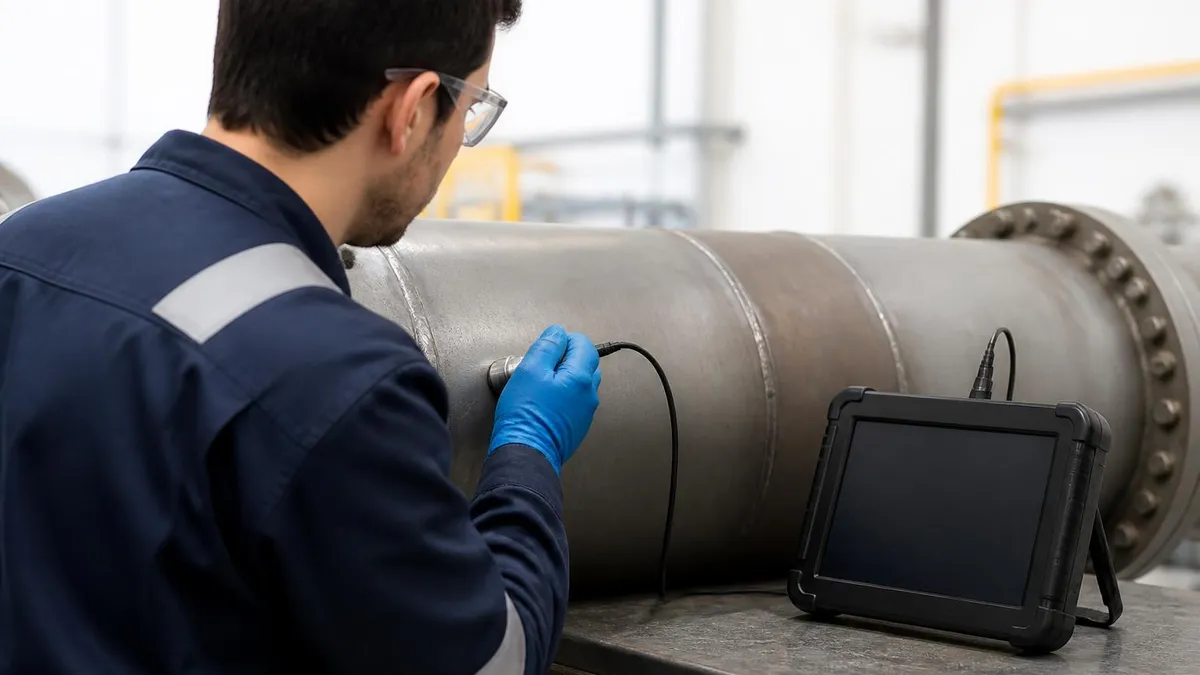
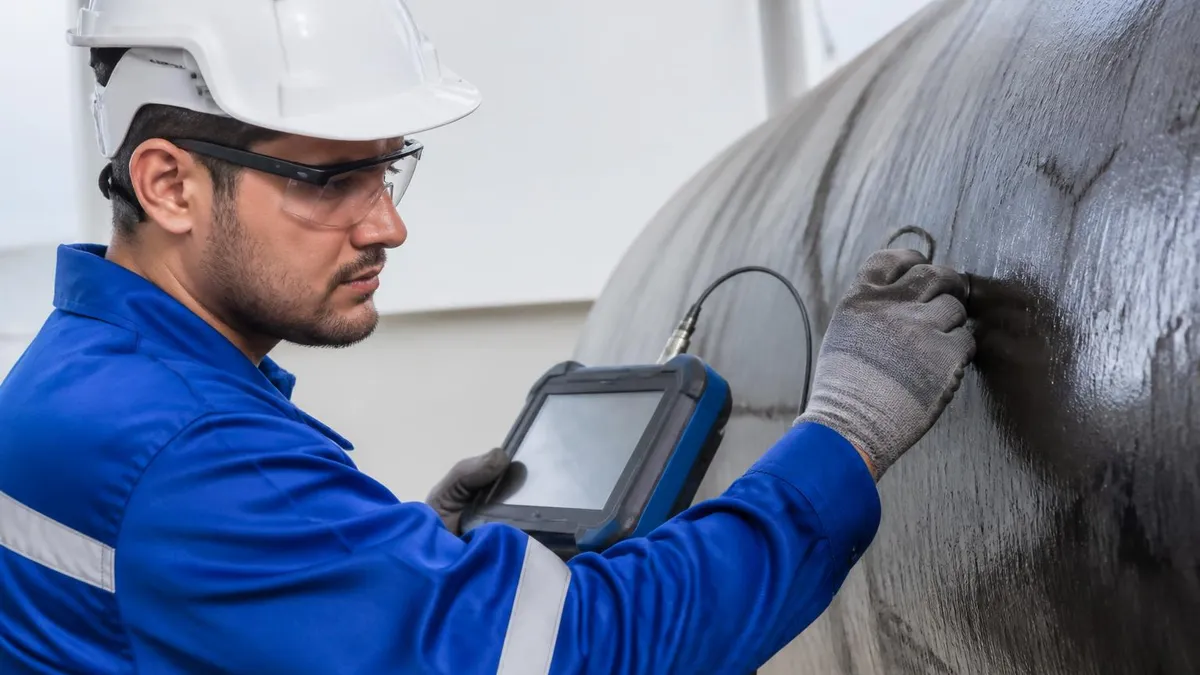
High-frequency sound waves are sent into the material and reflected echoes are interpreted on a screen. UT measures wall thickness, finds internal flaws, and is essential for thick welds and pressure vessels.
Gamma or X-ray radiation passes through the part and exposes film or a digital detector, producing an image of internal structure. Best for volumetric flaws like porosity, slag, and lack of fusion in welds.
An alternating current coil induces eddy currents in conductive materials. Changes in coil impedance reveal surface cracks, conductivity differences, and tube wall loss in heat exchangers.
To really answer what is NDT in a practical sense, you have to look at the underlying physics. Each method exploits a different property of materials. Ultrasonic testing uses the way sound waves propagate through metal and reflect off boundaries. Radiography uses how denser areas absorb more electromagnetic radiation. Magnetic particle testing relies on magnetic flux leaking out of a discontinuity that interrupts the field lines. Liquid penetrant uses capillary action and surface tension. Eddy current testing depends on Faraday's law of electromagnetic induction. Visual testing depends on light, optics, and the human eye.
A typical inspection begins with a written procedure that defines the scope, the acceptance criteria, the equipment to be used, calibration requirements, and the qualifications of the personnel involved. The procedure is usually written by a Level III specialist and approved by the responsible engineer. The technician then prepares the surface, calibrates the instrument on a known reference block or standard, performs the examination, records the data, and writes a report that includes location, size, orientation, and disposition of every reportable indication.
Calibration is one of the most misunderstood parts of NDT. It is not just turning the machine on. For ultrasonic testing, calibration means setting the screen distance, the sensitivity, and the reference level against a step block, IIW block, or distance-amplitude-correction curve. For radiography, it means selecting the right source, source-to-film distance, exposure time, and image quality indicator. Skipping calibration is one of the fastest ways to fail an audit and have your certification suspended.
Surface preparation often makes or breaks an inspection. A weld that has not been wire-brushed will scatter ultrasonic sound and hide indications. A surface that still has paint or oil will trap penetrant in the wrong places and produce false indications. Magnetic particle testing requires clean, dry surfaces with no residual magnetism from prior inspections. Experienced technicians know that ninety percent of inspection quality comes from the preparation, not from running the equipment.
Once data is collected, the technician has to interpret what the indications mean. This is where training, experience, and code knowledge come together. An indication is anything the instrument shows; a discontinuity is a real interruption in the material; a defect is a discontinuity that exceeds the allowable size or shape in the governing code. Calling something a defect prematurely can scrap a million-dollar weld; missing a true defect can cause a catastrophic failure. The judgment line between the two is exactly what separates a competent Level II from a beginner.
Documentation is the final, and legally critical, step. Inspection reports must include the date, technician name and certification number, equipment serial numbers, calibration records, procedure number, sketches or photographs of indications, and a clear accept or reject statement. These reports are kept for the life of the asset in many industries, and they are routinely reviewed by clients, third-party auditors, and government regulators such as the FAA, NRC, and DOT.
Finally, NDT is increasingly digital. Phased array probes generate stored data sets that can be reanalyzed years later. Computed and digital radiography replace film with reusable plates and direct sensors. Drones carry ultrasonic and visual sensors into confined spaces. Automated ultrasonic testing systems crawl along pipelines collecting gigabytes of data. The fundamentals have not changed, but the modern technician must be as comfortable with software as with a flashlight and inspection mirror.
NDT Practice Test Questions
Prepare for the NDT - Non-Destructive Testing exam with our free practice test modules. Each quiz covers key topics to help you pass on your first try.
NDT Penetrant Testing
NDT Exam Questions covering Penetrant Testing. Master NDT Test concepts for certification prep.
NDT Ultrasonic Testing
Free NDT Practice Test featuring Ultrasonic Testing. Improve your NDT Exam score with mock test prep.
NDT - Non-Destructive Testing Discontinuit...
NDT Mock Exam on - Non-Destructive Testing Discontinuity Interpretation and Evaluation. NDT Study Guide questions to pass on your first try.
NDT - Non-Destructive Testing Eddy Current...
NDT Test Prep for - Non-Destructive Testing Eddy Current Testing Theory. Practice NDT Quiz questions and boost your score.
NDT - Non-Destructive Testing Leak Testing...
NDT Questions and Answers on - Non-Destructive Testing Leak Testing Techniques. Free NDT practice for exam readiness.
NDT - Non-Destructive Testing Liquid Penet...
NDT Mock Test covering - Non-Destructive Testing Liquid Penetrant Testing Process. Online NDT Test practice with instant feedback.
NDT - Non-Destructive Testing Magnetic Par...
Free NDT Quiz on - Non-Destructive Testing Magnetic Particle Testing Methods. NDT Exam prep questions with detailed explanations.
NDT - Non-Destructive Testing NDT Certific...
NDT Practice Questions for - Non-Destructive Testing NDT Certification and Practices. Build confidence for your NDT certification exam.
NDT - Non-Destructive Testing NDT Codes an...
NDT Test Online for - Non-Destructive Testing NDT Codes and Standards. Free practice with instant results and feedback.
NDT - Non-Destructive Testing Radiographic...
NDT Study Material on - Non-Destructive Testing Radiographic Testing Safety. Prepare effectively with real exam-style questions.
Industries Where Non-Destructive Testing Is Critical
The oil and gas industry is the single largest employer of NDT technicians in North America. Pipelines, storage tanks, refineries, offshore platforms, and pressure vessels must all be inspected on scheduled intervals under codes like API 510, API 570, API 653, and ASME B31.3. A single pipeline integrity inspection can involve dozens of ultrasonic, radiographic, and magnetic flux leakage technicians working around the clock for weeks.
Inspectors hunt for wall loss from internal corrosion, stress corrosion cracking, hydrogen-induced cracking, and mechanical damage from third-party excavation. Crawler-mounted radiography units, intelligent pigs that travel inside pipelines, and automated ultrasonic testing systems generate millions of data points that Level II and Level III analysts review. Pay in oil and gas is high but often comes with rotational schedules and remote travel.

Is a Career in NDT Right for You?
- +Strong salary growth from Level I to Level III, often six figures within 7-10 years
- +Hands-on, problem-solving work that combines physics, materials, and code interpretation
- +High demand across multiple industries means job security and easy relocation
- +You can start with a high school diploma and certifications instead of a four-year degree
- +Travel opportunities — many techs work shutdowns and turnarounds across the country
- +Clear, structured certification ladder with measurable progress at each level
- +Transferable skills — UT and PA experience moves easily between oil, aerospace, and nuclear
- −Long shifts during plant shutdowns, often 12 hours a day, seven days a week
- −Outdoor and confined-space work in heat, cold, and at heights
- −Radiation exposure risk in radiography (managed with dosimetry but still a real factor)
- −Continuing education and recertification every five years adds time and cost
- −Heavy paperwork — reports, calibration logs, and traceability records consume hours
- −Travel can strain family life, especially for shutdown and pipeline technicians
Pros and Cons at a Glance
| Pros | Cons |
|---|---|
| Hands-on, problem-solving work that combines physics, materials, and code interpretation | Outdoor and confined-space work in heat, cold, and at heights |
| High demand across multiple industries means job security and easy relocation | Radiation exposure risk in radiography (managed with dosimetry but still a real factor) |
| You can start with a high school diploma and certifications instead of a four-year degree | Continuing education and recertification every five years adds time and cost |
| Travel opportunities — many techs work shutdowns and turnarounds across the country | Heavy paperwork — reports, calibration logs, and traceability records consume hours |
| Clear, structured certification ladder with measurable progress at each level | Travel can strain family life, especially for shutdown and pipeline technicians |
What It Takes to Become a Certified NDT Technician
- ✓Complete high school or GED with strong math and physics fundamentals
- ✓Choose an initial method to specialize in — PT and MT are easiest entry points
- ✓Enroll in a formal training course meeting ASNT SNT-TC-1A classroom hour requirements
- ✓Document supervised on-the-job experience hours required for your chosen method and level
- ✓Pass the general, specific, and practical examinations administered by your employer or ACCP
- ✓Obtain a vision examination including near-vision Jaeger 1 and color contrast every 12 months
- ✓Maintain a personal certification logbook with dates, methods, levels, and employer signatures
- ✓Stay current on revisions to ASME, API, AWS, and ASTM codes used in your industry
- ✓Renew certification every 5 years or per your employer's written practice document
- ✓Pursue Level II within 2-3 years and Level III within 7-10 years to maximize earnings
Certification is held by the individual, not the employer
Unlike many trade credentials, your NDT certifications follow you. When you change employers, your new company will accept your training and experience hours, but you must usually take a new specific and practical exam under their written practice. Keep your logbook, training certificates, and vision records carefully organized — they are your professional passport.
NDT salaries vary widely by method, certification level, geography, and industry, but the overall trajectory is one of the most attractive in the skilled trades. A brand-new Level I technician in liquid penetrant or magnetic particle testing typically earns between $20 and $26 an hour, which works out to roughly $42,000 to $54,000 annually before overtime. With overtime on shutdown work, even Level I technicians regularly clear $65,000 in their first year if they are willing to travel.
The big jump comes at Level II, especially in ultrasonic and radiographic testing. Level II UT and RT technicians command $30 to $45 an hour, and with mandatory overtime on turnarounds, six-figure annual incomes are routine. Phased array ultrasonic testing technicians and those certified in advanced methods such as Time-of-Flight Diffraction earn even more, because the equipment is expensive, the training is long, and the supply of qualified people lags behind demand from oil, gas, and nuclear operators.
Level III is where NDT becomes a true professional career. Level III specialists write procedures, qualify other technicians, audit programs, and serve as the responsible engineering authority for inspection programs. Salaries for full-time Level III professionals range from $110,000 to $180,000 depending on the number of methods held, with consulting Level IIIs billing $150 to $300 per hour. Many Level IIIs eventually move into senior quality engineering, project management, or run their own inspection companies.
Geography matters enormously. The Gulf Coast — Houston, Beaumont, Lake Charles, Baton Rouge — has the highest concentration of refining and petrochemical work, and pays accordingly. The Bakken in North Dakota, the Permian Basin in west Texas, and the Marcellus and Utica shales in Pennsylvania and Ohio offer high pipeline and well services pay with significant travel. Aerospace hubs in Wichita, Seattle, Charleston, and southern California pay slightly less but offer more stable, indoor work.
Career paths within NDT branch out further than most people realize. A technician can specialize technically and become a Level III in three or four methods, or move sideways into related fields: quality assurance, welding inspection (CWI), API authorized inspector roles, materials engineering, and even sales engineering for major equipment manufacturers. Each of these adjacent paths uses the foundational knowledge from NDT and pays well in its own right.
The skills that separate top earners from average technicians are not just technical. The best NDT professionals can read engineering drawings, understand welding processes, interpret material specifications, and communicate clearly with clients and welders on the shop floor. They also keep careful records, show up early, and never cut corners on calibration or safety. Employers will pay a premium for technicians they trust to work unsupervised on critical assets.
Looking ahead to 2026 and beyond, demand drivers are stacking up. The US Infrastructure Investment and Jobs Act is funding bridge, pipeline, and water system inspection at unprecedented levels. Aging baby boomer technicians are retiring faster than schools can train replacements. Hydrogen and carbon capture projects are creating entirely new inspection programs. For anyone entering the field today, the next decade looks very strong, and the certifications you earn now will compound in value for years.

If you pursue radiographic testing, you will work with gamma sources or X-ray equipment that can cause serious injury or death if mishandled. You must complete a 40-hour radiation safety course, wear a dosimeter at all times, never enter a posted radiation area without a survey meter, and follow the ALARA principle — As Low As Reasonably Achievable — for every shot.
Every NDT inspection is governed by a stack of codes and standards, and understanding which document applies is half the battle. The American Society of Mechanical Engineers (ASME) Boiler and Pressure Vessel Code is the dominant document for pressure equipment, with Section V covering NDT methods and Section IX covering welding qualifications. The American Petroleum Institute (API) publishes API 510 for pressure vessels in service, API 570 for in-service piping, and API 653 for storage tanks.
The American Welding Society (AWS) publishes D1.1 for structural steel welding, D1.5 for bridge welding, and D17.1 for aerospace fusion welding. These documents define what indications are acceptable in a finished weld and how each NDT method must be applied. ASTM International issues hundreds of standards covering specific test methods, reference standards, and acceptance criteria — for example, ASTM E165 for liquid penetrant and ASTM E709 for magnetic particle.
Personnel certification in the United States follows three main pathways. Most employers use ASNT Recommended Practice SNT-TC-1A, which is a guideline that companies adapt into their own written practice. Government and high-security work often uses ASNT CP-189, which is a stricter standard with mandatory requirements rather than recommendations. The ASNT Central Certification Program (ACCP) and PdM Level III certifications are issued directly by ASNT and travel with the individual rather than the employer.
Internationally, ISO 9712 is the dominant personnel certification standard. ISO 9712 certifications are issued by independent certification bodies and are widely accepted in Europe, the Middle East, and Asia. American technicians who plan to work overseas often pursue ISO 9712 alongside their domestic credentials to maximize their job market. Aerospace adds another layer with NAS 410 in the United States and EN 4179 in Europe, both of which require employer qualification on top of training and exams.
Safety standards extend beyond radiation. OSHA general industry standards cover confined space entry, fall protection, hearing conservation, and hazardous material handling — all routine concerns for field NDT technicians. The Nuclear Regulatory Commission licenses radiographers and inspects radiography operations annually. The Department of Transportation regulates the transport of radioactive sources and hazardous penetrants between job sites. Failing any of these audits can shut a company down overnight.
Reading a code is a skill in itself. Codes are written in carefully chosen language where the words "shall," "should," and "may" have very specific meanings. "Shall" is mandatory, "should" is recommended but not required, and "may" is optional. Mixing these up in an inspection report or procedure can lead to costly rework or a failed audit. Senior technicians spend years learning to navigate the code structure, cross-references, and case-by-case interpretations published by ASME and API.
Finally, the safety culture inside an NDT department often predicts the technical quality of the work. Companies that take stop-work authority seriously, that hold pre-job safety meetings, and that document near-misses also tend to have lower defect-escape rates and higher client satisfaction. If you are evaluating an employer or a project, watch how they handle safety meetings and calibration audits — those small habits reveal everything about how the operation runs.
If you have decided that NDT is the career or skill area you want to pursue, the practical question becomes how to start efficiently. The best first move is to pick one entry-level method — usually liquid penetrant or magnetic particle testing — and complete the classroom training hours required by SNT-TC-1A. Many community colleges and trade schools in Texas, Louisiana, Oklahoma, and the Carolinas offer full NDT programs lasting six to twelve months that combine multiple methods and lead directly to employment.
While you study, build a study habit that uses both reading and active practice. Read the ASNT Level II Study Guide for your chosen method, then immediately work through practice questions in the same topic area. Active recall is more effective than rereading textbooks, and timed quizzes mimic the pressure of the real general and specific examinations. Treat every wrong answer as a lesson, write down why you got it wrong, and revisit it a week later.
On the job, volunteer for the work that intimidates you. If you are nervous around radiography, ask to assist a radiographer on a night shoot. If ultrasonic A-scan traces look confusing, ask your Level II to walk you through a calibration on a step block. Experience hours required by SNT-TC-1A are tracked in your logbook, but the real learning happens when you push beyond the minimum and pick up secondary methods early in your career.
Invest in your own equipment basics. A high-quality flashlight, a five-power magnifier, a depth gauge, a thermometer, a digital camera, and a clean inspection mirror cost a few hundred dollars and pay for themselves in productivity. Many veteran technicians also keep personal copies of the latest ASME Section V, the relevant AWS code, and a pocket guide to weld discontinuities. These tools mark you as serious and professional from your first day on a project.
Networking matters more than newcomers realize. Join your local ASNT chapter, attend the annual ASNT Research Symposium or Fall Conference if you can, and connect with technicians from other companies on LinkedIn. Most of the best jobs in NDT are filled by referral, not by job board postings. A reputation for showing up, calibrating properly, and writing clean reports will travel ahead of you through the small community of working technicians.
Finally, plan your certifications in a logical sequence rather than chasing every method at once. A common high-earning combination is Level II in PT, MT, UT, and RT, plus a CWI from the American Welding Society. That stack opens the door to almost every refinery, pipeline, and fabrication shop in North America. Add phased array ultrasonics or eddy current array later, and you become one of the most sought-after technicians in the industry.
The journey from "what is NDT?" to a six-figure career is shorter than most people assume, but it requires deliberate practice, careful documentation, and continuous learning. Use free online question banks, read the codes, ask experienced technicians for guidance, and never let your certifications lapse. The materials, instruments, and software will keep changing, but the underlying physics and the disciplined habits of a good inspector are what carry a career across decades.
Sample NDT - Non-Destructive Testing Practice Questions
Try these questions from our free NDT - Non-Destructive Testing practice tests. The correct answer and an explanation follow each question.
What does 'DAC' stand for in ultrasonic testing, and what is its purpose?
- A. Distance Amplitude Correction — compensates for signal loss with increasing sound path distance
- B. Defect Area Calibration — sizes flaws by their surface area
- C. Digital Analog Conversion — converts signals to a readable waveform
- D. Diffraction Angle Correction — adjusts for beam bending at interfaces
Answer: A. Distance Amplitude Correction — compensates for signal loss with increasing sound path distance
Distance Amplitude Correction (DAC) is a reference curve that accounts for natural signal amplitude decrease with increasing depth, enabling consistent flaw evaluation at all depths.
At what minimum UV-A irradiance (black light intensity) should the inspection surface be maintained when performing fluorescent penetrant testing per ASTM E1417?
- A. 100 µW/cm²
- B. 1,000 µW/cm²
- C. 2,000 µW/cm²
- D. 5,000 µW/cm²
Answer: B. 1,000 µW/cm²
ASTM E1417 requires a minimum UV-A irradiance of 1,000 µW/cm² at the inspection surface to ensure adequate fluorescence of indications.
What is the primary advantage of multidirectional magnetization in magnetic particle testing?
- A. Stronger magnetic field than single-direction methods
- B. Detection of discontinuities in multiple orientations in one operation
- C. Elimination of the need for demagnetization
- D. Better particle adhesion on rough surfaces
Answer: B. Detection of discontinuities in multiple orientations in one operation
Multidirectional magnetization sequences through different field directions rapidly, allowing detection of variously oriented discontinuities without repositioning the part.
What is 'phase analysis' used for in eddy current testing?
- A. Determining the exact shape of a defect
- B. Distinguishing between different types of discontinuities and their depth
- C. Measuring the surface roughness of the test piece
- D. Calibrating the instrument's voltage output
Answer: B. Distinguishing between different types of discontinuities and their depth
Phase analysis uses the phase angle of the eddy current signal to discriminate between defect types (surface vs. subsurface) and estimate their depth.
NDT Questions and Answers
About the Author

Educational Psychologist & Academic Test Preparation Expert
Columbia University Teachers CollegeDr. Lisa Patel holds a Doctorate in Education from Columbia University Teachers College and has spent 17 years researching standardized test design and academic assessment. She has developed preparation programs for SAT, ACT, GRE, LSAT, UCAT, and numerous professional licensing exams, helping students of all backgrounds achieve their target scores.