
NDT Meaning: What Is Non-Destructive Testing and Why It Matters 2026 October
✏️ NDT meaning explained — Non-Destructive Testing evaluates materials without causing damage. Learn the 6 methods, career paths, salaries, and
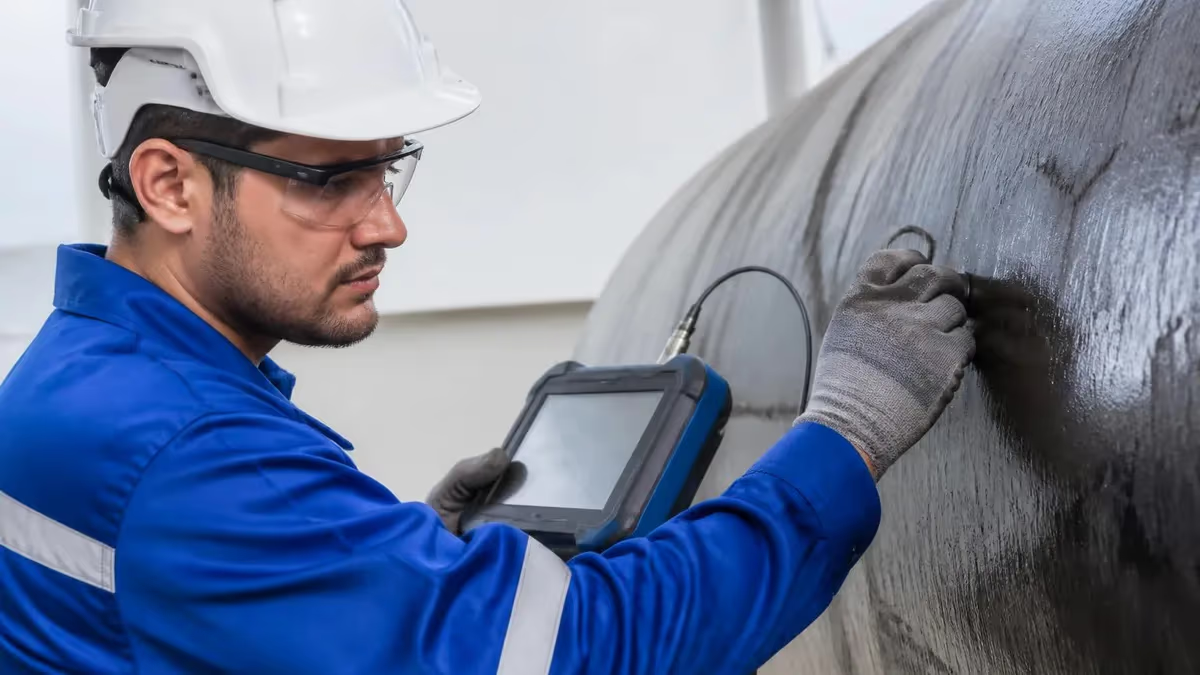
NDT stands for Non-Destructive Testing — a set of techniques used to evaluate materials, components, and structures without causing any damage. The whole point is that you can check whether something is safe or structurally sound, then put it right back into service. No cutting it open. No breaking a sample off. No destroying what you're testing.
That distinction matters enormously in industries where failures don't just cost money — they cost lives. Think aircraft fuselages, nuclear reactor pressure vessels, oil pipelines running through populated areas. In all of those contexts, knowing whether a weld has an internal crack before the part fails under load is the difference between routine maintenance and catastrophe. NDT is how engineers know.
The term gets used interchangeably with NDE (Non-Destructive Evaluation) and NDI (Non-Destructive Inspection). Technically there are subtle differences — NDT tends to refer to pass/fail detection, NDE to quantitative characterization — but in most workplaces, they mean the same thing. You'll see all three on job postings.
If you're studying for an NDT certification exam, an NDT practice test is the fastest way to identify which methods you know cold and which ones need more work before test day.
NDT is old technology that keeps getting more sophisticated. Radiographic testing dates to the early 1900s. Ultrasonic testing took off after World War II. Today, phased array ultrasonics, computed radiography, and drone-mounted inspection cameras are standard tools in modern NDT programs. The fundamentals haven't changed — find flaws before they become failures — but the technology has gotten dramatically better at finding smaller flaws in more complex geometries.
NDT at a Glance
Why NDT Exists — The Core Problem It Solves
Destructive testing is straightforward: you take a sample, apply stress until it breaks, and measure when and how it failed. That tells you exactly how strong the material is. The problem? You've just destroyed the sample. You can't put a broken bridge beam back in the bridge.
So destructive testing works for quality control on batches — you pull one piece from a production run, test it to failure, and infer the rest of the batch meets spec. That's fine for manufactured goods where you're checking a process. It's completely useless for inspecting actual in-service parts, welds, or structures that can't be sacrificed.
NDT solves this by using physical phenomena — sound waves, radiation, electromagnetic fields, dye penetration — that interact differently with flaws than with intact material. A sound wave traveling through solid steel moves at a predictable speed and reflects cleanly off the far wall. But if there's a crack or void in the middle, some of that wave reflects back early. The technician sees that early echo and knows something's there.
The other huge advantage: NDT allows 100% inspection. With destructive sampling, you test 1 piece and infer the rest. With NDT, you can inspect every single weld on a pressure vessel, every inch of a pipeline, every blade on a turbine. That's not a small thing — the cracks that cause catastrophic failures are often statistical outliers that sampling would miss.
That's why regulators across aerospace, nuclear, and petrochemical industries don't just allow NDT — they require it. The FAA mandates NDT inspection intervals for aircraft. ASME codes require ultrasonic or radiographic testing for pressure vessel welds. The Nuclear Regulatory Commission has detailed requirements for reactor component inspection. These aren't suggestions.

NDT vs. Destructive Testing — Direct Comparison
- Part survives inspection — goes back into service immediately
- 100% inspection possible — every weld, every component
- Works on in-service equipment during planned shutdowns
- Can detect developing flaws and track them over time
- Required by regulators (FAA, ASME, NRC) for critical components
- Limitation: Results require skilled interpretation
The 6 Primary NDT Methods
The simplest NDT method — direct observation of a component's surface. Can use borescopes and remote cameras for confined spaces. Detects surface discontinuities, corrosion, coating damage, and geometry issues. Every other NDT method starts here.
High-frequency sound waves sent into material detect internal flaws and measure thickness. Reflections from flaws appear on a display screen. Extremely versatile — works on welds, castings, forgings, composites. Phased array UT (PAUT) produces detailed cross-section images.
X-rays or gamma rays pass through material and expose a film or digital detector. Denser material absorbs more radiation; voids and cracks appear lighter on the image. The classic weld inspection method. Requires radiation safety controls.
A magnetic field is applied to ferromagnetic material (iron, steel, nickel). Magnetic particles accumulate at flux leakage points where cracks interrupt the field. Extremely sensitive to surface and near-surface flaws. Won't work on aluminum or austenitic stainless.
A colored or fluorescent dye seeps into open cracks by capillary action. Excess is removed, developer applied, and flaws show as bright indications. Works on any non-porous material — steel, aluminum, ceramics, plastics. Only detects surface-open defects.
An alternating current coil induces eddy currents in conductive material. Cracks and conductivity changes alter the coil's impedance, which the instrument detects. Fast, no contact required, excellent for tubing inspection and surface crack detection in aircraft skins.
The 6 NDT Methods — How They Actually Work
Each method has a niche — a combination of material type, flaw location, and access conditions where it works better than the others. No single method finds everything. That's why complex inspections often combine two or more.
Visual Testing — Where Every Inspection Starts
VT is exactly what it sounds like. You look at the part. But don't underestimate it — a skilled VT technician catches corrosion patterns, weld irregularities, mechanical damage, and geometry deviations that more expensive methods would confirm. Borescopes and remote cameras extend VT into turbine blades, pipe interiors, and any space a human eye can't reach directly.
The limitation is obvious: VT only works on surfaces you can see. Internal flaws are invisible to visual inspection. That's where the other methods come in.
Ultrasonic Testing — Sound as a Probe
A transducer sends a pulse of high-frequency sound (typically 1–15 MHz) into the material. The wave travels through until it hits something — a far wall, a weld fusion line, or a flaw — and part of the energy reflects back. The instrument measures how long that echo took to return, which tells you the depth of whatever caused it.
UT is the workhorse of industrial NDT. Portable, works on thick sections (up to several feet of steel), gives depth information, no radiation controls required. The downside is that interpreting UT signals takes real skill. You need to know what a legitimate echo looks like versus a mode-converted false signal. That's why ASNT certification requires hands-on demonstration, not just written tests.
The NDT ultrasonic testing questions show what UT exam questions actually look like — work through those before your exam. UT is typically one of the harder methods to certify in, and targeted practice makes a measurable difference.
Radiographic Testing — Industrial X-Ray
RT is conceptually simple: radiation passes through the material, and whatever's on the other side captures the image. Denser material absorbs more radiation and appears darker on film. Voids, porosity, and inclusions show as lighter areas — less material in the path, less absorption.
The main strength of RT is its permanent record. The radiograph is documentation. It also shows the full volumetric cross-section of a weld in a way that UT doesn't. The downsides are radiation safety requirements, film processing time, and the fact that RT detects flaws best when they're oriented along the beam — a crack perpendicular to the X-ray beam might not show at all. Radiographic testing safety practice covers regulatory and exposure calculation concepts that appear heavily on Level II exams.
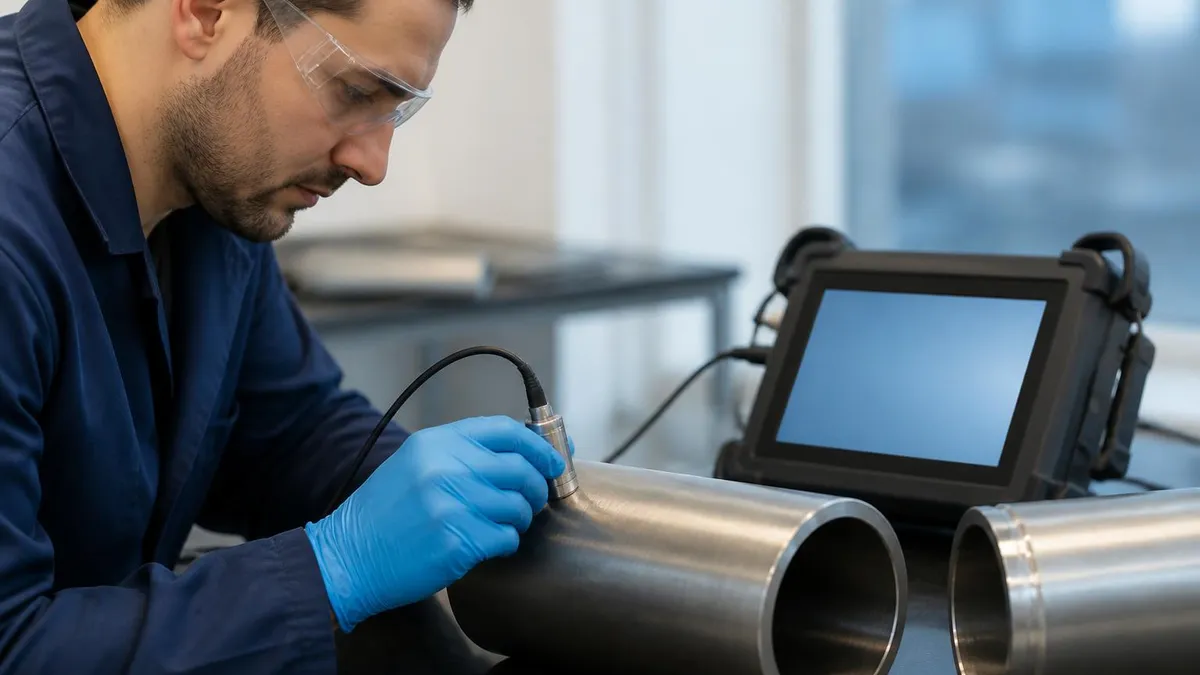
Magnetic Particle Testing — Finding Surface Cracks in Steel
MT works on a simple principle: magnetic flux likes to stay in the material. Where a crack interrupts the flux path, it leaks out of the surface — and magnetic particles accumulate at that leak. The indication glows under UV light if you're using fluorescent particles, or shows as a distinct color contrast with dry powder or visible dye.
Fast, sensitive, and relatively inexpensive. MT is the go-to method for weld inspections on structural steel, pipeline girth welds, and heavy equipment castings. But it's limited to ferromagnetic materials, and it only catches surface and near-surface flaws — internal flaws deeper than about a quarter inch won't show. Magnetic particle testing practice questions cover continuous and residual magnetization techniques you'll need for the written exam.
Liquid Penetrant Testing — Dye That Finds Cracks
PT is elegant in its simplicity. Apply a low-viscosity dye to a clean surface, let capillary action pull it into any open crack, remove the excess from the surface, then apply a developer that draws the trapped dye back out and amplifies it visually. The whole process takes 20 to 45 minutes depending on the penetrant dwell time required.
PT works on any non-porous material — steel, aluminum, titanium, ceramics, glass, plastic. That flexibility is its main advantage over MT. But it absolutely requires surface-open flaws. A tight subsurface crack won't hold penetrant. Surface preparation matters too — paint, scale, and contamination block penetrant entry and cause missed indications. The NDT penetrant testing practice questions cover both process steps and the ways technicians get false positives or miss real flaws.
Eddy Current Testing — No Contact, No Consumables
ET uses electromagnetic induction. An AC-driven coil creates a changing magnetic field, which induces circular eddy currents in any conductive material nearby. Flaws disrupt those currents — cracks, corrosion, wall thinning — and that disruption changes the coil's electrical impedance in a way the instrument can detect and display.
The biggest advantage of ET is speed and non-contact operation. Heat exchanger tube inspection is almost exclusively done by ET — a probe moves through each tube at high speed, flagging tubes with wall thinning or cracking. ET also works through thin coatings, which matters for painted aircraft structures where removing coating for every inspection isn't practical. The limitation: ET only works in conductive materials and typically only detects surface and near-surface flaws.
NDT Method Comparison at a Glance
NDT Careers — What the Job Actually Looks Like
NDT technicians — also called NDT inspectors — perform these tests in the field and interpret the results. It's a hands-on technical career that sits somewhere between skilled trades and engineering. You don't need a four-year degree. You do need solid technical training, good spatial reasoning, and the discipline to follow procedures exactly.
Most NDT techs specialize in one or two methods — UT and RT are the most common combination, or PT and MT for structural weld inspection. Some specialize by industry: aerospace NDT techs work on aircraft structures and engines; petrochemical techs inspect piping, pressure vessels, and storage tanks; power generation techs focus on turbine components and boiler tubing.
Day-to-day, a Level II UT technician might arrive at a refinery turnaround at 6 AM, set up their phased array system, scan 40 piping welds over a 10-hour shift, evaluate the data against accept/reject criteria, and submit a written report by end of shift. The report becomes part of the plant's inspection record. If they find a reject indication, they flag it — and a repair gets made before the plant restarts. That's the job. It's not glamorous. The stakes are real.
The work environment varies widely. Field inspection means traveling to job sites — refineries, power plants, shipyards, construction sites — often on rotating shifts. Shop inspection means working in a controlled environment inspecting parts coming off a production line. Field work generally pays more and involves more travel.

ASNT NDT Certification Levels
Level I technicians can set up equipment and perform tests, but they work under supervision and can't independently interpret results or write final reports. You reach Level I through a combination of classroom training hours and documented on-the-job experience in the specific method. Requirements vary by method — UT requires significantly more hours than PT or MT. Level I is the entry point; most employers expect you to pursue Level II within 1–2 years.
NDT Salaries — What You Can Expect to Earn
Salaries in NDT are genuinely competitive for a career that doesn't require a four-year degree. The range is wide because experience, method specialty, industry, and geography all matter.
Level I: Entry-level NDT techs typically start around $40,000–$50,000 per year. Overtime at a plant turnaround — which is common — can push that to $55,000–$60,000 in the first year, even at Level I.
Level II: Experienced Level IIs in high-demand methods (UT, RT, PAUT) earn $60,000–$85,000 in shop environments. Field inspectors in petrochemical or nuclear work regularly see $75,000–$95,000, partly because of shift differentials and per diem.
Level III: Level IIIs in quality engineering or inspection management roles typically earn $80,000–$120,000. Those with specialized aerospace or nuclear credentials, or who run their own inspection consultancy, can exceed that comfortably.
Geography is a real factor. Houston, the Gulf Coast, and Aberdeen, Scotland (for offshore) are high-pay NDT markets because of petrochemical concentration. The Pacific Northwest pays well for aerospace NDT. Rural areas with refineries or power plants often offer smaller base salaries but better overtime opportunities during turnarounds.
Industries That Hire NDT Technicians
Short answer: any industry where structural failures would be catastrophic or costly. That covers a lot of ground.
Aerospace. Every commercial aircraft in service undergoes regular NDT inspection. Fuselage skins, wing structures, landing gear, engine components — all inspected to FAA-mandated intervals. One of the most regulated and best-paying NDT segments.
Oil and Gas / Petrochemical. Refineries, LNG facilities, and offshore platforms are NDT-intensive environments. Pressure vessels, piping systems, storage tanks, and heat exchangers all require periodic inspection. Plant turnarounds create surge demand for NDT techs on short-term contracts.
Power Generation. Both fossil fuel and nuclear power plants rely heavily on NDT. Nuclear is especially demanding — NRC regulations require documented inspection programs, and certification requirements often exceed standard ASNT levels.
Manufacturing. Automotive, heavy equipment, and defense manufacturing use NDT for quality control on castings, forgings, and welds. Typically shop-based work with more regular hours than field inspection.
Construction and Infrastructure. Bridge inspections, high-rise structural steel, and pressure piping in commercial buildings all use NDT. This segment is growing as aging infrastructure across the US and Europe drives inspection demand.
How to Get Into NDT — The Training Path
There's no single mandatory path, but most people enter NDT one of three ways.
Vocational or trade school. Community colleges and technical schools offer NDT programs ranging from a single semester to a full two-year AAS degree. A focused program gets you trained in multiple methods quickly and often connects you with employer networks. Fastest entry route if you're starting fresh.
Military training. The military trains a significant number of NDT inspectors — often called Nondestructive Inspection (NDI) specialists in Air Force and Navy contexts. Veterans often come out with experience hours that translate directly to civilian ASNT certification requirements. If you're in the military and considering NDT as a post-service career, this route can shave years off your civilian qualification timeline.
On-the-job training at an employer. Some companies — particularly large inspection service providers and aerospace manufacturers — run internal training programs. You start in a support role, accumulate training hours on the job, and work toward Level I then Level II certification over two to four years. This path takes longer but means you're earning while you train.
Once you pick a path, the ASNT SNT-TC-1A document (Recommended Practice) is the key reference — it spells out training and experience hour requirements for each method at each level. Your employer or training program should be following it. Don't skip that document; it's what certification bodies use to evaluate your qualifications.
Ready to Start Preparing?
Whether you're studying for a Level I exam in a single method or building toward Level II in UT or RT, practice questions are one of the highest-value prep tools you have. They force active recall, expose gaps in your knowledge that re-reading notes doesn't, and familiarize you with question style before exam day.
The NDT practice test library covers multiple methods at different difficulty levels. Work through the method you're testing in first, then use the general NDT questions to make sure your foundational knowledge holds up across all methods. Level II exams test you on physics principles, equipment calibration, procedure development, and code interpretation — not just step-by-step procedure. The practice questions reflect that broader scope.
Bottom line: NDT is a career path that rewards technical precision, pays well without a four-year degree requirement, and gives you work that genuinely matters. The testing methods might sound exotic — sending sound waves through metal, using gamma radiation to image welds — but the goal has always been straightforward. Find the flaws before the part fails. That's what Non-Destructive Testing is for.
Is NDT Right for You?
- +No four-year degree required — certification based on training hours and exams
- +Strong job security driven by regulatory requirements and aging infrastructure
- +Clear career progression: Level I → Level II → Level III
- +Competitive pay — Level IIs in petrochemical earn $75K–$95K with overtime
- +Work with real stakes — your inspection findings prevent failures and save lives
- −Field work means shift schedules, travel, and sometimes demanding physical conditions
- −Each NDT method requires separate certification — specializing takes time
- −Interpretation errors carry serious consequences — the job demands precision
- −Radiation safety requirements add complexity for RT-certified techs
- −Peak demand is often tied to plant turnaround schedules — workload can be uneven
Pros and Cons at a Glance
| Pros | Cons |
|---|---|
| No four-year degree required — certification based on training hours and exams | Field work means shift schedules, travel, and sometimes demanding physical conditions |
| Strong job security driven by regulatory requirements and aging infrastructure | Each NDT method requires separate certification — specializing takes time |
| Clear career progression: Level I → Level II → Level III | Interpretation errors carry serious consequences — the job demands precision |
| Work with real stakes — your inspection findings prevent failures and save lives | Radiation safety requirements add complexity for RT-certified techs |
Sample NDT - Non-Destructive Testing Practice Questions
Try these questions from our free NDT - Non-Destructive Testing practice tests. The correct answer and an explanation follow each question.
What does 'DAC' stand for in ultrasonic testing, and what is its purpose?
- A. Distance Amplitude Correction — compensates for signal loss with increasing sound path distance
- B. Defect Area Calibration — sizes flaws by their surface area
- C. Digital Analog Conversion — converts signals to a readable waveform
- D. Diffraction Angle Correction — adjusts for beam bending at interfaces
Answer: A. Distance Amplitude Correction — compensates for signal loss with increasing sound path distance
Distance Amplitude Correction (DAC) is a reference curve that accounts for natural signal amplitude decrease with increasing depth, enabling consistent flaw evaluation at all depths.
What is the effect of excessive water pressure during the rinse step in water-washable penetrant testing?
- A. It improves fluorescence brightness
- B. It can wash penetrant out of shallow or wide discontinuities, causing missed indications
- C. It causes the developer to streak
- D. It increases dwell time effectiveness
Answer: B. It can wash penetrant out of shallow or wide discontinuities, causing missed indications
Excessive water pressure during rinsing can force penetrant out of open discontinuities, particularly shallow ones, leading to missed indications.
What is the critical angle in ultrasonic testing?
- A. The probe angle that produces maximum flaw signal amplitude
- B. The incident angle beyond which total internal reflection occurs and no transmitted longitudinal wave enters the second medium
- C. The angle of the weld bevel relative to the transducer axis
- D. The minimum scanning angle required for full weld coverage
Answer: B. The incident angle beyond which total internal reflection occurs and no transmitted longitudinal wave enters the second medium
The first critical angle is the incident angle at which the refracted longitudinal wave travels at 90° (along the interface), beyond which no refracted longitudinal wave enters the second medium.
What is the purpose of the pie-shaped (Berthold) gauge used in magnetic particle testing?
- A. Measuring the UV-A light intensity at the inspection surface
- B. Verifying adequate field strength and direction at the part surface
- C. Checking the particle bath concentration
- D. Measuring the distance between prods
Answer: B. Verifying adequate field strength and direction at the part surface
The pie-shaped (Berthold) gauge, a circular shim with radiating slots, is placed on the part to verify that the applied magnetic field is sufficient and properly oriented to detect discontinuities.
NDT Questions and Answers
About the Author

Educational Psychologist & Academic Test Preparation Expert
Columbia University Teachers CollegeDr. Lisa Patel holds a Doctorate in Education from Columbia University Teachers College and has spent 17 years researching standardized test design and academic assessment. She has developed preparation programs for SAT, ACT, GRE, LSAT, UCAT, and numerous professional licensing exams, helping students of all backgrounds achieve their target scores.