
Quest NDT and the Modern NDT Company: A Complete 2026 October Guide to Choosing Inspection Services
Quest NDT guide to choosing an NDT company in 2026 October — 💯 services, certifications, pricing, contracts, and what to expect from top inspection providers.

When you search for quest ndt or any other NDT company online, you quickly realize the non-destructive testing industry is far larger and more specialized than most outsiders expect. A modern NDT company is not just a team of inspectors with handheld gauges. It is a regulated service business, staffed by certified Level I, II, and III technicians, equipped with calibrated instruments, governed by procedures written to ASNT, ASME, API, AWS, and ISO standards, and audited regularly by its customers. Choosing the right partner shapes safety, schedule, and budget on every capital project.
The phrase quest ndt has become a catch-all search term that buyers use when they want to compare inspection vendors, understand price ranges, or simply learn what services exist. In this guide we use it as a lens to explain how the NDT company landscape actually works in the United States in 2026. You will learn what services these companies offer, how they price work, what certifications matter, how contracts are structured, and what red flags to avoid when you award a multi-year frame agreement.
The U.S. market for industrial inspection services is projected to exceed $11 billion in 2026, driven by aging refineries, the LNG export buildout, offshore wind, nuclear life-extension programs, and the rapid expansion of additive manufacturing inspection. That growth is fueling consolidation. Large platforms like Mistras, Acuren, Applus+, Intertek, and TÜV SÜD continue to acquire regional shops, while specialist firms compete on niche techniques such as phased array UT, guided wave, computed radiography, and digital eddy current array.
For an owner-operator, plant engineer, or procurement lead, the question is rarely "which NDT company is best" in the abstract. It is "which company is best for this asset, this code, this geography, and this schedule." A refinery turnaround in Texas demands very different capabilities than an aerospace composite inspection in Connecticut or a wind tower base-weld audit in Iowa. Understanding the supplier landscape is the first step toward writing a smart scope of work.
This article walks through the full procurement journey: how to define your scope, evaluate vendor quality systems, audit technician certifications, negotiate rate sheets, and manage day-to-day execution. We pull in current 2026 market data, real ASNT certification statistics, typical pricing per technique, and the contractual clauses that experienced owners insist on. If you want a quick refresher on the discipline itself, our companion guide on NDT meaning explains the core methods in plain language.
We also reference the way certifications shape who can sign off on what. The ASNT SNT-TC-1A recommended practice, the CP-189 standard, and the NAS 410 aerospace requirement all create a layered hierarchy: a Level I trainee performs the test, a Level II interprets and reports, and a Level III approves procedures. A reputable NDT company can produce written practice documents and individual qualification records on request. If a vendor cannot, that is your first warning sign.
Finally, this guide is grounded in the reality that buyers today expect more than a body shop. They expect digital reporting platforms, cloud-based radiography review, GPS-tagged inspection points, AI-assisted defect screening, and real-time dashboards that integrate with their CMMS. The companies winning frame agreements in 2026 are the ones that combine deep technical credibility with software-grade delivery. Let us look at how to identify them.
Free NDT - Non-Destructive Testing Study Tools
Interactive NDT - Non-Destructive Testing resources on PracticeTestGeeks, free to start:
- NDT - Non-Destructive Testing practice test — 400+ questions with instant scoring and answer explanations
- NDT - Non-Destructive Testing flashcards — review key terms and concepts card by card
- NDT - Non-Destructive Testing study guide — topic-by-topic overview of what the exam covers
- NDT - Non-Destructive Testing cheat sheet — one-page printable summary for last-minute review
The US NDT Company Market by the Numbers
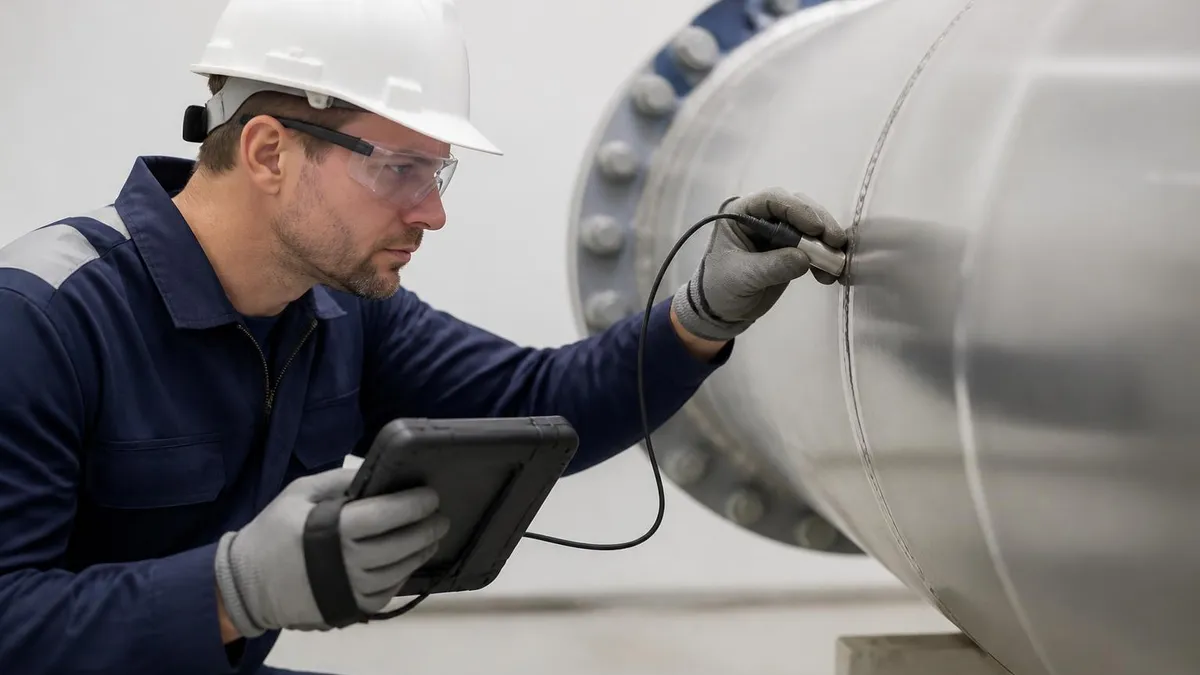
Core Services an NDT Company Delivers
Ultrasonic, radiographic, magnetic particle, liquid penetrant, and visual testing make up roughly 80% of revenue at a typical NDT company, especially in oil and gas, power, and structural steel sectors.
Phased array UT, time-of-flight diffraction, guided wave, eddy current array, and computed radiography command premium rates and require Level II technicians with method-specific endorsements and continuous training hours.
Many firms bundle IRATA or SPRAT rope access with NDT capability, allowing tank shell, flare stack, and offshore platform inspection without expensive scaffolding or crane mobilization on tight schedules.
Procedure writing, fitness-for-service evaluation, weld map development, and remote Level III support are increasingly sold as standalone consulting packages alongside field inspection crews.
Cloud dashboards, GIS-tagged inspection points, AI defect pre-screening, and integration with SAP, Maximo, or Pragma turn raw inspection data into actionable asset-integrity intelligence.
The US NDT company landscape in 2026 is a three-tier market. At the top sit five or six global platforms with revenue above $400 million each, offering nationwide coverage, in-house Level III networks, and software platforms. In the middle are roughly forty regional firms with $20 million to $200 million in revenue that dominate specific basins or refining clusters. At the bottom are more than two thousand owner-operated shops, often single-truck operations serving a handful of fabricators, pipelines, or municipal water utilities.
Mistras Group, headquartered in Princeton, New Jersey, remains the largest pure-play public NDT company in the United States. Acuren, owned by Rives, services upstream and midstream energy, while Applus+ and Intertek lean into power, transportation, and aerospace. TEAM Industrial, Pinnacle, and Versa Integrity round out the upper tier. Each of these names appears repeatedly on Master Service Agreements held by ExxonMobil, Phillips 66, Marathon, Valero, and the major LNG developers along the Gulf Coast.
Regional firms often outperform the giants on responsiveness, technician retention, and price per hour. Companies such as Acuren's local offices, IRISNDT in Houston, MQS Inspection in the Midwest, Versa in the Mid-Atlantic, and dozens of family-owned shops near refining centers like Lake Charles, Corpus Christi, and Pasadena win significant turnaround work every spring and fall. They typically charge 10 to 20 percent less per hour than national platforms while matching them on certification depth.
Specialist niche firms occupy a fourth, smaller category that buyers should not ignore. Phased array boutiques, guided wave specialists, eddy current array shops, and aerospace composite inspectors often hold proprietary procedures qualified by an OEM. If your asset is a Boeing wing skin, a GE turbine blade, or a hydrogen pressure vessel built to Section VIII Division 3, the right answer may be a 30-person specialist rather than a 3,000-person generalist.
How do you know which tier fits your project? Start with your code basis. Section V, Article 4 ultrasonic exams on carbon steel can be performed competently by hundreds of firms. A Section XI nuclear vessel exam can be performed by perhaps fifteen. An aerospace NAS 410 inspection on a composite repair can be performed by perhaps five with the right NADCAP accreditation. The narrower your code, the shorter your vendor list, and the more use that vendor has at the negotiating table.
Geography also matters. Mobilization fees for a single technician traveling 250 miles can exceed the daily rate itself. For routine work, prioritize vendors within a one-hour drive of your facility. For specialized work, accept the travel premium but build it into the contract. Many owners run dual-supplier strategies: a local generalist for daily volume and a national specialist for advanced or audit-sensitive scopes. To go deeper on what these technicians actually do day to day, see our overview of Indeed NDT jobs.
Finally, do not underestimate cultural fit. The NDT company you select will spend hundreds of hours inside your fence line, riding in your trucks, accessing your control room, and writing reports that auditors will read years later. A vendor with weak safety culture, poor data hygiene, or transient staffing will cost you far more in rework, lost time incidents, and audit findings than the hourly savings could ever recover.
NDT Practice Test Questions
Prepare for the NDT - Non-Destructive Testing exam with our free practice test modules. Each quiz covers key topics to help you pass on your first try.
NDT Penetrant Testing
NDT Exam Questions covering Penetrant Testing. Master NDT Test concepts for certification prep.
NDT Ultrasonic Testing
Free NDT Practice Test featuring Ultrasonic Testing. Improve your NDT Exam score with mock test prep.
NDT - Non-Destructive Testing Discontinuit...
NDT Mock Exam on - Non-Destructive Testing Discontinuity Interpretation and Evaluation. NDT Study Guide questions to pass on your first try.
NDT - Non-Destructive Testing Eddy Current...
NDT Test Prep for - Non-Destructive Testing Eddy Current Testing Theory. Practice NDT Quiz questions and boost your score.
NDT - Non-Destructive Testing Leak Testing...
NDT Questions and Answers on - Non-Destructive Testing Leak Testing Techniques. Free NDT practice for exam readiness.
NDT - Non-Destructive Testing Liquid Penet...
NDT Mock Test covering - Non-Destructive Testing Liquid Penetrant Testing Process. Online NDT Test practice with instant feedback.
NDT - Non-Destructive Testing Magnetic Par...
Free NDT Quiz on - Non-Destructive Testing Magnetic Particle Testing Methods. NDT Exam prep questions with detailed explanations.
NDT - Non-Destructive Testing NDT Certific...
NDT Practice Questions for - Non-Destructive Testing NDT Certification and Practices. Build confidence for your NDT certification exam.
NDT - Non-Destructive Testing NDT Codes an...
NDT Test Online for - Non-Destructive Testing NDT Codes and Standards. Free practice with instant results and feedback.
NDT - Non-Destructive Testing Radiographic...
NDT Study Material on - Non-Destructive Testing Radiographic Testing Safety. Prepare effectively with real exam-style questions.
Comparing NDT Company Capabilities by Method
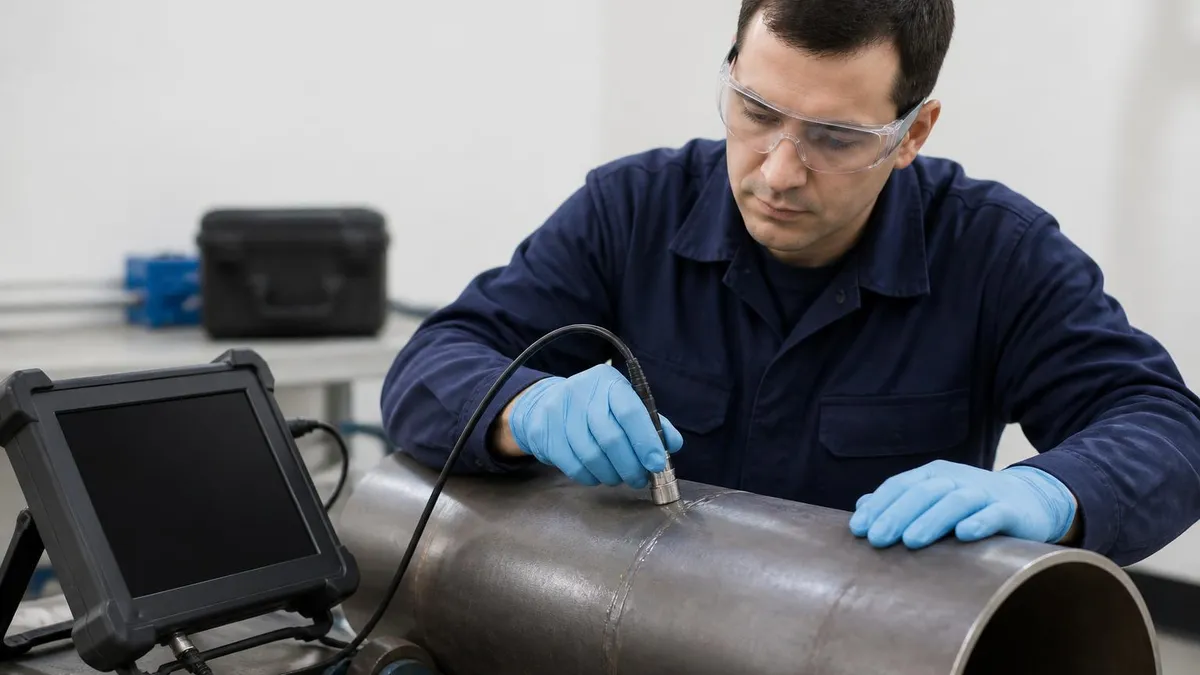
Ultrasonic testing is the highest-revenue method for most NDT firms because it spans corrosion mapping, weld inspection, thickness gauging, phased array, and time-of-flight diffraction. A capable vendor should own at least one phased array unit per crew, maintain calibration blocks for the alloys you run, and have technicians with both ASNT Level II UT and method-specific PAUT endorsements documented in their qualification file.
Pricing for conventional UT runs $85 to $140 per hour in 2026, while phased array work bills $160 to $260 per hour including data analysis. Encoded scans cost more but deliver permanent records that satisfy API 510 and 570 inspection plans. Ask vendors to demonstrate live scanning on a known calibration block before awarding a frame agreement, and request three sample reports from comparable projects.
Outsourcing to an NDT Company vs Building an In-House Team
- +Access to multiple methods without buying equipment for each
- +Certified Level II and Level III staff available on demand
- +Liability and radiation safety risks transfer to the vendor
- +Surge capacity for turnarounds, outages, and emergency shutdowns
- +Independent third-party reports satisfy auditors and regulators
- +Continuous training and certification renewal handled by vendor
- +No internal HR burden for retention in a tight labor market
- −Hourly rates plus mobilization add up on high-volume programs
- −Less control over technician selection on any given day
- −Knowledge of your specific assets must be rebuilt with new crews
- −Scheduling conflicts during peak turnaround season are real
- −Vendor markup on equipment rentals and consumables
- −Confidentiality of proprietary processes requires strong NDAs
Pros and Cons at a Glance
| Pros | Cons |
|---|---|
| Access to multiple methods without buying equipment for each | Hourly rates plus mobilization add up on high-volume programs |
| Certified Level II and Level III staff available on demand | Less control over technician selection on any given day |
| Liability and radiation safety risks transfer to the vendor | Knowledge of your specific assets must be rebuilt with new crews |
| Surge capacity for turnarounds, outages, and emergency shutdowns | Scheduling conflicts during peak turnaround season are real |
| Independent third-party reports satisfy auditors and regulators | Vendor markup on equipment rentals and consumables |
| Continuous training and certification renewal handled by vendor | Confidentiality of proprietary processes requires strong NDAs |
NDT Company Vendor Qualification Checklist
- ✓Verify ISO 9001 and ISO 17020 accreditation with current certificate numbers
- ✓Review the written practice document for SNT-TC-1A or CP-189 compliance
- ✓Sample at least five individual technician certification files and dates
- ✓Confirm Level III procedure approval authority and identify the named Level III
- ✓Audit the calibration program for all ultrasonic, eddy current, and radiation equipment
- ✓Request three reference customers in your industry and call them directly
- ✓Validate radiation safety license, dosimetry program, and source security plan
- ✓Inspect a recent third-party customer audit report and corrective action log
- ✓Confirm general liability, professional liability, and umbrella coverage limits
- ✓Review the digital reporting platform with sample exports to your CMMS format
- ✓Verify safety statistics: TRIR, DART, EMR, and OSHA 300 logs for last three years
- ✓Test the after-hours emergency dispatch process with an unannounced phone call
Awarding on Hourly Rate Alone
Buyers who optimize for the lowest hourly rate consistently overspend on the total program. A technician who takes 25 percent longer to set up, calibrate, scan, and report destroys any rate advantage on the first shift. The real metric is fully loaded cost per accepted weld, per shot, or per linear foot of corrosion mapping — and the best vendors will prove it on a paid pilot.
Pricing structures across the NDT company industry remain remarkably consistent in 2026, despite supply chain pressure on consumables and persistent wage inflation in the technician labor market. Most vendors quote on a combination of straight time, overtime, premium time, per diem, mobilization, equipment day rates, and pass-through expenses for consumables and films or imaging plates. Sophisticated buyers normalize all of these into a single fully loaded rate for apples-to-apples comparison across bidders.
Straight time rates for ASNT Level II technicians range from $78 to $115 per hour in most US markets, with phased array, TOFD, and eddy current array specialists commanding $150 to $230 per hour. Overtime is typically 1.5x after 40 hours per week, and double time on Sundays and federal holidays. During major turnarounds, crews routinely log 70 to 84 hours per week, so overtime can easily exceed straight time on a program-cost basis.
Mobilization fees are the most negotiable line item. A national vendor may quote $1,200 to $2,800 round trip per crew for travel under 300 miles. Frame agreements should cap this at a fixed amount per mobilization, or waive it entirely above a minimum daily commitment. For multi-week projects, push hard for waived mob in exchange for a guaranteed crew count. Per diem ranges from $185 to $245 per day depending on location, and should always reference GSA rates as a ceiling.
Equipment rental is where margin hides. A conventional UT unit may rent at $85 per day, but a phased array system can hit $325 to $480 per day, and a digital radiography kit $550 to $850. Some vendors bundle equipment into the labor rate, others itemize. Both are legitimate — but the bundled approach makes apples-to-apples comparison impossible without normalizing assumptions. Always ask for both formats from each bidder during the RFP phase.
Contract structure varies by project tempo. For predictable run-rate work, time-and-materials with a not-to-exceed cap remains the dominant model. For turnarounds, blended crew rates per shift are common — typically $3,800 to $5,200 per 12-hour shift for a two-person UT crew including equipment. For new construction, unit pricing per weld or per linear foot is sometimes used, but it transfers all efficiency risk to the vendor and usually carries a 15 to 25 percent premium.
Master Service Agreements are the standard contractual instrument for ongoing relationships. A well-drafted MSA includes rate schedules valid for 12 to 24 months, escalation clauses tied to BLS wage indices, performance guarantees with liquidated damages, insurance requirements, indemnification, IP ownership of inspection data, audit rights, and termination for convenience with 30 to 60 days notice. Owners with use routinely negotiate price holds for two full years.
For owners running formal training programs in-house, blended cost models work well. Vendors provide procedural oversight and Level III approval while internal staff handle field execution. This approach reduces hourly burn rates significantly but requires investment in NDT training for your own workforce, plus an audit trail that satisfies the same certification standards a vendor would use.

An NDT company can be audited and approved on day one with a perfect roster, then quietly lose Level II technicians and replace them with under-qualified staff over the following 18 months. Always reserve the right to audit individual certification files quarterly and require 48-hour notice of any technician substitution on your sites. Certification drift is the most common audit finding on supplier scorecards.
Selecting the right NDT company is a structured process, not a gut decision. Start by documenting your scope in code-specific terms: which methods, which acceptance standards, which assets, which expected volume, and which geographic footprint. A scope written in code language — Section V Article 4, API 1104 chapter 11, AWS D1.1 clause 8 — immediately separates serious bidders from generalists. Vague scopes attract vague proposals.
Issue a structured RFP rather than calling three friends. A good RFP includes the scope, expected annual volume, required certifications, mandatory insurance limits, MSA template, performance KPIs, and a clear evaluation matrix. Score on quality, capability, safety, commercial, and cultural fit — typically weighted 30/25/20/15/10. Make scoring blind where possible. The lowest price almost never wins an honest scorecard, and that is the right outcome.
Insist on a paid pilot before awarding a multi-year frame. A two-week pilot at full rates lets you observe technician quality, report timeliness, safety behavior, and responsiveness in real conditions. Document everything: arrival times, calibration thoroughness, report turnaround in hours, and customer service interactions. The behaviors you see in the first 80 hours are the behaviors you will live with for the entire contract.
Build performance KPIs into the contract from day one. Common metrics include first-time-right report rate above 95 percent, report submission within 24 hours of inspection, zero recordable safety incidents, technician substitution notice of at least 48 hours, and quarterly steering committee meetings. Tie financial consequences to KPI misses — typically a 2 to 5 percent rate adjustment for sustained underperformance, with termination for cause available at 90 days notice.
Manage the relationship actively after award. The biggest failures in NDT outsourcing come from passive management. Hold monthly operational reviews with field supervisors, quarterly commercial reviews with account managers, and annual strategic reviews with senior leadership. Track trend data across reports, safety, schedule, and commercial performance. Push vendors to invest in your account through joint capability development, technology pilots, and cross-training of your maintenance staff.
Plan for transitions before you need them. Every contract eventually ends. Build data portability requirements into your MSA so that inspection reports, calibration records, and digital scans transfer cleanly to your next vendor or to your CMMS. Insist on standard file formats — PDF for reports, native vendor format plus DICONDE for digital RT, raw and processed encoded UT scans — and a complete data handover within 30 days of contract end.
Finally, treat your NDT company as a strategic partner rather than a commodity supplier. The best vendors will contribute to risk-based inspection planning, fitness-for-service evaluations, and equipment integrity strategy. They will help you reduce inspection volume where data supports it, identify aging assets before failure, and benchmark your program against industry peers. That partnership value typically exceeds the hourly rate savings by an order of magnitude. For the broader context on the discipline, our explainer on what is NDT covers the foundational principles every buyer should understand.
Beyond the formal procurement work, there is a set of practical operating habits that separate owners who get great value from their NDT company from those who burn budget without realizing it. The first habit is preparing the inspection point properly before the crew arrives. Surface preparation, scaffold readiness, isolation, lockout, and permit-to-work all consume technician hours when not pre-staged. Every hour a Level II spends waiting on a permit is a billable hour you should not pay.
The second habit is integrating inspection planning with maintenance planning. If you tell your NDT vendor about turnaround scope eight weeks in advance, they can pre-qualify procedures, stage equipment, and lock in crews at base rates. Tell them eight days in advance and you are paying premium rates for whatever talent is available. The earlier the integration, the lower the cost — and the better the technical outcome on complex scopes.
The third habit is digitizing the data feedback loop. Inspection data has no value if it sits in PDFs on a shared drive. Push your vendor to deliver reports in structured formats that feed your CMMS, your risk-based inspection software, and your corrosion management dashboard. Trending data over five or ten years reveals corrosion rates, mechanical fatigue patterns, and lifecycle decisions that single-shot reports cannot.
The fourth habit is rotating Level III oversight. Many owners contract a Level III directly, separate from their inspection vendor, to audit procedures and witness select exams. This independence costs perhaps $5,000 to $15,000 per year for periodic engagements but routinely uncovers issues — procedure deviations, calibration problems, certification gaps — that the primary vendor's internal audits miss. The ROI on independent Level III oversight is consistently positive.
The fifth habit is investing in your own technical literacy. Procurement, engineering, and maintenance leads who can read a UT report, interpret an indication call, and challenge a vendor on technique selection get dramatically better outcomes. Send your engineers to ASNT events, sponsor selected staff for Level II personal certification, and require your inspection managers to maintain current code familiarity through annual refresher training.
The sixth habit is benchmarking. Once a year, ask a different NDT company to bid a small but representative scope at your facility. You do not need to switch vendors — you need to know the market. Pricing, technician quality, reporting capability, and digital maturity all shift quickly in this industry. Owners who only know one vendor inevitably overpay and miss innovation. Owners who benchmark annually keep their primary supplier honest and stay aware of capability gaps in their current arrangement.
The seventh habit, often overlooked, is treating safety as the primary scorecard. An NDT company that operates safely on your sites is almost always a company that operates well in every other dimension — training, procedures, documentation, retention, and culture. When you see seasoned technicians, proper PPE, thorough JSAs, and respectful interaction with your operators, you are seeing the visible surface of a deep operational culture. That is what you are really buying.
Sample NDT - Non-Destructive Testing Practice Questions
Try these questions from our free NDT - Non-Destructive Testing practice tests. The correct answer and an explanation follow each question.
Which post-cleaning method is MOST effective for removing penetrant materials from a part after inspection is complete?
- A. Dry brushing only
- B. Solvent soak followed by vapor degreasing
- C. Cold water rinse at low pressure
- D. Dry compressed air blow-off
Answer: B. Solvent soak followed by vapor degreasing
Solvent soaking followed by vapor degreasing thoroughly dissolves and removes penetrant, developer, and emulsifier residues from the part surface and discontinuities.
An oil refinery needs to conduct an in-service inspection of its existing process piping systems to assess for corrosion and other degradation. Which American Petroleum Institute (API) code specifically governs the inspection, rating, repair, and alteration of these in-service piping systems?
- A. API 510 - Pressure Vessel Inspection Code
- B. API 570 - Piping Inspection Code
- C. API 653 - Tank Inspection, Repair, Alteration, and Reconstruction
- D. API 1104 - Welding of Pipelines and Related Facilities
Answer: B. API 570 - Piping Inspection Code
API 570 is the specific code dedicated to the in-service inspection, rating, repair, and alteration of metallic and FRP piping systems. API 510 is for pressure vessels, API 653 is for storage tanks, and API 1104 is for the construction of new pipelines.
What is the minimum illuminance level (in foot-candles) required for general visual inspection per ASME standards?
- A. 25 fc
- B. 50 fc
- C. 100 fc
- D. 150 fc
Answer: B. 50 fc
ASME standards require a minimum illuminance of 50 foot-candles (540 lux) for general visual inspection.
When documenting a VT finding, which piece of information is LEAST critical to include in the inspection report?
- A. Location of the discontinuity using a reference system
- B. Dimensions and orientation of the discontinuity
- C. The inspector's shift supervisor's home address
- D. Date and identification of the inspector
Answer: C. The inspector's shift supervisor's home address
A supervisor's personal address is irrelevant to inspection documentation; location, dimensions, inspector ID, and date are all required fields.
NDT Questions and Answers

What Is NDT? A Complete Guide to Non-Destructive Testing in 2026
Indeed NDT Jobs: Complete Guide to Finding Non-Destructive Testing Careers in 2026
NDT Meaning: What Is Non-Destructive Testing and Why It Matters
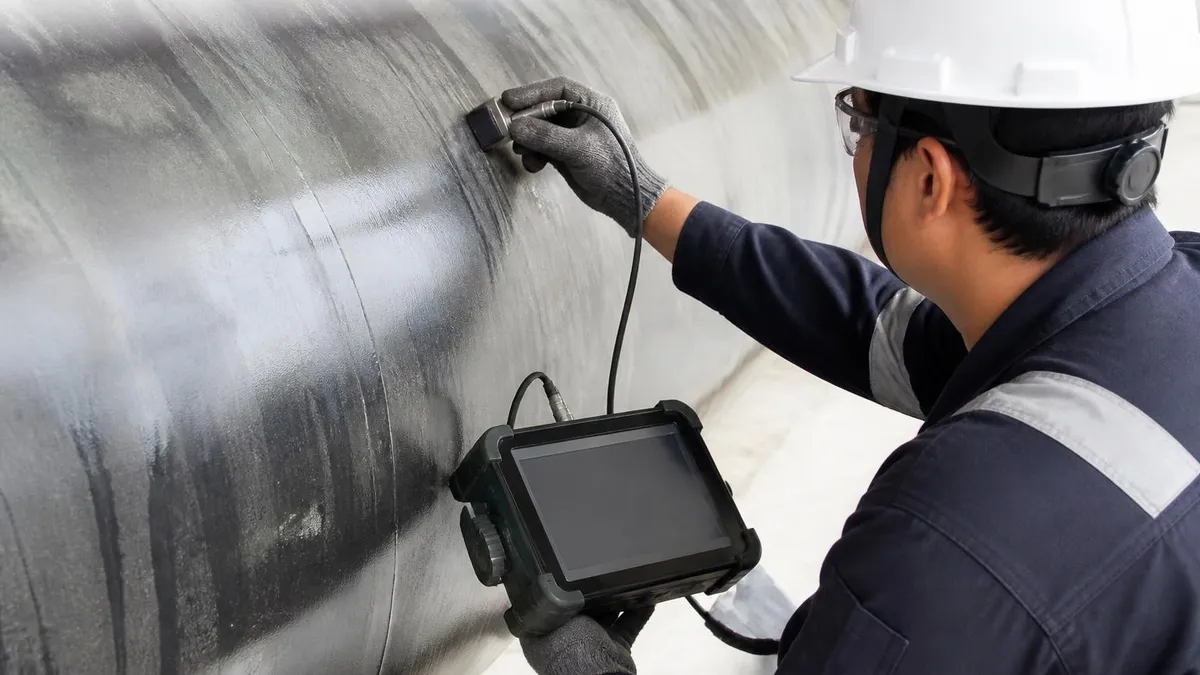
NDT Training: Complete Guide to Non-Destructive Testing Certification Courses in 2026
NDT Test Video Answers
About the Author

Educational Psychologist & Academic Test Preparation Expert
Columbia University Teachers CollegeDr. Lisa Patel holds a Doctorate in Education from Columbia University Teachers College and has spent 17 years researching standardized test design and academic assessment. She has developed preparation programs for SAT, ACT, GRE, LSAT, UCAT, and numerous professional licensing exams, helping students of all backgrounds achieve their target scores.