
NCLEX Mastery Review Requirements: Your Complete Exam Prep Blueprint 2026 August
Pass your NCLEX Mastery Review Requirements: Your exam on the first attempt. Practice questions with detailed answer explanations, hints, and instant ✏️
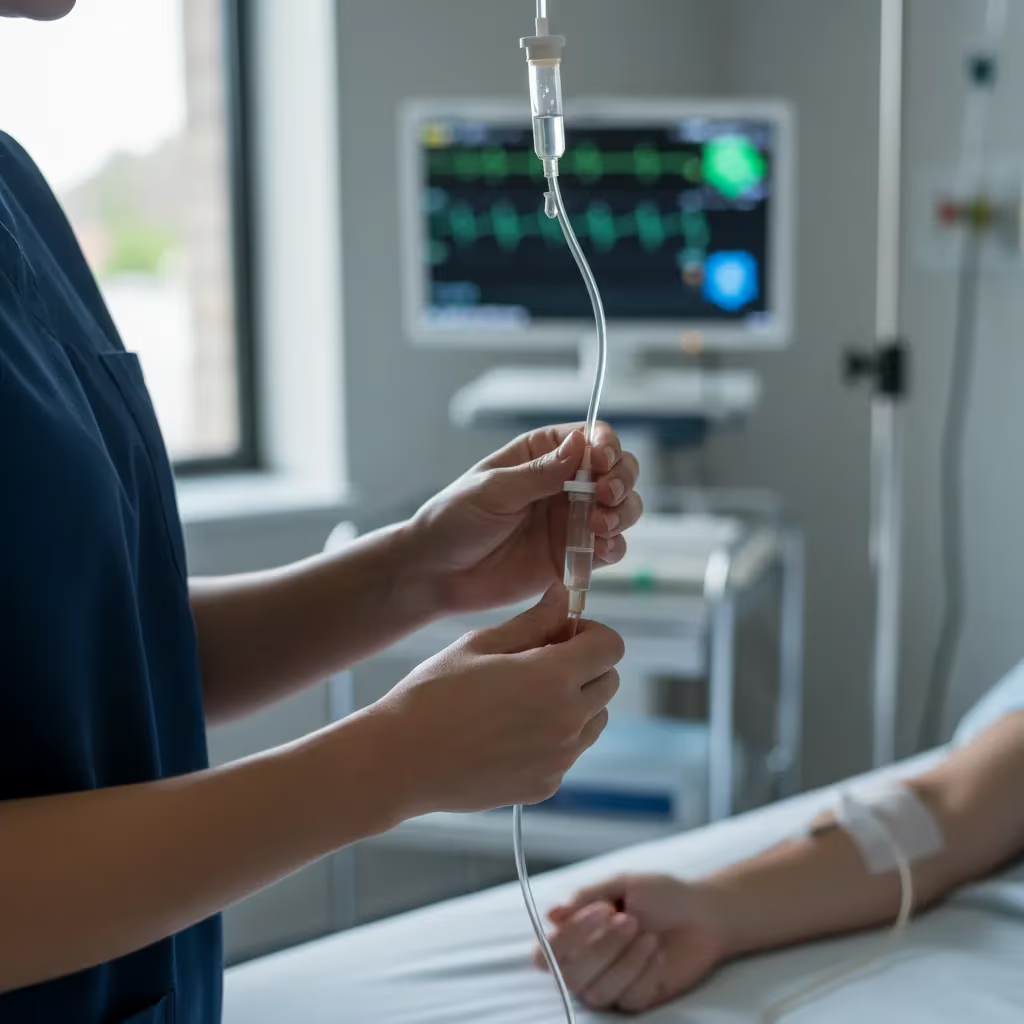
Understanding the NCLEX mastery review requirements is the first step toward passing your nursing licensure exam. Whether you're an RN or PN candidate, the path from nursing school graduate to licensed nurse runs straight through this test — and you can't afford to wing it. The requirements cover everything from educational prerequisites and application procedures to the testing format itself.
Resources like Archer NCLEX review courses and intensive NCLEX bootcamp programs have become go-to options for candidates who want structured preparation. These programs break down the exam's content domains, drill you on next-generation question types, and build the clinical reasoning skills you'll need on test day. But before you pick a prep method, you need to understand what the exam actually requires of you.
This page covers the full scope of NCLEX mastery review requirements — from state board applications and Pearson VUE registration to study strategies and practice test recommendations. You'll find quick-reference stats, detailed breakdowns of each requirement, and free practice quizzes to test your readiness. The NCLEX isn't something you pass by accident. It rewards candidates who prepare systematically, and that's exactly what we'll help you do here. Every section below targets a specific area of the exam process so you can study with purpose and track your progress along the way.

Choosing the right review program matters. A lot. An NCLEX bootcamp crams weeks of content into a few high-intensity days — perfect if your test date is close and you need rapid review. Longer prep courses spread the material over four to eight weeks with structured modules and scheduled practice exams. Either approach works, but only if you commit to the process.
NCLEX practice questions are your best friend during preparation. The exam uses computer adaptive testing, which means the difficulty adjusts based on your performance in real time. You can't just memorize facts — you need to apply clinical judgment to novel scenarios. High-quality question banks simulate this experience so you're not surprised by the format on test day. Aim for at least 2,000 practice questions before you sit for the real thing.
What separates candidates who pass on the first attempt from those who don't? Consistency. The data shows that students who study four to six hours daily for six to eight weeks have the highest first-attempt pass rates. Cramming the night before won't cut it. Build a schedule, stick to it, and use your practice question scores to identify weak areas that need extra attention. That targeted approach is far more effective than reading textbooks cover to cover. Your weak areas won't fix themselves — you have to actively hunt them down and drill relentlessly until they're solid strengths.
The NCLEX exam tests your ability to make safe, effective nursing decisions across eight client need categories. NCLEX questions don't ask you to recall isolated facts — they present clinical scenarios and ask what you'd do. A patient's blood pressure is dropping. The physician's order seems wrong. Two medications interact. What's your next move? That's the level of thinking the exam demands.
You'll encounter several question types: traditional multiple-choice, select-all-that-apply, ordered response (drag-and-drop), fill-in-the-blank calculations, hot-spot items, and the newer next-generation formats like case studies and bowtie questions. Each type requires a slightly different strategy. Practice with NCLEX practice questions that include all these formats so nothing catches you off guard when you're sitting in that testing center.
The NCLEX exam also emphasizes prioritization. You'll see questions asking which patient to see first, which action takes priority, or which assessment finding requires immediate intervention. The ABCs (airway, breathing, circulation) and Maslow's hierarchy of needs are your go-to frameworks for these questions. When two answers both seem correct, ask yourself: which one keeps the patient safest right now? That mental filter resolves most prioritization dilemmas quickly. Practice enough prioritization questions and the framework becomes second nature — you won't even need to consciously think through the hierarchy during the actual exam.
NCLEX Key Concepts
What is the passing score for the NCLEX exam?
Most NCLEX exams require 70-75% to pass. Check the official exam guide for exact requirements.
How long is the NCLEX exam?
The NCLEX exam typically allows 2-3 hours. Time management is critical for success.
How should I prepare for the NCLEX exam?
Start with a diagnostic test, create a 4-8 week study plan, and take at least 3 full practice exams.
What topics does the NCLEX exam cover?
The NCLEX exam covers multiple domains. Review the official content outline for the complete list.
NCLEX Exam Requirements Breakdown
You must graduate from an approved nursing program — either an ADN, BSN, or diploma program for the NCLEX-RN, or an approved practical/vocational nursing program for the NCLEX-PN. Your program must be approved by your state's board of nursing. International graduates need a credentials evaluation through CGFNS or a similar agency. Your nursing school reports your graduation directly to your state board, which then makes you eligible to register for the exam.
When people search for "NCLEX Q" tips or bootcamp NCLEX strategies, they're usually looking for shortcuts. Here's the truth: there aren't any. But there are efficient study methods that maximize your time. Spaced repetition — reviewing material at increasing intervals — beats rereading the same chapter three times in a row. Active recall — forcing yourself to answer questions from memory instead of just recognizing correct answers — strengthens retention dramatically.
A bootcamp NCLEX format typically compresses content review and question practice into three to five consecutive days. It's intense. Most programs run eight to ten hours daily with short breaks. They're effective for candidates who've already done foundational studying and need a final push. If you're starting from scratch, a bootcamp alone probably won't be enough — pair it with four to six weeks of self-study beforehand.
Study groups can help, but only if everyone stays focused. The best groups assign topics in advance, quiz each other using clinical scenarios, and discuss rationales for both correct and incorrect answers. Passive study groups where people just read notes aloud together tend to waste time. Be intentional about how you use group sessions, and don't replace solo practice question time with group work. Your individual weaknesses need individual attention — a study group won't fill pharmacology gaps for you.
Registration through Pearson VUE NCLEX is straightforward once you have your state board's approval. Log into the Pearson VUE website, create an account, and pay the $200 exam fee. After your state board confirms your eligibility, Pearson VUE emails your Authorization to Test. This ATT contains your candidate ID and the window during which you can schedule your exam. Don't wait until the last week — popular testing centers fill up fast.
Many candidates use UWorld NCLEX as their primary question bank, and for good reason. UWorld's questions are widely considered the closest match to actual exam difficulty. The detailed rationales explain not just why the correct answer is right, but why each wrong answer is wrong — that's where real learning happens. Other solid options include Archer, Kaplan, and NCLEX High Yield. Whichever you choose, track your scores over time to see your improvement trajectory.
When studying NCLEX questions, pay special attention to pharmacology. Drug names, classifications, side effects, and nursing implications show up heavily on the exam. Focus on the most commonly prescribed medications rather than memorizing every drug in the textbook. Cardiac drugs, antibiotics, pain management, and psychiatric medications appear most frequently. Make flashcards for the top 50 drugs and review them daily during your study period. Drug calculation questions also appear regularly — practice dosage math until you can solve them without a calculator slowing you down.
NCLEX Prep: Self-Study vs. Review Course
- +Self-study lets you set your own pace and focus on personal weak areas
- +Review courses provide structured schedules that keep procrastination in check
- +Question banks like UWorld offer thousands of practice items with detailed rationales
- +Bootcamps deliver intensive review in just a few days — great for final prep
- +Self-study costs less — many free resources and question banks are available online
- +Courses with live instructors let you ask questions and get immediate clarification
- −Self-study requires strong discipline — it's easy to fall behind without accountability
- −Review courses can be expensive, ranging from $200 to $500 or more
- −Not all question banks match the actual exam's difficulty level accurately
- −Bootcamps may overwhelm candidates who haven't done prior foundational review
- −Free resources vary wildly in quality — outdated material can hurt your preparation
- −Group courses move at one pace — too fast for some, too slow for others
NCLEX test sample questions come in various difficulty levels. The computer adaptive test starts at a moderate level and adjusts based on whether you answer correctly or incorrectly. Get a question right and the next one gets harder. Get it wrong and the difficulty drops. The algorithm is estimating your ability level with each answer. The test ends when the computer is 95% confident you're either above or below the passing standard — or when you hit the maximum number of questions.
NCLEX exam questions on the newer next-generation format deserve special attention. The NCSBN introduced these question types to better assess clinical judgment. Case study sets present a patient scenario across multiple screens, and your answers on earlier screens can affect what you see later. Bowtie items ask you to connect conditions, actions, and parameters simultaneously. These formats require deeper thinking than traditional multiple-choice, so practice them extensively before test day.
Don't ignore the testing logistics either. You can schedule your exam at any Pearson VUE testing center in the country — you're not limited to your home state. Some candidates travel to centers with more availability to avoid waiting weeks for an appointment. Check multiple locations when scheduling. The earlier you book after receiving your ATT, the more flexibility you'll have with dates and times. Weekend slots and early morning appointments tend to fill fastest, so have backup options ready when you log in to schedule.
NCLEX Exam Day Preparation Checklist
- ✓Confirm your exam date, time, and testing center address at least 48 hours before
- ✓Verify your government-issued photo ID is valid and matches your registration name exactly
- ✓Get a full night's sleep — aim for 7-8 hours to keep your mind sharp
- ✓Eat a balanced meal before the exam; avoid heavy foods that might cause drowsiness
- ✓Arrive at the testing center at least 30 minutes before your scheduled start time
- ✓Leave all personal items in your car or the center's locker — no phones or watches allowed
- ✓Review the erasable note board procedures and plan your scratch work strategy
- ✓Take the optional break after two hours to stretch, hydrate, and reset mentally
- ✓Remember: there's no penalty for taking your time — accuracy matters more than speed
- ✓Trust your preparation and avoid second-guessing answers after you've submitted them
The NCLEX-RN exam is your gateway to practicing as a registered nurse in any U.S. state or territory. Each state board of nursing sets its own licensure requirements beyond the exam — background checks, continuing education, and renewal timelines vary. Research your specific state's requirements early so you're not scrambling after you pass. Some states require a jurisprudence exam in addition to the NCLEX.
Logging into Pearson VUE NCLEX login portal after your test to check results can feel agonizing. Unofficial "quick results" are typically available about 48 hours after testing for a $7.95 fee. Official results come from your state board, and the timeline varies — some states post within a week, others take two to three weeks. The Pearson VUE "good pop-up" trick (where you try to re-register and get a message saying you can't) isn't officially reliable, but many candidates check it anyway.
If you don't pass on your first attempt, don't panic. You can retake the NCLEX exam after a waiting period — typically 45 to 90 days depending on your state. Use that time productively. Analyze your Candidate Performance Report (CPR), which shows how you performed in each content area. Focus your remediation on the areas where you scored "below the passing standard" and adjust your study strategy accordingly.
The NCLEX practice test experience should mirror the real exam as closely as possible. That means timing yourself, working in a quiet environment, and not checking rationales until after you finish the full set. It's tempting to peek at the explanation after each question, but that doesn't simulate test conditions. Train yourself to tolerate uncertainty — on the real exam, you won't know if you got a question right or wrong.
For NCLEX-RN candidates specifically, pharmacology and management of care are the two highest-yield content areas. Management of care alone can represent up to 23% of your exam. Questions in this domain cover delegation, assignment, supervision, advocacy, and ethical/legal nursing practice. Know the scope of practice differences between RNs, LPNs, and UAPs — these distinctions drive many delegation questions.
Time management during the exam itself is crucial. You've got five hours to complete up to 150 questions, which seems generous — but fatigue is real. Mental stamina drops sharply after hour three. Build your endurance during preparation by doing timed practice sets of 75 questions in a single sitting. If you can maintain accuracy through a three-hour session, you're in good shape for the real thing. Mental endurance is a real skill you can deliberately train just like clinical knowledge.
Your Authorization to Test is valid for a limited window — usually 90 days. If it expires before you schedule your exam, you'll need to reapply with your state board and pay fees again. Schedule your test date as soon as you receive your ATT, even if it's a few weeks out. Having a firm deadline actually improves study motivation and prevents the endless "I'll study more next week" cycle that derails many candidates.
The NCLEX-RN pass rate for first-time, U.S.-educated candidates typically hovers around 87-89%. That's encouraging, but it also means roughly one in ten candidates don't pass on their first try. International candidates face a tougher road — first-time pass rates for internationally educated nurses tend to be significantly lower, often around 40-50%. Understanding these numbers helps you calibrate your preparation intensity.
Practice NCLEX questions daily during your final month of preparation. Start with content-specific quizzes — like pharmacology or maternal-newborn — to build foundational knowledge. Then shift to mixed-topic practice tests that simulate the randomized nature of the actual exam. This two-phase approach ensures you've covered every content domain while also building the mental flexibility to jump between unrelated topics quickly.
For NCLEX-PN candidates, the exam covers slightly different content proportions. Coordinated care replaces management of care as the top category, and the overall question count ranges from 85 to 205 items. The PN exam focuses more on tasks within the practical nurse's scope — data collection rather than assessment, implementing care rather than planning it. Know these distinctions if you're sitting for the PN version, because they affect how you interpret answer choices.
NCLEX Practice Test Questions
Prepare for the NCLEX - National Council Licensure Examination exam with our free practice test modules. Each quiz covers key topics to help you pass on your first try.
NCLEX Basic Care and Comfort
NCLEX Exam Questions covering Basic Care and Comfort. Master NCLEX Test concepts for certification prep.
NCLEX Coordination of Care
Free NCLEX Practice Test featuring Coordination of Care. Improve your NCLEX Exam score with mock test prep.
NCLEX Medical Surgical Nursing
NCLEX Mock Exam on Medical Surgical Nursing. NCLEX Study Guide questions to pass on your first try.
NCLEX Medical Surgical Nursing Questions a...
NCLEX Test Prep for Medical Surgical Nursing Questions and Answers. Practice NCLEX Quiz questions and boost your score.
NCLEX Health Promotion and Maintenance
NCLEX Questions and Answers on Health Promotion and Maintenance. Free NCLEX practice for exam readiness.
NCLEX Management of Care
NCLEX Mock Test covering Management of Care. Online NCLEX Test practice with instant feedback.
NCLEX Exam: Nursing Prioritization, Delega...
Free NCLEX Quiz on Exam: Nursing Prioritization, Delegation and Assignment. NCLEX Exam prep questions with detailed explanations.
NCLEX-PN Test
NCLEX Practice Questions for NCLEX-PN Test. Build confidence for your NCLEX certification exam.
NCLEX-PN Test #10
NCLEX Test Online for NCLEX-PN Test #10. Free practice with instant results and feedback.
NCLEX-PN Test #1
NCLEX Study Material on NCLEX-PN Test #1. Prepare effectively with real exam-style questions.
NCLEX-PN Test #11
Free NCLEX Test covering NCLEX-PN Test #11. Practice and track your NCLEX exam readiness.
NCLEX-PN Test #12
NCLEX Exam Questions covering NCLEX-PN Test #12. Master NCLEX Test concepts for certification prep.
NCLEX-PN Test #13
Free NCLEX Practice Test featuring NCLEX-PN Test #13. Improve your NCLEX Exam score with mock test prep.
NCLEX-PN Test #14
NCLEX Mock Exam on NCLEX-PN Test #14. NCLEX Study Guide questions to pass on your first try.
NCLEX-PN Test #15
NCLEX Test Prep for NCLEX-PN Test #15. Practice NCLEX Quiz questions and boost your score.
NCLEX-PN Test #16
NCLEX Questions and Answers on NCLEX-PN Test #16. Free NCLEX practice for exam readiness.
NCLEX-PN Test #17
NCLEX Mock Test covering NCLEX-PN Test #17. Online NCLEX Test practice with instant feedback.
NCLEX-PN Test #18
Free NCLEX Quiz on NCLEX-PN Test #18. NCLEX Exam prep questions with detailed explanations.
NCLEX-PN Test #19
NCLEX Practice Questions for NCLEX-PN Test #19. Build confidence for your NCLEX certification exam.
NCLEX-PN Test #20
NCLEX Test Online for NCLEX-PN Test #20. Free practice with instant results and feedback.
NCLEX-PN Test #2
NCLEX Study Material on NCLEX-PN Test #2. Prepare effectively with real exam-style questions.
NCLEX-PN Test #22
Free NCLEX Test covering NCLEX-PN Test #22. Practice and track your NCLEX exam readiness.
NCLEX-PN Test #23
NCLEX Exam Questions covering NCLEX-PN Test #23. Master NCLEX Test concepts for certification prep.
NCLEX-PN Test #24
Free NCLEX Practice Test featuring NCLEX-PN Test #24. Improve your NCLEX Exam score with mock test prep.
NCLEX-PN Test #3
NCLEX Mock Exam on NCLEX-PN Test #3. NCLEX Study Guide questions to pass on your first try.
NCLEX-PN Test #4
NCLEX Test Prep for NCLEX-PN Test #4. Practice NCLEX Quiz questions and boost your score.
NCLEX-PN Test #5
NCLEX Questions and Answers on NCLEX-PN Test #5. Free NCLEX practice for exam readiness.
NCLEX-PN Test #6
NCLEX Mock Test covering NCLEX-PN Test #6. Online NCLEX Test practice with instant feedback.
NCLEX-PN Test #7
Free NCLEX Quiz on NCLEX-PN Test #7. NCLEX Exam prep questions with detailed explanations.
NCLEX-PN Test #8
NCLEX Practice Questions for NCLEX-PN Test #8. Build confidence for your NCLEX certification exam.
NCLEX-PN Test #9
NCLEX Test Online for NCLEX-PN Test #9. Free practice with instant results and feedback.
NCLEX Practice Exam
NCLEX Study Material on Practice Exam. Prepare effectively with real exam-style questions.
NCLEX-RN Practice Test
Free NCLEX Test covering NCLEX-RN Practice Test. Practice and track your NCLEX exam readiness.
NCLEX-RN Practice Test #12
NCLEX Exam Questions covering NCLEX-RN Practice Test #12. Master NCLEX Test concepts for certification prep.
NCLEX Select All That Apply Practice Exam
Free NCLEX Practice Test featuring Select All That Apply Practice Exam. Improve your NCLEX Exam score with mock test prep.
NCLEX Nursing Process
NCLEX Mock Exam on Nursing Process. NCLEX Study Guide questions to pass on your first try.
NCLEX Pharmacological and Parenteral Thera...
NCLEX Test Prep for Pharmacological and Parenteral Therapies. Practice NCLEX Quiz questions and boost your score.
NCLEX Physiological Integrity
NCLEX Questions and Answers on Physiological Integrity. Free NCLEX practice for exam readiness.
NCLEX Psychosocial Integrity
NCLEX Mock Test covering Psychosocial Integrity. Online NCLEX Test practice with instant feedback.
When you practice NCLEX questions, don't just track your overall score — break it down by content area. If you're consistently scoring 75% on pharmacology but only 55% on psychosocial integrity, that tells you exactly where to focus your remaining study time. Most question banks provide performance analytics by category. Use that data to drive your study plan rather than guessing at what you need to review next. Numbers don't lie — let your performance analytics be your study guide instead of your gut feeling about what you're weak on.
NCLEX-PN candidates should also prepare for the same next-generation question formats as RN candidates. The NCSBN has been integrating NGN items into both exams. Case studies, extended drag-and-drop, and highlight items all appear on the PN version now. Don't assume the PN exam is simpler in format — it tests the same clinical judgment framework, just within the practical nurse's scope of practice.
After you pass, remember that licensure is state-specific. Passing the NCLEX makes you eligible for a license in the state where you applied. If you want to practice in multiple states, you'll either need to apply for licensure by endorsement in each additional state or take advantage of the Nurse Licensure Compact, which currently covers over 40 states. Check whether your home state participates — it can save you significant time and paperwork if you ever decide to relocate or work as a travel nurse.
NCLEX Questions and Answers
About the Author

Registered Nurse & Healthcare Educator
Johns Hopkins University School of NursingDr. Sarah Mitchell is a board-certified registered nurse with over 15 years of clinical and academic experience. She completed her PhD in Nursing Science at Johns Hopkins University and has taught NCLEX preparation and clinical skills courses for nursing students across the United States. Her research focuses on evidence-based exam preparation strategies for healthcare certification candidates.
Join the Discussion
Connect with other students preparing for this exam. Share tips, ask questions, and get advice from people who have been there.
View discussion (8 replies)