
MSF Phone Number & Contact Guide: Course Costs, Written Test Prep & How to Reach the Motorcycle Safety Foundation
Find the MSF phone number, course costs ($25–$350), written test tips & practice tests. ✅ Everything to contact MSF & pass your riding course.

If you are trying to reach the Motorcycle Safety Foundation, the primary MSF phone number for general inquiries is 1-800-446-9227, and their main website is msf-usa.org. Whether you need help locating a BRC near you, understanding MSF course cost breakdowns, or getting answers about the MSF written test, knowing exactly how to contact the organization can save you significant time and frustration before you ever throw a leg over a motorcycle.
The MSF — Motorcycle Safety Foundation — is the nonprofit organization behind the Basic RiderCourse, the most widely recognized motorcycle training program in the United States. Every year, hundreds of thousands of new and returning riders enroll in MSF-sanctioned programs at more than 2,700 training sites across all 50 states. If you have questions about scheduling, waiver processing, or MSF class cost at a specific location, reaching out to the MSF directly or to your state's RiderCoach program is the fastest path to reliable answers.
Understanding the MSF contact ecosystem matters because the foundation itself does not run every course — it licenses curricula and trains RiderCoaches, while individual training sites (often community colleges, dealerships, or state DMV partners) actually deliver the classes. That means some questions — like exact MSF course cost at your local site — are best answered by the training provider, while policy and curriculum questions go to MSF headquarters in Irvine, California.
Many riders contact MSF because they want to understand the MSF test before they arrive at class. The written knowledge component, often called the MSF written test or the MSF course written test, covers riding strategies, hazard awareness, braking techniques, and traffic laws. Knowing what to expect on this assessment can dramatically reduce anxiety and improve your first-time pass rate, which is why MSF practice test resources have become so popular online.
Beyond the phone line, the MSF maintains strong digital contact options. Their online course-finder tool lets you search by zip code and filter by course type, price range, and available dates. The MSF eCourse portal — where riders complete the online portion of the BRC — has its own dedicated support section for technical and account issues. For media, research, and legislative inquiries, the foundation publishes department-specific email addresses on its press and government-relations pages.
The cost of MSF course varies by state and provider, but the national average sits between $150 and $350 for the full Basic RiderCourse including range time. Some states subsidize training through DMV partnerships, bringing the MSF class cost as low as $25 for residents. Calling the MSF or visiting the site finder is the best way to verify current pricing before you commit, since fees can change annually based on state funding and provider contracts.
This guide compiles every contact channel, explains what each department handles, breaks down MSF course cost tiers, and walks you through the MSF test format so you are fully prepared — both administratively and academically — before your first day of training. If you want a head start on the knowledge exam right now, explore the msf contact eCourse portal for digital pre-study materials that align directly with what appears on the MSF written test.
MSF by the Numbers

MSF Contact Channels: Who to Call and When
Call 1-800-446-9227 for curriculum questions, RiderCoach certification inquiries, research partnerships, media requests, and general policy questions. Headquarters handles national program standards but cannot book you into a local course.
For scheduling, MSF class cost at your specific location, cancellation policies, and range day logistics, contact the training site directly. Find your nearest site using the MSF course locator at msf-usa.org/find-a-course.
Technical issues with the online pre-study module — login problems, video playback errors, completion certificates — are handled through the eCourse help desk accessible directly from the portal login page.
Questions about how your MSF completion card transfers to a motorcycle endorsement or waives your DMV skills test go to your state motor vehicle agency, not to MSF. Rules vary significantly by state.
The foundation is active on Facebook, Instagram, and X (formerly Twitter) under @msfridertraining. Non-urgent questions can be submitted via the contact form at msf-usa.org/contact, with responses typically within 2–3 business days.
One of the most common reasons riders contact the MSF is to clarify MSF course cost before enrolling. The honest answer is that there is no single national price — the Motorcycle Safety Foundation sets curriculum standards but leaves fee-setting to individual training providers and state programs. That said, the typical range for the full Basic RiderCourse (BRC) runs between $150 and $350, which covers both the eCourse pre-study module and two days of range riding instruction led by certified RiderCoaches.
State subsidies can dramatically lower what you pay out of pocket. Several states — including California, Texas, and Florida — run government-funded motorcycle safety programs that reduce the cost of MSF course to as little as $25–$50 for state residents. In California, the California Motorcyclist Safety Program (CMSP) has historically offered courses at community colleges for around $25, though fees have been adjusting in recent years. Always verify current pricing with your specific provider, because state budgets and subsidy levels shift annually.
For military personnel, veterans, and first responders, many MSF-affiliated training sites offer discounted or even fully subsidized enrollment. Some employers and insurance carriers also reimburse MSF class cost as part of safety incentive programs — it is worth checking your benefits package or calling your insurer before you pay full price. The savings can be substantial, sometimes covering the entire enrollment fee.
The BRC is not the only MSF course with a price to consider. The Advanced RiderCourse (ARC), designed for experienced riders who want to sharpen their skills, typically costs $150–$250 at most sites. The BRC2, a one-day refresher for riders returning after a long break, often falls in the $100–$175 range. The MSF also offers specialty courses like the Scooter and Small Motorcycle course and the Three-Wheel Basic RiderCourse, each priced similarly to the standard BRC depending on site and state.
When you call an MSF training site to ask about MSF course cost, have a few pieces of information ready: your zip code, your experience level (complete beginner, returning rider, or licensed rider seeking endorsement waiver), and whether you need a motorcycle provided or own one. Some sites offer a small discount if you bring your own bike to range sessions, since it reduces their equipment overhead. Others include gear rental (helmet, gloves) in the base fee, while some charge separately for protective equipment.
Payment timing and cancellation policies vary significantly. Most sites require payment in full at the time of registration to hold your spot, since BRC classes fill quickly — especially in spring and summer. Cancellation windows typically range from 48 hours to 7 days before the course start date for a full refund. Missing the cancellation window usually results in forfeiture of the fee or a transfer credit toward a future class. Ask specifically about these policies when you contact the training site, because they are not standardized across MSF-affiliated providers.
A final cost consideration is the MSF written test and range evaluation — both are included in the standard BRC enrollment fee, not billed separately. If you fail either component and need to retest, policies differ: some sites allow one free retake during the same course weekend, while others charge a modest rescheduling fee. Understanding these details upfront, either by calling the MSF main line or contacting your local site, prevents surprise expenses and helps you budget accurately for your motorcycle licensing journey.
MSF Written Test & Course Written Test: What to Expect
The MSF written test is a knowledge assessment administered at the end of the classroom portion of the Basic RiderCourse. It typically consists of 25–50 multiple-choice questions drawn from the MSF curriculum, covering topics such as riding strategies, space management, hazard identification, protective gear selection, braking techniques, and the effects of alcohol and fatigue on riding performance. Most providers require a score of 70–80% or higher to pass the knowledge component.
Unlike the DMV written motorcycle knowledge test, the MSF course written test is curriculum-specific — meaning the questions align directly with what RiderCoaches teach during the eCourse and classroom segments. Riders who complete the eCourse pre-study module before arriving at class consistently outperform those who skip it. The test is not timed in most implementations, so you can work through questions carefully. If you fail, many sites permit a single retake on the same day before the range evaluation begins.

MSF Basic RiderCourse: Is It Worth the Cost?
- +Completion card waives the DMV motorcycle skills test in most states, saving an extra trip and test fee
- +Insurance discounts of 5–15% with many major carriers upon showing your MSF completion certificate
- +Motorcycles and basic safety gear provided at most sites — no need to own a bike to take the course
- +Certified RiderCoaches provide real-time, personalized feedback you cannot get from self-study alone
- +Structured curriculum covers both knowledge and physical skills in a low-risk, controlled environment
- +BRC completion is accepted as proof of training for military, fleet, and employer safety programs nationwide
- −MSF course cost of $150–$350 is a significant upfront investment before you even purchase a motorcycle
- −Classes fill quickly in spring and summer — popular sites may have wait lists extending 4–8 weeks out
- −Two full days of commitment (or evenings plus a weekend) can be difficult to schedule around work
- −Range evaluations are performance-based; anxiety or physical limitations can affect pass rates
- −The BRC motorcycle fleet uses small-displacement bikes that may feel very different from the bike you plan to ride
- −Not all states accept the MSF card as a full skills test waiver — always verify with your state DMV first
Pros and Cons at a Glance
| Pros | Cons |
|---|---|
| Completion card waives the DMV motorcycle skills test in most states, saving an extra trip and test fee | Two full days of commitment (or evenings plus a weekend) can be difficult to schedule around work |
| Motorcycles and basic safety gear provided at most sites — no need to own a bike to take the course | Range evaluations are performance-based; anxiety or physical limitations can affect pass rates |
| Certified RiderCoaches provide real-time, personalized feedback you cannot get from self-study alone | The BRC motorcycle fleet uses small-displacement bikes that may feel very different from the bike you plan to ride |
| Structured curriculum covers both knowledge and physical skills in a low-risk, controlled environment | Not all states accept the MSF card as a full skills test waiver — always verify with your state DMV first |
MSF Course Preparation Checklist: 10 Steps Before Class Day
- ✓Call your chosen training site or use the MSF course finder to confirm available dates, MSF class cost, and payment methods accepted.
- ✓Complete the MSF eCourse pre-study module at least 48 hours before your in-person class to allow review time.
- ✓Take at least two full MSF practice tests online and review every question you answer incorrectly.
- ✓Assemble required protective gear: DOT-approved helmet, over-the-ankle boots, long pants, long sleeves or jacket, and full-fingered gloves.
- ✓Confirm with the training site whether gear is provided or if you must bring your own helmet and gloves.
- ✓Get a full night of sleep before both class days — physical fatigue significantly impacts range skill performance.
- ✓Eat a real meal before each session; range days involve several hours of physical activity in outdoor conditions.
- ✓Arrive 15 minutes early on day one with your valid driver's license and any required registration documents.
- ✓Review the SEE system (Search, Evaluate, Execute) the night before class — it underpins both the MSF written test and range evaluations.
- ✓Bring sunscreen, water, and weather-appropriate layers — range sessions run regardless of minor weather changes.
Riders Who Finish the eCourse Before Class Pass the Written Test at a Rate Exceeding 95%
The MSF eCourse covers every knowledge domain tested on the MSF written test. Riders who treat the eCourse as genuine pre-study — taking notes, rewatching key segments, and completing all embedded knowledge checks — arrive at class with a massive advantage over those who rush through it the night before. Budget 3–4 hours for a thorough eCourse review, and your written test pass rate will be near-certain.
Passing the MSF test consistently comes down to three factors: understanding the MSF's core safety philosophy, memorizing the key numbers and thresholds the curriculum emphasizes, and practicing with realistic MSF practice test questions before class day. Riders who treat the test as an afterthought — something they'll figure out during class — are the ones who occasionally need retakes. Those who prepare in advance treat the classroom and range as confirmation of what they already know, which dramatically reduces stress and frees mental energy for physical skill development.
The MSF's core safety philosophy revolves around the concept of risk management through space and time. The foundation teaches that most motorcycle crashes are preventable when riders maintain adequate following distances, position themselves for maximum visibility and escape routes, and apply smooth, deliberate control inputs.
On the MSF written test, questions about following distance (the standard answer is two seconds minimum, increased to three or four in poor conditions) and lane positioning (riding in the left third of your lane when following a car, for example) appear in multiple forms. Knowing not just the answer but the reasoning behind it helps you handle paraphrased or scenario-based questions confidently.
Memorizing key numbers from the MSF curriculum pays outsized dividends on the MSF test. The most frequently tested figures include: two seconds minimum following distance; 11 seconds of visual lead time when scanning ahead; the 12 o'clock, 3 o'clock, and 9 o'clock lane position system; and the fact that alcohol impairment begins affecting riding performance at blood alcohol levels well below the legal limit of 0.08 BAC. The MSF curriculum emphasizes that even one drink measurably degrades reaction time and decision-making — a position they test directly on the MSF course written test.
Physical preparation for the range evaluation deserves as much attention as written test prep. The BRC range exercises include the normal stop, the quick stop, the curve and cornering exercise, and the obstacle swerve. Each exercise has specific performance criteria — for example, the quick stop requires you to bring the motorcycle to a controlled halt within a marked distance zone using both brakes simultaneously without skidding. Watching video demonstrations of these exercises before class day helps you visualize the correct body position, vision technique, and control sequence before you attempt them on an actual motorcycle.
One underappreciated element of MSF test preparation is understanding the range evaluation scoring system. RiderCoaches use a point-deduction system during range exercises, and accumulating too many points (typically more than 20–22 depending on the site) results in a course fail even if you aced the written test. Points are deducted for putting a foot down unexpectedly, stalling the motorcycle, missing a cone, crossing a boundary line, or losing control during an exercise. Knowing which mistakes carry the heaviest penalties helps you prioritize your practice focus during the range portions.
The psychology of the range evaluation matters more than most riders expect. Nerves cause the two most common first-timer errors: over-braking on the quick stop exercise (which leads to wheel lockup and a point deduction) and under-cornering on the curve exercise (which means exiting the turn too wide and crossing the boundary cone). Both errors stem from tension in the arms and a tendency to look down at the immediate front wheel rather than through the turn toward the exit.
The MSF's own instruction addresses these tendencies directly — listen closely to your RiderCoach's pre-exercise briefing, because it almost always contains the specific remedy for the most common failure mode on each exercise.
Finally, if you do not pass on your first attempt, do not despair. The MSF course is designed for absolute beginners, and most training sites offer remediation opportunities. Some allow a same-day retake of the failed exercise, while others schedule a make-up range session within a few weeks.
The important thing is to debrief honestly with your RiderCoach immediately after a failed exercise — they can identify exactly what went wrong and give you targeted guidance before your next attempt. Coming back after a first-attempt failure and passing is actually a common experience, and completing the BRC still earns you full certification regardless of how many attempts it took.

While most U.S. states accept the MSF BRC completion card to waive the DMV motorcycle skills test, not all states offer this waiver, and some require additional steps such as a written DMV motorcycle knowledge test even after BRC completion. Before enrolling, call your state DMV to confirm exactly what your MSF card unlocks — assuming a full waiver could leave you scrambling for an additional DMV appointment after completing the course.
Once you have completed your MSF Basic RiderCourse and passed both the written test and range evaluation, the next steps move quickly. Your RiderCoach will issue a completion card — often called the MSF card or BRC card — at the end of your final range session. This wallet-sized card carries your name, completion date, and the BRC course designation. It is valid for a limited period (typically one year) for DMV endorsement purposes, so do not wait too long before visiting the DMV to convert it into a full motorcycle endorsement on your driver's license.
The process for using your MSF completion to get your motorcycle endorsement varies by state. In most states, you take your completion card and current driver's license to the DMV, pay a modest endorsement fee (usually $5–$25), and leave the same day with an M endorsement or a temporary paper license while the updated license is mailed.
Some states require you to pass a written motorcycle knowledge test at the DMV even with BRC completion — a remnant policy that has not been updated despite the MSF's comprehensive written test component. Call your state DMV or check their website to confirm exactly which tests, if any, remain required after BRC.
Many riders discover after the BRC that they want to continue developing their skills through additional MSF programs. The Advanced RiderCourse (ARC) is the natural next step for licensed riders who want to refine their emergency braking, swerving, and cornering precision. The ARC requires you to bring your own motorcycle and wear your own full protective gear, and it is priced similarly to the BRC at most sites. The MSF also offers a Sport RiderCourse for riders of sportbikes and a Dirt Bike School for those interested in off-road riding fundamentals.
Insurance discounts are one of the most tangible financial benefits of BRC completion. Major insurers including Progressive, Allstate, Geico, and State Farm offer premium discounts ranging from 5% to 15% for riders who can prove MSF course completion. The discount typically applies to your comprehensive and collision coverage rather than liability only. Submit a copy of your MSF completion card to your insurer immediately after the course — some carriers require submission within 30 days of completion date to activate the discount for the current policy period.
If you plan to ride with others, the MSF's group riding guidelines — covered in the BRC curriculum — become immediately relevant. The foundation recommends staggered formation riding with a minimum two-second following distance from the rider directly ahead of you in the stagger. Passing maneuvers within a group should be coordinated in advance, not improvised on the road. Group ride leaders and sweepers have specific responsibilities that the MSF outlines in its supplemental group riding materials, available as a free download from msf-usa.org.
Continuing education through MSF resources does not stop with a course enrollment. The foundation publishes a free online library of riding tips, instructional videos, and gear guides that are useful long after your BRC card is tucked in your wallet. Their periodic rider updates and safety research summaries are worth bookmarking, particularly if you ride year-round or in diverse weather conditions. MSF research has directly influenced lane filtering legislation, helmet law debates, and vehicle detection standards — staying connected to their publications keeps you informed about changes that affect your riding environment.
For riders who eventually want to give back to the motorcycle community, becoming a certified MSF RiderCoach is a rewarding pathway. The certification process requires holding a valid motorcycle endorsement for at least two years, passing a rigorous multi-day RiderCoach Preparation Course, and demonstrating both riding proficiency and instructional competence. Certified RiderCoaches can teach at any MSF-affiliated site nationwide, earn supplemental income during peak training seasons, and play a direct role in reducing the motorcycle crash statistics that motivate the MSF's entire mission. Contact MSF headquarters at 1-800-446-9227 to learn about RiderCoach preparation course schedules in your region.
Practical preparation for the MSF test goes beyond reading the curriculum — it means actively engaging with realistic practice questions that mirror the format and difficulty level of what appears on the actual MSF course written test. The most effective study sessions are short (20–30 minutes), focused on one or two knowledge domains at a time, and immediately followed by a review of every question answered incorrectly. Spacing these sessions across three to five days before your class date produces far better retention than a single long cram session the night before.
When reviewing MSF practice test questions, pay attention to the distractor options — the wrong answers are designed to catch common misconceptions. For example, a question about braking technique might offer options suggesting front brake only, rear brake only, or both brakes simultaneously but with more emphasis on the rear. The correct MSF answer is always both brakes simultaneously with proportionally more force on the front, since the front brake provides approximately 70–80% of a motorcycle's stopping power under normal conditions. Recognizing and rejecting the common wrong answers is as important as knowing the right one.
Physical conditioning for the range day is something most first-time riders underestimate. Two days of motorcycle riding — even on small-displacement training bikes at low speeds — requires sustained use of muscles in your hands, wrists, forearms, core, and inner thighs. Riders who regularly experience muscle fatigue or cramps during the course are more likely to make control errors on range exercises. In the week before your BRC, spending ten to fifteen minutes daily squeezing a stress ball, doing forearm stretches, and practicing the clutch-lever pull motion (even in the air) can meaningfully reduce fatigue during actual riding exercises.
Weather contingency planning is another practical consideration that the MSF contact page and most training sites address in their FAQ sections. BRC range sessions run in light rain, wind, and moderate cold — they are cancelled only in cases of lightning, heavy downpour that creates standing water on the range surface, or extreme temperature warnings.
If you arrive at a range day and conditions are borderline, the RiderCoach makes the final safety call. Most sites will reschedule you at no additional charge if they cancel due to weather, but you may need to wait several weeks for the next available slot during peak season, so checking the weather forecast and having a flexible schedule helps.
Gear inspection is conducted at the start of the range day, and riders who arrive without compliant gear may be turned away without a refund at some sites. The minimum requirements are consistent across MSF-affiliated providers: a DOT-approved helmet (not novelty or non-certified helmets), full-fingered gloves, over-the-ankle boots with low heels, long pants with no tears or cutouts, and a jacket or long-sleeved shirt.
Some sites additionally require long pants made of abrasion-resistant material (denim at minimum, motorcycle pants preferred) and refuse participation for riders wearing shorts or open-toed shoes. When you call to register, ask the training site to read you their gear requirements verbatim — do not rely on general descriptions found online, since individual sites can set stricter standards than the MSF minimum.
For riders with disabilities or physical limitations, the MSF has developed adaptive riding programs and guidelines. Riders with hearing loss, limited hand strength, leg prosthetics, or other adaptive needs should contact MSF headquarters directly at 1-800-446-9227 to discuss accommodation options before registering at a local site. Some training sites have RiderCoaches with specific adaptive instruction certifications, and the MSF can help match you with those providers. Calling ahead ensures that both you and the training site are properly prepared for a successful and safe course experience.
Finally, remember that completing the MSF course is just the beginning of your riding education, not the end. The BRC certifies that you have mastered the foundational skills and knowledge to operate a motorcycle legally and with basic competency — it does not certify that you are ready for every riding situation you will encounter on public roads.
New riders should continue adding skills through controlled practice in low-traffic environments, by riding progressively more complex routes as competence builds, and by returning to formal MSF training every few years to reinforce and update their skills. The MSF itself recommends refresher training every three to five years, or whenever you return from a riding break of more than six months. Continuous learning is the mindset that separates long-term safe riders from those who plateau at minimal competency.
Sample MSF - Motorcycle Safety Foundation Practice Questions
Try these questions from our free MSF - Motorcycle Safety Foundation practice tests. The correct answer and an explanation follow each question.
How should a face shield on a motorcycle helmet be maintained for maximum safety?
- A. It should be tinted to reduce glare at all times
- B. It should be clean and scratch-free to ensure clear vision
- C. It should be kept partially open for ventilation while riding
- D. It only needs cleaning before nighttime riding
Answer: B. It should be clean and scratch-free to ensure clear vision
A scratched or dirty face shield distorts vision and increases glare, so it must be kept clean and replaced when scratched.
Which type of clothing material provides the best abrasion resistance for motorcycle riders?
- A. Denim jeans
- B. Polyester fleece
- C. Leather or reinforced textile riding gear
- D. Cotton cargo pants
Answer: C. Leather or reinforced textile riding gear
Leather and purpose-built textile riding gear with abrasion-resistant panels provide the protection needed in a slide after a crash.
When parking a motorcycle on a slope, which gear should it be left in?
- A. Neutral
- B. First gear (or reverse if equipped)
- C. Third gear
- D. Any gear is acceptable
Answer: B. First gear (or reverse if equipped)
Leaving the motorcycle in first gear (or reverse) uses the engine's compression to prevent rolling.
On a motorcycle, how do you swerve correctly?
- A. Quickly turn the handlebars.
- B. Quickly adjust your body's weight.
- C. In the direction of the turn, press the handgrip.
- D. Recline on the tank.
Answer: C. In the direction of the turn, press the handgrip.
Correct swerving on a motorcycle is achieved through counter-steering. This technique involves briefly pressing the handgrip in the direction of the desired turn (e.g., press the left grip to turn left), which causes the motorcycle to lean quickly and change direction efficiently. This allows for rapid avoidance of hazards.
Take the full MSF - Motorcycle Safety Foundation practice test
MSF Questions and Answers

MSF eCourse: Complete Guide to Online Training, Written Test Prep & Course Costs
MSF Practice Test Video Answers
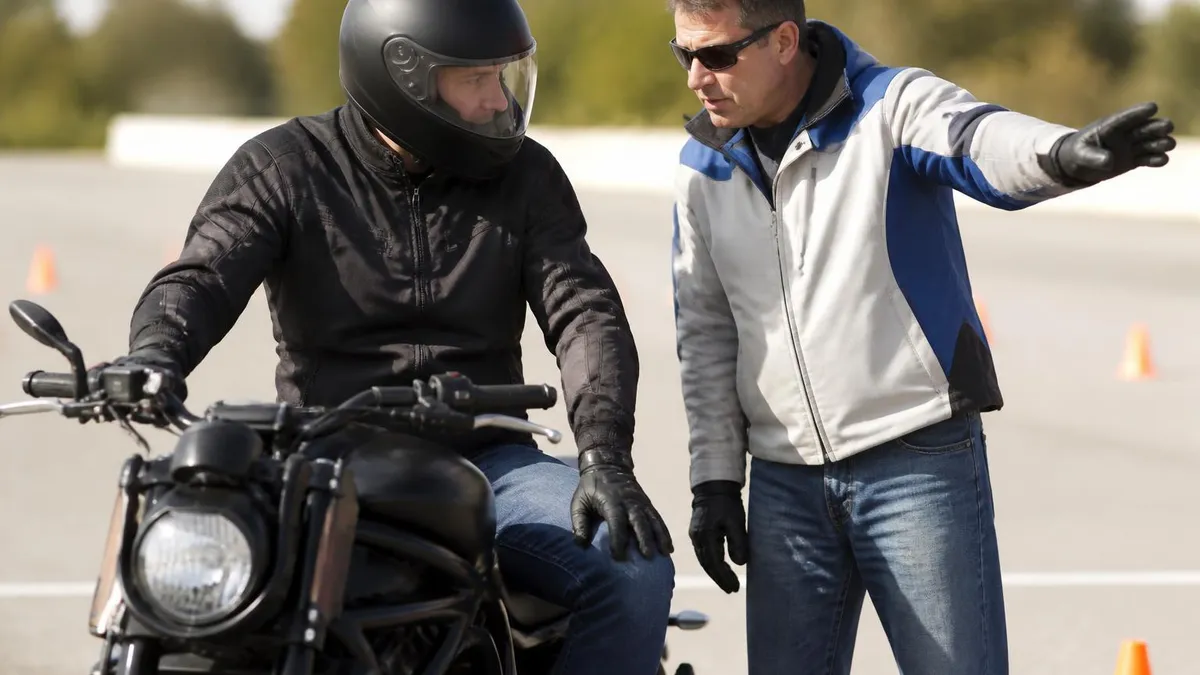
Motorcycle Safety Foundation Course: Complete 2026 Training Guide

MSF Card & Basic Rider Course: Complete 2026 Guide to Test Prep, Costs & Your Certificate

Ohio MSF Course: Complete Guide to Training, Costs & Written Test Prep
About the Author

Business Consultant & Professional Certification Advisor
Wharton School, University of PennsylvaniaKatherine Lee earned her MBA from the Wharton School at the University of Pennsylvania and holds CPA, PHR, and PMP certifications. With a background spanning corporate finance, human resources, and project management, she has coached professionals preparing for CPA, CMA, PHR/SPHR, PMP, and financial services licensing exams.