
How Long Does a Head MRI Take? Realistic Times & What Slows It Down
🔎 How long does a head MRI take? Most scans run 20–45 minutes. See timing by protocol, contrast, sedation, and what extends the appointment.
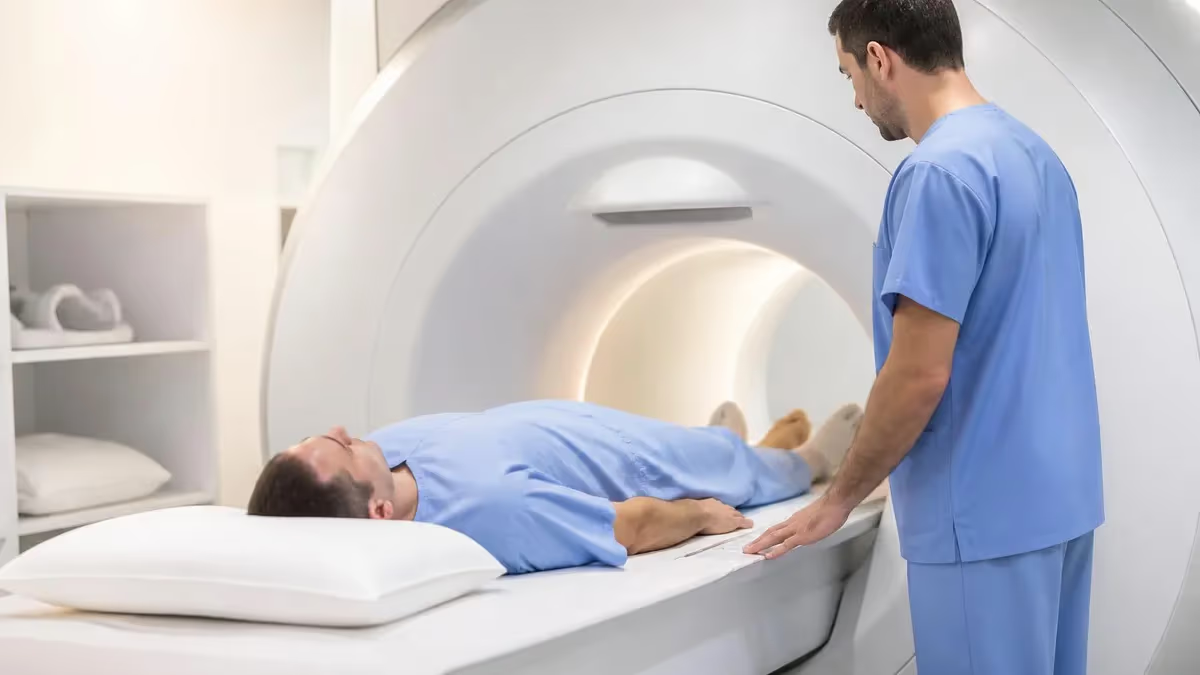
If your doctor just ordered a head MRI and you're trying to figure out how to slot it into a busy day, the short answer is this: plan for the appointment to take about an hour, even though the actual scan time is usually shorter. Most routine head MRIs run 20 to 45 minutes inside the magnet, but you'll also need check-in, screening, and prep time on top of that.
How long does a head MRI take in practice? It really comes down to what your doctor is looking for. A quick screening scan after a fall might be done in 15 minutes. A detailed protocol for suspected MS or a brain tumor workup can stretch past 60 minutes, especially with contrast dye involved. Knowing the realistic range helps you plan and lowers the stress of going in cold.
This guide breaks down head MRI scan times by protocol, walks through the factors that stretch or shrink your appointment, and gives you practical tips so the day runs smoothly. If you want a wider look at imaging duration across the body, the companion article on how long does an MRI take covers that ground in detail.
Head MRI Time at a Glance
How Long Does a Head MRI Take by Protocol?
Not all head MRIs are built the same. The radiologist sets the protocol based on the clinical question your doctor wrote on the order. A simple "rule out bleed" study is short. A detailed seizure or tumor workup is longer. Here's what to expect across common scenarios.
Routine head MRI without contrast: 20 to 30 minutes. This covers the bread-and-butter brain scan, ordered for headaches, dizziness, and general neurological symptoms. You'll get a standard set of sequences—T1, T2, FLAIR, DWI—that show structure, fluid, and any acute issues. No IV, no waiting around for dye. In and out fast.
Head MRI with contrast: 30 to 45 minutes. Add gadolinium-based contrast and your time goes up. The technologist runs a first set of sequences, then injects the dye through an IV, then captures additional post-contrast sequences. The dye highlights tumors, infection, inflammation, and abnormal blood vessels. Plan extra time for the IV placement and the contrast injection itself.
MRI of the brain for stroke or bleed: 10 to 20 minutes. In emergency settings, a stripped-down protocol focused on diffusion-weighted imaging can identify acute stroke in minutes. Hospitals running stroke alerts know how to move fast here. The trade-off is less anatomical detail, but speed matters when treatment windows are narrow.
Detailed brain MRI for tumor or MS: 45 to 75 minutes. These workups need more sequences. Tumor staging often includes contrast, MR spectroscopy, and sometimes perfusion imaging. MS protocols add high-resolution FLAIR, double inversion recovery, and post-contrast T1 sequences. Settle in.
Pituitary or internal auditory canal MRI: 30 to 45 minutes. These are targeted studies focused on a tiny anatomical region. Sequences run at higher resolution but cover less ground, so they don't always take longer than a standard brain MRI. Contrast is common, which can push the total time up.
Functional MRI (fMRI) of the head: 60 to 90 minutes. Used for pre-surgical mapping before brain tumor or epilepsy surgery, fMRI tracks blood-oxygen-level changes while you perform tasks (tapping fingers, naming objects, reading). It's interactive, complex, and the longest version of a head scan you're likely to encounter.
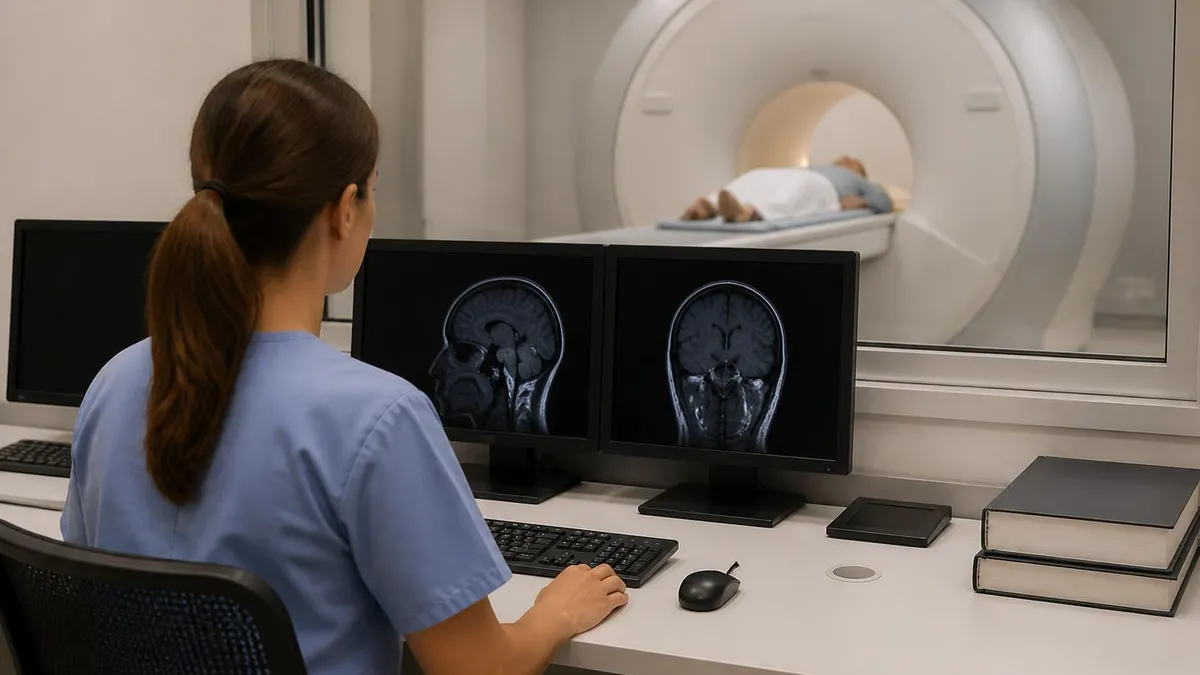
Common Head MRI Protocols & Times
Headache, dizziness, screening. 20–30 minutes, no contrast needed in most cases.
Tumor, infection, MS follow-up. 30–45 minutes including IV injection and post-contrast sequences.
Emergency rule-out for acute stroke. 10–20 minutes focused on diffusion sequences.
Small-region scans with high resolution. 30–45 minutes, often with contrast.
Mapping language and motor areas before surgery. 60–90 minutes with interactive tasks.
Often requires sedation. Scan itself runs 25–45 minutes, but expect 2–4 hours for the full appointment.
What Makes a Head MRI Take Longer?
The protocol is just one variable. Several other things can stretch your time in the scanner, and a few of them are within your control. Worth knowing before you go.
Contrast vs. No Contrast
Gadolinium-based contrast adds 10 to 20 minutes to the total scan. The technologist starts with non-contrast sequences. Then someone places an IV, injects the dye, waits a couple of minutes for it to distribute, and the scanner runs more sequences. If you already have an IV in place from the ER or another procedure, you save a little time on the front end.
Number of Sequences
Each "sequence" is a different way of weighting the image—T1, T2, FLAIR, DWI, susceptibility-weighted, MR angiography, and more. A basic head MRI uses 5 to 7 sequences. A detailed protocol can hit 12 or more. You can't negotiate this—the radiologist sets it based on the clinical question. But understanding the math explains why one head MRI took 22 minutes and the next one took an hour.
Patient Movement
This is the big one. MRI images are exquisitely sensitive to motion. Even small head movements—shifting, swallowing too hard, fidgeting your jaw—can blur a sequence enough to require a repeat. If you move during the last 30 seconds of a 4-minute sequence, the technologist has to start over. That's why staying perfectly still matters so much, and why pediatric scans often need sedation.
Scanner Field Strength
Higher-field scanners (3 Tesla) image faster than 1.5T units and provide sharper detail. Most hospital systems now have 3T magnets for routine work. Open MRI scanners use lower field strengths (often 0.3T to 1.2T) and typically take longer to acquire the same images. If scan speed matters and you're not claustrophobic, ask whether a high-field closed bore is available.
Claustrophobia and Anxiety
An anxious patient who needs to come out and reset can add 10 to 30 minutes. Some facilities offer mild oral sedation (lorazepam, diazepam) before the scan, but you'd need a ride home. Others use prism glasses to give the illusion of more space, or play music through MRI-safe headphones. Talking through the appointment ahead of time with the technologist often helps more than people expect.
Image Quality Repeats
If a sequence comes out blurry from motion, breathing artifacts, or technical issues, the tech will repeat it. This happens more often than people realize and is the main reason your "30-minute scan" became 45 minutes. Not the radiographer's fault—just physics meeting biology.
Head MRI by Patient Type
Routine adult head MRI runs 20–30 minutes without contrast, 30–45 with. Total appointment averages 60–75 minutes including check-in, MRI safety screening, IV placement (if needed), and changing into a gown. Most outpatient centers run on tight schedules, so showing up 15 minutes early helps keep things on track.
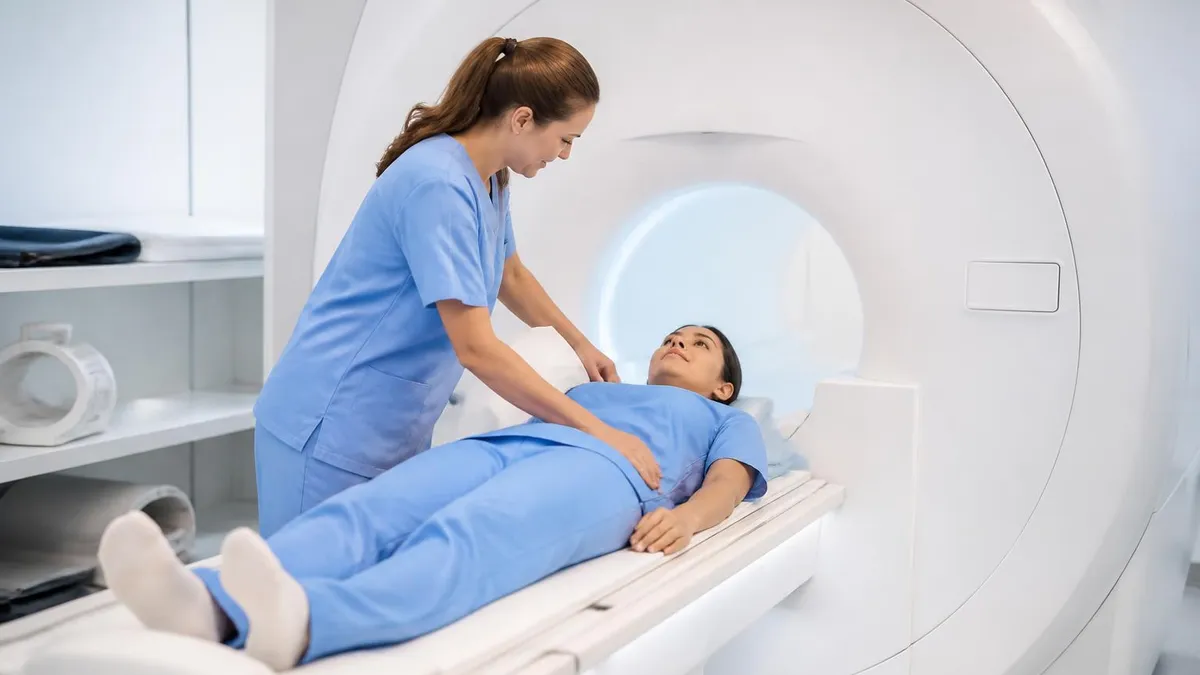
What Happens Before the Scan?
The actual scan time inside the magnet is only part of your appointment. Plan for the full sequence of events so the timing doesn't surprise you.
Check-in usually takes 5 to 10 minutes. You'll fill out an MRI safety questionnaire that asks about pacemakers, aneurysm clips, cochlear implants, metal fragments in your eyes, pregnancy, kidney function, and prior surgeries. If you've had any of those, the radiologist may want clearance documents before scanning—worth gathering this paperwork ahead of time.
Then you'll change into a hospital gown and lock up any metal items: jewelry, watches, hearing aids, glasses, hairpins, dentures with metal, and (yes, really) anything with magnetic strips like credit cards or hotel keys. The screening process itself usually takes 10 to 15 minutes, but it's not optional. MRI magnets are always on, and missed metal can cause serious injuries or destroy the image.
If your scan needs contrast, you'll get a brief IV placement. The technologist or nurse threads a small catheter into a vein in your arm or hand. It stings for a moment, then it's done. Most facilities also draw blood beforehand to check kidney function if you're over 60 or have known kidney disease—gadolinium clears through the kidneys, so this matters. Read more on what to expect with MRI with contrast before your appointment.
Quick Reality Check
The advertised "30-minute scan" is the time you spend inside the bore. The realistic appointment is closer to 60–75 minutes once you factor in check-in, safety screening, gowning, IV placement (if contrast), positioning, and the scan itself. Build in a buffer—rushing in five minutes before your slot rarely works out well.
During the Scan: What You'll Hear and Feel
Once you're on the table, the technologist positions your head in a coil—a specialized antenna that looks like a helmet or cage around your face. You'll get earplugs or MRI-safe headphones, since the scanner generates loud knocking, buzzing, and tapping sounds. A panic button goes in your hand. Anytime you need to come out, you press it.
The table slides into the bore. For a head MRI, your head goes in first, and your face ends up a few inches from the top of the tunnel. Some people find this uncomfortable. The technologist watches you through a window and stays in contact via intercom between sequences. You're never truly alone.
Each sequence runs 30 seconds to 6 minutes. Between sequences, the noise stops briefly and the technologist might ask how you're doing. The most important job: stay perfectly still, especially your head. Breathing is fine. Swallowing occasionally is fine. Big head shifts are not.
If contrast is being used, you'll feel a cool sensation in your arm when the dye goes in. Some people notice a metallic taste briefly. Allergic reactions are rare but possible—the imaging center has emergency protocols in place. After the injection, the scanner runs a few more sequences and you're done.
How Long Does It Take to Get Head MRI Results?
The scan itself is just the start. Once images are acquired, a radiologist reviews them, writes a report, and sends it to your ordering doctor. How long does that take? For routine outpatient scans, results typically land in 24 to 72 hours. Urgent or emergency scans can be read within an hour. Stat reads for inpatients usually come back in 2 to 6 hours.
For a deeper look at the reporting timeline, see how long do MRI results take. The short version: don't expect to leave the scanner with a diagnosis. Even if a tech glances at the images, they can't give you results—that's the radiologist's job, and they need uninterrupted time to read carefully.
How to Make Your Head MRI Go Faster
You can't shorten the protocol your doctor ordered. But you can avoid common time-wasters that turn a 30-minute scan into an hour-long ordeal.
Show up on time, ideally 15 minutes early. Late arrivals throw off the whole schedule and may get rescheduled. Wear clothing without metal (no underwire bras, no zippers, no metal-thread workout shirts) so you can skip the gown change. Leave jewelry at home. Empty your pockets in the car.
If you've had prior imaging, bring the disc or know which facility holds it. Your radiologist may want to compare. If you're prone to anxiety, talk to your doctor about a mild sedative beforehand—but only if you have a driver. Eat a normal meal and stay hydrated unless your facility tells you otherwise. Some scans (rare for head MRI) have fasting requirements, but most don't.
And the most underrated tip: ask the technologist to walk you through each sequence as it starts. Knowing "this next one is 4 minutes of loud knocking, please don't move" makes a huge difference compared to just hearing noises and waiting.
What to Bring & Do Before Your Head MRI
- ✓Arrive 15 minutes early to handle check-in and safety screening
- ✓Bring a photo ID, insurance card, and your physician's order
- ✓Wear metal-free clothing (no zippers, underwires, metal-thread fabric)
- ✓Leave jewelry, hairpins, hearing aids, and watches at home
- ✓Bring prior imaging discs or know the facility holding them
- ✓List all implants, surgical hardware, or metal exposures
- ✓Confirm whether contrast is part of your order so you know if you need an IV
- ✓Eat normally and stay hydrated unless told otherwise
- ✓Arrange a driver if taking oral sedation for claustrophobia
- ✓Wear comfortable clothes for the wait after the scan
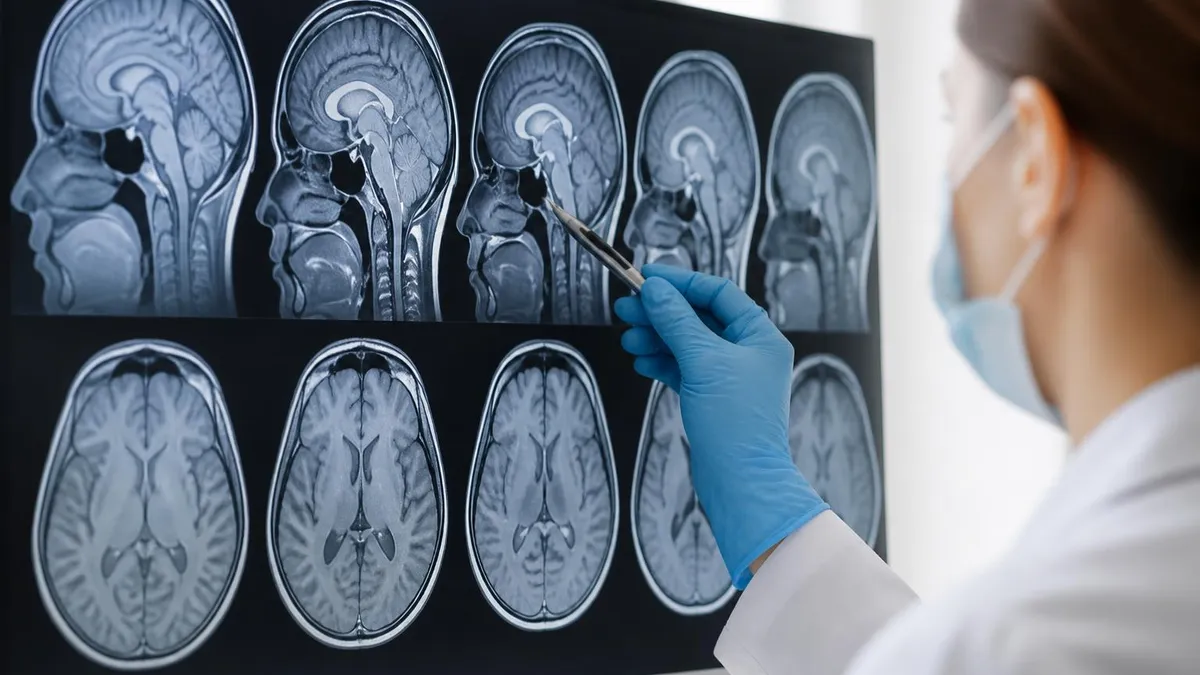
If you have a tight schedule, a child to pick up, or a medical condition that makes lying still painful, tell the scheduler when booking and the technologist when arriving. They can sometimes adjust the order of sequences, build in pauses, or recommend a different appointment time. A facility that tells you "30 minutes" without asking about your situation often means "scan time only" — ask explicitly about total appointment length.
How Head MRI Compares to Other Brain Imaging
Sometimes the question is not just MRI time — it's whether MRI is the right test in the first place. Here's how head MRI stacks up against other common brain imaging in terms of scan time and what each is best for.
Head Imaging Compared
5–10 minutes. Best for acute bleeding, skull fractures, fast triage. Uses ionizing radiation but is widely available.
20–60 minutes. Best for soft tissue detail, MS, tumor, infection, vascular issues. No radiation, more detailed than CT.
Adds 10–15 minutes to a brain MRI. Used for aneurysm screening and vascular malformations. See MRI vs MRA for details.
Scan 30–60 minutes plus a 30–60 minute tracer uptake wait. Used for cancer staging, dementia workups, epilepsy localization.
60–90 minutes. Used before brain surgery to map language and motor regions. The longest brain study most patients encounter.
Adds 10–20 minutes to a brain MRI. Measures chemical composition of brain tissue, often used in tumor workups.
Head MRI: Time vs. Detail Trade-Off
- +Highest soft-tissue detail of any brain imaging modality
- +No ionizing radiation, safe for repeat use
- +Detects MS lesions, tumors, and small strokes that CT misses
- +Excellent at imaging the posterior fossa and brainstem
- +Can image blood vessels (MRA) without IV contrast in some cases
- −Scan takes 4–6x longer than a head CT
- −Sensitive to motion — kids often need sedation
- −Loud, claustrophobic for many patients
- −Contraindicated with some implants and metal
- −Often more expensive and harder to schedule than CT
Cost and Scheduling Considerations
How long your head MRI takes also depends on where you go. Hospital-based scanners often run on tight schedules and may bump non-urgent outpatient scans for inpatient emergencies. Standalone MRI imaging centers tend to run more predictable timelines and often offer cheaper cash-pay rates—useful if you're paying out of pocket.
Cost ranges widely. A head MRI without contrast at a standalone center might run $400 to $1,200 cash-pay. With insurance, you're looking at copays and deductibles depending on your plan. The full breakdown is in our MRI scan cost guide.
Scheduling-wise, weekday daytime slots fill up fastest. If your scan is non-urgent and you're flexible, asking for an early-morning or late-afternoon slot can sometimes get you in within a few days instead of a week or more. Late evening and weekend slots are increasingly common at high-volume centers.
After the Scan: What Comes Next
Once the technologist confirms all sequences look good, you're done. The table slides out, you remove the head coil, and you can walk out within a few minutes. If you had contrast, you may be asked to wait 15 to 20 minutes to make sure you don't have a delayed allergic reaction. Drinking extra water helps flush the gadolinium through your kidneys.
You'll get a packet at discharge that may include a CD of your images and basic post-scan instructions. Don't expect a diagnosis at this point. The radiologist reads the images later and sends a report to your ordering physician. If you need the results urgently, ask the imaging center about their reporting timeline before you leave.
If your scan was for a workup of concerning symptoms, schedule a follow-up appointment with your doctor for 1 to 2 weeks out so you have time to discuss the results properly. Trying to interpret a 3-page radiology report on your own through the patient portal rarely ends well—the language is dense, hedged, and full of incidental findings that need context.
And finally: don't drive home if you took oral sedation. The half-life on benzodiazepines is longer than people realize, and impaired driving after even one dose is a real risk. Plan ahead.
Putting It All Together
So how long does a head MRI take, really? For most adults, plan on 60 to 75 minutes total at the imaging center, with 20 to 45 of those minutes spent inside the scanner. Contrast adds 10 to 20 minutes. Detailed protocols can push the scan past an hour. Quick emergency studies can finish in 10 to 20 minutes.
The factors that stretch your time the most: contrast dye, the number of sequences ordered, your ability to stay still, scanner field strength, and any anxiety that requires you to come out and reset. The factors you can actually control: showing up on time, wearing the right clothes, knowing what to expect, and breathing through the loud sequences without moving.
A head MRI is one of the most informative tools modern medicine has for figuring out what's happening inside your skull. The hour or so you'll spend at the imaging center buys you a level of detail that older imaging methods simply can't match. Now you know what to expect—go get the scan, stay still, and trust the process.
MRI Questions and Answers
About the Author

Medical Laboratory Scientist & Clinical Certification Expert
Johns Hopkins UniversityDr. Sandra Kim holds a PhD in Clinical Laboratory Science from Johns Hopkins University and is certified as a Medical Technologist (MT) and Medical Laboratory Scientist (MLS) through ASCP. With 16 years of clinical laboratory experience spanning hematology, microbiology, and molecular diagnostics, she prepares candidates for ASCP board exams, MLT, MLS, and specialist certification tests.
Join the Discussion
Connect with other students preparing for this exam. Share tips, ask questions, and get advice from people who have been there.
View discussion (8 replies)