
MEPS Depth Perception Test: What to Expect and How to Pass 2026 September
Pass the MEPS Depth Perception exam with confidence. Practice questions with detailed explanations and instant feedback on every answer.
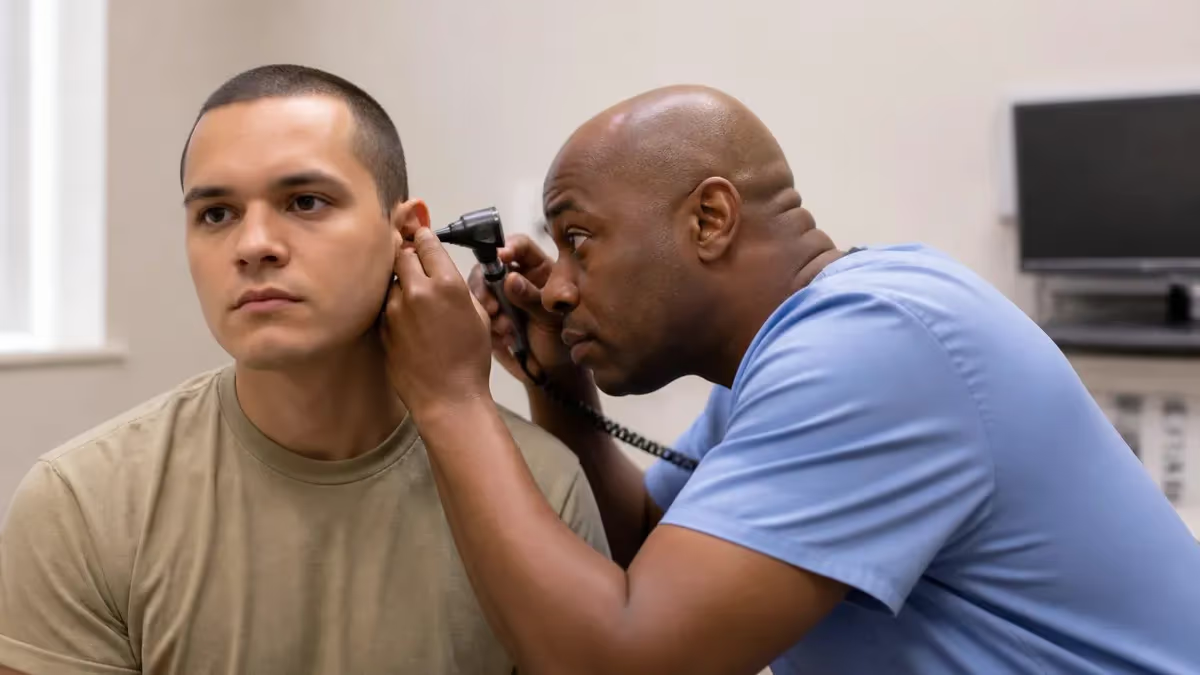
The MEPS depth perception test is one of several vision checks you'll face during your medical exam at the Military Entrance Processing Station. It doesn't get as much attention as the ASVAB or the hearing test — but it can catch recruits off guard if they don't know what's coming. Here's exactly what happens, what the military actually requires, and what you can do if your results aren't what you hoped for.
Key Takeaway: MEPS certification demonstrates expertise in this field. Most candidates spend 4-8 weeks preparing with practice tests before taking the exam.
What Is the MEPS Depth Perception Test?
Depth perception — your ability to judge distances in three dimensions — matters a lot in military roles. Pilots need precise spatial awareness. Infantrymen rely on it for accurate fire. Even mechanics and medics benefit from strong 3D vision. That's why MEPS military processing includes a dedicated stereoptic vision screening.
The test itself is quick — usually under five minutes. A technician hands you a small viewer (it looks like a pair of binoculars attached to a box) and asks you to look at a series of images. Each image contains objects at slightly different apparent depths, created by polarized lenses. You say which circle, fly wing, or animal appears to "pop out" or sit closest to you.
There's no right or wrong way to approach it in terms of strategy — you either see the depth or you don't. But being rested, not straining your eyes beforehand, and knowing what the test looks like can all make a difference.
How Is It Scored?
Depth perception is measured in arc seconds — a unit that describes the angular difference between what each eye sees. Lower numbers mean better stereo acuity:
- 40 arc seconds — Near-perfect stereopsis, seen in maybe 30% of people
- 80 arc seconds — The standard military cutoff for most branches
- 100–140 arc seconds — Below average; may disqualify for certain MOSs
- 200+ arc seconds — Poor stereopsis; disqualifying for aviation and many combat roles
On the Titmus Stereotest — the version most MEPS stations use — you go through a series of three-circle "rings" patterns numbered 1 through 9. Each circle set is worth a certain arc-second value. The last one you can correctly identify determines your score. Getting through all nine means 40 arc seconds; stopping at row five puts you around 100.
What the Military Branches Require
Requirements differ by branch and by the specific job you're applying for. Here's a general breakdown based on current military standards:
| Section | Questions | Time |
|---|---|---|
| Army | 80 arc seconds (most MOS); aviation requires 40 | — |
| Navy | 80 arc seconds standard; aviation/SEAL: 40 | — |
| Air Force | 40 arc seconds for pilot/navigator; 80 for others | — |
| Marine Corps | 80 arc seconds for most; combat arms may require 40 | — |
| Coast Guard | 40 arc seconds for aviation; 80 general | — |
Keep in mind: these are general standards. Your specific job code may have tighter requirements. If you're targeting aviation, special operations, or certain technical MOSs, confirm the exact vision standards with your recruiter before your MEPS processing day.
What Happens If You Fail?
Failing the depth perception test doesn't automatically disqualify you from military service. It might, however, close the door on specific jobs. Here's what usually happens:
You're still in-service eligible if your other vision is solid. Most branches have overall vision standards (corrected acuity, color vision, etc.) that are separate from stereopsis. Poor depth perception alone rarely means a full DQ.
Certain MOSs will be marked unavailable. Aviation jobs, sniper qualifications, special reconnaissance roles, and several technical positions have strict stereoptic requirements. Your recruiter will work with you to identify jobs that remain open.
Waivers are possible — but rare for this test. Because the test measures a physical attribute of your vision system, waivers aren't common. However, if you believe the initial reading was inaccurate (eye fatigue, equipment calibration issues), you can ask for a retest. The MEPS medical exam is thorough, but human and equipment error does occasionally occur.
Why Your Eyes Might Underperform at MEPS
A lot of recruits score worse on vision tests at MEPS than they do in their optometrist's office. There are real, correctable reasons for this:
- Sleep deprivation. You're spending the night before at the MEPS hotel, and nerves make sleep tough. Tired eyes lose fine spatial discrimination ability. Getting even six to seven solid hours makes a measurable difference.
- Screen overload. Staring at a phone or laptop for hours the night before strains your accommodative system — the mechanism your eyes use to shift focus. Give your eyes a break after dinner.
- Contact lenses worn too long. If you wear contacts, take them out the evening before. Slight corneal distortion from extended-wear contacts can affect stereo acuity temporarily.
- Anxiety and tension. Muscle tension around your eyes from anxiety can interfere with the fine convergence movements needed for stereopsis. Deep breathing before stepping into the vision station isn't overkill.
- Rushing through the test. You're allowed to take a moment with each image. Don't rush. If you're not sure, say so — the technician may give you another look.
Can You Practice Depth Perception?
Stereo vision is a product of how your brain processes input from two eyes simultaneously — it's not something you "practice" the way you study for the ASVAB. That said, there are meaningful steps you can take:
Get your eyes examined first. If you've never had a stereoptic test done at an optometrist, get one. Knowing your baseline score means no surprises at MEPS. Your eye doctor can run the Randot or Titmus test in-office.
Address any underlying vision issues. Amblyopia (lazy eye), strabismus, or significant anisometropia (different prescription in each eye) directly impairs stereopsis. If you have any of these conditions, vision therapy may improve your depth perception over months of treatment — but this isn't a two-week fix.
Try stereo vision exercises. Apps and printable stereo cards (Magic Eye-style images, red-green anaglyphs) can stimulate your stereo vision system. They won't transform poor stereopsis into perfect depth perception, but they can help your brain "warm up" its binocular fusion if you're borderline.
Don't strain the night before. This is the single most actionable step. Avoid screens for the two hours before bed. The difference in performance between a rested set of eyes and a fatigued one can be one to two arc-second tiers on the Titmus scale.
What Else Happens During MEPS Vision Testing?
Depth perception is just one component of the vision battery. The full Army MEPS (and all other branch) vision screening covers:
- Distance visual acuity — The classic eye chart, measured with and without correction
- Near visual acuity — Reading ability at arm's length
- Color vision — Usually the Pseudoisochromatic Plates (PIP) or FALANT test
- Depth perception — Titmus or Randot stereotest
- Field of vision — For aviation applicants or if there's a known concern
You'll cycle through these stations as part of the full physical, which typically takes four to eight hours total. Vision testing usually happens in the morning, alongside the hearing test and initial measurements. See our full guide on how long meps take if you want a complete timeline.
Depth Perception Standards by Job Category
Rather than memorizing every service's AR 40-501 standards, the easiest approach is to think in tiers:
Tier 1 — Strictest (40 arc seconds required): Fixed-wing pilot, helicopter pilot, flight navigator, air traffic control, special operations aviation. These roles demand near-perfect stereo vision because spatial judgment errors at altitude or during airdrop operations can be fatal.
Tier 2 — Standard (80 arc seconds): The vast majority of combat arms, infantry, armor, artillery, naval surface warfare, and most Air Force AFSCs fall here. If you score 80, you're cleared for most of what the military offers.
Tier 3 — Relaxed (100–200 arc seconds allowed): Certain administrative, logistics, and support roles have looser depth perception requirements. Poor stereopsis is less likely to affect job performance in these fields.
Your recruiter should have a copy of the vision standards for your desired MOS or rating. Don't rely on secondhand information from forums — ask directly, and get it confirmed in writing.
Tips for Depth Perception Test Day
You've done everything you can to prepare. Here are the practical steps to maximize your score on the day itself:
- Sleep 7–8 hours the night before. Non-negotiable. Set two alarms.
- Eat breakfast. Blood sugar dips affect cognitive performance, including visual processing.
- Skip the contacts if possible. Wear glasses. If you must wear contacts, wear them for no more than six hours before the test and opt for daily lenses if you have them.
- No screens in the last two hours before vision testing. Read a book, chat with other recruits, stare at a wall — anything to give your eyes a rest.
- Tell the tech if the equipment seems off. If one lens appears blurry or the viewer is uncomfortable, say something before the test starts.
- Don't rush your answers. Take two to three seconds per image. The test isn't timed.
- Ask for a second attempt if you're unsure. Technicians will usually allow one more try if you feel you weren't ready.
- ✓Review the official MEPS exam content outline
- ✓Take a diagnostic practice test to identify weak areas
- ✓Create a study schedule (4-8 weeks recommended)
- ✓Focus on your weakest domains first
- ✓Complete at least 3 full-length practice exams
- ✓Review all incorrect answers with detailed explanations
- ✓Take a final practice test 1 week before exam day
What to Expect After the Vision Station
Once you're done with vision testing, you'll move on to the rest of the physical — height and weight, hearing, blood draw, urinalysis, orthopedic screening, and the final physician review. Vision results are entered into your record and reviewed by the examining physician at the end. If anything is flagged, the doctor will discuss it with you and explain whether a waiver is needed or whether certain jobs need to be removed from your preference list.
Don't panic if a tech mentions your depth perception score. It's one data point among many. The doctor makes the final call on qualification, not the tech running the equipment.
For a full breakdown of what to expect across every station, see our what happens at MEPS guide.
MEPS: Pros and Cons
- +MEPS exam preparation strengthens your knowledge across all domains
- +Passing the exam proves competency to employers and clients
- +Study materials and practice tests are widely available
- +Exam-based credentials are portable across states and employers
- +Clear exam objectives help focus your study plan effectively
- −Exam anxiety can affect performance — practice tests help reduce it
- −Registration fees are non-refundable if you miss your test date
- −Limited retake opportunities may apply with waiting periods
- −Exam content updates periodically — use current study materials
- −Testing center availability may require advance scheduling
About the Author

Retired Military Officer & Armed Forces Test Preparation Specialist
United States Army War CollegeColonel Steven Harris (Ret.) served 28 years in the US Army, earning a Master of Arts in Military Science from the Army War College and a Bachelor of Science in Criminal Justice. He has coached thousands of military enlistment and officer candidate program applicants through the ASVAB, AFQT, AFCT, OAR, and officer selection assessment processes across all military branches.
Join the Discussion
Connect with other students preparing for this exam. Share tips, ask questions, and get advice from people who have been there.
View discussion (8 replies)