
LTO Exam Dumps Review: What Is LTO, What Does LTO Stand For, and How Practice Tests Really Work
What is LTO & do exam dumps work? 🎯 Honest review of LTO exam prep methods, practice tests, and tips to pass your driver's license exam in 2026 October.

If you have been searching for an exam dumps review to prepare for your LTO exam, you are not alone. Thousands of aspiring drivers across the Philippines look up what is LTO, what does LTO stand for, and whether using exam dumps is a smart or risky strategy before their official Land Transportation Office driver's license test. The truth is nuanced: some practice materials are genuinely helpful, while others can actually hurt your chances by feeding you outdated or incorrect answers that no longer reflect the real exam format.
LTO stands for the Land Transportation Office, the Philippine government agency responsible for registering motor vehicles, issuing driver's licenses, and enforcing road safety regulations nationwide. When people ask what does LTO mean in a driving context, they are referring to this specific regulatory body — not to be confused with LTO in other industries, such as the food and beverage world where LTO means Limited Time Offer. Understanding what the LTO actually does helps you frame your exam prep correctly: the test is designed to verify road safety knowledge, not just memorization of trivia.
The LTO written exam covers traffic laws, road signs, pavement markings, driver responsibilities, and vehicle regulations. Because the exam is standardized and administered at official LTO offices, many test-takers naturally seek shortcuts. Exam dumps — collections of questions and answers from previous test sessions — circulate widely on social media, YouTube, and various Filipino Facebook groups. Whether these dumps are accurate, current, or legally obtained is a serious question that any responsible test-taker must consider before relying on them heavily.
This guide provides an honest, in-depth exam dumps review so you can make an informed decision about how to spend your study time. We will walk you through what exam dumps are, how they compare to structured practice tests, what the actual LTO exam looks like in 2026, and how to build a study strategy that gives you the best possible chance of passing on your first attempt.
Along the way, we will clarify common questions like what is an LTO, what does LTO stand for in the food industry versus the transportation context, and how to use legitimate free resources instead of risky pirated content.
One important distinction worth making early is the difference between exam dumps and legitimate practice tests. Exam dumps are typically copied or leaked questions, often without proper context or verified correct answers. Legitimate practice tests, by contrast, are built by educators and subject-matter experts to mirror the format, difficulty, and content scope of the real exam without reproducing actual test questions. Sites like PracticeTestGeeks offer free, regularly updated practice questions aligned with the official LTO exam syllabus — a far safer and more effective path than downloading anonymous PDFs of questionable origin.
Many drivers also wonder is princeton review harder than real ap exam — a comparison that applies equally to LTO prep: structured third-party practice tests often feel slightly harder than the real thing, which is actually beneficial because it means you are over-prepared rather than under-prepared when you walk into the testing center. The goal of any good review material is to push you slightly beyond the minimum, so the actual exam feels manageable and familiar rather than surprising or stressful.
Throughout this article, we use real data, official LTO guidelines, and first-hand insights from drivers who have sat the exam recently to give you the most accurate picture possible. By the end, you will know exactly how to evaluate any exam dumps review you find online, which free resources are worth your time, and how to structure your final days of preparation so you walk into the LTO office confident, calm, and ready to pass.
LTO Exam by the Numbers
Key Facts at a Glance
| Item | Value | Details |
|---|---|---|
| Exam Questions | 60 | Multiple choice format |
| Time Limit | 30 min | Average test duration |
| Passing Score | 70% | 42 out of 60 correct |

LTO Written Exam Format 2026
| Section | Questions | Time | Weight | Notes |
|---|---|---|---|---|
| Road Signs and Pavement Markings | 15 | ~7 min | 25% | Regulatory, warning, and informational signs |
| Traffic Rules and Regulations | 15 | ~7 min | 25% | RA 4136 Land Transportation and Traffic Code |
| Driver's Duties and Responsibilities | 10 | ~5 min | 17% | Defensive driving and road etiquette |
| Road Safety and Defensive Driving | 10 | ~5 min | 17% | Accident prevention and hazard recognition |
| Traffic Violations and Penalties | 10 | ~6 min | 16% | Fines, penalties, and license sanctions |
| Total | 60 | 30 minutes | 100% |
The central question in any exam dumps review is simple: are these materials actually reliable? The honest answer is that exam dumps vary enormously in quality, and the majority of freely circulating LTO dumps online fall into the unreliable category. Here is why: the LTO periodically refreshes its question bank, removing outdated items and adding new questions that reflect changes in traffic law, updated road safety research, and revised administrative regulations. A dump compiled two or three years ago may contain questions that no longer appear on the exam, while missing entirely the newer topics that examiners are now emphasizing.
Beyond the accuracy problem, there is an integrity problem. Many exam dump PDFs circulating on Telegram channels and Facebook groups were compiled by individuals who wrote down questions from memory immediately after exiting the testing center. This process, called brain-dumping, is both ethically questionable and practically unreliable. Human memory under test conditions is imperfect, which means the question wording, the answer choices, and even the correct answers may be subtly or significantly wrong. Acting on one of these misremembered answers during your actual exam could cost you precious correct responses you would otherwise have gotten right.
A more useful framework is to think of legitimate practice tests as structured exam dumps review tools that have been verified and curated. When educators build practice questions based on the official LTO exam syllabus, they draw from the same public knowledge base that the LTO uses — the Republic Act 4136, the Implementing Rules and Regulations, and the official LTO Examiner's Manual. This means the coverage is accurate even if the specific wording differs from the real exam. You are building genuine knowledge rather than pattern-matching to leaked answers that may or may not appear on your test day.
It is also worth understanding what does LTO stand for in terms of its regulatory mission. The Land Transportation Office exists to reduce road accidents, fatalities, and traffic violations through licensing and enforcement. The written exam is therefore not merely a bureaucratic hurdle — it is a genuine safety check designed to confirm that every licensed driver understands the rules that protect everyone on the road. When test-takers bypass this knowledge-building step by memorizing dumps without understanding the content, they may pass the exam but fail catastrophically on the road. The LTO's mission and the exam's purpose are deeply aligned.
There is another practical risk to relying on dumps: the LTO computerized exam system now randomizes question order and answer choice order for every test session. Even if a dump contained perfectly accurate questions, a test-taker who memorized answers by position (option A, option B) rather than by content would be immediately thrown off when the same question appears with reshuffled answer choices. This is one of the strongest arguments for studying the material itself rather than pattern-matching answer sequences from screenshots or PDFs found online.
For those wondering how to review nbme exams — a question that parallels how medical students approach high-stakes licensing exams — the lesson is identical: the best review method combines content mastery with timed practice under realistic conditions. Medical licensing candidates who rely solely on question banks without understanding the underlying pathophysiology consistently underperform compared to those who integrate concept review with question practice. The LTO exam is no different in this regard.
Finally, it is important to acknowledge that some exam dumps review content online is simply a scam. Paid dumps sold through messaging apps or sketchy websites often promise guaranteed pass rates and claim to contain the "exact" questions from the current LTO exam. These products are not only unreliable — the LTO actively changes its question bank to prevent these exact schemes — but they also pose a financial risk. Save your money for legitimate review resources and invest your time in verified practice tests that actually improve your driving knowledge, not just your test-taking luck.
LTO Exam Dumps vs. Practice Tests vs. Official Review Materials
Exam dumps are unofficial collections of questions and answers reportedly copied from real LTO exam sessions. They circulate freely on social media, Telegram groups, and file-sharing platforms. While they may seem like an appealing shortcut, dumps carry significant risks: questions are often misremembered, answers may be wrong, and the LTO regularly updates its question bank, meaning older dumps can contain items that no longer appear on the current exam. Using dumps as your primary study tool is a gamble that frequently backfires on test day.
The most dangerous aspect of relying on exam dumps is the false confidence they create. A test-taker who scores 95% on a dump PDF may believe they are fully prepared, only to encounter rephrased or entirely new questions on the actual computerized exam. Because the LTO randomizes answer order, dump memorizers who relied on positional cues rather than content understanding often freeze when familiar questions appear in unfamiliar formats. Dumps work best as supplementary exposure material, never as a standalone review strategy.

Exam Dumps Review: Pros and Cons of Using Dumps to Prepare
- +Free and widely available on social media and Telegram groups
- +Provide quick exposure to the general style and format of LTO exam questions
- +Help anxious test-takers feel more familiar with multiple-choice question phrasing
- +Can highlight topic areas where you have obvious knowledge gaps
- +Useful as a final-day supplement to quickly review commonly tested concepts
- +Some dumps from recent test-takers accurately reflect current question themes
- −Questions are often misremembered or paraphrased inaccurately by the original source
- −Answer choices may be wrong, misleading, or missing the nuance of the real exam
- −LTO updates its question bank regularly, making older dumps quickly obsolete
- −The LTO computerized exam randomizes answer order, defeating positional memorization
- −Creates false confidence that can leave test-takers unprepared for unfamiliar questions
- −Many paid dump products are outright scams with no refund if you fail the exam
LTO Exam Prep Checklist: Everything to Do Before Test Day
- ✓Complete at least 3 full timed practice tests covering all five LTO exam subject areas.
- ✓Review every incorrect answer with an explanation — understand why, not just what.
- ✓Study all standard Philippine road signs including regulatory, warning, and informational categories.
- ✓Read the key provisions of Republic Act 4136 (Land Transportation and Traffic Code).
- ✓Memorize standard speed limits for urban, highway, and school zone driving conditions.
- ✓Practice identifying common traffic violations and their corresponding fines and penalties.
- ✓Review LTO license restriction codes and what each code permits or prohibits the driver to operate.
- ✓Complete at least one timed mock exam of exactly 60 questions within a 30-minute window.
- ✓Confirm your LTO appointment date, bring all required documents, and arrive 30 minutes early.
- ✓Avoid cramming the night before — instead do a light 20-question review and sleep well.

The 70% Passing Threshold Is Your Floor, Not Your Ceiling
Many test-takers aim just to pass the LTO exam with the minimum 42 out of 60 correct answers. A smarter goal is to target 85–90% in your practice tests so that nerves, unfamiliar question phrasing, or a few tricky items on test day still leave you comfortably above the passing line. Over-preparation is the best insurance against exam anxiety and unexpected question variations.
Building a genuinely effective LTO exam study strategy requires understanding how adults learn best under time pressure. Research in cognitive science consistently shows that spaced repetition — reviewing material at increasing intervals over several days — produces far better retention than massed cramming the night before a test. If you have two weeks before your LTO exam, spreading your study sessions across that time and revisiting your weakest areas multiple times will outperform six hours of last-minute review by a substantial margin.
Start your preparation by taking one full diagnostic practice test with no prior review. This baseline session will reveal exactly which of the five LTO exam subject areas you are already comfortable with and which ones need the most attention.
Many drivers discover, for example, that they are confident about road signs from years of driving experience but weak on the specific fines and penalty amounts for traffic violations — a topic that requires deliberate study because the numbers are not intuitively obvious. Knowing your weak spots early lets you allocate your limited study time where it will produce the greatest score improvement.
After your diagnostic, build a simple daily study schedule. On days one through four, focus exclusively on your two weakest subject areas, doing targeted practice sets of 15–20 questions per session and reviewing every incorrect answer thoroughly. On days five and six, shift to mixed practice sets that blend all five subject areas together, simulating the randomized nature of the actual LTO exam. On day seven, take a full 60-question timed mock exam and score yourself honestly. Repeat this weekly cycle as many times as your schedule allows before your test appointment.
One highly effective technique is to create a personal error log. Every time you answer a practice question incorrectly, write down the question topic, the wrong answer you chose, the correct answer, and the reason why the correct answer is right. Reviewing this error log daily — even for just five minutes — dramatically accelerates your improvement because it forces your brain to actively process mistakes rather than passively moving on to the next question. Error logs are particularly powerful for road sign identification questions, where visual details like shape, color, and symbol meaning are easily confused without deliberate reinforcement.
Understanding the context behind LTO rules also helps enormously with retention and reasoning. For example, knowing that the Philippines drives on the right side of the road and that right-of-way rules are designed to minimize intersection conflicts gives you a framework for answering scenario questions you have never seen before. When you understand why a rule exists, you can reason through novel situations rather than simply pattern-matching to memorized answers. This conceptual approach is especially valuable on the traffic violations section, where questions often present edge-case scenarios rather than straightforward definitional items.
Many successful LTO exam takers also benefit from finding a study partner. Explaining a concept aloud to another person — why a double yellow line prohibits overtaking, or what the difference is between a mandatory and prohibitory sign — forces you to articulate your understanding rather than relying on vague recognition. The act of teaching reveals gaps in your knowledge that silent reading often conceals. Even if your study partner is also preparing for the LTO exam, you can take turns quizzing each other on the five subject areas and discussing the reasoning behind correct answers together.
Pay particular attention to haven life no medical exam life insurance reviews — a reminder that just as insurance applicants must understand policy terms before signing, LTO exam takers must understand traffic laws before operating a vehicle. Both contexts reward informed, diligent preparation over guesswork. The parallel holds: studying the actual content of the law, rather than relying on secondhand summaries or dumps, produces the most durable knowledge and the most confident performance under pressure.
In the final 48 hours before your exam, shift from learning new material to consolidating what you already know. A light review of road sign flashcards, a quick pass through your error log, and one short practice set of 20 questions is sufficient. Attempting to absorb large volumes of new content in the last two days tends to increase anxiety and interfere with the well-organized knowledge you have already built. Trust your preparation, stay calm, and approach the exam as a demonstration of knowledge you genuinely possess rather than a high-stakes gamble.
Multiple social media accounts and messaging app channels sell LTO exam dumps for fees ranging from ₱200 to ₱1,500, claiming to offer the exact questions from the current LTO computerized exam. These products are not only unreliable — the LTO actively refreshes its question bank precisely to defeat such schemes — but purchasing them may also expose you to legal risk under RA 8293 (Intellectual Property Code) and LTO's own anti-cheating provisions. Stick to free, legitimate practice tests and official review materials instead.
When you walk into the LTO testing center on exam day, a few practical realities will immediately shape your experience. The exam is administered on a computer terminal, not on paper, so familiarizing yourself with a digital multiple-choice interface before your appointment is genuinely useful. Most modern online practice test platforms, including PracticeTestGeeks, present questions in a similar computerized format, which means your practice sessions also serve as interface rehearsal. This reduces the cognitive load on test day, letting you focus entirely on the content rather than figuring out how to navigate the system.
The 30-minute time limit sounds tight but is actually quite manageable for well-prepared candidates. Sixty questions in 30 minutes works out to 30 seconds per question — more than enough time if you are not second-guessing every answer. The most common time management mistake is spending too long on one or two difficult questions while rushing through others you know well.
A better strategy is to move through the exam at a steady pace, flagging any question you are unsure about and returning to it after completing the rest. This ensures you capture all the easy points before spending time on the harder items.
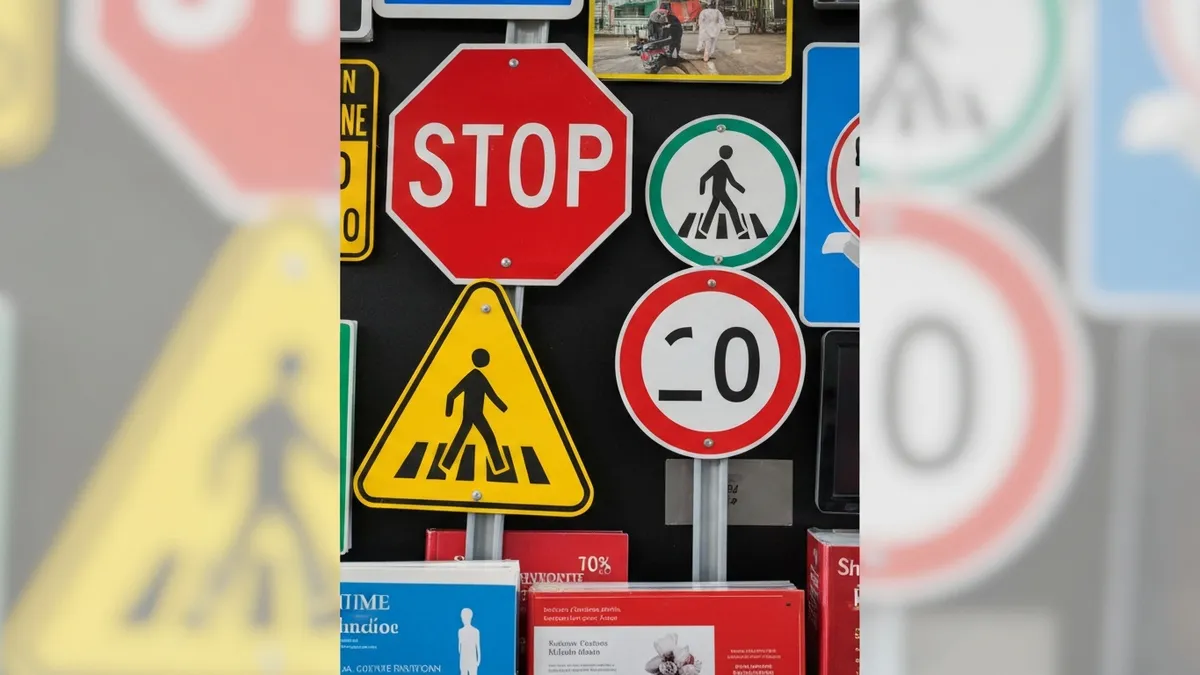
Road sign questions deserve special mention because they combine visual recognition with regulatory knowledge. On the computerized exam, road sign images appear clearly rendered, but many test-takers freeze when a sign looks slightly different from what they memorized. The key is to understand the systematic logic of Philippine road signs: shape encodes category (octagons are stop signs, triangles are warning signs, circles are prohibitory signs), and color encodes meaning (red borders indicate prohibition, yellow indicates warning). Once you internalize these systems, you can reason through unfamiliar signs rather than relying purely on visual recognition memory.
Traffic violation questions are among the most straightforward on the exam — if you have studied them. The LTO prescribes specific fines for specific offenses under RA 4136 and related administrative orders, and the exam frequently tests whether you know the correct penalty tier for common violations like illegal parking, overspeeding, and driving without a license. Make a simple reference table of the most common violations and their corresponding fines, and review this table daily in the week before your exam. The numbers are specific enough that you cannot reliably guess them, so deliberate memorization is necessary.
One aspect of the LTO exam that catches many test-takers off guard is the driver duties and responsibilities section. This section tests not just legal knowledge but also situational judgment — what should you do when you encounter a school bus unloading children, how should you respond to an approaching emergency vehicle, or what is your legal obligation if you witness a road accident? These scenario-based questions require you to apply principles rather than recall facts, which is why content understanding always outperforms dump memorization in this section specifically.
If you are renewing your license rather than applying for a new one, the exam format is identical but you may find the content feels more intuitive because of your existing driving experience. Use that experience as a foundation, but do not let it breed complacency — experienced drivers sometimes fail the renewal exam because they rely on habits and assumptions rather than reviewing the actual legal standards.
Take at least one full practice test even if you have been driving for years, and pay special attention to any regulation changes since you last sat the exam. The LTO periodically updates penalty amounts and adds provisions for new vehicle categories and road infrastructure.
Finally, remember that passing the LTO exam is not the end goal — it is the beginning. The knowledge you build preparing for your written test becomes the foundation of safe, law-abiding driving behavior for years to come. Whether you are a first-time applicant or a returning licensee, investing genuinely in your exam preparation pays dividends not just on test day but every time you get behind the wheel. Read more about what does exam review not performed mean to understand how procedural details at the LTO office can affect your licensing process beyond just the written exam score.
In the days immediately before your LTO exam appointment, practical logistics matter as much as content review. Confirm your appointment through the official LTO Online Appointment System and double-check the specific LTO office location, because some Metro Manila offices are located in different buildings than the main registration office. Bring your original documents — your Student Permit or existing license, your medical certificate from an accredited clinic, and any other requirements specific to your transaction type. Arriving with incomplete documents means a wasted trip regardless of how well you prepared for the written exam.
On the morning of your exam, eat a proper breakfast and stay hydrated. This sounds like generic advice but it genuinely affects cognitive performance. Studies on test-taking performance consistently show that candidates who skipped meals or were dehydrated performed measurably worse on attention and working memory tasks than well-nourished candidates — even when their prior knowledge was equivalent. The LTO exam is not cognitively demanding enough to exhaust you, but physical discomfort during a computerized test creates distracting noise that chips away at performance at the margins.
During the exam itself, read every question completely before looking at the answer choices. This sounds obvious but many test-takers skip to the answers as soon as they recognize a topic, missing qualifying words like always, never, except, and only that completely change which answer is correct. The LTO exam frequently uses these qualifier words to test whether you are reading carefully or just pattern-matching to keywords. Slowing down to read each question fully takes only a second or two and can save you from multiple careless errors.
When you encounter a question you genuinely do not know, use process of elimination methodically. In a four-choice LTO exam question, you can usually eliminate at least one answer immediately as obviously wrong, and often a second answer as improbable. Narrowing to two choices gives you a 50% chance of guessing correctly rather than the baseline 25%. Combined with any partial knowledge you have about the topic, strategic elimination frequently produces the right answer even from an initially uncertain position.
After you complete your written exam, the LTO terminal will display your score immediately. If you pass, proceed to the next step in your licensing transaction — typically a practical driving test for new applicants or a photo and biometrics capture for renewals. If you do not pass, you will need to retake the written exam at a new appointment. Use any failed attempt as a detailed diagnostic: most LTO terminals show your performance by subject area, so you can identify exactly which topics cost you the most points and target them aggressively before your retake.
Consistent practice with legitimate materials is the single most reliable predictor of LTO exam success. Test-takers who complete five or more full practice test sessions before their appointment pass at substantially higher rates than those who studied only from dumps or did no structured review at all. The PracticeTestGeeks free practice tests cover all five LTO exam subject areas with detailed answer explanations, making them one of the most comprehensive free study resources available to Filipino driver applicants in 2026. Use them as the backbone of your preparation rather than a last-minute supplement.
Remember that the LTO written exam ultimately exists to protect you and everyone else on Philippine roads. The questions about speed limits, road signs, right-of-way, and traffic violations are not arbitrary bureaucratic hurdles — they encode the rules that, when followed, prevent accidents, injuries, and fatalities. Approaching your exam review with genuine curiosity about road safety rather than resentment about a required test produces better study outcomes and, more importantly, makes you a safer driver for life. The best exam dumps review is ultimately one that leaves you not just test-ready, but road-ready.
Sample LTO - Exam Reviewer Practice Questions
Try these questions from our free LTO - Exam Reviewer practice tests. The correct answer and an explanation follow each question.
Under RA 10586, what happens to a driver who refuses to submit to a breathalyzer or drug test when lawfully requested by an officer?
- A. The driver is immediately arrested for assault
- B. Refusal is treated as a positive test result and carries the same penalties
- C. The driver is released with a written warning
- D. The officer must obtain a court order first before any penalty applies
Answer: B. Refusal is treated as a positive test result and carries the same penalties
RA 10586 expressly provides that refusal to undergo testing is deemed a positive result, triggering the full penalties for drunk or drugged driving.
An orange sign with black letters reading 'ROAD WORK AHEAD' is classified as a:
- A. Temporary traffic control sign
- B. Permanent regulatory sign
- C. Guide sign
- D. Warning sign for permanent hazard
Answer: A. Temporary traffic control sign
Orange temporary traffic control signs are used in construction and work zones to alert drivers of changing road conditions.
A driver who refuses to submit to a breathalyzer test under RA 10586 faces what consequence?
- A. The refusal is accepted and the driver is released
- B. The refusal is treated as prima facie evidence of DUI and carries the same penalties
- C. Only a fine of PHP 100
- D. The officer must obtain a court order first
Answer: B. The refusal is treated as prima facie evidence of DUI and carries the same penalties
Refusing a breathalyzer or drug test is treated as prima facie evidence of driving under the influence, carrying the same penalties as a positive test.
What does the abbreviation JRSO stand for?
- A. Junior Rage Security Officer.
- B. Junior Road Safety Officer.
- C. Junior Resolution Safety Operator.
- D. None of these
Answer: B. Junior Road Safety Officer.
The abbreviation JRSO stands for Junior Road Safety Officer. This role is typically found in schools, where students are trained to promote road safety awareness among their peers. JRSOs help educate other children about safe practices like using pedestrian crossings and understanding road signs, contributing to a safer environment for young pedestrians and cyclists.
LTO Questions and Answers

LTO License Renewal Guide Philippines 2026 — Requirements and Process
LTO Traffic Violations Philippines 2026 — Fines and Penalties Guide

LTO Plate Number Tracker: What Is LTO, What Does LTO Stand For, and How to Track Your Vehicle Registration in 2026

LTO Dress Code and What Is LTO: Complete Guide to the Philippines Land Transportation Office

LTO License Restriction Codes Philippines — Complete Guide 2026
About the Author

Educational Psychologist & Academic Test Preparation Expert
Columbia University Teachers CollegeDr. Lisa Patel holds a Doctorate in Education from Columbia University Teachers College and has spent 17 years researching standardized test design and academic assessment. She has developed preparation programs for SAT, ACT, GRE, LSAT, UCAT, and numerous professional licensing exams, helping students of all backgrounds achieve their target scores.
Join the Discussion
Connect with other students preparing for this exam. Share tips, ask questions, and get advice from people who have been there.
View discussion (8 replies)