
LTO License Restriction Codes Philippines — Complete Guide 2026 September
❓ Free LTO License Restriction Codes practice test with instant feedback and detailed answer explanations. Prepare for your exam.
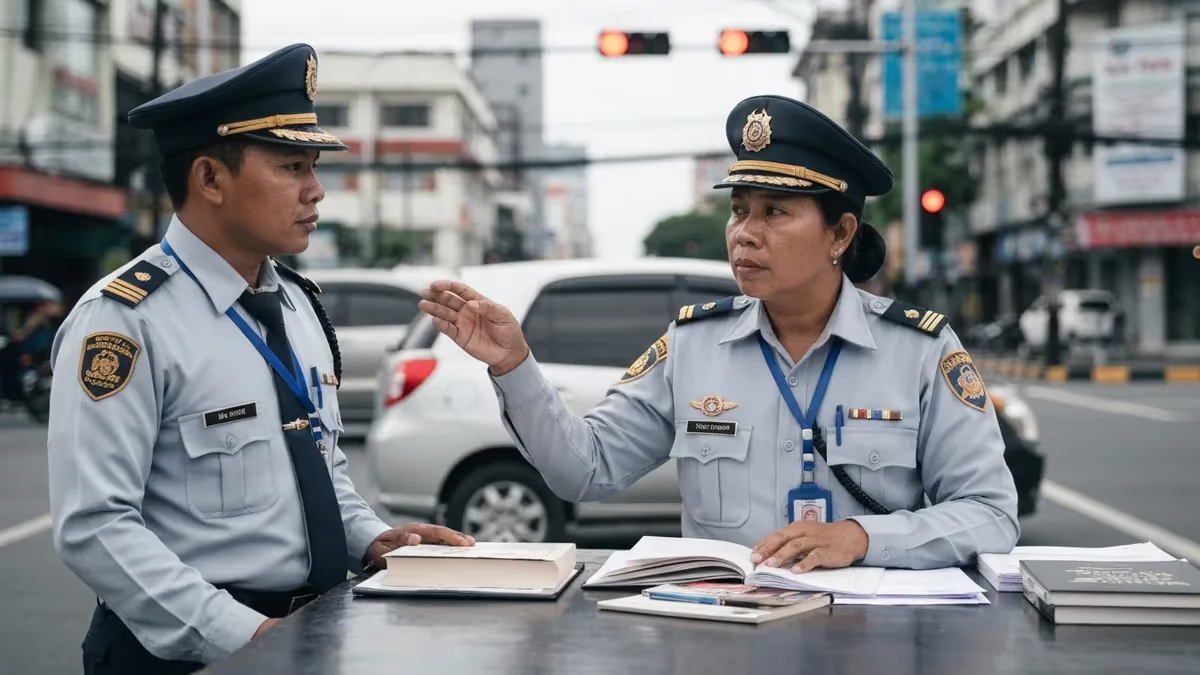
What Are LTO Restriction Codes?
LTO restriction codes are numeric codes printed on your Philippine driver's license that specify which types of vehicles you are legally permitted to operate. Every driver's license issued by the Land Transportation Office (LTO) carries one or more restriction codes that match the vehicle categories you qualified for during your licensing examination.
These codes appear in the "Restriction" field on your LTO driver's license card. If your license shows "1, 2" for example, you are authorized to drive motorcycles and light vehicles (cars, jeepneys, FX taxis) with a gross vehicle weight of up to 4,500 kg. Driving a vehicle outside your restriction code is a traffic violation and can result in fines, license suspension, or confiscation.
Restriction codes are part of the LTO's licensing system under Republic Act No. 4136 (Land Transportation and Traffic Code) and its implementing rules. The LTO periodically updates the restriction code system, so it's important to know the current codes and what they cover. For a broader overview, see the LTO Complete Guide and the Non-Professional License Guide.
Complete LTO Restriction Code Table
| Code | Vehicle Type | License Required |
|---|---|---|
| 1 | Motorcycles and motorbikes | Non-Professional or Professional |
| 2 | Cars, jeepneys, UV Express, light vehicles up to 4,500 kg GVW | Non-Professional or Professional |
| 3 | Trucks, buses, heavy vehicles over 4,500 kg GVW | Professional |
| 4 | Heavy equipment (bulldozers, cranes, forklifts) | Professional |
| 5 | Articulated vehicles (trailer trucks, semi-trucks) | Professional |
| 6 | Special vehicles (fire trucks, emergency vehicles) | Professional |
| 7 | Motorcycles with sidecar only | Non-Professional or Professional |
| 8 | Automatic transmission vehicles only | Non-Professional or Professional |
How Restriction Codes Are Assigned
Your restriction codes are determined during the LTO licensing process based on the vehicle type you applied for and the practical driving test you take. Here is how the process works:
- Application: When you apply for a student permit or driver's license, you specify the vehicle category (e.g., motorcycle only, or light vehicle). See LTO License Requirements for the full checklist.
- Written Exam: You take the LTO computerized theoretical exam covering traffic laws, road signs, and safe driving practices.
- Practical/Driving Test: You demonstrate vehicle operation at an LTO testing center. The vehicle type used in your test determines which restriction code you qualify for. If you only test on an automatic car, you receive Code 2 with Code 8 restriction (automatic only).
- License Issuance: The LTO encodes the appropriate restriction codes on your license card based on your test results.
Penalties for Driving Outside Your Restriction Code
Driving a vehicle not covered by your restriction code is a traffic violation under LTO regulations. Penalties include:
- Fine: ₱3,000 to ₱5,000 per violation depending on the offense and whether it is a repeat violation.
- License suspension: The LTO may suspend your license for a period determined by the number of violations on your record.
- Impounding: The vehicle may be impounded.
- Demerit points: Under the LTO's Traffic Violation System (TVS), restriction code violations carry demerit points that affect your license renewal eligibility.
For a full breakdown of LTO traffic fines and penalties, visit the LTO Traffic Violations Guide.
How to Upgrade Your Restriction Code
You can add restriction codes to your license at any LTO district office. Here is the step-by-step process:
- Prepare requirements: Valid driver's license, one government-issued ID, medical certificate (Form 1), and the applicable fee.
- File application: Go to the LTO district office and file a Change/Upgrade of Restriction Code application (use the standard License Renewal/Application form and indicate the upgrade).
- Take practical test: You must pass a practical driving test for the new vehicle category (e.g., motorcycle test for Code 1, heavy vehicle test for Code 3).
- Pay fees: License amendment fees range from ₱100 to ₱585 depending on the transaction type and professional vs. non-professional classification.
- Receive updated license: Your restriction codes are updated and a new license card is issued (or a temporary license is provided while the card is being printed).
Preparing for the LTO exam? Use the LTO Exam Reviewer to practice with real exam-style questions.

LTO Checklist
- ✓Check your license card — locate the "Restriction" field and note your codes
- ✓Match each code number to the vehicle types in the table above
- ✓Never drive a vehicle type not listed under your restriction codes
- ✓If you drive an automatic-only (Code 8), do NOT operate a manual transmission vehicle
- ✓Planning to drive a motorcycle? Apply for Code 1 at any LTO district office
- ✓Planning to drive trucks or buses? You need a Professional license + Code 3
- ✓Prepare a medical certificate before visiting LTO for a restriction code upgrade
- ✓Practice for the LTO written exam using the free exam reviewer before your appointment
LTO Key Concepts
What is the passing score for the LTO exam?
Most LTO exams require 70-75% to pass. Check the official exam guide for exact requirements.
How long is the LTO exam?
The LTO exam typically allows 2-3 hours. Time management is critical for success.
How should I prepare for the LTO exam?
Start with a diagnostic test, create a 4-8 week study plan, and take at least 3 full practice exams.
What topics does the LTO exam cover?
The LTO exam covers multiple domains. Review the official content outline for the complete list.
LTO Pros and Cons
- +LTO has a defined, publicly available content blueprint — candidates know exactly what to prepare for
- +Multiple preparation pathways (self-study, courses, coaching) accommodate different learning styles and schedules
- +A growing ecosystem of study resources means candidates at any budget level can access quality preparation materials
- +Clear score reporting allows candidates to identify specific strengths and weaknesses for targeted remediation
- +Professional recognition associated with strong performance provides tangible career and academic benefits
- −The scope of tested content requires substantial preparation time that competes with existing professional or academic commitments
- −No single resource covers the full content scope — candidates typically need multiple study tools for comprehensive preparation
- −Test anxiety and exam-day performance variability mean preparation effort does not always translate linearly to scores
- −Registration, preparation, and potential retake costs accumulate into a significant financial investment
- −Content and format can change between exam versions, making older preparation materials less reliable
LTO Restriction Codes Questions and Answers


About the Author

Educational Psychologist & Academic Test Preparation Expert
Columbia University Teachers CollegeDr. Lisa Patel holds a Doctorate in Education from Columbia University Teachers College and has spent 17 years researching standardized test design and academic assessment. She has developed preparation programs for SAT, ACT, GRE, LSAT, UCAT, and numerous professional licensing exams, helping students of all backgrounds achieve their target scores.
Join the Discussion
Connect with other students preparing for this exam. Share tips, ask questions, and get advice from people who have been there.
View discussion (8 replies)