
LTO Philippines Driver's License Complete Guide 2026
Free LTO Philippines Driver's License practice test with questions and answer explanations. 🗨️ Prepare for the 2026 exam with instant scoring.

What the LTO Theoretical Exam Tests
The LTO theoretical exam — also called the written exam or computer-based test (CBT) — evaluates your knowledge across four core areas that every Philippine driver must master before being allowed on the road. Understanding exactly what is tested helps you focus your review on the topics that matter most. Practice with the free LTO - Exam Reviewer practice test on PracticeTestGeeks (600+ questions with answer explanations).
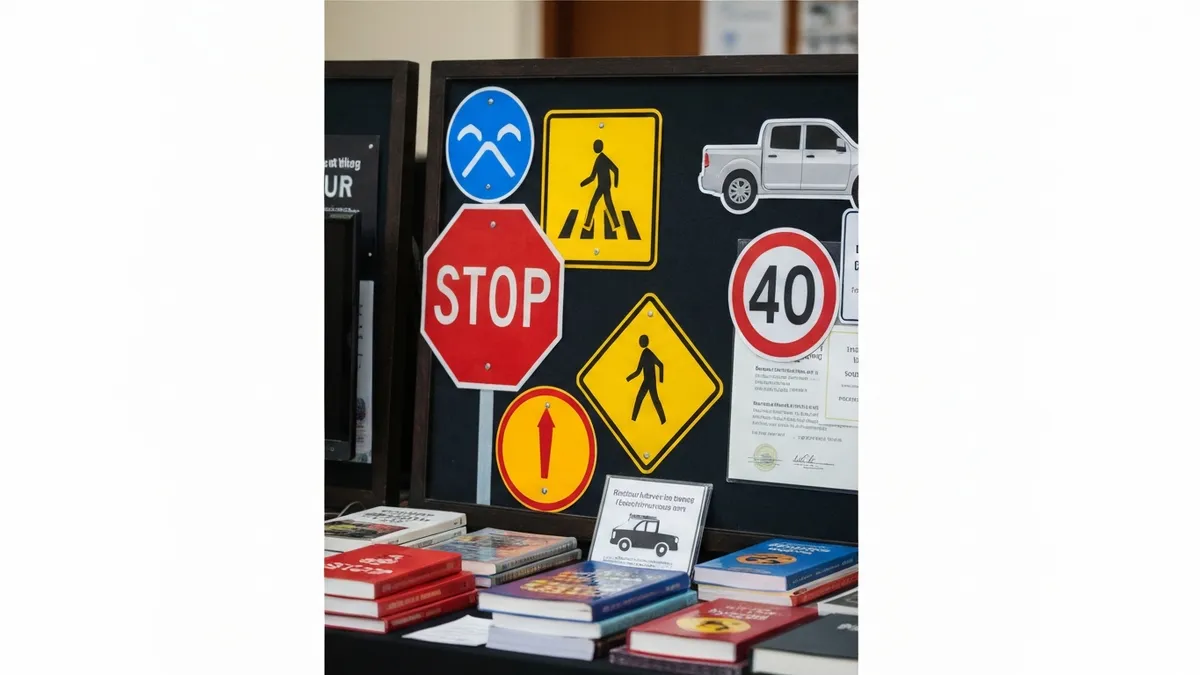
The exam covers: traffic signs and road markings (including regulatory, warning, and informational signs used on Philippine roads), rules of the road (right-of-way, lane discipline, overtaking rules, speed limits under the Land Transportation and Traffic Code), basic vehicle operation (proper use of controls, defensive driving principles, and road etiquette), and violations, fines, and penalties under the Motor Vehicle User's Charge Act and related laws.
Traffic signs are the most heavily tested area — expect roughly 30–40% of your exam questions to come from sign recognition. Use the LTO exam reviewer to drill all sign categories before your exam date.
- The LTO CDE Online Validation Exam, used for driver's license renewal applications, has 25 questions. (Land Transportation Office (LTO), Department of Transportation, Republic of the Philippines)
- Under LTO Memorandum Circular No. AHS-2008-949, the LTO written exam for a non-professional driver's license has 40 questions. (elibrary.judiciary.gov.ph)
- The LTO CDE Online Validation Exam has no time limit for answering the questions. (Land Transportation Office (LTO), Department of Transportation, Republic of the Philippines)
- To get a certificate from the LTO CDE Online Validation Exam, you need 80%, or at least 20 correct answers out of 25 questions. (Land Transportation Office (LTO), Department of Transportation, Republic of the Philippines)
- To pass the LTO written exam for a non-professional driver's license, an applicant needs at least 30 correct answers out of 40 questions. (elibrary.judiciary.gov.ph)
- The LTO CDE Online Validation Exam is taken online through the LTMS portal, and you must log in to an LTMS account to take it. (Land Transportation Office (LTO), Department of Transportation, Republic of the Philippines)
Facts verified Oct 17, 2026 against Land Transportation Office (LTO), Department of Transportation, Republic of the Philippines. Dates that have passed are removed automatically.
LTO Exam at a Glance
| Item | Detail | Official source |
|---|---|---|
| Number of questions (CDE Online Validation Exam (license renewal)) | 25 questions | Land Transportation Office (LTO), Department of Transportation, Republic of the Philippines |
| Number of questions (Non-professional driver's license written exam) | 40 questions | elibrary.judiciary.gov.ph |
| Number of questions (Professional driver's license written exam) | 60 questions | elibrary.judiciary.gov.ph |
| Time limit (CDE Online Validation Exam (license renewal)) | No time limit | Land Transportation Office (LTO), Department of Transportation, Republic of the Philippines |
| Passing score (CDE Online Validation Exam (license renewal)) | 80% (20 of 25 correct) | Land Transportation Office (LTO), Department of Transportation, Republic of the Philippines |
| Passing score (Non-professional driver's license written exam) | 30 of 40 correct (75%) | elibrary.judiciary.gov.ph |
| Passing score (Practical driving exam) | 70 points (start at 100, deductions for errors) | elibrary.judiciary.gov.ph |
| Passing score (Professional driver's license written exam) | 45 of 60 correct (75%) | elibrary.judiciary.gov.ph |
| Delivery (CDE Online Validation Exam (license renewal)) | Online via LTMS portal (login required) | Land Transportation Office (LTO), Department of Transportation, Republic of the Philippines |
Facts verified Oct 17, 2026 against Land Transportation Office (LTO), Department of Transportation, Republic of the Philippines. Dates that have passed are removed automatically.
Free LTO - Exam Reviewer Study Tools
Interactive LTO - Exam Reviewer resources on PracticeTestGeeks, free to start:
- Free LTO Traffic Safety Questions and Answers — 16 questions with instant scoring and answer explanations
- LTO - Exam Reviewer flashcards — review key terms and concepts card by card
- LTO - Exam Reviewer study guide — topic-by-topic overview of what the exam covers
- LTO - Exam Reviewer cheat sheet — one-page printable summary for last-minute review
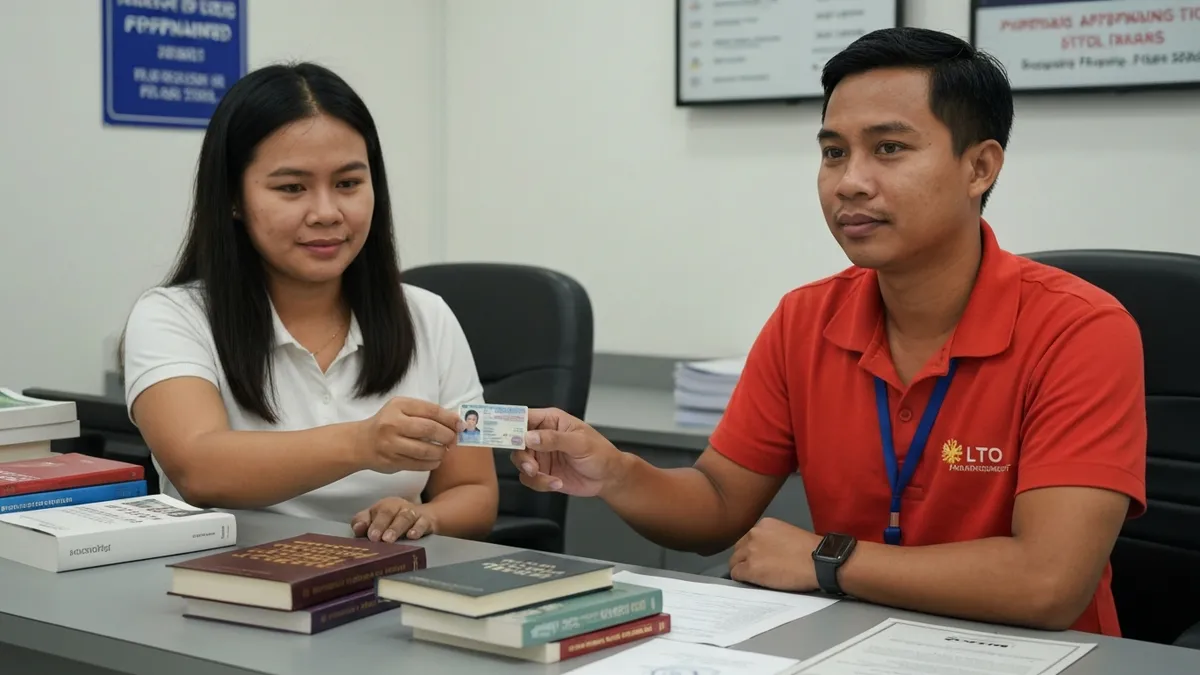
How to Get a Philippine Driver's License: Step-by-Step
The Philippine driver's licensing process follows a structured progression designed to ensure every driver builds competence before earning full driving privileges. There are three license types: the Student Permit, the Non-Professional Driver's License, and the Professional Driver's License.
Before you begin, study thoroughly using resources like the LTO exam questions with video answers to understand how real exam questions are worded and what the correct answers look like with full explanations.
LTO Theoretical Exam Format
The LTO computer-based test (CBT) is a standardized exam administered at LTO branches equipped with computer terminals. Knowing the exact format eliminates surprises and helps you pace yourself properly during the actual exam.
Questions: 40 multiple-choice questions
Passing score: 30 correct out of 40 (75% pass rate)
Time limit: 70 minutes (approximately 1 minute 45 seconds per question)
Format: Computer-based at the LTO terminal — no pen and paper
Language: Questions are available in Filipino and English
Most examinees finish well within the 70-minute limit. The difficulty lies not in time pressure but in recognizing the exact wording used for traffic signs and the specific penalty amounts under Philippine law. Reviewing the LTO exam reviewer in full is the single most effective preparation strategy.
If you fail the theoretical exam, you may retake it on a separate day. There is no mandatory waiting period, but you will need to pay the examination fee again. Repeat examinees should focus specifically on traffic signs and penalties — these are the sections where most applicants lose points.
LTO Practical Driving Test Guide
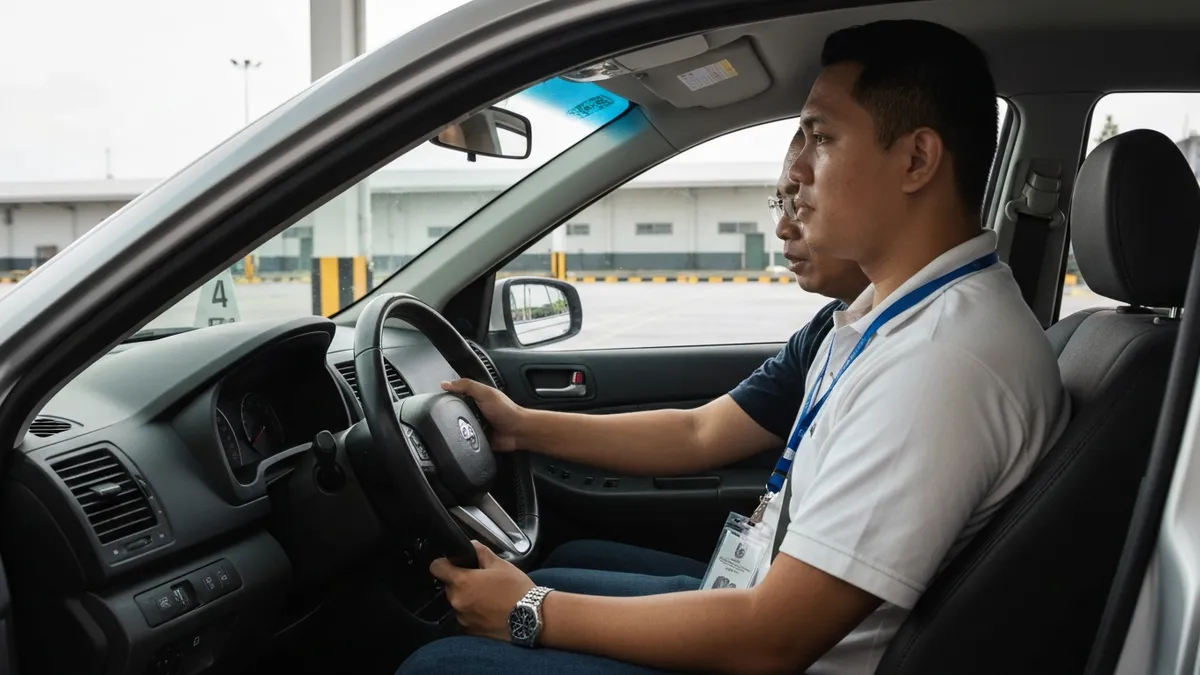
After passing the theoretical exam (during your student permit phase, the written test alone is required), applicants for a Non-Professional or Professional Driver's License must pass a practical driving test conducted by an LTO examiner.
The practical test evaluates your ability to perform standard driving maneuvers safely and competently. The examiner will assess: vehicle inspection and pre-drive checks, straight-line driving and lane control, turning at intersections (left and right), road positioning and mirror use, parking maneuvers (parallel and perpendicular), hill starts (where applicable), and proper observance of traffic signs encountered on the route.
Common reasons for failing the practical test include: crossing lane markings, improper mirror checks, stalling on hills, and failing to use turn signals consistently. Enroll in an accredited driving school for at least 8 hours of formal behind-the-wheel training before your test date — this is the most reliable way to pass on the first attempt. Review real exam scenarios using LTO exam questions with video answers to reinforce what correct driving behavior looks like.
Required Documents and Fees
Preparing your documents in advance saves significant time at the LTO branch. Incomplete submissions are a common cause of delays — arrive with all requirements ready to avoid making multiple trips.
Required Documents for Student Permit
- ✓Accomplished Application for Driver's License (ADL) form — available at the LTO branch
- ✓Medical Certificate from an LTO-accredited clinic (includes vision test and physical exam)
- ✓Birth Certificate (PSA-issued) or any valid government-issued ID showing age
- ✓Proof of address (barangay certificate, utility bill, or valid ID with address)
- ✓Tax Identification Number (TIN) — or affidavit of non-filing if not yet registered
- ✓1 recent passport-size photo (some branches take your photo on-site)
Tips for Passing the LTO Exam on Your First Try
The majority of first-time LTO exam failures happen because applicants underestimate the specificity of traffic sign questions and penalty amounts. Generic knowledge of driving is not enough — you need to know the exact penalty for texting while driving, the exact distance a bus must stop from a railroad crossing, and the precise meaning of every road sign shape and color used in the Philippines.
The most effective preparation strategy is focused practice on actual LTO-style questions. Use dedicated practice tools that replicate the CBT format so you experience real question wording before exam day. The LTO traffic violations and penalties quiz is particularly valuable since penalty questions are among the most commonly missed on the actual exam.
Also practice with the LTO road safety and defensive driving practice test — defensive driving principles account for a significant portion of the 40-question exam, and understanding WHY a rule exists helps you answer edge-case questions correctly even when you have not seen the exact wording before.
10 Tips to Pass the LTO Exam First Try
- ✓Study ALL Philippine traffic signs — regulatory, warning, and informational categories
- ✓Memorize exact penalty amounts under RA 4136 (Land Transportation and Traffic Code)
- ✓Know the Anti-Drunk Driving Act (RA 10586) penalties and BAC limits (0.05% limit)
- ✓Know the Anti-Distracted Driving Act (RA 10913) penalties for phone use while driving
- ✓Practice with LTO-format multiple choice questions — not just reading the handbook
- ✓Focus on road signs with similar shapes or colors — these are common trick questions
- ✓Understand right-of-way rules at intersections, roundabouts, and railroad crossings
- ✓Review speed limits in different zones: city streets, residential areas, and expressways
- ✓Get enough sleep the night before — the CBT is not difficult if you have prepared
- ✓Arrive at the LTO branch early with all documents complete to avoid stress
- +Validates your knowledge and skills objectively
- +Increases job market competitiveness
- +Provides structured learning goals
- +Networking opportunities with other certified professionals
- −Study materials can be expensive
- −Exam anxiety can affect performance
- −Requires dedicated preparation time
- −Retake fees apply if you don't pass
Pros and Cons at a Glance
| Pros | Cons |
|---|---|
| Validates your knowledge and skills objectively | Study materials can be expensive |
| Increases job market competitiveness | Exam anxiety can affect performance |
| Provides structured learning goals | Requires dedicated preparation time |
| Networking opportunities with other certified professionals | Retake fees apply if you don't pass |
Sample LTO - Exam Reviewer Practice Questions
Try these questions from our free LTO - Exam Reviewer practice tests. The correct answer and an explanation follow each question.
A driver's license has been expired for more than two years. What must the applicant do to renew it?
- A. Pay the renewal fee plus a small penalty.
- B. Submit a medical certificate and the expired license.
- C. Retake and pass both the written and practical driving examinations.
- D. Authorize a representative to renew on their behalf.
Answer: C. Retake and pass both the written and practical driving examinations.
If a driver's license has been expired for more than two years, the holder is required to retake and pass both the LTO written and practical driving examinations before the license can be renewed.
Under RA 4136, what must a driver do when an authorized officer asks to see their license?
- A. Ignore the request if they are in a hurry
- B. Present the license for inspection immediately
- C. Show only a photocopy of the license
- D. Call their lawyer first
Answer: B. Present the license for inspection immediately
Under RA 4136, drivers must present their valid driver's license upon demand by any authorized law enforcement officer.
What is the penalty for a person caught driving a motor vehicle without a valid driver's license for the first time?
- A. ₱1,000 fine and vehicle impoundment
- B. ₱3,000 fine
- C. ₱5,000 fine and a 1-year disqualification from applying for a license
- D. A warning and mandatory seminar
Answer: B. ₱3,000 fine
Driving without a license is a serious offense. The LTO imposes a standard fine of ₱3,000.00 for this violation, which also applies to driving with an expired, revoked, or fake license.
What does a Non-Professional Driver's License authorize its holder to do?
- A. Operate any vehicle for hire or reward
- B. Operate only private vehicles not used for hire or reward
- C. Operate motorcycles only
- D. Operate public utility jeepneys
Answer: B. Operate only private vehicles not used for hire or reward
A Non-Professional Driver's License allows the holder to drive private vehicles not used for hire, reward, or compensation.
LTO Questions and Answers
More LTO Exam Resources
How this page was made: written with AI tools. Exam facts are checked against the official sources listed below. Not reviewed by a subject-matter expert. Editorial policy
Sources & references
Exam facts on this page (fees, format, dates, passing scores) are checked against these official sources; the date is our last check. Editorial policy
- portal.lto.gov.ph — Test delivery, exam format, passing score, time limit · verified Oct 2026
- elibrary.judiciary.gov.ph — Exam format, passing score · verified Oct 2026