
LTO Student Permit Philippines 2026 September — Complete Guide
Prepare for the LTO Student Permit Philippines 2026 September certification. Practice questions with answer explanations covering all exam domains. 📗
What Is an LTO Student Permit?
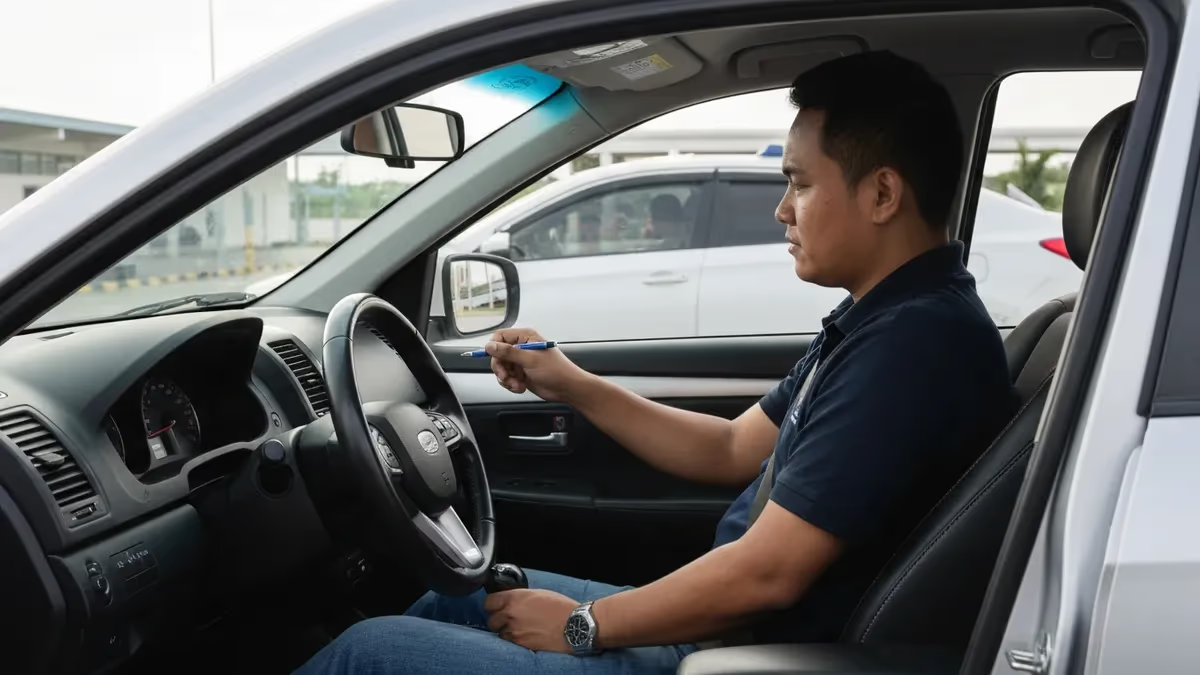
An LTO Student Permit (SP) is a government-issued learner's permit that allows a Filipino citizen (or qualified foreign national) to learn to drive a motor vehicle under the supervision of a person holding a valid Philippine driver's license. It is governed by Republic Act No. 4136, the Land Transportation and Traffic Code of the Philippines.
The Student Permit is not a full driver's license. You cannot drive alone with an SP — a licensed driver must be physically present in the vehicle with you at all times while you are behind the wheel.
For a deeper look at the full licensing pathway, visit our LTO Philippines Driver's License Complete Guide 2026.
Who Needs a Student Permit?
Any person who wishes to obtain either a Non-Professional Driver's License (NPDL) or a Professional Driver's License (PDL) in the Philippines must first secure and hold a valid Student Permit for a minimum of one month before they can apply to upgrade to a full license.
This applies to:
- First-time drivers applying for an NPDL (for private vehicles)
- First-time drivers applying for a PDL (for public utility or commercial vehicles)
- Foreign nationals who do not hold a convertible foreign license
If you already hold a valid foreign driver's license from a country with a reciprocal agreement with the Philippines, you may be exempt from the Student Permit requirement — consult the LTO directly for confirmation.
Step-by-Step Student Permit Application Process
Step 1: Get a Medical Certificate
Before visiting any LTO branch, you must secure a Medical Certificate from an LTO-accredited clinic. The exam checks your vision (corrected or uncorrected), color perception, and basic hearing. If you require corrective lenses, you must wear them when driving. Cost ranges from ₱300 to ₱500 depending on the clinic. The certificate is valid for 60 days.
Step 2: Complete the Application Form
Download and fill out the LTO Application Form (ADL) from the official LTO website (lto.gov.ph) or obtain one at the Licensing Center. Fill in all required fields legibly in ink. Do not leave any section blank.
Step 3: Submit Documents at the LTO Licensing Center
Bring all original documents plus one photocopy of each. Proceed to the Document Verification window. A staff member will review your requirements and assign you a queue number. Choose an LTO branch that processes Student Permits — not all LTO offices handle licensing transactions.
Step 4: Pay the Required Fees
After document verification, proceed to the cashier to pay the Student Permit fee and computer exam fee. Keep your official receipt — it is required at subsequent windows. Total fees typically fall between ₱500 and ₱700 inclusive of the medical certificate.
Step 5: Take the Written Examination
The LTO written exam is now administered as a Computer-Based Test (CBT) at most major Licensing Centers. The exam covers traffic rules and regulations, road signs, safe driving practices, and basic vehicle mechanics. You must answer at least 30 out of 40 questions correctly (75% passing rate) to pass. Brush up on road signs and the Land Transportation and Traffic Code beforehand.
Practice with our LTO Exam Reviewer 2026 and LTO Exam Questions with Video Answers to boost your chances of passing on your first try.
Step 6: Receive Your Student Permit
Upon passing the written exam, your Student Permit card will be printed and issued at the releasing window — usually on the same day. Inspect the card carefully to ensure your name, birthdate, and address are correct. Report any errors immediately before leaving the branch.

- ✓Accomplished LTO Application Form (ADL)
- ✓PSA Birth Certificate (original) or valid Philippine passport
- ✓One (1) valid government-issued photo ID
- ✓Medical Certificate from an LTO-accredited clinic
- ✓Tax Identification Number (TIN) or sworn statement of non-filing
- ✓Two (2) 1×1 ID photos with white background
- ✓Payment of Student Permit and exam fees (₱500–₱700 total)
- ✓Photocopies of all documents
Validity, Renewal, and Conversion to Full License
Validity Period
Your LTO Student Permit is valid for one (1) year from the date of issue. During this period, you should use the time to take formal driving lessons and accumulate supervised practice hours.
Minimum Holding Period
Philippine law requires you to hold your Student Permit for a minimum of one (1) month before you are eligible to apply for a Non-Professional or Professional Driver's License. This waiting period is non-negotiable and cannot be waived.
Renewal
If your Student Permit expires before you have applied for your full license, you may renew it once. Renewal requires you to submit a renewal application form and pay the applicable renewal fee. You do not need to retake the written exam for a first renewal, but check with your LTO branch as policies may vary.
Converting to a Full Driver's License
After holding your Student Permit for at least one month, you may apply for your Non-Professional Driver's License (NPDL) to drive private vehicles, or a Professional Driver's License (PDL) to drive public utility or commercial vehicles. The upgrade involves a practical driving test and submission of a new set of requirements.
Learn more about the complete process in our LTO Philippines Driver's License Complete Guide 2026 and our guide to LTO Driver's License Renewal Philippines 2026.
- +Validates your knowledge and skills objectively
- +Increases job market competitiveness
- +Provides structured learning goals
- +Networking opportunities with other certified professionals
- −Study materials can be expensive
- −Exam anxiety can affect performance
- −Requires dedicated preparation time
- −Retake fees apply if you don't pass
About the Author

Educational Psychologist & Academic Test Preparation Expert
Columbia University Teachers CollegeDr. Lisa Patel holds a Doctorate in Education from Columbia University Teachers College and has spent 17 years researching standardized test design and academic assessment. She has developed preparation programs for SAT, ACT, GRE, LSAT, UCAT, and numerous professional licensing exams, helping students of all backgrounds achieve their target scores.
Join the Discussion
Connect with other students preparing for this exam. Share tips, ask questions, and get advice from people who have been there.
View discussion (8 replies)