
LPN Travel Nursing Jobs: Complete 2026 Guide to Pay, Requirements & Top Specialties
LPN travel nursing jobs explained: ✅ pay rates, requirements, top specialties, agencies, and how to land your first assignment. Complete 2026 guide.
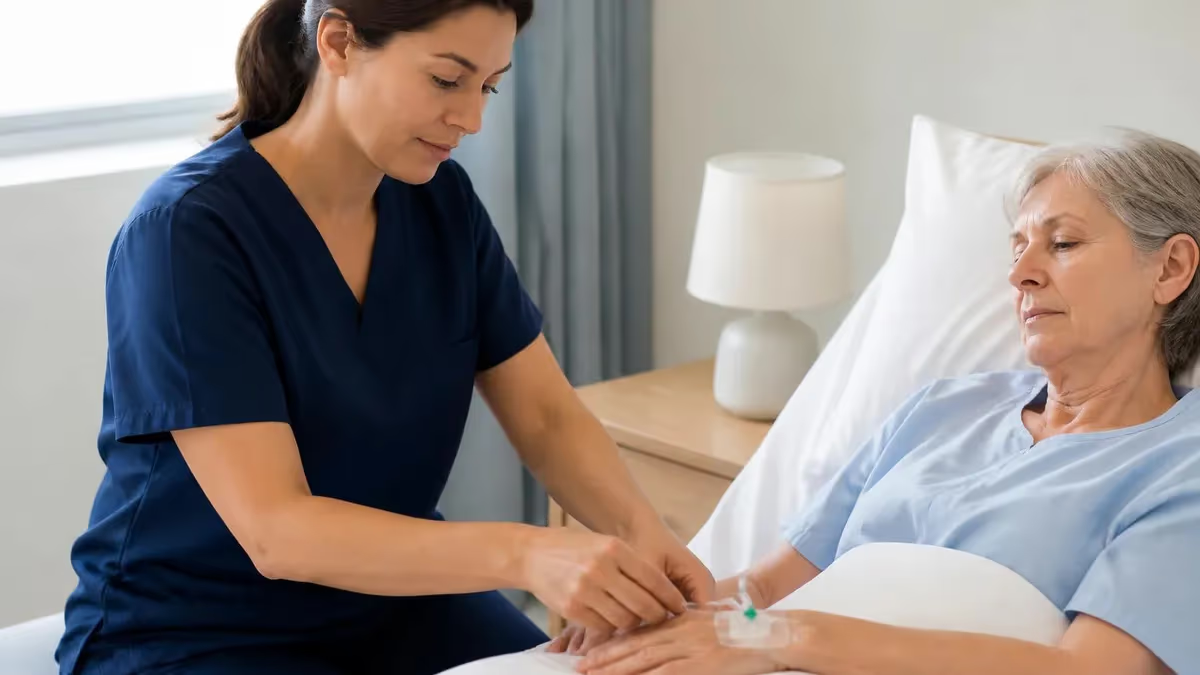
LPN travel nursing jobs let licensed practical nurses take short-term assignments across the country, usually lasting 8 to 13 weeks, while earning higher pay and free housing stipends. If you are an LPN who feels boxed in by a single facility, travel work opens doors to long-term care centers, rehabilitation units, correctional clinics, and rural hospitals that desperately need bedside staff. The demand has surged because facilities cannot fill permanent roles fast enough, and that staffing gap translates directly into opportunity, mobility, and a paycheck that often beats a traditional full-time position.
Before you picture yourself packing a suitcase, it helps to understand exactly what these roles involve. A travel LPN performs the same core duties as a staff LPN: administering medications, monitoring vital signs, dressing wounds, charting, and supporting RNs and physicians. The difference lies in the contract structure. Instead of a permanent hire, you sign a fixed-term agreement through a staffing agency, complete the assignment, and then choose whether to extend, take a new contract, or rest between jobs. That flexibility is the heartbeat of the entire career path.
Geography matters more than many newcomers expect. Some states hire LPNs heavily into skilled nursing and long-term care, while others lean on them in clinics and home health. Pay rates swing widely depending on the local cost of living, the urgency of the staffing shortage, and the specialty involved. A correctional facility in a remote county may pay far more than a suburban nursing home simply because fewer nurses want the location. Learning to read these patterns turns guesswork into a deliberate strategy that maximizes both income and experience.
Licensing is the gateway, and it is the single biggest factor that determines how quickly you can start. The Nurse Licensure Compact (NLC) allows LPNs who hold a multistate license in a compact state to practice across dozens of other compact states without applying for a new license each time. If your home state is not in the compact, you can still travel, but you will need to obtain individual state licenses, which adds time and paperwork. Understanding your compact status early prevents frustrating delays once an offer arrives.
Money is, understandably, the headline attraction. Travel LPN packages typically blend a taxable hourly wage with non-taxable stipends for housing, meals, and incidentals. When you add those pieces together, weekly take-home pay can comfortably exceed what a permanent LPN earns, sometimes by a wide margin. Still, the gross number on a job board is not the whole story. Smart travelers calculate the true value of a package after travel costs, license fees, and time spent between contracts before deciding whether an assignment is genuinely worth it.
This guide walks you through everything you need to launch and sustain a travel LPN career in 2026. You will learn the eligibility requirements, the documents to gather, realistic pay expectations, the highest-demand specialties, and the day-to-day rhythm of life on assignment. If you are still finishing your education, the LPN Programs Near Me resource can help you find accredited schools that prepare you for licensure and, eventually, the open road of travel nursing.
Finally, treat travel nursing as a skill you build, not a lottery you win. The nurses who thrive are organized, adaptable, and proactive about credentialing. They keep a digital folder of certifications, respond to recruiters quickly, and learn each new charting system without complaint. Those habits, far more than luck, separate travelers who string together lucrative back-to-back contracts from those who burn out after one rough placement. With the right preparation, an LPN license can become a passport to a flexible, well-paid, and genuinely adventurous career.
LPN Travel Nursing by the Numbers

How Travel LPN Jobs Work
You partner with one or more travel staffing agencies that hold contracts with facilities nationwide. Recruiters match your license, specialty, and location preferences to open assignments and negotiate pay packages on your behalf.
Before any assignment you submit your license, certifications, immunization records, and references. The agency verifies everything and may require a physical or drug screen so the facility can clear you to work quickly.
Each assignment is a fixed-term contract specifying pay, hours, shift type, location, and length. You review the details, confirm housing arrangements, and commit to the full term unless mutually canceled.
You report to the facility, complete a short orientation, and perform standard LPN duties for 8 to 13 weeks. Strong performance often earns an extension or a glowing reference for the next job.
As the contract nears its end, you decide whether to extend, take time off, or line up a new assignment in a different city. This cycle repeats as long as you want to keep traveling.
Understanding the money behind LPN travel nursing jobs starts with the pay package structure. Agencies rarely quote a single hourly figure. Instead, they break compensation into a taxable base wage and several non-taxable stipends covering housing, meals, and incidentals. The base might look modest at first glance, but the stipends are what push weekly totals well past what staff LPNs earn. Because stipends are not taxed, your effective take-home pay rises, though you must maintain a legitimate tax home to qualify for that favorable treatment under IRS rules.
Weekly pay for travel LPNs commonly lands between $1,100 and $1,600, with crisis or hard-to-fill assignments climbing higher. Several variables drive the number: the severity of the local staffing shortage, the cost of living in the area, the specialty, the shift differential for nights or weekends, and whether the facility offers completion or referral bonuses. A remote correctional clinic or a rural skilled nursing facility frequently pays a premium precisely because recruiters struggle to fill those seats with local talent.
To qualify, you generally need an active LPN or LVN license in good standing and at least one full year of recent bedside experience, though some agencies prefer two. That experience requirement exists because travelers must hit the ground running with minimal orientation. Facilities are paying premium rates and expect you to chart accurately, pass medications safely, and manage a full assignment from day one. Building that foundation in a permanent role first makes the transition into travel work dramatically smoother and less stressful.
Beyond the license and experience, agencies look for current certifications. Basic Life Support (BLS) is nearly universal, and depending on the setting you may also need certifications in IV therapy, wound care, or medication administration that meet state-specific rules. Keeping a tidy digital portfolio of these credentials, plus immunization titers, a TB test, and a recent physical, lets you accept offers fast. The travelers who win the best contracts are almost always the ones who can be cleared within days, not weeks.
It helps to think about the full financial picture rather than the gross weekly rate alone. Subtract the realistic cost of travel to the assignment, any state license application fees, gaps between contracts when you earn nothing, and the expense of maintaining your tax home. A package that looks spectacular on paper can shrink once those costs are accounted for. Conversely, a slightly lower rate in a low-cost city with guaranteed back-to-back extensions may deliver more annual income overall.
Many new travelers also underestimate the value of guaranteed hours. A reputable contract specifies a minimum number of paid hours per week, protecting you if the facility cancels a shift due to low census. Without that guarantee, a slow week can gut your paycheck. Always confirm the guaranteed-hours clause, the cancellation policy, and how the agency handles missed shifts before signing. These contract details matter as much as the headline pay rate when you calculate true earning potential.
If you are still preparing for licensure or want to strengthen your clinical knowledge before chasing premium contracts, working through an LPN Entrance Exam guide and practicing test-style questions builds the confidence that translates directly into bedside competence. The stronger your fundamentals, the easier it is to adapt to new facilities, new charting systems, and new patient populations every couple of months without feeling overwhelmed.
LPN Practice Test Questions
Prepare for the LPN - Certified Practical Nurse exam with our free practice test modules. Each quiz covers key topics to help you pass on your first try.
LPN - Certified Practical Nurse Basic Care...
LPN Exam Questions covering - Certified Practical Nurse Basic Care and Comfort. Master LPN Test concepts for certification prep.
LPN - Certified Practical Nurse Coordinate...
Free LPN Practice Test featuring - Certified Practical Nurse Coordinated Care. Improve your LPN Exam score with mock test prep.
LPN - Certified Practical Nurse Health Pro...
LPN Mock Exam on - Certified Practical Nurse Health Promotion and Maintenance. LPN Study Guide questions to pass on your first try.
LPN - Certified Practical Nurse Pharmacolo...
LPN Test Prep for - Certified Practical Nurse Pharmacological Therapies. Practice LPN Quiz questions and boost your score.
LPN - Certified Practical Nurse Physiologi...
LPN Questions and Answers on - Certified Practical Nurse Physiological Adaptation. Free LPN practice for exam readiness.
LPN - Certified Practical Nurse Psychosoci...
LPN Mock Test covering - Certified Practical Nurse Psychosocial Integrity. Online LPN Test practice with instant feedback.
LPN - Certified Practical Nurse Reduction ...
Free LPN Quiz on - Certified Practical Nurse Reduction of Risk Potential. LPN Exam prep questions with detailed explanations.
LPN - Certified Practical Nurse Safety and...
LPN Practice Questions for - Certified Practical Nurse Safety and Infection Control. Build confidence for your LPN certification exam.
LPN Ethical, Legal & Professional Standards
LPN Test Online for Ethical, Legal & Professional Standards. Free practice with instant results and feedback.
LPN Health Evaluation & Monitoring
LPN Study Material on Health Evaluation & Monitoring. Prepare effectively with real exam-style questions.
Top Travel LPN Specialties and Settings
Skilled nursing facilities and long-term care centers are the single largest source of travel LPN jobs. These settings rely heavily on practical nurses to administer medications, manage chronic conditions, and supervise daily care for elderly residents. Because turnover is high and census stays full, contracts are plentiful and extensions are easy to secure.
The pace is steady rather than frantic, but caseloads can be large, often 20 to 30 residents per nurse. Strong time management and careful charting are essential. Travelers who excel here build a reputation for reliability that keeps offers flowing across multiple states and facility chains.

Is a Travel LPN Career Right for You?
- +Higher weekly pay than most permanent LPN roles, especially with tax-free stipends
- +Free or subsidized housing arranged through the agency
- +Freedom to choose your location, shift, and time between contracts
- +Rapid skill growth from working in diverse facilities and systems
- +Opportunity to explore new cities and regions while earning
- +Strong job security driven by persistent nationwide staffing shortages
- +Ability to take extended breaks between assignments without penalty
- −Income gaps between contracts if you do not line up the next job
- −Repeated credentialing, licensing, and paperwork for new states
- −Short orientations require you to adapt quickly with little support
- −Being away from family, friends, and your established support network
- −Less long-term job stability than a permanent staff position
- −Tax complexity from maintaining a qualifying tax home for stipends
Pros and Cons at a Glance
| Pros | Cons |
|---|---|
| Higher weekly pay than most permanent LPN roles, especially with tax-free stipends | Income gaps between contracts if you do not line up the next job |
| Free or subsidized housing arranged through the agency | Repeated credentialing, licensing, and paperwork for new states |
| Freedom to choose your location, shift, and time between contracts | Short orientations require you to adapt quickly with little support |
| Rapid skill growth from working in diverse facilities and systems | Being away from family, friends, and your established support network |
| Opportunity to explore new cities and regions while earning | Less long-term job stability than a permanent staff position |
| Strong job security driven by persistent nationwide staffing shortages | Tax complexity from maintaining a qualifying tax home for stipends |
Getting Started in Travel Nursing Checklist
- ✓Confirm your LPN/LVN license is active and in good standing.
- ✓Determine whether your home state is part of the Nurse Licensure Compact.
- ✓Gather at least one year of recent bedside experience documentation.
- ✓Renew BLS certification and any specialty credentials you hold.
- ✓Collect immunization records, TB test results, and a recent physical.
- ✓Build a digital folder with your resume and professional references.
- ✓Research and contact two or three reputable travel staffing agencies.
- ✓Clarify pay structure, stipends, and guaranteed hours with each recruiter.
- ✓Compare contract details including housing, cancellation, and bonus terms.
- ✓Plan your tax home strategy to qualify for non-taxable stipends.
Speed wins the best contracts
Facilities pay premium rates because they need staff immediately. The traveler who can submit a complete, verified credential packet within 48 hours almost always lands the contract over an equally qualified nurse who takes a week to gather documents. Keep everything updated and cloud-stored so you can say yes the moment a great assignment appears.
Licensing is the foundation of every travel LPN career, and the Nurse Licensure Compact (NLC) is the rule that makes multi-state work practical. The compact lets a nurse who holds a multistate license issued by their home compact state practice in any other compact state without applying for a separate license. More than 40 states participate, which means a single license can unlock assignments across a huge swath of the country. For most aspiring travelers, confirming compact eligibility is the very first administrative step.
To hold a multistate license, your primary state of residence must be a compact state, and you must declare that state as your legal residence. If you live in a non-compact state, you can still travel, but you will apply for licensure by endorsement in each state where you want to work. Endorsement is the process of transferring your existing license to a new state, and it typically requires an application, fees, fingerprinting, and a processing wait that can range from days to several weeks.
Because processing times vary so widely, experienced travelers apply for licenses proactively rather than reactively. If you know you want to work in a particular non-compact state, starting the endorsement application before an offer arrives prevents missing out on time-sensitive contracts. Some agencies will reimburse license fees or even handle paperwork for you, so always ask what credentialing support a recruiter provides before signing on. That support can save you both money and significant administrative headaches.
Keeping your license in good standing is non-negotiable. That means completing required continuing education hours, renewing on time, and avoiding any disciplinary actions that could appear in the national nursing database. A single lapse or unresolved complaint can disqualify you from assignments and even trigger problems across every compact state at once. Treat your license like the valuable career asset it is, because in travel nursing it is quite literally your ticket to work anywhere.
Continuing education deserves special attention for travelers. Different states impose different CE requirements, and some specialties demand specific courses such as pharmacology updates or pain management modules. Tracking your CE credits in one organized system ensures you never scramble to meet a renewal deadline while juggling a demanding contract. Many travelers complete CE online during downtime between assignments, turning idle days into productive credential maintenance that keeps every license active and ready.
It is also wise to understand scope-of-practice differences between states. What an LPN is permitted to do, such as starting IVs, pushing certain medications, or performing specific assessments, varies from one state board to another. Before each assignment, review the host state's scope rules so you never unknowingly exceed your legal authority. A quick review of the state board website, combined with your agency's guidance, keeps you compliant and protects both your patients and your license.
Finally, save copies of every license, certification, and renewal confirmation in a secure cloud folder. Credentialing departments routinely request the same documents for each new contract, and having them instantly available accelerates your start date. Travelers who treat documentation as an ongoing system rather than a last-minute task consistently move from offer to first shift faster, which means fewer unpaid gaps and a steadier annual income across their travel career.

LPN scope of practice is not uniform nationwide. Tasks like IV push medications or independent assessments may be allowed in one state and prohibited in another. Always confirm the host state's specific rules before your first shift to avoid practicing outside your legal authority and risking your license.
Thriving on a travel assignment is a skill set all its own, separate from clinical competence. The first 48 hours at a new facility set the tone for the entire contract. Arrive early, introduce yourself warmly to the charge nurse and aides, and approach orientation with humility. You may have a decade of experience, but every facility has its own workflows, charting quirks, and unwritten rules. The travelers who ask thoughtful questions and avoid the phrase "that's not how we did it at my last job" earn trust fastest.
Adaptability is your greatest professional asset. Each assignment introduces a new electronic health record system, a new medication cart layout, and a new team dynamic. Rather than resisting these changes, treat them as puzzles to solve quickly. Take notes during orientation, keep a small reference card of unit-specific protocols, and identify one or two go-to colleagues you can ask when something is unclear. This proactive approach shortens your learning curve and signals to managers that you are dependable.
Communication carries extra weight when you are the outsider on a tight-knit team. Be precise in your handoffs, document thoroughly, and never let a question about a medication order or a patient's status go unasked. Strong communication protects patients and protects you from liability. It also builds the relationships that lead to contract extensions and the kind of references that recruiters use to place you in the next premium assignment without hesitation.
Self-care is not a luxury in travel nursing; it is what keeps the career sustainable. Long shifts in unfamiliar cities, far from your support network, can wear you down if you do not protect your wellbeing. Establish a routine in each new location: find a grocery store, a gym or walking route, and a quiet space to decompress. Travelers who guard their physical and mental health string together far more contracts than those who run themselves ragged chasing the highest possible pay.
Financial discipline turns a good income into lasting wealth. Because travel pay arrives in larger but less predictable chunks, budgeting matters more than in a salaried job. Set aside money for income gaps between contracts, for taxes on your base wage, and for an emergency fund that covers a canceled assignment. Many seasoned travelers automate savings the moment each paycheck lands, ensuring that a few lucrative years actually translate into long-term financial security rather than just a fun lifestyle.
Networking quietly compounds over a travel career. Every charge nurse, recruiter, and fellow traveler you impress becomes a potential reference or tip for a future contract. Stay in touch with managers who valued your work, connect with other travelers who share intel about agencies and facilities, and maintain a professional online presence. The travel nursing world is smaller than it looks, and a strong reputation often delivers better assignments than any job board search ever could.
Continuing to study even while working keeps your knowledge sharp across constantly changing patient populations. Reviewing a LPN Practice Test PDF during downtime reinforces pharmacology, care coordination, and physiological adaptation concepts you may not use daily but absolutely need when a complex case appears. The best travelers never stop learning, because every new facility eventually tests a corner of their knowledge they had not exercised in months.
Now that you understand the landscape, here is the practical roadmap for landing your first travel LPN assignment. Start by interviewing recruiters from at least two or three agencies rather than committing to the first one that calls. Recruiters vary enormously in responsiveness, honesty, and the quality of their facility relationships. Ask each one how they calculate pay, what happens if a facility cancels your shifts, and how they support credentialing. The recruiter you choose becomes your career partner, so personality fit and transparency matter as much as the pay quote.
When you receive a pay package, request a full written breakdown before saying yes. A trustworthy recruiter will itemize the taxable hourly wage, the housing stipend, the meals and incidentals stipend, any completion bonus, and the guaranteed weekly hours. If anyone resists putting numbers in writing or pressures you to commit immediately, treat that as a red flag. The strongest agencies welcome scrutiny because their packages hold up under it. Comparing two or three written offers side by side reveals which one truly serves your goals.
Negotiation is normal and expected in travel nursing, so do not accept the first number as final. If you have certifications, a strong specialty, or flexibility on location, use those as use. Even a modest bump of fifty dollars per week adds up over a thirteen-week contract. Be polite but direct, and remember that recruiters have margin built into most offers. The worst outcome is a no, and the best is hundreds of extra dollars for the same work you were already prepared to do.
Once you accept an assignment, lock down logistics immediately. Confirm your housing arrangement or stipend amount, map your commute, and verify the exact start date, shift, and reporting location. If you are taking agency-provided housing, ask about furnishings, lease length, and what happens if the contract ends early. If you are arranging your own housing with a stipend, start searching for short-term rentals right away, since affordable furnished options near healthcare facilities disappear fast in popular travel destinations.
Prepare a travel kit that makes each move painless. Seasoned LPNs keep a packed bag of scrubs, comfortable shoes, a stethoscope, badge reels, and copies of essential documents ready to go. They also keep digital backups of every credential in the cloud so a credentialing request never derails a start date. Building these systems once and reusing them for every assignment removes the friction that makes the first few contracts feel overwhelming and turns relocation into a smooth, repeatable routine.
Finally, give yourself grace during the first assignment. The initial contract is the steepest part of the learning curve, and almost every traveler feels a wave of nerves walking into a strange facility alone. By the second or third assignment, the process feels routine: you know how to read a contract, clear credentialing fast, settle into a new city, and win over a new team. Push through the early discomfort, lean on your recruiter and fellow travelers, and the career quickly becomes the flexible, well-paid adventure you signed up for.
Keep your long-term goals in view as you go. Some LPNs travel for a year or two to pay off debt or fund a down payment, then settle into a permanent role with a richer resume. Others make travel a multi-year lifestyle, chaining specialties and states into a remarkably varied career. There is no wrong path. The point is to use travel nursing intentionally, tracking your finances, your skills, and your wellbeing so that every assignment moves you closer to whatever future you are building.
Sample Certified Practical Nurse Practice Questions
Try these questions from our free Certified Practical Nurse practice tests. The correct answer and an explanation follow each question.
A pregnant client at 20 weeks gestation is scheduled for an amniocentesis. Which nursing action is most important after the procedure?
- A. Encourage increased oral fluid intake for the next week
- B. Monitor for uterine contractions, leaking fluid, and report decreased fetal movement
- C. Keep the client in supine position for 8 hours post-procedure
- D. Perform a sterile vaginal examination to assess cervical dilation
Answer: B. Monitor for uterine contractions, leaking fluid, and report decreased fetal movement
Post-amniocentesis complications include preterm labor and membrane rupture. The client must be taught to monitor for contractions, fluid leaking from the vagina, fever, and decreased fetal movement.
What is the purpose of pharmacology in nursing?
- A. To understand how medications work
- B. To prescribe medications
- C. To assess blood pressure
- D. To offer alternative treatments
Answer: B. To prescribe medications
Pharmacology is the scientific study of drugs and their effects, which is foundational to medication management in nursing. While LPNs do not prescribe, this knowledge is essential for understanding drug actions, safe administration, and monitoring patient responses. For advanced practice nurses, pharmacology directly informs their ability to prescribe medications, making it a critical aspect of comprehensive patient care within the broader nursing scope.
A client with Parkinson's disease is at risk for which complication requiring the highest nursing vigilance?
- A. Hypertension and stroke
- B. Aspiration pneumonia from dysphagia and choking
- C. Deep vein thrombosis from immobility
- D. Pressure ulcers from incontinence
Answer: B. Aspiration pneumonia from dysphagia and choking
Dysphagia and slowed swallowing in Parkinson's disease significantly increase the risk of aspiration, which is a leading cause of morbidity and mortality in this population.
A client is scheduled for a colonoscopy and asks why they need to complete a bowel prep. What is the best response by the LPN?
- A. It reduces the risk of bleeding during the procedure
- B. It helps the physician see the bowel lining clearly and reduces infection risk
- C. It prevents constipation after the procedure
- D. It lowers your blood pressure so you tolerate sedation better
Answer: B. It helps the physician see the bowel lining clearly and reduces infection risk
Bowel prep clears stool from the colon to allow clear visualization and reduces the risk of contamination if bowel perforation occurs.
LPN Questions and Answers

LPN Practice Test PDF (Free Printable 2026)

LPN Programs Near Me 2026: Find Accredited Schools & Costs

Macomb LPN Program: Complete 2026 Guide to Specific LPN Programs, Admission Requirements, Cost & Career Outcomes
LPN Nursing Care & Clinical Skills Practice Test

LPN Entrance Exam Guide 2026: TEAS, HESI, PAX & Kaplan Prep
About the Author

Registered Nurse & Healthcare Educator
Johns Hopkins University School of NursingDr. Sarah Mitchell is a board-certified registered nurse with over 15 years of clinical and academic experience. She completed her PhD in Nursing Science at Johns Hopkins University and has taught NCLEX preparation and clinical skills courses for nursing students across the United States. Her research focuses on evidence-based exam preparation strategies for healthcare certification candidates.
Join the Discussion
Connect with other students preparing for this exam. Share tips, ask questions, and get advice from people who have been there.
View discussion (7 replies)