
LPN Training Program: Complete 2026 September Guide to Curriculum, Costs, Clinicals & NCLEX-PN Prep
Complete 2026 September LPN training program guide: 🎯 curriculum breakdown, clinical hours, costs, accreditation, admission requirements, and NCLEX-PN exam prep.

An lpn training program is a state-approved, accredited educational pathway that prepares students to deliver bedside nursing care under the supervision of registered nurses and physicians. Most programs run between 12 and 18 months, blending classroom theory with hands-on clinical rotations in hospitals, long-term care facilities, clinics, and home health agencies. The training is intensive but considerably shorter than a registered nursing degree, which makes it a popular launchpad into the healthcare field for career changers and first-time college students alike.
The structure of an LPN program is intentionally compressed. You will move quickly from foundational anatomy and pharmacology into applied skills like wound care, medication administration, vital sign monitoring, catheter insertion, and patient education. Each module typically ends with a competency check, where instructors verify you can perform the skill safely on a manikin before you ever touch a real patient. By the second semester, most programs have students rotating through clinical sites two to three days per week.
Accreditation matters enormously here. The Accreditation Commission for Education in Nursing (ACEN) and the Council on Occupational Education (COE) are the two primary bodies that approve practical nursing programs in the United States. Without graduating from a board-approved program, you simply cannot sit for the NCLEX-PN exam. That single fact eliminates dozens of online-only or unaccredited options that occasionally surface in search results, so verifying program approval through your state board of nursing should be your first step.
Tuition varies wildly depending on the institution. Community colleges typically charge between $5,000 and $15,000 for the entire program, while private vocational schools can run $25,000 to $45,000. Public hospital-based programs, where they still exist, often sit in the middle. Beyond tuition, students need to budget for uniforms, stethoscopes, background checks, immunization records, drug screens, liability insurance, textbooks, and the NCLEX-PN exam fee itself, which is currently $200 plus any state licensing fees.
Demand for licensed practical nurses remains strong heading into 2026. The Bureau of Labor Statistics projects approximately 54,400 LPN job openings each year through 2032, driven largely by the aging Baby Boomer population and the resulting growth in long-term care, skilled nursing facilities, and home health. Wages have climbed steadily since 2020, with the national median now sitting near $59,730 annually and top earners in states like California, Massachusetts, and Washington clearing $75,000.
Choosing the right program means weighing more than just price. Pass rates on the NCLEX-PN, clinical site quality, instructor-to-student ratios, schedule flexibility (day, evening, hybrid), and bridge-to-RN articulation agreements all influence whether graduates actually land jobs and advance their careers. This guide breaks down every component of a modern LPN training program, from admission prerequisites through licensure and first job placement, so you can make an informed decision before signing an enrollment contract.
Whether you are evaluating your first program, comparing options across state lines, or simply trying to understand what to expect once classes begin, the sections below cover the curriculum, clinical experiences, costs, study schedule, common pitfalls, and exam preparation strategies that determine who finishes and who does not. Practical nursing remains one of the fastest, most affordable routes into a stable healthcare career, but only for students who enter with realistic expectations and a clear plan.
LPN Training Program by the Numbers
LPN Training Program Timeline: From Application to License
Application & Prerequisites
Foundations Semester
Clinical Specialties Semester
Capstone & Preceptorship
NCLEX-PN Examination
Licensure & First Job
Curriculum in an accredited lpn training program is built around the four NCLEX-PN client need categories: safe and effective care environment, health promotion and maintenance, psychosocial integrity, and physiological integrity. Every course you take maps back to these domains because the licensing exam draws every question from that framework. Understanding this structure early helps you see how seemingly disconnected courses—pharmacology, mental health, nutrition, gerontology—actually weave together into a coherent body of knowledge.
The foundations block usually opens with anatomy and physiology for nursing, covering all eleven body systems at a depth sufficient to understand disease processes and nursing interventions. This is paired with medical terminology, which teaches the prefixes, suffixes, and root words that decode clinical documentation. Students are typically expected to memorize hundreds of terms in the first six weeks, so flashcard apps and spaced repetition become essential tools. A weak foundation here cascades into every later course.
Pharmacology is widely considered the toughest theory course in any LPN curriculum. You will learn roughly 200 to 300 high-priority medications organized by drug class, including mechanism of action, therapeutic uses, adverse effects, contraindications, and key nursing considerations. Programs increasingly integrate dosage calculation drills throughout the semester rather than teaching math separately, because medication errors are the leading source of preventable patient harm. Expect weekly quizzes and a mandatory passing score, often 85% or higher, on calculation competency exams.
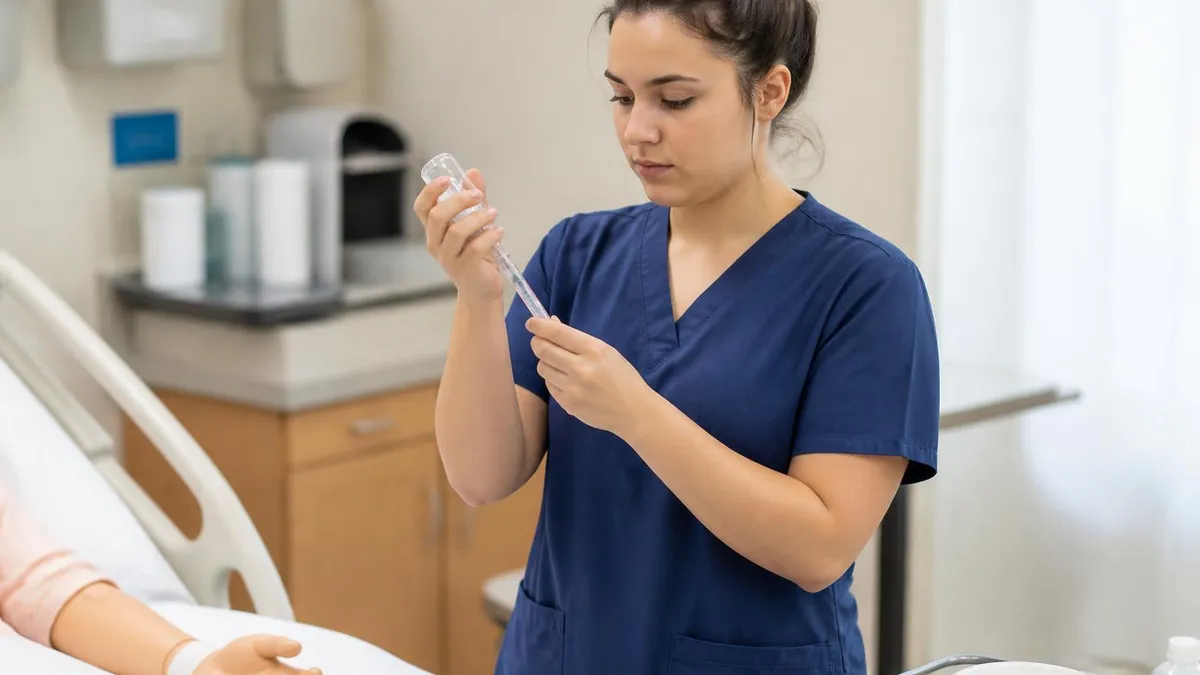
Fundamentals of nursing covers the bread-and-butter skills LPNs use every shift: assessment, hygiene, mobility, nutrition, elimination, oxygenation, fluid and electrolyte balance, wound care, and infection control. The companion skills lab is where you practice each skill on manikins and rubber arms until your instructor signs off. Programs require check-offs—graded demonstrations where you perform a skill from memory in front of faculty—and most students need two or three attempts on the harder skills like sterile catheter insertion or tracheostomy suctioning.
Medical-surgical nursing, often called med-surg, is the longest single course in the program. It walks system by system through common adult conditions: cardiovascular disease, respiratory disorders, diabetes, renal failure, GI bleeds, cancer, and neurological problems like stroke. The volume of content is enormous, and most students describe med-surg as a fire hose. Effective study strategies include concept maps linking pathophysiology to assessment findings to nursing actions, and weekly NCLEX-style practice questions to build clinical reasoning rather than rote memorization.
Specialty courses round out the program. Maternal-newborn nursing teaches prenatal care, labor and delivery support, postpartum assessment, and basic neonatal care. Pediatrics covers growth and development, immunization schedules, and common childhood illnesses. Mental health introduces therapeutic communication, common psychiatric diagnoses, and de-escalation techniques. Gerontology focuses on age-related changes, dementia care, polypharmacy risks, and end-of-life nursing. Each specialty typically includes its own clinical rotation, so you experience the patient population firsthand.
Many programs now embed standardized testing throughout the curriculum—ATI, HESI, or Kaplan products that benchmark your performance against national norms. These tests serve two purposes: they identify your weak content areas while there is still time to study, and they predict your NCLEX-PN performance. Students scoring below the 50th percentile on the final exit exam often must complete remediation before being cleared to sit for the NCLEX, so taking these benchmarks seriously throughout the program is non-negotiable.
LPN Practice Test Questions
Prepare for the LPN - Certified Practical Nurse exam with our free practice test modules. Each quiz covers key topics to help you pass on your first try.
LPN - Certified Practical Nurse Basic Care...
LPN Exam Questions covering - Certified Practical Nurse Basic Care and Comfort. Master LPN Test concepts for certification prep.
LPN - Certified Practical Nurse Coordinate...
Free LPN Practice Test featuring - Certified Practical Nurse Coordinated Care. Improve your LPN Exam score with mock test prep.
LPN - Certified Practical Nurse Health Pro...
LPN Mock Exam on - Certified Practical Nurse Health Promotion and Maintenance. LPN Study Guide questions to pass on your first try.
LPN - Certified Practical Nurse Pharmacolo...
LPN Test Prep for - Certified Practical Nurse Pharmacological Therapies. Practice LPN Quiz questions and boost your score.
LPN - Certified Practical Nurse Physiologi...
LPN Questions and Answers on - Certified Practical Nurse Physiological Adaptation. Free LPN practice for exam readiness.
LPN - Certified Practical Nurse Psychosoci...
LPN Mock Test covering - Certified Practical Nurse Psychosocial Integrity. Online LPN Test practice with instant feedback.
LPN - Certified Practical Nurse Reduction ...
Free LPN Quiz on - Certified Practical Nurse Reduction of Risk Potential. LPN Exam prep questions with detailed explanations.
LPN - Certified Practical Nurse Safety and...
LPN Practice Questions for - Certified Practical Nurse Safety and Infection Control. Build confidence for your LPN certification exam.
LPN Ethical, Legal & Professional Standards
LPN Test Online for Ethical, Legal & Professional Standards. Free practice with instant results and feedback.
LPN Health Evaluation & Monitoring
LPN Study Material on Health Evaluation & Monitoring. Prepare effectively with real exam-style questions.
Clinical Rotations in an LPN Training Program
Most programs begin clinicals on a general medical-surgical floor in a community hospital. Students typically arrive at 6:30 a.m. for shift report, receive one or two patient assignments, and perform morning assessments, medication passes, hygiene care, ambulation, and documentation under the watchful eye of a clinical instructor and a staff nurse preceptor.
A typical med-surg rotation runs 12 to 16 weeks, two days per week, eight hours per day. You will see post-op recovery, heart failure exacerbations, pneumonia, diabetic complications, and end-of-life care. Expect to write detailed care plans on every patient and complete clinical paperwork the same evening, often adding three to four hours of work beyond the shift itself.
LPN Training Program vs RN Program: Should You Start Here?
- +Significantly shorter time to licensure (12-18 months vs 2-4 years for RN)
- +Lower total tuition cost, often under $15,000 at community colleges
- +Faster entry into a paying healthcare job with full benefits
- +Real-world experience that strengthens future RN bridge applications
- +Strong job demand in long-term care, home health, and clinics
- +Easier admission requirements than competitive ADN or BSN programs
- +Many employers offer tuition reimbursement for LPN-to-RN bridge programs
- −Lower lifetime earning ceiling compared to RN or BSN-prepared nurses
- −Limited scope of practice (no independent IV push in many states)
- −Some hospital systems are phasing out LPN positions in acute care
- −Bridge programs add time and cost if RN is the ultimate goal
- −Heavy clinical schedule still demands full-time commitment
- −Fewer specialization options than RN or advanced practice roles
- −Pass rates and program quality vary widely between schools
LPN Training Program Admission Checklist
- ✓Earn a high school diploma or GED with a minimum 2.5 cumulative GPA
- ✓Complete prerequisite courses such as biology, English, and basic math with a C or better
- ✓Take and pass the TEAS or HESI A2 entrance exam (scores typically valid two years)
- ✓Submit a completed application with official transcripts before the program deadline
- ✓Provide proof of MMR, hepatitis B, varicella, Tdap, and annual influenza immunizations
- ✓Pass a criminal background check through your state nursing board's approved vendor
- ✓Complete a urine drug screen within 30 days of the program start date
- ✓Obtain current American Heart Association BPS Provider CPR certification
- ✓Purchase scrubs, white shoes, a stethoscope, blood pressure cuff, and required textbooks
- ✓Secure proof of health insurance coverage and personal liability insurance if required
- ✓Attend the mandatory program orientation and sign the student handbook acknowledgment
- ✓Confirm transportation and childcare arrangements for clinical days that may start at 6 a.m.
Verify your program is board-approved before paying a deposit
The single most important question to ask any LPN program is whether it is approved by your state board of nursing and accredited by ACEN or COE. Graduates of unapproved programs cannot sit for the NCLEX-PN, meaning the tuition you paid yields no license and no job. Every state board publishes its approved program list online—check it yourself and do not rely on a school's marketing claims.
Total cost of an LPN training program varies more than most prospective students realize. A community college program in the Midwest may charge $6,000 to $10,000 for in-district residents, all-in including books and lab fees. The same training at a private vocational school in California or New York can exceed $40,000. When you account for opportunity cost—the wages you forgo while studying full-time—the true cost of any program climbs considerably higher than the sticker tuition figure.
Beyond tuition, fixed costs run between $1,500 and $3,500 and rarely get adequate attention in school brochures. These include textbooks ($600-$1,200), uniforms and shoes ($200-$400), a quality stethoscope and blood pressure cuff ($150-$300), a watch with a second hand ($25-$80), nursing pen lights and bandage scissors ($30-$60), liability insurance ($35-$100 annually), background check and drug screen fees ($75-$150), the standardized testing package such as ATI or HESI ($400-$900), and the NCLEX-PN exam fee itself ($200).
Financial aid is widely available to LPN students attending accredited programs. The Free Application for Federal Student Aid (FAFSA) opens access to Pell Grants up to $7,395 annually for the 2025-2026 award year, plus Direct Subsidized and Unsubsidized loans. Many community colleges also offer institutional scholarships specifically for nursing students, and hospital systems frequently sponsor tuition reimbursement programs in exchange for a two-year employment commitment after graduation. These can effectively zero out tuition for students willing to commit.
State workforce programs deserve a careful look. Workforce Innovation and Opportunity Act (WIOA) funding can cover tuition, books, fees, and even childcare for displaced workers and low-income adults entering high-demand fields like practical nursing. Eligibility runs through your state's workforce development board or local American Job Center. Veterans should explore VA education benefits, including the Post-9/11 GI Bill, which covers tuition plus a monthly housing stipend during full-time enrollment.
Hidden costs catch many students off guard. Clinical sites may require parking permits ($50-$200 per semester), specific shoes that meet hospital dress code ($80-$150), color-coded scrubs that change between rotations, and additional vaccinations like the Bacillus Calmette-Guerin or N95 fit testing. Some programs charge separate fees for skills lab supplies, simulation equipment access, and graduation pinning ceremonies that can add another $300-$500 in the final semester.
Opportunity cost is the silent tuition multiplier. Most LPN programs require 25 to 35 contact hours per week between class and clinical, plus another 20 to 30 hours of study and clinical paperwork. That schedule effectively rules out full-time employment for most students. If you currently earn $40,000 annually, the income forgone during a 14-month program is roughly $47,000—often three to five times the actual tuition cost. Part-time or evening programs exist but typically extend the timeline to 24 months.
Return on investment remains strong despite the costs. Median LPN wages of $59,730 annually with relatively low debt loads produce one of the better short-term ROI calculations in healthcare education. Many students recover their full educational investment within the first 12 to 18 months on the job, especially if they begin in higher-paying long-term care or correctional nursing roles. Pairing LPN work with a tuition-reimbursed RN bridge program is a particularly cost-efficient pathway to advance further.
Several large for-profit nursing school chains have closed abruptly in recent years, stranding students mid-program with debt and no transferable credits. Before enrolling, verify NCLEX-PN pass rates published by your state board, confirm regional accreditation, and search the institution's name in the U.S. Department of Education's Postsecondary Education Participants System (PEPS) for any active enforcement actions or heightened cash monitoring status.
The NCLEX-PN is the final hurdle between graduation and a working license. The exam is administered by Pearson VUE on behalf of the National Council of State Boards of Nursing (NCSBN) and uses computerized adaptive testing (CAT), which means the questions adjust in difficulty based on your performance. You may finish in as few as 85 questions or be required to answer up to 150, with a maximum testing time of five hours including breaks. The pass/fail decision is made when the computer is 95% confident in your ability level.
The 2023-2025 NCLEX-PN test plan distributes questions across four major client need categories. Safe and Effective Care Environment, which includes coordinated care and safety and infection control, represents 28-42% of the exam. Health Promotion and Maintenance accounts for 6-12%, Psychosocial Integrity covers 9-15%, and Physiological Integrity—the largest single category—comprises 49-62% of all items, including basic care and comfort, pharmacological therapies, reduction of risk potential, and physiological adaptation.
Next Generation NCLEX (NGN) item types have transformed exam preparation. Beyond traditional multiple-choice and select-all-that-apply formats, students now encounter case studies with unfolding clinical scenarios, drag-and-drop ordering items, matrix grids requiring multiple correct selections, and bowtie questions that test the entire clinical judgment cycle. These items award partial credit, which slightly changes how you should approach each scenario—every reasonable choice matters, not just the single best answer.
Effective NCLEX-PN preparation begins inside the LPN training program itself. Students who consistently complete ATI or HESI practice assessments, work through a question bank of 2,000 to 3,000 practice questions before graduation, and review the rationales for every wrong answer pass at substantially higher rates than students who cram a single review course in the weeks after graduation. The strongest predictor of NCLEX success in most programs is the final HESI Exit Exam score, where 850 or above correlates with greater than 95% first-attempt pass rates.
Authorization to Test (ATT) timing matters more than students expect. After graduation, your program submits a completion verification to the state board, you submit your licensure application with fees ($150-$300 depending on state), and once approved you receive the ATT email from Pearson VUE. Most candidates can schedule their exam within one to two weeks. Statistical evidence consistently shows that testing within 30 to 45 days of graduation produces higher pass rates than waiting longer, because content retention degrades sharply after the program ends.
Test day logistics deserve advance planning. Arrive at the Pearson VUE testing center 30 minutes early with two forms of valid identification, leave all electronics in your locker, and expect a thorough check-in process including a palm vein scan and a digital signature. The center provides a dry-erase board for calculations. Breaks are optional and self-initiated, but the clock keeps running and the secondary check-in process consumes several minutes, so most candidates take only one short break around the midway point.
Results are released through the Quick Results service 48 hours after testing for a $7.95 fee, with official notification from your state board following within 7 to 14 business days. A passing result triggers automatic license issuance in most states, and your name appears on the state board's public license verification database, which is what employers check before extending offers. A failing result includes a Candidate Performance Report detailing your weakest content areas, and you may retest after a 45-day waiting period.
Practical study habits separate students who finish an LPN training program on time from those who struggle through extensions, course retakes, or program dismissal. The single most valuable habit is establishing a fixed study schedule from week one—ideally two hours every weekday evening and four to six hours each weekend, distributed across all current courses rather than crammed into the night before an exam. Consistency builds the kind of long-term memory the NCLEX rewards; cramming does not.
Active learning beats passive rereading every time. Instead of highlighting your textbook or rewatching recorded lectures, force yourself to recall material without looking. Cover the page after reading a paragraph and explain the concept aloud as if teaching another student. Create concept maps that link pathophysiology to assessment findings to nursing interventions. Work practice questions every day, even early in the program—the act of retrieving knowledge under pressure is what strengthens neural pathways for exam-day recall.
Form a study group of three to five committed classmates and meet at least twice weekly. The most productive groups assign specific topics to each member, who then teaches the others. Teaching forces you to organize your thinking and exposes gaps you did not know existed. Avoid passive group sessions where everyone reads quietly together—those produce social bonding but little academic benefit. Use group time for question-bank review, case-study discussion, and skills practice.
Clinical preparation is its own discipline. The night before each clinical day, review your assigned patients' diagnoses, medications, and lab values. Build a one-page brain sheet with your morning timeline: assessments at 7, medications at 8, treatments at 9, charting throughout. Anticipate the three or four most likely problems for each patient and pre-plan your nursing interventions. Students who arrive prepared get more learning opportunities because instructors trust them with greater responsibility.
Time management outside of school determines whether the program is survivable. Block your calendar in 15-minute increments for the first two weeks to discover where your time actually goes. Eliminate or delegate everything possible: meal prep on Sundays, automate bill payments, reduce social commitments, and have an honest conversation with family members about reduced availability. Most successful LPN students report that the program effectively becomes their full-time job for the duration, and treating it that way produces better outcomes.
Self-care is non-negotiable, not optional. Sleep deprivation directly degrades clinical reasoning, medication math accuracy, and exam performance. Aim for seven to eight hours nightly and protect your sleep schedule even during exam weeks. Regular exercise—even 20-minute walks—improves mood and cognitive function. Maintain at least one non-nursing social outlet to prevent burnout. Counseling services through the school are widely available and underused; reach out at the first sign that stress is overwhelming your coping ability.
Finally, identify your weak content areas early and remediate aggressively. If your first pharmacology exam grade falls below 80%, do not wait for the next test to address the problem. Meet with the instructor during office hours, hire a tutor through the campus tutoring center, work an additional 50 to 100 practice questions per week, and review the failed exam item by item until you understand every wrong answer. Small course corrections in week three are infinitely easier than course recovery in week twelve.
LPN Questions and Answers

LPN Practice Test PDF (Free Printable 2026)
Wound Care Certification for LPN: 2026 Complete Guide to WCC, CWCA & Specialty Credentials
LPN Program Cost: Complete 2026 Tuition & Fees Guide
LPN Programs Near Me 2026: Find Accredited Schools & Costs
Macomb LPN Program: Complete 2026 Guide to Specific LPN Programs, Admission Requirements, Cost & Career Outcomes
About the Author

Registered Nurse & Healthcare Educator
Johns Hopkins University School of NursingDr. Sarah Mitchell is a board-certified registered nurse with over 15 years of clinical and academic experience. She completed her PhD in Nursing Science at Johns Hopkins University and has taught NCLEX preparation and clinical skills courses for nursing students across the United States. Her research focuses on evidence-based exam preparation strategies for healthcare certification candidates.
Join the Discussion
Connect with other students preparing for this exam. Share tips, ask questions, and get advice from people who have been there.
View discussion (7 replies)