
LPN Job Openings 2026 September: Where to Find Positions, What to Expect, and How to Get Hired Fast
Explore LPN job openings across top settings, salaries & hiring tips. 🎯 Find where positions are growing fastest and how to stand out.
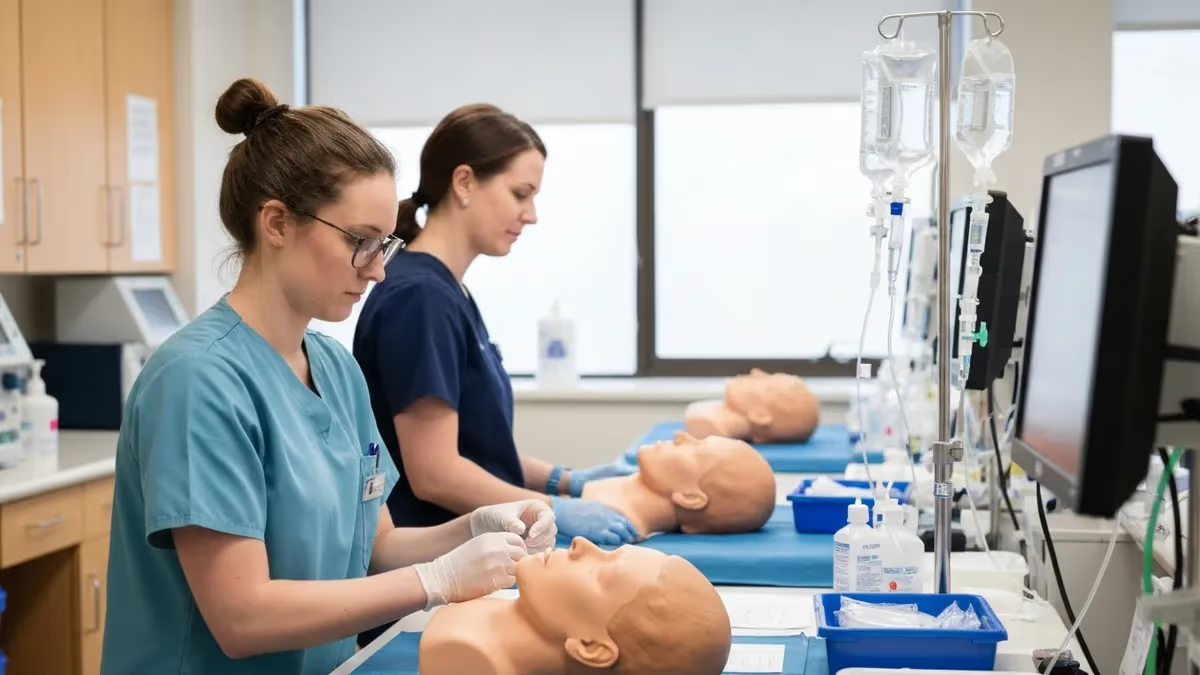
LPN job openings are more plentiful in 2026 than at almost any other point in recent history, driven by an aging population, expanded long-term care infrastructure, and persistent nursing workforce shortages across the United States. The Bureau of Labor Statistics projects employment of licensed practical and licensed vocational nurses to grow 5 percent through 2032, adding roughly 57,500 new positions on top of the hundreds of thousands of annual replacement openings that arise as experienced nurses retire or change careers. If you are exploring lpn job openings right now, the market conditions are strongly in your favor.
Understanding where those openings are concentrated and what employers expect from applicants is the most direct path to a fast, successful hire. Nursing homes and skilled nursing facilities account for the largest single share of LPN employment, but hospitals, home health agencies, physician offices, correctional facilities, and schools all compete aggressively for the same pool of candidates. Each setting offers a distinct mix of patient acuity, scheduling flexibility, pay structures, and advancement potential, so matching your personal priorities to the right environment matters as much as possessing the core clinical license itself.
Compensation is a major driver for most job seekers, and the numbers have moved substantially over the past few years. The national median annual wage for LPNs sits near $58,000, but experienced nurses in high-cost metropolitan markets routinely earn $70,000 to $80,000 or more, especially when shift differentials, overtime, and sign-on bonuses are factored in. Travel LPN contracts can push total compensation even higher, sometimes reaching six figures for nurses willing to accept short-term placements in underserved regions or facilities facing acute staffing crises.
The job search process itself has shifted dramatically toward digital platforms. Job boards such as Indeed, ZipRecruiter, and LinkedIn post thousands of LPN openings every week, and dedicated healthcare staffing sites like NurseFly, Vivian Health, and Trustaff aggregate travel and permanent positions in one searchable interface. State nursing workforce websites and hospital career portals are equally important, particularly for positions at large health systems that prefer direct applicants over agency referrals. Setting up email alerts with precise filters on specialty, shift type, and geography dramatically reduces the time from search to interview.
Certifications beyond the basic LPN license consistently appear in job postings as either required or strongly preferred qualifications. IV therapy certification, basic life support credentials, wound care training, and specialty certificates in dialysis, oncology, or geriatrics all make a candidate more competitive, especially when applying to openings that would otherwise attract a large applicant pool. Employers routinely sort resumes by certifications before reviewing work history, so front-loading your credentials section is a tactical decision with real financial consequences.
Networking remains underestimated as a job-finding strategy in nursing, yet internal referrals account for a disproportionate share of successful hires at many healthcare organizations. Clinical rotations, LPN-to-RN bridge program cohorts, professional associations like the National Association of Licensed Practical Nurses, and even continuing education workshops are all legitimate networking channels that can surface unadvertised openings. A brief conversation with a unit manager after a volunteer shift or a shadowing day can sometimes move a candidate from the application pile to the interview schedule within 48 hours.
Preparation for the hiring process should begin well before you submit your first application. A polished, healthcare-specific resume, a compelling cover letter that speaks to the employer's patient population, and a set of references from clinical supervisors who can speak to your competence and reliability are all table stakes. Knowing how to articulate your clinical skills clearly in behavioral interview questions, and being ready to discuss how your exam preparation translated into day-one competency, gives you a measurable edge over candidates who treat the interview as an afterthought.
LPN Job Market by the Numbers

Top Hiring Settings for LPN Job Openings
SNFs and long-term care facilities employ more LPNs than any other sector. Roles involve medication administration, wound care, resident assessments, and care plan coordination. Demand is growing fast as the population over 65 expands year over year.
Home health is one of the fastest-growing segments for LPN openings. Nurses visit patients in their residences for wound care, medication management, and chronic disease monitoring. Flexible scheduling and strong patient relationships make this setting highly popular.
Outpatient clinics and private practices regularly post LPN openings for roles covering triage, vital signs, patient education, and care coordination. Day-shift hours and stable schedules make these positions extremely competitive despite often-lower base salaries.
While RNs dominate hospital floors, LPNs fill vital support roles in med-surg units, rehabilitation wings, and specialty departments. Hospital positions frequently offer the highest hourly rates plus shift differentials for evenings, nights, and weekends.
County jails, state prisons, and federal detention facilities consistently post LPN openings that remain unfilled for months. Compensation is often 10 to 20 percent above market rate to attract nurses comfortable with the unique demands of correctional healthcare.
Salary variation across settings and states is one of the most important factors to evaluate when reviewing LPN job openings, because the same core skill set can command dramatically different compensation depending on geography and employer type. California consistently ranks as the highest-paying state for LPNs, with median wages exceeding $67,000 annually and experienced nurses in the San Francisco Bay Area or Los Angeles metro earning well above $80,000. Massachusetts, Alaska, and Washington State round out the top tier, all posting median wages above $60,000 and strong benefit packages that include retirement contributions and tuition reimbursement.
In contrast, Southern and Midwestern states tend to offer lower base wages, with medians in the low to mid $40,000 range in states like Alabama, Mississippi, and South Dakota. However, cost of living adjustments paint a more nuanced picture: a $45,000 salary in rural Iowa stretches considerably further than a $65,000 salary in metropolitan California, and many nurses in lower-wage states report higher quality of life and shorter commutes than their coastal counterparts. Regional job boards and state hospital association websites often publish annual wage surveys that allow direct comparisons adjusted for local cost of living.
Within any given state, the specific setting drives significant pay differences that job seekers should factor carefully into their decisions. Hospitals almost universally pay more per hour than nursing homes or physician offices, but they also typically require shift work, mandatory overtime, and higher patient acuity than many LPNs prefer.
Home health agencies occupy the middle ground: compensation is competitive, especially for nurses willing to travel across a wide service territory, and the scheduling flexibility is unmatched. Travel LPN contracts available through staffing agencies can push weekly take-home pay to $1,400 to $2,200 or more, which for nurses without geographic constraints represents an exceptional short-term earnings opportunity.
Sign-on bonuses have become a standard feature of LPN job openings at facilities struggling to maintain staffing ratios. Bonuses ranging from $2,000 to $10,000 are common at skilled nursing facilities and home health agencies in high-demand regions, with larger amounts—sometimes $15,000 or more—offered for hard-to-fill night shifts or rural postings. These bonuses typically come with a service commitment of 12 to 24 months, so candidates should read the repayment clauses carefully before accepting, since leaving early can trigger full or partial repayment obligations that eliminate the financial benefit entirely.
Shift differentials add a meaningful layer on top of base pay for nurses willing to work evenings, nights, or weekends. Evening differentials typically run $1.50 to $3.00 per hour above the base rate, while night and weekend differentials can reach $4.00 to $6.00 per hour at high-acuity facilities.
A full-time LPN consistently working night shifts could earn an additional $6,000 to $12,000 per year over a day-shift colleague with the same base hourly rate. Understanding how to calculate total annual compensation—base plus differential plus bonus plus overtime—is essential for comparing job offers that look similar on the surface but differ substantially in real income.
Benefits beyond salary deserve equal attention when evaluating LPN job openings, particularly for candidates early in their careers who stand to gain the most from employer-sponsored education benefits. Tuition reimbursement programs that cover LPN-to-RN bridge coursework are offered by many hospital systems and large long-term care chains, transforming a staff LPN role into a funded pathway toward an associate or bachelor's degree in nursing. Health insurance, paid time off, malpractice coverage, and 401(k) matching with employer contributions all add tangible financial value that should be quantified and compared across competing offers.
Negotiating compensation confidently is a skill that many new LPN graduates underutilize. Knowing the market rate for your specialty, certifications, and geographic area—information readily available from the BLS Occupational Employment and Wage Statistics program, state nursing association surveys, and salary aggregators like Glassdoor and Salary.com—gives you a factual foundation for asking for more. Employers expect negotiation, and the worst realistic outcome is that the offer remains unchanged. Starting your LPN career at the highest defensible salary has compounding benefits, since future raises and offers from other employers are almost always anchored to your current pay.
Where and How to Search for LPN Job Openings
Indeed, LinkedIn, ZipRecruiter, and Glassdoor are the most trafficked general job boards for LPN openings, each aggregating postings from hospitals, staffing agencies, and private employers simultaneously. Setting up saved searches with email alerts using filters for specialty, shift type, and radius from your zip code means new postings reach your inbox within hours of going live, giving you a competitive first-mover advantage over candidates who check boards manually once per week.
Healthcare-specific platforms like Vivian Health, NurseFly, Trusted Health, and NurseRecruiter go deeper than general boards, allowing you to filter by license compact state, facility type, and contract length. These platforms also display verified pay packages for travel positions, removing the guesswork from evaluating agency offers. Creating a complete, photo-verified profile on at least two healthcare-specific boards dramatically increases the volume of recruiter outreach you receive, since many facilities now actively source candidates rather than waiting for applications.

Is This the Right Time to Pursue LPN Job Openings?
- +Record high number of open LPN positions nationwide with low competition in many regions
- +Sign-on bonuses of $2,000–$15,000 available at facilities struggling to meet staffing targets
- +Travel contracts offer six-figure total compensation for nurses willing to relocate temporarily
- +Compact nursing license allows practice in 40+ states without additional licensure fees
- +Multiple care settings to choose from—long-term care, home health, hospitals, outpatient clinics
- +Employer-sponsored LPN-to-RN tuition benefits available at many large healthcare systems
- −High-demand settings like SNFs often require night or weekend shifts with limited flexibility
- −Sign-on bonus repayment clauses can lock you into a facility for 12–24 months
- −Pay gaps between states are significant—rural areas may offer 30% less than coastal metros
- −LPN scope of practice is more limited than RN in hospital settings, narrowing some roles
- −Correctional and psychiatric LPN openings carry unique safety risks requiring extra preparation
- −Physician office roles offer stable hours but frequently pay less than acute or long-term care
Pros and Cons at a Glance
| Pros | Cons |
|---|---|
| Record high number of open LPN positions nationwide with low competition in many regions | High-demand settings like SNFs often require night or weekend shifts with limited flexibility |
| Travel contracts offer six-figure total compensation for nurses willing to relocate temporarily | LPN scope of practice is more limited than RN in hospital settings, narrowing some roles |
| Multiple care settings to choose from—long-term care, home health, hospitals, outpatient clinics | Correctional and psychiatric LPN openings carry unique safety risks requiring extra preparation |
| Employer-sponsored LPN-to-RN tuition benefits available at many large healthcare systems | Physician office roles offer stable hours but frequently pay less than acute or long-term care |
LPN Job Application Checklist: What You Need Ready Before You Apply
- ✓Confirm your LPN license is active and in good standing with your state board of nursing.
- ✓Verify whether your state participates in the Nurse Licensure Compact (NLC) to expand your geographic eligibility.
- ✓Update your resume with a dedicated certifications section listing BLS, IV therapy, and any specialty credentials.
- ✓Write a customized cover letter that directly references the facility type and patient population in the job posting.
- ✓Gather three professional references from clinical supervisors or charge nurses who can speak to your hands-on performance.
- ✓Prepare concrete answers to behavioral interview questions using the STAR (Situation, Task, Action, Result) format.
- ✓Research the salary range for the specific role, setting, and metro area using BLS and Glassdoor data before your interview.
- ✓Create profiles on at least two healthcare-specific job platforms and set up daily email alerts for your target role and region.
- ✓Identify two or three large employers in your area and apply directly through their career portals as well as general boards.
- ✓Gather and scan all credentialing documents—nursing school diploma, NCLEX-PN results letter, immunization records, and CPR card—for digital upload.
Compact License States Expand Your Options by 10x
If you hold an LPN license in a Nurse Licensure Compact (NLC) member state, you can legally practice in more than 40 participating states without applying for additional licenses. This single credential multiplier opens thousands of travel contract opportunities and dramatically expands the geographic scope of your job search at zero additional cost. Confirm your home state's compact status at the NCSBN website before assuming you need a new application in every target market.
Standing out in a competitive LPN job market requires more than a clean license and a formatted resume—it demands a deliberate personal branding strategy that communicates clinical competence, professional reliability, and interpersonal fit before you ever walk through a hiring manager's door. The most successful LPN candidates approach the job search the same way they would approach a patient care plan: with clear goals, specific interventions, measurable milestones, and a willingness to adapt based on real-time feedback from each application cycle they complete.
One of the highest-use steps any LPN candidate can take is to earn an additional specialty certification that directly aligns with the type of opening they are targeting. For candidates pursuing skilled nursing facility positions, a certification in gerontological nursing or wound care signals specialized training that generic applicants lack. For candidates targeting pediatric clinics or schools, a pediatric first aid credential and documented experience with childhood immunization schedules adds credibility. Employers operating with thin training budgets increasingly prefer candidates who arrive capable of contributing on day one without a lengthy onboarding investment.
Professional references deserve much more strategic attention than most job seekers give them. Generic character references from former supervisors who barely remember your work contribute almost nothing to a hiring decision. Instead, cultivate three to five specific reference relationships during clinical rotations and early employment: a charge nurse who observed your medication administration technique under pressure, a clinical educator who can describe your documentation accuracy, a facility director who can speak to your attendance record and attitude. Priming these references before they receive a call—reminding them of specific patient scenarios you handled well—results in measurably more compelling employer conversations.
Your digital footprint increasingly influences whether a recruiter pursues you or moves on to the next candidate. A professional LinkedIn profile with a current headshot, complete work history, endorsements for clinical skills from former colleagues, and a brief summary that clearly articulates your specialty and availability is now a baseline expectation rather than a bonus. Many healthcare recruiters search LinkedIn specifically for passive candidates—nurses currently employed but open to opportunities—and a well-optimized profile means you get contacted about openings you never would have found through active searching alone.
Interview preparation for LPN positions has evolved significantly beyond the standard list of clinical competency questions. Behavioral interviews using the STAR format—Situation, Task, Action, Result—are now standard at hospitals and large long-term care chains.
Practicing your answers to questions like "Describe a time you caught a medication error before it reached a patient" or "Tell me about a difficult family member and how you managed the conversation" with specific, data-grounded examples demonstrates the kind of reflective clinical judgment that separates strong candidates from the average applicant pool. Recording yourself answering questions on video and reviewing the playback for filler words, hesitations, and non-verbal cues is a preparation technique that consistently improves interview performance.
Following up after every interview with a personalized thank-you email within 24 hours is a simple behavior that surprisingly few candidates execute consistently. The email should reference a specific conversation point from the interview—the unit's staffing model, a particular patient population challenge the manager mentioned, a policy the facility recently implemented—to demonstrate genuine attention and interest. Hiring managers making decisions between two equally qualified candidates frequently tip toward the one who demonstrated greater enthusiasm and professionalism throughout the process, and a well-crafted thank-you email is one of the lowest-effort ways to tilt that decision in your favor.
Finally, tracking your job search with a simple spreadsheet—recording every application submitted, the date, the hiring contact's name, and the current status—allows you to follow up strategically without losing track of promising leads. Many LPN candidates apply broadly and then never follow up on applications that entered a hiring pipeline but stalled. A brief, professionally worded follow-up email to a recruiter one to two weeks after application submission frequently revives interest in your candidacy and communicates the kind of proactive communication style that nursing supervisors value highly in day-to-day clinical operations.

Sign-on bonuses for LPN openings almost always come with a contractual commitment requiring repayment—sometimes 100 percent of the bonus amount—if you leave before the end of the service period, typically 12 to 24 months. Read the bonus agreement carefully before signing, confirm how repayment is calculated if you leave mid-contract, and factor the commitment into your decision if you expect your personal circumstances to change within the next two years.
Advancing your LPN career beyond your first position is a realistic and well-supported goal in 2026, given the number of healthcare employers actively investing in their frontline workforce as a retention strategy. The most straightforward vertical path is the LPN-to-RN bridge program, a curriculum structure that accepts active LPN licensure as equivalent to the foundational nursing coursework and allows completion of an associate degree in nursing or bachelor of science in nursing in a compressed timeline of one to two years.
Dozens of community colleges and online universities offer hybrid or fully online LPN-to-RN programs designed specifically for working nurses who need to maintain employment while advancing their education.
Lateral moves into specialty areas can increase both compensation and professional satisfaction without requiring an additional degree. LPNs with two or more years of experience in medical-surgical settings are strong candidates for specialty unit positions in dialysis centers, infusion clinics, and rehabilitation facilities, all of which pay premiums for nurses with demonstrated clinical competence and specialty-relevant certifications. Dialysis LPNs with BONENT certification, for example, regularly earn $5,000 to $10,000 more per year than comparable nurses in general long-term care settings, purely because of the specialized skill set involved.
Leadership and charge nurse roles represent another advancement pathway that is accessible to experienced LPNs without requiring a higher degree in many facility types. Skilled nursing facilities and home health agencies routinely promote high-performing LPNs to charge nurse, team leader, or supervisor positions that carry pay increases of 10 to 20 percent over staff nurse rates. These roles provide management experience that strengthens an LPN's application to RN programs and, later, to advanced practice or administration positions that require demonstrated leadership at the bedside level.
Teaching and preceptorship opportunities are increasingly available to experienced LPNs through vocational nursing programs at community colleges and career technical education centers. Serving as an adjunct clinical instructor or preceptor for student LPNs provides supplemental income, builds professional credibility, and keeps your clinical knowledge sharp in ways that routine bedside practice may not. Many LPN preceptors report that explaining foundational skills to students reinforced their own clinical reasoning and helped them identify gaps in their knowledge that they subsequently addressed through continuing education.
Professional association membership is an often-overlooked career accelerant that pays dividends across the entire arc of an LPN's working life. The National Association of Licensed Practical Nurses offers networking events, advocacy resources, and continuing education at reduced member rates.
State affiliate organizations run annual conferences that bring together LPNs from all specialties and settings, creating relationship-building opportunities with clinical educators, nurse executives, and industry vendors that simply do not happen in isolation at a single facility. These relationships are frequently the source of unadvertised job openings that go directly from a hiring manager's network to a trusted colleague before any public posting is made.
Documenting your professional development activities in a portfolio is a habit that pays compounding returns over an entire nursing career. Maintaining records of every certification earned, continuing education course completed, performance review received, and patient satisfaction commendation filed creates a verifiable professional narrative that supports salary negotiations, promotion applications, and graduate school admissions. Many experienced LPNs who never kept systematic records find themselves unable to reconstruct their full professional history when they need it most—during a career pivot or when applying to a competitive RN program with limited enrollment spots.
The long-term trajectory for LPNs who invest consistently in their skills, credentials, and professional networks is genuinely positive in 2026. Workforce data consistently shows that healthcare employers are more willing than ever to pay competitive compensation, fund continuing education, and create flexible scheduling arrangements to retain skilled practical nurses who deliver reliable, high-quality patient care.
Whether your goal is to remain at the bedside for the entirety of your career or to use the LPN credential as a stepping stone toward RN licensure and advanced practice, the foundation you build in your early years through strategic job selection, professional development, and active networking will define the ceiling of what you are able to achieve in the decade ahead.
Practical preparation strategies for landing your first or next LPN position begin with a brutally honest skills audit. Sit down with a blank sheet and list every clinical skill you have performed independently, every piece of equipment you are trained to use, every patient population you have cared for, and every documentation system you have operated. This inventory becomes the raw material for your resume's skills section, your responses to competency-based interview questions, and your self-identification of gaps that additional training or certification could close before you begin applying to your target roles.
Targeting your job search geographically requires more nuance than simply searching your home city. Facilities located in suburban and rural areas surrounding major metropolitan markets frequently offer salaries within 10 to 15 percent of urban rates while carrying dramatically lower costs of living, shorter commutes, and stronger sense of community among staff. Many experienced LPN job seekers report that expanding their search radius by just 20 to 30 miles revealed openings at high-quality facilities that they would never have found by filtering only within city limits, and that the positions came with far less competition from other applicants.
Timing your job search to align with the budget cycles and seasonal staffing patterns of healthcare facilities is a tactical insight that most candidates never consider. Long-term care facilities experience their highest staff turnover in January and February following the holiday season, creating a surge of new openings that peaks in March and April.
Hospital systems frequently open new positions in late spring ahead of summer census increases and in September following academic year transitions. Applying at these peak periods means more openings to choose from and, in some cases, more urgency on the employer's side—a combination that favors candidates willing to move quickly through the hiring process.
Following up on your application through LinkedIn is increasingly accepted and expected rather than considered intrusive. Sending a brief, professional connection request to the recruiter or hiring manager listed on the job posting—accompanied by a note that references your application and expresses specific interest in the role—demonstrates initiative and allows you to move your candidacy from a database queue to an actual human conversation.
Recruiters managing dozens of open positions simultaneously are more likely to prioritize candidates who demonstrate genuine enthusiasm through proactive outreach over those who submit applications and wait passively for a response that may take weeks to arrive.
Practicing your clinical interview responses out loud, ideally with a colleague or mentor who can provide honest feedback, is a preparation step that many candidates skip because it feels uncomfortable.
The discomfort is precisely the point: verbalizing your clinical experiences in real time under mild social pressure is directly analogous to the cognitive demands of a hiring interview, and the rehearsal reduces the likelihood of blanking on key details when your answer actually matters. Aim to practice at least ten to fifteen behavioral questions specific to the setting you are targeting, and record yourself doing it so you can review the playback critically.
Understanding the NCLEX-PN content areas deeply also helps in job interviews, because many hiring managers use exam-aligned questions to probe clinical reasoning. Demonstrating that you understand pharmacological safety priorities, physiological adaptation, and care coordination principles—not just as exam topics but as lived clinical realities—signals a level of professional preparation that resonates with experienced nursing supervisors. Connecting your exam study to real patient scenarios in your answers shows intellectual depth that distinguishes you from candidates who view the licensure exam as a checkbox rather than a genuine clinical competency assessment.
Finally, approach every interview as a two-way evaluation rather than a one-directional audition. Asking thoughtful questions about the facility's nurse-to-patient ratios, orientation length, staff retention rates, and advancement policies signals that you are a discerning professional who values workplace quality—not just someone eager to accept any offer. Hiring managers who encounter candidates asking substantive questions about the work environment consistently report higher confidence in those candidates' long-term job satisfaction and retention, which directly benefits the facility's bottom line and makes you a more attractive hire even before salary negotiations begin.
LPN Questions and Answers

LPN Requirements 2026: Complete Guide to Becoming a Licensed Practical Nurse

LPN IV Certification: Complete 2026 Guide to Training, Requirements & Cost

LPN Programs in Florida: Complete 2026 Guide to Accredited Schools, Costs, Requirements & Licensure

LPN Salary Wisconsin 2026: Average Pay, Top Cities, and How to Earn More

LPN Duties: Complete Guide to Daily Responsibilities and Scope of Practice
About the Author

Registered Nurse & Healthcare Educator
Johns Hopkins University School of NursingDr. Sarah Mitchell is a board-certified registered nurse with over 15 years of clinical and academic experience. She completed her PhD in Nursing Science at Johns Hopkins University and has taught NCLEX preparation and clinical skills courses for nursing students across the United States. Her research focuses on evidence-based exam preparation strategies for healthcare certification candidates.
Join the Discussion
Connect with other students preparing for this exam. Share tips, ask questions, and get advice from people who have been there.
View discussion (7 replies)