
LPN Programs in Ohio: Complete 2026 September Guide to Columbus, Cleveland & Cincinnati Practical Nursing Schools
LPN programs Columbus Ohio 2026 September: 🔎 tuition, NCLEX-PN pass rates, requirements & best practical nursing schools across Cleveland, Cincinnati & Toledo.
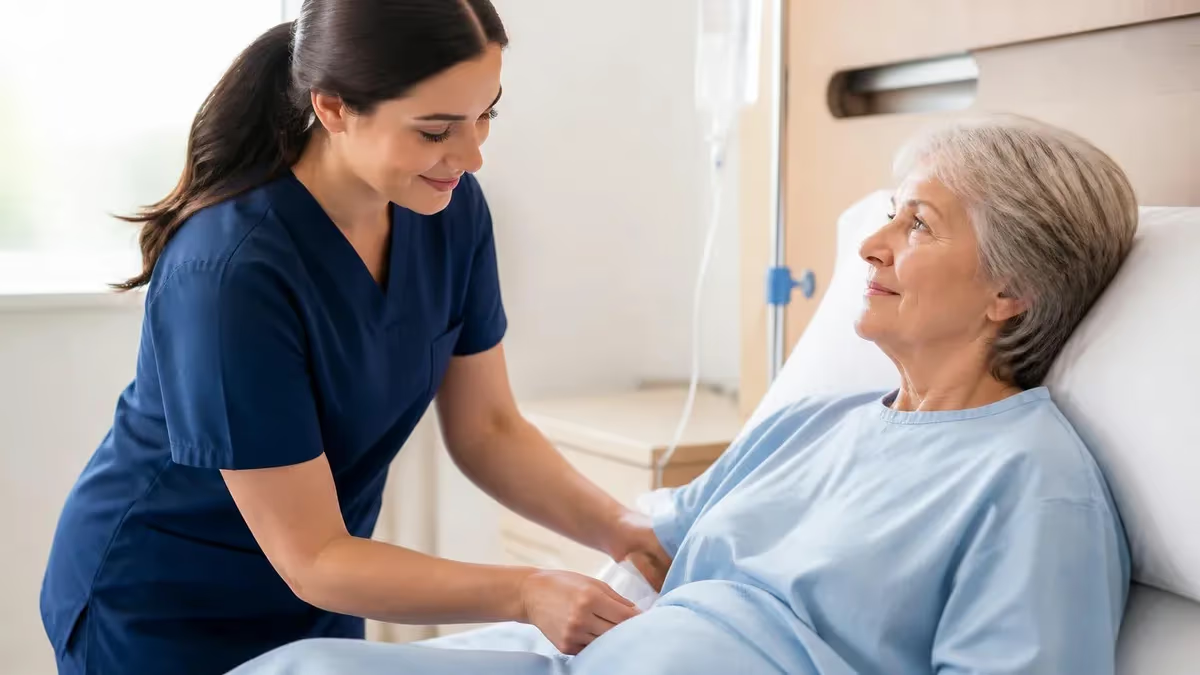
If you are researching lpn programs columbus ohio as your first step toward a practical nursing career, 2026 is one of the strongest years in a decade to enroll. Ohio currently licenses more than 41,000 active LPNs through the Ohio Board of Nursing, yet long-term care facilities, hospital systems like OhioHealth and Cleveland Clinic, and home-health agencies continue to report unfilled bedside positions. Tuition has held relatively flat at public career-technical centers, while clinical placement pipelines have expanded across Franklin, Cuyahoga, and Hamilton counties.
Ohio offers a uniquely diverse menu of practical nursing pathways. You can attend a tuition-free adult workforce program at a Joint Vocational School District, a 12-month diploma at a private career college, or a hybrid track tied to a community college such as Columbus State or Cuyahoga Community College. Each pathway leads to the same outcome: eligibility to sit for the NCLEX-PN exam and receive an Ohio practical nursing license. The differences lie in cost, schedule, clinical sites, and how quickly you can graduate.
Columbus alone hosts more than a dozen approved practical nursing programs, ranging from Eastland-Fairfield Career & Technical Schools to Hondros College of Nursing and Fortis College. Cleveland adds another cluster anchored by Cuyahoga Community College and Polaris Career Center, while Cincinnati feeds students through Great Oaks Career Campuses and Hocking College extensions. Because Ohio recognizes both daytime and evening cohorts, working adults can often complete a program without leaving full-time employment behind.
The investment is meaningful but manageable. Public LPN programs in Ohio typically cost between $7,500 and $14,000 in total tuition, fees, books, scrubs, and licensure expenses. Private career colleges run $19,000 to $32,000, but they sometimes offer monthly start dates and faster graduation. Either way, the median Ohio LPN salary of roughly $54,300 means most graduates recoup their tuition within the first 14 months of bedside work, especially in skilled nursing and rehab settings that pay shift differentials.
Ohio also makes credential portability simple. Because the state participates in the Nurse Licensure Compact, an Ohio practical nursing license issued in 2026 lets you accept assignments in 40+ partner states without applying for a new license. For graduates planning to travel or to follow family across state lines, that compact status is one of the most underrated benefits of training in Ohio versus a non-compact neighbor. Compare your total commitment using an LPN program cost calculator before committing to a school.
This guide walks through every requirement, cost line, and admissions hurdle you will face in 2026. You will learn how Ohio Board of Nursing approval differs from regional accreditation, why TEAS or HESI scores still matter even at open-enrollment centers, and how to read NCLEX-PN pass rate data the right way. By the end you will be able to short-list three or four programs that fit your budget, schedule, and career timeline.
Whether your goal is to start on a med-surg floor at Riverside Methodist, work hospice in Dayton, or eventually bridge into an RN program at Ohio State or the University of Cincinnati, the practical nursing credential is the most efficient on-ramp. Read on for stat grids, side-by-side school comparisons, application checklists, and an FAQ that answers the questions Ohio applicants ask most frequently in admissions interviews and online forums.
Ohio LPN Programs by the Numbers (2026)

Ohio LPN Eligibility & Admission Requirements
Every Ohio Board of Nursing-approved practical nursing program requires verified high school completion or a State of Ohio High School Equivalence Diploma. Official transcripts must be submitted directly from the issuing institution before clinical rotation start.
Applicants must turn 18 before the program start date to participate in clinical rotations at Ohio hospitals, long-term care facilities, and rehab centers. Seventeen-year-old seniors can apply early but cannot begin until birthday verification.
Most Ohio programs require the ATI TEAS or HESI A2 entrance exam with a minimum composite score between 58% and 70%, depending on competitiveness. Reading, math, science, and English sections are all weighted.
Ohio Revised Code 4723.09 requires BCI and FBI fingerprint background checks before clinical placement. A 10-panel urine drug screen is also standard. Certain felony convictions can disqualify applicants under Ohio Board rules.
Programs require a physical exam, two-step TB test, MMR, Tdap, varicella, hepatitis B series, current flu vaccine, and CPR certification (BLS for Healthcare Providers). Documentation is due before the first clinical day each term.
Ohio's practical nursing school landscape divides neatly into four categories: Joint Vocational School Districts (JVSDs), community colleges, private career colleges, and hospital-affiliated diploma programs. Each category has its champions across the Columbus, Cleveland, and Cincinnati metro areas, plus pockets of excellence in smaller markets like Toledo, Akron, Youngstown, and Dayton. Understanding the categories first will save you weeks of confused comparison shopping.
In Columbus, three programs dominate applicant interest. Eastland-Fairfield Career & Technical Schools runs an 11-month adult practical nursing program with NCLEX-PN pass rates routinely above 90 percent and total costs near $13,500. Hondros College of Nursing operates Columbus campuses in Westerville with a 12-month accelerated track and monthly starts. Fortis College adds another option with evening and weekend hybrid scheduling, designed specifically for STNAs already working in long-term care who want to upgrade their license.
Cleveland-area applicants have similar variety. Cuyahoga Community College's Practical Nursing certificate finishes in three semesters and feeds directly into Tri-C's LPN-to-RN bridge. Polaris Career Center in Middleburg Heights and Cuyahoga Valley Career Center deliver tuition-friendly adult programs with strong placement at MetroHealth, Cleveland Clinic Akron General, and University Hospitals. ECPI University and Brown Mackie alumni networks also remain active in northeast Ohio, though enrollment has shifted toward Tri-C and Lorain County Community College.
Cincinnati and Dayton applicants typically choose between Great Oaks Career Campuses (Scarlet Oaks and Diamond Oaks have particularly strong reputations), Hondros College's Cincinnati-area extensions, and Sinclair Community College in Dayton. Great Oaks publishes NCLEX-PN pass rates by cohort and historically posts above the national average. Sinclair's program is competitive and admits roughly one in three qualified applicants, so backup options matter for southwest Ohio residents.
Beyond metro centers, regional standouts include Lorain County JVS, Auburn Career Center east of Cleveland, Pioneer Career & Technology Center near Mansfield, Tri-Rivers Career Center in Marion, and Apollo Career Center in Lima. These programs serve students unwilling to commute into a major city and frequently partner with regional hospitals like Mercy Health, Kettering Health Network, and ProMedica for clinical rotations. Tuition at these sites is often the lowest in the state.
When narrowing your list, weigh four factors: NCLEX-PN first-time pass rate over the most recent three years, total cost including books and uniforms, clinical site quality and variety, and graduation rate. A 95 percent pass rate is meaningless if only 40 percent of admitted students actually graduate. Ohio Board of Nursing publishes annual program data at nursing.ohio.gov, and prospective students should download the most recent report before signing enrollment paperwork.
Finally, consider geographic flexibility. Many Ohio LPN programs hold clinical rotations at multiple regional facilities, which means applicants in Lancaster, Newark, or Marysville can train without relocating to downtown Columbus. If commuting concerns you, ask each admissions counselor for a clinical site list before applying. Comparing options across the state is easier with a centralized list of LPN programs near me filtered by zip code.
LPN Practice Test Questions
Prepare for the LPN - Certified Practical Nurse exam with our free practice test modules. Each quiz covers key topics to help you pass on your first try.
LPN - Certified Practical Nurse Basic Care...
LPN Exam Questions covering - Certified Practical Nurse Basic Care and Comfort. Master LPN Test concepts for certification prep.
LPN - Certified Practical Nurse Coordinate...
Free LPN Practice Test featuring - Certified Practical Nurse Coordinated Care. Improve your LPN Exam score with mock test prep.
LPN - Certified Practical Nurse Health Pro...
LPN Mock Exam on - Certified Practical Nurse Health Promotion and Maintenance. LPN Study Guide questions to pass on your first try.
LPN - Certified Practical Nurse Pharmacolo...
LPN Test Prep for - Certified Practical Nurse Pharmacological Therapies. Practice LPN Quiz questions and boost your score.
LPN - Certified Practical Nurse Physiologi...
LPN Questions and Answers on - Certified Practical Nurse Physiological Adaptation. Free LPN practice for exam readiness.
LPN - Certified Practical Nurse Psychosoci...
LPN Mock Test covering - Certified Practical Nurse Psychosocial Integrity. Online LPN Test practice with instant feedback.
LPN - Certified Practical Nurse Reduction ...
Free LPN Quiz on - Certified Practical Nurse Reduction of Risk Potential. LPN Exam prep questions with detailed explanations.
LPN - Certified Practical Nurse Safety and...
LPN Practice Questions for - Certified Practical Nurse Safety and Infection Control. Build confidence for your LPN certification exam.
LPN Ethical, Legal & Professional Standards
LPN Test Online for Ethical, Legal & Professional Standards. Free practice with instant results and feedback.
LPN Health Evaluation & Monitoring
LPN Study Material on Health Evaluation & Monitoring. Prepare effectively with real exam-style questions.
LPN Programs Ohio: Tuition by Pathway
Joint Vocational School Districts and Career-Technical Centers are the most affordable pathway in Ohio. Total program cost typically lands between $7,500 and $13,500, including tuition, lab fees, books, scrubs, NCLEX review materials, background checks, and licensure application. Examples include Eastland-Fairfield, Tolles Career & Technical Center, Polaris, Great Oaks, and Tri-Rivers. Adult learners often qualify for Pell Grants and TechCred funding to offset out-of-pocket costs significantly.
The trade-off is rigid scheduling. Most JVSD programs run Monday through Friday during daytime business hours for roughly eleven months. Evening tracks exist but fill quickly, sometimes a year in advance. Admissions are typically competitive but not as fierce as community-college nursing programs. If you live within commuting distance of a JVSD adult program, this is almost always the smartest financial choice for Ohio LPN training.
Pros and Cons of Training as an LPN in Ohio
- +Ohio is a Nurse Licensure Compact state, so your license works in 40+ partner states with no extra paperwork
- +Tuition at public JVSDs is among the lowest in the Midwest, often under $12,000 total
- +Strong demand from skilled nursing, long-term care, and home-health employers across all 88 counties
- +Multiple LPN-to-RN bridge programs at Columbus State, Tri-C, Sinclair, and Lorain County smooth the path to an ADN
- +NCLEX-PN first-time pass rates statewide average 86 percent, well above the national mean
- +Major hospital systems (OhioHealth, Cleveland Clinic, UC Health, Kettering) hire LPNs with sign-on bonuses up to $5,000
- +Workforce development funds including TechCred reimburse employers and trainees for credential costs
- −Hospital-based acute care LPN roles have narrowed; most acute floors prefer RNs for IV push and complex care
- −Median LPN salary trails neighboring Michigan and Pennsylvania by roughly $2,000 to $4,000 annually
- −Wait lists at top community college programs can stretch 12 to 24 months for first-time applicants
- −Background check disqualifications under ORC 4723.28 are stricter than in some neighboring states
- −Clinical site competition is intense in dense markets like Columbus and Cleveland, limiting cohort sizes
- −Private career college tuition can exceed $30,000, creating debt burdens difficult to repay on an LPN salary
Ohio LPN Program Application Checklist
- ✓Verify the program is approved by the Ohio Board of Nursing at nursing.ohio.gov
- ✓Request official high school or GED transcripts sent directly to the program
- ✓Complete the ATI TEAS or HESI A2 entrance exam and meet the program's minimum score
- ✓Submit a current resume or work history, especially if you hold an STNA credential
- ✓Schedule BCI and FBI fingerprint background checks through an approved WebCheck location
- ✓Complete a physical exam, two-step TB test, and verify all required immunizations
- ✓Obtain current BLS for Healthcare Providers certification from American Heart Association
- ✓File the FAFSA early to maximize Pell Grant and Ohio College Opportunity Grant eligibility
- ✓Tour at least two campuses and request to speak with current students or alumni
- ✓Submit completed application packet at least 30 days before the program's stated deadline
Use Ohio TechCred to Cover Up to $2,000 of LPN Tuition
Ohio TechCred reimburses employers up to $2,000 per credential when staff earn industry-recognized credentials, including practical nursing. If you already work as an STNA or in a healthcare support role, ask your employer to apply on your behalf during one of the rolling funding windows. Many long-term care facilities are actively using TechCred to grow their LPN pipeline at zero out-of-pocket cost to existing employees.
Passing the NCLEX-PN is the final hurdle between graduation and a paycheck. Ohio applicants apply through the Ohio Board of Nursing's eLicense system, pay a $75 licensure fee plus the $200 NCLEX-PN exam fee to Pearson VUE, complete fingerprinting, and wait for an Authorization to Test (ATT) email. From application to ATT typically takes two to four weeks once all transcripts and fingerprints clear, sometimes faster if you applied while still in your program.
The exam itself uses Computerized Adaptive Testing. Candidates answer between 85 and 150 questions over a maximum of five hours. Content covers four major client-need categories: Safe and Effective Care Environment, Health Promotion and Maintenance, Psychosocial Integrity, and Physiological Integrity. The computer stops the exam as soon as it has 95 percent confidence in your competence, which means strong candidates often finish in 85 to 100 questions, while struggling candidates may answer all 150.
Ohio's first-time pass rate for NCLEX-PN candidates hovered around 86 percent in 2024, slightly above the national average of 83 percent. Program-by-program variation is substantial. Some top JVSDs and community colleges post 95 percent or higher, while a handful of underperforming programs sit below 70 percent. Always check the Ohio Board of Nursing's annual program report before enrolling so you can avoid programs with a documented declining pass rate trend.
Preparation strategy matters more than test-taking tricks. Most successful Ohio candidates spend six to eight weeks after graduation doing focused review. The minimum effective dose is 75 to 100 NCLEX-style practice questions per day for six weeks, with detailed rationale review for every missed item. UWorld, Kaplan, ATI, and Hurst are the four most commonly recommended review platforms among Ohio graduates, with UWorld and Kaplan dominating in 2026 due to their updated Next Generation NCLEX-style case studies.
Once you pass, your Ohio practical nursing license is issued electronically through eLicense, usually within 48 hours of Pearson VUE reporting your result. The initial license is valid until August 31 of an odd-numbered year, after which you renew every two years with 24 hours of continuing education, including a mandatory one-hour category on Ohio law and rules. Track CE hours from day one because the Board audits a percentage of renewals.
Because Ohio belongs to the enhanced Nurse Licensure Compact, your single-state Ohio license automatically becomes a multi-state privilege as long as Ohio is your primary state of residence. That privilege lets you work in Texas, Florida, North Carolina, and 37 other compact states without applying for additional licenses, which is invaluable for travel nursing, military spouses, and graduates considering relocation. Non-resident graduates pay slightly more for endorsement processing.
If you do not pass on the first attempt, do not panic. Ohio allows 45 days between retakes, and most candidates who fail by 15 questions or fewer pass on attempt two with focused remediation. The Board does not cap the number of NCLEX-PN attempts, although Pearson VUE limits you to eight attempts per year. Reach out to your program's NCLEX coordinator immediately for a structured remediation plan tailored to your specific weak content areas.

Ohio Revised Code 4723.28 and 4776 list specific criminal convictions that can permanently or temporarily disqualify applicants from licensure. Convictions for offenses such as patient abuse, certain felony drug offenses, sexual battery, and aggravated theft from elderly or disabled victims trigger automatic ineligibility. If you have any criminal history, request a pre-application criminal records review with the Ohio Board of Nursing before paying any tuition. The pre-review costs $50 and saves applicants from investing in programs they cannot ultimately license from.
The Ohio LPN job market in 2026 remains decisively in favor of new graduates. The Bureau of Labor Statistics projects 5 percent national growth for LPNs through 2032, but Ohio outpaces that average in skilled nursing, assisted living, hospice, and home-health verticals. Major employers including Genesis HealthCare, Brookdale, Communicare, Kindred, Ohio Living, Otterbein SeniorLife, and the Cleveland Clinic post hundreds of open LPN requisitions on any given week, and signing bonuses of $3,000 to $5,000 are common.
Median annual wages for Ohio LPNs hit $54,300 in May 2024 BLS data, up from $50,890 in 2022. Top earners exceed $66,000, especially those who pick up weekend differentials, charge nurse stipends, or specialty certifications like wound care or IV therapy. Columbus and Cleveland tend to pay $1,500 to $3,000 more annually than rural counties, although cost of living in Appalachian Ohio is dramatically lower, which often makes rural LPN take-home pay competitive.
Practice settings vary widely. Roughly 40 percent of Ohio LPNs work in skilled nursing facilities, 18 percent in assisted living and continuing care, 14 percent in hospitals, 10 percent in home health, 8 percent in physician offices, and the remainder in correctional, school, occupational, and hospice settings. Each setting offers distinct career trajectories. Long-term care LPNs frequently move into charge nurse or unit manager roles, while home-health LPNs build flexible schedules ideal for parents.
Specialty certifications boost pay quickly. Wound care, IV therapy, gerontology, hospice and palliative, and developmental disabilities are the highest-yield Ohio LPN specialties in 2026. Wound Care Certified (WCC) credentials alone can add $2 to $4 per hour at long-term care employers actively battling pressure injury readmission penalties. Ohio's growing population aged 75 and older keeps gerontology demand high through at least 2035. Review options for a wound care certification for LPN after your first year on the job.
If you want hospital-based work, target community hospitals and rehab units rather than academic medical centers. OhioHealth, Mercy Health, Kettering Health Network, ProMedica, Bon Secours Mercy Health, and the Christ Hospital system actively staff LPNs on med-surg, rehabilitation, ortho, and behavioral health units. Cleveland Clinic and the Ohio State Wexner Medical Center still hire LPNs but primarily in outpatient clinics, ambulatory surgery, and specialty practices rather than inpatient acute care floors.
The LPN-to-RN bridge remains the most lucrative long-term play. Ohio has more than a dozen approved LPN-to-RN bridge programs, including Columbus State, Tri-C, Sinclair, Lorain County, Stark State, Hocking College, Hondros, and Chamberlain. A bridge typically takes 12 to 18 months and adds $20,000 to $30,000 to annual salary upon completion. Many Ohio employers offer tuition reimbursement of $5,000 or more per year for bridge students, making the path financially manageable.
Job hunting tactics matter. Tailor your resume to highlight clinical rotation experience, EMR proficiency (especially Epic, Cerner, and PointClickCare), and any STNA work prior to LPN training. Apply directly through hospital and long-term care chain career portals rather than relying solely on Indeed or ZipRecruiter aggregators. Most Ohio LPN graduates accept offers within 30 days of license issuance, and many secure offers before passing NCLEX-PN.
To turn this guide into action, narrow your shortlist to three programs that match your geography, budget, and schedule. Schedule campus tours for the top two. Bring a notebook and ask the same five questions at every school: most recent three-year NCLEX-PN pass rate, total all-in cost including books and licensure fees, graduation rate, clinical site list, and average wait time from application to start date. Comparing apples to apples is impossible without standard data.
Plan your finances early. The FAFSA opens October 1 every year, and Ohio's College Opportunity Grant runs on a first-come, first-served basis. Pell Grants currently top out near $7,400 annually, which covers nearly all tuition at most JVSDs and a meaningful slice at community colleges. Avoid private student loans whenever possible because their variable interest rates and limited deferment options can become a long-term burden on an LPN salary.
Build your clinical confidence before you start. If you can, work as an STNA or patient care technician for at least three to six months before your program begins. Hands-on exposure to bedside care, vital signs, transfers, and documentation makes your first clinical rotation dramatically less stressful. Many Ohio LPN programs actively prefer STNA-credentialed applicants and may grant interview priority or scholarship preference to them.
Treat the program itself like a full-time job. Plan to study two to three hours for every hour of lecture. Form a study group of three or four classmates in week one, schedule weekly meeting times, and rotate who leads each topic review. Successful Ohio LPN students consistently report that small-group active recall (not passive rereading) is the single highest-yield study tactic, followed by daily NCLEX-style practice questions starting in month two.
Begin NCLEX-PN preparation on day one of your program, not after graduation. Subscribe to a question bank early, set a goal of 25 to 40 questions per day during didactic months, ramping to 75 to 100 per day during the final two months. Use a structured review platform like Kaplan, UWorld, ATI Comprehensive Predictor, or Hurst. The minute your final exam ends, take a one-week break, then commit to a six-to-eight-week intensive review.
Network aggressively during clinical rotations. Every preceptor, charge nurse, and unit manager you impress is a potential job lead. Bring chocolate or a small treat to your rotation site on the last day, leave a hand-written thank you card with your contact information and license target date, and connect on LinkedIn the same week. Most Ohio LPN job offers originate from clinical rotation contacts rather than online applications.
Finally, take care of your body and mind. Practical nursing programs are physically demanding and emotionally taxing. Build sleep, exercise, and mental-health support into your weekly routine from week one. Burnout in nursing school predicts burnout on the floor, and Ohio's nursing workforce desperately needs graduates who can sustain a 30 or 40 year career. The patients you serve deserve a clinician who has taken care of herself first.
LPN Questions and Answers


About the Author

Registered Nurse & Healthcare Educator
Johns Hopkins University School of NursingDr. Sarah Mitchell is a board-certified registered nurse with over 15 years of clinical and academic experience. She completed her PhD in Nursing Science at Johns Hopkins University and has taught NCLEX preparation and clinical skills courses for nursing students across the United States. Her research focuses on evidence-based exam preparation strategies for healthcare certification candidates.
Join the Discussion
Connect with other students preparing for this exam. Share tips, ask questions, and get advice from people who have been there.
View discussion (7 replies)