
LPN Program in Broward County: Complete Guide to Schools, Requirements & Licensure
Find the best LPN program in Broward County. 🎯 Compare accredited schools, costs, admission requirements, and NCLEX-PN licensure steps for 2026 September.
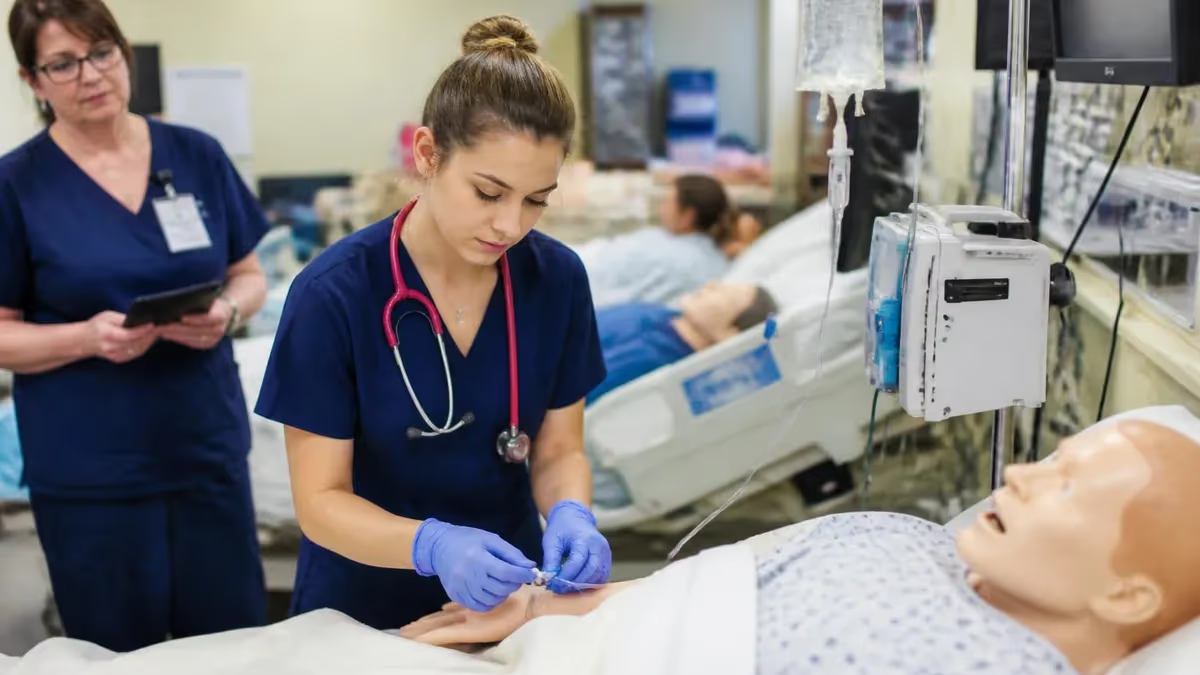
Finding the right LPN program in Broward County is one of the most important decisions you will make on your path to a nursing career. Broward County, home to Fort Lauderdale and dozens of surrounding communities, offers a robust network of accredited practical nursing programs at community colleges, vocational schools, and private career institutions. Whether you are starting fresh, transitioning from a healthcare aide role, or completing an LPN-to-RN bridge, the county's options provide realistic timelines, affordable tuition, and strong clinical partnerships with the region's major hospital systems.
Florida is one of the fastest-growing states for healthcare employment, and Broward County sits at the center of that expansion. The Florida Department of Health and the Florida Board of Nursing require all Licensed Practical Nurse candidates to complete an approved PN program, pass the NCLEX-PN examination, and meet background check requirements before practicing. Understanding these state-level rules alongside the specific admission criteria of each Broward County school will save you months of guesswork and help you enroll in a program that genuinely fits your schedule and budget.
Many students who research lpn programs by county are surprised to discover how much variation exists between neighboring counties and even between schools within the same county. Broward County programs differ in length — ranging from 12 months at accelerated vocational institutions to 18 months at community colleges with a traditional semester structure — and in how they balance classroom theory with hands-on clinical hours. Knowing the difference before you apply prevents costly program transfers and delays in your graduation date.
Tuition is another critical variable. Public programs at Broward College charge substantially less per credit hour than private career schools, but private schools sometimes offer more flexible evening and weekend schedules that working adults need. Some programs also include fees for uniforms, clinical supply kits, liability insurance, and NCLEX review materials, so the sticker price rarely reflects your true out-of-pocket cost. This guide breaks down the full financial picture for each type of institution so you can plan your budget with confidence.
Clinical training in Broward County benefits from the county's dense healthcare infrastructure. Students rotate through facilities such as Broward Health Medical Center, Memorial Healthcare System hospitals, Cleveland Clinic Florida, and numerous long-term care and rehabilitation centers. These partnerships translate directly into job-readiness: graduates who train in high-acuity environments consistently outperform their peers on NCLEX-PN skills-based items and enter the workforce with a practical depth of experience that employers value immediately.
NCLEX-PN pass rates vary significantly between programs, and Florida publishes annual data by school through the Board of Nursing. Before committing to any program, check the most recent pass-rate report. Programs reporting rates above 85% demonstrate strong curriculum alignment with the current NCLEX-PN test plan, which as of 2023 uses a Next Generation format emphasizing clinical judgment over simple recall. Programs with rates below 75% may have curriculum gaps worth investigating before you enroll.
This complete guide covers every major aspect of pursuing an LPN education in Broward County: accredited school options, admission requirements, program duration and costs, clinical training expectations, NCLEX-PN preparation strategies, and the Florida licensure process. By the time you finish reading, you will have a clear action plan for enrolling in the program that best matches your goals and timeline.
LPN Programs in Broward County by the Numbers
Accredited LPN Schools in Broward County
The largest public option in the county, Broward College offers a full-time PN certificate program with campuses in Fort Lauderdale, Davie, and Coconut Creek. Low per-credit tuition and strong NCLEX-PN pass rates make it the most competitive option for cost-conscious students.
A well-regarded public vocational school in Davie offering a daytime Practical Nursing program with a track record of high NCLEX-PN passage rates. McFatter emphasizes hands-on skills labs and partners with Broward Health for clinical rotations, giving students exposure to acute-care environments early in training.
Located in Hollywood, Sheridan Technical College offers a state-approved PN program with morning and afternoon session options. The school draws heavily from Memorial Healthcare System for its clinical placements and offers robust financial aid resources for qualifying students.
Several ABHES- or ACCSC-accredited private institutions in Broward County offer accelerated evening and weekend LPN programs. These schools carry higher tuition but provide scheduling flexibility that full-time workers require. Always verify Florida Board of Nursing approval before enrolling in any private program.
Admission requirements for LPN programs in Broward County follow a consistent baseline set by the Florida Board of Nursing, but each institution layers additional criteria on top of state minimums. At the foundational level, every applicant must hold a high school diploma or GED, demonstrate English language proficiency, and show evidence of legal authorization to work in the United States. Some programs require proof of immunizations including hepatitis B, MMR, varicella, and an annual flu shot before clinical rotations begin, so gathering these records early saves weeks of administrative delay.
Academic prerequisites vary considerably between public and private programs. Broward College and the county's two technical colleges — McFatter and Sheridan — typically require a minimum GPA of 2.5 on any prior college coursework and may require applicants to complete or test out of developmental English and math before the nursing sequence begins.
Many programs also require a passing score on an approved pre-admission exam such as the TEAS (Test of Essential Academic Skills) or the HESI A2. These exams assess reading comprehension, math fundamentals, and basic science reasoning, and competitive programs in Broward County often set cutoff scores of 60% to 70% composite.
Healthcare experience is not universally required, but it significantly strengthens your application at competitive programs. Applicants with current certification as a Certified Nursing Assistant (CNA) or Patient Care Technician (PCT) often receive priority placement, shorter waitlists, or direct-entry status at some Broward County schools. If you are not yet working in healthcare, volunteering at a hospital or long-term care facility for even 50 to 100 hours before applying can differentiate your application meaningfully from the hundreds of others programs review each cycle.
Background checks are mandatory under Florida Statute 464.008. Programs submit fingerprint-based background checks through the Florida Department of Law Enforcement (FDLE) and the FBI. Certain criminal convictions — particularly those involving fraud, patient abuse, or controlled substances — can result in denial of nursing licensure, which means investing in a program without understanding your background-check status is a financial risk. The Florida Board of Nursing offers a Declaratory Statement process that allows prospective applicants to request a preliminary determination of licensure eligibility before enrolling, a step worth taking if your record includes any prior charges.
Drug screening requirements are enforced by clinical sites rather than the school itself in many cases, but programs require students to pass an initial drug screen upon enrollment and may conduct random screenings throughout the program. Students who fail a drug screen are typically dismissed from clinical rotations immediately, which effectively halts program progress. Understanding both the school's and the clinical partner's substance testing policies before enrolling is essential for any applicant with a history of substance use.
Healthcare certifications required prior to or during the program include Basic Life Support (BLS) for Healthcare Providers through the American Heart Association. Most Broward County programs require students to hold a current BLS card before their first clinical day. The cost is typically $30 to $60 and the certification is valid for two years. Some programs also require students to obtain CPR instructor-level credentials before graduation, though this is less common at the entry-level PN certificate tier.
Competitive programs in Broward County maintain waitlists, and waitlist times can range from one semester to two full years at the most popular public institutions. If waitlist time is a concern, applying to multiple programs simultaneously — including private institutions with shorter waitlists — is a practical strategy. Just ensure every program you consider is listed on the Florida Board of Nursing's approved program directory, as completing an unapproved program makes you ineligible to sit for the NCLEX-PN regardless of your academic performance.
LPN Program Costs, Duration & Financial Aid in Broward County
Public programs at Broward College and the county's technical colleges charge Florida residents approximately $8,000 to $12,000 for the full PN certificate, including fees but excluding textbooks and clinical supplies. Private career schools in Broward County range from $16,000 to $22,000 and sometimes bundle NCLEX review materials, uniforms, and clinical kits into the package price, which can narrow the real-world cost gap compared to public programs once supplemental expenses are added.
Hidden costs catch many LPN students off guard. Beyond tuition, budget for NCLEX-PN registration ($200), Florida Board of Nursing licensure application ($100), fingerprinting ($75), BLS certification ($50), liability insurance ($30 per year), and clinical uniform and supply kits ($200–$400). A conservative total for a public Broward County program including all ancillary costs runs $10,000 to $13,500, while a private program all-in lands between $18,000 and $25,000 depending on the institution.
Pros and Cons of LPN Programs in Broward County
- +Access to major hospital systems like Broward Health and Memorial Healthcare for clinical rotations
- +Public program tuition among the lowest in Florida for county residents
- +Multiple program formats — full-time days, evenings, weekends — accommodate diverse schedules
- +High regional demand for LPNs in long-term care, home health, and physician offices
- +Florida's diverse patient population builds cultural competency and bilingual care experience
- +Strong NCLEX-PN pass rates at top programs due to rigorous curriculum and dedicated review courses
- −Waitlists at public programs can extend 12 to 24 months at high-demand institutions
- −Private program tuition is significantly higher and may require substantial loan borrowing
- −Florida's humid climate and traffic congestion add commute time and stress for students
- −Clinical rotation schedules are fixed and often non-negotiable, conflicting with work shifts
- −Background check disqualifications under Florida law can eliminate program investment with no refund
- −Competitive pre-admission exam cutoffs mean some applicants must retest one or more times before admission
LPN Licensure Checklist for Florida Graduates
- ✓Confirm your program is on the Florida Board of Nursing approved PN program list before graduating.
- ✓Submit the Florida LPN licensure application through the NCSBN online portal immediately after graduation.
- ✓Pay the Florida Board of Nursing application fee of $100 at the time of submission.
- ✓Complete FDLE and FBI fingerprint-based background check within the required window.
- ✓Register for the NCLEX-PN through Pearson VUE and pay the $200 examination fee.
- ✓Receive your Authorization to Test (ATT) email and schedule your exam at a local Pearson VUE center.
- ✓Complete a minimum of 75 questions on exam day — the adaptive test may extend to 150 questions.
- ✓Use the Quick Results service through Pearson VUE (48 hours after testing) for a preliminary pass/fail result.
- ✓Check the Florida Board of Nursing license verification portal once your license is officially issued.
- ✓Complete the mandatory two-hour HIV/AIDS training required for initial Florida nursing licensure.
Florida's Two-Hour HIV/AIDS Requirement Is Mandatory for First Licensure
Florida Statute 456.033 requires all first-time healthcare license applicants, including LPNs, to complete a Board-approved two-hour HIV/AIDS education course. This is separate from your NCLEX-PN preparation and must be completed before the Board will issue your license. Many approved online courses cost under $20 and can be finished in an afternoon — do not let this small requirement delay your license issuance by weeks.
Preparing for the NCLEX-PN is a structured process, and students who treat it as an extension of their program curriculum rather than a separate event consistently outperform those who cram in the final weeks. The current NCLEX-PN uses Next Generation NCLEX (NGN) technology, which means roughly 20 to 30 percent of questions are in new formats: extended multiple response, drop-down cloze, highlight-in-text, matrix grids, drag-and-drop, and bow-tie clinical judgment items. These question types cannot be answered through memorization alone; they require you to demonstrate a deliberate clinical reasoning process that connects assessment data to nursing actions and expected outcomes.
The most effective study strategy begins with a thorough diagnostic. Most major NCLEX review platforms — including UWorld, ATI, and Kaplan — offer comprehensive pre-assessments that identify your weakest content areas. Take a full diagnostic exam in your first study week and build your schedule around the results rather than reviewing topics in textbook order. If your diagnostic reveals weaknesses in pharmacological therapies and physiological adaptation, allocate proportionally more study time there because these categories carry the heaviest weight on the NCLEX-PN test plan.
Consistent daily practice with NCLEX-style questions is more effective than marathon weekend study sessions. Research on nursing licensure preparation consistently shows that students who answer 75 to 100 questions per day over a 6-to-8-week period outperform those who study the same total number of questions in compressed bursts. Daily practice keeps clinical reasoning pathways active, allows you to immediately apply concepts from recent review sessions, and builds the stamina needed to maintain focus through a test that can last up to five hours.
Rationale review is the highest-value step in question-based studying, yet many students skip it when they answer correctly. Reading the rationale for every question — right or wrong — reinforces why an answer is correct and why the distractors are incorrect. This is especially important for NGN formats where the reasoning chain is multistep. A student who can articulate why option B is wrong in a drag-and-drop question is far better prepared than one who selected option A correctly by intuition without understanding the underlying principle.
Broward County LPN students benefit from several free and low-cost local resources to supplement their review. The Broward County Public Library system offers free access to nursing reference databases and some digital NCLEX review resources through its digital card membership. Study groups organized through your program cohort or through nursing student associations can provide peer accountability, shared notes, and collaborative case-study analysis. Many Broward County hospitals that partner with local LPN programs also offer NCLEX prep workshops for students completing clinical rotations — ask your clinical coordinator about availability.
Time management on exam day is a skill that requires deliberate practice. NCLEX-PN test-takers have up to five hours to complete their examination. Spending more than two minutes on any single standard question is inefficient. Practice answering 75 questions in 90 minutes during your study sessions to build pacing habits before exam day.
For NGN items, which are often longer and more complex, allow up to four minutes per item. If you are consistently running over time in practice sessions, examine whether your reading strategy is efficient — reading the question stem before the scenario can help you focus your attention on relevant clinical data.
Sleep and nutrition on exam day are not trivial concerns. Cognitive fatigue disproportionately impairs clinical reasoning and working memory, the exact mental capacities the NGN format is designed to test. Sleep studies consistently show that one night of poor sleep reduces reasoning performance by 20 to 40 percent, which can turn a borderline pass into a fail.
Schedule your exam for your peak cognitive time of day whenever possible — many Broward County Pearson VUE sites offer early morning slots that suit students who perform best before noon — and eat a protein-rich breakfast two hours before the exam to maintain blood glucose stability throughout the session.
Once the Florida Board of Nursing approves your licensure application, Pearson VUE issues an Authorization to Test (ATT) letter that is valid for 90 days. If you do not schedule and sit for the NCLEX-PN within that window, your ATT expires and you must reapply and repay the $200 examination fee. Avoid this costly mistake by scheduling your exam appointment the same day your ATT arrives — popular Broward County testing centers fill quickly, especially in January and May when large program cohorts graduate.
The LPN career outlook in Broward County is strong by virtually every economic and demographic measure. Broward County's population exceeds 1.9 million residents, making it the second-most-populous county in Florida, and population projections show continued growth through 2035 driven largely by retirees relocating from northern states and an expanding immigrant community requiring bilingual healthcare services. This demographic reality translates directly into sustained demand for practical nurses across every care setting — hospitals, physician offices, urgent care centers, skilled nursing facilities, home health agencies, and correctional health programs.
The Bureau of Labor Statistics projects a 5 percent national growth rate for LPNs through 2032, but Florida consistently outpaces national projections. The Florida Agency for Health Care Administration estimated a shortage of more than 50,000 licensed nurses statewide by 2025, and LPNs represent a critical part of the workforce strategy to fill that gap at a lower cost point than registered nurses. Broward County health systems have responded by expanding partnership programs with local LPN schools, offering sign-on bonuses ranging from $1,500 to $5,000, and creating direct hire pipelines from clinical rotation sites to staff positions for high-performing students.
Salary ranges for LPNs in Broward County and the broader South Florida metropolitan area reflect both the cost of living and the competitive labor market. Entry-level LPNs in the county earn approximately $46,000 to $50,000 annually in long-term care and outpatient settings. Hospital-based LPN positions — particularly in specialty units and procedural areas — range from $52,000 to $60,000 with additional shift differentials for evenings, nights, and weekends. Home health and private duty LPN roles often pay the highest hourly rates, ranging from $27 to $38 per hour, though they lack the benefits packages typical of institutional employers.
Specialty certifications significantly enhance LPN earning potential in Broward County. IV therapy certification is among the most sought-after, as Florida's scope of practice for LPNs includes IV insertion and infusion monitoring when the LPN holds appropriate certification. Wound care certification, gerontology certification through NACE, and long-term care administration credentials all command salary premiums of $3,000 to $8,000 annually above base LPN wages. Investing in one specialty credential within your first two years of practice is one of the most reliable return-on-investment decisions an LPN can make in this market.
Bilingual LPNs — particularly those fluent in Spanish and English, or in Haitian Creole and English — are in extraordinary demand throughout Broward County. A substantial portion of the county's population is Spanish-speaking or Haitian Creole-speaking, and healthcare systems increasingly seek bilingual clinical staff to serve these communities without relying on interpreter services for every patient encounter. Bilingual LPNs in Broward County frequently receive language-differential pay ranging from $1.00 to $3.00 per hour above base, and their job placement rates upon graduation are consistently higher than monolingual graduates in the same cohorts.
Career advancement pathways from LPN are robust in Florida, which offers an active LPN-to-RN bridge infrastructure. Broward College's Associate Degree Nursing program, along with several private institutions in the county, offer LPN-to-RN articulation pathways that grant credit for prior LPN coursework and clinical experience, reducing the additional time and cost to achieve RN licensure.
Most LPN-to-RN bridge students in Broward County complete the transition in 12 to 18 additional months of study, positioning themselves for a 30 to 50 percent salary increase upon passing the NCLEX-RN. Planning this pathway from the outset of your LPN education — choosing a program that has an established articulation agreement with a local RN program — is a strategic long-term investment.
The geographic diversity of Broward County also means that LPN employment opportunities span urban, suburban, and rural-adjacent care settings. Fort Lauderdale and Hollywood anchor the county's urban healthcare corridor with large acute-care hospitals. Western communities like Coral Springs, Plantation, and Weston house physician office complexes, ambulatory surgery centers, and specialty clinics where LPNs perform patient intake assessments, medication administration, wound care, and patient education. Northern communities like Deerfield Beach and Coconut Creek have seen rapid growth in assisted living and memory care facilities, creating entry-level LPN demand with predictable daytime schedules that suit new graduates.
Building a competitive LPN job application in Broward County starts well before graduation. Students who cultivate professional relationships with their clinical supervisors, charge nurses, and unit managers during rotations are far more likely to receive job offers from those same facilities. Treating every clinical day as a working interview — arriving on time, demonstrating initiative, asking thoughtful questions, and taking on tasks beyond the minimum required — creates the impression that distinguishes hireable graduates from forgettable ones in a competitive job market.
Your resume as a new LPN graduate should lead with your clinical rotation experience, listing each site by name, the unit type, and the primary skills performed. Broward County employers recognize the names of local clinical partners, and a resume that lists Broward Health Medical Center, Memorial Regional Hospital, or Cleveland Clinic Florida immediately signals that you trained in high-quality environments with rigorous standards. Follow your clinical experience with your certification list: BLS, IV therapy certification if completed, and any specialty training received during the program.
Networking through professional organizations accelerates job placement for Broward County LPN graduates. The Florida Nurses Association (FNA) and the National Association for Licensed Practical Nurses (NALPN) both maintain regional chapters and hold events in South Florida throughout the year. Attending a single networking event before graduation often generates more tangible job leads than submitting dozens of online applications, because employers consistently prioritize candidates they have met in person. The FNA's Broward chapter also provides mentorship matching that connects new graduates with experienced LPNs who can advise on career decisions and employer selection.
Online job boards including Indeed, ZipRecruiter, and NurseRecruiter.com aggregate LPN openings in Broward County daily. The Florida Nurses Registry, which maintains a database of per diem and contract nursing positions, is a particularly useful resource for new graduates who want to supplement a part-time hospital position with additional per diem shifts while building experience across multiple care settings. Per diem work typically pays $5 to $10 per hour more than staff positions, and the varied exposure accelerates skill development significantly in the first year of practice.
License renewal in Florida occurs every two years on the LPN's birth month anniversary. Florida requires 24 continuing education hours per renewal cycle, including mandatory topics: two hours on prevention of medical errors, two hours on laws and rules governing nursing practice, and one hour on recognizing and reporting domestic violence. Tracking your CE completions in a dedicated log from day one of licensure prevents the scramble of completing 20+ hours in the final month before renewal, which is how many nurses approach it and how costly late penalties get incurred.
Maintaining your Florida LPN license in good standing also requires promptly reporting any criminal arrests, changes of address, and changes in employment status to the Board of Nursing within 30 days. Failure to report a disqualifying event does not eliminate it from your record — it adds a non-disclosure violation that can result in probation or license suspension. Florida's Board of Nursing is active in monitoring licensee compliance, and the administrative process for addressing a violation is both time-consuming and professionally damaging if not handled proactively with legal counsel familiar with nursing license defense.
The practical nursing profession in Broward County rewards practitioners who commit to continuous learning, professional engagement, and scope-of-practice excellence. LPNs who pursue specialty certifications, maintain excellent CE compliance, build strong professional networks, and actively explore bridge programs to advanced practice levels consistently achieve income growth and career satisfaction well above the national average for the profession. Starting that trajectory with a well-chosen, accredited LPN program in Broward County — and arriving at the NCLEX-PN fully prepared — is the foundation everything else builds upon.
LPN Questions and Answers
LPN Requirements 2026: Complete Guide to Becoming a Licensed Practical Nurse
LPN IV Certification: Complete 2026 Guide to Training, Requirements & Cost
LPN Programs in Florida: Complete 2026 Guide to Accredited Schools, Costs, Requirements & Licensure

LPN Salary Wisconsin 2026: Average Pay, Top Cities, and How to Earn More
LPN Duties: Complete Guide to Daily Responsibilities and Scope of Practice
About the Author

Registered Nurse & Healthcare Educator
Johns Hopkins University School of NursingDr. Sarah Mitchell is a board-certified registered nurse with over 15 years of clinical and academic experience. She completed her PhD in Nursing Science at Johns Hopkins University and has taught NCLEX preparation and clinical skills courses for nursing students across the United States. Her research focuses on evidence-based exam preparation strategies for healthcare certification candidates.
Join the Discussion
Connect with other students preparing for this exam. Share tips, ask questions, and get advice from people who have been there.
View discussion (7 replies)