
LPN Online Programs 2026 September: Hybrid Schools, Costs & How to Enroll
LPN online programs explained: 🎯 hybrid coursework, clinical requirements, tuition costs, accredited schools, and how to enroll and pass the NCLEX-PN
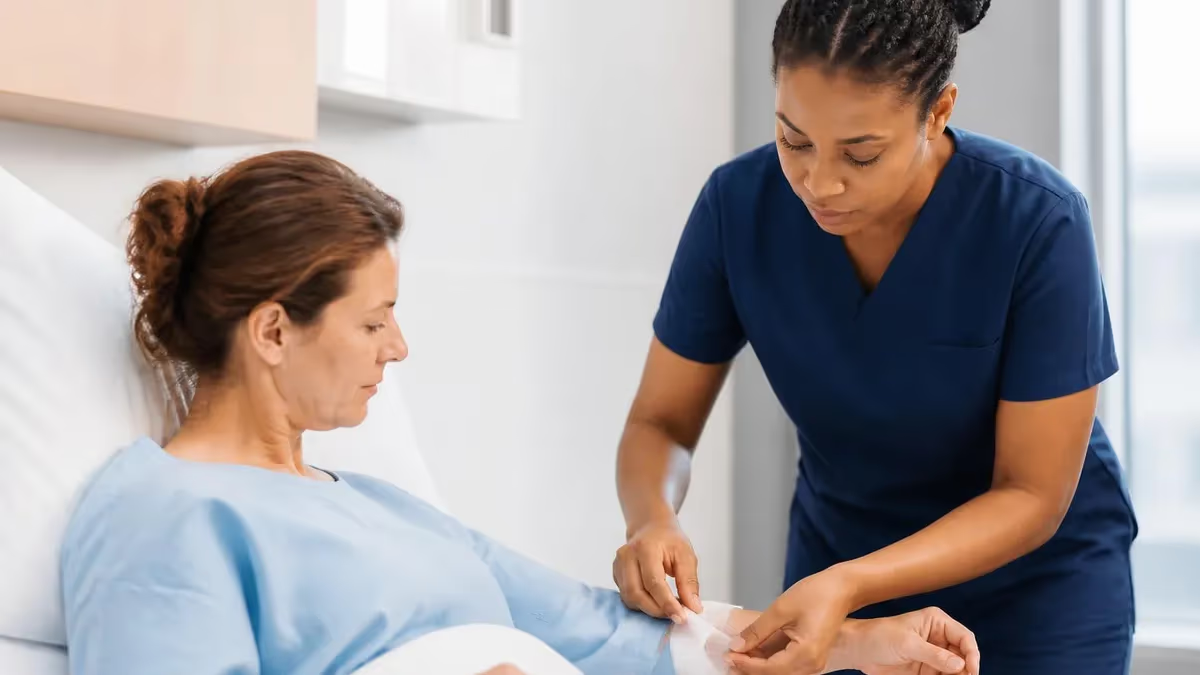
Searching for an lpn online program is one of the smartest moves a future nurse can make in 2026, especially if you are balancing a job, childcare, or a long commute to campus. The truth is that no Licensed Practical Nurse program in the United States is 100% online because state boards of nursing require supervised, in-person clinical hours before you can sit for the NCLEX-PN.
What you will actually find are hybrid LPN programs that move the lecture, theory, and exam preparation online while keeping skills labs and patient-care clinicals in person at a partnering hospital, long-term care facility, or simulation center.
This guide walks you through everything you need to evaluate before you enroll: accreditation, state board approval, tuition transparency, clinical placement support, NCLEX-PN pass rates, and the real weekly time commitment of an online-hybrid format. We will also compare typical costs, financial aid eligibility, and what employers actually think when they see a hybrid LPN credential on your resume. None of that matters, though, if the school is not approved in your state, so we start there.
Most hybrid LPN programs run 12 to 18 months full-time or 18 to 24 months part-time. Expect roughly 1,500 total clock hours split between online theory (around 750 hours), in-person skills lab (around 350 hours), and supervised clinical rotations (around 400 hours). The online portion is usually delivered through Canvas, Blackboard, or Moodle, with weekly live Zoom sessions and pre-recorded lectures you can pause and replay at midnight after the kids are asleep.
Tuition for a reputable hybrid LPN program ranges from about $5,000 at a community college in the Midwest to over $35,000 at a private career college on the coasts. Add another $2,000 to $4,000 for uniforms, a stethoscope, immunizations, a background check, books, ATI testing fees, and the NCLEX-PN application. Federal Pell Grants, state workforce grants, hospital sign-on tuition reimbursement, and the Workforce Innovation and Opportunity Act (WIOA) program can cover a meaningful chunk of that bill.
Before you put down a deposit, verify three things in writing: that the program holds approval from your state Board of Nursing, that it is accredited by the Accreditation Commission for Education in Nursing (ACEN) or the Council on Occupational Education (COE), and that its first-time NCLEX-PN pass rate sits at or above the national average, which has hovered between 79% and 84% in recent reporting cycles. If a recruiter cannot give you those three numbers on the first call, treat that as a red flag.
Online learning is not easier than the traditional classroom version. It is, in fact, harder for students who lack self-discipline, because no one is going to walk into your living room and remind you that pharmacology Module 4 is due Sunday at 11:59 PM. The students who thrive are the ones who block out a fixed weekly study schedule, set up a quiet workspace, and treat the program like a 40-hour-a-week job. By the end of this guide you will know exactly whether that lifestyle fits yours.
We will cover accreditation, costs, hybrid course delivery, clinical placement, the NCLEX-PN exam, and a realistic 18-month roadmap. Bookmark the page, because you will want to come back to the checklist and the FAQs once you start shortlisting schools.
LPN Online Programs by the Numbers (2026)
Your Path from Online Application to LPN License
Research & Verify Accreditation
Submit Application & Prerequisites
Begin Online Theory Coursework
Attend In-Person Skills Labs
Complete Supervised Clinical Rotations
Apply for NCLEX-PN & License
A hybrid lpn online program is built around three concurrent tracks: didactic theory delivered online, hands-on skills labs delivered in person, and supervised patient-care clinicals delivered at hospital and long-term care partners. Understanding how these tracks interlock will save you from picking a school that looks convenient on paper but turns into a logistical nightmare once your first clinical rotation starts 90 miles from home at 6:30 AM on a Saturday.
The theory portion is the part that genuinely lives online. You will work through modules covering nursing fundamentals, medical-surgical concepts, maternal and newborn care, pediatric nursing, mental health, gerontology, pharmacology, nutrition, and leadership. Most programs release one module per week, with reading assignments, recorded lectures of 30 to 60 minutes, a discussion board post, a graded quiz, and a proctored unit exam every three to four weeks using ProctorU or Honorlock webcam monitoring.
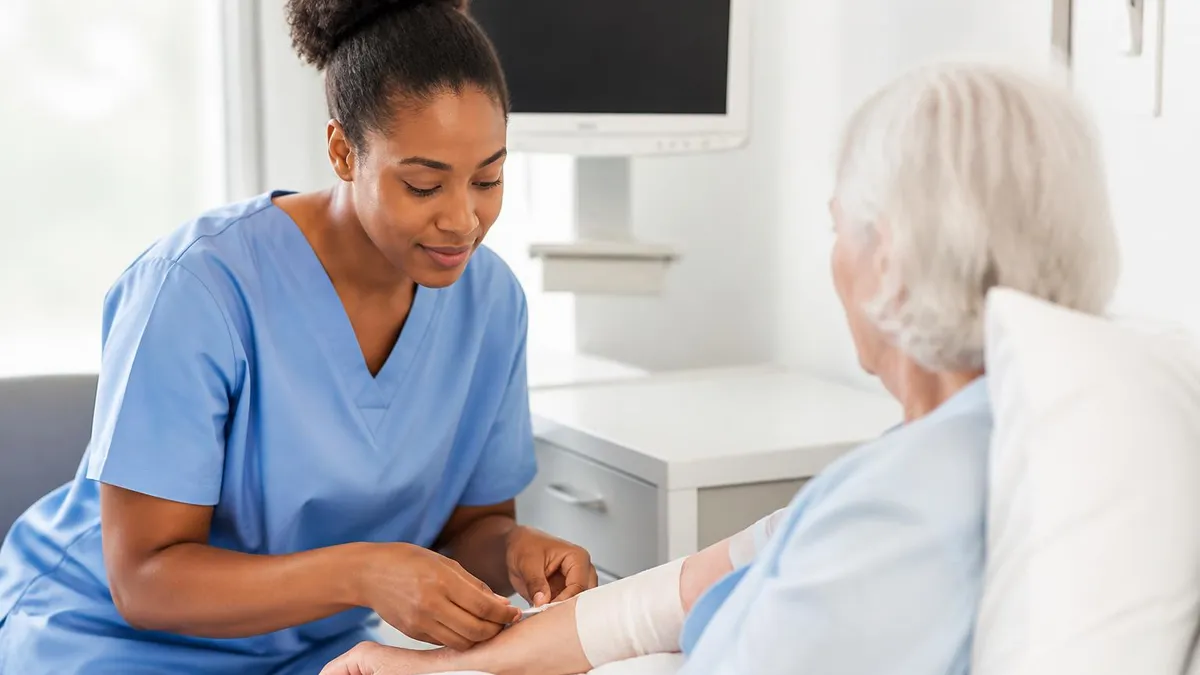
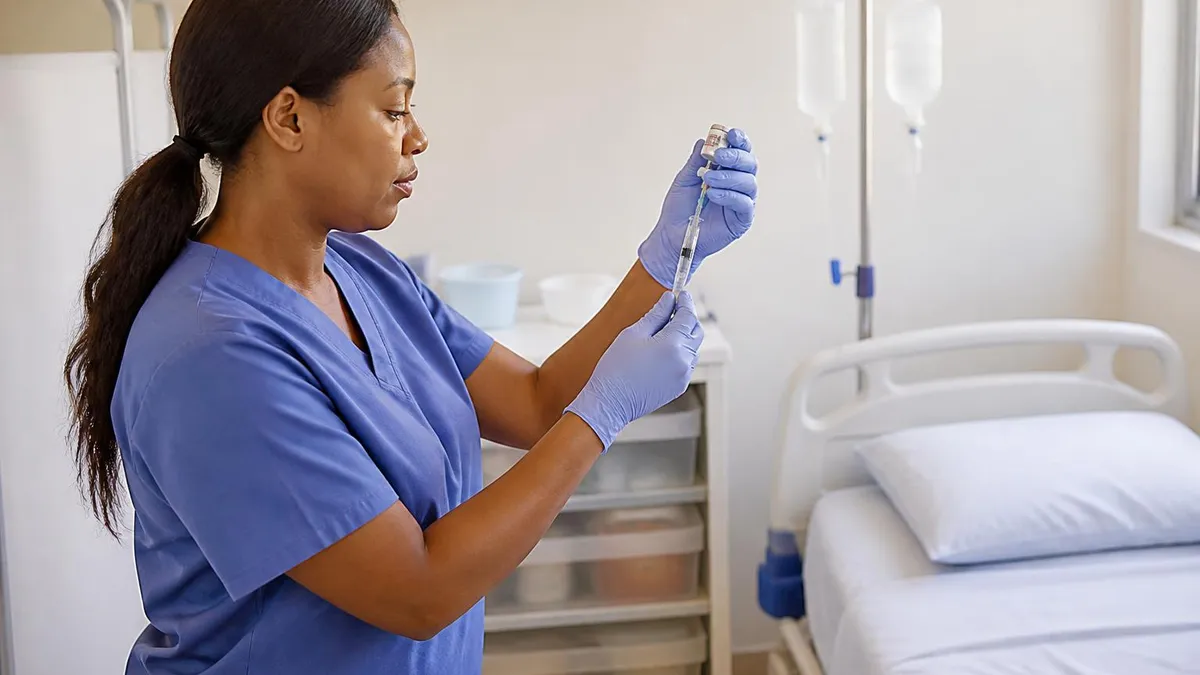
Skills labs are where many "online" programs stop being online. Schools that advertise themselves as fully remote often partner with a regional skills center where you must appear in person for one 8-hour Saturday every two weeks, or for a concentrated two-week intensive each semester. You will practice injections on mannequins, insert Foley catheters, manage sterile fields, transfer patients with mechanical lifts, and run through high-fidelity simulation scenarios that mimic real bedside emergencies before clinicals.
Clinical rotations are non-negotiable and non-virtual. Every state Board of Nursing requires a minimum number of supervised, hands-on patient-care hours, typically between 350 and 500, performed in licensed healthcare facilities under the direct supervision of a registered nurse clinical instructor. You cannot pass an LPN program by watching videos of someone else giving an insulin injection. You will give the injection yourself, document it, and be evaluated on it.
This is why clinical placement support is the single most important factor when comparing online LPN programs. Ask each school three questions in writing: How many clinical sites do you currently have within 30 miles of my home zip code? Who arranges the placement, the student or the school? And what happens if a contracted site cancels mid-semester? Schools that put the burden of finding your own preceptor or clinical site on you should be ranked lower.
The other detail people miss is the synchronous attendance requirement. Many hybrid programs require live Zoom attendance for two or three sessions per week, often 6:00 PM to 9:00 PM Eastern, and missing more than two sessions without medical documentation triggers an automatic course failure. Check the syllabus before enrolling, because "online" does not always mean "on your own schedule." Truly asynchronous programs exist but are rarer and usually cost more.
Once you understand the structure, the appeal becomes clear. A working CNA can keep her day shift, log into theory at night, drive to skills lab every other Saturday, and complete clinical rotations during a planned three-month unpaid leave. That flexibility is the entire reason online LPN programs exist, and it is also the reason they demand more discipline than a traditional schedule.
LPN Practice Test Questions
Prepare for the LPN - Certified Practical Nurse exam with our free practice test modules. Each quiz covers key topics to help you pass on your first try.
LPN - Certified Practical Nurse Basic Care...
LPN Exam Questions covering - Certified Practical Nurse Basic Care and Comfort. Master LPN Test concepts for certification prep.
LPN - Certified Practical Nurse Coordinate...
Free LPN Practice Test featuring - Certified Practical Nurse Coordinated Care. Improve your LPN Exam score with mock test prep.
LPN - Certified Practical Nurse Health Pro...
LPN Mock Exam on - Certified Practical Nurse Health Promotion and Maintenance. LPN Study Guide questions to pass on your first try.
LPN - Certified Practical Nurse Pharmacolo...
LPN Test Prep for - Certified Practical Nurse Pharmacological Therapies. Practice LPN Quiz questions and boost your score.
LPN - Certified Practical Nurse Physiologi...
LPN Questions and Answers on - Certified Practical Nurse Physiological Adaptation. Free LPN practice for exam readiness.
LPN - Certified Practical Nurse Psychosoci...
LPN Mock Test covering - Certified Practical Nurse Psychosocial Integrity. Online LPN Test practice with instant feedback.
LPN - Certified Practical Nurse Reduction ...
Free LPN Quiz on - Certified Practical Nurse Reduction of Risk Potential. LPN Exam prep questions with detailed explanations.
LPN - Certified Practical Nurse Safety and...
LPN Practice Questions for - Certified Practical Nurse Safety and Infection Control. Build confidence for your LPN certification exam.
LPN Ethical, Legal & Professional Standards
LPN Test Online for Ethical, Legal & Professional Standards. Free practice with instant results and feedback.
LPN Health Evaluation & Monitoring
LPN Study Material on Health Evaluation & Monitoring. Prepare effectively with real exam-style questions.
Online LPN Coursework vs In-Person Requirements
Theory courses cover nursing fundamentals, anatomy and physiology, microbiology, pharmacology, nutrition, lifespan development, mental health, maternal-newborn, pediatrics, and medical-surgical concepts. Lectures are pre-recorded and can be watched on your phone during a lunch break, but every module ends with a timed proctored exam that demands genuine mastery. Expect 20 to 25 hours of weekly screen time during a full-time track.
Discussion boards and case-study simulations replace traditional classroom debate. Most programs use Sentinel U, Shadow Health, or vSim virtual patient simulations to practice clinical reasoning before you ever step onto a real unit. These platforms grade your assessment order, your communication, and your safety decisions, and many programs require an 85% or higher score before you advance to the next module.
Are Online LPN Programs Right for You?
- +Watch lectures at night, on weekends, or during a lunch break around your work schedule
- +Save money on commuting, parking, childcare, and on-campus housing
- +Pause and rewind recorded lectures to master tough pharmacology and pathophysiology concepts
- +Stay in your current healthcare job (CNA, CMA, MA) while progressing through theory
- +Access nationwide programs, not just whatever school is closest to your home
- +Build digital skills employers increasingly value for telehealth, eMAR, and remote charting
- −Clinical rotations are always in person and often require unpaid time off work
- −Requires strong self-discipline; procrastinators routinely fail proctored exams
- −Skills lab and clinical sites may be 60+ miles from home with early morning arrival times
- −Reliable high-speed internet and a working webcam are mandatory for proctored testing
- −Less spontaneous peer support than a traditional classroom cohort experience
- −Some employers still prefer graduates of traditional brick-and-mortar nursing programs
LPN Online Program Enrollment Checklist
- ✓Verify the program is approved by your state Board of Nursing — search the official BON website
- ✓Confirm ACEN or COE accreditation and check the most recent NCLEX-PN pass rate (aim for 80%+)
- ✓Request a written list of clinical partner sites within 30 miles of your home address
- ✓Compare total cost of attendance, not just per-credit tuition — include fees, books, and uniforms
- ✓Submit FAFSA early to maximize Pell Grant and state workforce grant eligibility
- ✓Take and pass the TEAS or HESI A2 entrance exam — most programs require a 60% or higher
- ✓Complete a 10-panel drug screen, criminal background check, and full immunization record
- ✓Obtain BLS for Healthcare Providers certification before orientation week
- ✓Set up a dedicated, distraction-free study workspace with reliable internet and a webcam
- ✓Block 30 to 40 hours per week on your calendar for theory, lab, clinical, and study time
Treat your online LPN program like a 40-hour job, not an elective.
Students who pass online LPN programs on the first attempt almost universally report blocking out the same study hours every single day, in the same physical spot in their home, with their phone in another room. The flexibility of online learning is a trap if you treat it casually. Schedule theory hours on your calendar like a paid shift and you will finish the program on time with a strong GPA.
The real cost of an lpn online program is almost never the tuition number on the school's landing page. To budget accurately you have to add tuition, required fees, books, uniforms, lab kits, immunizations, background checks, drug screens, ATI or HESI testing packages, malpractice insurance, the NCLEX-PN exam, the state licensure application, and the income you may lose during clinical rotations if you cannot keep your day-shift hours.
Community college hybrid LPN programs typically run between $5,000 and $12,000 in tuition for residents, and they are almost always the best financial value when one is available in your state. Private career colleges and for-profit hybrid programs range from $18,000 to $35,000 because they include higher overhead, faster start dates every six to eight weeks, and dedicated clinical placement coordinators. Neither is inherently better, but you must do the math.
Federal Pell Grants can provide up to about $7,400 per academic year for students with demonstrated financial need based on the FAFSA. Many states also offer workforce shortage grants for nursing students, and the Workforce Innovation and Opportunity Act (WIOA) program through your local American Job Center can cover full tuition for displaced workers and adults re-entering the labor market. Always apply for these before signing a private student loan.
Hospitals and long-term care chains have aggressively reentered the tuition reimbursement market because of the ongoing LPN shortage. Genesis HealthCare, Encompass Health, HCA, ProMedica, and many regional health systems offer $2,000 to $15,000 in tuition reimbursement in exchange for a one- or two-year post-graduation work commitment. Some programs pay tuition up front; others reimburse after you pass NCLEX-PN. Check the fine print before signing.
Hidden costs that consistently surprise students include $200 for the NCLEX-PN exam itself, $150 for the state Board of Nursing licensure application, $300 to $600 for required immunizations and titers if your records are incomplete, $80 to $150 for a comprehensive background check across all states you have lived in, $400 to $800 for ATI or HESI testing packages, and $150 to $300 for uniforms, shoes, and a quality stethoscope.
Do not forget opportunity cost. Most students cannot work full time during the clinical portion of the program because rotations may run Monday through Friday during normal day shifts. Plan for 8 to 16 weeks of reduced income, and start saving an emergency fund at least three months before clinicals begin. A modest $3,000 buffer is often the difference between finishing the program and dropping out mid-semester.
The good news is that the return on investment for an LPN credential is unusually strong. The Bureau of Labor Statistics reports a median LPN wage of about $59,730 per year, with experienced LPNs in long-term care, dialysis, and hospice often earning $70,000 or more with shift differentials and overtime. Recouping a $15,000 total program cost in the first year of work is realistic for graduates who pass NCLEX-PN on the first try.

Several online schools market themselves aggressively to working adults but lack state Board of Nursing approval. If a program is not on your state BON's official approved-program list, you will not be eligible to sit for the NCLEX-PN exam no matter how much you paid in tuition. Always verify approval directly on the BON website before enrolling — never rely on the school's marketing claims alone.
The NCLEX-PN is the final gate between an online LPN graduate and a license to practice. It uses computerized adaptive testing (CAT), so the exam adjusts difficulty based on your performance and ends anywhere between 85 and 150 questions. The pass-or-fail decision is based on whether the algorithm is 95% confident your ability falls above or below the passing standard, not on a percentage score. The recent national first-time pass rate for U.S.-educated candidates hovers between 79% and 84%.
The exam blueprint is organized around four client-needs categories: Safe and Effective Care Environment (which includes Coordinated Care and Safety and Infection Control), Health Promotion and Maintenance, Psychosocial Integrity, and Physiological Integrity (which is the largest category and includes Basic Care and Comfort, Pharmacological Therapies, Reduction of Risk Potential, and Physiological Adaptation). Pharmacology and prioritization questions appear in almost every test plan.
Online LPN students often worry that they are at a disadvantage on NCLEX-PN because they did not sit in a physical classroom. Data from recent reporting cycles does not support that fear. Graduates of accredited hybrid programs pass at rates equivalent to traditional graduates, provided their program achieved at least an 80% pass rate institutionally. The variable that matters is program quality, not delivery format, and you can also explore the LPN Practice Test PDF (Free Printable 2026) for offline study.
The most effective preparation strategy is to spend the final 4 to 6 weeks before your test date doing 75 to 100 NCLEX-PN style questions every single day, with detailed rationale review for every item you miss. Use a question bank with adaptive difficulty such as UWorld, Kaplan, ATI, or Archer, and track your performance by client-needs category so you can target your weakest area each week.
Pharmacology consistently trips up new graduates. Memorize the top 100 medications by classification, mechanism, common adverse effects, and key nursing considerations rather than trying to memorize every drug ever made. Focus on insulin types and onset times, anticoagulants and reversal agents, opioids and naloxone, beta blockers, ACE inhibitors, antibiotics and major adverse effects, and high-alert medications like heparin, potassium, and digoxin.
Prioritization questions are the second-biggest source of missed points. When you see a question asking which patient to see first, apply Maslow's hierarchy, the ABCs (airway, breathing, circulation), and the rule that unstable patients always come before stable ones. When asked which task to delegate to an unlicensed assistant, remember that LPN-scope tasks like initial assessments, IV push medications, and teaching never delegate down to a CNA.
Test-day logistics matter more than students expect. Sleep eight hours the night before, eat a real breakfast with protein, arrive at the Pearson VUE testing center 30 minutes early with two forms of valid identification, and bring a sweater because testing centers run cold. The exam will end when the CAT algorithm is statistically confident in its decision. Trust the process and do not panic if your test stops at 85 questions or runs to all 150.
Once you have chosen an accredited online LPN program and mapped out your budget, the next step is to build a survival routine for the first semester. Most dropouts happen in weeks 4 through 8, when the initial excitement fades and the workload of pharmacology, anatomy, and fundamentals all converge. Setting up your study habits during week one, before you actually need them, is the highest-leverage thing you can do.
Start by mapping every assignment, quiz, exam, and clinical date for the entire semester onto a single visual calendar. Color code by course. Then back-plan from each due date: when will you do the reading, when will you watch the lecture, when will you complete the discussion board post, and when will you take the practice quiz? Students who plan backward from due dates almost never pull all-nighters or miss assignments.
Build a study group of two or three classmates from the very first week, even in an online format. Use Zoom, Discord, or a group text. Quiz each other on medications, talk through care plans, and hold each other accountable for clinical paperwork deadlines. Online programs can feel isolating, and students with an active peer group consistently outperform solo students on both course grades and the NCLEX-PN.
Master the art of active recall and spaced repetition. Passive rereading of textbooks is the single most common, single most useless study technique in nursing school. Instead, after every lecture, close the slides and write down everything you remember on a blank sheet of paper. Then check what you missed. Repeat that exercise three days later, then a week later. Anki flashcards are powerful for medications and lab values, so check out our LPN Programs Near Me 2026: Find Accredited Schools & Costs guide for school-specific tips.
Treat clinical paperwork as a routine, not as a creative project. Build template documents for care plans, medication worksheets, and patient summaries, and reuse the scaffold every week. The first care plan will take you six hours. By week four, the template should let you finish a full care plan in 90 minutes, freeing up your evenings for proper sleep before back-to-back clinical days.
Take care of your body. Nursing students who sleep less than six hours a night during the program have measurably higher exam failure rates. Eat regular meals, hydrate, exercise three times a week even if it is only a 20-minute walk, and protect your mental health with whatever counseling or peer support your school offers. The LPN you eventually become will be better at caring for patients because she first learned to care for herself.
Finally, never lose sight of the why. Whether you are going into nursing for the income stability, the work-from-anywhere licensure, the opportunity to ladder into RN later, or the chance to genuinely help people through the hardest moments of their lives, write that reason on a sticky note and put it on your monitor. The exam will get hard. The clinical instructor will sometimes be unfair. The reason on the sticky note is what gets you to graduation day.
LPN Questions and Answers

About the Author

Registered Nurse & Healthcare Educator
Johns Hopkins University School of NursingDr. Sarah Mitchell is a board-certified registered nurse with over 15 years of clinical and academic experience. She completed her PhD in Nursing Science at Johns Hopkins University and has taught NCLEX preparation and clinical skills courses for nursing students across the United States. Her research focuses on evidence-based exam preparation strategies for healthcare certification candidates.
Join the Discussion
Connect with other students preparing for this exam. Share tips, ask questions, and get advice from people who have been there.
View discussion (7 replies)