
LPN License Verification: Complete State-by-State Guide for 2026
LPN california license verification made simple. 📗 Step-by-step guide to verify any LPN license, check status, and confirm credentials in all 50 states.
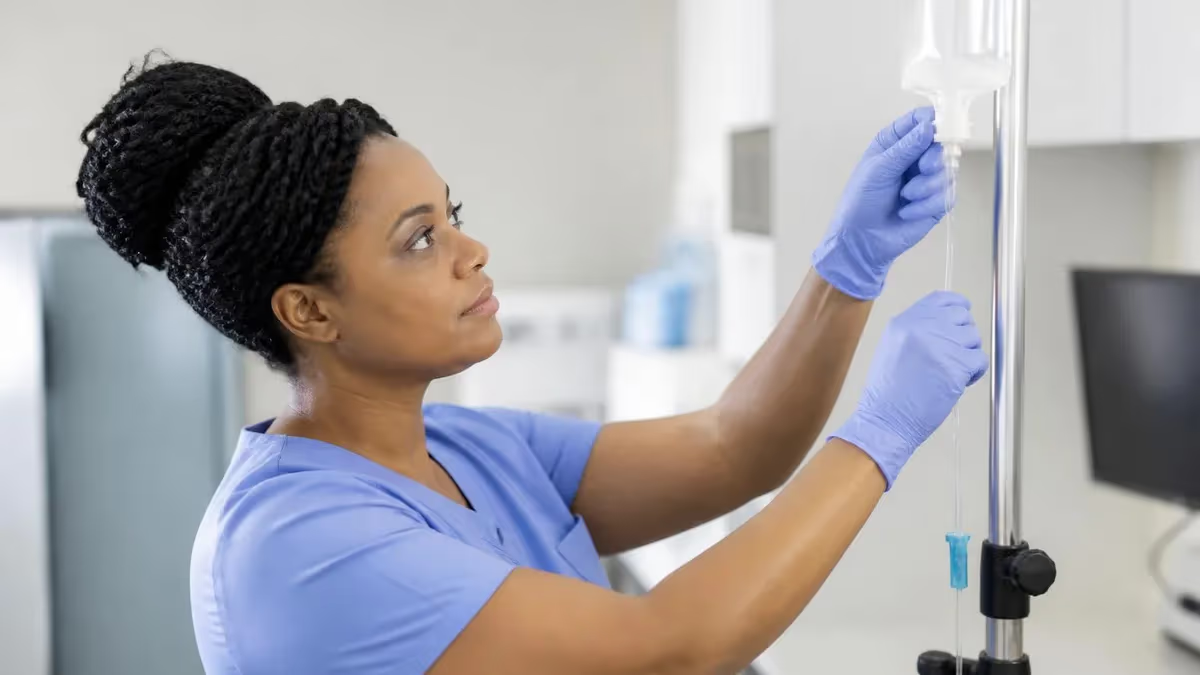
LPN california license verification is one of the most common credential checks performed in American healthcare, and understanding how it works can save you weeks of delay when applying for jobs, endorsing into a new state, or confirming a coworker's credentials. Every Licensed Practical Nurse holds a state-issued license, and that license must be verified through an official board of nursing portal before any employer, school, or compact state will treat it as valid. The verification process is digital, free in most states, and instant when you know where to look.
Whether you are an LPN moving from Texas to California, a hospital recruiter screening a new hire, or a student tracking the status of your first license application, the verification process follows a similar pattern. You enter the nurse's name or license number into the board's online lookup tool, the system displays the current status, and you either accept that record or request an official primary source verification through Nursys for compact and endorsement purposes. Each step matters because licensing data is the single source of truth for who can legally practice nursing in the United States.
This guide walks through every major scenario LPNs and employers face: how to perform a quick license lookup, how California's Board of Vocational Nursing differs from other state boards, what Nursys is and when to use it, how the Nurse Licensure Compact affects verification, and what to do if your license shows as inactive, lapsed, or under investigation. We also cover the cost, the typical timeline, and the most common errors that delay job offers or endorsement applications.
If you are still studying for your NCLEX-PN or preparing for clinical responsibilities, sharpening your test knowledge is just as important as understanding the licensing back end. Many LPNs find that working through targeted question banks alongside their license paperwork helps them feel more confident on day one. You can pair this guide with our LPN (Certified Practical Nurse) Test: Your Complete Guide for a full picture of what to expect from exam to licensure.
The stakes for accurate verification are real. Practicing on a lapsed license, even by accident, can trigger a disciplinary report that follows you across state lines through Nursys. Employers who hire an unlicensed nurse face state fines and federal billing exposure. And nurses who fail to update their address or renewal information often discover the problem only when a background check rejects their job application. Knowing how to read your own verification record is therefore a core professional skill, not just an administrative chore.
By the end of this guide you will know exactly how to verify any LPN license in any state, what the status codes mean, how compact privileges work for travel nurses, and how to fix the most common verification problems. Every step is based on official board of nursing procedures current as of 2026, with specific guidance for California, Texas, Florida, New York, and the 41 compact states that share data through the Nurse Licensure Compact.
LPN License Verification by the Numbers
How LPN License Verification Works Step by Step
Identify the Issuing State
Open the Official Lookup Portal
Enter Required Search Fields
Review the Status Record
Order Nursys Primary Source
State-by-state license lookup tools are the front door of nurse credential verification, and every state runs its own version. The interfaces look slightly different, but the underlying data is the same: a real-time feed from the board of nursing's licensing database. Once you know the URL for your target state, verifying any LPN takes less than a minute. The challenge is knowing the correct board name, because some states call practical nurses LVNs (licensed vocational nurses) and route them through a separate board entirely.
California is the most common source of confusion. LPNs in California are officially titled Licensed Vocational Nurses, or LVNs, and they are regulated by the Board of Vocational Nursing and Psychiatric Technicians — not the Board of Registered Nursing. If you search the BRN site for an LVN, you will get zero results even when the license is fully active. Texas uses the same LVN terminology but combines RN and LVN regulation under one board, the Texas Board of Nursing, which simplifies lookup considerably.
Florida, New York, Pennsylvania, and Ohio each maintain their own LPN portals through their respective departments of health or nursing boards. Florida's MQA Services portal returns LPN records alongside RN, ARNP, and CNA records in a single search. New York's Office of the Professions handles all licensed professions including LPNs through the same lookup tool. Pennsylvania routes verification through the Pennsylvania Licensing System (PALS), and Ohio uses the eLicense Center.
For employers verifying out-of-state hires, the smart workflow is to identify the original issuing state, run the free state lookup, and then place a paid Nursys verification only if the role requires a formal primary source document. Most hospital systems require Nursys for permanent hires but accept the free state lookup printout for temporary or per-diem staff.
Travel nursing agencies almost always require Nursys because their LPNs frequently work in multiple compact states. If you need to find current openings while your verification is in process, our LPN Jobs Near Me 2026: How to Find Licensed Practical Nurse Jobs guide breaks down where employers are hiring most aggressively.
Compact states share a single Nursys backbone, which means an LPN licensed in a compact state can be verified through any compact state's portal — but only for the multi-state privilege, not for the underlying single-state license. If an LPN holds a primary license in Virginia and a compact privilege to work in Tennessee, employers must verify the Virginia license through Virginia's board and confirm the privilege through Nursys. This two-step verification is non-negotiable for compact-state hires.
Mobile access has improved dramatically since 2023. Every major state board now offers a mobile-friendly lookup, and several states — including Florida, Ohio, and North Carolina — have dedicated mobile apps that nurses can use to display their license to an employer in real time. Bookmark your state's lookup URL on your phone before your next interview and you can demonstrate active status on the spot.
When a license search returns no results, the issue is almost always a name mismatch, a missed renewal, or a search of the wrong board. Try variations of the name, search by license number only, and confirm you are on the correct board's site before assuming the license is invalid. The next sections walk through state-specific search procedures and the most common error patterns.
LPN Practice Test Questions
Prepare for the LPN - Certified Practical Nurse exam with our free practice test modules. Each quiz covers key topics to help you pass on your first try.
LPN - Certified Practical Nurse Basic Care...
LPN Exam Questions covering - Certified Practical Nurse Basic Care and Comfort. Master LPN Test concepts for certification prep.
LPN - Certified Practical Nurse Coordinate...
Free LPN Practice Test featuring - Certified Practical Nurse Coordinated Care. Improve your LPN Exam score with mock test prep.
LPN - Certified Practical Nurse Health Pro...
LPN Mock Exam on - Certified Practical Nurse Health Promotion and Maintenance. LPN Study Guide questions to pass on your first try.
LPN - Certified Practical Nurse Pharmacolo...
LPN Test Prep for - Certified Practical Nurse Pharmacological Therapies. Practice LPN Quiz questions and boost your score.
LPN - Certified Practical Nurse Physiologi...
LPN Questions and Answers on - Certified Practical Nurse Physiological Adaptation. Free LPN practice for exam readiness.
LPN - Certified Practical Nurse Psychosoci...
LPN Mock Test covering - Certified Practical Nurse Psychosocial Integrity. Online LPN Test practice with instant feedback.
LPN - Certified Practical Nurse Reduction ...
Free LPN Quiz on - Certified Practical Nurse Reduction of Risk Potential. LPN Exam prep questions with detailed explanations.
LPN - Certified Practical Nurse Safety and...
LPN Practice Questions for - Certified Practical Nurse Safety and Infection Control. Build confidence for your LPN certification exam.
LPN Ethical, Legal & Professional Standards
LPN Test Online for Ethical, Legal & Professional Standards. Free practice with instant results and feedback.
LPN Health Evaluation & Monitoring
LPN Study Material on Health Evaluation & Monitoring. Prepare effectively with real exam-style questions.
LPN California License Verification, Texas LVN, and Florida LPN Lookup
California licenses practical nurses as Licensed Vocational Nurses through the Board of Vocational Nursing and Psychiatric Technicians (BVNPT). The free license verification portal is hosted at the DCA BreEZe Online Services site and lets you search by name, license number, or business. Results display issue date, expiration date, status, and any public disciplinary actions. California LVN licenses renew every two years and require 30 hours of approved continuing education plus a renewal fee of $150 as of 2026.
Out-of-state LPNs cannot use a compact privilege in California because California is not a Nurse Licensure Compact state. To work as an LVN in California you must apply for endorsement through BVNPT, submit fingerprints via Live Scan, and request Nursys primary source verification from your original licensing state. Total processing time is typically 8 to 12 weeks. Track the application status through your BreEZe account dashboard, which updates in real time as each verification document arrives.
Free State Lookup vs. Paid Nursys Verification
- +Free state lookups return results instantly with no account required
- +Official board portals are accepted by most per-diem and temporary employers
- +Mobile-friendly interfaces let you display status during an interview
- +State portals show local disciplinary actions and license history
- +No transaction fees or third-party data middlemen involved
- +Direct from the licensing authority, so always current and accurate
- −State lookups are not accepted as primary source verification for endorsement
- −Compact privileges require a separate Nursys check beyond the state portal
- −Some states limit how many free searches one IP address can run per day
- −Search interfaces vary widely between states, creating a learning curve
- −Name changes that were not reported will return zero matches
- −Free lookups do not generate the formal PDF document hospitals often require
Pros and Cons at a Glance
| Pros | Cons |
|---|---|
| Free state lookups return results instantly with no account required | State lookups are not accepted as primary source verification for endorsement |
| Official board portals are accepted by most per-diem and temporary employers | Compact privileges require a separate Nursys check beyond the state portal |
| Mobile-friendly interfaces let you display status during an interview | Some states limit how many free searches one IP address can run per day |
| State portals show local disciplinary actions and license history | Search interfaces vary widely between states, creating a learning curve |
| No transaction fees or third-party data middlemen involved | Name changes that were not reported will return zero matches |
| Direct from the licensing authority, so always current and accurate | Free lookups do not generate the formal PDF document hospitals often require |
LPN License Verification Pre-Check Checklist
- ✓Confirm the issuing state and correct board name (LVN vs LPN matters)
- ✓Gather the LPN's full legal name as printed on the license
- ✓Note the license number if available to speed up name-mismatch searches
- ✓Have date of birth ready in case the board requires identity confirmation
- ✓Bookmark the official state board URL — avoid third-party verification sites
- ✓Check whether the role requires Nursys primary source or accepts state lookup
- ✓Verify the license expiration date is at least 90 days in the future
- ✓Review any disciplinary or board action history listed in the record
- ✓Save or print the verification page as a dated PDF for HR records
- ✓Confirm compact privilege status separately if the nurse works across state lines
A free state lookup is not the same as a Nursys primary source verification
Hospital credentialing, endorsement applications, and federal compliance audits require the formal Nursys primary source document, not a printed screenshot. Always confirm which level of verification your employer or board actually needs before paying for or skipping the $30 Nursys order.
Nursys is the centralized license database operated by the National Council of State Boards of Nursing, and it is the single most important tool in nurse license verification. Every U.S. state board of nursing — including those that issue LPN and LVN licenses — feeds licensure data directly into Nursys in real time. When you order a Nursys verification, you are receiving the official, legally recognized primary source of that nurse's credentials, accepted in every state for endorsement, compact privilege confirmation, and employer compliance reporting.
The Nurse Licensure Compact, often shortened to NLC, allows LPNs whose primary state of residence is a compact state to hold a single multi-state license that authorizes practice in all other compact states without additional fees or applications. As of 2026, 41 states participate in the compact, including Texas, Florida, North Carolina, Virginia, Tennessee, Arizona, and most of the Southeast and Midwest. California, New York, Illinois, Oregon, Washington, Massachusetts, and Hawaii are notable non-compact holdouts that still require formal endorsement for out-of-state LPNs.
To qualify for the multi-state privilege, an LPN must declare a primary state of residence in a compact state, hold an unencumbered license in that state, and meet uniform licensure requirements including federal and state criminal background checks. The privilege travels with the nurse, so an LPN who moves from Tennessee to Virginia must apply for licensure by endorsement in Virginia within 60 days of establishing residence. Failing to update your primary state is a common cause of compact privilege revocation.
Employers verifying compact LPNs need to perform a two-part check. Step one is the standard state board lookup of the primary single-state license. Step two is a Nursys QuickConfirm check that displays the multi-state privilege flag and any current compact privilege expirations. Both checks are free for individual searches, though formal Nursys reports cost $30 per state and are commonly required by hospital credentialing offices for permanent staff.
Nursys also operates an e-Notify service that gives employers real-time alerts when one of their LPNs has a license change — expiration, renewal, disciplinary action, or compact privilege change. This service is increasingly required by Joint Commission accredited facilities because it eliminates the risk of letting an expired license slip through routine audits. Subscribing is free for employers and takes about 10 minutes to set up per facility.
For LPNs personally tracking their own credentials, Nursys offers a free Nurse Self Service tool that displays all current licenses and privileges across all states. This is especially useful for travel nurses, agency LPNs, and any practitioner who has held licenses in multiple states over a career. The tool also serves as a backup record if your physical wallet card is ever lost or damaged before a workplace audit.
Understanding the relationship between state boards, Nursys, and the NLC is foundational for any LPN planning a long-term nursing career. The system is built around primary source verification, which is the principle that licensing data must always flow directly from the issuing authority to the verifying party with no intermediaries who could alter or delay it. That principle is what makes nurse license verification one of the most reliable credential systems in American healthcare.

Practicing on a lapsed, inactive, or delinquent LPN license is a violation of state nurse practice acts and can trigger disciplinary action that follows you nationwide through Nursys. Always confirm your renewal is complete before your next shift, and never rely on a grace period to legally cover patient care hours after expiration.
Failed verifications are the most stressful moment in the licensing process, but nearly every failure has a known cause and a known fix. The most common reason a license search returns no results is a name mismatch — a married name that was not reported, a hyphenated name searched without the hyphen, or a middle initial entered as a full middle name. Always retry with the license number only, then with name variations, before assuming the license is invalid or expired.
The second most common failure mode is searching the wrong board. California, Texas, and a handful of other states use LVN terminology, while most states use LPN. If you search a California Board of Registered Nursing portal for an LVN, you will see zero results because LVNs are regulated by an entirely separate board. Confirm the correct issuing authority before declaring a verification failure. The boards' own websites typically include redirect links if you land on the wrong one.
Lapsed renewals are a third frequent issue. LPN licenses generally expire every two years, and most boards send renewal reminders 60 to 90 days in advance via email and physical mail. If the nurse moved without updating their address with the board, the reminder is lost and renewal is missed. Lapsed licenses can usually be reinstated by paying back fees, completing overdue CE hours, and submitting a delinquency form, but the process can take 4 to 8 weeks and bars the LPN from practicing during that window.
Disciplinary holds are a more serious cause of verification failure. If a board has placed a license under investigation, suspension, or probation, the public record will show that status and many employers will pause hiring until the matter is resolved. Nurses with active disciplinary records should be prepared to provide context and documentation directly to the employer rather than hoping the issue is overlooked. Honesty during onboarding almost always produces better outcomes than discovery during a background check.
Endorsement delays cause verification problems when an LPN has moved between states and the destination board has not yet processed the application. During that window, the nurse may not legally practice in the new state even though the old state license is fully active.
The fix is to apply for endorsement at least 90 days before the planned start date, request Nursys verification immediately, and confirm the new state's processing timeline before accepting a job offer. Reviewing the full licensing pathway in our How to Become an LPN: Step-by-Step Journey From Decision to Job guide can help you anticipate timing milestones.
Fingerprint and background check holds round out the common failure list. Many states require a Live Scan or FBI fingerprint submission as part of initial licensure or renewal, and a single technical rejection — a smudged print, an incomplete form — can hold up the entire application. Track the status of your fingerprint submission separately from your license application and follow up directly with the fingerprinting agency if 30 days pass without confirmation.
When a verification fails for an unknown reason, the fastest path forward is a direct phone call or email to the issuing board. Every state board has a licensing services team that can manually look up records and explain status discrepancies. Have your full name, license number, date of birth, and last known address ready before calling, and request a written confirmation of whatever explanation they provide.
Practical tips for keeping your LPN license verification clean start the day you receive your first license. The single most valuable habit is keeping your contact information current with every state board where you hold a credential. Boards send renewal reminders, disciplinary notices, and audit requests by mail and email, and a missed notification is the most common pathway to an accidentally lapsed license. Update your address within 30 days of any move, and add the board's email domain to your safe sender list to prevent renewal notices from landing in spam.
Set calendar reminders 120, 90, and 30 days before your license expires. Most boards open the renewal window 60 to 90 days in advance, and starting early gives you time to complete continuing education, gather fingerprint receipts, and resolve any unexpected issues. Renewing on the last day is a trap that catches thousands of LPNs each year when the board's website crashes under load or a payment fails to process. Early renewal also protects your scheduled shifts from any administrative delay.
Document your continuing education hours as you complete them, not at renewal time. Save course completion certificates as PDFs in a dedicated folder, log them in your state's CE tracking tool if available, and keep a running spreadsheet with course name, provider, date, and contact hours. Random audits happen every renewal cycle, and selected nurses must produce documentation within 30 days. A well-maintained CE folder turns an audit into a five-minute task instead of a panicked weekend.
If you work in multiple states under compact privilege, run a free Nursys QuickConfirm on yourself once a quarter. This catches any status change before your employer does and gives you time to fix issues before they affect your paycheck. The same check is invaluable for travel LPNs whose assignments cross compact-state lines every few months. Self-monitoring is faster than waiting for someone else to flag the problem.
Keep a digital copy of your license verification screenshot or printout in your phone, especially before interviews and first shifts at a new facility. HR onboarding teams routinely ask for it, and producing it on the spot signals professionalism. If you want to combine credential prep with skill review, browse free practice resources like our LPN Practice Test PDF (Free Printable 2026) alongside your renewal paperwork.
Finally, treat every licensing communication as time-sensitive. Boards do not extend deadlines for nurses who claim they did not see an email. If you receive a notice of audit, investigation, or missing documentation, respond within 48 hours even if you cannot fully resolve the issue immediately. A short message acknowledging receipt and outlining your next steps is far better than silence, and it often buys additional response time when needed.
License verification is not glamorous work, but it is the foundation of every LPN's ability to legally practice nursing in the United States. Mastering the verification process — knowing where to look, what the status codes mean, when to use Nursys, and how to fix common errors — protects your career, your paycheck, and your patients. The thirty minutes you spend learning this system today will save you weeks of stress over a thirty-year nursing career.
Sample Certified Practical Nurse Practice Questions
Try these questions from our free Certified Practical Nurse practice tests. The correct answer and an explanation follow each question.
An LPN is admitting a new client to a substance abuse treatment facility. During the initial interview, the client becomes defensive and states, 'I don't have a problem. I can quit anytime I want.' What is the LPN's most appropriate action?
- A. Confront the client with evidence of their substance abuse problem.
- B. Document the client's statement as denial and continue the admission process.
- C. Explain the negative health consequences of continued substance use.
- D. Agree with the client to build rapport and trust.
Answer: B. Document the client's statement as denial and continue the admission process.
Denial is a common coping mechanism in clients with substance use disorders. The LPN's role is to remain non-judgmental, accurately document the client's statements and behaviors, and proceed with the established admission protocol. Confronting the client can create a barrier to the therapeutic relationship.
An LPN in a pediatric clinic is assessing a toddler with numerous bruises in various stages of healing on their trunk and back. The parent states the child is clumsy and falls a lot. Which of the following actions is the LPN's legal responsibility?
- A. Document the findings and ask the parent to return in one week.
- B. Confront the parent about the suspicious nature of the injuries.
- C. Tell the parent to implement better safety measures at home.
- D. Report the suspected child abuse to the appropriate authorities.
Answer: D. Report the suspected child abuse to the appropriate authorities.
Nurses are mandated reporters. When there is a suspicion of child abuse, such as bruises in locations not typically associated with accidental falls, the LPN has a legal and ethical obligation to report their findings to Child Protective Services or the designated state agency for investigation.
Which organization is responsible for investigating complaints of nursing misconduct and can revoke an LPN's license?
- A. The American Nurses Association (ANA)
- B. The State Board of Nursing
- C. The Joint Commission (TJC)
- D. The National Council of State Boards of Nursing (NCSBN)
Answer: B. The State Board of Nursing
State Boards of Nursing have the legal authority to investigate complaints and take disciplinary action, including license revocation.
A patient states, 'I feel like I'm watching myself from across the room.' The LPN recognizes this as:
- A. Depersonalization
- B. Hallucination
- C. Derealization
- D. Illusion
Answer: A. Depersonalization
Depersonalization is the feeling of being detached from or an outside observer of one's own thoughts, feelings, or body.
LPN Questions and Answers


About the Author

Registered Nurse & Healthcare Educator
Johns Hopkins University School of NursingDr. Sarah Mitchell is a board-certified registered nurse with over 15 years of clinical and academic experience. She completed her PhD in Nursing Science at Johns Hopkins University and has taught NCLEX preparation and clinical skills courses for nursing students across the United States. Her research focuses on evidence-based exam preparation strategies for healthcare certification candidates.
Join the Discussion
Connect with other students preparing for this exam. Share tips, ask questions, and get advice from people who have been there.
Start the conversation