
LPN License Renewal: Complete Guide to Renewing Your Practical Nurse License in 2026 October
LPN nursing license renewal made simple: deadlines, CE hours, fees, state-by-state rules, and step-by-step instructions to renew on time in 2026 October. 🧠
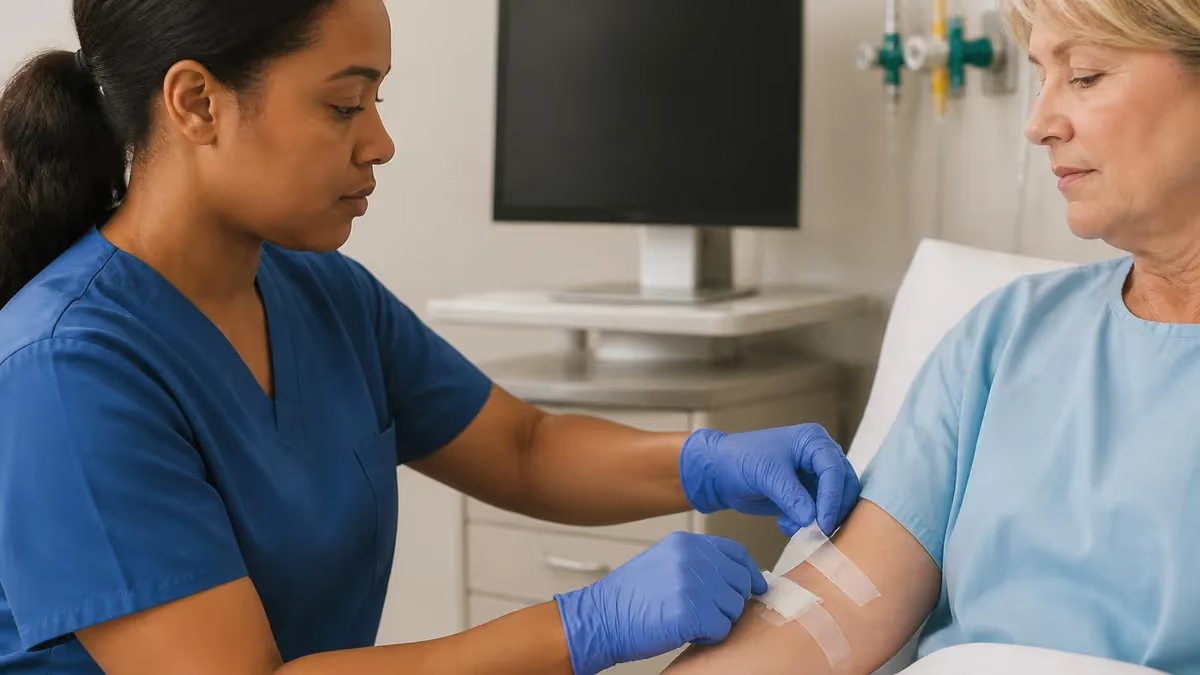
LPN nursing license renewal is one of those administrative tasks that sneaks up on nurses every one to two years, and missing the deadline can sideline your career overnight. Whether you work in long-term care, a busy clinic, home health, or a hospital floor, your state board of nursing requires you to verify continued competence, pay a renewal fee, and confirm that you remain in good standing. The process sounds simple, but each state has its own twists — different cycles, different continuing education requirements, and very different penalties for late filing.
This guide walks you through everything a licensed practical nurse needs to know about renewing in 2026. We cover the universal steps that apply in every state, the state-specific quirks that trip up even experienced nurses, the continuing education hours you must document, the fees you should expect, and the compact license rules that have reshaped renewal for nurses who cross state lines. By the end, you will have a clean checklist you can act on today.
Renewal is also a chance to clean up your professional file. Many LPNs discover during renewal that their employer records, address with the board, and even their legal name have drifted out of sync. Sorting these out before you submit prevents the dreaded "pending review" status that can stretch a 10-minute online renewal into a six-week wait. We will show you how to audit your file in under 30 minutes.
If you are also weighing a career step up, renewal is the ideal moment to map your next move. Many practical nurses use the renewal window to enroll in a bridge program, and our LPN to RN: Bridge Programs, Requirements, and Career Paths guide explains how to stack continuing education credit toward an RN degree while you keep your current license active. That dual-track approach saves money and time.
Before we dive in, a quick note on timing. Most states open the renewal window 60 to 90 days before your expiration date. Renewing during that window — rather than in the final 48 hours — gives you breathing room if your fingerprint background check, CE certificate upload, or payment fails to process. Late fees in some states reach $200, and a lapsed license can mean unpaid suspension from your shift schedule until reinstatement clears.
The good news? Renewal is almost entirely online in 2026. Forty-eight states accept fully digital submissions, and most boards process clean applications within five business days. If you prepare your documents in advance, gather your CE certificates, and confirm your employer information, you can complete the entire renewal in a single 20-minute sitting. Let us start with the numbers that frame every renewal decision.
This article focuses on practical nurses (LPNs) and licensed vocational nurses (LVNs in California and Texas). The renewal process is functionally identical for both titles, with only minor terminology differences on state forms. If you hold a multistate compact license, pay close attention to the dedicated section below — the rules differ in important ways.
LPN License Renewal by the Numbers

The LPN Renewal Timeline Step by Step
90 Days Before Expiration
60 Days Before Expiration
30 Days Before Expiration
14 Days Before Expiration
Day of Expiration
Continuing education is the single biggest source of renewal headaches for LPNs. Every state except a small handful requires documented CE hours, and the totals range from zero in Colorado and Wisconsin to 30 hours in Florida and California. Some states bundle mandatory topics — pain management, human trafficking recognition, opioid prescribing awareness, or domestic violence — into the total, while others require these on top of general CE. Reading your state's CE rule carefully, in writing, is non-negotiable.
The most common pitfall is assuming that any course labeled "nursing" counts. State boards only accept CE from approved providers, typically those accredited by the American Nurses Credentialing Center (ANCC), a state nurses association, or a board-approved vendor. Free CE on social media or unaccredited YouTube modules will be rejected during audit. Always confirm the provider's approval number appears on your certificate before you click "complete" and pay for the course.
If you bridge to an RN role, check our Online LPN to RN Programs: Bridge to Your RN License Without Leaving Work guide — many bridge program courses double as renewal CE if you submit transcripts in time. This stacking strategy saves $200 to $500 per renewal cycle for nurses already pursuing further education.
Audits happen randomly. Roughly 1 in 10 LPNs is selected for CE audit each cycle, and the burden of proof is entirely on you. Keep certificates for at least four years, ideally in a cloud folder with a second copy in your email. If audited, you will have 30 days to submit clean PDFs. Failure to respond typically results in a complaint investigation, fines, and a temporary suspension until compliance is verified.
Some states allow carryover hours. Florida lets you bring forward up to half your hours from a previous biennium, but most states do not. Avoid front-loading your CE in year one and assuming you are done. Spread courses across the biennium so you can absorb a missed deadline, a new mandated topic that gets added mid-cycle, or a job transition that disrupts your planned learning schedule.
Free CE is widely available. The CDC, state health departments, and major hospital systems offer free contact hours that satisfy mandatory topics like infection control and immunizations. NurseCE.com, RN.com, and your employer's learning management system are also reliable sources. Budget roughly $1 to $5 per contact hour if you pay, and avoid "too good to be true" bulk packages from unfamiliar vendors.
Finally, document your hours as you go, not at the end. Create a one-page log with course title, provider, approval number, date completed, contact hours, and a link to the PDF. When renewal opens, you can transcribe the log into the application in under five minutes. This habit alone prevents the late-night certificate hunt that causes most renewal stress.
LPN Practice Test Questions
Prepare for the LPN - Certified Practical Nurse exam with our free practice test modules. Each quiz covers key topics to help you pass on your first try.
LPN - Certified Practical Nurse Basic Care...
LPN Exam Questions covering - Certified Practical Nurse Basic Care and Comfort. Master LPN Test concepts for certification prep.
LPN - Certified Practical Nurse Coordinate...
Free LPN Practice Test featuring - Certified Practical Nurse Coordinated Care. Improve your LPN Exam score with mock test prep.
LPN - Certified Practical Nurse Health Pro...
LPN Mock Exam on - Certified Practical Nurse Health Promotion and Maintenance. LPN Study Guide questions to pass on your first try.
LPN - Certified Practical Nurse Pharmacolo...
LPN Test Prep for - Certified Practical Nurse Pharmacological Therapies. Practice LPN Quiz questions and boost your score.
LPN - Certified Practical Nurse Physiologi...
LPN Questions and Answers on - Certified Practical Nurse Physiological Adaptation. Free LPN practice for exam readiness.
LPN - Certified Practical Nurse Psychosoci...
LPN Mock Test covering - Certified Practical Nurse Psychosocial Integrity. Online LPN Test practice with instant feedback.
LPN - Certified Practical Nurse Reduction ...
Free LPN Quiz on - Certified Practical Nurse Reduction of Risk Potential. LPN Exam prep questions with detailed explanations.
LPN - Certified Practical Nurse Safety and...
LPN Practice Questions for - Certified Practical Nurse Safety and Infection Control. Build confidence for your LPN certification exam.
LPN Ethical, Legal & Professional Standards
LPN Test Online for Ethical, Legal & Professional Standards. Free practice with instant results and feedback.
LPN Health Evaluation & Monitoring
LPN Study Material on Health Evaluation & Monitoring. Prepare effectively with real exam-style questions.
State-by-State LPN License Renewal Rules
Florida, California, Kentucky, and Nevada sit at the top of the CE requirement list, demanding 24 to 30 hours per biennium. Florida requires specific hours in medical errors, HIV/AIDS, human trafficking, domestic violence, laws and rules, and impairment prevention. California requires LVNs to complete 30 contact hours every two years with no carryover, and the board strictly audits new licensees.
These states also publish detailed audit guidelines on their board websites. If you practice in any of them, set a calendar reminder six months before expiration to complete state-mandated topics first. The general CE hours can be filled later, but mandated topic availability sometimes lags new legislation, so claim those courses early in the cycle to avoid scrambling at renewal time.

Renewing Early vs Waiting Until the Deadline
- +Avoids late fees that can exceed the renewal cost itself
- +Gives time to fix CE deficiencies before expiration
- +Prevents employer suspension or removal from the schedule
- +Allows background check and fingerprints to process unhurried
- +Keeps your Nursys verification active for travel assignments
- +Reduces stress and last-minute documentation hunts
- −Ties up renewal funds 60 to 90 days earlier than required
- −May not capture the latest CE hours completed near deadline
- −Some boards reset the new cycle from the renewal date, shortening it
- −Easy to forget you renewed and accidentally pay twice
- −Cannot adjust if your employer or address changes mid-cycle
- −Early renewal does not exempt you from new mandated topics added later
Pros and Cons at a Glance
| Pros | Cons |
|---|---|
| Avoids late fees that can exceed the renewal cost itself | May not capture the latest CE hours completed near deadline |
| Gives time to fix CE deficiencies before expiration | Some boards reset the new cycle from the renewal date, shortening it |
| Prevents employer suspension or removal from the schedule | Easy to forget you renewed and accidentally pay twice |
| Allows background check and fingerprints to process unhurried | Cannot adjust if your employer or address changes mid-cycle |
| Keeps your Nursys verification active for travel assignments | Early renewal does not exempt you from new mandated topics added later |
Your LPN License Renewal Pre-Flight Checklist
- ✓Confirm your exact license expiration date on your state board portal
- ✓Verify your legal name matches your Social Security record and any court orders
- ✓Update your mailing address, email, and phone number with the board
- ✓Add or update your current employer and primary practice setting
- ✓Total your continuing education hours and confirm provider approval numbers
- ✓Save all CE certificates as PDFs in a dedicated cloud folder
- ✓Complete any state-mandated topics such as opioids, child abuse, or implicit bias
- ✓Gather payment method — most boards require credit card or e-check
- ✓Review disclosure questions about criminal, disciplinary, or health matters
- ✓Submit at least 30 days before expiration to allow processing buffer
Take a screenshot of every confirmation page
After you submit your renewal, the confirmation page appears for only a few seconds before redirecting. Screenshot the confirmation number, payment receipt, and submission timestamp before you close the browser. If your application gets stuck in pending, this screenshot is your only proof of timely filing — and it can save you from late fees and employer suspension.
Renewal fees vary widely. Most states charge between $50 and $130 for on-time LPN renewal, but the real cost surfaces when you miss the deadline. Late fees range from $25 in Iowa and Nebraska to $200 in Florida and Texas. A lapsed license — usually defined as more than 30 to 60 days past expiration — typically requires a full reinstatement application, a separate reinstatement fee of $100 to $300, and proof of recent practice or refresher coursework.
Reinstatement after a long lapse is significantly harder than annual renewal. Many state boards require a refresher course, a competency exam, or proof of supervised clinical hours if you have not practiced within the past five years. The Idaho, Texas, and Ohio boards require new fingerprints and a fresh background check at reinstatement, even if your originals are on file. Budget at least eight weeks for a lapsed-license reinstatement to fully process.
If you cannot pay your renewal fee, contact the board before your expiration date. Several states offer hardship deferrals or installment plans for nurses facing documented financial difficulty. Active military members and their spouses qualify for fee waivers in most jurisdictions, as do nurses on extended military deployment. Document everything in writing and keep email confirmations — verbal promises from board staff do not protect you in an audit.
Inactive status is another option worth knowing. Most states allow LPNs to declare voluntary inactive status, which pauses the license without lapsing it. You pay a reduced annual fee (often $25 to $50), skip CE requirements, and cannot practice for pay until you reactivate. This is ideal for nurses taking extended leave for family, education, or relocation, but reactivation may still require updated CE before you return to practice.
Watch your bank statement for the actual charge. Some boards process payments through third-party vendors that may add a convenience fee of $3 to $15. The renewal fee posted by the board does not always include this surcharge. Confirm the final amount on your payment confirmation before you close the browser. Disputing a charge with your bank can void your renewal and trigger a payment-failure status that requires manual board intervention.
Tax considerations matter too. Renewal fees, CE costs, professional liability insurance, and association dues are deductible as unreimbursed employee expenses on Schedule A for self-employed LPNs and travel nurses. Save receipts. The IRS no longer allows W-2 employees to deduct these costs federally, but many states still permit the deduction on state returns. Consult a tax professional familiar with healthcare workers if your annual professional expenses exceed $500.
Finally, if you are working in multiple settings or as a travel LPN, factor in fingerprint-based background check costs at renewal. Federal and state fingerprint processing typically runs $40 to $75 and is required every two to four renewal cycles depending on the state. Schedule fingerprints at the start of your renewal window, since results can take three weeks to post to your file.

If your LPN license lapses, you are legally prohibited from practicing nursing for pay — even a single shift can trigger an unauthorized-practice complaint, fines up to $5,000, and a permanent disciplinary mark on your record. Most employers will immediately remove you from the schedule the day your license expires, and reinstatement can take 6 to 8 weeks. Renew at least 30 days early to avoid this scenario entirely.
The Nurse Licensure Compact (NLC) has transformed LPN renewal for nurses who work across state lines. Forty-one states now participate as of 2026, with Pennsylvania, Connecticut, and Massachusetts among the most recent additions. A compact license — also called a multistate license — lets you practice physically or via telehealth in any other compact state without applying for additional licenses. At renewal time, however, the rules diverge from a single-state license in three important ways.
First, you must continue to meet the compact's uniform licensure requirements at every renewal: federal and state criminal background check on file, no felony convictions, no disciplinary actions limiting practice, and active US citizenship or authorized work status. Some nurses lose multistate privilege at renewal because of an arrest or expired work authorization, even when the underlying license remains active. Address these issues with the board before submitting renewal.
Second, your primary state of residence (PSOR) controls renewal. If you have moved across state lines since your last renewal, you may need to apply for licensure by endorsement in your new PSOR before you can renew. Driver's license, voter registration, federal tax return address, and lease or mortgage are the most common documents boards use to determine residency. Travel LPNs without a stable PSOR sometimes lose compact privileges during transitional periods.
Third, CE requirements follow your PSOR rules, not the rules of every state where you have practiced. An LPN with PSOR in Virginia who worked travel assignments in Florida, Texas, and Arizona during the renewal cycle only needs to satisfy Virginia's CE requirements at renewal — not all four. This is one of the biggest practical advantages of holding a compact license for travel nurses, and a major reason to maintain PSOR in a low-burden compact state when possible.
If you are considering a career move into travel nursing or relocation, the renewal window is a smart time to evaluate. Our LPN Jobs 2026: Where LPNs Work and How to Find Positions resource breaks down which markets pay best, how compact licensure expands your job pool, and what employers expect from credentials at hire. Aligning your renewal with a planned relocation can save weeks of paperwork later.
Watch for new compact states. The compact map shifts every legislative session as states enact or repeal NLC legislation. Always check the official NCSBN compact map before assuming a destination state recognizes your multistate license. Boards do not notify individual nurses when compact status changes, and practicing in a non-compact state on a multistate license is treated as unauthorized practice.
One final note for nurses outside the compact: a single-state renewal does not block you from applying for licensure by endorsement in a compact state later. Many LPNs in California, New York, Oregon, and Illinois — none of which are compact members as of 2026 — eventually relocate and obtain compact licenses. Save your renewal documentation and CE certificates indefinitely; you will need them when you apply by endorsement in your next state.
With the rules and timelines clear, here are the practical tips that separate stress-free renewals from last-minute scrambles. Build a renewal binder — physical or digital — that lives in the same place year after year. Inside, keep your latest pocket card, your most recent renewal confirmation, all CE certificates from the current and previous cycle, fingerprint receipts, and a one-page summary of your state's specific rules. When the renewal window opens, everything you need is in one place.
Automate your reminders. Most state boards send a single email reminder about 60 days before expiration, and that email lands in spam more often than nurses realize. Set three calendar alerts at 90, 60, and 30 days before expiration, plus a final alert at 14 days post-submission to verify the renewal posted. Pair email reminders with a phone alarm on the day you plan to submit, so the task does not get lost in a busy shift.
Treat CE like a savings account, not a deadline sprint. Complete two contact hours per month and you will have 24 hours banked at renewal time with zero pressure. Combine free CDC modules, employer in-services, and one paid course per quarter to keep variety high and costs low. If you are pursuing certification in IV therapy, gerontology, or hospice, those certification CE hours typically count toward state renewal too.
Keep your address current with the board even after you renew. Many state boards mail audit notices, disciplinary notices, and renewal reminders to the address on file. If you move and forget to update, you may miss critical correspondence that affects your license. Update your address with the board within 30 days of any move — this is a regulatory requirement in most states, not a courtesy, and failure to update can itself trigger a complaint.
Document any name change immediately. Marriage, divorce, or legal name change must be reported to the board with supporting documentation (marriage certificate, divorce decree, or court order). Renewing under a name that does not match your legal documents can flag your application for manual review and delay processing by weeks. Many travel agencies and per diem registries also require the name on your license to match the name on your federal tax documents.
Finally, build a relationship with your state board's licensing staff before you need them. Save the customer service phone number and main email in your contacts. When you call with a routine question, you learn how the office operates, who responds quickly, and what hours work best. That knowledge is invaluable if you ever need expedited handling for a stuck application, a name correction, or a hardship renewal — a friendly, prepared caller almost always gets faster results.
Plan your next career step around renewal. Whether you are eyeing an RN bridge, a specialty certification, or a move to a higher-paying state, completing those plans during a renewal cycle keeps you continuously licensed and minimizes the risk of practice gaps. Practice gaps of more than five years can trigger refresher course requirements at reinstatement, so even nurses temporarily leaving the workforce should consider inactive status rather than letting the license fully lapse.
Sample Certified Practical Nurse Practice Questions
Try these questions from our free Certified Practical Nurse practice tests. The correct answer and an explanation follow each question.
A licensed practical nurse (LPN) is preparing to enter the room of a client diagnosed with pulmonary tuberculosis. Which combination of personal protective equipment (PPE) is essential for the nurse to don before providing care?
- A. Surgical mask and gloves
- B. Gown, gloves, and face shield
- C. N95 respirator and gloves
- D. Gown and surgical mask
Answer: C. N95 respirator and gloves
Pulmonary tuberculosis requires airborne precautions. The essential PPE for airborne precautions includes a fit-tested N95 respirator to prevent inhalation of small airborne particles. Gloves are also necessary as part of standard precautions when contact with bodily fluids is possible.
A nurse discovers a small fire in a client's wastebasket. After rescuing the client from the immediate area, what is the nurse's next priority action according to the RACE acronym?
- A. Extinguish the fire with the nearest fire extinguisher.
- B. Contain the fire by closing the door to the room.
- C. Activate the facility's fire alarm system.
- D. Evacuate all other clients from the unit.
Answer: C. Activate the facility's fire alarm system.
The RACE acronym for fire safety stands for Rescue, Alarm, Contain, and Extinguish/Evacuate. After rescuing anyone in immediate danger, the next step is to activate the alarm to alert others and initiate an emergency response.
A nurse is caring for a client with preeclampsia who is receiving magnesium sulfate. Which assessment finding requires the nurse to hold the medication and notify the provider?
- A. Urine output of 35 mL/hr
- B. Respiratory rate of 10 breaths/min
- C. Mild headache rated 3/10
- D. Deep tendon reflexes rated 2+
Answer: B. Respiratory rate of 10 breaths/min
A respiratory rate below 12 breaths/min indicates magnesium toxicity, which can cause respiratory depression and arrest.
A client in the third trimester reports right upper quadrant pain, headache, and visual disturbances. The nurse measures a BP of 158/106 mmHg. Which condition does the nurse suspect?
- A. HELLP syndrome
- B. Gestational hypertension
- C. Hyperemesis gravidarum
- D. Cholestasis of pregnancy
Answer: A. HELLP syndrome
HELLP syndrome (Hemolysis, Elevated Liver enzymes, Low Platelets) presents with RUQ pain, headache, visual changes, and severe hypertension.
LPN Questions and Answers




About the Author

Registered Nurse & Healthcare Educator
Johns Hopkins University School of NursingDr. Sarah Mitchell is a board-certified registered nurse with over 15 years of clinical and academic experience. She completed her PhD in Nursing Science at Johns Hopkins University and has taught NCLEX preparation and clinical skills courses for nursing students across the United States. Her research focuses on evidence-based exam preparation strategies for healthcare certification candidates.
Join the Discussion
Connect with other students preparing for this exam. Share tips, ask questions, and get advice from people who have been there.
View discussion (7 replies)