
LPN Hybrid Programs: Complete 2026 October Training Guide for Aspiring Practical Nurses
LPN programs hybrid explained: schedules, costs, clinical hours & how to choose. Complete 2026 October guide. 🎓
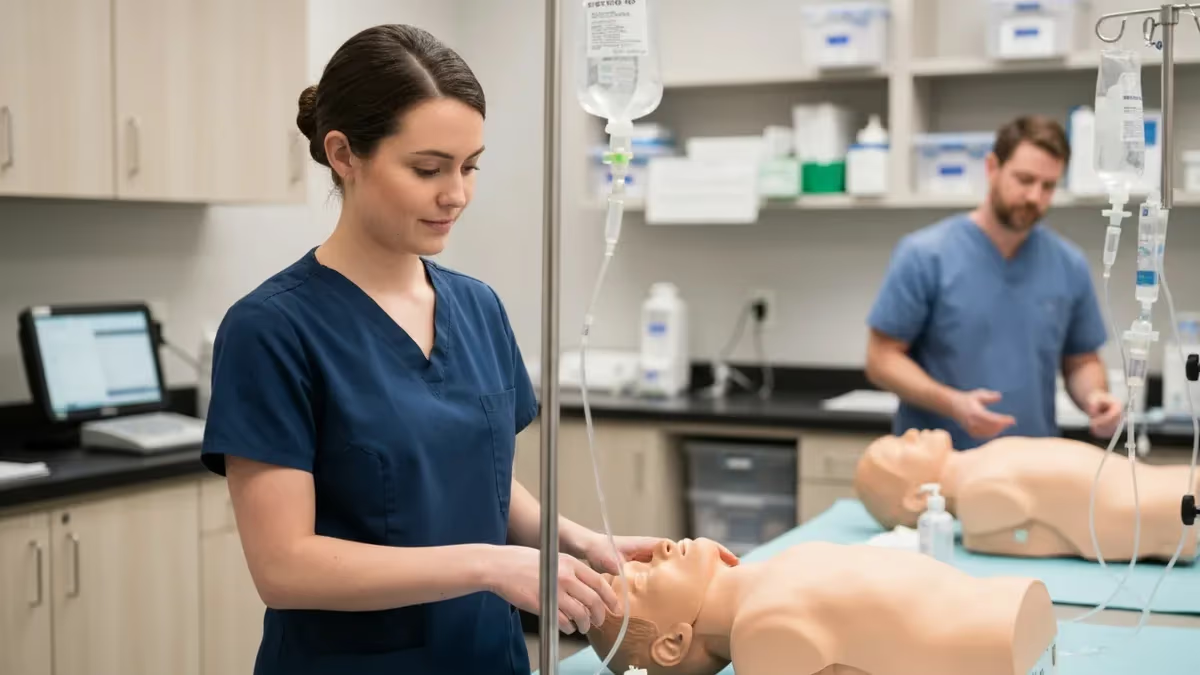
LPN programs hybrid formats have rapidly become one of the most popular pathways for students who want to enter nursing without uprooting their existing work and family schedules. A hybrid LPN program splits coursework between online learning and in-person clinical training, giving students the flexibility of digital education while preserving the hands-on patient-care experience that state boards and employers require. Programs typically run between 12 and 18 months, which is significantly shorter than a two-year RN associate degree, making the hybrid format an especially attractive route for career changers who need to reach the workforce quickly.
Understanding what a hybrid LPN program actually looks like week to week is essential before you enroll. In most schools, theory courses such as anatomy and physiology, pharmacology, and nursing fundamentals are delivered through a learning management system where you watch recorded lectures, complete graded discussions, and take proctored exams on your own schedule. Clinical rotations, by contrast, happen on fixed days at partner hospitals, long-term care facilities, and community health clinics. The clinical component cannot be waived or moved online because it requires real patients, real equipment, and direct faculty supervision.
The demand for licensed practical nurses continues to grow steadily across the United States. The Bureau of Labor Statistics projects roughly 5 percent job growth for LPNs through 2032, adding tens of thousands of new positions in home health, assisted living, and outpatient settings. Hybrid programs help close the supply gap by removing geographic and scheduling barriers that prevent qualified candidates from completing traditional brick-and-mortar curricula. Students in rural areas, working parents, and employed adults all benefit enormously from the asynchronous online component of these programs.
Accreditation is the single most important quality filter when evaluating any hybrid LPN program. Regional institutional accreditation from bodies such as the Higher Learning Commission or the Accrediting Commission of Career Schools and Colleges ensures the curriculum meets national education standards. Additionally, the program must have approval from your state's board of nursing, because graduation from a state-approved program is a prerequisite for sitting the NCLEX-PN licensing examination. Always verify both types of approval before paying a deposit or enrolling, as graduating from a non-approved program can disqualify you from licensure entirely.
Tuition for hybrid LPN programs varies considerably depending on whether the school is a community college, a vocational school, or a private institution. Community college programs often fall in the $6,000 to $12,000 range, while private vocational programs can reach $20,000 or more. Online hybrid models can reduce costs by cutting facility fees, but clinical placement coordination still requires institutional resources. Financial aid, Pell Grants, and workforce development scholarships are available at many schools, so prospective students should complete the FAFSA before assuming they must pay out of pocket.
Before choosing a program, it helps to understand all the formal lpn hybrid programs prerequisites and state-specific licensing rules that will govern your path from student to licensed nurse. Requirements such as minimum GPA, completed prerequisite science courses, background checks, immunization records, and CPR certification are standard across most programs, but the exact list varies from school to school and state to state. Doing this research upfront prevents costly surprises mid-enrollment.
This guide walks you through every major dimension of hybrid LPN education: how programs are structured, what clinicals look like, how to compare schools, what the NCLEX-PN demands, and what your career trajectory looks like after licensure. Whether you are just beginning to research your options or are ready to submit an application, the information below will help you make a confident, well-informed decision about one of healthcare's most accessible and rewarding credentials.
LPN Hybrid Programs by the Numbers
How a Hybrid LPN Program Is Structured
Pre-Admission Requirements
Online Didactic Coursework
Skills Lab Sessions
Clinical Rotations
NCLEX-PN Preparation
Licensure & Job Placement
Clinical training is the dimension of any LPN program that cannot be compressed, waived, or moved online, and this is especially true in hybrid formats where students might assume the flexible structure applies to every component. State boards of nursing set minimum clinical hour requirements that typically range from 500 to 600 hours, and each state mandates specific practice settings. A student completing an LPN program in Texas, for example, must fulfill hours in medical-surgical, maternal-newborn, pediatric, and mental health settings, even if the theoretical content for those specialties was studied entirely online.
Clinical placements in hybrid programs are coordinated by the school's clinical education department, which maintains formal affiliation agreements with hospitals, skilled nursing facilities, and community health centers. Students do not arrange their own placements, but they may be assigned to sites that require a commute. This is a practical reality to plan for before enrolling in a program marketed as flexible. If the nearest clinical partner is 45 minutes away and requires two full weekdays per week, the actual time commitment is considerably higher than the online scheduling might suggest.
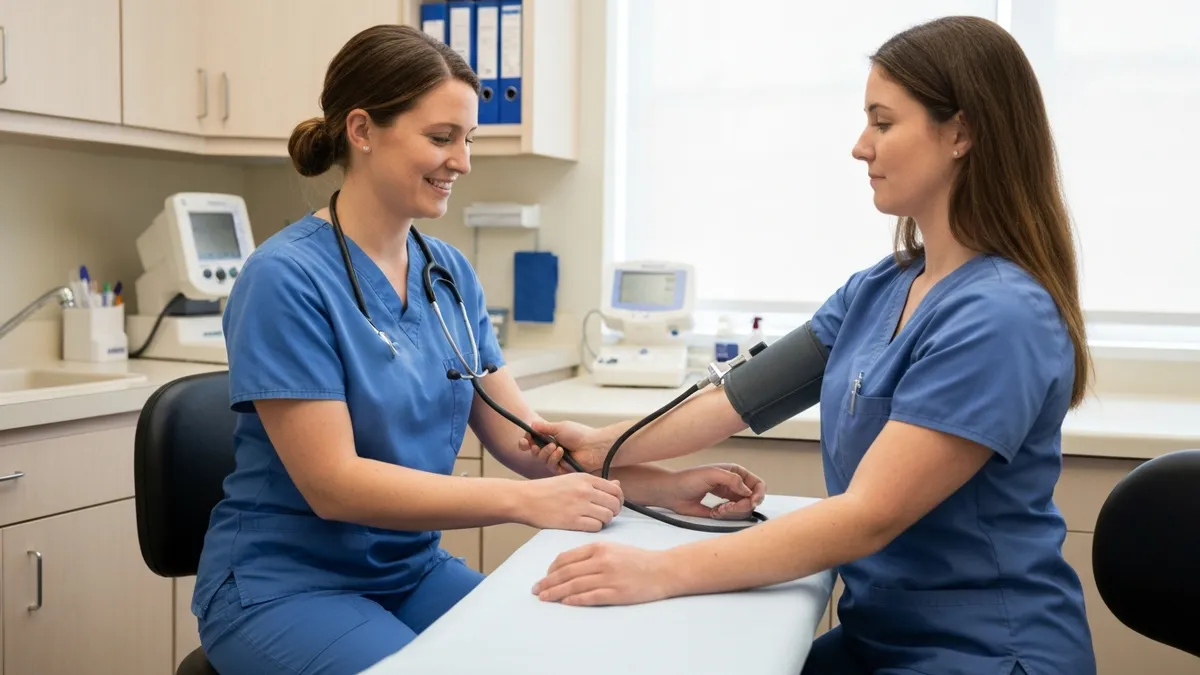
During clinical rotations, students are directly supervised by a licensed preceptor and evaluated on clinical competency checklists that correspond to program learning objectives. Common tasks observed and assessed include medication preparation and administration, vital sign monitoring and documentation, wound and ostomy care, catheter care, patient mobility assistance, and therapeutic communication. Faculty also evaluate professional conduct, infection control compliance, and accurate charting using electronic health records, which are now standard in nearly all clinical environments.
Simulation labs bridge the gap between online theory and live patient care. High-fidelity mannequins equipped with programmable physiological responses allow students to practice scenarios such as administering insulin to a patient showing signs of hypoglycemia, performing CPR, and responding to a patient experiencing respiratory distress. Research consistently shows that simulation-based training improves clinical confidence and reduces critical errors during live patient rotations, making strong simulation lab access an important quality criterion when comparing hybrid programs.
Students in hybrid LPN programs should expect clinical schedules to be far less flexible than the online component. Hospitals and nursing facilities operate on fixed staffing calendars, and clinical education slots are assigned months in advance. Missing a scheduled clinical day often requires making it up, and excessive absences can result in dismissal from the clinical rotation entirely. Many programs require 100 percent clinical attendance, which means personal commitments that conflict with assigned clinical days must be managed carefully and communicated to faculty well in advance.
The importance of hands-on patient care experience extends beyond licensure eligibility. Employers hiring new LPN graduates consistently cite clinical hours as one of the top indicators of job readiness. A graduate who has completed rotations across diverse settings — acute care, long-term care, maternal-child health, and community nursing — arrives in the workplace with a broader skill set and better adaptability than a graduate whose clinical exposure was limited to a single care environment. When evaluating programs, ask specifically about the diversity and reputation of clinical placement sites, not just the total number of hours required.
For students who want to understand the full clinical and didactic expectations they will encounter as they work through their program, reviewing the detailed requirements outlined for hybrid learners provides valuable context. Every clinical rotation you complete during your hybrid program directly prepares you for the procedural and patient interaction questions you will face on the NCLEX-PN and in your daily LPN duties on the floor.
Comparing Hybrid LPN Program Types
Community college hybrid LPN programs are among the most affordable options, with tuition commonly ranging from $6,000 to $12,000 for the full program. These schools are regionally accredited, maintain strong relationships with local clinical sites, and often benefit from public funding that keeps per-credit costs low. Financial aid, Pell Grants, and in-state tuition waivers make community college programs accessible to students from a wide range of economic backgrounds, and completion timelines typically run 12 to 14 months.
The tradeoff at community colleges is that admission is competitive and cohort sizes are small, sometimes capped at 20 to 30 students per cycle. Programs may only admit students once or twice per year, meaning a missed application deadline can delay enrollment by a full semester or more. Students should apply to multiple programs simultaneously to avoid a year-long gap, and should confirm that the program's state board approval status is current before submitting any enrollment deposit.
Hybrid LPN Programs: Advantages and Drawbacks
- +Flexibility to complete online coursework during evenings and weekends without quitting your current job
- +Shorter completion timeline of 12 to 18 months compared to two-year RN associate degree programs
- +Lower commute burden since only clinical days require in-person attendance at a specific site
- +Access to programs from schools outside your immediate geographic area for the online component
- +Technology-enhanced learning tools such as virtual simulations and interactive case studies reinforce clinical concepts
- +Many hybrid programs offer rolling or frequent start dates compared to once-a-year traditional cohorts
- −Clinical rotation days are fixed and non-negotiable, limiting scheduling flexibility for working students
- −Self-discipline is essential since no one monitors your attendance at online lectures or reminds you of deadlines
- −Reliable high-speed internet and a functional computer are absolute prerequisites, creating a barrier for some students
- −In-person simulation lab sessions are scheduled in advance and cannot typically be rescheduled easily
- −Clinical sites may be located far from home, adding significant commute time on rotation days
- −Some employers or state boards may scrutinize hybrid-format credentials more closely than traditional programs
Pros and Cons at a Glance
| Pros | Cons |
|---|---|
| Flexibility to complete online coursework during evenings and weekends without quitting your current job | Clinical rotation days are fixed and non-negotiable, limiting scheduling flexibility for working students |
| Lower commute burden since only clinical days require in-person attendance at a specific site | Self-discipline is essential since no one monitors your attendance at online lectures or reminds you of deadlines |
| Access to programs from schools outside your immediate geographic area for the online component | Reliable high-speed internet and a functional computer are absolute prerequisites, creating a barrier for some students |
| Technology-enhanced learning tools such as virtual simulations and interactive case studies reinforce clinical concepts | In-person simulation lab sessions are scheduled in advance and cannot typically be rescheduled easily |
| Many hybrid programs offer rolling or frequent start dates compared to once-a-year traditional cohorts | Clinical sites may be located far from home, adding significant commute time on rotation days |
Hybrid LPN Program Enrollment Checklist
- ✓Verify the program holds current state board of nursing approval in your state of intended licensure
- ✓Confirm the school holds regional or national accreditation recognized by your state board
- ✓Request the program's NCLEX-PN first-attempt pass rate for the past three graduating cohorts
- ✓Ask specifically how many clinical hours are required and which care settings are included
- ✓Confirm the location and distance of primary clinical placement partners before enrolling
- ✓Calculate the total cost including tuition, fees, uniforms, equipment, and background check expenses
- ✓Complete the FAFSA and investigate workforce development grants, scholarships, and employer tuition assistance
- ✓Check prerequisite science course requirements and determine which you still need to complete
- ✓Obtain updated immunization records, including hepatitis B series, flu shot, and TB test results
- ✓Secure current CPR certification from an American Heart Association or Red Cross approved course
NCLEX-PN Pass Rate Is the Most Honest Quality Signal
A hybrid program's NCLEX-PN first-attempt pass rate is the clearest indicator of whether the curriculum actually prepares students for licensure. Top programs consistently post rates above 85 percent. Any accredited program unable or unwilling to share its pass rate data should be treated with caution, as this information is typically reported to state boards and is publicly accessible.
The NCLEX-PN is the standardized licensing exam that every LPN candidate must pass after completing an approved program, regardless of whether that program was delivered in a traditional, online, or hybrid format. The exam uses computerized adaptive testing, meaning the difficulty of each question adjusts in real time based on your previous answers. The minimum exam length is 85 questions and the maximum is 150, but most candidates finish within 85 to 130 questions. The exam is timed at five hours including breaks, and it tests clinical judgment across all major nursing content areas.
The NCLEX-PN Next Generation format introduced in 2023 significantly increased the proportion of clinical judgment questions. Rather than simply recalling a fact, candidates must analyze a patient scenario, identify the most pressing nursing concern, and select or rank appropriate nursing interventions. Case study question clusters, matrix questions, and extended multiple-response items are now integral to the exam. Hybrid program students who studied pharmacological principles and disease pathophysiology online will be tested on whether they can apply that knowledge in realistic, pressure-driven patient scenarios.
Effective NCLEX-PN preparation for hybrid students should begin well before the final semester. The most successful test-takers incorporate daily practice questions throughout their program rather than cramming in the weeks after graduation. Aim for 50 to 75 practice questions per day in the months leading up to your exam date, and focus on understanding the rationale for each answer rather than memorizing correct responses. Why an answer is correct — and why the distractors are wrong — is the insight that transfers to novel exam questions.
Content areas to prioritize based on NCLEX-PN exam blueprints include safe and effective care environment, health promotion and maintenance, psychosocial integrity, and physiological integrity. Pharmacology questions appear throughout all content areas because medication safety is a core LPN responsibility. Students who struggle with pharmacology during their online coursework should seek tutoring or supplemental resources early in their program, because this is one of the most heavily weighted domains on the licensing exam and the one where knowledge gaps are hardest to close quickly.
ATI Nursing Education and Hurst Review are among the most widely used NCLEX-PN review systems integrated into hybrid LPN curricula. Many programs require students to pass ATI proctored assessments with minimum scores before advancing to the next semester or before graduating. These embedded assessments serve as early indicators of NCLEX-PN readiness and identify content gaps while there is still time for remediation. If your program uses ATI or a similar system, treat those assessments with the same seriousness you give to clinical evaluations.
Test-taking strategy matters as much as content knowledge on the NCLEX-PN. Common evidence-based strategies include reading the entire question stem before looking at answer choices, identifying the priority patient in multi-patient questions using Maslow's Hierarchy and the nursing process, and eliminating answers that contain absolute language like always or never unless there is strong clinical justification. Recognizing the difference between what a question asks you to do versus what you might do instinctively based on clinical experience is a skill that improves with consistent practice.
Students enrolled in hybrid programs often have a scheduling advantage when it comes to NCLEX-PN preparation because they are accustomed to managing self-directed study online. The habit of logging in to complete coursework independently, without a professor monitoring engagement, translates well to the self-discipline required for rigorous test prep. Build a dedicated study schedule, use a high-quality question bank with detailed rationales, and take full-length timed practice exams under realistic conditions at least three times in the four to six weeks before your scheduled test date.

After your state board approves your NCLEX-PN application, Pearson VUE issues an Authorization to Test (ATT) with a specific expiration date, typically 60 to 89 days depending on the state. If you do not schedule and sit the exam before the ATT expires, you must reapply and pay fees again. Schedule your exam immediately upon receiving your ATT to avoid losing your testing window and incurring additional costs.
The financial investment in a hybrid LPN program is meaningfully offset by the speed at which graduates enter a well-paying healthcare career. The Bureau of Labor Statistics reports a 2024 median annual salary for LPNs of approximately $57,000 nationally, with the top 10 percent of earners exceeding $75,000 depending on specialty, setting, and geography. States like California, Massachusetts, and Alaska report some of the highest LPN wages in the country, while rural Midwestern and Southern states tend to cluster near the national median. Understanding regional wage variation matters when choosing where to complete your program and begin your career.
Employment setting significantly influences both salary and working conditions. Hospital-based LPN positions often carry higher wages and shift differentials for nights and weekends, but they also involve faster patient throughput and higher physical demands. Long-term care and skilled nursing facilities employ the largest share of LPNs nationally and often offer more stable scheduling with predictable resident assignments. Home health LPN positions have grown rapidly in recent years as the U.S. population ages and payers increasingly reimburse home-based care as a lower-cost alternative to institutional settings.
After licensure, many LPNs pursue additional certifications to increase their earning potential and broaden their scope of practice. IV therapy certification is among the most common, as not all states include IV medication administration in the default LPN scope. Wound care, gerontology, and long-term care certifications are also widely recognized by employers and often tied to pay increases. Some LPNs use their foundational credential as a stepping stone toward an LPN-to-RN bridge program, which awards a registered nurse credential in an accelerated format that recognizes prior learning and clinical experience.
When calculating the return on investment of a hybrid LPN program, factor in both direct costs and opportunity costs. Direct costs include tuition, fees, textbooks, uniforms, clinical supplies, examination fees, and licensure application costs. Opportunity costs include any reduction in work hours during the program.
A student who cuts from full-time to part-time employment for 14 months to accommodate clinical rotations is effectively paying the wage difference as part of the program's true cost. Despite these expenses, most LPN graduates recover their total investment within 12 to 18 months of beginning full-time employment, making it one of healthcare's strongest short-term ROI credentials.
Employer tuition assistance and loan forgiveness programs are underutilized resources that can dramatically reduce the net cost of a hybrid LPN program. The National Health Service Corps Loan Repayment Program provides substantial loan relief for LPNs who commit to working in Health Professional Shortage Areas. Many hospital systems, long-term care chains, and home health agencies offer their own tuition assistance of $2,500 to $10,000 per year for employees pursuing nursing credentials. Some even offer full sponsorship in exchange for a post-graduation employment commitment.
State workforce development grants administered through departments of labor or higher education are another funding source that many students overlook. These grants are often targeted at healthcare programs because nursing shortages are a recognized workforce development priority in nearly every state. Community colleges administering hybrid LPN programs frequently have dedicated financial aid advisors with knowledge of these specific grant opportunities. Scheduling a financial aid consultation before enrolling can reveal funding sources that make a program significantly more affordable than the sticker price suggests.
Career mobility is one of the most compelling long-term arguments for completing a hybrid LPN program rather than delaying entry into nursing until an RN slot opens. Working as a licensed LPN while completing an online LPN-to-RN bridge program is a well-established pathway that allows nurses to advance without taking a financial step backward. Many nurses who follow this path credit their LPN clinical experience with making them stronger and more confident RN students, because they arrive in the bridge program with years of real-world patient care context that purely academic students lack.
Succeeding in a hybrid LPN program requires proactive time management from the very first week. Unlike traditional classrooms where attendance is enforced externally, hybrid students must create their own structure. Designate specific blocks of time each day for online coursework, build in buffer time for assignments that take longer than expected, and use a digital calendar that integrates your clinical schedule, online deadlines, and simulation lab sessions into a single unified view. Students who treat the online component with the same discipline as an in-person class consistently outperform those who log in reactively only when a deadline approaches.
Building relationships with faculty and peers is harder in a hybrid format but just as important as in a traditional program. Instructors in hybrid LPN programs communicate primarily through email, discussion boards, and virtual office hours, so students must be proactive about reaching out when they have questions rather than waiting to ask after class. Many hybrid programs create peer study groups through platforms like GroupMe or Discord, and participating actively in these communities provides academic support, emotional encouragement, and informal mentorship from students who are one or two semesters ahead of you in the program.
Technical preparedness is a practical prerequisite that is easy to overlook. Before your first week of online coursework, verify that your computer meets the program's technical specifications, including operating system requirements, webcam capability for proctored exams, reliable upload and download speeds of at least 25 Mbps, and a backup internet option such as a mobile hotspot for days when your home connection drops. Many proctored exam platforms require the ability to display the testing environment in real time, and a technical failure during an exam can result in a failing grade regardless of academic preparation.
Medication mathematics is a foundational skill that hybrid students must master early and review continuously. Dosage calculation errors are among the most common patient safety incidents in nursing, and the NCLEX-PN tests calculation competency directly. Practice dimensional analysis for weight-based dosing, IV drip rate calculations, and pediatric dosing adjustments regularly throughout your program. Many hybrid programs use dedicated pharmacology modules with embedded calculation practice, but supplementing with external resources such as nursing math textbooks or online calculation tools can accelerate your proficiency.
Mental health and resilience are topics that nursing educators increasingly address explicitly because the attrition rate in LPN programs can be significant. The combination of demanding online coursework, intensive clinical days, and the emotional weight of patient care creates a uniquely stressful environment. Hybrid students who also hold jobs and family responsibilities face additional pressure. Developing a specific self-care routine, setting firm boundaries around study time, and identifying a support network of family members or fellow students who understand the demands of nursing school are evidence-based strategies for persisting to graduation.
Licensing application logistics should be researched and prepared during the final semester rather than after graduation. The process of submitting your program transcript, passing a background check through a fingerprinting vendor, completing the NCLEX-PN registration through Pearson VUE, and awaiting state board processing can take four to eight weeks. Students who begin gathering required documents in the final month of their program can apply the day after graduation, receive their Authorization to Test sooner, and begin earning a licensed salary while their peers are still waiting on paperwork.
Finally, approaching your hybrid LPN program with the mindset of a future professional rather than a student checking off requirements changes how you engage with every component of the curriculum. Read nursing journals, follow LPN advocacy organizations, stay current on scope-of-practice updates in your state, and begin building a professional LinkedIn profile during your program rather than scrambling to create one during job searching. The nurses who advance most quickly after licensure are those who treated their education as the foundation of a career, not a box to be checked on the way to a first paycheck.
Sample Certified Practical Nurse Practice Questions
Try these questions from our free Certified Practical Nurse practice tests. The correct answer and an explanation follow each question.
A patient taking lithium reports nausea, tremors, and confusion. What is the nurse's priority action?
- A. Give the next dose as scheduled
- B. Hold the dose and notify the provider immediately
- C. Administer an antiemetic
- D. Encourage fluid intake and recheck in one hour
Answer: B. Hold the dose and notify the provider immediately
These symptoms indicate lithium toxicity; the nurse must hold the medication and notify the provider immediately.
A client returns from a bronchoscopy procedure. Which assessment finding requires the LPN to notify the charge nurse immediately?
- A. Mild throat soreness
- B. Absence of gag reflex
- C. Blood pressure 118/76 mmHg
- D. Heart rate of 78 bpm
Answer: B. Absence of gag reflex
Absence of the gag reflex after bronchoscopy indicates the local anesthetic is still active and the client is at high risk for aspiration.
The nurse is teaching a client about taking sublingual nitroglycerin for angina. Which instruction is most important?
- A. Swallow the tablet with a full glass of water
- B. If pain persists after 3 doses 5 minutes apart, call 911
- C. Store the medication in a clear plastic container on a windowsill
- D. Take 2 tablets at the first sign of chest pain
Answer: B. If pain persists after 3 doses 5 minutes apart, call 911
If angina is not relieved after 3 sublingual nitroglycerin doses taken 5 minutes apart, the client should call 911 as this may indicate an acute MI.
An LPN is caring for an elderly client who is confused and has been trying to get out of bed without assistance. After attempting alternative measures without success, the provider orders soft wrist restraints. Which of the following actions is a critical safety measure for the nurse to implement?
- A. Secure the restraint ties to the side rails of the bed.
- B. Ensure the restraints are applied tightly to prevent any movement.
- C. Check the client's circulation and skin integrity every 4 hours.
- D. Use a quick-release knot to secure the restraints to the bed frame.
Answer: D. Use a quick-release knot to secure the restraints to the bed frame.
When using restraints, it is crucial to secure them to a part of the bed frame that moves with the client to avoid injury. A quick-release knot must be used to allow for rapid removal in an emergency. Restraints should never be tied to side rails. Circulation and skin checks should be performed much more frequently, typically every 1-2 hours, and the restraint should be snug but not tight.
LPN Questions and Answers

LPN Requirements 2026: Complete Guide to Becoming a Licensed Practical Nurse

LPN IV Certification: Complete 2026 Guide to Training, Requirements & Cost

LPN Programs in Florida: Complete 2026 Guide to Accredited Schools, Costs, Requirements & Licensure

LPN Salary Wisconsin 2026: Average Pay, Top Cities, and How to Earn More

LPN Duties: Complete Guide to Daily Responsibilities and Scope of Practice
About the Author

Registered Nurse & Healthcare Educator
Johns Hopkins University School of NursingDr. Sarah Mitchell is a board-certified registered nurse with over 15 years of clinical and academic experience. She completed her PhD in Nursing Science at Johns Hopkins University and has taught NCLEX preparation and clinical skills courses for nursing students across the United States. Her research focuses on evidence-based exam preparation strategies for healthcare certification candidates.
Join the Discussion
Connect with other students preparing for this exam. Share tips, ask questions, and get advice from people who have been there.
View discussion (7 replies)