
LAPD Vehicles: The Complete Guide to Los Angeles Police Department Fleet, SWAT Units, and Patrol Equipment
Explore LAPD vehicles from patrol cars to SWAT armored units. 🎯 Learn about LAPD gear, ranks, salary, and the full fleet used by Los Angeles police officers.
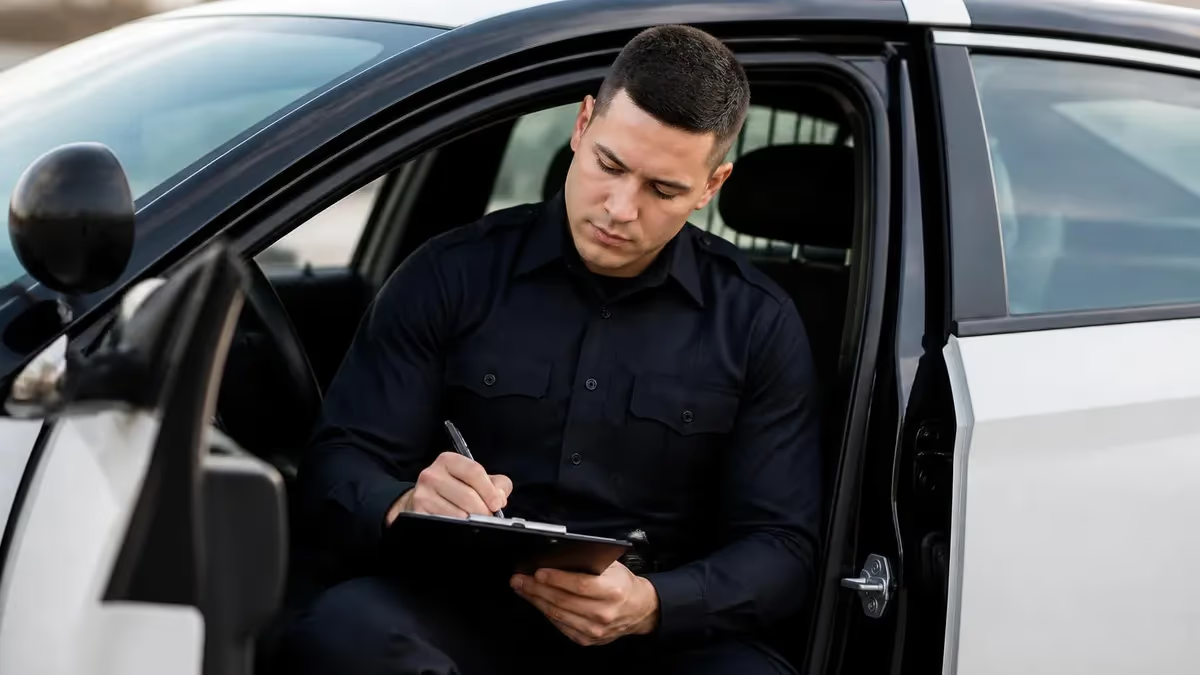
LAPD vehicles are among the most recognized law enforcement assets in the United States, representing a sprawling fleet that supports over 9,000 sworn officers across one of the largest municipal police departments in the world. From the iconic black-and-white patrol cruisers to heavily armored SWAT carriers, the Los Angeles Police Department maintains a diverse range of vehicles purpose-built for every conceivable law enforcement scenario. Keeping up with lapd news means staying informed about how the department continuously upgrades and modernizes its fleet to meet the demands of a city with more than four million residents.
The department's vehicle inventory spans conventional patrol sedans, SUVs, motorcycles, helicopters, and specialized units used exclusively by tactical teams. Each vehicle type is selected after rigorous evaluation of performance metrics, officer safety ratings, fuel efficiency, and maintenance cost over a projected service life. The LAPD's procurement decisions are typically approved by the Los Angeles City Council and are subject to public budget hearings, making fleet management a surprisingly civic topic for Los Angeles taxpayers who fund the department's operations.
Understanding LAPD vehicles also means understanding the organizational structure that deploys them. The department is divided into four bureaus — Central, South, Valley, and West — each overseeing multiple geographic divisions. Patrol vehicles are assigned at the division level, while specialized fleet assets like SWAT carriers, canine units, and air support helicopters are managed centrally. The LAPD chief ultimately oversees all fleet policy decisions, though day-to-day logistics are handled by the Fleet Services Division within the department's administrative branch.
For anyone preparing for the LAPD written exam or oral interview, knowledge of department vehicles, equipment designations, and the phonetic alphabet used over police radio is genuinely tested material. Officers must know the difference between a Basic Car unit and a specialized unit, understand how Air Support Division helicopters coordinate with ground patrol, and be familiar with the tactical terminology that governs vehicle deployments during major incidents. This foundational knowledge separates candidates who have genuinely studied LAPD operations from those who have only a surface-level familiarity with the department.
The LAPD fleet also plays a central role in the department's community policing philosophy. Senior Lead Officers, or SLOs, use their assigned patrol vehicles as mobile community outreach hubs, often parking conspicuously in neighborhoods to encourage resident interaction. Community policing vehicles may carry pamphlets, local resource guides, and even recreational equipment for youth engagement programs. This dual function — law enforcement tool and community relations asset — reflects the department's broader strategy of building trust while maintaining a visible deterrent presence throughout the city.
Fleet technology has advanced dramatically over the past decade. Modern LAPD patrol vehicles are equipped with automated license plate readers, in-car video systems, ruggedized laptops connected to the department's real-time crime center, and body camera charging docks. Some newer vehicles also integrate with ShotSpotter acoustic gunshot detection systems, automatically routing officers toward potential shooting incidents before a 911 call is even received. These technology investments have transformed the patrol car from a simple transportation tool into a rolling data collection and dispatch node integrated with department-wide situational awareness platforms.
This guide covers the full spectrum of LAPD vehicles — from everyday patrol cars and police motorcycles to Air Support helicopters, mounted unit horses, and the fearsome armored carriers operated by LAPD SWAT. Whether you are a curious civilian, a journalist covering public safety, or a recruit candidate studying for the department entrance exam, understanding the LAPD fleet gives you essential insight into how Los Angeles polices a city unlike any other in America.
LAPD Fleet & Department by the Numbers

LAPD Vehicle Categories: From Patrol to Tactical
The backbone of daily operations, LAPD uses Ford Police Interceptor Sedans and Utility SUVs as primary patrol vehicles. These units carry standard equipment including AR-15 patrol rifles, medical kits, spike strips, and ruggedized MDT laptops connected to real-time crime data systems.
LAPD Traffic officers ride BMW R 1250 RT-P and Harley-Davidson motorcycles for traffic enforcement, VIP escort, and ceremonial duties. Motorcycle officers are uniquely trained to navigate congested L.A. surface streets and freeway on-ramps at high speed during emergency response.
Metropolitan Division D Platoon operates BearCat armored personnel carriers and Lenco armored rescue vehicles for high-risk warrant service, barricade situations, and mass casualty events. These vehicles provide ballistic protection up to rifle-caliber rounds and can deploy tactical teams safely under fire.
The LAPD Air Support Division operates 19 helicopters, primarily Airbus H125 and Bell 206 platforms, from Hooper Helipad. Each aircraft carries FLIR thermal cameras, searchlights, and a tactical flight officer who coordinates ground units via radio during pursuits and major incidents.
Detectives and plainclothes units use unmarked sedans, pickup trucks, and vans for surveillance and undercover operations. The department also maintains horse trailers for the Mounted Platoon, boat trailers for the Harbor Division, and command post vehicles for incident management.
LAPD SWAT is formally organized as D Platoon within the Metropolitan Division, and the tactical vehicles it operates represent the most sophisticated and heavily armored assets in the department's fleet. The platoon's primary heavy vehicle is the Lenco BearCat G3, a 4x4 armored personnel carrier capable of carrying ten officers in full tactical kit while resisting sustained rifle fire.
The BearCat is deployed on high-risk warrant service operations, active shooter calls, barricaded subject situations, and any incident where officers require ballistic protection to approach a fortified position safely. LAPD SWAT also maintains the V-300 Commando, an older but still combat-capable wheeled armored vehicle used for perimeter containment on large-scale tactical incidents.
Beyond armored carriers, SWAT operates a fleet of specially configured Ford F-250 pickup trucks used as mobile equipment platforms. These trucks carry breaching tools, ballistic shields, ladder systems, less-lethal munitions, and medical trauma equipment. Every SWAT callout includes at least one paramedic-level trauma unit staffed by a SWAT medic trained in hemorrhage control, airway management, and tactical casualty care. The inclusion of dedicated medical assets alongside tactical vehicles reflects the department's hard-learned lessons from high-profile incidents like the 1997 North Hollywood Shootout, which exposed critical gaps in both officer armor and rapid trauma response capability.
Recruits and exam candidates often encounter questions about lapd gear and the tactical equipment carried aboard department vehicles. The standard patrol car loadout includes a Remington 870 shotgun or AR-15 patrol rifle secured in a locked front-seat rack, a defibrillator, a trauma kit, road flares, spike strips, a fire extinguisher, and a portable radio charger.
SWAT vehicles carry an extended inventory that includes breaching rams, explosive entry charges, flashbang grenades, gas masks, and specialized less-lethal launchers for crowd control scenarios. Understanding this equipment hierarchy — from patrol car to SWAT carrier — helps candidates contextualize department operations during oral board interviews.
The LAPD also operates a Mobile Field Force, a crowd control unit that uses specially marked police buses and vans to transport large numbers of officers rapidly to civil unrest scenes. These vehicles carry less-lethal equipment, extra protective gear, and logistical supplies to sustain officers during prolonged deployments at demonstrations, sporting events, or large-scale emergencies. During the 2020 civil unrest following the death of George Floyd, LAPD Mobile Field Force vehicles were deployed extensively across the city, and their operational performance — including several incidents of alleged improper use of force — generated significant public scrutiny and internal review.
The department's bomb squad, organized under the Hazardous Devices Section, operates a fleet of specialized vehicles including a Remotec Andros robot-carrying truck and several armored response units. These vehicles are equipped with portable x-ray systems, water disruptors, and remote rendering tools that allow technicians to neutralize suspected improvised explosive devices without risking human life. The bomb squad's vehicles are among the most rarely deployed in the LAPD fleet but represent some of the highest-value insurance assets the department maintains for catastrophic risk scenarios like stadium threats or infrastructure attacks.
For candidates preparing for the LAPD hiring process, the oral interview frequently includes scenario-based questions about tactical vehicle deployments. A typical question might ask a recruit to describe how they would coordinate with Air Support and SWAT vehicles during a barricaded suspect situation. Strong answers demonstrate knowledge of radio communication protocols, an understanding of how SWAT and patrol units establish inner and outer perimeters, and awareness of the incident command system that governs multi-unit responses. Candidates who can fluently describe vehicle roles in these scenarios signal operational readiness that impresses oral board evaluators significantly.
The LAPD headquarters at Parker Center's successor, the Police Administration Building on West First Street, houses the command infrastructure that coordinates all fleet deployments citywide. The Real-Time Analysis and Critical Response Division, known as RACR, operates from this building and uses digital mapping tools to track active units, monitor patrol vehicle GPS positions, and allocate specialized assets like air support and SWAT during major incidents.
Understanding how headquarters coordinates vehicle resources across the department's 21 geographic divisions gives exam candidates a richer picture of how the LAPD functions as a unified operational organism rather than a collection of independent patrol units.
LAPD Practice Test Questions
Prepare for the LAPD - Los Angeles Police Department exam with our free practice test modules. Each quiz covers key topics to help you pass on your first try.
LAPD - Los Angeles Police Department Backg...
Free LAPD Practice Test featuring - Los Angeles Police Department Background Investigation Standards. Improve your LAPD Exam score with mock test prep.
LAPD - Los Angeles Police Department Basic...
LAPD Mock Exam on - Los Angeles Police Department Basic Police Terminology. LAPD Study Guide questions to pass on your first try.
LAPD - Los Angeles Police Department Depar...
LAPD Test Prep for - Los Angeles Police Department Department Interview Procedures. Practice LAPD Quiz questions and boost your score.
LAPD - Los Angeles Police Department Logic...
LAPD Questions and Answers on - Los Angeles Police Department Logical and Deductive Reasoning. Free LAPD practice for exam readiness.
LAPD - Los Angeles Police Department Obser...
LAPD Mock Test covering - Los Angeles Police Department Observation and Memory Recall. Online LAPD Test practice with instant feedback.
LAPD - Los Angeles Police Department Physi...
Free LAPD Quiz on - Los Angeles Police Department Physical Fitness Qualifier. LAPD Exam prep questions with detailed explanations.
LAPD - Los Angeles Police Department Readi...
LAPD Practice Questions for - Los Angeles Police Department Reading Comprehension Skills. Build confidence for your LAPD certification exam.
LAPD - Los Angeles Police Department Situa...
LAPD Test Online for - Los Angeles Police Department Situational Judgment and Ethics. Free practice with instant results and feedback.
LAPD SWAT, Air Support & Specialized Vehicle Operations
LAPD SWAT's D Platoon operates Lenco BearCat G3 armored personnel carriers as its primary tactical transport, capable of withstanding rifle-caliber fire while safely deploying up to ten operators. These vehicles include built-in gun ports, a roof hatch for ballistic observation, and heavy-duty push bumpers for breaching vehicle barricades. Every BearCat deployment is approved by a SWAT lieutenant and coordinated through the Metropolitan Division command structure before any tactical action begins.
In addition to BearCats, SWAT maintains V-300 Commando armored vehicles for large perimeter containment operations and specially configured Ford F-250 trucks that carry breaching tools, less-lethal munitions, flashbang grenades, and tactical medical equipment. SWAT medics embedded within the platoon train to TCCC standards and respond aboard these support vehicles to every high-risk callout. The combined fleet gives D Platoon the ability to handle anything from a single barricaded subject in a residential home to a mass casualty event at a public venue.

LAPD Vehicle Fleet: Strengths and Challenges
- +Diverse fleet covers every operational scenario from patrol to mass casualty response
- +Air Support Division provides aerial coordination unavailable to most U.S. municipal departments
- +SWAT BearCat armored vehicles offer exceptional ballistic protection for officer safety
- +In-car technology integration with real-time crime centers improves response efficiency
- +Mounted and marine units extend patrol capability to parks, coastlines, and open spaces
- +Continuous fleet modernization funded through annual city budget allocations
- −High acquisition and maintenance costs strain the LAPD annual operating budget
- −Aging vehicles in some patrol divisions receive delayed replacement due to budget cycles
- −Heavy armored SWAT vehicles draw community criticism over perceived militarization of policing
- −Helicopter deployments generate significant noise complaints from residential neighborhoods
- −Fuel and carbon footprint of the large fleet face scrutiny amid city sustainability goals
- −Specialized vehicles require extensive training time that reduces deployable patrol hours
LAPD Vehicle & Equipment Knowledge Checklist for Exam Candidates
- ✓Learn the names and functions of each LAPD vehicle category: patrol, SWAT, air, marine, and mounted.
- ✓Memorize the standard equipment loadout carried in a basic patrol car, including medical and defensive tools.
- ✓Study the LAPD phonetic alphabet (Adam, Boy, Charles...) used in all radio transmissions and vehicle unit designations.
- ✓Understand how Air Support Division helicopters coordinate with ground units during pursuit operations.
- ✓Know the difference between Basic Car, A-Car, and specialized unit designations in LAPD patrol structure.
- ✓Review the organizational structure of Metropolitan Division, including D Platoon (SWAT) vehicle responsibilities.
- ✓Familiarize yourself with the Incident Command System (ICS) framework that governs multi-vehicle deployments.
- ✓Understand how LAPD SWAT vehicle callouts are authorized and the chain of command that must approve tactical action.
- ✓Study LAPD headquarters location, bureau structure, and how vehicle assets are allocated across the four bureaus.
- ✓Practice scenario-based questions involving vehicle coordination, perimeter establishment, and radio communication protocols.
The LAPD Phonetic Alphabet Is Tested Material
The LAPD phonetic alphabet (Adam, Boy, Charles, David, Edward, Frank, George, Henry, Ida, John, King, Lincoln, Mary, Nora, Ocean, Paul, Queen, Robert, Sam, Tom, Union, Victor, William, X-ray, Young, Zebra) is used in all radio communications and appears directly in unit designations like '12-Adam-45.' Memorizing this alphabet is essential for both the written exam and the oral board, where situational scenarios often require candidates to correctly decode or transmit a unit call sign.
LAPD ranks determine not only an officer's authority but also which vehicles they are authorized to operate and in what capacity. The department's rank structure begins with Police Officer I through III, followed by Detective, Sergeant I and II, Lieutenant I and II, Captain I through III, Commander, Deputy Chief, Assistant Chief, and finally Chief of Police. Each rank carries distinct operational responsibilities, and senior ranks — particularly Captains and above — are frequently assigned to command vehicles used to manage scenes from a mobile command post during major incidents or disasters.
The LAPD chief, currently serving from the Police Administration Building, oversees all departmental policy including fleet management, vehicle procurement, and the tactical doctrine that governs SWAT vehicle deployments. The chief's office regularly interfaces with the Los Angeles City Council's Public Safety Committee to justify vehicle expenditures and respond to community concerns about fleet composition. High-profile vehicle-related controversies, such as the 2013 Christopher Dorner manhunt in which LAPD officers opened fire on civilian vehicles they mistook for Dorner's truck, have prompted significant departmental review of vehicle engagement protocols and tactical decision-making frameworks.
LAPD salary figures are closely tied to rank and assignment. A Police Officer I earns approximately $64,000 annually at the start of their career, while senior detectives and sergeants can earn well above $100,000 when overtime and specialized pay bonuses are factored in. Officers assigned to specialized units — including SWAT, Air Support, and the Mounted Platoon — often receive assignment pay supplements that can add several thousand dollars annually to their base compensation. These financial incentives help the department attract and retain officers willing to pursue the additional training that specialized vehicle operations require.
The LAPD's online reporting system allows residents to file certain types of reports without a patrol vehicle being dispatched, reducing the demand on the fleet for lower-priority calls. Reports for vandalism, petty theft, and minor traffic incidents can often be completed through the department's digital portal, freeing up patrol vehicles for priority calls requiring physical officer presence. Understanding this system is part of a well-rounded knowledge base for LAPD exam candidates, as it reflects the department's broader strategy of leveraging technology to improve resource allocation across its geographic divisions.
Candidates for the LAPD written exam will encounter questions about department organization that require knowing which bureau oversees which divisions and how vehicle resources are distributed geographically. The Central Bureau covers downtown Los Angeles and its surrounding neighborhoods, the South Bureau covers Watts, Compton-area neighborhoods, and South LA, the Valley Bureau covers the sprawling San Fernando Valley, and the West Bureau covers affluent westside communities including West Hollywood, Brentwood, and Pacific Palisades. Each bureau maintains its own motor pool, though specialized assets like SWAT, bomb squad, and Air Support are deployed citywide on request.
The department's investment in fleet technology extends to predictive maintenance programs that use telematics data from vehicle onboard diagnostics to anticipate mechanical failures before they strand an officer on patrol. Fleet Services analysts review mileage, engine hours, brake wear, and battery health data for every vehicle in the inventory, scheduling preventive service at intervals calculated to minimize emergency breakdowns. This data-driven approach to fleet management has reportedly reduced vehicle downtime by a measurable percentage compared to the purely calendar-based maintenance schedules used in earlier decades, according to internal department efficiency reports reviewed by city auditors.
For the oral board interview, candidates should be prepared to speak intelligently about how vehicle technology — including automated license plate readers, in-car video, and GPS tracking — intersects with civil liberties concerns. The LAPD has faced legal challenges and policy debates over the use of ALPR data for retroactive location tracking, and supervisors in the department increasingly expect officers to understand the legal boundaries governing surveillance technology used aboard patrol vehicles.
A candidate who can articulate both the operational value and the constitutional constraints of these systems demonstrates the kind of nuanced judgment that oral board panels explicitly evaluate during the hiring process.

Many candidates underestimate how frequently LAPD written and oral exam scenarios involve vehicle operations, radio terminology, and equipment identification. Questions about which unit type responds to a barricaded suspect, how to request Air Support, and what the phonetic designation for a patrol unit means have all appeared in past exam cycles. Study vehicle and equipment material as seriously as you study department history and law enforcement ethics — it carries equal weight in scenario-based evaluation sections.
Preparing for the LAPD exam requires a multi-layered approach to vehicle and equipment knowledge that goes beyond simply memorizing a list of car models. Effective study means understanding the operational context in which each vehicle type is used, the chain of command that authorizes its deployment, and the radio protocols that coordinate its movements during a field incident. Candidates who treat vehicle knowledge as a standalone memorization task tend to struggle on scenario-based questions, while those who integrate it into a broader understanding of department operations perform consistently well across all exam sections.
One of the most practical study tools available to candidates is the LAPD's own publicly available materials, including the department's Strategic Plan, the Personnel Department's candidate bulletin, and the Bureau of Police Communications training manual, which contains the phonetic alphabet and standard radio code formats used in all LAPD transmissions. Cross-referencing these documents with practice exam questions helps candidates identify which factual details are most likely to appear in tested scenarios and which are interesting background information that will not directly affect their score.
When reviewing vehicle-related exam content, pay particular attention to how the LAPD designates patrol units using the phonetic alphabet. A unit like '12-Adam-45' indicates Division 12 (77th Street), Adam (two-officer patrol car), unit number 45. Understanding this naming convention means candidates can instantly parse any unit designation they encounter on the exam, demonstrating a level of operational fluency that examiners notice and reward. The lapd online report system and scanner communications use these same phonetic designations, making real-world listening practice a surprisingly effective exam preparation technique.
The LAPD's use of body-worn cameras mounted on officer uniforms rather than vehicles represents an important evolution in accountability technology that exam candidates should understand. While in-car video systems record traffic stops and vehicle pursuits from a fixed forward-facing angle, body cameras capture the officer's perspective throughout all interactions including those that occur away from the patrol vehicle.
The department's body camera policy, which governs when cameras must be activated and how footage is retained, is a frequently discussed topic in LAPD oral board interviews, where candidates are often asked how they would handle situations where camera footage and officer memory differ in a report.
Specialized vehicle assignments within the LAPD typically require additional application steps beyond standard patrol assignment. Officers interested in Air Support must hold a commercial pilot certificate or be enrolled in flight training, and competition for the limited number of positions is intense. SWAT selection involves a grueling physical assessment, written examination, and tactical skills evaluation that only a fraction of applicants pass.
Motorcycle officers must demonstrate advanced riding proficiency on a closed course. Understanding these assignment pathways helps candidates who aspire to these roles plan their early career moves strategically, including which patrol divisions offer the best exposure to specialized units and supervisors who can provide strong recommendation letters.
The LAPD badge, issued upon graduation from the Police Academy, represents the officer's authority to operate all department vehicles within their training certification. Officers cannot operate specialized vehicles — motorcycles, pursuit intervention technique vehicles, or SWAT carriers — without completing the specific training program for that asset. This training progression mirrors the rank progression through LAPD's career ladder, where each new capability unlocks additional responsibilities and vehicle access. Knowing this system helps candidates frame career progression questions intelligently during oral board discussions about long-term professional goals.
Finally, staying current with lapd badge news and department announcements about fleet updates is itself a form of exam preparation. The department periodically issues press releases about new vehicle acquisitions, technology integrations, and policy changes affecting how vehicles are used in the field. Candidates who read these announcements demonstrate genuine engagement with the department during oral board interviews, signaling that their interest in the LAPD goes beyond exam performance and reflects an authentic commitment to joining the organization as an informed and self-directed professional.
Practical preparation for the LAPD exam requires consistent, structured study habits that mirror the way professional officers approach ongoing training. Rather than cramming in the days before the written exam, the most successful candidates build their knowledge base over a period of six to twelve weeks, allocating specific study sessions to different topic areas — department history one day, vehicle and equipment knowledge another, law and procedure a third. This spaced repetition approach is supported by extensive cognitive science research and is explicitly recommended in LAPD candidate preparation materials distributed by the Personnel Department.
When studying vehicle and equipment topics, use active recall rather than passive review. Instead of simply reading a list of LAPD vehicle types, close the list and try to write every category from memory, including a brief description of its primary function. Then check your recall against the source material and note which items you missed. Repeat this process every three to four days until your recall is consistent and accurate. Applying this same technique to the phonetic alphabet, radio code structure, and unit designation system will build the automatic recall speed that exam time pressure demands from candidates.
Mock oral board practice is essential for vehicle scenario questions. Ask a friend, family member, or study group partner to read you a scenario — for example, 'You are the first patrol unit to arrive at a reported barricaded suspect with a firearm in a residential building. What do you do?' — and practice articulating your response clearly, using correct vehicle and radio terminology.
Strong oral board answers include specific references to calling for SWAT, requesting Air Support to establish an aerial perimeter, setting up inner and outer perimeters with available patrol vehicles, and initiating crisis negotiation protocols. These structured responses demonstrate operational knowledge that generic answers completely lack.
Physical preparation also intersects with vehicle knowledge in the context of the LAPD Physical Agility Test, which includes a vehicle exit simulation requiring candidates to rapidly exit a patrol car, pursue a suspect on foot, and complete obstacle course elements. Candidates who have never practiced exiting a vehicle under stress often waste critical seconds fumbling with the door and seatbelt, losing time that separates passing from failing scores. Practicing the physical mechanics of vehicle entry and exit — a detail most candidates overlook — can meaningfully improve PAT performance with minimal additional training time.
Study groups organized around LAPD exam preparation are an underutilized resource that dramatically improves both retention and motivation. When group members share responsibility for teaching different topic areas — one person covers vehicles and equipment, another covers department history, a third covers California Penal Code sections — the teaching requirement forces deeper mastery than individual study typically produces. Group members also catch each other's factual errors and provide the accountability structure that keeps preparation on schedule during the weeks when motivation naturally ebbs and distractions compete for study time.
The online practice test resources available through platforms like PracticeTestGeeks allow candidates to simulate actual exam conditions, including time pressure and question format. Working through timed practice tests specifically focused on vehicle knowledge, department organization, and scenario-based judgment questions reveals the specific topic areas where each candidate's preparation is weakest, enabling efficient allocation of remaining study time before the exam date. Candidates who identify and address these gaps in the weeks before the exam consistently outperform those who simply review material they already know because it feels comfortable and familiar during study sessions.
On exam day, read every vehicle and equipment scenario question twice before answering. LAPD exam writers frequently include subtle details — such as specifying that the scenario involves a school zone, or that SWAT is unavailable because of a concurrent callout — that significantly change the correct answer. Rushing through scenario questions because they seem straightforward is one of the most common reasons otherwise well-prepared candidates lose preventable points on what should be their strongest exam sections. Take the additional twenty seconds per question to ensure you have absorbed every relevant detail before committing to an answer.
LAPD Questions and Answers
LAPD Practice Test Video Answers
LAPD Scanner: How to Listen to Los Angeles Police Radio in 2026

LAPD Starting Salary: 2026 Pay Scale, Benefits, and Career Earnings Guide
LAPD Police Department Phone Number: Complete Contact Directory and How to Reach Every Division

LAPD Police Officer: Complete Career Guide to Duties, Salary, Ranks, and Daily Life on the Force
About the Author

Law Enforcement Trainer & Civil Service Exam Specialist
John Jay College of Criminal JusticeMarcus B. Thompson earned his Master of Arts in Criminal Justice from John Jay College of Criminal Justice and served 12 years as a law enforcement officer before transitioning to full-time academy instruction. He is a POST-certified instructor who has prepared candidates for police entrance exams, firefighter assessments, and civil service examinations across dozens of agencies.
Join the Discussion
Connect with other students preparing for this exam. Share tips, ask questions, and get advice from people who have been there.
View discussion (9 replies)