
LAPD Police Report Online: How to File for Theft, Vandalism, Lost Property, and Hit-and-Run Incidents
🎓 File LAPD police report online: what crimes qualify (theft, vandalism, lost property), required information, step-by-step process, and when to call
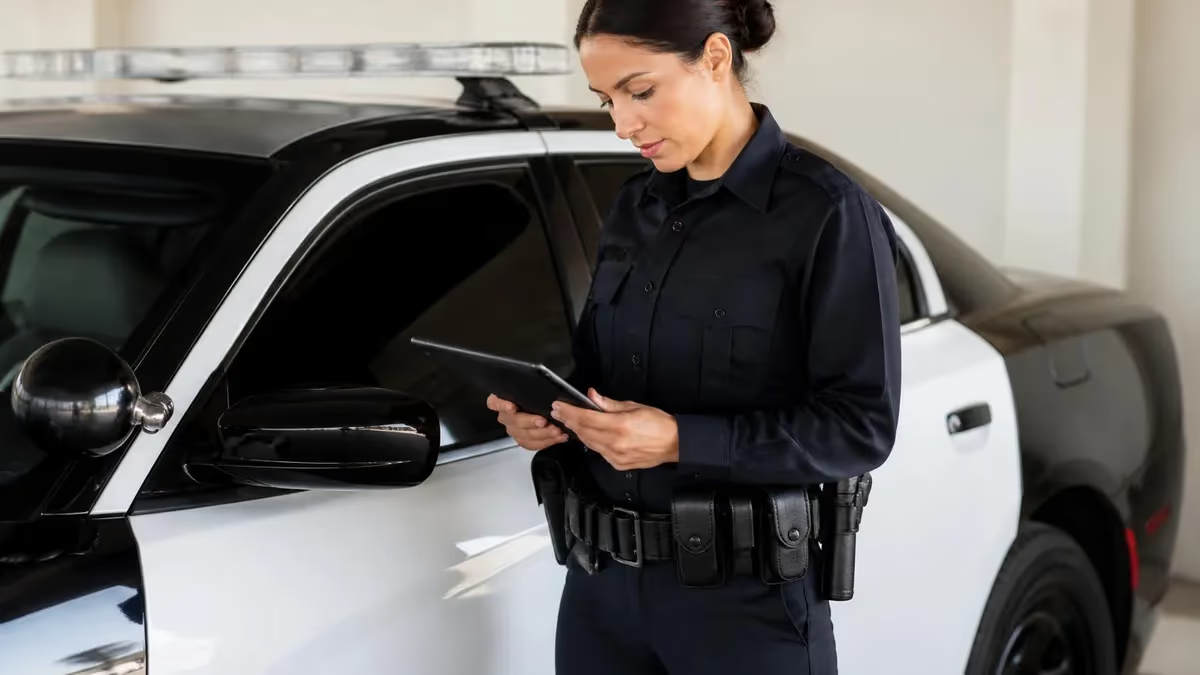
The Los Angeles Police Department offers an online system for filing certain types of police reports — primarily for non-emergency, non-violent incidents where no immediate response is required. This online filing system is part of LAPD's effort to make reporting easier for victims while freeing officer time for higher-priority calls. Understanding what can and cannot be reported online prevents wasted effort and ensures appropriate response.
Online reports can be filed at lapdonline.org or through LAPD's mobile-friendly online reporting portal. The system is available 24 hours per day, 7 days per week. After completing the online form, the report is reviewed by an LAPD records management specialist who issues an official report number. The submitter receives confirmation by email with the report number and other details.
Reports that can be filed online: Lost property (purse, wallet, phone, keys, etc. with no theft involved), Theft of property (under $950 if value-based misdemeanor; varies by circumstances), Vandalism (damaged property, graffiti, etc. when no suspect is present), Hit-and-run (when minor damage and no injuries), Identity theft (preliminary reports for insurance purposes), Harassment without imminent threat (verbal incidents, phone harassment when no immediate danger).
Reports that cannot be filed online: Crimes in progress, Crimes with violent threats, Crimes involving weapons, Crimes with known suspect identification on scene, Reports requiring evidence collection (DNA, fingerprints, physical evidence), Domestic violence (requires in-person investigation), Sexual assault (requires specialized investigation), Major crimes (felony robbery, burglary with breaking, homicide, etc.).
For crimes that cannot be filed online, victims should call 911 for emergencies or LAPD's non-emergency line (888-275-5273) for incidents requiring officer response. Walking into the local LAPD division is also an option for filing more complex reports.
Why use online filing: Convenience — file from home at any hour. No waiting for an officer to arrive. Faster initial documentation. Useful for insurance purposes (insurance companies typically require a police report number for claims). Time-saving for both victim and police department.
Limitations of online filing: No suspect investigation typically follows (limited resource allocation). Reports for property crimes may not result in detective follow-up unless the value or pattern warrants it. The report serves primarily as documentation rather than active investigation. Victims hoping for stolen property recovery typically need more than an online report — physical investigation, neighborhood canvassing, etc. only happens for higher-priority cases.
This guide covers the LAPD online reporting system in detail — what qualifies for online filing, the step-by-step filing process, what happens after submission, when to call instead, and how to use the report number for insurance and other purposes. It's intended for LA residents and visitors who need to report incidents and want to understand their options.

Key Online Reporting Information
- Where: lapdonline.org (Online Police Reporting)
- Availability: 24 hours, 7 days a week
- Eligible: Lost property, theft, vandalism, hit-and-run (minor), harassment
- NOT eligible: Crimes in progress, violence, weapons, known suspects on scene
- Response: Email confirmation with report number
- For emergencies: Call 911
- Non-emergency phone: 888-275-5273
- Use case: Documentation for insurance, formal record
- Time required: 15-30 minutes typical for the form
- Cost: Free
- In-person option: Local LAPD division for complex cases
What types of incidents qualify for online reporting. Understanding the eligibility criteria saves time — only file online for incidents that match the criteria.
Lost property reports: Items that you lost (not stolen), such as wallet, purse, phone, keys, jewelry. The form requires: where you last had the item, where you believe it was lost, description of the item, estimated value, contact information. Use case: You misplaced your wallet at a restaurant and want a report number to demonstrate you didn't lose it through theft.
Theft (property under specific value thresholds): When property was stolen but you have no suspect information. Common examples: items stolen from your car (left visible), bicycle stolen from a rack, package stolen from your doorstep. The threshold is typically under $950 for misdemeanor petty theft; higher values may require in-person reporting or detective involvement.
Vandalism: Damaged property where you don't know who did it. Graffiti on your building, broken windows, damaged car, defaced property. The form requires: when you discovered the damage, location, description of damage, estimated cost to repair.
Hit-and-run with minor damage: Car damage where the responsible driver fled the scene, and damage is below specific value thresholds (typically $5,000), no injuries occurred. For major collisions with injuries, call 911 immediately.
Identity theft: Initial reports for insurance and credit bureau purposes. The report establishes that you've notified law enforcement about the theft. Detective follow-up depends on the specifics.
Harassment (non-imminent): Phone calls, text messages, online harassment without immediate physical threat. Useful documentation if pattern continues; can support eventually obtaining a restraining order.
Lost license plates: When license plates are lost from your vehicle (without theft involvement). Useful for DMV interactions.
What doesn't qualify: Any crime in progress (call 911). Any crime with violence, threats of violence, or weapons involved. Robbery (taking property with force or threat). Burglary (breaking and entering). Domestic violence. Sexual assault. Felony-level crimes. Cases where you have suspect identification or can describe a specific suspect.
What to Report Online vs Call
Lost wallet, stolen bike, vandalism, hit-and-run (minor), harassment, identity theft preliminary.
Crime in progress, violence, weapons, suspect on scene, injuries, urgent situations.
Robbery (force/threat), burglary with breaking, crime with witness on scene, more serious incidents.
Complex cases needing officer interview, evidence collection, missing person, child concerns.
Anonymous tip for crimes you witnessed: tipsla.org or 800-222-TIPS (8477). Up to $1,000 reward.
Domestic violence: 1-800-799-7233. Sexual assault: 1-800-656-HOPE. Specialized response.
Step-by-step online filing process. Following these steps produces a properly documented report.
Step 1: Determine eligibility. Use the LAPD website's checklist to verify your incident qualifies for online reporting. If it doesn't, call 911 or 888-275-5273 instead.
Step 2: Gather information. Before starting the form, collect: When the incident happened (date and time), Where the incident happened (specific address, intersection, or location), What was taken/damaged/lost (specific items, description, value), Any witnesses (names, contact information), Your contact information (name, address, phone, email).
Step 3: Navigate to LAPDonline.org. Find the 'Online Police Report' link or menu option. Click to begin the form.
Step 4: Select report type. Choose from: Lost Property, Theft, Vandalism, Hit-and-Run, Harassment, Identity Theft, or other categories. Each leads to a slightly different form with specific questions.
Step 5: Provide incident details. Fill in: date, time, location, narrative description of what happened. Be specific and detailed. Vague descriptions hurt the report's usefulness for insurance and investigation.
Step 6: Provide property/loss information. List specific items with descriptions, estimated values, and any serial numbers. The more specific your descriptions, the better the report supports any future investigation or insurance claim.
Step 7: Provide witness information (if any). Names, contact information, what they witnessed.
Step 8: Provide your contact information. Full name, address, phone, email. Required for the agency to contact you if needed and to send your report confirmation.
Step 9: Review and submit. Double-check all information before submitting. After submission, the form is reviewed by an LAPD records specialist (typically within 24-48 hours).
Step 10: Receive confirmation. You'll receive an email with your report number and report details. Save this email and the report number — you'll need it for insurance claims, future reference, and any subsequent inquiries.
Online Reporting Stats
Key Facts at a Glance
| Item | Value | Details |
|---|---|---|
| Form completion time | 15-30 minutes | |
| Cost | Free | |
| Available hours | 24/7 |

What happens after you submit an online report. Understanding the next steps helps set realistic expectations.
Review by records specialist: An LAPD records management specialist reviews your submission to verify it meets the criteria for online reporting. Most submissions are accepted within 24-48 hours. Some submissions are rejected and bounce back as 'requires in-person/phone reporting.'
Approval and report number: If accepted, you receive an email with your official LAPD report number. This number is the proof of your report — needed for insurance, future inquiries, and any related interactions with the department.
Detective follow-up: For most online reports, detective investigation is limited. The agency receives many reports daily; resource allocation prioritizes higher-priority cases. Detectives may follow up on: Identity theft with specific suspect information, Patterns of theft in your neighborhood that suggest organized criminal activity, Higher-value losses (typically above $5,000-10,000), Cases with substantial evidence or leads.
What you can do with the report number: File insurance claims (the number is required by most insurance companies for stolen property claims), Establish a paper trail if the incident continues (multiple harassment reports build a pattern), Request copies of the report for legal purposes, Reference the number in any subsequent contact with police.
What you typically cannot expect: Recovery of stolen property (most online reports don't result in property recovery), Officer investigation of your specific case (unless very high-value or pattern detected), Arrest of suspects (without leads or evidence, investigations are limited), Court resolution (most cases simply close).
Modifying or canceling the report: If you discover new information, additional witnesses, or find your lost item, contact the LAPD records division. Don't file a duplicate online report — that creates confusion. Email or call the records line to update or close your existing report.
Insurance claim process: Submit the report number to your insurance company. They may also request additional documentation: receipts for stolen items, photographs of damage, witness statements (if applicable), itemized list of losses. Most insurance companies process claims within 30-60 days of receiving complete documentation.
After Submission
Records specialist reviews within 24-48 hours. If accepted, you receive an email with the official report number. If rejected, you're directed to call or visit in-person for the type of incident you reported.
Common questions about LAPD online reporting. Understanding these helps avoid frustration during the process.
Q: What if my submission is rejected? A: You'll receive an email indicating the report doesn't qualify for online filing. The email typically explains why and suggests alternatives (call 911, non-emergency line, or visit station). Don't refile online — pursue the suggested alternative.
Q: What if I need a physical copy of the report? A: Most online reports are accessible only as the email confirmation. For an official copy, contact LAPD records division (213-244-2727) and request a copy. Charges may apply for paper copies.
Q: What if my insurance company needs a 'real' police report instead of the online one? A: Online reports are real police reports — they have official report numbers and are filed in the LAPD records system. If insurance pushes back, contact the agent for specifics. Some agents are unfamiliar with online reporting; provide them the report number and any documentation you received.
Q: Can I file an online report for someone else? A: Generally, no. The reporting party must be the victim, witness, or authorized representative. For family members, you may report on their behalf if they're incapacitated. Otherwise, the affected person should file their own report.
Q: Does filing an online report mean detectives will investigate? A: Probably not for most online reports. The agency receives many reports daily; resources prioritize crimes in progress and higher-value cases. Online reports establish documentation but rarely result in active investigation unless the value or pattern warrants it.
Q: What if I need to add more details after filing? A: Contact LAPD records division to add supplementary information. Don't file a duplicate online report. The supplementary report is added to your existing case.
Q: Are there language options? A: LAPD offers reporting in multiple languages (Spanish, others). Some online forms may be available in additional languages. For non-English-speaking reporters, in-person filing with translator support may be more practical.
Q: What if I made an error on the report? A: Contact LAPD records to update. Don't refile. The correction is added to the existing record. Honest errors are corrected; deliberate falsifications can result in criminal charges (false reporting).
Q: How long is the report kept? A: LAPD records are retained per California public records law. Most reports are accessible for several years. Specific retention periods vary by report type and any active investigation status.
Common Issues with Online Reports
Filing online for incident that requires in-person. Solution: Call non-emergency line for correct intake.
Vague descriptions reduce report usefulness. Solution: Include specific times, addresses, descriptions, values.
Insurance unfamiliar with online reports. Solution: Provide report number; emphasize it's official LAPD record.
Can't find report number. Solution: Search email for 'LAPD' or call records division to look up your report.
New information after submission. Solution: Contact records division to add supplementary information.
Submitting same report twice. Solution: Don't refile — single record per incident. Contact records to consolidate.

Alternative reporting methods when online doesn't apply. LAPD has several reporting channels for different situations.
911: For emergencies only. Crime in progress, immediate threat, injury, weapons involved, suspect on scene. Calls are prioritized — dispatchers send officers based on urgency and resources. 911 is appropriate for: someone breaking into your home, witnessing violence, hearing gunshots, medical emergencies, fires.
LAPD Non-Emergency Phone (888-275-5273): For incidents that require police response but aren't urgent. Examples: noise complaints (loud party), suspicious activity (someone watching neighborhood from car), minor disturbances (verbal argument outside), missing person reports (where person isn't in immediate danger), accidents without injuries.
In-Person at LAPD Division: For complex cases that benefit from face-to-face interaction. Examples: missing person reports, child welfare concerns, complex incident narratives that require explanation, requesting case status updates, requesting copies of reports. Find your division at lapdonline.org.
Specialized Hotlines: For specific concerns. Domestic violence: 1-800-799-7233 (National Domestic Violence Hotline). Sexual assault: 1-800-656-HOPE (RAINN). Anonymous crime tips: 800-222-TIPS (Crime Stoppers). Suspicious activity (suspected terrorism): 1-877-ATIPS-LAPD (1-877-284-7752).
Email Inquiries: For general questions and information requests. police@lapd.online (general inquiries). Specific divisions may have email contacts for non-urgent matters.
Online Crime Stoppers: tipsla.org for anonymous crime tips. Reward up to $1,000 for tips leading to arrest. Identity protection during the process. Many cases solved through Crime Stoppers tips.
Walk-in Reports: Most LAPD divisions have report-taking capability. Hours vary; verify before going. Officer interview may be required. Useful for complex reports or for those who prefer in-person interaction.
Choosing the right method: For active or urgent situations, always 911. For non-urgent incidents requiring response, non-emergency phone. For straightforward documentation (lost property, simple theft, vandalism), online. For complex cases, in-person.
The online reporting system is for non-emergency, non-violent incidents only. Any crime in progress, immediate threat, situation with injuries, or scenario where suspects are present requires immediate response — call 911. Filing online for an emergency would: delay response (your report waits in queue for 24-48 hour review), miss the opportunity to apprehend suspects, create documentation but no investigation. For all emergencies, weapons, violence, or in-progress situations, 911 is the only appropriate option. The online system is for after-the-fact documentation when no immediate response is needed.
Best practices for using the LAPD online reporting system effectively. Following these practices ensures the report supports your needs.
Practice 1: Verify eligibility first. Use the LAPD website's checklist or call the non-emergency line if unsure. Wasted online submissions delay your actual reporting and may direct you to the wrong system anyway.
Practice 2: Document before filing. Take photos of damaged property, lost items (if available), or any relevant evidence. Save receipts and other documentation. Have all this ready when filling out the form.
Practice 3: Be specific. Vague descriptions hurt your report's usefulness. Instead of 'a phone was stolen,' say 'Apple iPhone 13 Pro, 256GB, Silver, IMEI 123456789012345, in clear case with red trim.' Specific descriptions help with both insurance and any future investigation.
Practice 4: Include witness contacts. If anyone witnessed the incident, include their full name and phone number. Witnesses can corroborate your account if questions arise later.
Practice 5: Save the email confirmation. Treat the email as a valuable document. Save it in a dedicated folder. Keep a screenshot. Forward to a backup email. The report number is your reference for everything that follows.
Practice 6: Use the report number consistently. When filing insurance claims, communicating with the agency, or making related inquiries, reference the specific report number. This ensures everyone is discussing the same incident.
Practice 7: Don't file duplicates. If you realize new information after submission, contact records to update. Filing multiple reports for the same incident creates confusion and may slow processing.
Practice 8: Understand the limitations. Online reporting is documentation, not active investigation. Don't expect that filing the report will recover your stolen property or identify the perpetrator. The report serves primarily for insurance, formal record, and pattern documentation.
Practice 9: Update if circumstances change. If your stolen property is recovered (rare), if you discover the actual cause was different than initially thought, if new information emerges — contact records to update the report.
Practice 10: Combine with other actions. Filing a police report is one action; consider also: notify your insurance company, freeze credit if identity theft, change locks if break-in (even if minor), warn neighbors, consider security improvements (cameras, lights, etc.).
Online Reporting Workflow
Immediately After Incident
Verify Eligibility
File Online Report
Wait 24-48 Hours
Save Confirmation
File Insurance Claim
Take Preventive Actions
Follow Up if Needed
LAPD Pros and Cons
- +LAPD has a publicly available content blueprint — you know exactly what to prepare for
- +Multiple preparation pathways accommodate different schedules and budgets
- +Clear score reporting shows specific strengths and weaknesses
- +Study communities share current insights from recent test-takers
- +Retake policies allow recovery from a difficult first attempt
- −Tested content scope requires substantial preparation time
- −No single resource covers everything optimally
- −Exam-day performance can differ from practice test performance
- −Registration, prep, and retake costs accumulate significantly
- −Content changes between versions can make older materials less reliable
Sample Los Angeles Police Department Practice Questions
Try these questions from our free Los Angeles Police Department practice tests. The correct answer and an explanation follow each question.
In a police report, when should you use 'I' versus 'this officer'?
- A. Always use 'this officer' for formality
- B. Always use 'I' for clarity and directness
- C. Use 'I' only in narrative sections and 'this officer' in summaries
- D. Either is acceptable; consistency within the report is key
Answer: D. Either is acceptable; consistency within the report is key
LAPD style accepts both 'I' and 'this officer,' but the chosen form must be used consistently throughout the report.
Which sentence best demonstrates concise, clear police report writing?
- A. The individual in question did proceed to exit the vehicle at that point in time.
- B. At approximately 2300 hours the suspect exited the vehicle.
- C. The suspect, who was in the vehicle, got out of it.
- D. Exiting of the vehicle by the suspect occurred.
Answer: B. At approximately 2300 hours the suspect exited the vehicle.
The second sentence is direct, includes a specific time, uses active voice, and avoids unnecessary words.
Which of the following sentences is the clearest and most appropriate for a police report?
- A. The suspect, who seemed to be agitated, was pacing back and forth and was looking around nervously near the vehicles in the parking lot.
- B. I observed the suspect pacing back and forth near the vehicles in the parking lot. His fists were clenched and he was scanning the area.
- C. The suspect was acting in a suspicious manner in the parking lot where the cars were, and his behavior made me think he was going to do something.
- D. It was observed that the suspect was moving in an erratic way near the cars in the lot, causing concern.
Answer: B. I observed the suspect pacing back and forth near the vehicles in the parking lot. His fists were clenched and he was scanning the area.
The correct sentence is written in the first-person, active voice ('I observed...'). It states objective facts (pacing, clenched fists, scanning) without making subjective conclusions like 'agitated' or 'suspicious manner'. Police reports require clear, objective, and factual descriptions of events.
An officer observes: 'Whenever it rains, traffic incidents on the 101 increase.' There are no increased traffic incidents today. What is the most logical conclusion?
- A. It is raining today
- B. It is not raining today
- C. The 101 freeway is closed
- D. Traffic data is unavailable
Answer: B. It is not raining today
If rain caused incidents and there are no extra incidents, rain has not occurred — contrapositive reasoning.
LAPD Questions and Answers
LAPD's online police reporting system makes documenting non-emergency incidents convenient and accessible. For lost property, minor theft, vandalism, and similar non-urgent situations, online filing saves time, provides immediate documentation, and gives you an official report number for insurance and personal record purposes. The system's limitations — limited detective follow-up, no in-progress crime handling, no evidence collection — are reasonable trade-offs for the convenience.
For most LA residents, understanding when to use online reporting (non-urgent documentation) vs. calling the non-emergency line (response needed but not urgent) vs. 911 (emergencies) is the key knowledge. Use the right channel for the right situation. The online system serves a specific role; using it correctly gets you the documentation you need without delays for either your case or for the department's active emergency response.
About the Author

Law Enforcement Trainer & Civil Service Exam Specialist
John Jay College of Criminal JusticeMarcus B. Thompson earned his Master of Arts in Criminal Justice from John Jay College of Criminal Justice and served 12 years as a law enforcement officer before transitioning to full-time academy instruction. He is a POST-certified instructor who has prepared candidates for police entrance exams, firefighter assessments, and civil service examinations across dozens of agencies.
Join the Discussion
Connect with other students preparing for this exam. Share tips, ask questions, and get advice from people who have been there.
View discussion (9 replies)