
LAPD Non Emergency Number: When to Call 1-877-275-5273 vs 911 2026 October
The LAPD non emergency number is 1-877-275-5273. Learn when to call it instead of 911, ✏️ what to expect, and how LAPD dispatch handles non-emergency reports.
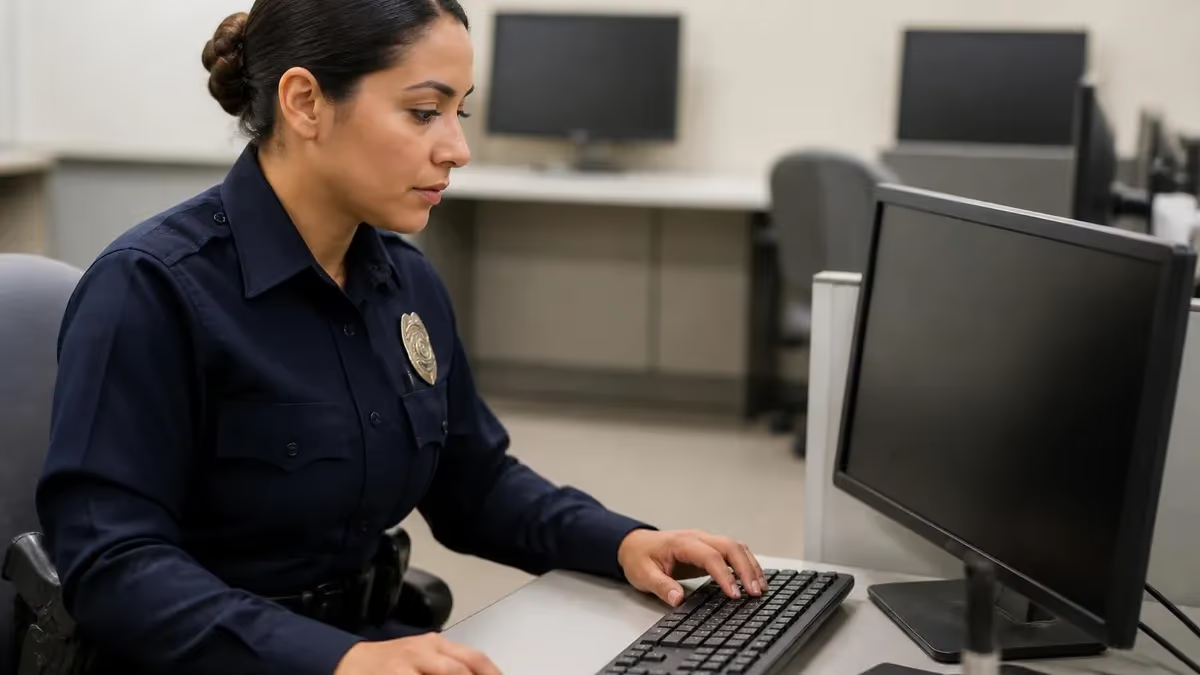
You need to report a barking dog at 2 a.m., a stolen package from your porch, or a noise complaint that has been driving you up the wall for the past three hours. None of these are 911 situations. So who do you call? The LAPD non emergency number is 1-877-275-5273 (1-877-ASK-LAPD), and it is the right line for everything that matters but is not life-threatening or actively in progress.
Most people in Los Angeles know 911. Far fewer remember the non-emergency line, and that gap creates two problems: 911 gets clogged with calls that do not belong there, and real issues go unreported because folks assume nobody will respond. Both of those outcomes hurt your neighborhood.
This guide walks through when to use the LAPD non emergency number, what to expect when you call, how it differs from 911, which alternatives work better for certain situations, and how the LAPD dispatch system actually routes calls behind the scenes. If you are also studying for the LAPD entrance exam, understanding the dispatch system gives you a real edge on the situational judgment sections.
LAPD Communications Division by the Numbers

What Is the LAPD Non Emergency Number?
The official LAPD non emergency line is 1-877-275-5273. The mnemonic is 1-877-ASK-LAPD, which spells out on a phone keypad. This number is toll-free and works from any phone inside or outside Los Angeles. It is staffed twenty-four hours a day, seven days a week, by the same Communications Division that handles 911.
You can also reach a specific LAPD division directly. There are 21 community police stations across the city, and each one publishes its own desk line. If you know which division covers your area, calling that station gets you straight to a desk officer who knows the neighborhood. For everything else, the 1-877 number routes you to the right place.
A common point of confusion: 311 is the City of Los Angeles services line, not the police. Call 311 for potholes, graffiti removal, trash pickup, or abandoned shopping carts. Call the LAPD non emergency number when you actually need a police response, even if there is no immediate danger.
When to Call the Non Emergency Line
Use 1-877-275-5273 when something needs police attention but nobody is in immediate danger and the suspect is gone. The bar is whether time matters. If a crime is happening right now, or a suspect is still on scene, that is 911 territory. If the crime happened earlier, the suspect left, and you just need a report filed, that is non-emergency.
Typical non-emergency situations include reporting a stolen car that you discovered missing this morning, filing a report for a burglary that happened while you were at work, complaining about loud music at midnight, reporting a suspicious vehicle that has been parked on your street for a week, or asking general questions about LAPD policy. Mail theft, package porch pirates, vandalism with no suspect in sight, and minor fender benders without injuries also belong here.
Quick Reference
911 — emergencies, in-progress crimes, immediate danger.
1-877-275-5273 — past crimes, reports, complaints, questions.
311 — city services like potholes, graffiti, trash.
211 — community and social services.
911 vs LAPD Non Emergency: Which One Should You Use?
The shortest answer: 911 is for emergencies, the non-emergency line is for everything else. But that distinction collapses under stress. People dial 911 for everything because it is the only number they remember, and dispatchers spend real time triaging calls that should have gone elsewhere.
Here is the cleaner test. Ask yourself three questions. Is someone hurt, threatened, or about to be? Is the crime happening right now? Is the suspect still there or fleeing? If you answer yes to any of these, dial 911. If all three are no, dial 1-877-275-5273.
The Cost of Calling the Wrong Number
911 dispatchers in Los Angeles handle roughly four million calls per year, and a significant percentage are non-emergencies. Every one of those calls ties up a dispatcher who could be answering a real emergency. When you call the non-emergency line for a non-emergency, you free up 911 capacity and often get faster service because non-emergency calls are not constantly being preempted.
Call the Right Line for the Situation
Someone is hurt, being threatened, or in danger right now. A crime is happening this minute. A suspect is still at the scene or fleeing. Fire, medical emergency, or someone unresponsive. Domestic violence in progress. Active break-in.
What Happens When You Call
You will reach the LAPD Communications Division, located at the dispatch center. A call-taker answers, asks your location, the nature of the incident, and your contact information. They classify the call by priority, log it in the Computer-Aided Dispatch (CAD) system, and either send a unit, transfer you to a desk officer, or take a phone report.
Not every non-emergency call results in an officer showing up. Some calls are handled entirely by phone, especially low-value property crimes and lost-property reports. Others are routed to your local division for follow-up. If a unit is sent, response times vary widely depending on call volume, time of day, and the number of available cars in your division.
Priority Levels and Response Times
LAPD classifies calls into priority levels, generally numbered from 1 (highest, in-progress emergencies) to 4 or higher (non-emergency reports). Most non-emergency calls are Priority 2 or 3. The dispatcher does not always tell you the priority, but it determines how fast a unit gets to you.
For comparison: a Priority 1 call (officer down, active shooter, robbery in progress) gets immediate dispatch. A Priority 4 cold report — say, a stolen bicycle from last week — may not see a unit for hours, or may be handled by phone the same day. Response time is not a measure of how much LAPD cares about your call. It is a triage system that puts the most dangerous situations first.
Phone Reports vs In-Person Reports
For a lot of non-emergency situations, LAPD offers phone-based reporting. You call the non-emergency line, give your details, and a report number is generated. You do not have to wait for an officer or travel to a station. This is the standard workflow for things like petty theft under a certain dollar amount, lost property, and certain types of vandalism.
Some situations require an in-person report. Stolen vehicles, hit-and-run accidents with damage, hate crimes, sexual assault, and incidents involving evidence or witness statements usually need a unit on scene. The dispatcher will tell you which path your situation falls into.
Filing an Online Report
LAPD also accepts online reports for certain low-priority crimes through the official LAPD website. You get a temporary case number immediately and a permanent one after review. This is the fastest option for lost property, identity theft documentation, and minor vandalism. It is not appropriate for anything in progress or anything requiring physical evidence collection.
LAPD Geographic Bureaus
Covers Downtown, Hollenbeck, Newton, Northeast, Rampart, and Central divisions. Heaviest call volume in the city.
77th Street, Harbor, Southeast, and Southwest divisions. Covers South LA and the Harbor area.
Devonshire, Foothill, Mission, North Hollywood, Topanga, Van Nuys, and West Valley divisions.
Hollywood, Olympic, Pacific, West LA, and Wilshire divisions. Covers the Westside and Hollywood.

Common Mistakes People Make
The biggest mistake is calling 911 for non-emergencies. The second biggest is the opposite — not calling at all because you think the police are too busy. Both behaviors break the system. If something needs reporting but is not urgent, use the non-emergency line. The dispatchers want you to call.
Another common mistake: hanging up because you got put on hold. Non-emergency lines can have wait times, especially Friday and Saturday nights. Stay on the line. Hanging up and calling back puts you at the back of the queue.
LAPD Divisions and Local Numbers
LAPD has 21 community police stations grouped into four geographic bureaus: Central, South, Valley, and West. Each station has its own desk officer line, and for community-specific concerns, calling that direct line often gets faster results than the centralized non-emergency number.
For example, if you live in Hollywood, the Hollywood Community Police Station is at 1358 N. Wilcox Avenue and has its own desk line. If you live in Van Nuys, you would call the Van Nuys station. The LAPD website maintains an updated list of all stations with current phone numbers, addresses, and the boundaries each one covers.
Finding Your Division
If you are not sure which division covers your address, the LAPD has an online Find Your Station tool. You enter your address, and it returns the station name, address, phone, and the senior lead officer assigned to your block. Bookmarking that page is one of the highest-use things a Los Angeles resident can do for their own safety knowledge.
Direct-to-station calls also matter when you want to speak with a specific officer, follow up on a report you already filed, or ask about a community meeting. Going through 1-877-275-5273 will eventually route you to the right place, but it adds steps.
Dispatch centers nationwide report that 25 to 40 percent of 911 calls do not meet the legal definition of an emergency. Every misrouted call ties up a dispatcher who could be helping someone in real danger. When in doubt, ask yourself: is someone hurt, is it happening right now, is the suspect still here? If all three are no, call 1-877-275-5273.
Senior Lead Officers and Community Liaisons
Every LAPD basic car area (roughly a neighborhood) has a Senior Lead Officer, or SLO. The SLO is your community police liaison. They handle ongoing neighborhood problems — chronic loitering, repeat noise complaints, drug houses, encampment issues — and they hold regular community meetings.
If you have a problem that keeps recurring, the non-emergency line will dispatch a unit each time, but the SLO is the person who can actually do something structural. They coordinate with code enforcement, social services, and community groups. Their contact info is on the LAPD division website.
When to Skip the Phone and Walk In
Every community police station has a public desk officer during business hours. You can walk in without an appointment for most non-emergency matters. This is often faster than calling, especially for things like getting a copy of a police report you previously filed, requesting clearance letters, or asking about gun registration paperwork.
What to Have Ready Before You Call
Dispatchers ask the same set of questions on almost every call. Having the answers ready cuts your call time in half and gets a faster response. The basics: your name, your callback number, the exact location of the incident, what happened, when it happened, and whether anyone was hurt.
For property crimes, also have ready a description of stolen items including serial numbers if you have them, photos of the property if available, and any video footage from doorbell cameras or security systems. You will need to give a statement, so think through the sequence of events before you dial.
What to Have Ready Before You Call
- ✓Your name and a callback phone number
- ✓Exact location of the incident (address, cross streets, landmarks)
- ✓What happened, in plain language and in sequence
- ✓When it happened (date and approximate time)
- ✓Description of any suspects (clothing, height, build, direction of travel)
- ✓Description of vehicles (color, make, model, partial plate if known)
- ✓List of stolen or damaged property with serial numbers if available
- ✓Any video footage from doorbell cameras or security systems
LAPD Call Priority Levels Explained
Active shooter, officer down, robbery in progress, kidnapping in progress, serious injury or death threat. Multiple units dispatched immediately with lights and sirens. Average response measured in minutes.
Crimes in progress without immediate threat to life, in-progress disturbances, burglary alarms with signs of entry, traffic accidents with injuries. Units dispatched as soon as available, often within 15 to 30 minutes.
Cold property crimes, suspicious activity reports, noise complaints, parking issues with safety implications, welfare checks without immediate concern. Queued behind higher-priority calls. Response varies from one hour to several hours.
Old reports with no suspect information, lost property, follow-up reports, minor vandalism. Often handled entirely by phone or scheduled for the next available unit. May not see a physical response on the same day.
For Suspicious Activity Calls
If you are reporting suspicious activity rather than a confirmed crime, describe what you saw, not what you assume. Dispatchers and responding officers need specifics: a male in a red hoodie walked up to three parked cars and pulled on the door handles, then walked east on Vermont. Useless: a guy looked suspicious. The more concrete the description, the more useful the call.
This applies to vehicles too. Color, make, model, partial plate, direction of travel, and number of occupants are all valuable. Anything you can capture about height, build, clothing, and distinguishing features adds value. The point is not to play detective — it is to give the responding officer enough to actually find the person.
Translation and Accessibility
The LAPD Communications Division offers translation services in over 140 languages through a contracted interpreter line. Tell the call-taker the language you need, and they will conference in an interpreter. There is no extra charge, and the service is available 24/7.
For deaf and hard-of-hearing callers, LAPD accepts TTY/TDD calls at 1-877-275-5273 and also supports text-to-911 in emergencies. Text-to-911 should only be used when you cannot make a voice call safely. Voice is still faster and gives the dispatcher more information.
Texting the Non-Emergency Line
Currently, LAPD does not offer text-message support for the non-emergency line. If you cannot call, use the online reporting portal or visit a station in person. Text-to-911 is reserved for true emergencies where calling is not possible — for example, an active intruder where speaking would alert them.

Effective Suspicious-Activity Description Template
- ✓Number of people involved and their direction of travel
- ✓Clothing color and type (hoodie, jacket, hat, footwear)
- ✓Approximate height, build, and any distinguishing features
- ✓Vehicle color, make, model, and partial license plate
- ✓Specific behaviors observed (pulling door handles, looking through windows)
- ✓Exact location and time you witnessed the activity
- ✓Whether they appeared armed or threatening
- ✓Whether they noticed you watching them
How LAPD Dispatch Works Behind the Scenes
When you call either 911 or the non-emergency line, you reach the LAPD Communications Division at the Police Administration Building downtown. Call-takers receive the call, enter the details into the CAD system, and the call is routed to a dispatcher who covers the geographic division where the incident is.
The dispatcher sees available units on a map, selects the closest appropriate unit, and assigns the call. The radio dispatcher then voices the call out to that unit. The officer acknowledges, and an estimated time of arrival is logged. This whole process can take under sixty seconds for high-priority calls.
For non-emergency calls, the dispatcher queues the call by priority. If all units are tied up on higher-priority work, your call waits. When a unit clears and you are the highest-priority unassigned call in their area, they get sent. This is why response times for low-priority calls can vary so dramatically.
Why You Might Get Transferred
Some non-emergency calls do not need a patrol response at all. They need a detective, a specific unit (gang, narcotics, vice, traffic), or a different agency entirely. Call-takers transfer those out. If your call involves a federal crime, they may route you to the FBI. If it is an animal issue, you might be sent to Animal Services. If it is a fire hazard or a medical issue, LAFD takes over.
The transfer process is supposed to be warm — meaning the call-taker stays on the line until the new agency picks up. In practice, with high call volumes, you sometimes get a direct transfer with no introduction. If you get disconnected, call back and explain that you were already in the system.
Phone Report vs In-Person Report
- +Faster for low-value property crimes
- +No travel or wait time at a station
- +Case number issued immediately
- +Works 24/7 with translation support
- −No physical evidence collection
- −Some report types still require in-person filing
- −Cannot file stolen vehicle, hit-and-run, or hate crime reports by phone
- −Phone-only reports may receive less follow-up
Pros and Cons at a Glance
| Pros | Cons |
|---|---|
| Faster for low-value property crimes | No physical evidence collection |
| No travel or wait time at a station | Some report types still require in-person filing |
| Case number issued immediately | Cannot file stolen vehicle, hit-and-run, or hate crime reports by phone |
When LAPD Is Not the Right Agency
Los Angeles is large and jurisdictionally complicated. LAPD covers the City of Los Angeles. The Los Angeles County Sheriff's Department (LASD) covers unincorporated areas of the county and contract cities like West Hollywood, Lynwood, and Compton. The California Highway Patrol covers freeways and state highways within city limits.
If your call is about a freeway incident, CHP is the right agency: 1-800-TELL-CHP (1-800-835-5247). If it is about a Sheriff's area, you want LASD: each station has its own number. The LAPD non-emergency line will redirect you, but calling the right agency directly saves time.
Federal and State Agencies
Some incidents involve federal jurisdiction: postal mail theft (USPIS), counterfeit currency (Secret Service), immigration matters (ICE/HSI), or interstate threats (FBI). For postal-related crimes, the U.S. Postal Inspection Service runs 1-877-876-2455. For internet crimes, the FBI's IC3 portal at ic3.gov is the central reporting tool.
If you are not sure who has jurisdiction, call the LAPD non-emergency line. They handle this every day and will point you to the correct agency. Just do not call 911 to ask.
Special Situations Worth Knowing About
A few common scenarios trip people up. Domestic disputes are always 911 if anyone is hurt, threatened, or if a protective order is being violated, even if the situation has temporarily calmed down. Mental health crises where someone is a danger to themselves or others are 911. For mental health crises where the person is not in immediate danger, the LA County Department of Mental Health crisis line (1-800-854-7771) is often the better call.
Welfare checks — where you want LAPD to physically check on someone who has not been heard from — are non-emergency calls unless you have specific reason to believe they are in immediate danger.
Reporting Mail and Package Theft
Porch piracy is one of the most common non-emergency reports. The LAPD will take a phone report and assign a case number. If you have video footage from a doorbell camera, mention it during the call. The case number matters for filing insurance claims or for retailer refund requests.
For mail theft specifically — meaning items taken from your actual mailbox or stolen from a USPS truck — also file with USPIS at 1-877-876-2455. Mail theft is a federal crime, and USPIS has investigators who specialize in package and mail theft rings. The two reports run in parallel and increase the chance of recovery.
What Happens to Your Report
Every report becomes part of the LAPD records system. For investigative cases, a detective from the local division is assigned. For lower-priority property crimes, the report may sit in a queue, with follow-up depending on workload and whether new information surfaces (like a stolen item being recovered or a similar M.O. crime nearby).
You can request a copy of your report from the LAPD Records and Identification Division. For incidents involving an arrest or a court case, the report becomes evidence. For insurance purposes, the case number is usually enough — insurers verify directly with LAPD.
Following Up on a Report
If you do not hear anything for a while, you can call the detective division at your local station. They cannot always give you details mid-investigation, but they can tell you the case is still active, has been closed, or has been forwarded to another unit. Patience helps — non-violent property crime investigations often take weeks or months when they progress at all.
If You Are Studying for LAPD Recruitment
Understanding the dispatch system and the priority structure is exactly the kind of background that helps on the LAPD entrance exam and oral interview. Recruits are expected to know how the Communications Division fits into the overall LAPD structure, what the priority levels mean, and how a call moves from intake to closure.
The situational judgment portions of the exam also lean heavily on understanding when to escalate, when to handle by phone, and when to pull in other units. If a question describes a non-emergency call that turns into an emergency mid-conversation, the right answer requires knowing both protocols.
Take the LAPD practice test to drill on the situational judgment scenarios. Many of them involve call routing decisions exactly like the ones a Communications Division call-taker makes every shift.
Saving the Numbers
The single most useful thing you can do right now is save 1-877-275-5273 in your phone under LAPD Non-Emergency. Add your local division desk line too. When the moment comes, you will not be googling — you will be dialing.
Call Routing Quick Decision Guide
Bleeding, unconscious, or actively threatened individuals always require 911. Active fire, smoke, gas leaks, or medical emergencies route through 911 because the same dispatcher reaches LAFD paramedics. No exceptions, no second-guessing — dial 911 first and let the call-taker route.
Crime happening right now or suspect still on scene is 911 even if no one has been injured yet. Burglary in progress, prowler in the yard, armed robbery, kidnapping, domestic violence in progress — all require immediate patrol dispatch with lights and sirens.
Property crimes discovered hours or days later, noise complaints after hours, suspicious vehicles parked for days, stolen mail or packages — all go to 1-877-275-5273. The dispatcher will determine whether a unit is needed or a phone report covers it.
Freeway incidents go to CHP at 1-800-835-5247. Potholes, graffiti, abandoned shopping carts are 311 city services. Mental health crises without immediate danger go to LA County DMH at 1-800-854-7771. Federal mail theft adds USPIS at 1-877-876-2455 alongside LAPD.
How LAPD Dispatch Handles Volume
Sample Los Angeles Police Department Practice Questions
Try these questions from our free Los Angeles Police Department practice tests. The correct answer and an explanation follow each question.
You are instructed to watch a video of a traffic stop and count the number of times the driver touches their face. During the video, a small drone flies past the passenger-side window. When questioned later, you did not see the drone. This failure to perceive an unexpected object while your attention is focused on a specific task is a classic example of:
- A. Memory Decay
- B. Inattentional Blindness
- C. Source Amnesia
- D. Auditory Exclusion
Answer: B. Inattentional Blindness
Inattentional blindness is the failure to notice a fully visible, but unexpected, object because attention was engaged on another task or event. By focusing on the specific task of counting face touches, the brain filters out the unexpected drone.
When preparing for the LAPD Department Interview, a candidate's use of personal examples in response to behavioral questions should primarily aim to demonstrate which of the following?
- A. That they have an extensive knowledge of LAPD's internal policies and procedures.
- B. That their previous jobs were more demanding than being a police officer.
- C. Their ability to connect past experiences to the core competencies required of a police officer.
- D. That they have never made a significant mistake in past professional roles.
Answer: C. Their ability to connect past experiences to the core competencies required of a police officer.
The interview panel uses behavioral questions (e.g., "Tell me about a time when...") to predict future performance based on past behavior. The most effective answers link specific personal experiences to required officer traits like integrity, problem-solving, and communication.
An LAPD applicant was arrested but never charged for an incident three years ago. Must this be disclosed during the background investigation?
- A. No, because no charges were filed and there is no conviction
- B. No, only convictions from the past seven years must be disclosed
- C. Yes, all arrests regardless of disposition must be disclosed
- D. Yes, but only if the arrest appears on a commercial background check
Answer: C. Yes, all arrests regardless of disposition must be disclosed
LAPD requires applicants to disclose all arrests, regardless of whether charges were filed or a conviction resulted, as the circumstances are evaluated for character suitability.
An LAPD officer observes their partner conduct a search of a vehicle's trunk without establishing clear probable cause. The search does not uncover any illegal items. Which of the following actions is the officer ethically and professionally required to take?
- A. Ignore the action since no evidence was found and no harm was done.
- B. Casually mention to the partner later that the search might have been questionable.
- C. Immediately report the partner's potential misconduct to a supervisor, as required by department policy.
- D. Make a note of the incident in case the partner develops a pattern of such behavior.
Answer: C. Immediately report the partner's potential misconduct to a supervisor, as required by department policy.
LAPD policy requires that when an employee becomes aware of possible misconduct by another member of the Department, the employee shall immediately report the incident to a supervisor. This duty exists regardless of the outcome of the misconduct (i.e., whether evidence was found or not). Upholding constitutional standards and departmental integrity is paramount, and failing to report misconduct can impair public trust.
LAPD Questions and Answers
About the Author

Law Enforcement Trainer & Civil Service Exam Specialist
John Jay College of Criminal JusticeMarcus B. Thompson earned his Master of Arts in Criminal Justice from John Jay College of Criminal Justice and served 12 years as a law enforcement officer before transitioning to full-time academy instruction. He is a POST-certified instructor who has prepared candidates for police entrance exams, firefighter assessments, and civil service examinations across dozens of agencies.
Join the Discussion
Connect with other students preparing for this exam. Share tips, ask questions, and get advice from people who have been there.
View discussion (9 replies)