
Sanders Supply HVAC Parts & Supplies: The Complete Guide to Finding Reliable HVAC Parts Suppliers, Wholesalers, and Distributors
Sanders Supply HVAC parts & supplies guide: 📝 compare distributors, wholesalers, pricing, inventory, and shipping for contractors and DIYers.
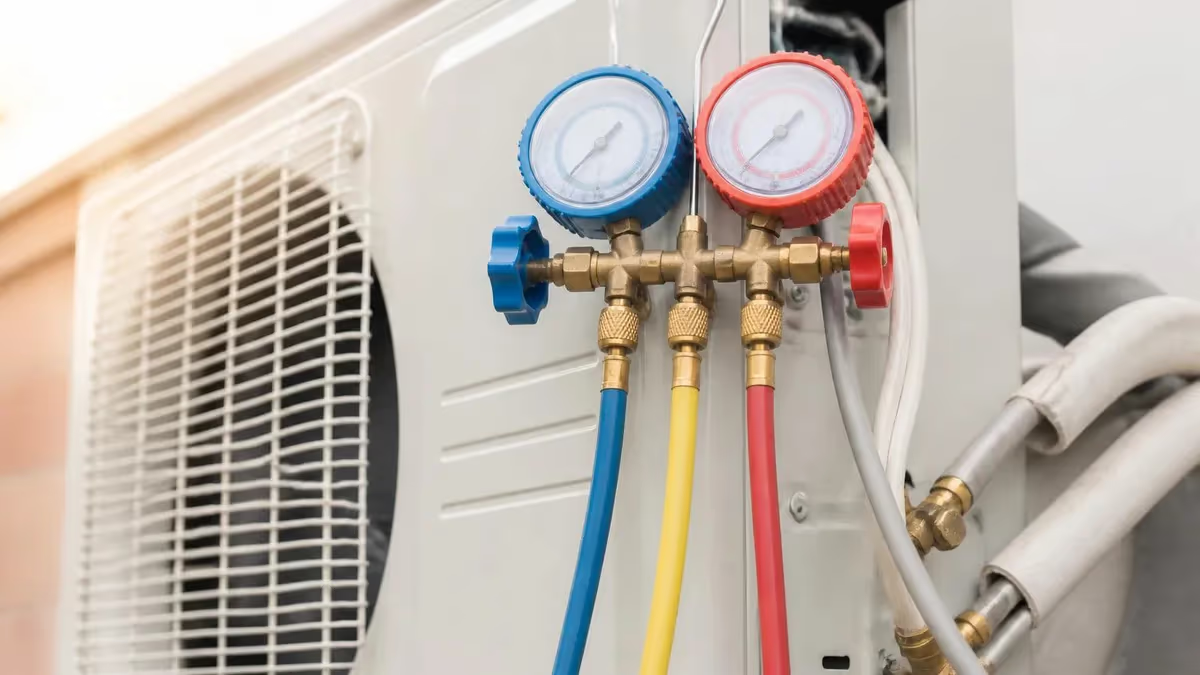
When contractors search for sanders supply hvac parts and supply & supplies, they are usually trying to solve a very specific problem: finding a reliable HVAC parts supplier that stocks the right brands, ships fast, and offers fair contractor pricing. Whether you run a service truck, manage a fleet of installers, or handle maintenance for a property portfolio, the supplier you choose can make or break your daily margins. This guide unpacks how the HVAC parts distribution market actually works and how to navigate it intelligently.
HVAC parts suppliers in the United States generally fall into three tiers: national distributors with hundreds of branches, regional specialists that focus on a few states, and local independents like family-owned counter houses that have served their towns for decades. Sanders Supply is one example of a regional name many technicians know, but the broader category includes Ferguson, Johnstone Supply, Baker Distributing, Gemaire, R.E. Michel, and Carrier Enterprise. Each plays a different role in your hvac equipment distributor.
The reason supplier choice matters so much is simple: hvac equipment brands failures rarely happen on a convenient Tuesday morning. They happen during a heat wave, on a holiday weekend, or at 4:45 PM on a Friday when you have one shot to get the homeowner back in cool air before nightfall. A supplier that has the OEM blower motor in stock, two miles from your van, is worth more than one offering a 12% discount and a three-day shipping window.
Pricing is the other big variable. Trade pricing for HVAC parts is rarely posted publicly. Most distributors require a contractor account, a tax ID, and sometimes proof of a trade license before they will show you wholesale tiers. Walk-in customers typically pay 30 to 60 percent more than account holders for identical SKUs, which is why establishing relationships with two or three suppliers early in your career pays compounding dividends.
Inventory depth is another differentiator. A good HVAC parts supplier carries refrigerants like R-410A and R-32, capacitors in every common microfarad rating, contactors, condenser fan motors, ECM modules, thermostats, line sets, gauges, recovery cylinders, brazing rods, nitrogen, and the specialty boards that fail on five-year-old high-efficiency furnaces. The depth of inventory often correlates with how big the supplier's warehouse footprint is in your region.
This article walks through everything you need to evaluate suppliers, set up accounts, source obsolete parts, manage returns, and avoid the common pitfalls that quietly drain profitability. We will also look at how online HVAC parts marketplaces have changed the game, when to use them, and when sticking with your local counter house is still the smartest move. By the end, you will have a framework that works whether you are buying a single capacitor or stocking an entire warehouse.
If you are also evaluating the broader supply chain for ductwork and air distribution components, our companion HVAC Duct Supplies guide pairs naturally with this one and covers the sheet metal side of the equation in detail.
HVAC Parts Distribution by the Numbers

Types of HVAC Parts Suppliers You Will Encounter
Companies like Ferguson, Johnstone Supply, and Carrier Enterprise operate hundreds of branches nationwide. They offer deep inventory, online ordering portals, credit programs, and consistent pricing across regions for multi-location contractors.
Mid-sized chains like Baker Distributing, Gemaire, and Sanders Supply cover specific geographies with tight service areas. They often beat national chains on local stocking depth and personal account management for medium contractors.
Family-owned local suppliers serve a single metro area with decades of relationships. Their advantage is flexibility, willingness to source unusual parts, and same-day will-call without the bureaucracy of national chains.
Manufacturers like Trane, Lennox, Goodman, and Daikin sell parts directly through certified dealer networks. OEM channels guarantee warranty validity and original specifications but typically require dealer credentials.
SupplyHouse, PexUniverse, Amazon Business, and eBay handle high-volume commodity parts with overnight shipping. Best for non-urgent stocking orders, obsolete parts hunting, and price-shopping major component replacements.
Understanding HVAC parts pricing requires knowing how the distribution channel actually marks up product. Manufacturers sell to distributors at a base wholesale price. Distributors then create tiered pricing for different customer classes: residential contractor, commercial contractor, national account, government, and walk-in retail. The same exact capacitor might be $4.10 at the top tier, $6.80 at the bottom contractor tier, and $14.50 over the counter to a homeowner.
Setting up a contractor account is the single highest-use move a new HVAC business can make. Required documents typically include a state contractor license or registration, a federal EIN, a sales tax resale certificate, proof of liability insurance, and sometimes trade references. Most distributors approve accounts within 48 hours. Once approved, you gain access to net-30 terms, online ordering, price books, and rebate programs that can return four to six percent on annual spend.
Volume rebates are an underused profit lever. Programs like Johnstone Supply's PRO Rewards, Carrier Enterprise's Factory Authorized Dealer incentives, and manufacturer-specific programs from Trane, Lennox, and Daikin pay back significant dollars at year-end. A contractor doing $200,000 in annual parts spend can realistically capture $8,000 to $15,000 in combined rebates, co-op marketing dollars, and tiered discounts.
Negotiating pricing is normal in this industry, especially on big-ticket items like condensers, furnaces, and air handlers. Distributors expect contractors to shop two or three suppliers for major equipment purchases. The trick is being honest about it: tell your rep you have a competing bid, share the SKU and price, and ask if they can match or get close. Most reps have authority to discount five to fifteen percent without manager approval.
Watch for hidden costs that erode advertised pricing. Core charges on compressors and motors, restocking fees on returns, freight fees on direct-ship items, and minimum order requirements can all chip away at margin. Some distributors charge a 25 percent restocking fee on opened items. Always confirm return policy before ordering high-dollar parts that might end up being the wrong fit.
Credit terms matter more than you might think for cash flow. Net-30 is standard for contractor accounts. Some suppliers offer net-45 or net-60 for established accounts with strong payment history. Late payments hurt your trade rating with companies like Cortera and can result in COD status, which kills service truck flexibility. Treat your parts house payments like a sacred deadline.
For a deeper look at how parts pricing fits into the broader service economy, our hvac contractors guide covers labor rates, service agreements, and how to package parts and labor for healthy gross margins on every job.
HVAC Practice Test Questions
Prepare for the HVAC - Heating Ventilation and Air Conditioning exam with our free practice test modules. Each quiz covers key topics to help you pass on your first try.
HVAC Air Conditioning
HVAC Exam Questions covering Air Conditioning. Master HVAC Test concepts for certification prep.
HVAC Code Compliance
Free HVAC Practice Test featuring Code Compliance. Improve your HVAC Exam score with mock test prep.
HVAC Electrical Controls
HVAC Test Prep for Electrical Controls. Practice HVAC Quiz questions and boost your score.
HVAC Energy Efficiency
HVAC Questions and Answers on Energy Efficiency. Free HVAC practice for exam readiness.
HVAC Heating Systems
HVAC Mock Test covering Heating Systems. Online HVAC Test practice with instant feedback.
HVAC Load Calculations
Free HVAC Quiz on HVAC Load Calculations. HVAC Exam prep questions with detailed explanations.
HVAC Tools and Equipment
HVAC Practice Questions for HVAC Tools and Equipment. Build confidence for your HVAC certification exam.
HVAC Refrigeration
HVAC Test Online for Refrigeration. Free practice with instant results and feedback.
HVAC Safety Practices
HVAC Study Material on Safety Practices. Prepare effectively with real exam-style questions.
HVAC System Design
Free HVAC Test covering System Design. Practice and track your HVAC exam readiness.
HVAC Thermodynamics
HVAC Exam Questions covering Thermodynamics. Master HVAC Test concepts for certification prep.
Inventory, Brands & Parts Availability at HVAC Suppliers
Universal parts make up the bulk of every HVAC supplier's inventory because they fit a wide range of equipment. Capacitors, contactors, relays, transformers, thermostats, fan motors, blower wheels, line voltage controls, copper fittings, and refrigerant cylinders are typically stocked in dozens of variations at every branch. A good supplier carries multiple brands like Mars, Packard, Supco, Honeywell, and Diversitech to give you sourcing flexibility.
The advantage of universal parts is interchangeability. A 45/5 microfarad dual-run capacitor from Mars functions identically to one from Packard, so suppliers compete primarily on price, packaging, and warranty. Many techs build relationships with specific brands because they trust the failure rate. Stock your truck with three to five common capacitor sizes and you can solve roughly 30 percent of summer no-cool calls without a parts house visit.
Local Counter House vs Online HVAC Parts Supplier: Which Wins?
- +Same-day will-call pickup eliminates lost service hours during emergency calls
- +Counter staff often identify parts from a description alone, saving research time
- +Returns and warranty exchanges happen face-to-face with no shipping delays
- +Personal relationships unlock special pricing, loaner tools, and after-hours access
- +Local suppliers stock regional brands and refrigerants that match local code requirements
- +Training events, manufacturer reps, and product demos happen at the branch level
- −Local pricing is typically 5 to 15 percent higher than aggressive online competitors
- −Inventory depth varies by branch and may not include uncommon SKUs in stock
- −Counter wait times during peak season can eat 30 to 45 minutes per visit
- −Operating hours often end at 5 PM, limiting after-hours emergency parts access
- −Smaller suppliers may lack strong online ordering portals and real-time inventory
- −Account setup paperwork and credit checks delay first-time purchases by several days
Pros and Cons at a Glance
| Pros | Cons |
|---|---|
| Same-day will-call pickup eliminates lost service hours during emergency calls | Inventory depth varies by branch and may not include uncommon SKUs in stock |
| Counter staff often identify parts from a description alone, saving research time | Smaller suppliers may lack strong online ordering portals and real-time inventory |
| Returns and warranty exchanges happen face-to-face with no shipping delays | Account setup paperwork and credit checks delay first-time purchases by several days |
HVAC Parts Supplier Evaluation Checklist
- ✓Confirm the supplier has at least one branch within 15 miles of your service area
- ✓Verify trade pricing tiers and request a sample price book before opening an account
- ✓Test stock depth by calling on three common parts and three obscure parts
- ✓Review return and core-charge policies on motors, compressors, and control boards
- ✓Confirm credit terms (net-30 minimum) and check rebate or rewards program details
- ✓Evaluate the online ordering portal for real-time inventory, pricing, and order history
- ✓Ask which OEM brands they are authorized to distribute and warranty
- ✓Confirm same-day will-call hours and whether after-hours emergency parts are available
- ✓Check delivery options, minimum order values, and freight charges on direct shipments
- ✓Get the names and phone numbers of your outside sales rep and counter manager
Why one supplier is never enough
Experienced HVAC contractors maintain accounts with at least three suppliers: one national chain for consistent pricing, one regional specialist for OEM warranty work, and one local independent for emergency same-day parts. This redundancy means a single supplier's stockout or pricing increase never derails your week. The 30 minutes of extra paperwork pays back every single month.
The rise of online HVAC parts suppliers has reshaped how contractors source non-urgent inventory. Platforms like SupplyHouse, PexUniverse, AC Wholesalers, HVAC.com, and Amazon Business now compete directly with traditional counter houses on commodity parts. For stocking orders placed during slow seasons, online pricing can run 15 to 25 percent below local trade pricing, particularly on motors, capacitors, thermostats, and refrigerant accessories.
Online ordering shines for predictable replenishment. If you know you burn through 40 dual-run capacitors per summer, ordering in bulk in March from an online supplier with free freight on $300+ orders can shave hundreds off seasonal costs. The same logic applies to filter media, line set insulation, condensate pumps, and PVC fittings that move predictably through your van.
Where online suppliers fail is hvac equipment rental. When a homeowner has a flooded basement at 6 PM and you need a specific condensate pump in 20 minutes, no overnight shipping can compete with a local branch eight blocks away. The break-even calculation usually comes down to job urgency, ticket size, and whether the cost savings exceed the value of your service hour.
Counterfeit and gray-market parts are a real concern with some online sellers, particularly on third-party marketplaces. Compressors, refrigerants, and electronic boards sold significantly below market price are often gray-market imports, refurbished returns, or outright counterfeits with forged labels. Stick to authorized distributors and reputable named platforms for any safety-critical or warranty-related component.
Refrigerant sales add another layer of complexity. EPA Section 608 certification is required to purchase R-410A, R-32, and other regulated refrigerants. Most reputable online suppliers verify certification before processing refrigerant orders, but some sellers skip this step, which puts the buyer at legal risk. Always purchase refrigerant from suppliers that explicitly verify your EPA card on file.
Hybrid sourcing models are the modern answer. Use online channels for planned, bulk, non-urgent inventory. Use local counter houses for emergency parts, OEM warranty work, and anything safety-critical. Track your annual spend by channel and renegotiate every January with your top three suppliers. The contractors who do this consistently outperform their peers on gross margin by three to five percentage points.
Cross-checking part numbers before ordering is a discipline that prevents costly returns. Take a photo of the failed component's label, search the OEM part number on the manufacturer's parts lookup site, and confirm the cross-reference before clicking buy. Investing 90 seconds in verification prevents 90 minutes of round-trip return logistics.

Federal law requires EPA Section 608 certification to purchase R-410A, R-32, R-454B, and most other HVAC refrigerants. Suppliers that sell refrigerant without verifying your certification card put you at legal risk and may be violating federal regulations themselves. Always provide your EPA card during account setup and keep a digital copy on your phone for over-the-counter purchases.
Sourcing obsolete and hard-to-find HVAC parts is where experienced techs separate themselves from the pack. When a 22-year-old furnace needs a discontinued ignition control module, the wrong move is quoting a full system replacement immediately. The right move is working a sourcing playbook: OEM cross-reference, aftermarket equivalent, refurbished unit, or used pull from a salvaged system. Each path has its time and place.
OEM cross-reference databases are your first stop. Manufacturers like ICM Controls, Supco, Mars, and Packard publish exhaustive cross-reference tables that map their aftermarket parts to original OEM numbers from Carrier, Trane, Lennox, Rheem, York, and dozens more. A $180 OEM board often has a $65 aftermarket equivalent with identical specs and a longer warranty.
For genuinely impossible-to-find parts, contractor networks become invaluable. Facebook groups like HVAC Talk, Reddit's r/HVAC community, and regional contractor associations regularly post and locate obsolete parts within hours. Retiring contractors with garage shelves full of new-old-stock components are often willing to sell entire inventories for pennies on the dollar. Building these connections pays back over an entire career.
Salvage yards specializing in HVAC equipment have grown into a legitimate channel for refurbished compressors, blower assemblies, and intact circuit boards. Companies like Climate Solutions, AC Recycling Network, and regional players strip salvaged equipment, test components, and resell them with limited warranties. For non-warranty repairs where the alternative is full replacement, a $200 refurbished compressor with a 90-day warranty is a real solution.
If you specifically service Philadelphia and the surrounding region, our hvac repair philadelphia covers local parts house relationships and the specific suppliers homeowners and contractors rely on across the Delaware Valley. Regional knowledge often matters more than national brand affiliation.
Building a relationship with a manufacturer's regional technical service representative is another underused tactic. Every major brand has hvac scheduling software engineers who can authorize warranty claims, locate obscure parts in factory inventory, and approve goodwill replacements for equipment that is technically out of warranty. These relationships are built through dealer programs, factory training events, and consistent professional communication.
Document your obsolete parts wins. Every time you successfully source a hard-to-find component, log the part number, supplier, price, and lead time in a simple spreadsheet. Within two years you will have a personal parts database that solves future tickets in 60 seconds instead of 60 minutes. This single habit is one of the highest-ROI moves a young technician can make.
Finally, know when to walk away. If sourcing parts will cost more than 40 percent of replacement equipment value plus labor, the honest recommendation is replacement. Customers respect contractors who do this math transparently, and your reputation for straight talk drives more long-term referrals than any single salvage repair ever could.
Related reading: sanders supply hvac parts & supplies covers the next step in more detail.
Related reading: sanders supply hvac parts & supplies covers the next step in more detail.
Practical day-to-day execution is what separates a profitable parts strategy from a chaotic one. Start every morning with a five-minute truck inventory check: capacitors in five common ratings, two universal contactors, one transformer, ten common thermostat wires, refrigerant in working cylinders, leak sealant, brazing supplies, and the specific OEM boards for the most common equipment in your local seo for hvac. This single habit prevents 80 percent of mid-job parts runs.
Stock smarter, not bigger. Most contractors carry too much of the wrong inventory and too little of the right inventory. Pull your last 90 days of invoices, sort by parts used, and stock the top 30 SKUs by frequency on your truck. The long tail of rarely-used parts can live at the parts house or arrive next-day from an online supplier without hurting service quality.
Use technology to your advantage. Apps like ServiceTitan, Housecall Pro, and Jobber integrate directly with major distributor catalogs, letting you check pricing, build invoices, and order parts from a customer's driveway. Even a simple barcode scanner and a basic inventory app like Sortly cuts truck stockout incidents by half and surfaces shrinkage issues you would otherwise never catch.
Train your team on supplier relationships explicitly. Junior technicians often default to whichever counter house is closest, missing the price tiers, rebates, and OEM authorizations available at the supplier you have negotiated with. A 15-minute weekly huddle covering this week's pricing changes, stockouts, and special orders pays back in margin and consistency.
Returns discipline is another quiet profit lever. Industry data suggests contractors lose two to four percent of gross margin annually to parts that were ordered, opened, and never returned. Designate a single bin in your shop for return-eligible parts, assign one person to process returns weekly, and track the recovered dollars. Most contractors who implement this recover $4,000 to $12,000 annually.
Build a parts pricing book in your office that maps your top 100 SKUs to current supplier pricing, markup percentage, and customer-facing price. Update it quarterly. When a tech in the field needs to quote a repair, they consult the book instead of guessing, which protects gross margin and creates consistent pricing across every truck in your fleet.
Looking ahead, the HVAC parts industry is moving toward more digital transparency, more direct-to-contractor manufacturer programs, and continued consolidation among regional distributors. Companies like Sanders Supply that maintain personal service while investing in digital tools will continue to win contractor loyalty, but every contractor should have at least one strong online supplier relationship as a hedge against local pricing pressure. Stay flexible, build relationships, and protect your margin one part at a time.
Sample HVAC Practice Questions
Try these questions from our free HVAC practice tests. The correct answer and an explanation follow each question.
A technician is checking a heat pump in cooling mode and finds high suction pressure and high discharge pressure with warm air from the supply. What does this MOST likely indicate?
- A. Low refrigerant charge
- B. Refrigerant overcharge or a dirty outdoor condenser coil
- C. Failed reversing valve stuck in heating position
- D. Blocked indoor air filter
Answer: B. Refrigerant overcharge or a dirty outdoor condenser coil
High pressures on both sides in cooling mode typically indicate an overcharge of refrigerant or a dirty condenser coil restricting heat rejection.
What is the minimum clearance required between uninsulated supply ducts and combustible materials in most US building codes?
- A. 1 inch
- B. 3 inches
- C. 6 inches
- D. 12 inches
Answer: A. 1 inch
Most US codes require at least 1 inch of clearance between uninsulated supply ducts and combustible materials to reduce fire risk.
In displacement ventilation design, supply air is introduced at which location?
- A. High on the wall or ceiling
- B. Low on the wall or floor level
- C. Through ceiling diffusers at high velocity
- D. Through return air grilles
Answer: B. Low on the wall or floor level
Displacement ventilation supplies cool, fresh air at low velocity near the floor, allowing it to rise naturally as it absorbs heat and contaminants from occupants.
Per the International Energy Conservation Code (IECC), what is the minimum duct insulation R-value required for supply ducts located in an unconditioned attic in climate zone 5?
- A. R-4
- B. R-6
- C. R-8
- D. R-10
Answer: C. R-8
The IECC requires R-8 insulation for supply ducts located in unconditioned attics in climate zones 3 through 8 to minimize energy loss.
HVAC Questions and Answers

HVAC Duct Supplies: The Complete Buyer's Guide to Ductwork Components, Sizing, and Installation Materials

HVAC Duct Calculator: The Complete Guide to Sizing Ductwork for Airflow, Static Pressure, and System Efficiency
Certified HVAC Contractors: How to Find, Vet, and Hire the Right Professional for Your Home or Business

HVAC Repair Philadelphia: The Complete Homeowner's Guide to Finding, Hiring, and Working With Local Heating and Cooling Pros

Best HVAC Repair in Bandon, OR: Local Services Near Me Guide
About the Author

NATE Certified HVAC Technician & Licensing Exam Trainer
Universal Technical InstituteMike Johnson is a NATE-certified HVAC technician and EPA 608 universal-certified refrigerant handler with a Bachelor of Science in HVAC/R Technology. He has 19 years of commercial and residential HVAC installation and service experience and specializes in preparing technicians for NATE certification, EPA 608, A2L refrigerant safety, and state HVAC contractor licensing examinations.