
HVAC Company Ft. Mitchell: How to Find, Vet, and Hire the Right Local Heating and Cooling Pro
HVAC company Ft. Mitchell guide: ✏️ how to vet, compare, and hire the right local heating and cooling pro for installs, repairs, and maintenance.
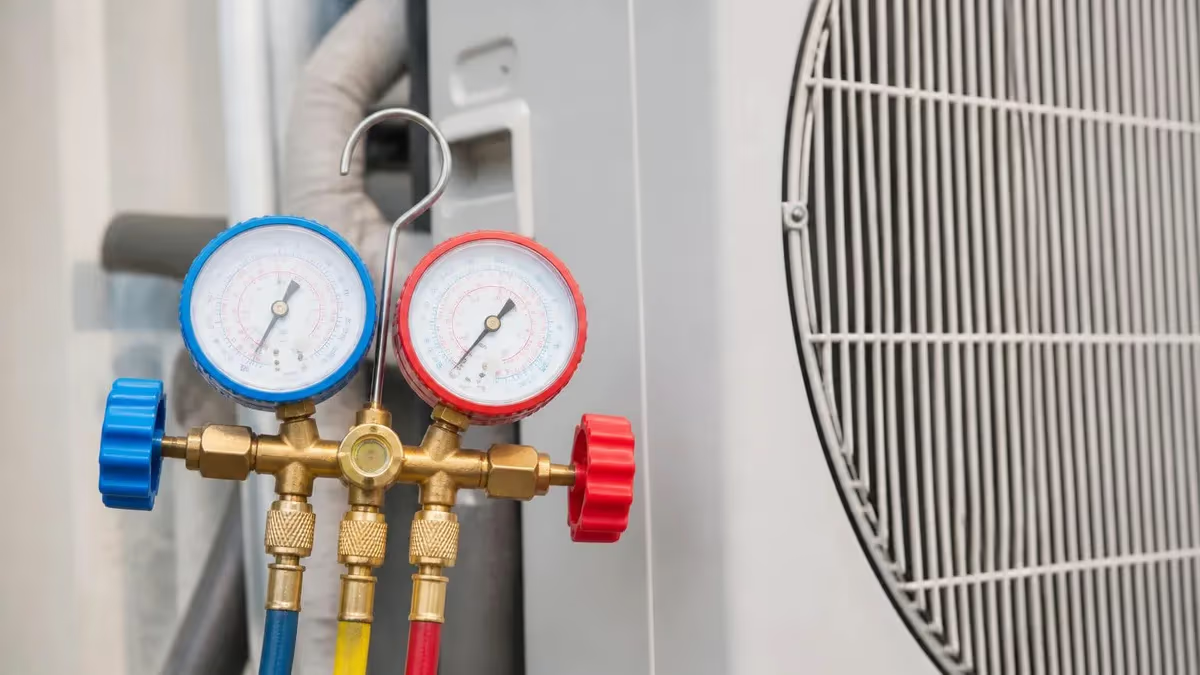
Choosing an HVAC company Ft. Mitchell homeowners can actually trust is harder than it sounds, especially when your furnace quits on a 15-degree January morning or your AC condenser fails during the first 90-hvac emergency repair mc leanwave of July. Northern Kentucky weather swings hard in both directions, and the equipment that keeps a Ft. Mitchell home comfortable has to be sized, installed, and maintained correctly. The contractor you hire affects everything from your monthly utility bill to the lifespan of a $9,000 system.
Most Ft. Mitchell residents only call a heating and cooling company a few times per decade, so the hiring process feels unfamiliar. You are not just buying a service call — you are buying years of warranty support, parts availability, and a relationship with technicians who will be inside your home. A weak choice means refrigerant leaks you discover next summer, ductwork that whistles at every register, or a permit that was never pulled at the county.
This guide walks through how to evaluate an HVAC company in Ft. Mitchell from the first phone call through the final inspection. We cover licensing under Kentucky HVAC contractor rules, the difference between a Carrier Factory Authorized Dealer and a generic installer, what a fair price looks like in the I-71/I-75 corridor, and how to read a load calculation so you are not oversold a system that short-cycles all winter.
You will also learn how to spot the warning signs of a shop that subcontracts work to unlicensed crews, why a written Manual J calculation matters more than a glossy brochure, and how to verify NATE certifications before you sign a proposal. For a broader look at vetting installers nationwide, the resource on Certified HVAC Contractors covers the underlying credential framework in depth.
Ft. Mitchell sits inside Kenton County, and local building codes require permits for system replacements, line-set runs, and most ductwork modifications. A company that tells you a permit is unnecessary for a full equipment swap is either uninformed or hoping to skip a step that protects you. Kentucky HVAC mechanical contractors must hold a Master HVAC license issued by the state Division of HVAC, and that license number should appear on every estimate.
The good news is that the Ft. Mitchell market has several legitimate, long-tenured HVAC companies serving Crescent Springs, Lakeside Park, Edgewood, and the broader 41017 ZIP. Many have been family-owned for two or three generations. The challenge is sorting the real local pros from the storm-chasers, the private-equity roll-ups, and the high-pressure sales operations that have moved into Northern Kentucky over the past five years.
By the end of this article, you will have a clear checklist for vetting any Ft. Mitchell HVAC company, a framework for comparing bids on a like-for-like basis, and the language to ask the technical questions that separate a competent installer from a salesperson with a clipboard.
Ft. Mitchell HVAC Hiring by the Numbers

What a Local Ft. Mitchell HVAC Company Actually Does
A real installer performs a Manual J load calculation, sizes equipment to the Kenton County climate, runs new line sets when needed, and pulls a permit before any refrigerant moves. Expect 1-2 day installs for residential changeouts and a written commissioning report at the end.
Repairs cover everything from capacitor replacements and thermostat swaps to compressor failures and refrigerant leak searches. A competent Ft. Mitchell shop arrives with a stocked truck, runs static pressure and superheat readings, and gives you a flat-rate quote before pulling any parts.
Annual or twice-yearly tune-ups extend equipment life and protect warranty coverage. Plans typically run $180-$280 per year and include coil cleaning, refrigerant pressure checks, electrical testing, and combustion analysis on gas furnaces. Most pay for themselves in efficiency gains alone.
Beyond heating and cooling, local pros install media filters, UV lights, whole-home humidifiers, and fresh-air ventilators. Northern Kentucky basements get humid, and tight new builds need mechanical ventilation. A good company tests humidity and CO2 before recommending equipment.
Equipment changeouts in Ft. Mitchell require a Kenton County mechanical permit and a final inspection. Reputable companies handle this paperwork as part of the project price. If a contractor offers a discount to skip the permit, walk away — your homeowners insurance can deny future claims.
Licensing is the single most important filter when evaluating any HVAC company Ft. Mitchell offers, and Kentucky takes it more seriously than many neighboring states. The Kentucky Division of HVAC issues a Master HVAC Contractor license, and only a license holder can pull permits and sign off on work. Ask any company you are considering for their KY HVAC Master license number and verify it on the state portal before the first appointment.
Beyond the state license, look for technician-level credentials. NATE certification (North American Technician Excellence) is the industry-standard skills test, and EPA Section 608 certification is federally required for anyone handling refrigerant. A shop that cannot produce these certifications on request is one that has either let them lapse or never held them. Both are red flags in a market with plenty of qualified alternatives.
Insurance is the next layer. A legitimate Ft. Mitchell HVAC company carries general liability coverage of at least $1 million, workers compensation for every employee on your property, and commercial auto coverage on its service vans. Ask for a certificate of insurance naming you as additional insured for the duration of the project — any reputable shop will email this within an hour. For a deeper dive into the broader credential landscape, see the HVAC Technician Jobs Near Me resource on how technicians earn and maintain these credentials.
Manufacturer authorizations matter more than many homeowners realize. A Carrier Factory Authorized Dealer, a Trane Comfort Specialist, or a Lennox Premier Dealer has met training, parts-stocking, and customer-satisfaction thresholds that generic installers have not. These designations also unlock extended parts and labor warranties — sometimes 12 years instead of the standard 10 — and they require the company to maintain a minimum NATE-certified headcount.
Ft. Mitchell sits in a market with several reputable factory-authorized dealers across multiple brands. If a company claims dealer status, verify it on the manufacturer website. Carrier, Trane, Lennox, Bryant, and American Standard all publish dealer locators where you can confirm credentials in under 60 seconds. This step alone weeds out half of the shops that overpromise during the sales call.
Better Business Bureau accreditation is a softer signal but still useful. An A+ rating with a five-year track record and fewer than three complaints suggests a company that resolves issues rather than letting them escalate. Pair the BBB profile with Google reviews — read the one-star reviews specifically, because that is where you learn how a company behaves when something goes wrong.
Finally, ask whether the company is a member of ACCA (Air Conditioning Contractors of America) or the local Cincinnati-Northern Kentucky chapter. Membership is not mandatory, but it signals investment in ongoing technical training, code updates, and best-practice installation methods like Manual J, S, D, and T calculations.
HVAC Practice Test Questions
Prepare for the HVAC - Heating Ventilation and Air Conditioning exam with our free practice test modules. Each quiz covers key topics to help you pass on your first try.
HVAC Air Conditioning
HVAC Exam Questions covering Air Conditioning. Master HVAC Test concepts for certification prep.
HVAC Code Compliance
Free HVAC Practice Test featuring Code Compliance. Improve your HVAC Exam score with mock test prep.
HVAC Electrical Controls
HVAC Test Prep for Electrical Controls. Practice HVAC Quiz questions and boost your score.
HVAC Energy Efficiency
HVAC Questions and Answers on Energy Efficiency. Free HVAC practice for exam readiness.
HVAC Heating Systems
HVAC Mock Test covering Heating Systems. Online HVAC Test practice with instant feedback.
HVAC Load Calculations
Free HVAC Quiz on HVAC Load Calculations. HVAC Exam prep questions with detailed explanations.
HVAC Tools and Equipment
HVAC Practice Questions for HVAC Tools and Equipment. Build confidence for your HVAC certification exam.
HVAC Refrigeration
HVAC Test Online for Refrigeration. Free practice with instant results and feedback.
HVAC Safety Practices
HVAC Study Material on Safety Practices. Prepare effectively with real exam-style questions.
HVAC System Design
Free HVAC Test covering System Design. Practice and track your HVAC exam readiness.
HVAC Thermodynamics
HVAC Exam Questions covering Thermodynamics. Master HVAC Test concepts for certification prep.
Comparing HVAC Services Offered in Ft. Mitchell
Repair service in Ft. Mitchell typically starts with a diagnostic fee of $89 to $149, which most companies credit toward the repair if you authorize the work. Common repairs include capacitor replacement ($180-$320), contactor swaps ($210-$350), blower motor replacement ($550-$900), and refrigerant leak searches ($350-$650 plus repair). Expect 24-72 hour response in shoulder seasons and same-day or next-day service during peak summer and winter weeks.
The best local shops carry parts on the truck for the most common 30 failures, which means a single visit instead of two. Ask whether the company stocks universal capacitors, contactors, ignitors, flame sensors, and common ECM modules. A well-stocked truck signals an organized operation and saves you a return-trip diagnostic fee on the second appointment.

Hiring a Local Ft. Mitchell HVAC Company vs a National Chain
- +Owner accountability — you can usually reach a decision-maker directly
- +Faster response times for emergency calls in 41017 and surrounding ZIPs
- +Technicians familiar with local home stock, basement humidity, and duct quirks
- +Parts inventory tailored to brands common in Northern Kentucky
- +Long-term relationships that improve diagnostic speed on return visits
- +Permit and inspection coordination handled by staff who know Kenton County inspectors
- −Smaller after-hours coverage during regional weather events
- −Limited financing options compared to large franchises
- −May carry only 2-3 equipment brands instead of every major manufacturer
- −Vacation or staff illness can stretch scheduling windows
- −Online review counts are lower, making vetting feel less data-rich
- −Less aggressive promotional pricing on shoulder-season installs
Ft. Mitchell HVAC Hiring Checklist
- ✓Verify Kentucky Master HVAC license number on the state portal
- ✓Confirm general liability insurance of at least $1 million in force
- ✓Ask for proof of workers compensation coverage for all employees
- ✓Request NATE certification details for the technicians assigned to your job
- ✓Verify factory authorized dealer status on the manufacturer website
- ✓Read at least 10 one-star and three-star Google reviews, not just five-star ones
- ✓Demand a written Manual J load calculation before accepting an install bid
- ✓Require a Kenton County mechanical permit and final inspection in writing
- ✓Get three line-itemed bids and compare on equipment, SEER2, and labor scope
- ✓Confirm the company pulls and registers manufacturer warranties on your behalf
Ask to see the Manual J before signing anything
If an HVAC company in Ft. Mitchell cannot produce a written Manual J load calculation for your home, they are guessing at equipment size — and guesses cost you comfort, efficiency, and equipment life. A correctly sized 2.5-ton system in a 1,900 sq ft Ft. Mitchell ranch will outperform an oversized 3.5-ton system every day of the year, even though the bigger unit costs more upfront.
Pricing for HVAC work in Ft. Mitchell falls within a fairly predictable band, and understanding that band protects you from both overpaying and chasing a bid that is too cheap to deliver real value. As of 2026, a complete residential system replacement — meaning a new outdoor condenser, indoor coil or air handler, and a properly sized furnace — runs $7,500 to $13,000 for typical 2-3.5 ton homes in the 41017 ZIP. High-efficiency variable-speed systems push that range to $14,000-$18,000.
The single largest cost driver is efficiency rating. A base 14.3 SEER2 single-stage system represents the minimum federal standard, while a 16-18 SEER2 two-stage system adds $1,200-$2,400 and a variable-speed 20+ SEER2 system adds $3,500-$6,500. The payback math depends on your usage. Ft. Mitchell homeowners running AC 4-5 months a year and heating 5-6 months typically break even on a 16-18 SEER2 upgrade in 7-9 years, well within equipment lifespan.
Furnaces follow a parallel logic. An 80% AFUE single-stage gas furnace runs $3,200-$4,800 installed, while a 96% AFUE modulating furnace costs $5,400-$7,800. With Duke Energy and Greater Cincinnati Water Works gas rates trending upward, the high-efficiency furnace often returns the premium within 6-8 winters in a Northern Kentucky climate. Resources covering equipment selection in depth, like the CFM HVAC Basics guide, are worth reading before you compare quotes.
Repair pricing in Ft. Mitchell uses flat-rate books rather than time and materials for most jobs, which protects you from open-ended labor charges. A typical capacitor replacement runs $180-$320 including the diagnostic fee, a contactor swap is $210-$350, an inducer motor on a furnace is $550-$900, and a compressor replacement (if not under warranty) is $1,800-$3,200. Refrigerant leak searches with electronic detection run $350-$650.
Maintenance contracts are typically priced at $189-$289 per year per system, with discounts for dual-system homes. The plan should include two visits, priority dispatch, a percentage discount on repairs, and waived after-hours fees. If a contract costs less than $150 per year, the company is likely making margin by accelerating repair recommendations during the visit — read reviews carefully for patterns of that behavior.
Financing offers in Ft. Mitchell range from manufacturer-backed promotional rates (0% for 12-18 months, deferred interest) through Synchrony, Wells Fargo, and GoodLeap, to longer-term installment loans at 7-12% APR. Read the fine print on deferred-interest plans — if the balance is not paid in full by the promo deadline, all accrued interest from day one is added back. This catches more Ft. Mitchell homeowners than any other financing gotcha.
Finally, watch for the bid spread. Three competing quotes for the same scope in Ft. Mitchell should fall within roughly 15-20% of each other. A bid that is 30%+ below the others is almost always missing the permit, skipping the line set replacement, undersizing the equipment, or using a lower-tier sub-brand from the same manufacturer. Ask the low bidder to itemize the proposal and compare specifications line by line — the gap usually reveals itself within minutes.
If a salesperson presents a system replacement quote and offers a steep discount only if you sign today, this is a textbook high-pressure tactic — not a legitimate market price. Reputable Ft. Mitchell HVAC companies honor their quotes for 14-30 days. A 'today only' discount almost always means the original price was inflated, the equipment is overstock the company needs to move, or the install crew is not the one named in the proposal.
Warranties and aftercare separate a transactional HVAC company from a long-term partner, and Ft. Mitchell homeowners should evaluate this dimension as carefully as the install price. Most major manufacturers — Carrier, Trane, Lennox, Bryant, American Standard, Rheem, and Goodman — offer a 10-year parts warranty on registered equipment, with the heat exchanger or compressor sometimes covered for 12 years or even lifetime depending on the model and dealer authorization.
The catch is that the warranty must be registered within 60-90 days of installation, and the registration is the installer's responsibility. A surprising number of Ft. Mitchell homeowners discover, four years into ownership, that their installer never registered the equipment — dropping the warranty from 10 years to the default 5. Always ask for a copy of the warranty registration confirmation email and store it with your closing documents. If you ever sell the home, transferring the warranty to the new owner requires this paperwork.
Labor warranties are entirely separate from parts and are issued by the contractor, not the manufacturer. A standard Ft. Mitchell labor warranty runs 1-2 years, with extended labor warranties of 5-10 years available through the contractor or through third-party plans. Extended labor coverage typically costs $400-$900 upfront and is usually worth it for homeowners staying in place for the long term. For comparison shoppers, the Commercial HVAC Contractors Near Me guide explains how commercial labor warranties differ from residential.
Aftercare also includes how the company handles callbacks. Even a flawless install will occasionally produce a punch-list issue — a thermostat wire that needs reseating, a return register that whistles, or a humidifier that needs commissioning. A quality Ft. Mitchell HVAC company schedules a 30-day post-install check automatically and treats the first-year callback list as part of the install price. Companies that nickel-and-dime callbacks signal what the relationship will look like in year five.
Maintenance plan continuity is another factor. Some companies sweeten the install with a free first-year maintenance plan, then auto-renew at a premium rate. Read the renewal terms before accepting the freebie. The best plans are renewable at a fixed rate locked at install, not subject to annual increases tied to vague labor cost indexes.
Filter and parts availability matters more in year 8 than year 1. Ask which models the company stocks parts for, and whether they keep capacitors, contactors, ignitors, and ECM modules for your specific equipment in inventory. A company that abandons a discontinued line leaves you scrambling for parts when something fails outside warranty.
Finally, evaluate the company's after-hours and emergency policy. Ft. Mitchell winters produce no-heat calls at 2 a.m., and a maintenance plan that includes priority dispatch can be the difference between a same-night repair and waiting 48 hours during a polar vortex event. Confirm in writing whether after-hours fees are waived for plan members, capped at a specific amount, or applied at standard overtime rates.
Once you have narrowed your Ft. Mitchell HVAC company shortlist to two or three finalists, the final step is the on-site evaluation. Schedule each company for a full home visit — never accept a phone quote or a one-room walk-through for a system replacement. The technician should spend 45-90 minutes in your home, measuring rooms, inspecting the attic and basement, examining duct runs, and asking about comfort issues by zone. A 15-minute visit is a quote, not an assessment.
Pay attention to the questions the technician asks. A good Ft. Mitchell installer wants to know which rooms are too hot in summer, which are cold in winter, how many people live in the home, whether anyone has allergies or asthma, where you spend evening hours, and what your monthly utility costs look like. These details feed the Manual J calculation and the equipment selection logic. A salesperson who asks none of these questions is selling from a price book, not designing a system.
When the proposal arrives, read it line by line. The model and serial-prefix of every piece of equipment should appear, along with the AHRI matched-system reference number that confirms the indoor and outdoor units are tested together for the rated efficiency. Without an AHRI match, you have no guarantee that the system actually delivers the SEER2 and HSPF2 figures on the proposal. The AHRI reference number is free to verify at ahridirectory.org.
Confirm the line set strategy in writing. If the existing line set is being reused, the proposal should describe how it will be flushed of old refrigerant oil — typically with R-141b or a nitrogen sweep — and how it will be pressure-tested. Reusing a line set that carried an older refrigerant without proper flushing contaminates the new system within months and can void the compressor warranty. New line sets add $400-$900 to a project but eliminate this risk entirely.
Ask how the system will be commissioned at startup. A proper commissioning includes a refrigerant weigh-in to factory spec, superheat and subcooling verification, static pressure measurement across the indoor coil, airflow measurement at the supply plenum, and a temperature split across the evaporator. The technician should leave you a written commissioning report. If commissioning is not mentioned in the proposal, the system is being installed at factory-default settings — which are almost never optimal for a specific home.
Communication style is a final but often overlooked factor. The company that returns calls within four hours, sends an arrival window the morning of, texts when the technician is en route, and emails the invoice the same day will treat you the same way in year three. The company that takes 24 hours to respond to your initial inquiry will take three days to respond hvac emergency repair mc lean AC is out in August.
Trust your gut on the comfort fit. You will see this team multiple times over the next 15 years for tune-ups, repairs, and eventual replacement. Choose the Ft. Mitchell HVAC company whose technicians explain their findings clearly, respect your home, and answer your questions without condescension. The right local pro is out there — and the vetting work you do up front pays dividends for the entire life of your equipment.
HVAC Questions and Answers
HVAC Technician Jobs Near Me: How to Find, Land, and Grow in Local HVAC Careers
CFM HVAC Basics: How Airflow, Sizing, and System Performance Work Together

Commercial HVAC Contractors Near Me: How to Find, Vet, and Hire the Right Local Pro for Your Building
Certified HVAC Contractors: How to Find, Vet, and Hire the Right Professional for Your Home or Business

Ameristar HVAC: Complete Guide to Units, Reliability, Costs, and Buyer Considerations
About the Author

NATE Certified HVAC Technician & Licensing Exam Trainer
Universal Technical InstituteMike Johnson is a NATE-certified HVAC technician and EPA 608 universal-certified refrigerant handler with a Bachelor of Science in HVAC/R Technology. He has 19 years of commercial and residential HVAC installation and service experience and specializes in preparing technicians for NATE certification, EPA 608, A2L refrigerant safety, and state HVAC contractor licensing examinations.