
Largest HVAC Companies in the World: A Complete 2026 September Guide to the Industry Giants Shaping Heating, Cooling, and Refrigeration
Discover the largest HVAC companies in the world by revenue, market share, and global reach. 🟢 Compare Daikin, Carrier, Trane, Lennox, and more in 2026 September.
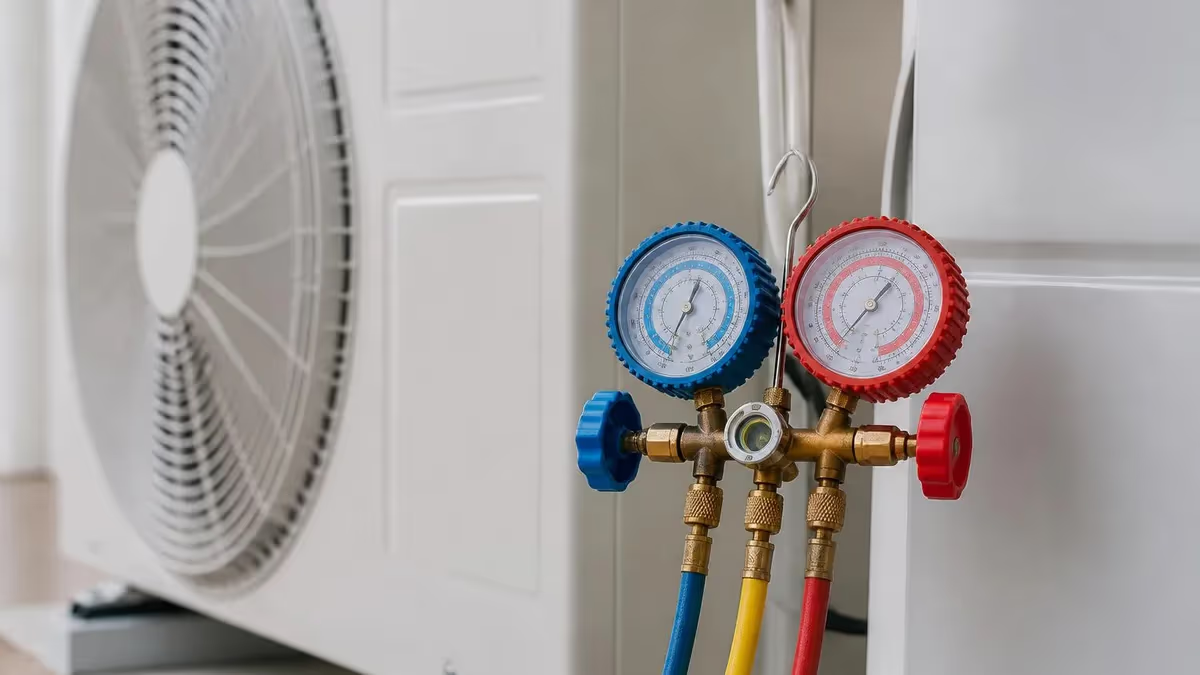
The largest hvac companies in the world generate hundreds of billions of dollars in combined annual revenue, employ more than a million people across six continents, and quietly shape the indoor climate of nearly every building you walk into. From Japanese manufacturing giants like Daikin to American legacy brands like Carrier and Trane, these corporations design, build, sell, and service the heating, ventilation, air conditioning, and refrigeration systems that keep homes comfortable, hospitals safe, data centers cool, and food supply chains intact. Understanding who they are matters whether you are a homeowner, technician, or investor.
The global HVAC market crossed $240 billion in 2025 and is projected to reach $370 billion by 2030, driven by climate change, urbanization, electrification, and tightening efficiency regulations. That growth has consolidated the industry: a small group of multinationals now controls roughly 60 percent of residential and commercial unit shipments. The rest of the market is filled by regional players, private equity rollups, and thousands of independent contractors who install and service what the giants build. The names you see on a rooftop unit usually trace back to one of ten parent companies.
This guide ranks and profiles the biggest HVAC manufacturers and service organizations operating today, explains how they earned their position, and shows how their product lines compare on efficiency, reliability, and warranty coverage. We also look at the consolidation wave that is reshaping the contractor side of the business, where firms like ARS/Rescue Rooter and Service Experts now operate hundreds of branches under a single roof. If you are studying for licensing exams, brushing up on industry knowledge, or just choosing a brand for your next system, the context here will help you make smarter decisions.
The competitive landscape has shifted dramatically since 2020. Daikin overtook Carrier as the world's largest HVAC manufacturer by revenue, Carrier completed a strategic separation from Raytheon and acquired German giant Viessmann's climate solutions division for €12 billion, and Johnson Controls merged its residential business with Hitachi before later divesting it back. Heat pump adoption, refrigerant transitions to A2L low-GWP gases like R-454B, and the Inflation Reduction Act's tax credits have reshuffled product roadmaps and pricing power across every major brand.
What makes a company "large" in HVAC depends on the metric. Daikin leads in revenue and unit volume. Carrier dominates North American commercial chillers. Trane Technologies leads in commercial controls and building automation. Lennox is the largest pure-play residential brand in the United States. Mitsubishi Electric and Fujitsu lead the ductless mini-split segment globally. Bosch and Viessmann (now under Carrier) dominate European heating. Each of these companies has a distinct strategy, geographic footprint, and product philosophy worth understanding before you sign a purchase order.
For technicians and contractors, knowing the corporate parent of each brand matters because parts availability, warranty terms, training requirements, and dealer programs all flow from the manufacturer. The brand on the cabinet may be different from the brand on the compressor inside. American Standard and Trane share the same factories. Heil, Tempstar, Comfortmaker, and ICP are all Carrier products. Goodman, Amana, and Daikin residential share platforms. If you want to vet a contractor properly, start by reading our guide to Certified HVAC Contractors before signing anything.
Throughout this article, you will find current revenue figures, employee counts, headquarters locations, flagship product lines, and the strategic moves each company made in the past 24 months. We have also included practice quiz tiles tied to the topics covered on most HVAC licensing exams, since understanding the manufacturer ecosystem is increasingly part of certification testing. By the end, you should have a clear mental map of who builds what, who owns whom, and where the industry is heading next.
The Global HVAC Industry by the Numbers
Top 10 HVAC Companies Ranked by 2025 Revenue
Osaka-based global leader with $36.4B revenue. Owns Goodman, Amana, and McQuay. Dominates VRV/VRF multi-zone systems and mini-splits. Operates in 170+ countries with 98,000 employees and 100+ manufacturing plants worldwide.
Florida-based with $22.5B revenue after Viessmann Climate acquisition. Inventor of modern air conditioning in 1902. Owns Bryant, Heil, Payne, Tempstar, Toshiba-Carrier JV, and now Viessmann residential heat pumps and boilers.
Ireland-domiciled with $19.2B revenue. Owns Trane, American Standard residential, and Thermo King transport refrigeration. Strong in commercial chillers, building controls, and sustainability-focused commercial applications.
Cork-headquartered with $27.4B total revenue (HVAC segment $18B+). Owns York, Coleman, Luxaire, Champion, and Hitachi commercial JV. Leader in building automation, fire safety, and security integration.
Tokyo giant with $9.8B HVAC segment revenue. Dominant in ductless mini-splits, hyper-heat cold-climate heat pumps, and CITY MULTI VRF commercial systems. Premium positioning with industry-leading reliability scores.
The current pecking order did not emerge by accident. Each of the top ten HVAC companies in the world built its position through a specific combination of engineering breakthroughs, regulatory tailwinds, and aggressive mergers and acquisitions. Daikin's rise from a Japanese refrigerant maker to global number one took roughly three decades and more than $20 billion in deals, including the 2012 acquisition of Goodman Global, which instantly gave it the largest residential footprint in North America. Today, Daikin builds everything from $400 window units to $2 million chiller plants for semiconductor fabs.
Carrier's path was different. Founded by Willis Carrier in 1915 after he invented mechanical air conditioning in 1902, the company spent most of the 20th century as part of United Technologies. The 2020 spin-off into a standalone public company gave Carrier the capital and focus to pursue heat pumps aggressively. The 2024 acquisition of Viessmann's Climate Solutions division for €12 billion was the single largest deal in HVAC history and instantly made Carrier the European heat pump leader, complementing its strong North American chiller business.
Trane Technologies traces back to 1885 but the modern company emerged from the 2008 merger of American Standard and Trane, followed by the 2020 split that separated industrial assets into Allegion. Trane's strategic bet has been sustainability: it was the first major manufacturer to publish a Gigaton Challenge pledging to reduce one billion metric tons of customer carbon emissions by 2030. That positioning has won large commercial accounts in healthcare, data centers, and government, where ESG procurement increasingly matters.
Johnson Controls grew through a different model entirely. The company started as a thermostat maker in 1885 and expanded into building controls before acquiring York International in 2005 and merging with Tyco in 2016. The 2024 sale of its residential and light commercial HVAC business to Bosch for $8.1 billion marked a strategic pivot toward commercial buildings, data centers, and digital services. JCI now generates more recurring revenue from software and service contracts than from equipment sales, a model competitors are racing to copy.
Mitsubishi Electric and Fujitsu represent the Japanese ductless tradition. Both companies pioneered inverter-driven variable-speed compressors in the 1980s, decades before American manufacturers adopted the technology. Their hyper-heating units routinely operate at full capacity down to minus 13 Fahrenheit, making them the default choice for cold-climate retrofits where ductwork is impractical. If your home cannot easily accept a traditional split system, you may want to read about flexible HVAC Solutions that include ductless options before deciding.
European players Bosch Thermotechnology, Viessmann, Vaillant, and Ariston have historically dominated residential heating with hydronic systems and condensing boilers. The EU's Fit for 55 regulations, which effectively phase out fossil-fuel boilers in new construction by 2030, have forced these companies to pivot rapidly to heat pumps. Bosch's 2024 acquisition of Johnson Controls' residential business gave it manufacturing scale in North America to match its European base, creating a transatlantic heating powerhouse that did not exist 24 months earlier.
The Chinese manufacturers Midea, Gree, and Haier deserve their own paragraph. Midea alone shipped more than 60 million room air conditioners in 2024 and owns the Carrier joint venture in China plus Toshiba's home appliance division. Gree is the world's largest residential AC manufacturer by unit volume, though its premium revenue trails the Japanese and American giants. Haier owns GE Appliances and sells under multiple labels globally. These three companies dominate domestic Chinese demand and increasingly compete on quality, not just price, in export markets.
HVAC Practice Test Questions
Prepare for the HVAC - Heating Ventilation and Air Conditioning exam with our free practice test modules. Each quiz covers key topics to help you pass on your first try.
HVAC Air Conditioning
HVAC Exam Questions covering Air Conditioning. Master HVAC Test concepts for certification prep.
HVAC Code Compliance
Free HVAC Practice Test featuring Code Compliance. Improve your HVAC Exam score with mock test prep.
HVAC Electrical Controls
HVAC Test Prep for Electrical Controls. Practice HVAC Quiz questions and boost your score.
HVAC Energy Efficiency
HVAC Questions and Answers on Energy Efficiency. Free HVAC practice for exam readiness.
HVAC Heating Systems
HVAC Mock Test covering Heating Systems. Online HVAC Test practice with instant feedback.
HVAC Load Calculations
Free HVAC Quiz on HVAC Load Calculations. HVAC Exam prep questions with detailed explanations.
HVAC Tools and Equipment
HVAC Practice Questions for HVAC Tools and Equipment. Build confidence for your HVAC certification exam.
HVAC Refrigeration
HVAC Test Online for Refrigeration. Free practice with instant results and feedback.
HVAC Safety Practices
HVAC Study Material on Safety Practices. Prepare effectively with real exam-style questions.
HVAC System Design
Free HVAC Test covering System Design. Practice and track your HVAC exam readiness.
HVAC Thermodynamics
HVAC Exam Questions covering Thermodynamics. Master HVAC Test concepts for certification prep.
Largest HVAC Manufacturers by Region
The North American market is dominated by Carrier, Trane, Lennox, Goodman/Daikin, and Rheem. Carrier brands (Bryant, Heil, Payne, Tempstar) hold roughly 28 percent of US residential split-system shipments, while Lennox commands about 15 percent and operates the only fully owned distribution network through Lennox Stores. Goodman, owned by Daikin since 2012, leads the value segment with the broadest dealer base.
Commercial market share looks different. Trane and Carrier together hold more than half of US commercial chiller installations above 100 tons, with Johnson Controls York a strong third. In rooftop packaged units, Lennox, Carrier, and Trane each carry 20-plus percent share. The 2025 transition to A2L refrigerants reshuffled inventories and gave manufacturers with earliest production ramps, especially Goodman and Carrier, a temporary market share boost.
Buying From a Large HVAC Brand: Pros and Cons
- +Wider dealer and service network means faster parts availability and warranty support
- +Deeper R&D budgets produce higher SEER2 and HSPF2 efficiency ratings on flagship models
- +Stronger warranty programs, often 10-year parts and 12-year compressor coverage
- +Better resale value when selling a home with a recognized brand on the equipment
- +More training resources and certification programs for installing contractors
- +Established refrigerant supply chains during the R-410A to R-454B transition
- +Financial stability reduces risk of warranty claims being orphaned mid-coverage
- −Premium pricing of 15 to 30 percent over comparable regional brands
- −Proprietary parts can mean higher repair costs after warranty expires
- −Dealer-locked communicating thermostats reduce DIY upgrade options
- −Frequent platform changes can orphan older models faster than expected
- −Customer service quality varies widely between independent dealers
- −Some flagship technology is rebadged across multiple brand tiers, blurring value
- −Aggressive marketing can mislead homeowners into oversizing systems
Choosing the Right HVAC Brand Checklist
- ✓Verify the local dealer is a factory-authorized installer with documented training certifications
- ✓Confirm parts warehouse distance is under 100 miles to ensure same-day or next-day parts availability
- ✓Compare flagship efficiency ratings using AHRI-matched system numbers, not single-component specs
- ✓Check that the brand has at least 10 years of US market presence with the same parent company
- ✓Request the full written warranty document and read the labor coverage exclusions carefully
- ✓Ask whether the communicating thermostat will work with future replacement equipment from other brands
- ✓Verify the proprietary refrigerant blend, if any, has multiple licensed suppliers in your region
- ✓Read independent reliability data from Consumer Reports and industry technician surveys
- ✓Confirm the contractor will register the equipment online within 60 days to activate full warranty
- ✓Get at least three quotes from different brand dealers to understand pricing benchmarks
Many "different" HVAC brands share factories, designs, and parts.
Trane and American Standard are built on the same production lines. Carrier, Bryant, Payne, Heil, Tempstar, Comfortmaker, Arcoaire, KeepRite, and ICP all roll out of the same Carrier-owned plants. Goodman, Amana, and Daikin residential share platforms in Houston. Knowing the corporate parent matters more than the brand sticker, especially for parts availability and warranty service.
Product strategy at the largest HVAC companies in the world increasingly revolves around three trends: heat pumps replacing fossil-fuel heating, A2L refrigerants replacing R-410A, and connected controls turning equipment into recurring-revenue services. Every major manufacturer launched at least one cold-climate heat pump line in 2024 or 2025 that can deliver rated capacity below 5 degrees Fahrenheit. Carrier's Infinity Variable Speed Heat Pump, Trane's XV20i, Lennox's SL25XPV, Daikin's Atmosphera, and Mitsubishi's Hyper-Heating H2i Plus represent the technology frontier.
The A2L refrigerant transition has been the single most disruptive supply-chain event in modern HVAC history. R-454B (Puron Advance) and R-32 replaced R-410A in residential equipment effective January 1, 2025, under EPA's AIM Act. The mildly flammable A2L classification required updated installation procedures, leak detection sensors in some applications, and revised codes. Manufacturers spent more than $3 billion collectively retooling factories and recertifying field technicians, costs that have shown up as 8 to 14 percent equipment price increases at the dealer level.
Variable-capacity inverter-driven compressors used to be a Japanese specialty. Today every top-ten manufacturer offers inverter modulation across at least one premium product line. The benefits are real: 30 to 50 percent energy reduction at part-load conditions, longer equipment life from reduced cycling, quieter operation, and tighter humidity control. The downside is complexity. Inverter boards cost $400 to $1,200 to replace and are sensitive to voltage surges, dirty power, and lightning. Whole-home surge protection has become essential for these systems.
Connected controls and IoT integration are the second frontier. Carrier's CO₂NNECT, Trane's BluEdge Digital, Daikin One+, Lennox iComfort S40, and Mitsubishi Kumo Cloud each offer remote diagnostics, firmware updates, and predictive maintenance alerts. For commercial customers these platforms enable performance contracting, where the manufacturer guarantees energy savings and bills monthly. For residential customers, the picture is more mixed because dealer participation rates vary, but homeowners increasingly expect smartphone control as a baseline feature.
Indoor air quality has become a major product category since the COVID-19 pandemic. UV-C lights, bipolar ionization, HEPA filtration, MERV 16 filters, and dedicated outdoor air systems (DOAS) are now offered by every major manufacturer. The science behind some of these technologies, especially ionization, remains contested, and EPA has tightened guidance on health claims. Carrier's OptiClean and Trane's CleanEffects are among the more rigorously tested IAQ products in mainstream channels, both verified by independent third-party laboratories.
Commercial product lines diverge significantly from residential. Magnetic-bearing centrifugal chillers from Daikin/McQuay, Trane, and Carrier offer 0.30 kW/ton efficiency, roughly 40 percent better than conventional chillers from a decade ago. Heat-recovery chillers that simultaneously heat and cool different parts of a building have become standard for hotels, hospitals, and mixed-use towers. Data center cooling is a fast-growing niche where Vertiv, Schneider Electric, Stulz, and Mitsubishi Heavy Industries compete with the traditional HVAC giants on liquid cooling and immersion technology.
Refrigeration is often overlooked but represents a major business line. Carrier's Carrier Transicold and Trane's Thermo King dominate truck and trailer refrigeration globally, with combined revenue exceeding $7 billion. Supermarket and cold storage refrigeration is led by Hussmann (owned by Panasonic), Hillphoenix, and Heatcraft. CO₂ transcritical systems and propane (R-290) display cases have replaced HFC equipment in most new European and increasingly North American installations, reflecting tighter F-gas regulations.

R-410A equipment can no longer be manufactured for installation after January 1, 2025, in the United States. If a contractor offers you new R-410A equipment at a discount, verify it is pre-2025 inventory and confirm parts and refrigerant will remain available for the system's full 15 to 20 year life. Most major manufacturers have committed to R-410A parts availability through 2035, but pricing is rising rapidly.
The contractor side of HVAC has consolidated almost as aggressively as the manufacturer side. Private equity firms have rolled up thousands of family-owned heating and cooling businesses into national platforms over the past decade. ARS/Rescue Rooter (owned by American Residential Services) operates more than 75 branches under multiple brand names. Service Experts, owned by Enercare, runs over 130 locations across the US and Canada. Wrench Group, backed by Leonard Green and Partners, has acquired more than 50 regional contractors since 2019.
Direct-from-manufacturer service models are growing too. Carrier Enterprise and Trane Service operate company-owned branches in major metros that compete with independent dealers. Daikin Comfort Pro Network and Lennox Premier Dealer programs offer enhanced training, marketing support, and warranty backing to qualifying independent contractors, creating a tiered ecosystem where top dealers function almost as franchised extensions of the manufacturer. These programs typically require minimum annual purchase volumes, specific technician certifications, and customer satisfaction scores above defined thresholds.
The contractor consolidation trend has significant implications for homeowners. National rollups bring standardized pricing, financing partnerships, and 24/7 call centers, but often charge 20 to 40 percent more than local independents for comparable work. They also rotate technicians more frequently and rely heavily on commissioned sales representatives. Independent family-owned contractors typically offer more competitive pricing and longer technician tenure but may lack after-hours coverage and financing options. The right choice depends on your priorities. To compare options in your area, see our guide to Commercial HVAC Contractors Near Me for vetting tips.
Training and certification flow from the manufacturers down through their dealer networks. NATE (North American Technician Excellence) certification remains the gold-standard third-party credential, but each major brand also runs its own factory schools. Carrier's Technical Training Academy, Trane Technologies University, Daikin Comfort Pro Training, Lennox Learning Solutions, and Mitsubishi Electric Diamond Contractor program each graduate thousands of technicians per year. EPA Section 608 universal certification is required to handle refrigerants, and many states layer additional licensing on top.
Service revenue is increasingly where the largest HVAC companies make their money. New equipment carries 8 to 12 percent operating margins, while service contracts, parts, and digital monitoring services generate 25 to 35 percent margins. Trane Technologies derives nearly 40 percent of revenue from services and aftermarket, Johnson Controls roughly 45 percent, and Carrier is targeting 50 percent by 2027. This shift mirrors the business model evolution seen in elevator (KONE, Otis) and industrial automation (Honeywell, Siemens) sectors over the past two decades.
Distribution remains a critical competitive battleground. Lennox is the only major brand that distributes exclusively through company-owned stores, giving it tight control over pricing and inventory. Carrier and Trane mix factory branches with independent distributors. Daikin uses a hybrid model with Daikin Comfort Pros for residential and HARDI distributors for parts. The choice of distribution model affects everything from contractor margins to homeowner pricing transparency, and changes in this area can rapidly reshape competitive dynamics in specific regional markets.
Looking forward, expect more vertical integration as manufacturers acquire installation contractors directly, more horizontal consolidation as private equity continues rolling up service businesses, and more software-driven service models that turn HVAC equipment into recurring-revenue subscriptions. The largest HVAC companies in the world are slowly transforming from equipment vendors into building-systems-as-a-service providers, with profound implications for how buildings are designed, owned, and operated over the next 20 years.
If you are buying new equipment, the best practical advice is to focus less on the brand sticker and more on three things: the contractor doing the installation, the size of the equipment relative to your actual heat load, and the matched AHRI system rating. Even the most expensive flagship system from any of the largest HVAC companies in the world will underperform if it is oversized by 30 percent (which is depressingly common) or installed with leaky ductwork. Manual J load calculations and Manual D duct designs cost a few hundred dollars and pay for themselves many times over.
Always request a written load calculation before signing a contract. Reputable contractors from any brand will produce a Manual J printout showing room-by-room cooling and heating loads. If a contractor refuses or relies on "rules of thumb" based on square footage, walk away. This single document predicts comfort, efficiency, and equipment lifespan better than any brand badge. Combine it with a blower-door test on tight homes to identify infiltration losses that no equipment upgrade can overcome.
For replacement work, take advantage of the Inflation Reduction Act tax credits and rebates while they remain available. The 25C Energy Efficient Home Improvement Credit offers up to $2,000 for qualified heat pumps, and the High-Efficiency Electric Home Rebate Act program provides additional state-administered rebates of up to $8,000 for income-qualified households. These incentives meaningfully change the math on heat pump upgrades, especially for cold-climate models from Mitsubishi, Carrier, Trane, Lennox, and Daikin that meet CEE Tier 2 specifications.
Maintenance matters more than brand. A poorly maintained premium system will fail faster and run less efficiently than a well-maintained mid-tier unit. Annual professional tune-ups, filter changes every 60 to 90 days, condenser coil cleaning each spring, and drain pan treatment to prevent algae growth extend equipment life by 30 to 50 percent on average. Read our complete guide to HVAC Tune Up Service for a detailed walkthrough of what professional maintenance should include.
Warranty registration is the single most overlooked step in HVAC purchases. Every major manufacturer requires online registration within 60 to 90 days of installation to activate the full parts warranty, which is typically 10 years. If you forget to register, coverage often defaults to five years. The contractor should handle this, but verify it was done by logging into the manufacturer's owner portal yourself. Keep the registration confirmation email and serial number records together with your home documents.
For older homes or unusual layouts, ductless mini-splits often outperform traditional central systems regardless of brand. Mitsubishi, Daikin, Fujitsu, LG, and Carrier all offer compelling multi-zone systems. The right choice depends on heating load (Mitsubishi and Daikin lead cold-climate performance), aesthetics (low-wall units versus ceiling cassettes), and available service network. Get quotes from at least two manufacturers because pricing varies more than you might expect on multi-zone configurations.
Finally, do not be swayed by aggressive sales tactics around "limited-time" rebates or refrigerant scarcity claims. The transition to A2L refrigerants is real, but it does not require panic upgrades. Existing R-410A equipment will operate normally for its full service life with parts and refrigerant available for at least another decade. Take the time to get multiple quotes, verify load calculations, check contractor reviews, and read warranty terms carefully before committing. The largest HVAC companies in the world all make excellent equipment when installed properly.
HVAC Questions and Answers
HVAC Repair Portland: The Complete 2026 Homeowner's Guide to Furnace, AC, and Heat Pump Service in the Rose City
Commercial HVAC Contractors Near Me: How to Find, Vet, and Hire the Right Local Pro for Your Building
HVAC Tune Up Service: The Complete Guide to Professional HVAC Maintenance and Why It Pays for Itself
HVAC Solutions: The Complete Guide to Heating, Cooling, and Indoor Air Quality Systems for Homes and Buildings
Certified HVAC Contractors: How to Find, Vet, and Hire the Right Professional for Your Home or Business
About the Author

NATE Certified HVAC Technician & Licensing Exam Trainer
Universal Technical InstituteMike Johnson is a NATE-certified HVAC technician and EPA 608 universal-certified refrigerant handler with a Bachelor of Science in HVAC/R Technology. He has 19 years of commercial and residential HVAC installation and service experience and specializes in preparing technicians for NATE certification, EPA 608, A2L refrigerant safety, and state HVAC contractor licensing examinations.