
Commercial HVAC Installation: Cost, Timeline & Equipment Guide 2026 September
🔎 Commercial HVAC installation guide for 2026 September: rooftop units, chillers, VRF systems, contractor selection, permits, cost ranges from $5K to $1M+.
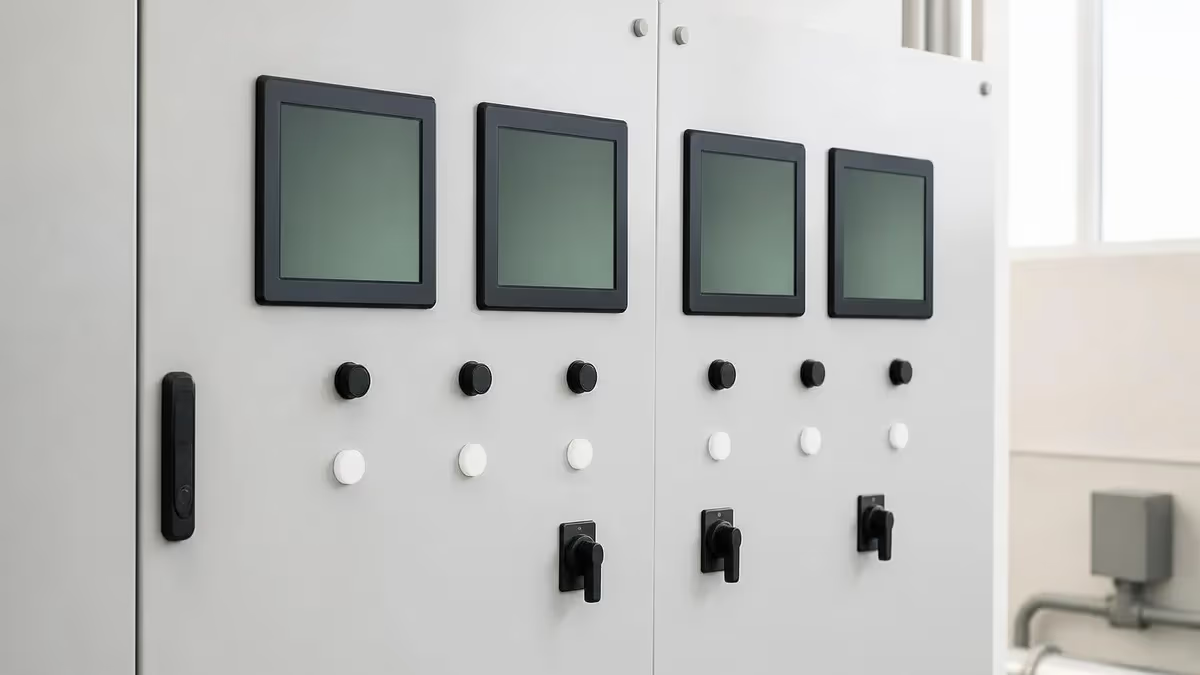
Commercial HVAC installation isn't just residential work scaled up. You're dealing with bigger equipment, tougher codes, complex ductwork, building automation, and budgets that can range from $5,000 for a small rooftop swap to over $1 million for a hospital chiller plant. Whether you own a strip mall, manage a 200,000-square-foot office tower, or run facilities for a regional restaurant chain, the choices you make during installation will shape your energy bills, tenant comfort, and maintenance headaches for the next 15 to 25 years.
This guide walks through what commercial HVAC installation actually involves in 2026. We cover equipment types and cost ranges, contractor selection, permits, refrigerant transitions, and tax incentives. If you're planning a project, scoping a budget, or trying to figure out whether that bid from a contractor is reasonable, you'll find the numbers and process details you need here. For related guidance, see our piece on commercial HVAC services and ongoing maintenance.
Here's the punchline upfront: success on a commercial install comes down to three things — picking the right equipment for the building, hiring a contractor who has done it before, and planning the timeline so equipment lead times don't blow up your opening date. Get those right and the rest is paperwork. Get any one wrong and you'll be writing change orders for months.
A quick word on who actually needs this. Building owners, asset managers, facility directors, and operations leads make most commercial HVAC purchase decisions. Architects and MEP engineers spec the systems. General contractors coordinate the install with other trades. Each role sees the project differently. Owners care about lifecycle cost and tenant retention. GCs care about schedule and coordination. Engineers care about meeting code and design intent. Knowing where you sit helps you ask the right questions of the right people.
Typical cost range: $5,000 (small RTU swap) to $1M+ (large chiller plant). Most projects land at $5–$25 per square foot installed.
Timeline: 12 to 30 weeks from consultation to commissioning, with major equipment lead times of 6 to 12 weeks driving the schedule.
Equipment options: Rooftop units (RTUs) for small-medium buildings, chiller systems for large facilities, VRF for flexible zoning. Choose based on size, layout, and energy goals.
Let's start with what makes commercial HVAC fundamentally different. Residential systems are typically 1.5 to 5 tons of cooling capacity, with a furnace and split-system AC controlled by a thermostat in the hallway. Commercial systems regularly run 5 to 500 tons or more, often packaged as rooftop units or distributed through a central chilled-water plant. Controls are handled by a building automation system (BAS) with scheduling, alarms, remote access, and data analytics — not a Honeywell round on the wall.
Codes are tougher too. You'll be working with ASHRAE 90.1 for energy, ASHRAE 62.1 for ventilation, the International Building Code (IBC), and local commercial amendments. Permits usually include mechanical, electrical, sometimes plumbing and structural, and inspections happen at rough-in, final, and performance stages. None of this is optional. If you're searching for qualified commercial HVAC companies, expect them to handle permits as part of the scope.
Ductwork is another world entirely. Residential ducts are typically flex or sheet metal trunk-and-branch in a single zone. Commercial ductwork can run for hundreds of feet through plenum ceilings, navigate fire-rated assemblies, and serve dozens of zones via variable air volume (VAV) boxes. Sheet metal gauge, sealing class, insulation, and pressure ratings all step up. Get the ductwork sizing wrong and no amount of equipment upgrade will fix comfort complaints later.
One more thing worth flagging early: zoning strategy. Commercial buildings rarely have one uniform use pattern. A corner office gets blasted by afternoon sun while interior conference rooms stay cool. South-facing retail glass swings 30 degrees by mid-morning. Different floors of an office tower run on different schedules. A well-designed system handles all of this through zoning, VAV terminals, or VRF indoor units. Skip the zoning thinking during design and you'll spend years chasing complaints with band-aids that never quite work.

Common Commercial HVAC Equipment Types
Best for: Small to medium commercial buildings, typically 5 to 50 tons. Think strip retail, small offices, restaurants, and standalone stores.
RTUs are packaged units sitting on the roof that combine cooling, heating (gas or electric), and air handling in one box. They're popular because they're relatively simple, the equipment stays out of the tenant space, and crane installation is straightforward when the roof is accessible. Common brands include Trane, Carrier, York (Johnson Controls), Lennox Commercial, and Daikin.
Newer RTUs hit SEER2 ratings of 14.3 or higher (the 2023+ minimum standard) and many now offer inverter-driven variable-speed compressors that cut energy use 20–30% versus single-stage units. AAON is a popular specialty manufacturer for custom RTU configurations.
Pricing varies wildly because commercial work is rarely apples-to-apples. A 10-ton rooftop unit at a small office might land at $25,000 installed. The same tonnage going onto a 50-year-old building with structural reinforcement, asbestos abatement, and a new electrical service can easily hit $80,000 once it's all done. Building age, roof access, electrical capacity, and code upgrades drive surprises faster than equipment selection. For a deeper breakdown, see our piece on HVAC installation cost.
Here's a useful rule of thumb: when you compare bids, look at total cost per ton of installed capacity. Small RTU swaps come in at $1,000 to $2,400 per ton. Mid-range commercial runs $2,500 to $5,000 per ton. Chiller plants with full ductwork and BAS often land at $5,000 to $10,000 per ton when you count everything. If one bid is dramatically lower than the others, ask what's missing — usually it's commissioning, controls integration, or something you'll pay for twice later.
Don't forget soft costs either. Engineering fees for full mechanical design run $5,000 to $50,000 depending on project size. Permit fees add 1 to 3 percent of construction cost. Commissioning by a third-party agent runs another $0.50 to $2 per square foot on larger projects. Energy modeling for LEED or ENERGY STAR certification adds $10,000 to $30,000. None of these line items shows up on the equipment quote, but they all need to be in your budget from day one.
Watch your contingency too. On commercial HVAC, a 10 to 15 percent contingency is realistic. Older buildings can hit 20 to 25 percent because hidden conditions show up once demo starts. Asbestos in old duct insulation, undersized electrical panels, structural reinforcement for heavier modern equipment, and code-mandated upgrades to fire dampers all appear after the bid is locked in. Owners who skip contingency end up writing change orders or cutting corners on commissioning — both bad outcomes. Put real money aside for the unknown.
Where Your Money Goes — Cost Breakdown
Major Commercial HVAC Manufacturers
- Strengths: Premier RTUs, chillers, broad commercial lineup
- Best for: Mid to large commercial, all building types
- Notable: Inventor of modern AC, strong dealer network
- Strengths: High-end equipment, controls integration
- Best for: Enterprise, healthcare, education
- Notable: Tracer SC+ BAS, Trane TRACE energy modeling
- Strengths: Chillers, large commercial, Metasys controls
- Best for: Large office, hospital, industrial
- Notable: Integrated building controls platform
- Strengths: VRF leader, inverter technology
- Best for: Hotels, schools, multi-zone buildings
- Notable: Largest HVAC manufacturer globally
- Strengths: VRF specialist, residential to commercial scale
- Best for: Mixed-use, retrofit, zoning-heavy projects
- Notable: City Multi VRF platform, long warranty
- Strengths: Custom rooftop specialist, premium efficiency
- Best for: Owner-occupied, energy-focused projects
- Notable: US manufacturing, configurable RTUs
The manufacturer you pick matters less than the contractor you hire to install it. A great installer with a mid-tier brand will outperform a careless installer using premium equipment every single time. That's why getting your contractor selection right is more important than chasing the cheapest equipment quote. Look at HVAC installation services with proven commercial track records, not just residential crews moonlighting on a strip mall job.
Ask any commercial HVAC veteran what kills jobs, and they'll say the same things: poor coordination between trades, missing as-built drawings, and contractors who underbid the work. The lowest bid usually wins the work and loses the relationship. You'll be on the phone with that contractor for the next 10 years every time something breaks, so factor in responsiveness, geographic proximity, and the quality of the service organization — not just the install price.
Get three to five competitive bids on any project over $50,000. Make sure each bidder sees the same scope, the same specs, and the same drawings. Hold a pre-bid walkthrough so everyone sees the existing conditions. Require bids in a consistent format with line-item pricing — equipment, labor, ductwork, controls, electrical, permits, commissioning, warranty. Apples-to-apples comparison is impossible if one bid is two pages and another is twenty. The clearest, most detailed proposal is usually from the contractor who's done this dozens of times.
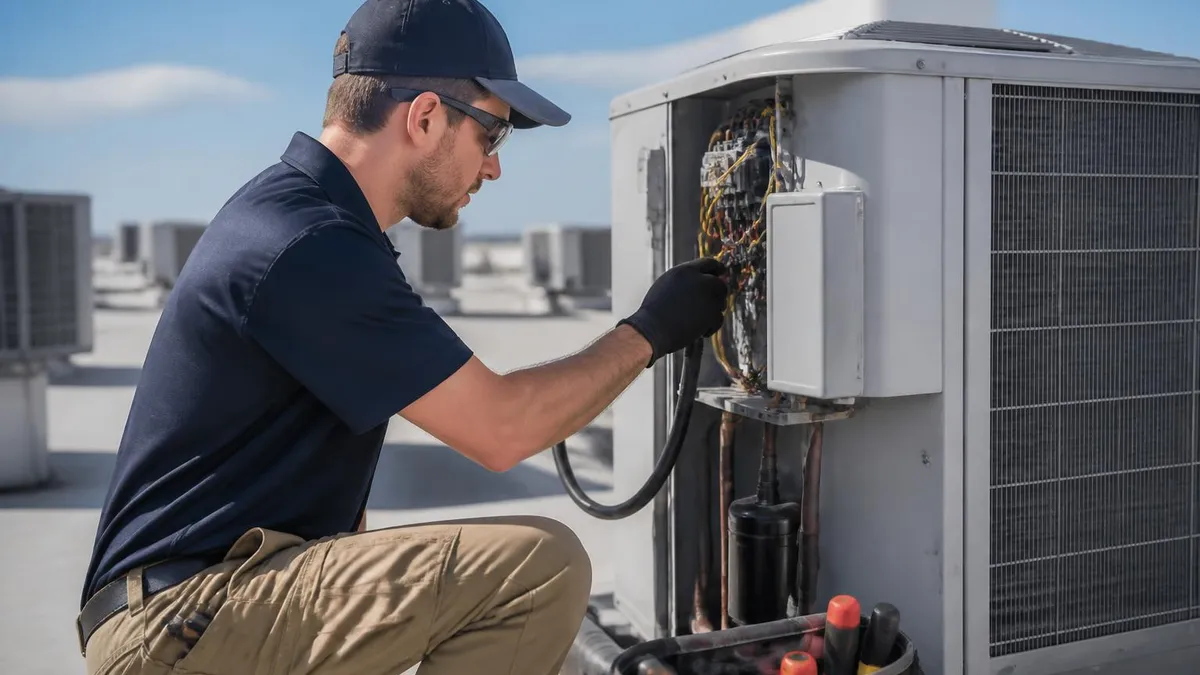
How to Vet a Commercial HVAC Contractor
- ✓Verify state-specific commercial HVAC license (some states require separate from residential)
- ✓Confirm bonded and insured with at least $1M general liability coverage
- ✓Require minimum 5 years of commercial experience on similar building types
- ✓Look for NATE-certified technicians and AABC or NEBB commissioning credentials
- ✓Request at least 3 references from comparable projects you can actually call
- ✓Demand a detailed written scope of work — not a one-page estimate
- ✓Check manufacturer authorization for the specified equipment brand
- ✓Confirm warranty: minimum 1 year parts and labor, ideally longer on major components
- ✓Ask about service contract options after install
- ✓Get an itemized proposal with no vague allowances — surprises kill projects
Typical Commercial HVAC Installation Timeline
Consultation & load calc
Design & engineering
Equipment order
Site preparation
Installation
Commissioning
Inspections & approvals
Permits are where a lot of projects get hung up. Most jurisdictions require a mechanical permit at minimum, plus separate electrical permits, sometimes plumbing for condensate management, and structural permits when rooftop loads exceed existing design capacity. Energy code compliance is checked through documentation (often a COMcheck or REScheck report) and verified at inspection. Refrigerant handling falls under EPA Section 608, which requires certified technicians for any work involving the refrigerant circuit.
Don't underestimate the inspection cycle. Expect at least three inspections on most jobs: rough-in (before you close walls or ceilings), final (after all equipment is set and connected), and a performance or commissioning sign-off (verifying the system actually works as designed). Inspectors will flag missing labels, improper refrigerant transition certifications, undersized condensate drains, and ventilation rates below ASHRAE 62.1 minimums.
Load calculations deserve their own mention. Residential designers use ACCA Manual J, but commercial work calls for ACCA Manual N or Manual Q for spaces between 25 and 150 tons. Larger projects move up to the ASHRAE Heat Balance Method or Cooling Load Temperature Difference approach. Software like Trane TRACE 3D Plus, Carrier HAP, and DOE-2-based eQUEST does the heavy lifting. The output gives you total cooling tons, heating BTUs, and ventilation CFM needed — the starting point for every equipment decision.
Oversizing is a common rookie mistake. A bigger system isn't always better. Oversized equipment short-cycles, fails to dehumidify properly, wears out faster, and costs more upfront. The right load calc accounts for your building envelope, internal heat gains from lighting and equipment, occupancy patterns, and climate zone. If a contractor specs equipment based on rules of thumb (like 400 square feet per ton), get a second opinion. Modern commercial design demands real engineering analysis, not back-of-napkin estimates.
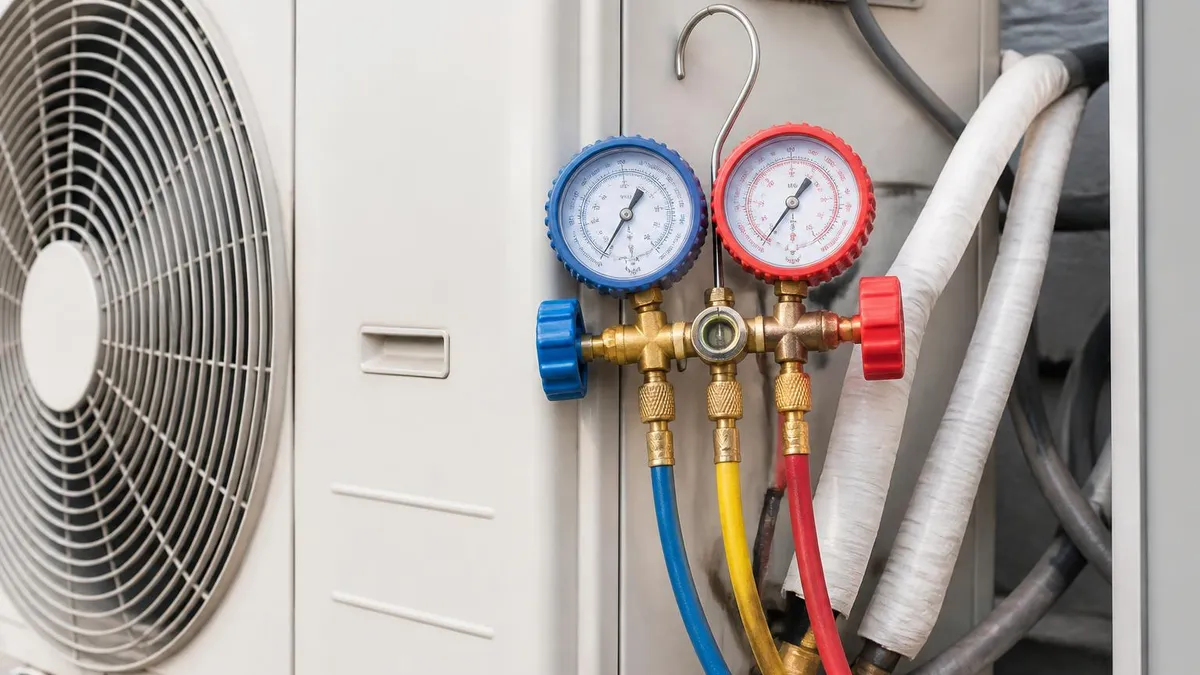
Heads up: R-410A is being phased out under the AIM Act. New systems installed in 2025 and beyond should use lower-GWP refrigerants like R-454B or R-32. R-410A equipment is becoming harder to source and more expensive to service.
If you're planning a commercial install in 2026, specify R-454B or R-32 equipment to future-proof your system. Verify your contractor's technicians are certified to handle the new refrigerants — they require updated tools, leak detection, and safety procedures because R-454B is A2L (mildly flammable).
Energy efficiency isn't just a green-credentials box to tick — it's where the real money lives over a system's lifetime. A typical commercial building spends 40–60% of its energy bill on HVAC, so a 25% efficiency improvement on a $50,000 annual bill saves $12,500 per year. Over a 15-year system life, that's $187,500 in operational savings — often more than the install premium for high-efficiency equipment.
Look at SEER2 ratings (14.3 minimum for 2023+ RTUs), AFUE ratings on boilers (80% minimum, 90%+ for condensing units), and integrated efficiency metrics like IEER on packaged equipment. VRF systems, when applied to the right building, can hit 25–50% lower energy use than conventional rooftop systems. Dedicated Outdoor Air Systems (DOAS) decouple ventilation from cooling, giving you better humidity control and lower energy use in humid climates.
Heat pumps are having a moment in commercial construction too. Federal investment tax credits (the 30% ITC under the Inflation Reduction Act), aggressive state incentives in the Northeast and West Coast, and increasingly stringent building electrification mandates have pushed heat pump adoption hard. Cold-climate heat pumps now perform credibly down to single-digit temperatures, and dual-fuel hybrid setups can use a gas backup only on the coldest days. If your project has decarbonization goals, this is the path.
Don't forget incentives stack. You can often combine federal tax credits, state rebates, utility incentives, and accelerated depreciation on the same project. A medium-sized commercial heat pump install might capture 30 percent ITC, plus a $50,000 utility rebate, plus a Section 179D deduction of $2 per square foot. Add it up and your effective net cost can drop 40 percent or more. Get a knowledgeable tax advisor and energy consultant involved early — these dollars only flow if you document everything correctly from the start.
Tax Credits & Incentives (2026)
Don't sleep on the building automation system. A well-designed BAS pulls everything together: scheduling, occupancy-based ventilation, demand-controlled CO2 sensing, equipment alarms, fault detection, and remote access. The big-name BAS platforms — Tridium Niagara, Distech Controls, Schneider EcoStruxure, Honeywell Tridium-based stacks, and Johnson Controls Metasys — all do roughly the same job at the component level, but integration quality varies enormously between contractors.
BAS costs run from about $10,000 for a small standalone building to $500,000+ for a large multi-building campus. The ROI typically lands at 15–30% in energy savings within 2–4 years, which is one of the better paybacks in commercial construction. Pair it with submetering and you'll catch equipment problems before they become emergencies.
Watch out for proprietary lock-in. Some BAS systems use closed protocols that tie you to one service provider for life. Specify open protocols — BACnet/IP is the industry standard — and make sure your installer hands over admin credentials, programming source files, and as-built network diagrams at project closeout. Without those, you've paid for a building you can't fully control. This is a common dispute on commercial projects and worth nailing down in writing before you sign.
Cybersecurity is the new BAS frontier. Building automation systems are network-connected, often on the internet, and have become a target for ransomware and unauthorized access. Make sure your install includes network segmentation, secure VPN access for remote service, regular firmware updates, and strong authentication. Older BAS installations frequently run on default passwords and unpatched firmware — a real risk. If your contractor brushes off security questions, find another contractor.
New Install vs. Replacement: Trade-offs
- +Greenfield design lets all components work together optimally
- +Latest equipment efficiency and refrigerant compliance built in
- +Modern controls and BAS integrated from day one
- +Full manufacturer warranties on every component
- +Easier to hit aggressive energy or certification targets
- +Clean documentation and as-builts for future maintenance
- −Significantly higher upfront cost than replacement
- −Longer timeline — full design + permit + install cycle
- −Disruption if building is occupied during construction
- −Possible structural or electrical upgrades required
- −Lead times on major equipment can stretch 12+ weeks
- −Higher engineering fees for full MEP design package
For most owners, the choice between new install and replacement comes down to the condition of the existing infrastructure. If the ductwork, electrical, and structural elements are sound, a like-for-like replacement saves money and time. If you're chasing energy targets, dealing with serious capacity issues, or working with a building that hasn't been touched in 25 years, a full design-build often makes more sense once you factor in operational savings and tenant retention.
One commonly overlooked option: phased replacement. Instead of swapping everything at once, you replace equipment as it reaches end of life over a 3 to 5 year window. This spreads capital expense, lets you piggyback on planned tenant turnover, and gives you a chance to test new technology (heat pumps, VRF) on one zone before committing the whole building. The downside is you may run mixed refrigerants and mixed control systems during transition, which complicates maintenance and reduces overall efficiency until the project completes.
Whichever path you choose, document everything. Keep a digital binder of equipment manuals, warranty cards, commissioning reports, balancing test results, refrigerant logs, and inspection sign-offs. Five years from now when something fails, this documentation will save you thousands in diagnostic time. Many owners also benefit from a basic CMMS (computerized maintenance management system) to track preventive maintenance, service tickets, and equipment lifecycle. It's a small investment that pays back fast.
Outdoor equipment placement deserves attention too. A poorly located HVAC condenser unit can short-cycle from recirculated hot air, suffer from debris ingestion, or violate setback codes near property lines. Keep at least 3 feet of clearance on all sides, avoid placement directly under windows or near loading docks, and consider acoustic enclosures for residential-adjacent properties. Roof-mounted condensers need adequate structural support and easy crane access for future service. These small site-planning details affect performance, longevity, and neighbor relations for the entire life of the system.
Code Compliance Checklist
- ✓Mechanical permit application submitted with stamped drawings
- ✓Electrical permit pulled separately by licensed electrician
- ✓Plumbing permit if condensate piping ties into building drain system
- ✓Structural permit for rooftop equipment exceeding existing load capacity
- ✓ASHRAE 90.1 energy code compliance via COMcheck documentation
- ✓ASHRAE 62.1 ventilation rate verification with sequence of operations
- ✓EPA Section 608 certification on file for all techs handling refrigerant
- ✓AIM Act compliance — refrigerant choice documented and approved
- ✓Acoustic compliance for residential-adjacent equipment locations
- ✓All required inspections scheduled: rough, final, and performance
One last piece: don't skip the service contract conversation before the install crew packs up. The cheapest hour you'll ever spend on your HVAC system is preventive maintenance, and the most expensive hour is reactive repair at 2 AM on a Saturday. Typical quarterly inspection contracts run $500 to $2,000 per year for small buildings, $5,000 to $20,000 per year for larger facilities with 24/7 emergency response. Multi-year agreements (3 to 5 years) often come with 5 to 10% discounts and locked-in pricing.
You'll also want to think about indoor air quality from day one. MERV-13 filtration is becoming the minimum spec in many jurisdictions, and post-pandemic tenant expectations are higher than ever. UV-C lighting in air handlers, HEPA filtration in critical zones, and demand-controlled ventilation based on CO2 sensing all add modest upfront cost but pay off in tenant satisfaction and lease renewals.
Bottom line: commercial HVAC installation is a major capital project with long-lasting consequences. Plan for 12 to 30 weeks of timeline. Budget $5 to $25 per square foot. Choose equipment based on building size and use pattern — RTUs for small-medium, chillers for large facilities, VRF for flexible zoning. Hire a licensed commercial contractor with verified credentials, not the cheapest bid. Get permits and inspections right. Specify the latest refrigerants and high-efficiency equipment to capture available tax credits and rebates. Do all that and you'll have a system that delivers comfort, efficiency, and reliable performance for 15 to 25 years.
Commercial HVAC Installation Questions and Answers
About the Author

NATE Certified HVAC Technician & Licensing Exam Trainer
Universal Technical InstituteMike Johnson is a NATE-certified HVAC technician and EPA 608 universal-certified refrigerant handler with a Bachelor of Science in HVAC/R Technology. He has 19 years of commercial and residential HVAC installation and service experience and specializes in preparing technicians for NATE certification, EPA 608, A2L refrigerant safety, and state HVAC contractor licensing examinations.