
Best HVAC Contractors Near Me: How to Find, Vet, and Hire Top Local Heating and Cooling Pros
🗨️ Find the best HVAC contractors near me with this practical guide to vetting licenses, reading reviews, comparing quotes, and hiring trusted local pros.

Searching for the best hvac contractors near me usually starts with a problem — an air conditioner that quit on the hottest afternoon of the year, a furnace blowing cold air in January, or a utility bill that suddenly doubled. Whatever the trigger, the contractor you pick will shape your indoor comfort, energy costs, and equipment lifespan for the next decade or longer. That makes the hiring decision far more consequential than most homeowners realize when they type a quick search and call the first three results.
A great local HVAC contractor brings four things to your driveway: a current state license, manufacturer-level technical training, transparent pricing, and a reputation built on hundreds of verified jobs in your zip code. A weak contractor might have a truck and a website but cut corners on load calculations, refrigerant charging, ductwork sealing, or warranty paperwork. The difference between those two outcomes can easily exceed five thousand dollars in repair costs and lost efficiency over the system's life.
Local matters more in HVAC than in almost any other home service. Climate zones dictate equipment sizing, regional building codes change inspection requirements, and utility rebate programs vary city by city. A contractor who installs heat pumps daily in Phoenix understands desert load conditions, while a Minneapolis pro lives and breathes cold-climate defrost cycles. You want someone who has wired, brazed, charged, and commissioned systems in homes that look like yours, in weather that feels like yours.
This guide walks through every step of finding and hiring the right pro. You will learn how to verify licensing in seconds, read reviews critically, structure apples-to-apples bids, spot red flags during the in-home consultation, and protect yourself with written agreements. If you want a deeper look at credentials and how the trade is regulated, our companion piece on Certified HVAC Contractors covers credential verification in detail.
You will also see why price alone is a terrible filter. The cheapest quote frequently skips line items that the better contractors include by default — permit fees, code-required disconnects, condensate safety switches, refrigerant line set replacement, or a Manual J load calculation. By the time the low bidder finishes adding those back as change orders, the original savings disappear and you have an awkward dispute on your hands.
Finally, the article gives you concrete scripts, checklists, and questions to ask during phone screenings and in-home visits. By the end, you should be able to walk through three contractor visits, compare proposals line by line, and choose with confidence — whether you need a same-day repair, a seasonal tune-up, or a full system replacement that will run twelve to twenty years.
Treat this process like hiring an electrician for a panel upgrade or a roofer for a full tear-off. The dollar amounts are similar, the consequences of a bad install linger longer, and the difference between a careful professional and a fast-talking salesperson is usually visible inside the first ten minutes of conversation if you know what to listen for.
Hiring HVAC Contractors by the Numbers
Your Step-by-Step Hiring Roadmap
Diagnose the Real Problem
Build a Shortlist of Three to Five
Verify Credentials and Insurance
Schedule In-Home Estimates
Compare Proposals Line by Line
Sign, Schedule, and Inspect
Vetting local HVAC pros is part paperwork, part interview. Start with the basics: a current state mechanical license, EPA Section 608 certification for anyone touching refrigerant, NATE certification for technicians, and at least one million dollars in general liability coverage. Most state boards publish a free online lookup — type the company name, hit search, and you will see the license status, expiration date, any disciplinary actions, and bond information within seconds.
Reviews require more skill than people assume. Five-star averages with twelve reviews mean almost nothing. Look for contractors with 100 to 500 verified Google reviews, an average between 4.5 and 4.9, and a pattern of responses from the owner. Read three or four negative reviews carefully — how the company handled a complaint tells you more about their character than the praise. If you see repeated mentions of high-pressure sales, surprise change orders, or no-show appointments, move on.
Ask each candidate how long they have served your specific city or county. A shop that has been local for fifteen years with stable phone numbers, the same physical address, and named owners on the website is far less risky than a brand-new LLC operating out of a P.O. box. Long-tenured contractors also tend to know your local code officials, utility rebate processes, and which permit windows close on Fridays — small details that prevent project delays.
Manufacturer affiliations add a useful filter. Programs like Trane Comfort Specialist, Lennox Premier Dealer, Carrier Factory Authorized, and Bryant Factory Authorized require ongoing training, customer satisfaction scores, and warranty performance. They are not a guarantee, but they signal that a contractor invests in education and answers to a brand that can pull their dealer status. Cross-reference with our deep dive on Ameristar HVAC if you want to understand how brand tiers translate to homeowner value.
Phone screening is your fastest filter. Call each contractor and listen to how the receptionist or estimator handles your questions. Do they ask about your home size, system age, and current symptoms? Do they offer a written estimate or push hard for an immediate sale? Do they mention permits voluntarily? A professional shop answers within two rings during business hours, returns voicemails the same day, and emails you a confirmation with the estimator's name and arrival window.
References still matter for larger jobs. For any replacement above six thousand dollars, ask for three customer references in your zip code from the last twelve months. Call all three. Ask whether the crew arrived on time, kept the home clean, finished on schedule, passed inspection without re-work, and showed up promptly when a small punch list item came up two weeks later. The answers shape your confidence faster than any glossy brochure.
Finally, pay attention to the truck and the tech. A clean, well-stocked van, uniformed technicians, shoe covers at the door, and a tablet-based diagnostic process all reflect operational discipline. Sloppy presentation usually correlates with sloppy installs. You are about to hand someone a five-figure check and let them work in your attic for three days — they should look and act the part from the first encounter.
HVAC Practice Test Questions
Prepare for the HVAC - Heating Ventilation and Air Conditioning exam with our free practice test modules. Each quiz covers key topics to help you pass on your first try.
HVAC Air Conditioning
HVAC Exam Questions covering Air Conditioning. Master HVAC Test concepts for certification prep.
HVAC Code Compliance
Free HVAC Practice Test featuring Code Compliance. Improve your HVAC Exam score with mock test prep.
HVAC Electrical Controls
HVAC Test Prep for Electrical Controls. Practice HVAC Quiz questions and boost your score.
HVAC Energy Efficiency
HVAC Questions and Answers on Energy Efficiency. Free HVAC practice for exam readiness.
HVAC Heating Systems
HVAC Mock Test covering Heating Systems. Online HVAC Test practice with instant feedback.
HVAC Load Calculations
Free HVAC Quiz on HVAC Load Calculations. HVAC Exam prep questions with detailed explanations.
HVAC Tools and Equipment
HVAC Practice Questions for HVAC Tools and Equipment. Build confidence for your HVAC certification exam.
HVAC Refrigeration
HVAC Test Online for Refrigeration. Free practice with instant results and feedback.
HVAC Safety Practices
HVAC Study Material on Safety Practices. Prepare effectively with real exam-style questions.
HVAC System Design
Free HVAC Test covering System Design. Practice and track your HVAC exam readiness.
HVAC Thermodynamics
HVAC Exam Questions covering Thermodynamics. Master HVAC Test concepts for certification prep.
Repair, Replace, or Tune-Up: What the Best HVAC Contractors Near Me Recommend
Repair makes sense when your system is under ten years old, the failure is a single component, and the repair quote is less than thirty percent of replacement cost. Common repairs include capacitor replacement at $150 to $400, contactor swaps at $200 to $300, blower motor failures at $400 to $700, and refrigerant leak fixes that range from $200 for a simple Schrader valve to $1,500 for an evaporator coil replacement.
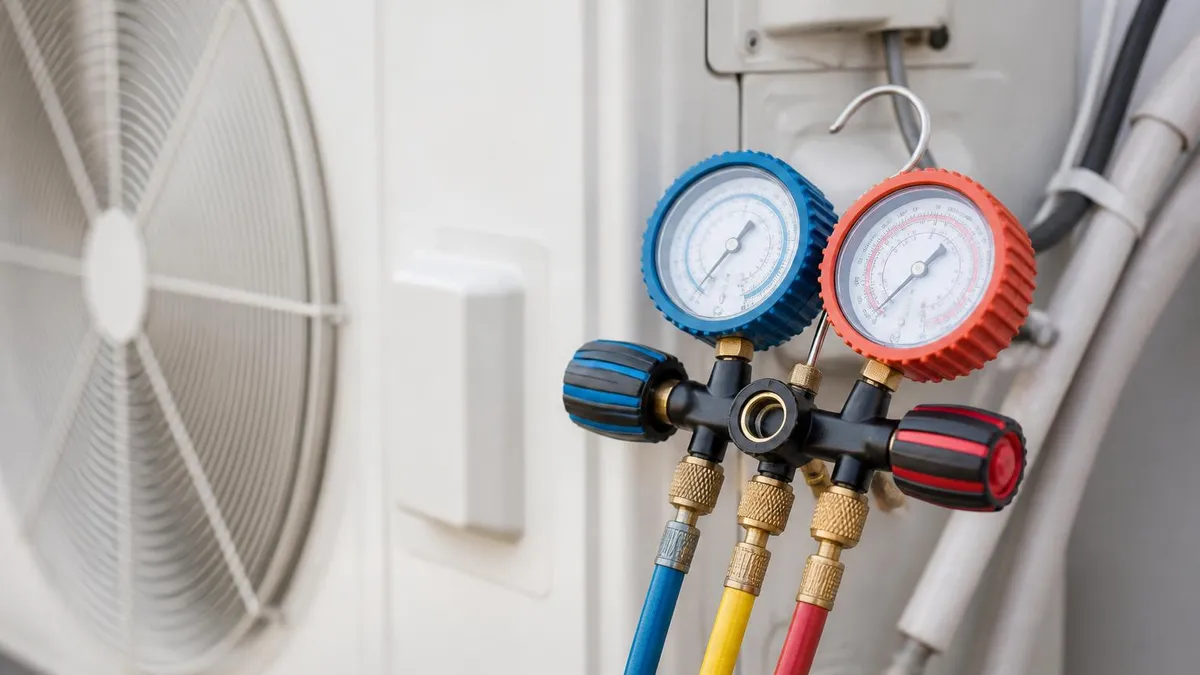
A trustworthy contractor diagnoses with gauges, multimeter readings, and superheat or subcool measurements — not guesswork. Ask for the actual readings on the invoice. If a tech recommends a $2,800 repair on a fifteen-year-old R-22 system, push back and request a replacement quote. Sometimes the right answer is repair plus a planned replacement next spring before the next failure leaves you without cooling.

Hiring a Local HVAC Contractor vs. a National Chain
- +Faster response times — local trucks are usually 20 minutes away
- +Owner accountability — the person who answers may sign the warranty
- +Knowledge of local codes, climate, and rebate programs
- +Stronger relationships with city inspectors and permit offices
- +Lower overhead often translates to fairer pricing
- +Personalized service and easier scheduling for follow-ups
- +Community reputation creates real incentive to do quality work
- −Smaller crews may struggle with same-week emergency capacity
- −Financing options may be more limited than national franchises
- −Less standardized paperwork and digital invoicing in some shops
- −Vacation or illness can stall a project if only one master tech
- −Smaller marketing budgets make initial discovery harder
- −Brand affiliations may be fewer, limiting access to premium lines
Pre-Hire Checklist for the Best HVAC Contractors Near Me
- ✓Verify the state mechanical contractor license number on the official state board website
- ✓Confirm general liability insurance of at least one million dollars with a current certificate of insurance
- ✓Confirm workers' compensation coverage for every employee who will enter your property
- ✓Check at least 30 recent Google reviews and read the most critical ones carefully
- ✓Ask whether they pull permits and schedule city or county inspections as standard practice
- ✓Request EPA Section 608 universal certification for every refrigerant-handling technician
- ✓Confirm they perform a Manual J load calculation before any replacement quote
- ✓Request three local references from jobs completed within the last twelve months
- ✓Get written, itemized estimates from at least three contractors with matching scopes
- ✓Read the warranty fine print on both parts and labor before signing any contract
Ask: "Will you perform a Manual J load calculation before you size my new system?"
Lazy contractors sell tonnage by square footage rules of thumb. Real pros run a Manual J calculation that accounts for insulation, window orientation, ceiling height, duct leakage, and infiltration. If the answer is anything other than "yes, included," you are talking to the wrong shop. This single question separates careful professionals from order-takers faster than any other.
HVAC pricing confuses homeowners because identical systems can carry quotes that differ by four thousand dollars. Understanding what drives that spread is the difference between feeling cheated and feeling confident. Start by recognizing that a contractor's price reflects three layered costs: equipment at wholesale, labor and overhead, and a margin that funds warranty service for the next ten years. The cheapest bid often cuts the third layer, and that is exactly the layer you rely on when something fails on a Sunday in August.
Expect a 2.5-ton 15-SEER2 single-stage AC replacement to run $6,500 to $9,500 installed in most US markets in 2026. A 3-ton 18-SEER2 two-stage heat pump with new line set, pad, and disconnect typically lands between $10,500 and $14,000. Variable-speed inverter systems from premium brands push $15,000 to $19,000. Add $1,200 to $4,500 if ductwork needs modification, sealing, or replacement. These ranges already include permits and standard accessories.
Common red flags hide inside suspiciously low quotes. Watch for missing line items such as the refrigerant line set, condensate safety switch, surge protector, equipment pad, electrical disconnect, thermostat, or permit fees. Contractors who omit these know the change-order conversation is coming after demolition starts. Always ask for an itemized proposal that lists every part with a model number, not a vague bundle priced as one number. If a contractor refuses, that alone tells you to keep shopping.
Financing deserves scrutiny too. Zero-percent promotional periods of 12 to 24 months can be genuinely useful, but many contractors build the financing cost back into the price by 8 to 15 percent. Ask each contractor for the cash price and the financed price side by side. If they are identical, the financing is truly free. If the cash price is lower, you are paying a hidden fee — sometimes worth it for the cash flow, sometimes not. Either way, you deserve to see both numbers.
Rebates and tax credits change the math meaningfully. The federal Energy Efficient Home Improvement Credit (Section 25C) covers up to $2,000 for qualifying heat pumps and $600 for high-efficiency AC. Many utilities stack another $200 to $1,800 on top, and Inflation Reduction Act state programs add more for income-qualified households. A good contractor walks you through every rebate, fills out the paperwork, and knows which model numbers qualify. A weak contractor shrugs and says "check the website." Reference our guide to CFM HVAC Basics for context on why airflow and efficiency ratings affect rebate eligibility.
High-pressure sales tactics remain the biggest red flag in residential HVAC. If an in-home estimator pushes a "today-only" discount, refuses to leave a written quote, or claims your existing system is leaking carbon monoxide without showing you a calibrated combustion analyzer reading, end the meeting politely and call the next contractor on your list. Reputable shops give you a written proposal, a few days to think, and a follow-up email — never an artificial deadline.
Finally, beware of refrigerant scams on repair calls. R-410A pricing has spiked since the AIM Act phasedown, but legitimate per-pound costs in 2026 sit between $90 and $140 installed. Quotes of $200 or more per pound, or vague "we added some refrigerant" line items without weight documentation, usually indicate padding. Always ask the tech to write the exact pounds added and to take a photo of the scale reading before completing the work.
Reputable HVAC contractors typically require a 10% to 30% deposit on signing, with the balance due at completion after the inspection passes. If a contractor demands 50% or more upfront — or insists on full payment before equipment arrives — that is a major warning sign of cash flow problems or potential fraud. Use a credit card when possible to preserve dispute rights, and never pay the final balance until permits close and the system runs correctly.
The contract you sign is the single most important document in the entire project. A handshake and a one-page quote are not enough for a $9,000 install that will sit in your basement for two decades. A proper written agreement spells out the exact equipment by manufacturer, model number, serial number, and AHRI reference number. It includes the SEER2, HSPF2, and tonnage ratings, the start and completion dates, the payment schedule, lien waiver language, and the warranty terms for both parts and labor in plain English.
Equipment warranties typically run ten years on parts when you register within 60 to 90 days of installation. Registration is the homeowner's job, not the contractor's, in most cases — so confirm in writing who handles it. Compressor warranties often extend to twelve years on premium models. Labor warranties vary wildly: many contractors offer one year by default, a few include two years standard, and the best dealers offer five to ten year labor coverage at extra cost. Compare carefully because labor is often the larger expense after year five.
Permits and inspections protect you legally and financially. An unpermitted install can void your homeowners insurance, complicate a home sale, and create liability if a fire or carbon monoxide event traces back to the work. Insist on permits even if a contractor offers to skip them for a $300 discount — that discount becomes worthless the moment your insurer denies a claim. After install, request a copy of the closed permit and the final inspection card for your records, and store both with the equipment paperwork.
Commissioning is where good installs separate themselves from average ones. A complete startup procedure includes verifying refrigerant charge by superheat or subcool, measuring static pressure across the air handler, confirming airflow with a flow hood or duct traverse, calibrating the thermostat, testing safety switches, and documenting all readings on a startup sheet. Ask for a copy of that sheet. If the contractor cannot produce one, the system is not properly commissioned and warranty claims will be harder to win later.
Aftercare matters more than people expect. Sign up for the contractor's maintenance plan during the first year while the system is under full warranty. Two annual visits — one in spring for cooling, one in fall for heating — catch small issues like a low capacitor reading or a clogged condensate trap before they become emergencies. Maintenance also satisfies the manufacturer's documented service requirement, which most homeowners do not realize is a condition of the parts warranty until a claim gets denied. For a related local-service perspective, see our piece on Best HVAC Repair in Bandon, OR.
Keep a project folder — paper or digital — with the signed contract, AHRI certificate, permit documents, inspection reports, startup commissioning sheet, equipment registration confirmations, warranty cards, and every maintenance invoice. When you eventually sell the home, buyers and appraisers love seeing this documentation. It often supports a higher sale price and faster closing because it removes uncertainty about the largest mechanical system in the building.
Build a long-term relationship with the contractor you hire. The best shops want repeat customers and referrals, not one-time transactions. Save the office number in your phone, sign up for their email or text reminders, and call them first for any concern, even small ones. A contractor who knows your equipment history will diagnose faster, charge fairer, and respond quicker than any random search-and-call replacement when the next problem appears.
Now that you understand vetting, pricing, and contracts, here is how to put it all together over a single weekend. Friday evening, pull together your information: utility bills from the last 12 months, the existing equipment model and serial numbers from the data plates, photos of the indoor and outdoor units, and a rough sketch of your home's square footage by floor. This packet helps every estimator quote accurately and lets you compare proposals fairly because everyone is working from the same data.
Saturday morning, run your phone screen. Call five contractors from your shortlist. Ask the same five questions to each: How long have you served this area? Do you pull permits and run Manual J calculations? What is your labor warranty on a full replacement? Can you provide three local references? Which brands do you install most often? Take notes. By the end of an hour you will have narrowed the list to the three contractors you actually want in your home.
Schedule those three in-home visits across the next 5 to 10 business days. Set them on different days, not back-to-back, so each estimator gets your full attention and you have time to digest each proposal before the next visit. During each appointment, walk the entire system together — outdoor unit, indoor air handler or furnace, ductwork, thermostat, electrical panel — and ask the estimator to explain what they see. Watch for who teaches versus who sells.
Once you have all three written proposals in hand, build a comparison spreadsheet. Columns: contractor name, brand, model number, tonnage, SEER2, HSPF2 (if heat pump), AHRI number, included accessories, permit included, labor warranty, parts warranty, total price, financing terms. Rows: each line item. The patterns jump out immediately. One contractor includes a surge protector and condensate safety switch; the others do not. One quotes a 16-SEER2 system; the others quote 15. Now you can compare apples to apples by adding the missing items at retail to each lower quote.
Talk to your top two finalists one more time. Email them your spreadsheet and ask for clarification on anything missing. The way they respond — quickly and thoroughly, or defensively and slowly — reveals how they will handle a warranty call in year three. Many homeowners discover that the second-lowest bid actually offers the best value once you account for warranty length, included accessories, and the company's service reputation. Price alone almost never wins.
Before signing, do one final reference call. Pick two of the three references your finalist provided and ask one question: "If you had to do it over, would you hire them again?" Listen for hesitation. Confident yeses with specific examples — "They came back within two hours when my thermostat acted up last month" — are the green light you want. Vague or qualified answers mean keep shopping. The five minutes you spend on this call can save you years of frustration.
After install day, walk the job site with the lead technician before they leave. Confirm the model and serial numbers match the contract, the AHRI certificate is in your hand, the thermostat is programmed and labeled, every register has airflow, and the system runs through one complete cooling and heating cycle. Pay the final balance only after the permit is closed and the city inspection passes. Then schedule your first maintenance visit six months out — and welcome to a comfortable, well-documented decade of reliable HVAC.
HVAC Questions and Answers
HVAC Technician Jobs Near Me: How to Find, Land, and Grow in Local HVAC Careers
CFM HVAC Basics: How Airflow, Sizing, and System Performance Work Together
Certified HVAC Contractors: How to Find, Vet, and Hire the Right Professional for Your Home or Business

Ameristar HVAC: Complete Guide to Units, Reliability, Costs, and Buyer Considerations

Best HVAC Repair in Bandon, OR: Local Services Near Me Guide
About the Author

NATE Certified HVAC Technician & Licensing Exam Trainer
Universal Technical InstituteMike Johnson is a NATE-certified HVAC technician and EPA 608 universal-certified refrigerant handler with a Bachelor of Science in HVAC/R Technology. He has 19 years of commercial and residential HVAC installation and service experience and specializes in preparing technicians for NATE certification, EPA 608, A2L refrigerant safety, and state HVAC contractor licensing examinations.