
SOTA Ham Radio Activities: Summits on the Air, POTA, and the Best On-Air Adventures for Technicians
✍🏼 Explore SOTA ham radio, POTA, contests, nets, and DXing. A complete guide to ham radio activities for Technician license holders in 2026 October.
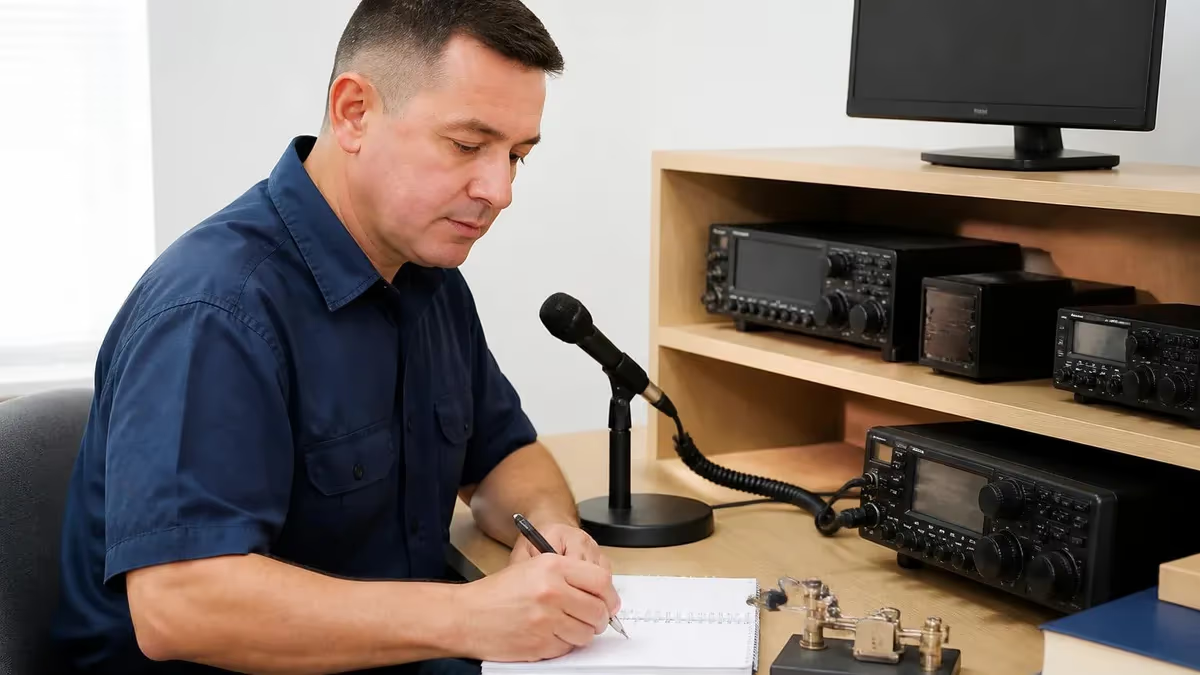
SOTA ham radio, short for Summits on the Air, is one of the most addictive on-air adventures you can pursue once you earn your ham radio license. The program turns mountain peaks into temporary radio stations, blending hiking, navigation, and operating skills into a single weekend project. Whether you carry a five-watt handheld or a small high-frequency rig, SOTA proves that amateur radio is not a hobby trapped in a basement shack — it is a passport to the outdoors, to distant continents, and to a global community of operators who genuinely want to hear from you.
Ham radio activities extend far beyond SOTA, of course. Technicians can chase Parks on the Air (POTA) activations, jump into VHF contests, ragchew on local repeaters, bounce signals off the moon, or talk to astronauts on the International Space Station. Each activity teaches a different facet of the hobby — propagation, antenna design, weak-signal techniques, or simple conversational etiquette — and each one strengthens the operating muscles that the FCC question pool tests on exam day.
The Technician license is your gateway. It grants full privileges on every amateur band above 30 MHz, plus limited high-frequency access on 10 meters and Morse-code-only segments of 80, 40, and 15 meters. That coverage is more than enough to participate in nearly every popular activity in the United States, and it is the reason most new hams feel astonished at how much they can actually do with that first ticket in hand.
This guide walks through the landscape of ham radio activities a Technician can realistically pursue in 2026. We cover SOTA and POTA in depth, then move into contests, nets, satellite work, digital modes, and emergency communications. Along the way, we point out which ham radio frequencies, which antennas, and which radios are best suited to each activity so that you can spend money once and operate confidently for years.
You will also see how each activity prepares you for the next license class. Many General and Extra upgrades happen because a Technician got hooked on POTA, realized the 20-meter band would let them work Europe in the afternoon, and decided the upgrade exam was worth a weekend of study. Activities are not a distraction from license progression — they are the strongest motivator for it.
Finally, we will be honest about the gear. You do not need a four-thousand-dollar station to participate. A used dual-band handheld, a roll-up J-pole antenna, and a fully charged battery have launched thousands of careers in the hobby. The activities below scale from absolute beginner to seasoned DXer, and the rest of this article will help you pick the ones that match your interests, your terrain, and your weekend availability.
By the end, you will have a clear roadmap: which activities to try first, what equipment to acquire, and how each adventure ties back to the exam material you are studying. Ham radio rewards curiosity more than any other test-driven hobby, and the activities ahead are the reason the licenses exist in the first place.
Ham Radio Activities by the Numbers

How the SOTA Program Is Structured
Each qualifying summit is assigned a point value from 1 to 10 based on elevation and prominence. Higher peaks earn more points, and winter activations award bonus points in many associations to reward harsher conditions.
Activators are the operators who hike to the summit and transmit from the activation zone, defined as the area within 25 vertical meters of the peak. Four valid contacts are required to claim a successful activation.
Chasers operate from home or any location off-summit and log contacts with activators on the air. Chasers accumulate points based on the summits they work, with the same summit countable once per UTC day.
SOTA issues certificates for Shack Sloth, Mountain Goat, and various continental awards. Reaching 1,000 activator or chaser points is a major milestone that thousands of hams pursue over many years of operating.
Each country or region forms an association that maintains a vetted list of qualifying summits. The W6 association covers California, W7 covers the Pacific Northwest, and so on across the United States and the world.
Parks on the Air (POTA) is SOTA's flatland sibling, and for many Technicians it becomes the gateway drug to portable operating. Instead of hiking to a summit, you simply drive to a qualifying park — a national forest, state park, wildlife refuge, or historic site — and set up a station within the park boundary. Four contacts make the activation valid, and the program logs roughly one hundred thousand activations every month worldwide. The accessibility is unmatched: a city dweller with a sedan and a wire antenna can easily activate three parks in an afternoon.
The equipment story for POTA mirrors SOTA but with more flexibility. Because you are not carrying weight up a mountain, you can bring a larger battery, a hundred-watt transceiver, and a more elaborate antenna. Many activators run a small ham radio outlet staple like the Yaesu FT-891 paired with an end-fed half-wave wire thrown into a tree. Other activators prefer compact QRP rigs and verticals on tripods. Either approach works; the program rewards the operator, not the gear.
POTA dovetails beautifully with the Technician license thanks to 10-meter and 6-meter activity. During the current solar cycle peak, 10 meters has been open daily across the continent, and Technicians can use single-sideband from 28.300 to 28.500 MHz. A Technician with a wire dipole at a state park can work hundreds of stations on a Saturday morning when the band cooperates. Six meters, often called the magic band, adds sporadic-E openings that make 1,500-mile contacts feel routine in summer.
Logging is straightforward but matters more than newcomers expect. POTA requires an electronic log uploaded to the POTA system, typically in ADIF format exported from logging software like HAMRS, AClog, or N3FJP. The log must include the activator's call sign, the park reference number, each chaser's call sign, the band, the mode, and the UTC date and time. Cleanliness here protects your activations from rejection and helps build the hunter awards that drive park-to-park contacts.
The social dimension is where POTA shines. Spotting networks like pota.app announce activations in near-real time, and hunters from across the country pile on within seconds. New activators frequently work a hundred stations in their first hour, an experience that delivers more on-air practice than weeks of casual repeater chatting. The instant feedback loop accelerates operating skill better than any classroom.
Finally, POTA gets you outside. Mental-health research consistently links time outdoors to lower stress and better sleep, and combining that with a goal-oriented hobby keeps activators returning weekly. The program has rescued many lapsed hams from the appliance-operator trap of buying gear and never turning it on. If your station has been silent, POTA is the most reliable way to restart your on-air life within a single weekend.
Beyond POTA, the broader Outdoor Activations world includes Islands on the Air (IOTA), Beaches on the Air, Mills on the Air, and Lighthouses on the Air. Each program follows a similar pattern: travel to a qualifying location, make contacts, log them, and chase awards. The variety means that any geographic feature you find interesting probably already has a dedicated radio program built around it.

Ham Radio Technician Practice Test Questions
Prepare for the Ham Radio Technician Test exam with our free practice test modules. Each quiz covers key topics to help you pass on your first try.
Ham Radio Technician Antennas & Feedlines
Ham Radio Technician Exam Questions covering Antennas & Feedlines. Master Ham Radio Technician Test concepts for certification prep.
Ham Radio Technician Basic Electronics & C...
Free Ham Radio Technician Practice Test featuring Basic Electronics & Circuitry. Improve your Ham Radio Technician Exam score with mock test prep.
Ham Radio Technician Equipment & Tools Usage
Ham Radio Technician Mock Exam on Equipment & Tools Usage. Ham Radio Technician Study Guide questions to pass on your first try.
Ham Radio Technician Amateur
Ham Radio Technician Test Prep for Amateur. Practice Ham Radio Technician Quiz questions and boost your score.
Ham Radio Technician General
Ham Radio Technician Questions and Answers on General. Free Ham Radio Technician practice for exam readiness.
Ham Radio Technician III
Ham Radio Technician Mock Test covering III. Online Ham Radio Technician Test practice with instant feedback.
Ham Radio Technician II
Free Ham Radio Technician Quiz on II. Ham Radio Technician Exam prep questions with detailed explanations.
Ham Radio Technician I
Ham Radio Technician Practice Questions for I. Build confidence for your Ham Radio Technician certification exam.
Ham Radio Technician License
Ham Radio Technician Test Online for License. Free practice with instant results and feedback.
Ham Radio Technician Licensing Regulations...
Ham Radio Technician Study Material on Licensing Regulations & Standards. Prepare effectively with real exam-style questions.
Ham Radio Technician Operating Procedures ...
Free Ham Radio Technician Test covering Operating Procedures & Etiquette. Practice and track your Ham Radio Technician exam readiness.
Ham Radio Technician Radio Wave Propagatio...
Ham Radio Technician Exam Questions covering Radio Wave Propagation & Modulation. Master Ham Radio Technician Test concepts for certification prep.
Ham Radio Technician Safety Procedures & R...
Free Ham Radio Technician Practice Test featuring Safety Procedures & Risk Management. Improve your Ham Radio Technician Exam score with mock test prep.
Ham Radio Frequencies Used for SOTA, POTA, and Contests
The most popular SOTA and local-activity frequencies sit on 2 meters and 70 centimeters. The national simplex calling frequency 146.520 MHz is where most VHF SOTA activators first call CQ, then move up or down five kilohertz to clear the calling channel. On 70 cm, 446.000 MHz performs the same role. A Technician with a five-watt handheld and a roll-up J-pole can routinely make the four required contacts in mountainous terrain.
Repeaters add another dimension. Linked repeater systems like the Western Intertie Network System (WIN System) cover thousands of miles, and many activators use a local repeater to spot themselves on the SOTAWatch site. Just remember that direct simplex contacts count toward activations while contacts through repeaters generally do not, so plan to call CQ on the calling frequency first.
Is Portable Operating Right for You? Pros and Cons
- +Forces you outdoors and away from screens for several hours each weekend
- +Builds genuine operating skill faster than any home-shack-only routine
- +Inexpensive to start — a used handheld and wire antenna are enough
- +Connects you to a global community of activators and chasers
- +Provides constant motivation to learn propagation, antennas, and logging software
- +Translates directly into emergency communications readiness
- −Weather can ruin a planned activation with little warning
- −Hauling gear up mountains requires physical fitness and good navigation
- −Battery and power management add complexity not present in home stations
- −Some summits and parks have spotty cellular coverage for spotting
- −Antenna deployment in public parks can attract curious onlookers and questions
- −Logging and uploading takes additional time after every outing
Pros and Cons at a Glance
| Pros | Cons |
|---|---|
| Forces you outdoors and away from screens for several hours each weekend | Weather can ruin a planned activation with little warning |
| Builds genuine operating skill faster than any home-shack-only routine | Hauling gear up mountains requires physical fitness and good navigation |
| Inexpensive to start — a used handheld and wire antenna are enough | Battery and power management add complexity not present in home stations |
| Connects you to a global community of activators and chasers | Some summits and parks have spotty cellular coverage for spotting |
| Provides constant motivation to learn propagation, antennas, and logging software | Antenna deployment in public parks can attract curious onlookers and questions |
| Translates directly into emergency communications readiness | Logging and uploading takes additional time after every outing |

SOTA and POTA Activation Checklist
- ✓Confirm the summit or park reference number on SOTAWatch or pota.app
- ✓Submit an alert at least 24 hours in advance so chasers can plan
- ✓Pack a fully charged battery rated for at least four hours of operating
- ✓Bring a backup antenna — a roll-up J-pole or wire — in case the primary fails
- ✓Carry paper logging supplies as a fallback for electronic logger failure
- ✓Check weather, sunset time, and any park closure notices before departing
- ✓File a route plan with a family member or hiking partner
- ✓Verify your handheld is programmed with the national calling frequency and local repeaters
- ✓Bring water, snacks, and sun protection appropriate for the season
- ✓Upload your log to the SOTA or POTA database within 72 hours of the activation
Spot Yourself — Don't Wait to Be Found
The single biggest mistake new activators make is calling CQ for ten minutes, getting frustrated, and packing up. Use SOTAWatch, pota.app, or a self-spotting SMS gateway the moment you start transmitting. A spotted activator typically logs the first four contacts within five minutes, while an unspotted activator may never be heard at all.
Satellite operating is the activity that most reliably hooks Technicians who thought they would never afford HF. Amateur radio satellites in low earth orbit, including SO-50, AO-91, and the linear transponder birds like RS-44 and FO-29, pass overhead several times a day. With a dual-band handheld, an Arrow antenna, and a free pass-prediction app, a Technician can work coast-to-coast contacts in a ten-minute satellite window. The first time you hear your own signal coming back down from space, the hobby permanently changes for you.
Contesting is another arena where Technicians can compete on equal footing. The ARRL VHF contests, the June and September events especially, are wide-open opportunities for any operator with a 2-meter SSB radio. The North American Sprint, the Field Day weekend in late June, and the 10-Meter Contest in December are all accessible to Technicians and offer real chances to win plaques in entry-level categories. Contests sharpen logging speed, signal-report fluency, and quick band-change discipline.
Field Day deserves its own paragraph. Held the fourth full weekend of June, Field Day is part contest, part emergency-preparedness exercise, part club picnic. More than 35,000 hams participate every year, often operating from parks, fairgrounds, or hilltops under generator or battery power. New ham radios get their first real workout, and Technicians often make their initial HF contacts under the supervision of higher-class operators using a process called control operator privileges.
Digital modes deserve a deeper look because they reshape what is possible with limited power. FT8 has effectively democratized DX. A Technician running five watts to a wire dipole on 10 meters during a band opening can work Europe, South America, and Japan in a single afternoon. JS8Call layers conversational text on the same protocol, allowing structured ragchews when propagation is too poor for voice. Winlink provides an email-over-radio service that emergency operators rely on every hurricane season.
Mesh networking, primarily under the AREDN project, is the activity most resembling modern internet work. Operators repurpose surplus Wi-Fi hardware on amateur frequencies to build high-speed data networks across cities, useful for video, voice over IP, and file transfer when conventional internet fails. AREDN nodes have supported real disaster response from hurricanes in the Gulf to wildfires in the West, and Technicians can fully participate because most AREDN spectrum lies on bands they are already authorized to use.
D-STAR, DMR, and Yaesu's System Fusion expand the repeater landscape into the digital domain. These modes route voice over the internet between repeaters, allowing a Technician in Phoenix to talk to an operator in Tokyo through a dual-band hotspot the size of a deck of cards. Each system has its own learning curve — code plugs for DMR are notoriously fiddly — but the rewards are global conversations from a five-watt handheld.
Finally, the International Space Station hosts an amateur radio station that downlinks on 145.800 MHz and uplinks on 144.490 MHz. Technicians have worked the ISS with handhelds and rubber-duck antennas. School groups arrange formal ARISS contacts where students question astronauts on the air, and these events count among the most powerful outreach moments the hobby ever produces.
Technicians have voice privileges on 10 meters only from 28.300 to 28.500 MHz — transmitting voice outside that window violates Part 97 and could jeopardize your license. The 10-meter example segment from 28.190 to 28.300 MHz is receive-only for voice operators. Print a band-plan card and keep it in your go-bag.
Emergency communications, often abbreviated EmComm, is the activity that ties amateur radio to its public-service roots. The Amateur Radio Emergency Service (ARES), Radio Amateur Civil Emergency Service (RACES), Skywarn, and the National Traffic System all welcome Technicians. After hurricanes, wildfires, ice storms, and earthquakes, amateur operators have repeatedly provided communications when cellular, internet, and landline systems collapsed simultaneously. The activity is part service, part skill-building, and part insurance for your own community.
Joining a local ARES group typically involves filling out an application, completing FEMA's free online Incident Command System courses (IS-100 and IS-700 at minimum), and attending monthly meetings or nets. Most groups run weekly check-in nets on a local repeater, giving members regular practice with formal traffic-handling procedures. These nets are also among the friendliest places for a new Technician to make their first on-air contacts without feeling judged for hesitation.
Skywarn is the National Weather Service's volunteer spotter program, and amateur radio is its primary communication backbone in most counties. After a free four-hour training class, you become a certified spotter authorized to report damaging hail, wind, flooding, and tornadoes directly to local NWS forecasters. Many counties operate dedicated Skywarn nets that activate the moment severe-weather warnings are issued, and Technicians with handhelds and outdoor antennas are valuable contributors.
Health and welfare traffic is the formal system for passing personal messages into and out of disaster zones. The National Traffic System (NTS) trains operators to handle messages in a standardized radiogram format, complete with preamble, address, text, and signature. Practicing radiograms on weekly nets pays off enormously when an actual incident requires moving 500 messages from shelter operators to family members nationwide.
Pairing emergency communications with the right gear matters. Most EmComm operators prefer a 50-watt mobile or base radio for 2 meters and 70 centimeters, a deep-cycle battery with a solar-charging option, and a magnetic-mount antenna that can transfer between vehicles. A small ham radio frequencies reference card with local repeater inputs, outputs, tones, and offsets belongs in every go-kit, ideally laminated against rain and sweat.
The training pipeline never ends. Above the basic ICS courses, FEMA offers IS-200, IS-800, the position-specific G-series, and even advanced classroom courses at the Emergency Management Institute. ARRL also offers a series of online EmComm courses (EC-001 and beyond) that cover message handling, agency relationships, and personal safety. Each completed course strengthens your credibility with served agencies and prepares you for higher-responsibility roles like net control operator or section emergency coordinator.
Critically, emergency communications is not a separate hobby from SOTA, POTA, or contesting — it is the same skill set wearing a different hat. The operator who can spot themselves on a mountaintop, log a hundred contacts in an hour, and switch from voice to digital when conditions change is exactly the operator who shines during a real activation. The activities reinforce each other, which is why the most respected EmComm volunteers are usually the same names you see on the SOTA and POTA leaderboards.
Practical tips separate Technicians who keep operating from those who let their handhelds gather dust. The first tip is to schedule your activity rather than wait for inspiration. Pick a recurring Saturday morning POTA park or a Tuesday-evening net and treat it like a gym appointment. Operators who block calendar time complete five to ten times more contacts annually than those who wait for the mood to strike. Consistency turns hobby novelty into lifelong fluency.
The second tip is to invest in antennas before radios. A modest hundred-dollar transceiver paired with a well-tuned wire antenna at 30 feet will outperform a thousand-dollar radio attached to a compromised indoor stub almost every time. End-fed half-wave antennas, off-center-fed dipoles, and the venerable G5RV remain the workhorses of portable and home operation. Spend your antenna budget first, and your radio investment will reward you for decades.
The third tip is to learn a logging program early. HAMRS on tablets and phones is free, fast, and exports the ADIF and Cabrillo files every contest and award program requires. AClog and N3FJP serve the same role on Windows. Logging in real time during a contact builds the muscle memory you need for contests, sweepstakes, and EmComm exercises, and it eliminates the painful post-event log reconstruction that frustrates many activators.
The fourth tip is to listen before you transmit. Tuning across a band for fifteen minutes before calling CQ teaches you what stations are working, which propagation paths are open, and what calling frequencies are clear. The most skilled operators are universally the best listeners. A patient ear is the single most underrated piece of equipment in the entire hobby, and it costs nothing to develop except discipline.
The fifth tip is to join a club, even if you consider yourself a lone wolf. Local clubs run Field Day operations, antenna parties, license study sessions, and equipment swap meets where you will find used gear for a fraction of new prices. Clubs also generate the mentor relationships, often called Elmer relationships, that accelerate your progress more than any book or video course. The ARRL maintains a national directory of affiliated clubs searchable by ZIP code.
The sixth tip is to keep your ham radio license renewal current. Licenses expire after ten years, and a lapsed license forfeits your call sign after the two-year grace period ends. Renewal is free on the FCC ULS website, takes about ten minutes, and should be tied to a recurring calendar reminder. Losing a memorable callsign because of a missed renewal is the single most preventable tragedy in the hobby.
The final tip is to teach what you learn. Sharing knowledge — through club presentations, YouTube videos, or simply mentoring a neighbor through their first Technician exam — cements your own understanding faster than any solo study method. The act of explaining propagation forces you to clarify it in your own mind, and the new operators you create become the chasers, spotters, and net members who make your next activation worth the effort.
Sample Ham Radio Technician Test Practice Questions
Try these questions from our free Ham Radio Technician Test practice tests. The correct answer and an explanation follow each question.
An amateur radio operator wants to help during a community disaster. Which FCC authorization allows amateur radio operators to communicate on behalf of non-amateur entities during emergencies?
- A. Emergency Use License (EUL)
- B. Third-party traffic provisions and Part 97 emergency rules
- C. Special Temporary Authority (STA) only
- D. No authorization exists — amateurs may not act on behalf of others
Answer: B. Third-party traffic provisions and Part 97 emergency rules
Part 97 emergency provisions and third-party traffic rules allow amateurs to pass communications on behalf of others during emergencies.
How soon can you transmit on amateur radio bands after passing the test for your first amateur radio license?
- A. As soon as you receive your license in the mail from FCC
- B. Immediately on receiving your Certificate of Successful Completion of Examination (CSCE)
- C. As soon as your operator/station license grant appears on the ARRL website
- D. As soon as your operator/station license grant appears in the FCC's license database
Answer: D. As soon as your operator/station license grant appears in the FCC's license database
Explanation: As soon as your identity and call sign show in the ULS database of the FCC, you are eligible to operate a transmitter on an amateur service frequency after passing the test necessary for your first amateur radio license.
What is the purpose of the FCC amateur radio station log?
- A. To record station operations for reference and to assist in resolving interference complaints
- B. To report daily usage to the FCC automatically
- C. To track antenna performance over time
- D. To register each contact in the national database
Answer: A. To record station operations for reference and to assist in resolving interference complaints
Station logs are kept voluntarily by most operators for personal reference and can help resolve interference or other complaints.
When transmitting AFSK signals via a radio in single sideband mode, what is likely to happen if the ALC system on the transceiver is not properly configured?
- A. Improper action of ALC distorts the signal and can cause spurious emissions
- B. All these choices are correct
- C. ALC will invert the modulation of the AFSK mode
- D. When using digital modes, too much ALC activity can cause the transmitter to overheat
Answer: A. Improper action of ALC distorts the signal and can cause spurious emissions
Explanation: This statement is partially correct. ALC (Automatic Level Control) is a system in a transceiver that automatically adjusts the gain of the transmitted signal to maintain a constant output power. When transmitting AFSK (Audio Frequency-Shift Keying) signals using single sideband mode, the ALC system needs to be set properly to prevent distortion and spurious emissions. If the ALC system is not set properly, it may result in overdriving the transmitter's power amplifier, causing distortion and spurious emissions that can interfere with other radio signals in the vicinity. Additionally, improper ALC setting can cause the transmitted signal to be too weak or too strong, leading to poor signal quality and potentially disrupting communications.
Ham Radio Technician Questions and Answers
Ham Radio License Practice Test: Free Technician Exam Prep & Question Pool
Ham Radio Handheld: Complete Guide to HT Selection, Programming, and Technician License Use
Ham Radio Technician
Ham Radio License: What It Is and How to Get One
Ham Radio Transceiver Guide: Choosing Your First Radio for the Technician License
About the Author

Educational Psychologist & Academic Test Preparation Expert
Columbia University Teachers CollegeDr. Lisa Patel holds a Doctorate in Education from Columbia University Teachers College and has spent 17 years researching standardized test design and academic assessment. She has developed preparation programs for SAT, ACT, GRE, LSAT, UCAT, and numerous professional licensing exams, helping students of all backgrounds achieve their target scores.
Join the Discussion
Connect with other students preparing for this exam. Share tips, ask questions, and get advice from people who have been there.
View discussion (3 replies)