
What Is the NAICS Code for General Contractor? Licensing Guide for FL, NC, TX & More
What is the NAICS code for general contractor? Learn FL, NC & TX licensing steps, costs, and exam tips. ✅ Start your career today.

If you are asking what is the NAICS code for general contractor work, the primary answer is code 236220 (Commercial and Institutional Building Construction) and 236115/236116 for residential new construction and remodeling. These six-digit North American Industry Classification System codes determine how the federal government categorizes your business for tax purposes, SBA loan eligibility, government contracting bids, and insurance classification. Understanding your correct NAICS code is a foundational step before you pursue a general contractor license florida or in any other state.
Beyond the federal classification system, every state layer adds its own licensing requirements on top of NAICS registration. Whether you want to get general contractor license nc or register a contracting company in Texas, you will need to navigate state boards, bond requirements, exam schedules, and continuing education mandates. The NAICS code itself does not grant you the authority to build — your state-issued contractor license does that, and the two systems work in parallel rather than substituting for each other.
The construction industry is massive, generating over $1.8 trillion annually in the United States and employing more than 7.8 million workers. General contractors sit at the center of this ecosystem, coordinating subcontractors, managing project timelines, securing permits, and serving as the legally responsible party on virtually every commercial and residential build. Because of that responsibility, state licensing boards maintain high bars for entry, including financial statements, insurance certificates, experience documentation, and rigorous written exams.
NAICS codes also matter when you bid on government contracts. Federal agencies use these codes to set aside work for small businesses, minority-owned firms, and veteran-owned enterprises under SBA programs. If your code is listed incorrectly — say, as a specialty trade subcontractor when you actually function as a prime general contractor — you may be ineligible for certain solicitations or receive incorrect size-standard thresholds. Double-checking your SAM.gov registration against your actual scope of work can directly affect your revenue.
For anyone doing a florida general contractor license search, it is equally important to confirm your license is active in the state database before bidding on new projects. Florida's DBPR (Department of Business and Professional Regulation) maintains a public lookup portal where clients, lenders, and project owners can verify your credentials in seconds. An expired or incorrectly categorized license can cost you a contract before negotiations even begin.
This article walks through the NAICS classification system for general contractors, explains licensing requirements across the most active markets — Florida, North Carolina, and Texas — and provides a practical roadmap for candidates preparing for the contractor licensing exam. Whether you are an experienced tradesperson ready to upgrade to a GC license or a construction manager entering the field for the first time, understanding both the business classification side and the licensing side of contracting will set you up for long-term success.
We will also cover what to expect from written exams, how to prepare effectively, what common pitfalls derail applications, and why pairing your NAICS registration with the right license classification can open doors to federal and state government work worth millions of dollars annually. Read through each section carefully — the details here apply whether you are based in Miami, Charlotte, Houston, or anywhere in between.
General Contractor Licensing by the Numbers

Key NAICS Codes for General Contractor Businesses
The most common NAICS code for general contractors working on office buildings, schools, hospitals, retail centers, and government facilities. This code covers prime contractors responsible for the overall construction project and its coordination.
Assigned to GCs who build new single-family homes as the prime contractor. Includes custom home builders and production builders. Important for SBA loan qualification and small business set-aside contracts in residential markets.
Covers contractors building apartment buildings, condominiums, and mixed-use residential projects. Requires separate classification from single-family work for accurate federal reporting and government bid eligibility.
Applies when the primary business activity is remodeling or renovating existing residential structures. Contractors who split work between new construction and remodeling should select the code that reflects their majority revenue stream.
General contractors specializing in infrastructure work — roads, highways, bridges, and related civil projects — fall under this code rather than the building construction series. Critical for transportation agency bid qualification.
Knowing the correct NAICS code is just the starting line. The real competitive advantage comes from obtaining and maintaining the appropriate state contractor license for every jurisdiction where you plan to work. Each state operates its own licensing board with unique requirements, and failing to comply can result in fines, project shutdowns, and civil liability. If you are looking to general contractor license nc details or navigating requirements in Texas, the process is more involved than simply filling out a form — it requires documented experience, financial verification, and in most cases, a proctored written exam.
In Florida, general contractors must hold a license issued by the Florida Department of Business and Professional Regulation (DBPR). The state distinguishes between a Certified General Contractor — who can work anywhere in Florida — and a Registered General Contractor, whose scope is limited to a specific county or municipality. To obtain a Certified GC license, applicants need at least four years of proven field experience, with at least one year as a supervisor or foreman. Financial responsibility is also evaluated, requiring applicants to demonstrate a minimum credit score and provide a full financial statement audited by a CPA.
North Carolina operates its contractor licensing through the NC Licensing Board for General Contractors, established in 1925 — making it one of the oldest contractor licensing programs in the nation. The state offers three license classifications based on total project value: Limited (up to $500,000), Intermediate (up to $1,000,000), and Unlimited (no cap). Contractors seeking to get general contractor license nc must pass a written examination covering business law, project management, building codes, and safety regulations. The NC exam is administered by PSI Exams and must be scheduled in advance at an approved testing center.
Texas takes a notably different approach: there is no statewide general contractor license requirement. However, many Texas cities — including Houston, Dallas, Austin, and San Antonio — impose local licensing, bonding, and registration requirements. Contractors working on specific project types, such as electrical, plumbing, or HVAC systems within a general contracting scope, still need the relevant trade licenses. If you are pursuing a general contractor license texas credential, the key is to research both the city and county where your projects are located rather than looking for a single statewide credential.
Regardless of state, nearly every jurisdiction requires contractors to carry general liability insurance and workers' compensation coverage before a license will be issued or renewed. Minimum coverage thresholds vary: Florida requires at least $300,000 in general liability for residential contractors and $1,000,000 for commercial work. North Carolina typically requires a minimum $500,000 general liability policy. These insurance requirements protect project owners, workers, and the public — and they are non-negotiable checkboxes on every application review.
Bonding is a separate but related requirement found in many states and municipalities. A surety bond guarantees that a contractor will fulfill their contractual obligations and comply with local building codes. Bonds are typically priced as a percentage of the bond amount — usually 1% to 3% annually — and are obtained through a surety company after a credit and financial review. Contractors with strong credit histories pay less for bonding, giving another financial incentive to maintain clean credit records throughout your career.
Continuing education is increasingly mandatory as well. Florida requires licensed general contractors to complete 14 hours of approved continuing education every two years for license renewal. Topics include changes to the Florida Building Code, workplace safety updates, legal responsibilities, and business practices. North Carolina requires 8 hours of CE annually for renewal. Staying current not only keeps your license active but also keeps you informed of code changes that directly affect how projects must be built and inspected.
How to Obtain a General Contractor License in FL, NC, and TX
To obtain a florida general contractor license, applicants must submit documentation of at least four years of construction experience, including one year in a supervisory role. The application goes to the Florida DBPR, which reviews financial statements, credit reports, and proof of insurance. Candidates must then pass the Florida Contractor Competency Exam, which covers project management, business and finance, and building codes. The exam is administered by Pearson VUE at testing centers statewide and requires a score of at least 70% to pass.
After passing the exam, Florida applicants pay a licensing fee ranging from $209 to $309 depending on license type. The license must be renewed every two years with 14 hours of approved continuing education. Contractors who want to verify another contractor's credentials can use the DBPR's online portal — the same tool clients and lenders use when performing a florida general contractor license search before awarding a project.

Pros and Cons of Pursuing a General Contractor License
- +Legally authorized to bid on and manage large commercial and residential projects
- +Higher earning potential compared to specialty trade contractors
- +Ability to self-perform as prime contractor without a licensed GC above you
- +Eligibility for government contracting set-asides using your NAICS code
- +Increased credibility and trust with clients, lenders, and project owners
- +Can sponsor and hire other licensed specialty contractors under your umbrella
- −Significant upfront costs for application fees, bonding, and insurance premiums
- −Time-intensive exam preparation, especially for business law and financial sections
- −Ongoing continuing education requirements to maintain license in good standing
- −Personal financial review including credit score can disqualify unprepared applicants
- −Each state requires a separate license, creating complexity for multi-state operations
- −License can be suspended or revoked for code violations, complaints, or financial issues
General Contractor License Application Checklist
- ✓Identify the correct NAICS code (236220, 236115, or 236116) for your primary business activity.
- ✓Register or update your business entity (LLC, corporation, or sole proprietorship) with the state.
- ✓Gather proof of at least four years of construction experience with employer verification letters.
- ✓Obtain a credit report and resolve any derogatory items that may disqualify your application.
- ✓Commission a CPA-audited financial statement meeting your state board's minimum net worth requirements.
- ✓Purchase general liability insurance at the required minimum coverage level for your license class.
- ✓Obtain a surety bond from an approved surety company at the required bond amount for your state.
- ✓Schedule and pass the state contractor licensing exam through the designated testing provider.
- ✓Submit the completed application with all supporting documents and the applicable application fee.
- ✓Register your business and NAICS code on SAM.gov if you plan to pursue federal contracting opportunities.
Reciprocity Agreements Can Save Months of Work
Several states have reciprocity agreements that allow licensed contractors to obtain licenses in partner states without retaking the full exam. Florida, for example, has reciprocity arrangements with several southern states. If you already hold a qualifying license, check your state board's reciprocity list before starting a new application from scratch — you may qualify for an expedited pathway that waives the written exam requirement entirely.
Preparing for a general contractor licensing exam is a multi-week investment that rewards candidates who treat it like a professional certification rather than a simple open-book test. Most state exams are closed-book or open only to approved reference materials, and the content is genuinely challenging — covering construction law, contract administration, financial management, project scheduling, OSHA safety standards, and building codes simultaneously. Candidates who underestimate the difficulty and walk in without structured preparation routinely score below the 70% passing threshold on their first attempt.
The most effective study strategy starts with a diagnostic phase. Before committing to a study schedule, take a full-length practice exam under timed conditions. Your results will reveal which domains need the most attention. Most candidates find that the business law and finance sections are hardest because they draw on knowledge from outside the job site — tax law, contract formation, lien rights, workers' compensation, and basic accounting principles. Construction workers who have spent their careers in the field often underestimate how much emphasis these exams place on the business side of contracting.
Once you have identified your weak areas, allocate study time proportionally. If business and finance represents 35% of the exam and you scored 50% on it in your diagnostic, devote at least half your total study hours to that domain before rotating to building codes and project management. Use official reference materials — in Florida, the approved references include the Florida Building Code, the OSHA 1926 standards, and the Florida Statutes governing contractor licensing. North Carolina candidates should study the NC General Statutes Chapter 87 along with the NC Building Code and the NASCLA Contractors Guide.
Practice exams are the single most reliable predictor of actual exam performance. Research consistently shows that candidates who complete five or more full-length practice tests with review of every missed question score significantly higher on test day than those who only read study guides. PracticeTestGeeks.com offers free practice questions organized by exam domain — building codes, business law, safety, and project management — allowing you to drill exactly where you need improvement without working through content you already know.
Time management during the exam itself is a skill that needs deliberate practice. The Florida contractor exam is 4 hours long with 120 questions, giving you an average of two minutes per question. The NC exam allots similar time. Candidates who spend too long on difficult questions and run out of time for easy questions at the end routinely fail by narrow margins. Practice completing 30-question sets in under one hour to build the pacing instincts you need on test day.
The night before your exam, resist the urge to cram additional content. Your brain consolidates memories during sleep, meaning that a full night of rest is more valuable at this stage than reviewing another chapter. Prepare your approved reference materials the evening before — index your codebooks with tabs if your exam allows open references, since the ability to quickly locate an answer in a physical reference can save critical minutes on the harder code questions. Arrive at the testing center 20 to 30 minutes early to complete check-in procedures without rushing.
After passing, do not treat your license as a static credential. The construction industry evolves rapidly — energy codes, seismic standards, fire protection requirements, and accessibility regulations all change on regular update cycles. The contractors who build long-term reputations and referral networks are the ones who stay current with code changes, maintain their CE hours proactively rather than rushing to complete them at renewal deadlines, and invest in their teams by sponsoring employee licensing and training programs.
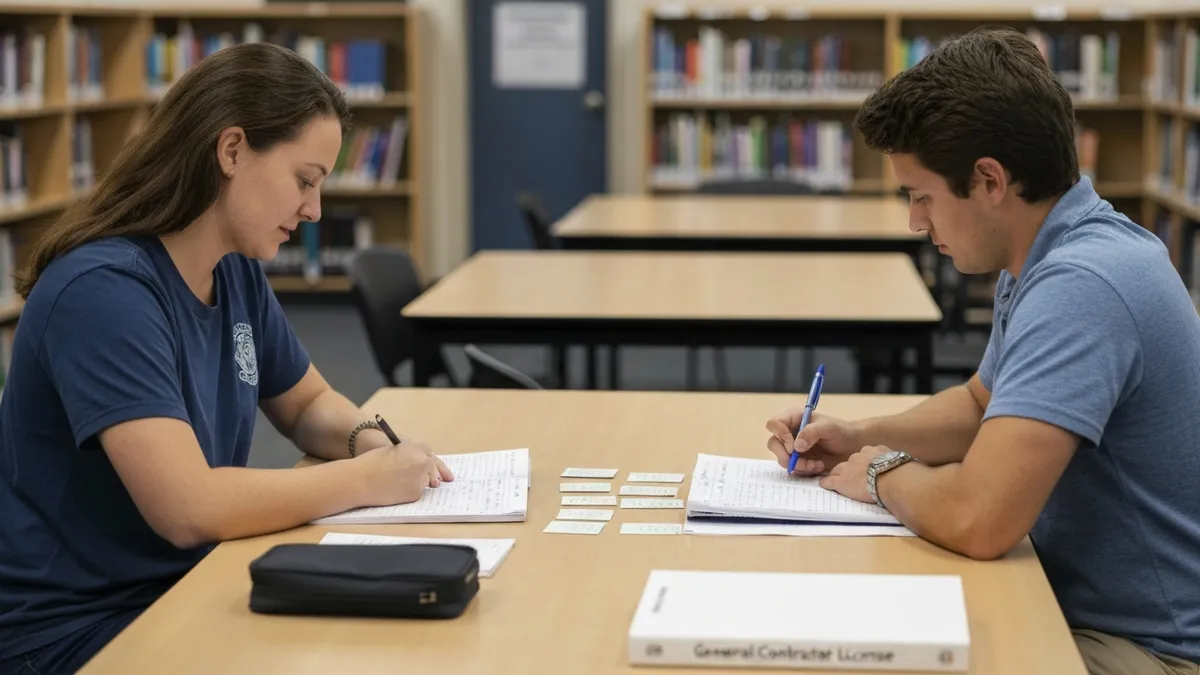
Most state licensing boards process applications 4 to 12 weeks before they authorize exam scheduling. Submitting an incomplete application — missing a financial statement, insurance certificate, or experience verification letter — resets the clock and can push your test date back by months. Submit a complete, reviewed application at least 60 days before your target exam date to avoid delays that affect your project bidding timeline.
The long-term career outlook for licensed general contractors is strong. The Bureau of Labor Statistics projects construction management occupations — which include licensed general contractors running their own firms — to grow 8% through 2032, faster than the average for all occupations. Drivers of this growth include aging infrastructure in need of replacement, a sustained housing supply deficit in most major U.S. metros, and increased federal investment in roads, bridges, schools, and energy infrastructure under programs like the Infrastructure Investment and Jobs Act and the Inflation Reduction Act.
Compensation scales significantly with experience, license classification, and business structure. A sole proprietor general contractor in the southeastern United States might net $80,000 to $120,000 annually managing residential projects in the $300,000 to $1,000,000 range. A licensed GC running a 20-person firm with commercial clients can generate substantially more — many mid-sized general contracting businesses report $5 to $15 million in annual revenue with owner compensation well above $200,000. The license itself is the credential that enables both entry and growth in this income range.
Geographic positioning matters enormously. Florida and North Carolina are among the fastest-growing states in the nation by population, creating sustained demand for new residential and commercial construction. The nc general contractor license market is particularly robust in the Research Triangle (Raleigh-Durham-Chapel Hill) and the Charlotte metro, where commercial development, data center construction, and residential subdivision work are all expanding rapidly. Florida's licensing framework for contractors similarly reflects the state's population boom — South Florida, the Tampa Bay area, and the Orlando corridor are among the most active construction markets in the country.
Diversifying your project portfolio also reduces income volatility. Contractors who specialize exclusively in custom residential work are highly sensitive to interest rate cycles — when mortgage rates rise sharply, new home starts decline quickly. Contractors who maintain capabilities in light commercial, renovation, tenant improvement, and government work tend to have more stable revenue streams because these market segments respond differently to economic cycles. Holding the right NAICS codes on your government registrations and keeping your bonding capacity high enough for commercial project sizes positions you to pivot when residential markets slow.
Government contracting is an underutilized opportunity for many small and mid-sized general contractors. Federal, state, and municipal agencies collectively spend hundreds of billions of dollars annually on construction projects, and a significant portion of that spending is reserved for small businesses under SBA set-aside programs.
To compete effectively, you need an active SAM.gov registration, the correct NAICS codes, relevant past performance documentation, and in many cases a Capability Statement — a one-page document describing your company's services, past projects, key personnel, and differentiators. Many contractors discover that their first government contract becomes a springboard to a pipeline of recurring agency work.
The path to a florida general contractor license or any state credential is ultimately an investment in your ability to operate at scale. Without the license, you are legally limited in the scope and value of projects you can manage independently. With it, you have access to project opportunities, financing structures, insurance products, and client relationships that simply are not available to unlicensed operators. The exam and application process, while demanding, is designed to ensure that every licensed general contractor has demonstrated the minimum competency required to protect the public.
Building a sustainable general contracting business also means building the systems behind it — estimating templates, project management software, subcontractor vetting processes, contract templates reviewed by a construction attorney, and a reliable accounting system that separates job costing from overhead tracking. Many contractors who obtain their licenses quickly discover that the business management side of the profession is as demanding as the technical side. Investing time in learning those systems in parallel with your licensing preparation will compress your path from new licensee to profitable, growing business.
Practical exam preparation goes beyond reading — it requires active recall, timed practice, and deliberate review of every missed question. The most common reason candidates fail state contractor licensing exams is not lack of intelligence or experience; it is insufficient familiarity with exam-specific phrasing and the tendency to apply real-world shortcuts rather than code-specified procedures. On exam day, always answer based on what the code says, not what you have done on past job sites, even when your field experience suggests a different answer.
Building code questions deserve special attention because they are precise and unforgiving. A question about maximum stair riser height, minimum egress window opening, or required fire separation between occupancies has one correct answer defined in the code — not a range of reasonable field judgments. Practice finding these answers quickly in your reference materials before the exam so that on test day you are confirming rather than searching. Contractors who have tabbed and indexed their codebooks consistently outperform those who rely on memory alone for code-specific questions.
The business and finance domain trips up many experienced field contractors because it requires understanding concepts like markup versus margin, the difference between gross profit and net profit, how to calculate overhead recovery rates, and the fundamentals of job cost accounting. A contractor who consistently underbids projects because they confuse markup and margin can win every project and still go bankrupt. The exam tests these concepts specifically because they are financially critical — getting them wrong in practice is among the most common reasons contracting businesses fail within their first five years.
Safety and OSHA knowledge is another domain where comprehensive preparation pays dividends both on the exam and on the job site. The OSHA 1926 construction standards cover fall protection, excavation, scaffolding, electrical safety, personal protective equipment, and hazard communication. Exam questions in this area often present a scenario and ask you to identify the correct OSHA-required action — fall protection required at six feet for residential construction, competent person requirements for excavations deeper than five feet, and specific training mandates for workers handling hazardous materials are all common exam topics.
After you pass the exam and receive your license, consider joining your state's general contractor association. Florida has the Florida Home Builders Association and the Associated Builders and Contractors Florida East Coast chapter. North Carolina has the Home Builders Association of North Carolina and the Associated General Contractors of the Carolinas. These organizations provide access to continuing education courses, legislative advocacy, networking events, and preferred vendor relationships for insurance, bonding, and materials. Membership also signals credibility to clients who look for association affiliations as a quality indicator when selecting contractors.
Technology adoption is reshaping what it means to be a competitive general contractor. Project management platforms like Procore, Buildertrend, and CoConstruct have moved from nice-to-have tools to operational necessities for firms managing multiple concurrent projects. These platforms centralize document management, RFI tracking, change order processing, subcontractor communication, and scheduling in a single interface that is accessible from the job site via mobile. Contractors who resist technology adoption find themselves at a disadvantage when competing for clients who expect digital communication, real-time schedule updates, and online payment portals.
Finally, remember that your license is a professional credential that carries legal and ethical obligations. You are personally responsible for work performed under your license, including work done by subcontractors you hired. Disciplinary actions by state licensing boards — including fines, license suspension, and revocation — are a matter of public record and can permanently damage your ability to bid on projects.
Building a culture of compliance, quality, and transparency within your organization is not just good ethics — it is the foundation of a general contracting business that can sustain itself through economic cycles and build the kind of reputation that generates referrals for decades.
General Contractor License Questions and Answers

NAICS Code for General Contractors: What It Is and How to Get Licensed

General Contractor License Wisconsin: Requirements and How to Get Licensed

What Is a General Engineering Contractor? Duties, Licensing & Career Guide

Can a Homeowner Be the General Contractor? State Rules, Risks & How to Get Licensed

GA General Contractor License Lookup: How to Verify, Apply, and Get Licensed in Georgia and Beyond
About the Author

Educational Psychologist & Academic Test Preparation Expert
Columbia University Teachers CollegeDr. Lisa Patel holds a Doctorate in Education from Columbia University Teachers College and has spent 17 years researching standardized test design and academic assessment. She has developed preparation programs for SAT, ACT, GRE, LSAT, UCAT, and numerous professional licensing exams, helping students of all backgrounds achieve their target scores.
Join the Discussion
Connect with other students preparing for this exam. Share tips, ask questions, and get advice from people who have been there.
View discussion (7 replies)